Summary
Table of Content

North America Bifold Doors Market
Get a free sample of this report
Form submitted successfully!
Error submitting form. Please try again.
Thank you!
Your inquiry has been received. Our team will reach out to you with the required details via email. To ensure that you don't miss their response, kindly remember to check your spam folder as well!
Request Sectional Data
Thank you!
Your inquiry has been received. Our team will reach out to you with the required details via email. To ensure that you don't miss their response, kindly remember to check your spam folder as well!
Form submitted successfully!
Error submitting form. Please try again.
North America Bifold Doors Market Size
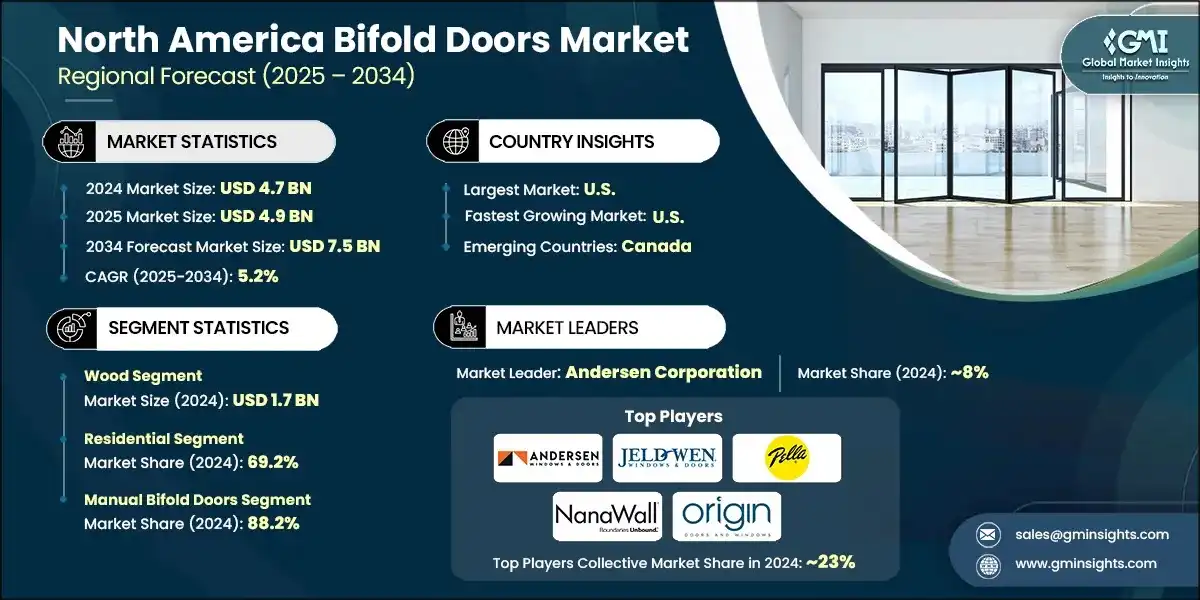
The North America bifold doors market was estimated at USD 4.7 billion in 2024. The market is expected to grow from USD 4.9 billion in 2025 to USD 7.5 billion in 2034, at a CAGR of 5.2% according to latest report published by Global Market Insights Inc.
North America Bifold Doors Market Key Takeaways
Market Size & Growth
- 2024 Market Size: USD 4.7 billion
- 2025 Market Size: USD 4.9 billion
- 2034 Forecast Market Size: USD 7.5 billion
- CAGR (2025–2034): 5.2%
Key Market Drivers
- Residential & commercial construction expansion.
- Space-saving & indoor–outdoor lifestyle trends.
- Rising demand for space-saving solutions in urban housing.
Challenges
- Complex installation & maintenance requirements.
- Labor & Supply Constraints.
Opportunity
- Smart & automated bifold systems.
- Material & design innovation.
Key Players
- Market Leader: Andersen Corporation led with over 8% market share in 2024.
- Leading Players: Top 5 players in this market include Andersen Corporation, JELD-WEN, Inc., Pella Corporation, NanaWall Systems, Inc., Origin Frames Ltd., which collectively held a market share of 23% in 2024.
Get Market Insights & Growth Opportunities
- The growth in North American bifold doors market is attributed to the growth potential of residential and commercial construction projects. The U.S. Census Bureau indicated that construction spending in the country totaled approximately USD 1.9 trillion in 2023 and consistently rises while making new investments in housing and infrastructure projects is expected. In turn, this has created a higher demand for aesthetically pleasing and more functional door systems. Homeowners and developers alike are taking advantage of bifold doors in their new home builds and renovations to improve the resale value and appeal of their property.
- In the commercial sector, bifold doors are being implemented in a variety of business sectors, including restaurants, retail shops, and hospitality, to promote flexible layouts and an open facade to retain customers while maximizing space. Therefore, the increase in construction spending and preference for higher-end design elements has caused bifold doors to become an integral part of interactions with contemporary architecture.
- Another key factor in growth is the increasing demand for space-saving solutions and the continued rise of the indoor-outdoor lifestyle. Consumers are favoring open-plan living concepts that connect indoor and outdoor spaces. Bi-fold doors create wide openings, maximizing ventilation and natural light, and creating a sense of openness and connection to outdoor spaces, whether that be a patio or garden.
- This trend has gained significant traction post-pandemic as homeowners sought comfort, function, and wellness in their living environment. In commercial space, bi-fold doors help adapt spaces to seasonal requirements while improving customer experience and operational flexibility. For example, a restaurant can create open-air dining during warm months, which enhances customer satisfaction and sales potential.
- Furthermore, the rising demand for space optimization in urban housing is fueling market expansion. Urbanization is increasing, and with limited living surface area in apartments and condominiums, bifold doors represent an ideal option for maximizing usable space. According to the UN, as of 2023, 83.6% of North America's population lives in urban areas, highlighting the need for space-efficient design.
- Internal bifold doors for closets, as room dividers, and in small-sized spaces are becoming more prevalent with consumers to combine style and usefulness. manufacturers are innovating with lightweight materials, slim profiles, and customizable configurations tailored to urban living requirements, creating significant opportunities for growth in the bifold doors market.
To get key market trends
North America Bifold Doors Market Trends
- The market for bifold doors in North America is undergoing notable change as smart and automated systems are becoming popular, fueled by the growth of connected home technologies. Consumers are increasingly prioritizing convenience, enhanced security, and energy efficiency, which has driven the demand for bifold doors equipped with advanced Internet of Things (IoT) features. Features of these systems include remote access through mobile applications, motion sensors, and automated locks that enhance safety. In addition, some systems are integrated with voice assistants like Amazon Alexa, Google Assistant, and Apple Siri to give users voice control.
- Smart and automated systems will not only help the user experience, but they are also an extension of the smart home movement with devices or services that are interconnected and can contribute to a seamless and easy home. In commercial spaces, automation provides additional advantages (increased access for disabled individuals, reduction of manual efforts, etc.). These benefits increase the appeal of smart bifold systems in high-traffic areas like restaurants, corporate buildings, retail environments, and hospitality venues where convenience and access must be considered.
- Alongside technological advancements, innovations in materials and design continue to play a vital role in both helping differentiation and allowing for premiumization. Manufacturers are increasingly utilizing lightweight yet durable materials such as aluminum composites, engineered timber, and high-performance tempered or laminated glass. These materials provide structural strength while maintaining a sleek and modern aesthetic.
- To cater to shifting architectural trends, manufacturers are producing frames that are slim and enhance surface area glass, creating a seamless appearance, and offering finishes that can be configured to fit individual interiors or externals. Sustainability is also becoming more of a focus with eco-friendly materials gaining importance such as sustainably sourced timber and recyclable aluminum.
- In addition, many manufacturers are implementing energy efficiency in glazing technology, utilizing low-emissivity (Low-E) coatings, or double or tripled mannered. These not only contribute to general factors of the bifold door, such as durability, weathering, and thermal performance, but they follow through with an appealing aesthetic presentation so bifold doors can be regarded as statement investment and fixtures in residential or commercial spaces.
North America Bifold Doors Market Analysis
Learn more about the key segments shaping this market
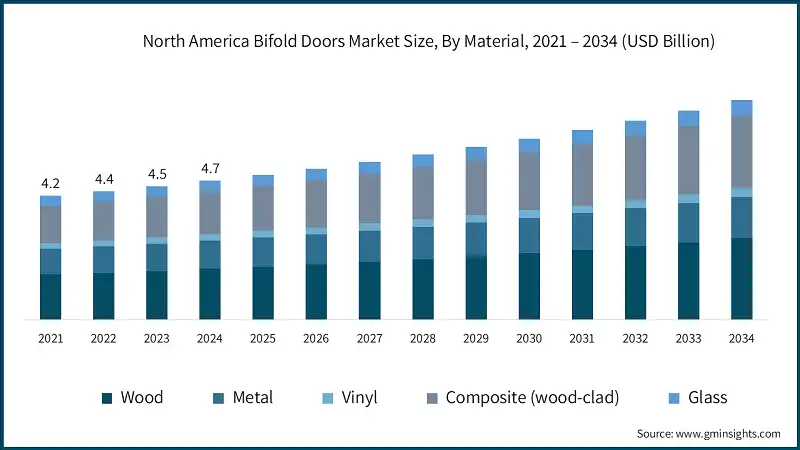
Based on material, the North America bifold doors market is categorized into wood, aluminum, vinyl, composite (wood-clad), steel, and glass. The wood material accounted for revenue of around USD 1.7 billion in 2024 and is anticipated to grow at a CAGR of 5.4% from 2025 to 2034.
- Homeowners and designers increasingly favor wood for its premium look and versatility in customization, including stains, finishes, and intricate detailing that enhance interior and exterior spaces. Beyond aesthetics, wood offers excellent insulation properties, contributing to energy efficiency a critical factor as building codes tighten and consumers prioritize sustainable living. The rising trend of eco-friendly construction further supports wood’s popularity, as manufacturers adopt responsibly sourced timber and low-VOC finishes to meet green building standards.
- Additionally, the surge in luxury home renovations and high-end residential projects amplifies demand for wood bifold doors, which are perceived as a symbol of quality and sophistication. While alternative materials like aluminum and vinyl dominate in cost-sensitive segments, wood continues to thrive in premium markets where durability, customization, and design flexibility outweigh initial cost considerations, ensuring steady growth throughout the forecast period.
Based on application of North America bifold doors market consists of residential, commercial and industrial. The Residential application emerged as leader and held 69.2% of the total market share in 2024 and is anticipated to grow at a CAGR of 5% from 2025 to 2034.
- Homeowners increasingly prioritize open-plan layouts and seamless indoor–outdoor connectivity, which bifold doors deliver by creating wide openings that maximize natural light and ventilation. Post-pandemic lifestyle changes have amplified this trend, as people invest more in home improvement projects to enhance comfort and functionality, particularly in outdoor living spaces like patios and decks.
- Additionally, rising urbanization and the popularity of compact housing have fueled demand for space-saving solutions, with internal bifold doors offering practical options for closets, partitions, and small rooms. Energy efficiency regulations and sustainability goals also play a role, as residential buyers seek thermally efficient designs that reduce heating and cooling costs.
Learn more about the key segments shaping this market
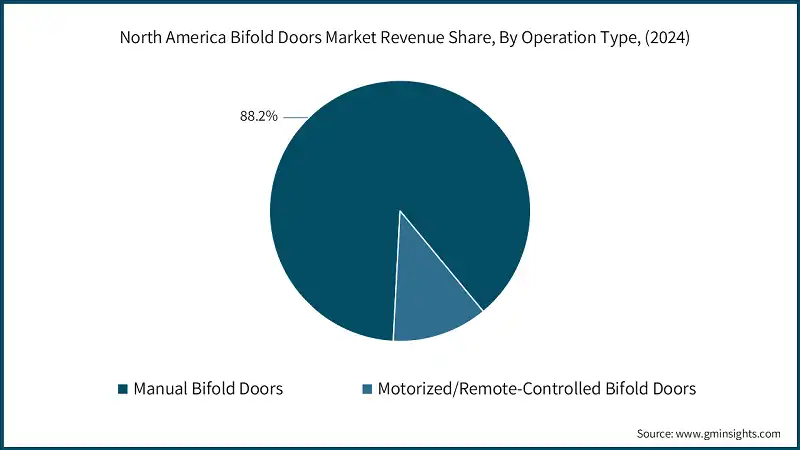
Based on operation type of North America bifold doors market consists of manual bifold doors and motorized/remote-controlled bifold doors. The manual bifold doors emerged as leader and held 88.2% of the total market share in 2024 and is anticipated to grow at a CAGR of 5% from 2025 to 2034.
- Unlike motorized or remote-controlled systems, manual bifold doors require no electrical components, reducing installation complexity and maintenance costs, which appeals to price-sensitive consumers and builders. Their simplicity ensures reliability and longevity, making them ideal for high-traffic areas and environments where automation may not be necessary or feasible.
- Additionally, manual systems provide flexibility in customization, allowing homeowners and designers to choose from a wide range of materials, finishes, and configurations without the added expense of automation technology. The strong demand for manual bifold doors is further supported by the renovation and remodeling boom, where homeowners prioritize aesthetic upgrades and space optimization without incurring significant costs.
Looking for region specific data?
North America Bifold Doors Market
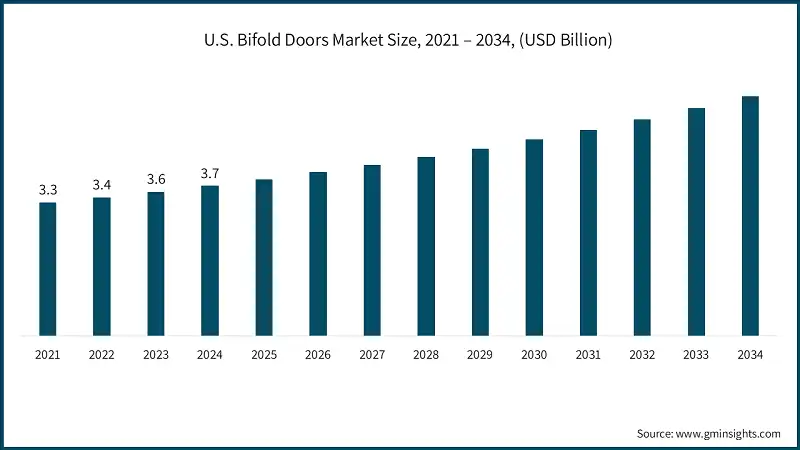
The U.S. dominates an overall market and valued at USD 3.7 billion in 2024 and is estimated to grow at a CAGR of 5.3% from 2025 to 2034.
- The country has witnessed significant growth in residential housing starts and commercial projects, creating a consistent demand for premium door systems that enhance aesthetics and functionality. Homeowners in the U.S. increasingly favor open-plan layouts and indoor–outdoor living concepts, which bifold doors perfectly support by providing wide openings and maximizing natural light.
- Additionally, the U.S. market benefits from a strong preference for energy-efficient and sustainable solutions, driven by stringent building codes and green certification programs, encouraging the use of advanced bifold designs with thermal insulation and eco-friendly materials.
North America Bifold Doors Market Share
- In 2024, the prominent manufacturers in market are Andersen Corporation, JELD-WEN, Inc., Pella Corporation, NanaWall Systems, Inc. and Origin Frames Ltd. collectively held the market share of ~23%.
- Andersen Corporation a leading manufacturer of windows and doors, specializes in offering bifold door systems that cater to both residential and commercial applications. The company has built a strong market position through its well-established brand reputation, known for delivering superior quality and durable products. Andersen’s extensive distribution network, which spans across North America, ensures widespread product availability and accessibility, making it a trusted choice for customers in the region. The company’s focus on innovation and customer satisfaction further strengthens its competitive edge in the market.
- JELD WEN holds the second-largest market share in the bifold doors market and provides a comprehensive range of residential interior and exterior doors. This includes patio doors and folding or sliding wall systems, which are designed to meet diverse customer requirements. The company’s strong global presence is supported by its extensive distribution network, which spans multiple regions, and its wide array of product offerings. JELD-WEN operates several brands within the industry, allowing it to cater to a broad spectrum of customer preferences and solidify its position as a key player in the bifold doors market.
North America Bifold Doors Market Companies
Major players operating in the North America bifold doors industry include:
- Andersen Corporation
- ATIS Group
- AWM Building Maintenance
- BiFolds BiDesign Ltd.
- Chase Windows Co.
- Cascade Windows Inc.
- Euramax Solutions Limited
- JELD-WEN, Inc.
- Kloeber
- Nana Wall Systems, Inc.
- Origin Frames Ltd.
- Pella Corporation
- The Bifold Door Company
- Ply Gem Industries Inc.
- YKK Corporation
Pella Corporation is highly regarded for its exceptional craftsmanship, dedication to sustainability, and emphasis on energy efficiency across its extensive portfolio of windows and doors, including bifold doors. The company’s strong market position is driven by its consistent focus on innovation, which addresses the increasing demand for high-efficiency and environmentally friendly products. Pella’s approach prioritizes customization and direct customer engagement, ensuring its products are tailored to meet specific needs and preferences. This customer-centric strategy has enabled Pella to maintain its competitive advantage in the market.
NanaWall Systems is recognized for its expertise in designing and manufacturing customizable opening glass wall systems. The company offers precision-engineered folding and sliding glass doors that are tailored to meet a wide range of customer needs. NanaWall’s unique market position is bolstered by its extensive portfolio of over 50 high-quality systems, each designed to deliver advanced sound control, enhanced security, and superior comfort across various climate conditions. These features, combined with the company’s commitment to innovation and quality, make NanaWall a preferred choice for customers seeking premium and reliable solutions in the bifold doors market.
North America Bifold Doors Market Report Attributes
| Key Takeaway | Details |
|---|---|
| Market Size & Growth | |
| Base Year | 2024 |
| Market Size in 2024 | USD 4.7 billion |
| Market Size in 2025 | USD 4.9 billion |
| Forecast Period 2025 - 2034 CAGR | 5.2% |
| Market Size in 2034 | USD 7.5 billion |
| Key Market Trends | |
| Drivers | Impact |
| Residential & commercial construction expansion | Boosts demand for bifold doors in new builds and renovations, driving volume growth across housing and hospitality sectors. |
| Space-saving & indoor–outdoor lifestyle trends | Encourages adoption of bifold doors for open-plan layouts and patio connections, enhancing living comfort. |
| Rising demand for space-saving solutions in urban housing | Supports internal bifold door installations in compact apartments and condominiums, optimizing limited floor space. |
| Pitfalls & Challenges | Impact |
| Complex installation & maintenance requirements | Increases upfront labor costs and deters DIY adoption, slowing penetration in budget-conscious segments. |
| Labor & Supply Constraints | Material shortages and skilled labor gaps lead to longer lead times and higher prices, impacting profitability. |
| Opportunities: | Impact |
| Smart & automated bifold systems | Opens premium market segments with IoT integration, catering to smart home and commercial automation trends. |
| Material & design innovation | Drives adoption through sustainable, lightweight, and customizable options aligned with modern aesthetics. |
| Market Leaders (2024) | |
| Market Leaders |
Market share of ~8% |
| Top Players |
Collective market share in 2024 is Collective market share of ~23% |
| Competitive Edge |
|
| Regional Insights | |
| Largest Market | U.S. |
| Fastest Growing Market | U.S. |
| Emerging Country | Canada |
| Future Outlook |
|
What are the growth opportunities in this market?
North America Bifold Doors Industry News
- In March 2025, Andersen Corporation introduced its Big Doors Architectural Collection, which includes advanced pocketing and stacking configurations designed for modern architectural needs. The collection features a durable AAMA 2605 finish, ensuring long-lasting performance and resistance to environmental wear.
- In 2025, Origin Frames Ltd. launched its OB-49 and OB-72 slimline bifold doors, engineered with narrow sightlines for enhanced aesthetics, multi-point locking systems for superior security, and an impressive 1.0 U-value for energy efficiency. The launch also included comprehensive DWG files and detailed installation guides to support architects and installers.
- In February 2025, NanaWall Systems, Inc. unveiled its Generation 4 MultiSlide 630, Tilt-Turn, and Swing Door systems at IBS 2025. These systems feature uniform glass lines for a sleek appearance and barefoot-friendly sills for enhanced user comfort, catering to both residential and commercial applications.
- In July 2025, Pella Corporation released its 2025 Design Trends, focusing on resilient and wellness-driven fenestration solutions. The trends emphasize seamless indoor-outdoor integration, innovative materials, and designs that promote sustainability and well-being in modern living spaces.
The North America bifold doors market research report includes in-depth coverage of the industry, with estimates & forecast in terms of revenue (USD Billion) and volume (Thousand Units) from 2021 to 2034, for the following segments:
Market, By Material
- Wood
- Aluminium
- Vinyl
- Composite (wood-clad)
- Steel
- Glass
Market, By Operation Type
- Manual bifold doors
- Motorized/remote-controlled bifold doors
Market, By Price
- Low
- Medium
- High
Market, By Application
- Residential
- Commercial
- Industrial
Market, By Distribution Channel
- Direct sales
- Indirect sales
The above information is provided for the following regions and countries:
- North America
- U.S.
- Canada
Frequently Asked Question(FAQ) :
What is the market size of the North America bifold doors market in 2024?
The market size was estimated at USD 4.7 billion in 2024, with a CAGR of 5.2% expected through 2034, driven by the adoption of smart and automated systems and increasing demand for energy-efficient solutions.
What is the projected value of the North America bifold doors market by 2034?
The market is expected to reach USD 7.5 billion by 2034, fueled by advancements in IoT-enabled features and growing applications in residential and commercial spaces.
What is the projected size of the North America bifold doors market in 2025?
The market is projected to reach USD 4.9 billion in 2025.
How much revenue did the wood material segment generate?
The wood material segment generated approximately USD 1.7 billion in 2024 and is anticipated to grow at a CAGR of 5.4% from 2025 to 2034.
What was the market share of the residential application segment?
The residential application segment held 69.2% of the total market share in 2024 and is expected to grow at a CAGR of 5.0% from 2025 to 2034.
Which operation type led the North America bifold doors market?
Manual bifold doors dominated the market, holding 88.2% of the total market share in 2024, with a projected CAGR of 5% from 2025 to 2034.
Which country leads the North America bifold doors market?
The United States leads the market, valued at USD 3.7 billion in 2024, and is estimated to grow at a CAGR of 5.3% from 2025 to 2034.
What are the upcoming trends in the North America bifold doors industry?
Key trends include the rising adoption of IoT-enabled bifold doors, integration with voice assistants, and increasing demand for automated systems in both residential and commercial spaces.
Who are the key players in the North America bifold doors market?
Major players include Andersen Corporation, ATIS Group, AWM Building Maintenance, BiFolds BiDesign Ltd., Chase Windows Co., Cascade Windows Inc., Euramax Solutions Limited, JELD-WEN, Inc., Kloeber, and Nana Wall Systems, Inc.
North America Bifold Doors Market Scope
Related Reports