Summary
Table of Content

North America Barge Transportation Market
Get a free sample of this report
Form submitted successfully!
Error submitting form. Please try again.
Thank you!
Your inquiry has been received. Our team will reach out to you with the required details via email. To ensure that you don't miss their response, kindly remember to check your spam folder as well!
Request Sectional Data
Thank you!
Your inquiry has been received. Our team will reach out to you with the required details via email. To ensure that you don't miss their response, kindly remember to check your spam folder as well!
Form submitted successfully!
Error submitting form. Please try again.
North America Barge Transportation Market Size
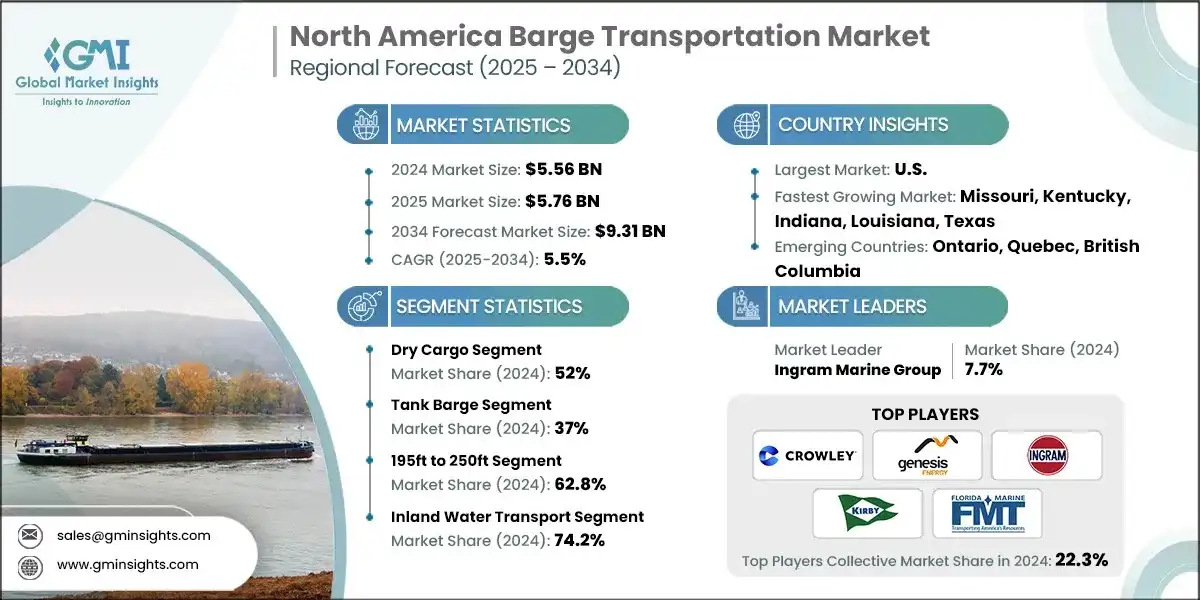
The North America barge transportation market size was valued at USD 5.56 billion in 2024. The market is expected to grow from USD 5.76 billion in 2025 to USD 9.31 billion in 2034, at a CAGR of 5.5%, according to latest report published by Global Market Insights Inc.
North America Barge Transportation Market Key Takeaways
Market Size & Growth
- 2024 Market Size: USD 5.56 Billion
- 2025 Market Size: USD 5.76 Billion
- 2034 Forecast Market Size: USD 9.31 Billion
- CAGR (2025–2034): 5.5%
Regional Dominance
- Largest Market: US
- Fastest Growing Country: Missouri, Kentucky, Indiana, Louisiana, Texas
Key Market Drivers
- Agricultural & Industrial Demand.
- Cost Efficiency.
- Extensive Waterway Infrastructure.
- Environmental Sustainability.
- Regulatory & Safety Support.
Challenges
- Seasonal Waterway Limitations.
- Infrastructure Bottlenecks.
Opportunity
- Expansion of Industrial & Petrochemical Hubs.
- Fleet Modernization & Digitalization.
- Green & Sustainable Logistics.
- Infrastructure Investments & Marine Highways.
Key Players
- Market Leader: Ingram Marine Group led with over 7.7% market share in 2024.
- Leading Players: Top 5 players in this market include Crowley Maritime Corporation, Genesis Energy, Ingram Marine Group, Kirby Corporation, Florida Marine Transporters (FMT), which collectively held a market share of 22.3% in 2024.
Get Market Insights & Growth Opportunities
- Barges are a highly efficient means of transport for bulk commodities. They consume significantly less fuel per ton-mile than either a truck or a train. Thus, fewer emissions into the atmosphere. Being such a cost-effective transport vehicle, barges are champions for shipping coal, grains, chemicals, and petroleum, which aids the U.S. export market to be competitive while providing stable demand for commodities in the largest inland waterway freight market in the world.
- The U.S. exports a lot of grains, soybeans, and bulk agricultural products, as well as a healthy petrochemical and energy sector. Barge shipments can quickly accommodate high volumes that coincide with seasonal harvests and collectivity facilitate logistics with industrial factories that surely maintain the integrity of the supply chain for commodities, including crude oil, chemicals, and refined petroleum products.
- In North America, there is a vast inland waterway network that includes the Mississippi, Ohio, and Missouri Rivers. Government infrastructure investments such as locks, dams, and port modernization will not only create more efficient operation, looser economic regulation, and regulatory incentives but can pave the way toward business decisions to use barges instead of carbon-intensive freight modes.
- In April 2025, ACBL submitted permit requests for construction of a barge fleeting facility on the Tombigbee River, adjacent to the AM/NS Calvert steel producing facility. The site will house 128 barges and include updated mooring and shoreline protection. This project adds efficiencies to the steel supply chain, reduces congestion in the port, and adds to ACBL's industrial logistics capabilities.
- In the United States, the dominant driver of barge transportation is cost, given its ability to move bulk commodities, such as grains, coal, and petroleum, in substantial quantities at a fraction of the fuel and labor costs (per ton-mile) of rail and trucks. Barge transportation delivers competitive supply chains and consistent demand and provides reliable, sustainable freight along the major inland waterways in the United States.
To get key market trends
North America Barge Transportation Market Trends
- Operators are updating fleets with fuel-efficient engines, GPS tracking, automated scheduling and predictive maintenance in order to reduce costs, maximize routes, improve safety, and allow a barge operator to remain competitive versus rail and trucking and improve service reliability for shipments of higher-value goods and bulk cargo.
- Investments in locks, dams, and port facilities are improving navigability, capacity, and cargo volume. Strategic actions such as U.S. Marine Highways, allow the opportunity for increased travel in the inland waterways, will improve road and rail congestion, and can facilitate intermodal efficiency for industrial and agricultural cargo.
- Barges are one of the lowest-emission freight modes by ton-miles. Increased regulatory pressure, as well as corporate commitments to sustainability goals, will contribute to an increase in cleaner fuels and hybrid propulsion and can allow barges to be a green alternative to road and rail transport, appealing to environmentally conscious shippers.
- With coal shipments declining and demand increasing for crude oil, refined petroleum, and liquid chemicals, the cargo mix is changing. Tank barges are growing faster than dry cargo reflecting the changes in energy generation and industrial supply chains particularly on the Mississippi River and Gulf Coast.
- For example, rivers such as Missouri have witnessed dramatic increases in barge traffic levels since terminals were restored and port operations improved. This revival supports regional trade, increases reliability in supply chains, and may encourage more investment in inland waterway systems throughout North America.
North America Barge Transportation Market Analysis
Learn more about the key segments shaping this market
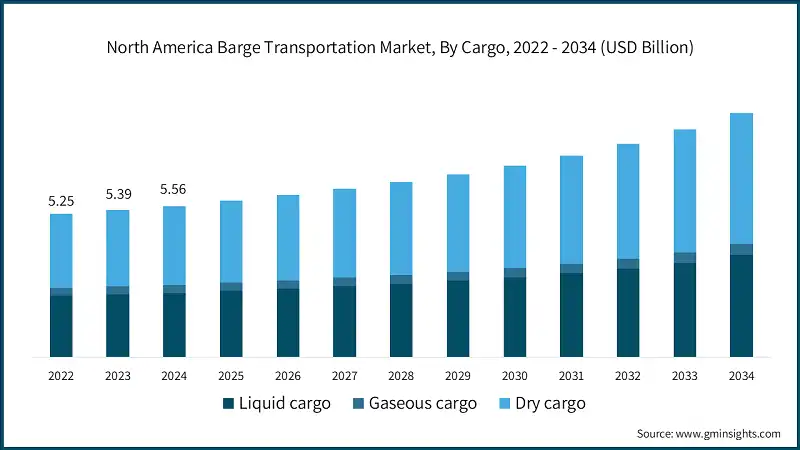
Based on cargo, the North America barge transportation market is divided into liquid cargo, gaseous cargo and dry cargo. The dry cargo segment dominated the market accounting for around 52% in 2024 and is expected to grow at a CAGR of over 5.7% through 2034.
- Dry cargo remains the largest segment of the market as this segment is comprised of the largest volume of commodities transported inland, which include coal, grains, aggregates, ores, and other low-value, high-volume goods, which are best suited for barge transport since barges provide low-cost, fuel-efficient movement of bulk goods over long distances along Inland Waterways, and with a focus on the large volume of the Midwest, both upriver, and down the Mississippi and Ohio, as well as other rivers like the Missouri.
- Grains, soybeans, and corn drive dry cargo barge transport. During harvest season lots of volume moves and as exports grow to Asia and Latin America the volume becomes more substantial.
- The current U.S. shale boom and developing Gulf Coast petrochemical projects are increasing demand for liquid cargo transport, including crude oil, refined petroleum, and chemicals. Tank barges are increasingly preferred to transport liquid cargo as barges move more of these goods to support a reliable supply chain for refineries and industrial customers. Tank barges provide a safe, cost-effective way of managing large volumes associated with liquid cargo transport.
- With rigorous federal requirements for the transport of gas, fleets must review operating parameters, and upkeep safety and emergency monitoring equipment. Upgraded standardized training provides higher levels of crew and operational safety. There are general client liability perceptions that improve with exceptional human factors and systems operational safety because they need to build reliability with industrial and energy sector clients.
- In North America, the barge transport business may be seeing new developments with Redwood Holdings' acquisition of Canal Barge Company, which took place on June 24, 2025, was announced. The acquisition company Canal Barge and purchased Marquette Transportation is expected to operate over $500 million of revenue in 2024. This acquisition not only builds Redwood's position in the Jones Act marine logistics space but also appeared to not provide job loss to employees and almost certainly retained the entire leadership team.
Learn more about the key segments shaping this market
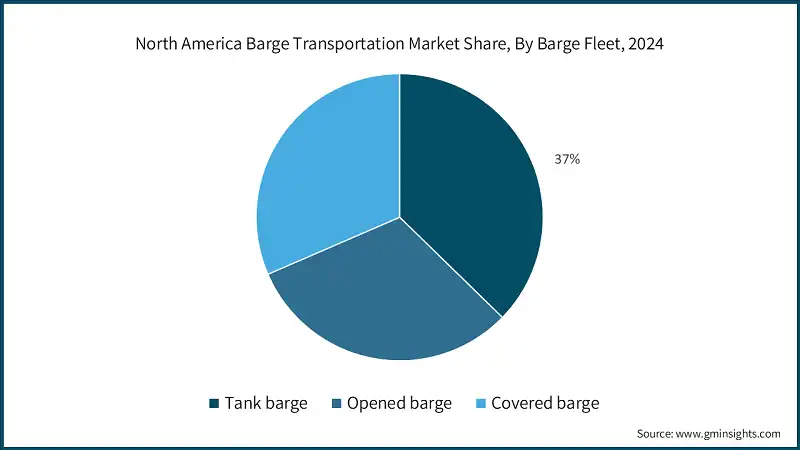
Based on barge fleet, the North America barge transportation market is fragmented into tank barge, opened barge and covered barge. The tank barge segment dominates the market with 37% share in 2024, and the segment is expected to grow at a CAGR of over 5.6% from 2025 to 2034.
- The increase in crude oil, refined petroleum, and chemicals is pushing expansion of the tank barge industry. Operators are investing in double hulls, real-time monitoring systems, and compliance upgrades to improve safety and reduce environmental liability, as well as support greater capacity for liquid cargo on inland and coastal waterways.
- Open barges continue to be vital for transporting bulk commodities, such as coal, ores, and aggregates. The upgrade process has been extensive and includes strengthening cargo areas or hulls, developing systems for cargo handling, and connecting to intermodal transport logistics systems. This allows operators to achieve operational cost-effectiveness while also accommodating seasonal fluctuations during peak transportation capacity when transporting high volume of dry cargo commodities is necessary.
- Covered barges are routinely being used for moving agricultural grains and other similar sensitive dry cargo. Covered barges provide protection against contaminating weather or conditions which may affect the material quality. Some of the trends for covered barges include automated systems for cargo loading/managing and fleet optimization software that will ensure safe delivery of dry commodities and reduce product loss while on the inland transport leg.
- To optimize and maximize freight transport whilst maintaining fleet safety, fleet operators continue to pilot systems that utilize GPS ignition, predictive maintenance, and automated scheduling that allow for route optimization, decreased fleet downtime and greater safety outcomes. Digital technology advances have resulted in improved operational efficiency across tanks, open and covered barges, while concurrently providing more effective fleet usage and monitoring of cargo in real time for industrial and agricultural opportunities.
- In May 2025, it was revealed that the Galveston LNG Bunker Port (GLBP), the first dedicated LNG bunkering hub on the U.S. Gulf Coast, will be located on the Texas City Ship Channel. The $300 million facility will provide LNG via fuel barges to LNG-powered vessels, playing an important role in emissions reduction as well as in support of U.S. LNG policy.
Based on size, the North America barge transportation market is segmented into 140ft to 180ft, 195ft to 250ft, 260ft to 300ft and 300ft and above. The 195ft to 250ft segment held 62.8% in 2024 and is expected to dominate the market as it can transport substantial volumes of dry, liquid, or gaseous cargo while easily navigating inland rivers, canals, and locks.
- 140ft to 180ft barges are becoming more popular in areas with shallow drafts or narrow locks like parts of the Mississippi River and the Great Lakes. Since these barges are much smaller and can access ports and terminals that larger ships cannot use, they facilitate cargo movements in constrained environments where specialization is most important.
- 195ft to 250ft offers a balance between cargo haul and navigability remains the reason this type of ship stays in demand. The barges are a great solution in carrying huge volumes of commodities such as coal, grain, and chemicals through major inland waterways and give the cargo owners economy and fuel efficiency.
- In terms of transporting high-volume dry and liquid cargo over long distances, on the other hand, 260ft to 300ft barges are strategically utilized. Since these barges are larger, the cost per ton lessens as the amount shipped increases; thus, offering an attractive alternative for industries with bulk demands such as petrochemicals, and agriculture.
- 300ft and above barges are being used in conjunction with intermodal logistics, where they provide transport capacity for international export supply chains. The movement of a significant amount of cargo per trip advances all supply chain solutions, specifically industries like energy and mining that necessitate international demand.
- In December of 2024, American Commercial Barge Line (ACBL) acquired the Mariner, a 195ft to 250ft line-haul towboat which is largest U.S. built towboat in 50 years. The addition increases inland cargo capacity and enhances efficiency of operations while also enhancing ACBL’s position in marketplace.
Based on barge activity, the North America barge transportation market is bifurcated as inland water transport and intracoastal transport. The inland water transport segment dominates the market in 2024 with 74.2% share and is expected to grow at a CAGR of 5.7% from 2025 to 2034.
- The inland waterways and, specifically, the Mississippi River system remain important avenues for moving agricultural bulk commodities, such as grains, soybeans, and corn. The attributes of the U.S. as one of the largest exporters in the world allow for barge movement to be an effective transport option in terms of cost and fuel efficiency over both rail and trucking. This growth reflects the need for an efficient waterborne logistics infrastructure to sustain the global competitiveness of U.S. agriculture.
- Modernization projects on critical river systems are underway to improve transport reliability. Modernization projects funded through the Corps of Engineers are meant to improve lock congestion and allow for larger barge tows by upgrading or eliminating locks, dams, and channels. Investments in inland waterways not only reduce expensive delays but also improve safety and sustainability of inland barge transportation systems.
- Within the U.S. Gulf Coast, one of the largest refining and petrochemical complex areas in the world, the use of barges for intracoastal transportation is becoming more prevalent. The number of movements of petroleum products, LNG, and chemicals is increasing to fulfill both domestic consumption and export demand. Barges offer a flexible, cost-effective, and safe means of surface transportation for hazardous or bulk energy commodities over coastal waterways.
- The connection of intracoastal barge transport to ports is becoming stronger in cities like Houston, New Orleans, and Mobile. Ports and barge transport are the same ecosystems and the integration maximizes the efficiency of intermodal transfer of cargo between inland waterways, ocean shipping, and rail networks. Intracoastal transport has the potential to alleviate congestion at ports and build seamless logistics chains that will bolster North America’s presence in global trade.
- In 2024–2025, total grain and soybean exports from the U.S. are projected to be approximately 140.8 million metric tons (8.5% growth from last year). Importantly, over 95% of those exports through the Center Gulf are moved by barge on the Mississippi River Ship Channel which illustrates the important role of inland waterways in export logistics.
Based on applications, the North America barge transportation market is segmented into coal, crude & petroleum products, liquid chemicals, food pulp & other liquid, agricultural products, metal ores and fabricated metal products, pharmaceuticals, dry & gaseous chemicals, LPG, CNG, and other gaseous products, electronics & digital equipment, and others. The crude and petroleum products segment dominate the market, as barges offer the most cost-efficient and safe means of transporting bulk liquid energy cargo across inland and intracoastal waterways.
- Barge transportation remains the primary mode for moving crude oil and refined petroleum products in North America. Increasing refinery operations along the Gulf Coast, along with the growth of energy exports and the rising logistics costs of competing modes of transportation such as road and rail, have increased reliance on a barge because of economy, bulk, and the ability to connect inland production centers with coastal export terminals.
- Although there are long-term environmental concerns, barges continue to transport steady amounts of coal in the near term, given international demand for coal and domestic energy generation practices. Barge transportation provides a reliable connection for large volumes of coal from extensive inland mines to coastal ports, allowing bulk shipments by barge, and alleviating, even more than other modes of transportation, the risks of congestion that may arise by truck or rail.
- In addition to being essential for moving coal, barge transportation has significant importance for a wide range of agricultural commodities, including grains, soybeans, and fertilizers, across inland waterways. Barge transportation allows farmers and exporters to continue to be competitive in global markets by moving large amounts of product at low cost. Agricultural commodities will continue to be dependent upon barge transport, as national harvest cycles and rising food demand will play a role in its importance.
- U.S. grain and soybean exports increased in early 2025, and more than 95% of that exported grain and soybeans moved via barges through the Mississippi River Ship Channel to the Center Gulf. This illustrates the continuing importance of inland waterways in global agricultural and logistical supply systems.
Looking for region specific data?
The North America barge transportation market held market revenue of USD 5.55 billion in 2024 and is expected to grow at a CAGR of 5.5%.
- Barge operators are moving to utilize AI enhanced navigation, IoT telematics, and tools for predictive maintenance. Barge operators have a better chance of routes, predictive maintenance, and making it safer during barge operations through real-time monitoring.
- The industry is adopting cleaner technologies, including hybrid-electric propulsion, LNG, biofuels, and even hydrogen. These technologies allow operators to reduce emissions, comply with regulations, and meet changing expectations about sustainability.
- There are increased efforts to provide intermodal connections, including container-on-barge services at Paducah-McCracken river ports. This service adds seamless transfers of cargo from waterways to rail and road modes and provides more flexibility in the supply chain.
- In June 2025, New York City announced the decommissioning of the Vernon C. Bain Center to make way for a brand-new marine terminal in Hunts Point, which is scheduled to open in 2030-31. Barge logistics will expand container movement to and from the waterfront and strengthen the concurrent revitalization of NYC's waterfront to achieve more freight in a more climate-friendly way.
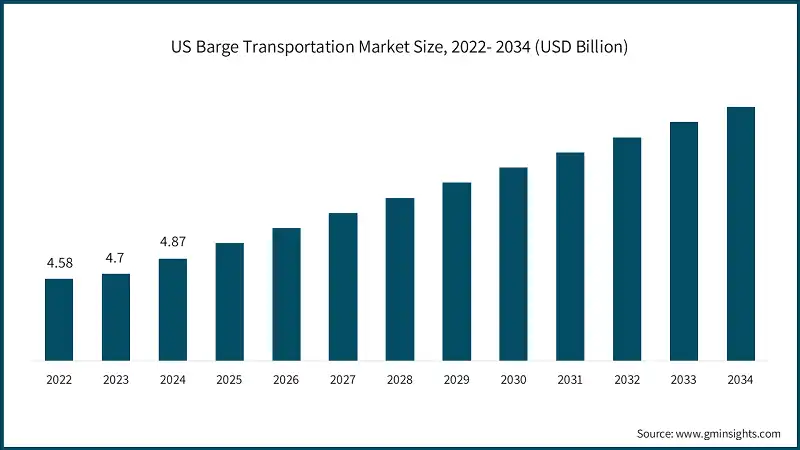
US dominated the barge transportation market in North America with around 87.6% share in 2024 and generated USD 4.87 billion in revenue.
- The U.S. barge industry is embarking on a new era with cleaner fuel, introducing LNG-powered barges and hybrid systems into the fleet. The Gulf Coast region of the U.S. which is the epicenter for energy exports in the U.S., and with the development of new LNG bunkering facilities and alternative energy transitions, including LNG, the barge industry is able to consistently eliminate emissions while complying with federal and state regulations to work toward environmental decarbonization.
- Screening and modernization of the Mississippi and Missouri Rivers, including upgrades to locks and dams, to help reduce delays and shipping congestion. Federal funding through the infrastructure bills will continue speedy upgrades that will create safer and less delays in barge movements, increasing reliability and potentially larger barge tows while simultaneously improving barge operations will continue to benefit transportation of agricultural and energy commodities.
- U.S. grains, soybeans, and corn continue to be exported via barge, especially across the Mississippi River system. With global demand for U.S. agricultural exports increasing, barge operators will continue to increase their capacity and efficiency. The U.S. Department of Agriculture continues to say that when moving bulk crops, barges system is the cheapest mode of transport.
North America Barge Transportation Market Share
- The top 7 companies in the North America barge transportation industry are American Commercial Barge Line (ACBL), Crowley Maritime Corporation, Florida Marine Transporters (FMT), Genesis Energy, Ingram Marine Group, Kirby, Campbell Transportation Company contributing around 35.6% of the market in 2024.
- Ingram is the largest operator of inland barges in the US and has a huge fleet of dry and liquid cargo barges. It operates predominately along the Mississippi River and has a vast terminal network which allows it to maintain its leadership in the bulk agricultural, coal and chemical sectors while having the largest market share.
- Genesis focuses on crude oil and refined products logistics with a significant presence in the Gulf Coast and inland waterways. Its combined midstream business such as marine transportation, pipeline and storage facilities provides it with the ability to provide entire energy supply chain logistics that enables it has a significant portion of market share.
- Kirby is the largest tank barge operator in the U.S., specializing in liquid cargoes over transport such as petrochemicals, black oil and refined petroleum products. Its size, reputation as a safe shipper, and investment in modernizing its barge fleets place it in a competitive position in the transport of high value, regulated cargos.
- Crowley is a force in both intracoastal and offshore barge, particularly in moving petroleum and LNG. Its significant presence in the Gulf Coast and Caribbean combined with its interests in LNG bunkering and integrated logistics provide Crowley with an advantage in energy and intermodal supply chains.
North America Barge Transportation Market Companies
Major players operating in the North America barge transportation industry are:
- Kirby Corporation
- Ingram Marine
- American Commercial Barge Line (ACBL)
- Crowley Maritime
- Florida Marine Transporters (FMT)
- Campbell Transportation Company
- Magnolia Marine Transport Company
- Genesis Energy
- Tidewater
- Ingram operates the largest inland barge fleet in the United States, with over 4,000 barges and 150 towboats in its fleet. Ingram is focused on dry cargo (coal, grain, aggregates) and liquid cargo (chemicals, petroleum) and has dominance on the Mississippi River system with the broadest logistics services to support scalability like no company can offer in the inland barge industry.
- Genesis Energy operates a fleet of tank barges and tugboats, with a primary focus on the inland waterways and Gulf Intracoastal Waterway for crude oil, refined petroleum products, and liquid chemicals. The strength of Genesis Energy in the barge transportation market is due in part to significant vertical integration with midstream assets (pipelines, terminals, storage) that provide integrated barge services to the U.S. energy logistics space.
- Kirby is the largest U.S. tank barge operator, with approximately 1,000 active tank barges and 300 towboats. Kirby operates in the petrochemical, black oil, and refined products markets, and is also active in transporting agricultural chemicals. Kirby's sheer size, prominence with the regulatory authorities on safety compliance, and overall investment in new fleets of barges puts the best position in the liquid cargo movement by barge category.
- Crowley is focused on petroleum movements, particularly LNG, on intracoastal routes and has strong operations in the Gulf Coast and Caribbean. Crowley's most recent investments in barge transportation include LNG bunkering barges and LNG services as well as logistics services in the energy sector and are continuing to invest in barge transportation in sustainable barge transportation. Crowley also where the barge integrates onshore and offshore logistics with cargo transport on barges.
North America Barge Transportation Market Report Attributes
| Key Takeaway | Details |
|---|---|
| Market Size & Growth | |
| Base Year | 2024 |
| Market Size in 2024 | USD 5.56 Billion |
| Market Size in 2025 | USD 5.76 Billion |
| Forecast Period 2025 - 2034 CAGR | 5.5% |
| Market Size in 2034 | USD 9.31 Billion |
| Key Market Trends | |
| Drivers | Impact |
| Agricultural & Industrial Demand | Supports seasonal grain exports and petrochemical transport, ensuring stable, high-volume cargo flows. Strengthens supply chain reliability for U.S. domestic and international markets. |
| Cost Efficiency | Reduces transportation costs per ton-mile compared to rail and trucks, making bulk shipments more profitable. Encourages shippers to use barges for high-volume, low-value commodities like grains and coal. |
| Extensive Waterway Infrastructure | Navigable rivers and canals facilitate efficient inland transport, reducing road congestion. Investments in locks and ports enhance operational capacity and vessel turnaround times. |
| Environmental Sustainability | Lower fuel consumption and emissions compared to trucks and rail improve environmental compliance. Attracts shippers seeking greener logistics solutions. |
| Regulatory & Safety Support | Government policies and safety regulations increase operational reliability and fleet compliance. Enhances investor and customer confidence in inland waterway transport. |
| Pitfalls & Challenges | Impact |
| Seasonal Waterway Limitations | Droughts, floods, and low water levels reduce navigability and cargo capacity. This disrupts supply chains and increases freight costs during adverse conditions. |
| Infrastructure Bottlenecks | Aging locks, dams, and ports can create congestion and delays. Limited modernization slows operational efficiency and restricts the full potential of inland barge transport. |
| Opportunities: | Impact |
| Expansion of Industrial & Petrochemical Hubs | Growth in shale, petrochemical, and manufacturing industries increases demand for liquid and bulk transport. Barge operators can capture higher-value cargo flows and long-term contracts. |
| Fleet Modernization & Digitalization | Adoption of fuel-efficient engines, GPS tracking, and automated scheduling improves efficiency and reduces operational costs. Enhance competitiveness against rail and trucking. |
| Green & Sustainable Logistics | Emphasis on low-emission transport positions barges as a preferred sustainable option. Attracts eco-conscious shippers and supports compliance with environmental regulations. |
| Infrastructure Investments & Marine Highways | Upgrades to locks, dams, and ports increase capacity and reduce congestion. Expands the reach and reliability of barge networks for domestic and export cargo. |
| Market Leaders (2024) | |
| Market Leaders |
7.7% market share |
| Top Players |
Collective market share in 2024 is 22.3% |
| Competitive Edge |
|
| Regional Insights | |
| Largest Market | US |
| Fastest growing market | Missouri, Kentucky, Indiana, Louisiana, Texas |
| Emerging market | Ontario, Quebec, British Columbia |
| Future outlook |
|
What are the growth opportunities in this market?
North America Barge Transportation Industry News
- In July 2025, Crowley Wind Services partnered with Nexans to develop and operate a Jones Act-compliant cable lay barge. The newly built 300-foot barge has a 3,500-ton capacity carousel for laying and burying subsea cables. It will now support offshore wind projects (e.g., Equinor's Empire Wind farm that is going off New York).
- In November 2024, the American Commercial Barge Line Company (ACBL) celebrated the christening of its 200 ft. x 50 ft. towboat "Mariner" on the Mississippi River in New Orleans. This vessel is the largest U.S.-built towboat in 50 years and uses the industry's largest propellers at 124 inches. The "Mariner" will help ACBL meet its growing demand for inland cargo movement.
- In July 2024, Crowley took delivery of the "Progress", which is the largest U.S.-flagged LNG bunker barge. The barge was built at Fincantieri Bay Shipbuilding in Wisconsin. "Progress" is a Jones Act-compliant vessel and supports clean shipping and LNG fuel availability in the Port of Savannah.
- In January 2024, Campbell Transportation repowered its M/V Louise S towboat with Mitsubishi S16R Tier 3 engines furnished from Laborde Products. These engines will improve fuel savings and operational performance for Campbell's fleet modernization strategy.
The North America barge transportation market research report includes in-depth coverage of the industry with estimates & forecasts in terms of revenue ($ Mn/Bn, units) from 2021 to 2034, for the following segments:
Market, By Cargo
- Liquid cargo
- Gaseous cargo
- Dry cargo
Market, By Barge Fleet
- Covered barge
- Opened barge
- Tank barge
Market, By Size
- 140ft to 180ft
- 195ft to 250ft
- 260ft to 300ft
- 300ft and above
Market, By Barging Activity
- Intracoastal transportation
- Inland water transport
Market, By Application
- Coal
- Crude & petroleum products
- Liquid chemicals
- Food pulp & other liquid
- Agricultural products
- Metal ores and fabricated metal products
- Pharmaceuticals
- Dry & gaseous chemicals
- LPG, CNG, and other gaseous products
- Electronics & digital equipment
- Others
The above information is provided for the following regions and countries:
- US
- Northeast US
- Connecticut
- Maine
- Massachusetts
- New Hampshire
- New Jersey
- New York
- Pennsylvania
- Rhode Island
- Vermont
- Midwest US
- Illinois
- Indiana
- Iowa
- Kansas
- Michigan
- Minnesota
- Missouri
- Nebraska
- North Dakota
- Ohio
- South Dakota
- Wisconsin
- South US
- Alabama
- Arkansas
- Delaware
- Florida
- Georgia
- Kentucky
- Louisiana
- Maryland
- Mississippi
- North Carolina
- Oklahoma
- South Carolina
- Tennessee
- Texas
- Virginia
- West Virginia
- Washington D.C.
- West US
- Alaska
- Arizona
- California
- Colorado
- Hawaii
- Idaho
- Montana
- Nevada
- New Mexico
- Oregon
- Utah
- Washington
- Wyoming
- Canada
- Alberta
- British Columbia
- Manitoba
- New Brunswick
- Newfoundland and Labrador
- Nova Scotia
- Ontario
- Prince Edward Island
- Quebec
- Saskatchewan
Frequently Asked Question(FAQ) :
What is the market size of the North America barge transportation in 2024?
The market size was valued at USD 5.56 billion in 2024, with a CAGR of 5.5% expected through 2034. The market is driven by the cost-effectiveness and fuel efficiency of barges.
What is the projected value of the North America barge transportation market by 2034?
The market is poised to reach USD 9.31 billion by 2034, supported by investments in infrastructure, sustainability initiatives, and advancements in fleet technology.
What is the expected size of the North America barge transportation market in 2025?
The market size is projected to reach USD 5.76 billion in 2025.
How much revenue did the dry cargo segment generate in 2024?
The dry cargo segment accounted for approximately 52% of the market in 2024 and is expected to witness over 5.7% through 2034.
What was the valuation of the tank barge segment in 2024?
The tank barge segment held a 37% market share in 2024 and is set to expand at a CAGR of over 5.6% till 2034.
What is the growth outlook for the inland water transport segment from 2025 to 2034?
The inland water transport segment, which dominated the market with a 74.2% share in 2024, is anticipated to observe around 5.7% CAGR up to 2034.
Which region leads the North America barge transportation sector?
The U.S. leads the market with an 87.6% share, generating USD 4.87 billion in revenue in 2024. This leadership is fueled by its position as the epicenter of energy exports and advancements in sustainable fuel technologies.
What are the upcoming trends in the North America barge transportation market?
Trends include fleet upgrades with fuel-efficient engines, GPS tracking, cleaner fuels, infrastructure investments, and a cargo shift to chemicals and petroleum.
Who are the key players in the North America barge transportation industry?
Key players include Kirby Corporation, Ingram Marine, American Commercial Barge Line (ACBL), Crowley Maritime, Magnolia Marine Transport Company, Genesis Energy, and Tidewater.
North America Barge Transportation Market Scope
Related Reports