Summary
Table of Content

North America Automotive Aluminum Wheels Market
Get a free sample of this report
Form submitted successfully!
Error submitting form. Please try again.
Thank you!
Your inquiry has been received. Our team will reach out to you with the required details via email. To ensure that you don't miss their response, kindly remember to check your spam folder as well!
Request Sectional Data
Thank you!
Your inquiry has been received. Our team will reach out to you with the required details via email. To ensure that you don't miss their response, kindly remember to check your spam folder as well!
Form submitted successfully!
Error submitting form. Please try again.
North America Automotive Aluminum Wheels Market Size
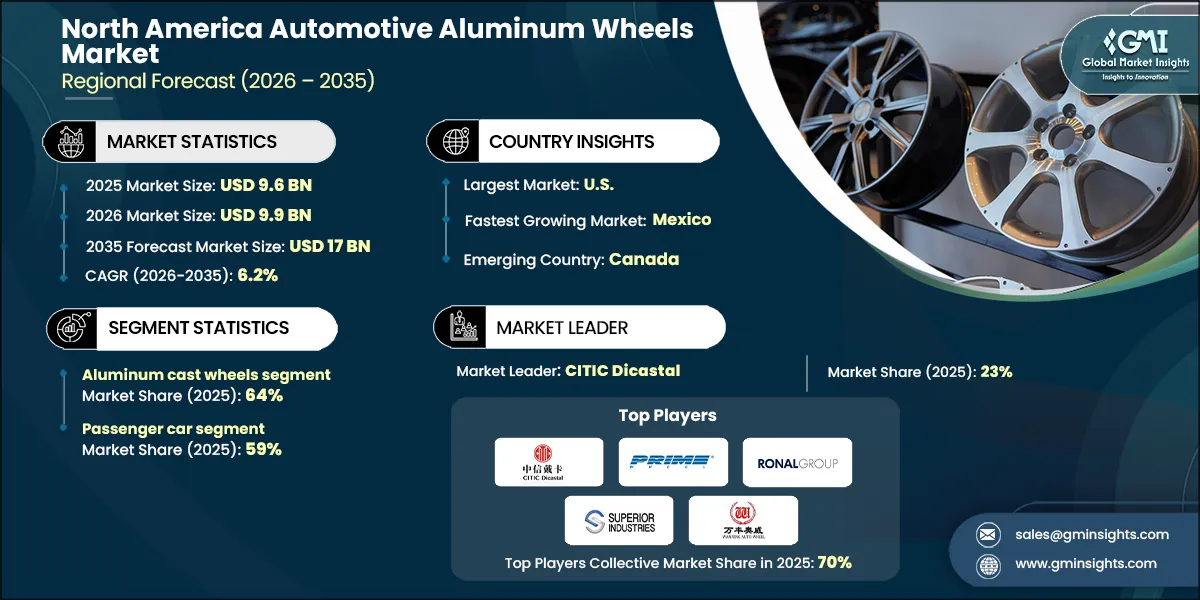
The North America automotive aluminum wheels market was estimated at USD 9.6 billion in 2025. The market is expected to grow from USD 9.9 billion in 2026 to USD 17 billion in 2035, at a CAGR of 6.2% according to latest report published by Global Market Insights Inc.
North America Automotive Aluminum Wheels Market Key Takeaways
Market Size & Growth
- 2025 Market Size: USD 9.6 Billion
- 2026 Market Size: USD 9.9 Billion
- 2035 Forecast Market Size: USD 17 Billion
- CAGR (2026–2035): 6.2%
Regional Dominance
- Largest Market: US
- Fastest Growing Country: Mexico
Key Market Drivers
- Electrification-driven lightweighting.
- Rising SUV and pickup truck sales.
- Premiumization across mass-market vehicles.
- Growth of aftermarket customization.
- Advanced manufacturing technologies.
Challenges
- Volatility in aluminum prices.
- Competition from steel and composite wheels.
Opportunity
- EV platform expansion.
- Growth in Mexico-based manufacturing.
- Aftermarket premium wheel demand.
- Sustainable and recycled aluminum adoption.
Key Players
- Market Leader: CITIC Dicastal led with over 23% market share in 2025.
- Leading Players: Top 5 players in this market include CITIC Dicastal, Prime Wheel, Ronal, Superior Industries International, Wanfeng, which collectively held a market share of 70% in 2025.
Get Market Insights & Growth Opportunities
The speed with which electric vehicles are infiltrating the North American market is driving a rise in demand of aluminum wheels as manufacturers are focusing on lightweight components to balance out the huge battery packs. Aluminum wheels decrease the unsprang mass, increase the vehicle range and thermal performance, and are universally present as standard OEM equipment in EVs and hybrids, structurally boosting the adoption levels of aluminum wheels in the passenger and light truck markets.
US aluminum wheels market is growing rapidly due to the shift toward electric vehicles (EVs), which need lightweight and high-performing wheel solutions. According to ICCT, after ten years of steady growth, EV adoption reached a turning point in 2025. More than 1.2 million new light-duty EVs were sold in the first three quarters alone, marking the highest annual sales level for EVs to date. EVs made up nearly 12% of total light-duty vehicle sales in Q3 2025, highlighting their quick entry into the mainstream automotive market.
SUVs and pickup trucks are still growing in market share with respect to North American sales especially in the U.S. and Canada. These cars are also progressively using bigger diameter aluminum wheels (18-22 inches) as a performance, durability and aesthetic distinction. Increased volume of aluminum wheel per unit vehicles in SUVs and trucks directly improve the growth in average revenues per unit and in market value.
Automotive manufacturers are applying aluminum designs of wheels as a major visual and performance distinguishing factor between trims and model types. Machined, multi-spoke and aerodynamic aluminum wheels are available as standard or middle range options, rather than as premium ones. This change is widening the penetration of aluminum wheels through the luxury car market to masses.
The culture of high vehicle parc and customization in North America is still a strong factor that promotes the development of the aluminum wheel aftermarket. Customers are progressively substituting factory wheels with less massive or cosmetically enhanced aluminum versions in order to enhance the appearance, performance and resale. The spread of e-commerce platforms and products that are tailored to fitment is also increasing the pace of aftermarket-based replacements of aluminum wheels.
The Mexican market is the most dynamic in the aluminum wheels market in North America because it is growing as an export-based automobile production region. The increased investments by the US, European and Asian OEMs, especially in EVs, and SUVs are also contributing to local sourcing of aluminum wheels. Low cost of labor, USMCA advantages, and closeness to US plants of OEM speed up the growth of production.
US has the largest share of the market. This is due to its large number of vehicles, high sales of new vehicles, and high rates of aluminum wheel fitment. The strong demand for SUVs, pickups, and premium trims, along with the fast adoption of electric vehicles (EVs), drives both original equipment manufacturer (OEM) installations and a strong replacement market. This helps maintain a dominant market share.
To get key market trends
North America Automotive Aluminum Wheels Market Trends
The growing interest in sustainability and recycled production is also hastening the use of recycled aluminum in wheels manufacturing. Car manufacturers prefer those suppliers who provide low-carbon aluminum solutions to achieve ESG goals. High recyclability and reduced lifecycle emissions of aluminum wheels make it more appealing over time in North America.
Stricter fuel-efficiency and emissions regulations throughout North America are compelling vehicle manufacturers to lower the vehicle curb weight. Aluminum wheels help to enhance compliance by reducing rotational mass and enhancing overall efficiency without reducing strength or safety. Since OEMs have adjusted all components to ensure that they meet regulatory requirements, aluminum wheels are gaining more popularity compared to steel, contributing to the continued growth in demand.
Other technologies in the manufacture of wheels like the flow forming, low-pressure casting and rotary forging among others are improving the ratio of strength against weight, as well as reducing the rate of defects. The innovations make possible thinner, lighter and larger-diameter aluminum wheels at competitive prices which can be used across mass-market vehicles and the light commercial fleets in North America.
The growing demand among consumers to use larger wheel diameters and violent styling is adding weight in the content of aluminum wheels per vehicle. The trends in design give preference to multi-spoke, machined and aerodynamic aluminum wheels which adds to the vehicle aesthetics and value to the eyes. It is the aesthetic-based demand that is high in SUVs and crossovers in terms of average selling price and market revenue.
The vehicle parc in North America is aging and this will continue to generate a consistent replacement demand of aluminum wheels. Damage and corrosion of road surfaces, and wear make consumers switch damaged steel or factory wheels with aluminum ones. This replacement cycle, coupled with insurance-driven wheel turnover, results in inelastic replacement aftermarket demand that is not subject to fluctuations in new vehicle sales.
The increase in fleet leasing and the ride-hailing services is also indirectly contributing to the demand of aluminum wheels. Fleet operators have a preference to aluminum wheels due to their durability, resistance against corrosion as well as fuel efficiency as opposed to high-mileage usage. With the modernization of commercial fleets to enhance the cost of operation and brand image, the use of aluminum wheels is still growing.
North America Automotive Aluminum Wheels Market Analysis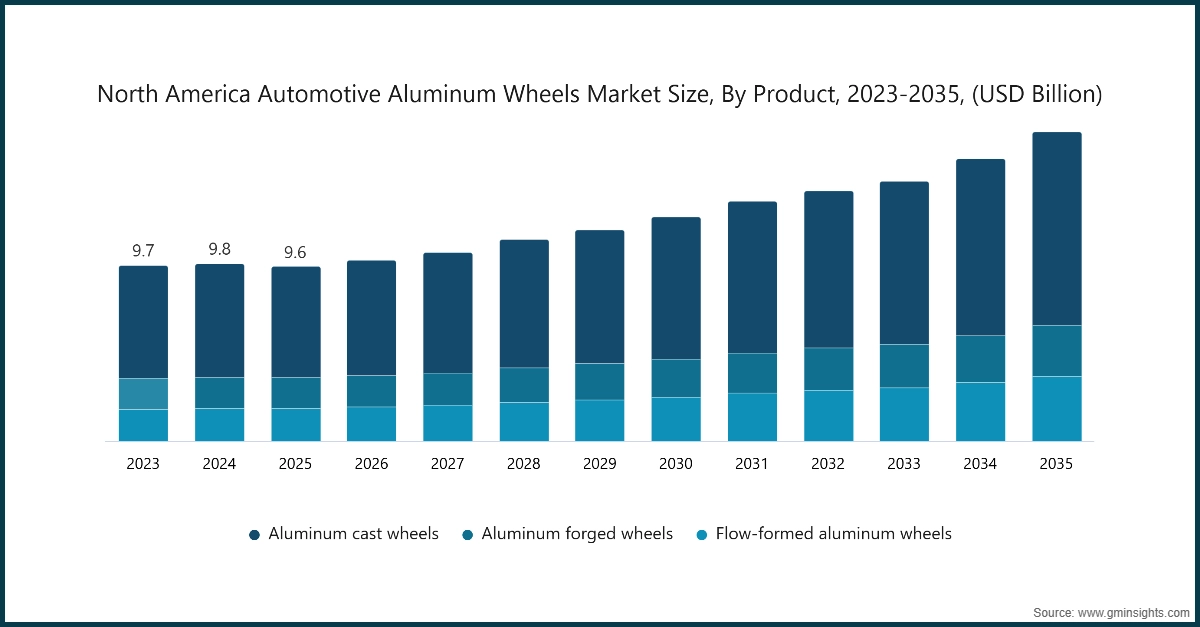 Learn more about the key segments shaping this market
Learn more about the key segments shaping this market
Based on product, the North America automotive aluminum wheels market is divided into aluminum cast wheels, aluminum forged wheels, and flow-formed aluminum wheels. The aluminum cast wheels segment dominated the North America automotive aluminum wheels, accounting for around 64% in 2025 and is expected to grow at a CAGR of more than 5.5% through 2035.
- OEMs favoring cast aluminum wheels are increased by the fact that these offer the best combination of cost, weight reduction and design flexibility. Cast wheels have scalable production at a lower cost compared to forged wheels, and are therefore suitable to the mass-market passenger cars, SUVs, and light trucks in North America, which can afford high volumes.
- The market penetration of aluminum cast wheels is widening with the growing standardization that is being applied to the wheels by a larger range of vehicle trims in the mid-range market. To improve the aesthetics of vehicles and to increase their perceived value, especially compact SUVs and crossovers, automakers are switching steel wheels to entry-level cast aluminum ones, which is a structurally increasing cast wheel volume.
- Developments in low-pressure and gravity casting technology are enhancing the structural integrity, as well as the surface finish of aluminum cast wheels. These enhancements allow lighter constructions, lower level of porosity, and increased load-bearing abilities, casting cast wheels are applicable to larger-diameter applications required by North American customers.
- Electric vehicles are experiencing rapid growth that is contributing to the demand of aluminum cast wheels particularly the high volume EV. Cast wheels offer inexpensive, low-weight choices that allow them to offset the battery weight, yet remain manufacturable viable on large scale, which is why they are a favorite of mainstream electric passenger cars.
- Leveraging on OEM production in Mexico and local sourcing by USMCA are reinforcing the aluminum cast wheels supply chain. The location near assemblies lowers the logistics costs and lead times, which motivates auto manufacturers to source more cast wheels locally when applying to North American vehicle programs.
- Good aftermarket replacement market is supporting the development of aluminum cast wheels. Consumers often substitute factory damaged wheels with cheap cast aluminum wheels that have better styling capabilities and lifestyles. Cast wheels are the replacement market leaders in North America, thanks to their wide availability, compatibility in terms of fitments, and pricing.
Learn more about the key segments shaping this market
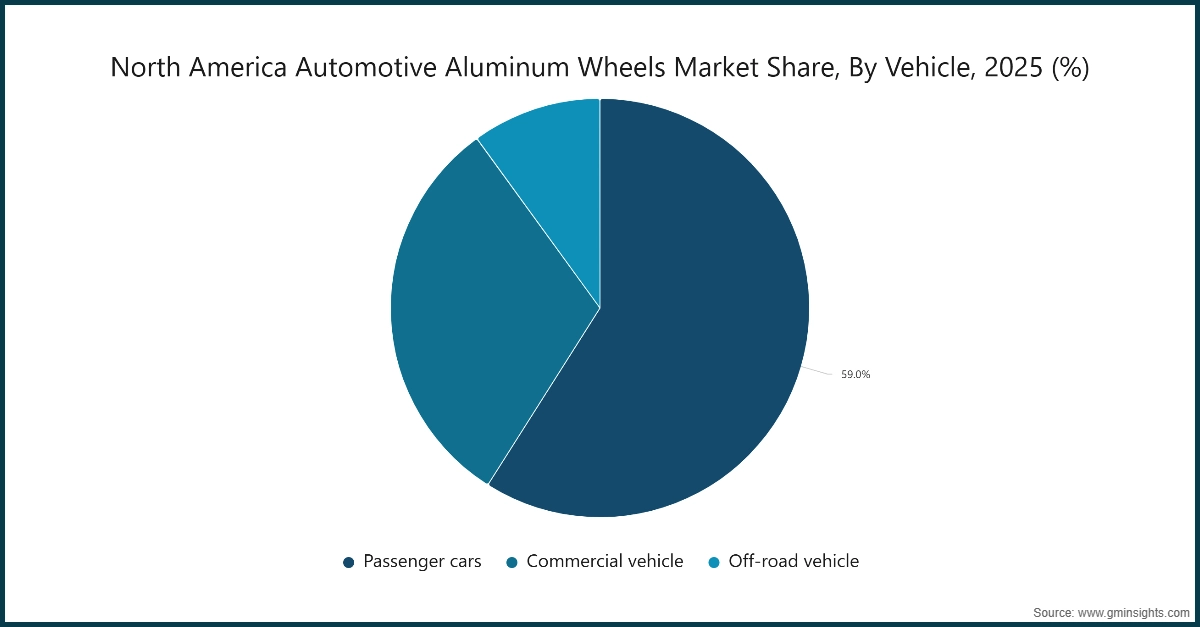
Based on vehicle, the North America automotive aluminum wheels market is segmented into passenger car, commercial vehicle, and off-road vehicle. The passenger car segment dominates the market accounting for 59% share in 2025, and the segment is expected to grow at a CAGR of over 6% from 2026-2035.
- Increasing electrification of passenger cars in North America is hastening the move toward aluminum wheels, as the car makers are in search of lightweight materials to improve the driving range and fuel efficiency. Aluminum wheels are used to balance battery weight and improve thermal performance, and they are more favored by OEMs to electric sedans and compact cars that are entering mass-market price ranges.
- Consumer demands to have better looks and ride comfort on their cars increase the adoption of aluminum wheels as a standard passenger car feature. To add more beauty, lower and middle-level trims, automakers are replacing steel wheels with aluminum ones to reduce noise, and make their car look good.
- The increasing popularity of smaller and middle-size passenger vehicles with sport-based models is favoring demand of bigger and performance-oriented aluminum wheels. Sport trims may have bigger and aerodynamically optimized aluminum wheels and become wheel-pricier vehicles, as well as giving those suppliers more revenue chances.
- The development of passenger cars with aerodynamic wheels is stimulating the demand of aluminum wheels. Airflow and closed-spoke aluminum wheels are also better at creating drag reduction and efficiency, especially in EVs and hybrids, and OEMs are compelled to consider using aluminum solutions instead of steel wheels.
- The foreign automobile parcel of North America is aging and this is creating consistent aftermarket demand of aluminum wheel replacement. Road conditions and seasonal driving damage drive up the rate of replacements and consumers are willing to replace their wheels with aluminum to enhance beauty and resale value, which is why the aftermarket continues to grow steadily.
- The high level of safety and performance demanded in passenger cars is also leaning towards the use of aluminum wheels because of its weight-to-strength ratio. Aluminum wheels are becoming more popular in modern passenger cars because of their improved braking heat dissipation, enhanced handling traits, and compatibility with the advanced braking systems.
Based on sales channel, the North America automotive aluminum wheels market is divided into OEM, and aftermarket. The OEM segment held the major market share in 2025.
- In a bid to achieve the lightweighting and efficiency requirements, automakers are increasingly defining aluminum wheels as standard OEM. Substituting steel wheels with aluminum will enable OEMs to lower the vehicle curb weight, raise their fuel efficiency, and extend the electric vehicle range, so aluminum wheels are a promising part of new vehicle platform design.|
- OEM consolidation in terms of sourcing is affecting higher volume purchasing of aluminum wheels. Cross-brand vehicle designs can raise the standardized specifications of wheels in more than one model, and enable aluminum wheel vendors to enter long term and high-volume contracts and enhance economies of scale in North America.
- The increased focus on vehicle differentiation is prompting OEMs to apply aluminum wheel design to distinguish trims and model variants. It is also being incorporated at the factory level; to include unique finishes, spokes patterns and larger diameters that add to the aluminum wheel content without having to depend on aftermarket upgrades.
- The USMCA localization of OEM is giving a boost to the demand for aluminum wheels. The North American aluminum wheel manufacturers enjoy increased demand from the automakers who favor regional suppliers with manufacturing footprint in the U.S. and Mexico to alleviate the risk of logistics and to fulfil the trade regulations and maintaining supply continuity.
- The fast development of EV and hybrid vehicle manufacturing is transforming the OEM sourcing strategies. Aluminum wheels are preferred due to their capacity to counterbalance mass of batteries and incorporation of aerodynamic characteristics to it and thus they are a default selection of high-volume electric vehicle program across North America.
- Sustainability is also aiding the adoption of aluminum wheels, as OEM pays more attention to sustainability. Recycled and low-carbon aluminum recyclable suppliers are becoming desirable since automakers are working towards achieving ESG goals, meeting carbon reporting requirements, and developing more environmentally friendly supply chains in next-generation vehicles.
Based on rim size, North America automotive aluminum wheels market is divided into 13–15 inches, 16–18 inches, and more than 18 inches. The 16–18 inches segment dominated the market.
- The high demand in 16–18 inch aluminum wheels is as a result of increasing superiority of compact SUVs, crossovers and mid-size passenger vehicles in North America. Such vehicles prefer balanced sizes of the wheels that provide comfort, durability and cost-efficiency; hence 16-18 inch rims are the most commonly adopted OEM fitment in high-volume car bodies.
- The current standardization trend of OEM towards 16-18 inch rim diameter in mass-market cars is quite popular. All these sizes maximize the ride experience, tires, and production cost so that automakers can use the same platform in different regions and retain the same look and performance of aluminum wheels, which allows them to grow in volume.
- Increased demand of 16-18 inch aluminum wheels is taking place because of the growth of electric and hybrid passenger cars in the low-end segment. Such rim sizes are characterized by a lower rolling resistance and decreased weight than larger wheels and contribute to the better vehicle range and efficiency without raising the cost of manufacturing.
- The aftermarket replacement demand is being sustained by the huge installed base of vehicles with 1618 inch wheels. Wear, seasonal tires and destruction of roads is a common cause of replacement of the wheels and consumers tend to upgrade to aluminum in this size as it is available, priced low and compatible.
- The wheel replacement and repair cycles where the insurance companies are involved give a huge pressure on 16-18 inch aluminum wheels. These are normally included under standard replacement policies, which is why the aluminum wheels are the default choice of collision repairs and personal accident-related replacement, and the reason in favor of consistent aftermarket volume.
- The presence of tires and other accessories that fit the 16 inch to 18 inch rims gives strong demand to aluminum wheels in this market segment. The market of high tire models, competitive prices, and simple fitment will compel OEMs and customers to stick to the use of aluminum-made wheels in this category of rim size.
Looking for region specific data?
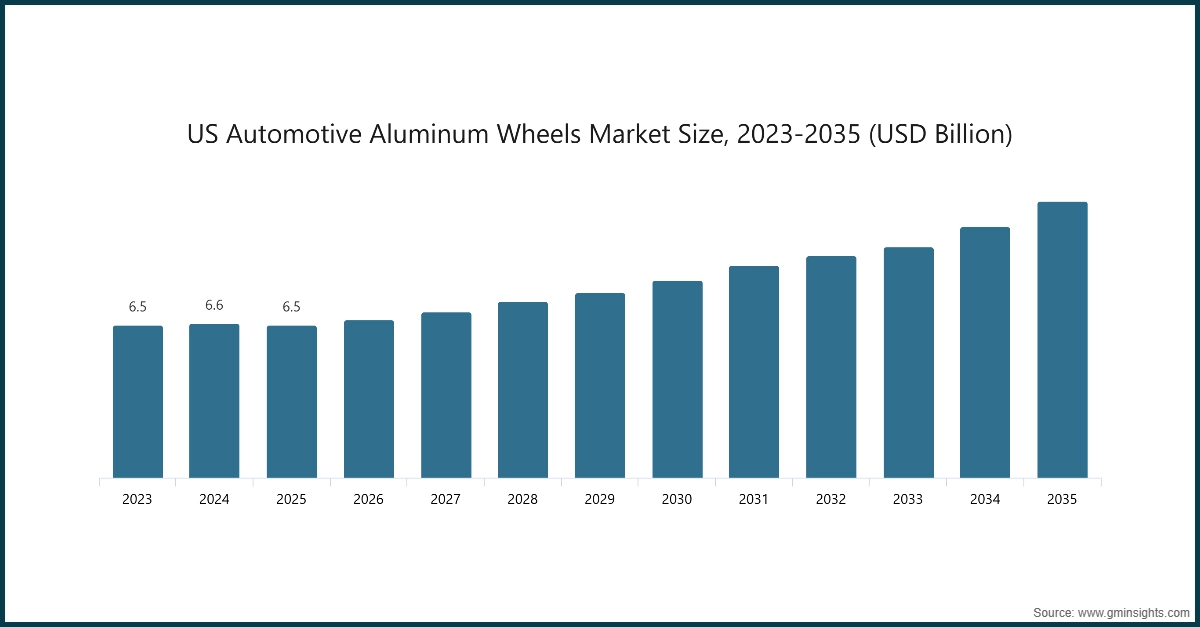
US dominated the North America automotive aluminum wheels market with around 67% share and generated USD 6.5 billion in revenue in 2025.
- The demand of aluminum wheels is greatly stimulated by the high popularity of SUVs, crossovers, and pickup trucks in US. These types of vehicles represent the bulk of new vehicle sales and more of them are now equipped with aluminum wheels as a standard item, especially in the mid and upper end models, which boosts the penetration of aluminum wheels and their overall market value.
- US electric vehicle adoption is rapidly increasing thus resulting in a surge in the need of lightweight aluminum wheel. Automakers are focusing on aluminum wheels as a means to counter battery mass, enhance range, and incorporate aerodynamic soundness, and thus has become a default OEM choice on growing electric passenger vehicles and light truck platforms.
- The huge and aged vehicle market in the US facilitates high aftermarket needs of aluminum wheels. The damage of roads, corrosion and wear continue to result in frequent changes of wheels which consumers usually replace with aluminum wheels to improve appearance, performance and resale value which keeps the replacement volumes steady.
- The consumer spending power in the US is high and thus promotes the premiumization of vehicle parts such as wheels. Buyers are moving to purchase larger-diameter aluminum wheels, which have more sophisticated finishes, and with branded designs, selling prices and revenue growth in both OEM and aftermarket segments are on the rise.
- High supplier ecosystems and presence of large OEM assembly facilities in the US favor local sourcing of aluminum wheels. Closeness to automakers also lowers logistics risks and enables just-in-time production, high-strength, long-term supply agreement with suppliers of aluminum wheels in the domestic market.
- The increasing focus on sustainability and fuel efficiency in the American automotive sector is facilitating the use of aluminum wheels. The benefits associated with recyclability of aluminum, loss of weight, and compatibility with regulatory and ESG requirements are preferred by automakers and consumers, which contributes to the growth of the market in the long run.
Canada automotive aluminum wheels market is projected to exceed USD 760.8 million in 2025, driven by strong preference for passenger cars and compact SUVs equipped with aluminum wheels. Automakers increasingly standardize aluminum wheels across mid-level trims to improve vehicle aesthetics and ride quality, driving higher aluminum wheel penetration in Canada’s mass-market vehicle segment.
- The driving season in Canada is very harsh during winter and hence the demand of wheel replacement is high, and this is an advantage to aluminum wheels that have a better corrosion resistance and durability. Wear on steel wheels is increased by the presence of road salt, snow and freeze-thaw cycles and consumers are upgrading to aluminum wheels which have a higher life span and performance.
- An increasing number of electric and hybrid vehicles are being used in Canada, which is increasing the demand of aluminum wheels. Wheels made of lightweight aluminum are beneficial to expand the driving range in cold climates where batteries have a lower output as a bonus, thus becoming a popular choice among EV manufacturers and consumers who are interested in better energy efficiency.
- The developed culture of aftermarket and tire changing in Canada favors the development of aluminum wheels. Seasonal changes to tire swaps promote the adoption of specific sets of wheels and many consumers are buying aluminum wheels that they use in the summer and winter seasons to expand the total volumes of wheels per vehicle.
- The use of fuel-efficient and low-emission cars is encouraged by the government, which indirectly facilitates the use of aluminum wheels. The automakers are maximuse weight to achieve the regulatory requirements to make more efforts on lightweighting vehicles using aluminum wheels as a cost-effective lightweighting method in passenger vehicles and light trucks.
- The locality of Canada to the US automotive supply chain enhances the demand of aluminum wheel with the integration of cross-border manufacturing. Collaborative vehicle platforms and supplier chains facilitate effective sourcing and distribution of aluminum wheels, which facilitate consistent OEM demand of aluminum wheels in the Canadian assembly and import markets.
The automotive aluminum wheels market in Mexico is projected to grow at a 5.5% CAGR from 2026 to 2035. Mexico’s role as a major automotive manufacturing hub is a key driver of aluminum wheel demand. Expanding production of passenger cars, SUVs, and light trucks for export to the U.S. and Canada increases OEM sourcing of aluminum wheels, particularly under USMCA-compliant supply chains.
- In Mexico, the demand of aluminum wheels is increasing at a high rate due to the rapid inflow of foreign direct investment by the global automakers. The increased use of aluminum wheels as standard fitments in new and new and larger assembly facilities to satisfy North American efficiency and styling concerns are supporting their continuing growth in volume.
- Mexico is a suitable site to make aluminum wheels because of cost-competitive manufacturing and labor benefits. Equipment Suppliers are increasing local casting and finishing capacity to meet the nearby OEM plants, which enhances cost-effective logistics and allows just in time delivery to support the status of Mexico as the fastest-growing regional market.
- The increasing manufacturing of electric and hybrid cars in Mexico is increasing the use of aluminum wheels. The automakers depend on the use of lightweight aluminum wheels to balance battery weight and efficiency, and the percentage of aluminum wheels per vehicle in export-focused EV platforms is higher.
- High demand of aluminum wheels in the U.S. automotive market is facilitated by the strategic geographical location of Mexico to the region. Reduced transportation costs and shorter supply chains will be an incentive to OEMs to buy aluminum wheels in Mexico plants to enhance volumes of localized production and the trade flows in the region.
- The localization of the production of aluminum wheels in Mexico is being stimulated by favorable trade policies and USMCA rules of origin. Regulatory mandates encourage automobile manufacturers to outsource more regionally, which has led to investments in aluminum wheel factories and solidified the growth trend in Mexico in North America.
North America Automotive Aluminum Wheels Market Share
- The top 7 companies in the North America automotive aluminum wheels industry are CITIC Dicastal, Superior Industries International, Wanfeng, Ronal, Prime Wheel, Maxion Wheels, and Central Motor Wheel of America, together contributing around 74% of the market in 2025.
- CITIC Dicastal is able to leverage its scale in competition by producing aluminum wheels in large volumes with the aid of advanced casting technology. Its orientation on lightweight designs and robust OEM relationships allows it to engage in massive passenger car and SUV development in North America. Automation, process control, and quality system investments improve delivery reliability and strengthen the attraction to the key automakers.
- Superior industries international continues to be a strong player in the market with strong level of integration with North American OEM programs and localization in the manufacture of products within the US and Mexico. The company focuses on lightweight wheel-based platforms and scalability in production to meet the demand of SUVs, trucks, and EVs. Effective responsiveness and sustainability measures in supply chains are useful in obtaining long-term contracts with OEM.
- Wanfeng competes on the strength of its international production presence and cost leadership in both OEM and aftermarket business. Diverse casting and machining operations by the company can assist the company to handle a diverse array of wheel sizes and specifications. Continued growth in alliances with North American car manufacturers and emphasis on the efficiency of operations reinforces its multi-platform competitiveness.
- Ronal keeps competitive by precision engineering and effective flow-forming technologies that provide light weight high strength aluminum wheels. There is a high focus on design, performance and quality, which appeals to both high and low-end OEM consumers. Co-sponsorship with automobile manufacturers and sustainability-oriented production further improves the market positioning of Ronal.
- Prime Wheel is an aftermarket leadership and agile customization company, providing an extensive list of performance-based, aesthetically appealing aluminum wheels. Being closely associated with distributors allows quick reaction to shifting consumer trends. Its aftermarket competitiveness is maintained by competitive pricing, short design cycles and strong brand presence in the niche market.
- Maxion Wheels improves its standing by providing a wide range of products in passenger vehicles, light trucks, and commercial trucks. Using the global R and D and manufacturing capability, the company provides durable low-cost aluminum wheels to meet the needs of North American OEM. Long-term growth is backed by strategic alliances, quality focus, and supply chain resilience.
- Central Motor Wheel of America remains competitive by focusing on aluminum wheel manufacturing supported by technical knowledge and additional services. Its emphasis on specific solutions, local support, and teamwork with engineers strengthens relationships with OEMs and regional manufacturers. This helps maintain a strong position in the North American market.
North America Automotive Aluminum Wheels Market Companies
Major players operating in the North America automotive aluminum wheels industry are:
- Alcoa Wheels
- Central Motor Wheel of America
- CITIC Dicastal
- Hands
- Lizhong
- Maxion Wheels
- Prime Wheel
- Ronal
- Superior Industries International
- Wanfeng
- The North America automotive aluminum wheels market is very competitive, with both global and regional players working hard to balance cost, quality, and innovation. Major OEM suppliers like CITIC Dicastal, Superior Industries International, Wanfeng, and Ronal focus on lightweight designs, improved casting and flow-forming technologies, and local manufacturing to serve passenger cars, SUVs, trucks, and EV programs. These companies secure long-term OEM contracts by providing scalable production, reliable supply chains, and meeting sustainability and efficiency standards. This strengthens their positions in the market.
- In the aftermarket segment, companies such as Prime Wheel, Maxion Wheels, Central Motor Wheel of America, and TSW Alloy Wheels compete by offering customization, quick design cycles, and extensive distributor networks. They emphasize performance-oriented, stylish, and application-specific aluminum wheels to meet consumer demand for aesthetic upgrades and replacements. Continuous investment in research and development, design innovation, and local manufacturing helps both OEM and aftermarket suppliers stay competitive as EV adoption rises and consumer preferences and regulatory pressures change in North America.
North America Automotive Aluminum Wheels Market Report Attributes
| Key Takeaway | Details |
|---|---|
| Market Size & Growth | |
| Base Year | 2025 |
| Market Size in 2025 | USD 9.6 Billion |
| Market Size in 2026 | USD 9.9 Billion |
| Forecast Period 2026-2035 CAGR | 6.2% |
| Market Size in 2035 | USD 17 Billion |
| Key Market Trends | |
| Drivers | Impact |
| Electrification-driven lightweighting | Rapid EV penetration increases demand for aluminum wheels to offset battery weight, improve range, and enhance energy efficiency, driving higher OEM aluminum wheel fitment rates. |
| Rising SUV and pickup truck sales | Growing dominance of SUVs and light trucks increases adoption of larger-diameter aluminum wheels, raising per-vehicle wheel value and total market revenue. |
| Premiumization across mass-market vehicles | Aluminum wheels are increasingly standard across mid-range trims, expanding penetration beyond luxury vehicles and strengthening volume growth. |
| Growth of aftermarket customization | Strong vehicle parc and personalization culture in North America drive replacement demand for alloy wheels, supported by e-commerce and specialty retailers. |
| Advanced manufacturing technologies | Adoption of flow forming and low-pressure casting improves strength-to-weight ratios, enabling cost-efficient production of high-performance aluminum wheels. |
| Pitfalls & Challenges | Impact |
| Volatility in aluminum prices | Fluctuating raw material prices impact manufacturing costs and supplier margins, particularly for OEM long-term contracts. |
| Competition from steel and composite wheels | Cost-sensitive segments continue to favor steel wheels, while emerging composite technologies pose long-term substitution risk. |
| Opportunities: | Impact |
| EV platform expansion | New EV launches across passenger cars and light trucks create sustained OEM demand for lightweight aluminum wheels. |
| Growth in Mexico-based manufacturing | Expansion of export-oriented vehicle production in Mexico supports localized aluminum wheel sourcing under USMCA. |
| Aftermarket premium wheel demand | Increasing demand for larger, styled, and performance-oriented wheels boosts aftermarket revenue and margins. |
| Sustainable and recycled aluminum adoption | Use of low-carbon and recycled aluminum enhances ESG positioning and improves supplier competitiveness with global OEMs. |
| Market Leaders (2025) | |
| Market Leader |
23% market share |
| Top Players |
Collective Market Share in 2025 is 70% |
| Competitive Edge |
|
| Regional Insights | |
| Largest Market | US |
| Fastest growing market | Mexico |
| Emerging countries | Canada |
| Future outlook |
|
What are the growth opportunities in this market?
North America Automotive Aluminum Wheels Industry News
- In January 2026, American Tire Distributors (ATD) launched Edge Wheels, a new wheel brand. The brand offers various sizes, styles, and finishes for cars and light trucks. This launch gives customers more choices for aftermarket wheels. Edge joins ATD’s existing wheel lineup, which includes TIS, Gear Offroad, and Motiv Wheels.
- In December 2025, Fastco announced it acquired ENVY, further expanding its range of innovative wheel solutions designed for Canadian roads and conditions. This acquisition strengthens Fastco’s role as a progressive Canadian manufacturer, blending similar design approaches with engineering expertise and a shared goal of providing great value to dealers and customers across North America.
- In July 2025, Fastco revealed plans for a new distribution center in Ontario. This expansion supports the company’s growth and focuses on improving service for its retail partners in Ontario. The new facility, covering 13,849 sq. ft., aims to improve logistics and delivery efficiency throughout the province. By expanding in Ontario, Fastco hopes to increase product availability and reduce lead times for customers in the region.
- In June 2023, Citic Dicastal opened its first plant in Mexico. The plant, located in Santa, involves a significant investment of 100 million dollars in its initial phase and is set to create over 1,200 direct and indirect jobs. With this plant, the company, which produces aluminum wheels for well-known brands like Mercedes-Benz, BMW, Audi, Volkswagen, Toyota, Honda, General Motors, Ford, and Chrysler, aims to strengthen its presence in the Latin American market and boost its supply capabilities for customers in the area.
The North America automotive aluminum wheelss market research report includes in-depth coverage of the industry with estimates & forecasts in terms of revenue ($Bn), volume (units) from 2022 to 2035, for the following segments:
Market, By Product
- Aluminum cast wheels
- Aluminum forged wheels
- Flow-formed aluminum wheels
Market, By Sales Channel
- OEM
- Aftermarket
Market, By Vehicle
- Passenger car
- Hatchback
- Sedan
- SUV
- Commercial vehicle
- Light duty
- Medium duty
- Heavy duty
- Off-road vehicle
Market, By Rim Size
- 13–15 inches
- 16–18 inches
- More than 18 inches
The above information is provided for the following regions and countries:
- US
- Northeast
- Maine
- Massachusetts
- New Jersey
- New York
- Pennsylvania
- Midwest
- Illinois
- Indiana
- Michigan
- Ohio
- Wisconsin
- Iowa
- Kansas
- Minnesota
- Missouri
- Nebraska
- North Dakota
- South Dakota
- South
- Florida
- Georgia
- North Carolina
- South Carolina
- Virginia
- West Virginia
- Alabama
- Kentucky
- Mississippi
- Tennessee
- Arkansas
- Louisiana
- Oklahoma
- Texas
- West
- Arizona
- Colorado
- Idaho
- Montana
- Nevada
- New Mexico
- Utah
- Wyoming
- Alaska
- California
- Oregon
- Washington
- Northeast
- Canada
- Ontario
- Quebec
- British Colombia
- Alberta
- Manitoba
- Saskatchewan
- Nova Scotia
- New Brunswick
- Newfoundland and Labrador
- Prince Edward Island
- Mexico
Frequently Asked Question(FAQ) :
What was the market size of the North America automotive aluminum wheels in 2025?
The market size was USD 9.6 billion in 2025, with a CAGR of 6.2% expected through 2035. The growing adoption of electric vehicles and the demand for lightweight components are driving market growth.
What is the projected value of the North America automotive aluminum wheels market by 2035?
The market is poised to reach USD 17 billion by 2035, driven by advancements in manufacturing technologies, increasing EV penetration, and regulatory compliance requirements.
What is the expected size of the North America automotive aluminum wheels industry in 2026?
The market size is projected to reach USD 9.9 billion in 2026.
What was the market share of the aluminum cast wheels segment in 2025?
The aluminum cast wheels segment accounted for approximately 64% of the market share in 2025 and is expected to grow at a CAGR of over 5.5% through 2035.
What was the market share of the passenger car segment in 2025?
The passenger car segment dominated the market with a 59% share in 2025 and is set to expand at a CAGR of over 6% till 2035.
Which country led the North America automotive aluminum wheels market in 2025?
The United States led the market with a 67% share, generating USD 6.5 billion in revenue in 2025. The high demand for SUVs, crossovers, and pickup trucks equipped with aluminum wheels contributed to this dominance.
What are the key trends driving the North America automotive aluminum wheels market?
Key trends include rising use of recycled aluminum, advances in flow forming and rotary forging, growing demand for larger and more aesthetic wheel designs, and replacement demand driven by aging vehicle fleets.
Who are the major players in the North America automotive aluminum wheels industry?
Key players include Alcoa Wheels, Central Motor Wheel of America, CITIC Dicastal, Hands, Lizhong, Maxion Wheels, Prime Wheel, Ronal, Superior Industries International, and Wanfeng.
North America Automotive Aluminum Wheels Market Scope
Related Reports