Summary
Table of Content

North America Automated Breast Ultrasound Systems Market
Get a free sample of this report
Form submitted successfully!
Error submitting form. Please try again.
Thank you!
Your inquiry has been received. Our team will reach out to you with the required details via email. To ensure that you don't miss their response, kindly remember to check your spam folder as well!
Request Sectional Data
Thank you!
Your inquiry has been received. Our team will reach out to you with the required details via email. To ensure that you don't miss their response, kindly remember to check your spam folder as well!
Form submitted successfully!
Error submitting form. Please try again.
North America Automated Breast Ultrasound Systems Market Size
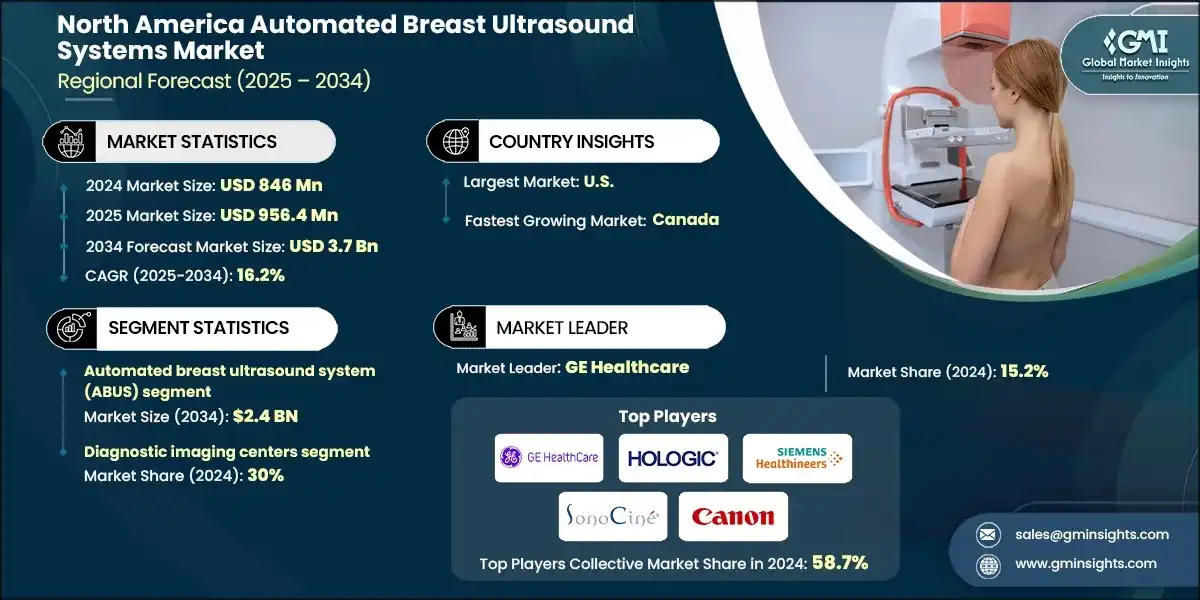
The North America automated breast ultrasound systems market was valued at USD 846 million in 2024 and is projected to grow from USD 956.4 million in 2025 to USD 3.7 billion by 2034, expanding at a CAGR of 16.2%, according to the latest report published by Global Market Insights Inc. The market is experiencing significant growth, driven by several key factors, including the increasing prevalence of breast cancer in North America, rapid technological advancements in ABUS technology, and heightened awareness supported by favorable government initiatives.
To get key market trends
Automated breast ultrasound (ABUS) offers advanced 3D imaging, significantly improving breast cancer detection, especially in women with dense breast tissue. Its growing adoption across hospitals, diagnostic centers, and breast care clinics in North America is due to its ability to enhance lesion visibility and diagnostic accuracy. Key players include GE Healthcare, Siemens Healthineers, Canon, Hologic, and SonoCine. Market innovations focus on automated scanning, consistent image acquisition, and enhanced diagnostic capabilities, aiming to improve patient outcomes and streamline screening workflows.
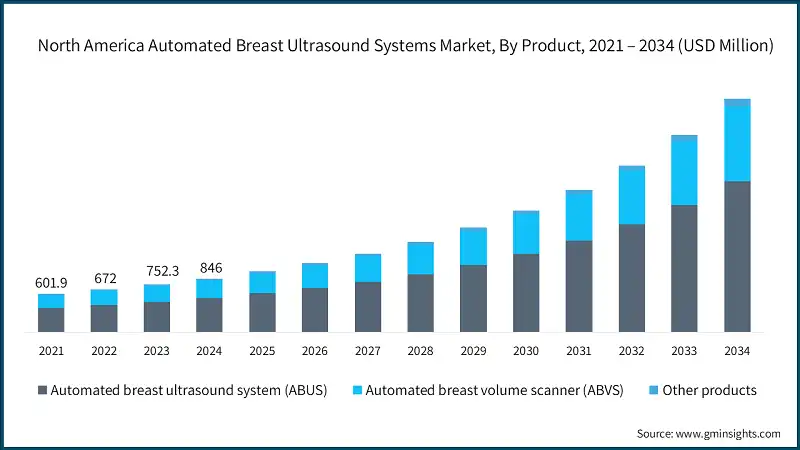
The market grew from USD 601.9 million in 2021 to USD 752.3 million in 2023. The growth of the North American ABUS market is driven by rising breast cancer rates, increased awareness of early detection, and supportive government screening initiatives. Adoption has accelerated due to advances in imaging technology, favorable regulations, and a shift toward personalized diagnostics. ABUS enhances lesion detection, offers operator-independent imaging, boosts diagnostic confidence, and provides a more comfortable, efficient screening experience.
The rising prevalence of breast cancer in North America is a key driver propelling the growth of the market. For instance, according to the National Breast Cancer Foundation, an estimated 316,950 new cases of breast cancer are expected to be diagnosed in the U.S. in 2025, representing approximately 15.5% of all new cancer cases. This underscores breast cancer’s continued status as the most common cancer among women. The increasing incidence is fueling demand for advanced screening technologies such as ABUS, particularly systems integrated with digital and AI capabilities that enhance screening efficiency, accuracy, and workflow optimization.
Further, growing awareness and supportive government initiatives are key factors driving the growth of the market. Prominent public health programs and organizations have played an important role in promoting education, advocacy, and regular screening, especially for women with dense breast tissue, where ABUS provides significant diagnostic advantages through high-resolution 3D imaging. For instance, initiatives such as the CDC’s National Breast and Cervical Cancer Early Detection Program (NBCCEDP), which offers screening services to low-income women, and programs led by the National Cancer Institute have been instrumental in expanding access and encouraging early detection efforts.
ABUS is a specialized breast cancer screening technology for women with dense breast tissue, using a wide, automated transducer to capture standardized 3D images. Unlike handheld ultrasound, it reduces operator dependency and delivers consistent, high-resolution results for improved diagnostic accuracy.
North America Automated Breast Ultrasound Systems Market Report Attributes
| Key Takeaway | Details |
|---|---|
| Market Size & Growth | |
| Base Year | 2024 |
| Market Size in 2024 | USD 846 Million |
| Market Size in 2025 | USD 956.4 Million |
| Forecast Period 2025 - 2034 CAGR | 16.2% |
| Market Size in 2034 | USD 3.7 Billion |
| Key Market Trends | |
| Drivers | Impact |
| Growing prevalence of breast cancer in North America | Drives demand for ABUS as an effective early detection tool, especially for dense breast tissue which is more common in North America. |
| Rising technological advancements in automated breast ultrasound systems | Enhances imaging precision, patient comfort, and diagnostic reliability, leading to wider adoption. |
| Increasing national breast screening programs across the North America | Accelerates the adoption of ABUS by integrating it into large-scale screening initiatives, especially for women with dense breast tissue. |
| Rising awareness and favorable government initiatives regarding breast cancer | Boosts ABUS adoption through public health campaigns and funding support. |
| Pitfalls & Challenges | Impact |
| High cost of the automated breast ultrasound system | Limits adoption in smaller clinics and low-resource settings due to budget constraints. |
| Lack of skilled or trained personnel | Hinders effective implementation and interpretation of ABUS results. |
| Opportunities: | Impact |
| Hinders effective implementation and interpretation of ABUS results. | • Enhances diagnostic accuracy, streamlines workflow, and enables predictive screening strategies. |
| Market Leaders (2024) | |
| Market Leaders |
15.2% market share |
| Top Players |
Collective market share in 2024 is Market Share 58.7% |
| Competitive Edge |
|
| Regional Insights | |
| Largest market | U.S. |
| Fastest growing market | Canada |
| Future outlook |
|
What are the growth opportunities in this market?
North America Automated Breast Ultrasound Systems Market Trends
- Technological advancements in ABUS systems are driving market growth across North America, as healthcare providers increasingly adopt 3D imaging and AI-powered solutions to improve breast cancer detection, especially in women with dense breast tissue. These innovations provide faster scan times, enhanced image quality, and greater diagnostic accuracy, positioning ABUS as a vital complement to mammography.
- 3D ultrasound imaging, a core feature of ABUS, delivers detailed volumetric views that improve the detection of small lesions often missed by traditional methods. For example, GE Healthcare’s Invenia ABUS 2.0, an FDA-approved system, integrates AI-enhanced interpretation and has shown cancer detection rates increase by up to 35.7% when used alongside mammography.
- Similarly, the SonoCine AWBUS system employs robotic scanning to capture high-resolution images of the entire breast, including the axilla. It integrates digital enhancement techniques to improve image clarity and contrast, helping radiologists identify subtle abnormalities more effectively. Its compatibility with existing ultrasound machines also makes it a cost-effective and flexible solution for clinics.
- Thus, the continued evolution of 3D imaging, artificial intelligence, automated acquisition, and digital image enhancement is propelling the ABUS market, offering transformative benefits in breast cancer screening and diagnosis.
North America Automated Breast Ultrasound Systems Market Analysis
Learn more about the key segments shaping this market
Based on the product, the North America automated breast ultrasound systems market is segmented into automated breast ultrasound system (ABUS), automated breast volume scanner (ABVS), and other products. The ABUS segment was valued at USD 538.6 million in 2024 and is projected to reach USD 2.4 billion by 2034, growing at a CAGR of 16.4%. In comparison, the ABVS segment, valued at USD 278.7 million in 2024, is expected to grow to USD 1.2 billion by 2034, at a CAGR of 15.9%.
- The automated breast volume scanner (ABVS) is an advanced imaging technology that provides standardized, high-resolution 3D ultrasound examinations of the entire breast. These scans generate volumetric data that can be reviewed across multiple planes, enhancing diagnostic precision.
- In North America, ABVS plays an important role in expanding the ABUS market by offering a reliable and reproducible alternative to conventional imaging methods. Its ability to deliver consistent results and reduce interpretation variability makes it a preferred choice in clinical settings.
- A notable example is the ACUSON S2000 ABVS by Siemens Healthineers, which combines automated scanning with advanced features such as elastography and multimodality review. This system enables comprehensive breast volume analysis, enhances diagnostic confidence, and streamlines workflows in hospitals and imaging centers.
- Additionally, the integration of technologies such as automated scanning, volumetric imaging, and digital enhancement in ABVS systems is revolutionizing breast cancer diagnosis. These innovations drive greater accuracy, improve efficiency, and enhance clinical workflows, thereby supporting the growth and adoption of ABUS solutions across North America.
Learn more about the key segments shaping this market
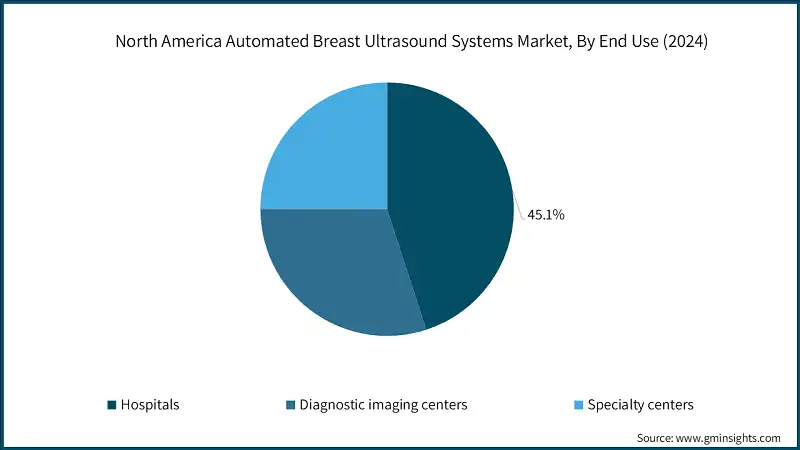
Based on end use, the North America automated breast ultrasound systems market is segmented into hospitals, diagnostic imaging centers, and specialty centers. The diagnostic imaging centers accounted for the market share of 30% in 2024.
- Diagnostic imaging centers are emerging as a rapidly expanding segment within the North American automated breast ultrasound systems (ABUS) market, highlighting their growing role in breast cancer screening and diagnostics.
- These centers are increasingly recognized for their ability to provide specialized imaging services in outpatient settings, contributing to broader access and faster turnaround times.
- The segment’s growth is primarily driven by the proliferation of dedicated breast imaging facilities, which are adopting ABUS systems to enhance their service offerings. The compact design and user-friendly interface of ABUS devices make them particularly suitable for high-throughput environments, enabling efficient and consistent diagnostic workflows.
- Additionally, with a vast network of diagnostic imaging centers and increasing demand for early breast cancer detection. These centers expand access to advanced imaging and play a critical role in extending the reach and impact of ABUS, supporting earlier and more accurate diagnosis.
Looking for region specific data?
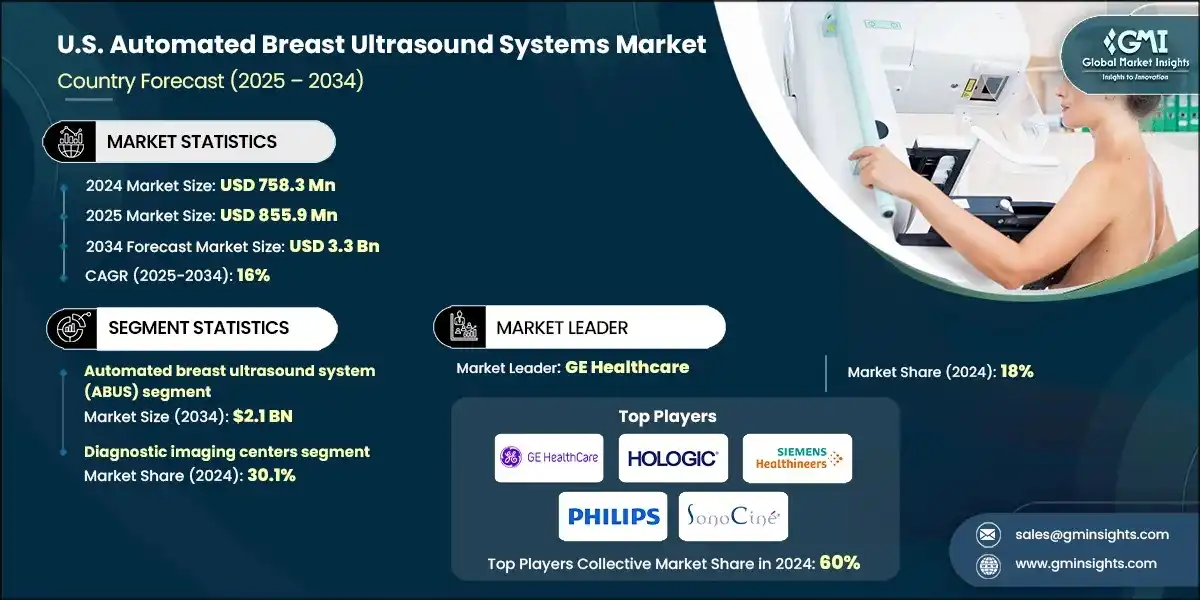
The U.S. automated breast ultrasound systems market was valued at USD 542.2 million and USD 604.3 million in 2021 and 2022, respectively. In 2024, the market size reached USD 758.3 million from USD 675.5 million in 2023.
- The rising prevalence of breast cancer in the U.S. is a key factor driving the market's growth.
- For instance, according to the American Cancer Society, breast cancer is the most frequently diagnosed cancer among women in the U.S., accounting for about 30% (or 1 in 3) of all new female cancer cases each year. By 2025, experts estimate that approximately 316,950 new cases of invasive breast cancer and 59,080 cases of ductal carcinoma in situ (DCIS), a non-invasive form, will be diagnosed.
- Therefore, as the number of breast cancer cases in the country increases, the demand for effective and technologically advanced automated breast ultrasound systems, which is estimated to reach USD 5.3 billion by 2032 for early detection and staging of cancer also rises, thereby accelerating market growth in the country.
Canada automated breast ultrasound systems market accounted for USD 87.6 million in 2024 and is anticipated to show lucrative growth over the forecast period.
- The growth of the market in Canada is primarily driven by the rising incidence of breast cancer and initiatives taken by the government to raise awareness among the population about breast cancer through screening programs and campaigns.
- For instance, according to the Canadian Cancer Society, an estimated 30,500 Canadian women will be diagnosed with breast cancer in 2024, accounting for 25% of all new cancer cases in women. This alarming statistic underscores the urgent need for advanced screening technologies, such as ABUS, to support early diagnosis and reduce disease progression.
- Furthermore, the growth of the market in the country is primarily driven by technological advancements in automated breast ultrasound systems. Innovations such as 3D imaging, high-resolution imaging, and the integration of artificial intelligence in healthcare are enhancing diagnostic efficiency and precision, making imaging more accessible across the country.
North America Automated Breast Ultrasound Systems Market Share
- The top 5 players in this industry include GE Healthcare, Siemens Healthineers, Canon, Hologic, and SonoCine, collectively holding a 58.7% share of the market. These industry leaders strengthen their market positions through FDA-approved technologies, strong clinical partnerships, and extensive product portfolios.
- Siemens Healthineers drives innovation in the ABUS market with systems such as the ACUSON S2000 ABVS. These systems offer high-resolution 3D imaging, elastography, and multimodality review, enhancing diagnostic accuracy, reducing scan times, and improving workflow efficiency. This makes them ideal for high-volume clinical environments and adaptable to both centralized and decentralized care models.
- Manufacturers in the ABUS market are increasingly adopting value-based strategies to penetrate cost-sensitive regions. To address the needs of underserved and semi-urban areas with limited healthcare access, they are introducing compact, mobile ABUS platforms. These platforms feature ergonomic designs, cloud-based data sharing, and AI-powered lesion detection, making them suitable for outpatient clinics and mobile screening units. This approach helps expand the reach of breast cancer diagnostics and supports early detection.
- The ABUS market is also evolving with trends such as AI-integrated imaging, radiomics-enabled platforms, and workflow-enhancing tools. These advancements are driven by the global push for early-stage breast cancer detection, particularly in women with dense breast tissue, and the growing demand for personalized, less invasive screening solutions.
North America Automated Breast Ultrasound Systems Market Companies
Few of the prominent players operating in the North America automated breast ultrasound systems industry include:
- Canon
- CapeRay Medical
- Delphinus Medical Technologies
- GE Healthcare
- Hitachi
- Hologic
- Koninklijke Philips
- Metritrack
- QView Medical
- SonoCine
- Supersonic Imagine
- Siemens Healthineers
- Seno Medical Instruments
- Shantou Institute of Ultrasonic Instruments
- Theraclion
Hologic is a global medical technology company known for its advanced and clinically focused breast imaging solutions. In the field of automated breast ultrasound, Hologic offers the Aixplorer Series, which integrates UltraFast imaging and ShearWaveElastography to provide real-time, non-invasive assessment of tissue stiffness.
Canon leverages its deep expertise in imaging technology to deliver high-performance ultrasound solutions, including ABUS-compatible platforms. Canon ensures robust distribution and service capabilities. Its ABUS-compatible system, the Aplio i-series, integrates advanced beamforming and elastography technologies to support breast lesion characterization and workflow efficiency.
Philips maintains a competitive presence in the North America ABUS market through its diagnostic imaging systems and integrated informatics platforms. The company’s ABUS-compatible solution, the EPIQ Elite Ultrasound System, offers high-resolution imaging and AI-powered breast tissue analysis, tailored for dense breast screening.
North America Automated Breast Ultrasound Systems Industry News:
- In March 2023, MetriTrack announced a distribution partnership with Storage Solutions Technology Group, Inc. (SST Group), granting SST the rights to distribute and support the BVN-2000 breast volume navigator system across all segments of the radiology market in the Midwestern U.S. This strategic collaboration expanded MetriTrack’s market reach, improved product accessibility, and strengthened its presence in breast ultrasound imaging.
The North America automated breast ultrasound systems market research report includes in-depth coverage of the industry with estimates and forecast in terms of revenue in USD Million and from 2021-2034 for the following segments:
Market, By Product
- Automated breast ultrasound system (ABUS)
- Automated breast volume scanner (ABVS)
- Other products
Market, By End Use
- Hospitals
- Diagnostic imaging centers
- Specialty centers
The above information is provided for the following countries:
- U.S.
- Canada
Frequently Asked Question(FAQ) :
Who are the key players in the North America automated breast ultrasound systems market?
Key players include GE Healthcare, Siemens Healthineers, Canon, Hologic, SonoCine, Philips, Delphinus Medical Technologies, CapeRay Medical, Metritrack, QView Medical, Supersonic Imagine, Seno Medical Instruments, Hitachi, Shantou Institute of Ultrasonic Instruments, and Theraclion.
What are the upcoming trends in the North America automated breast ultrasound systems industry?
Key trends include: • Integration of AI for predictive breast cancer screening. • Evolution of 3D imaging and real-time lesion detection. • Expansion of compact and mobile ABUS platforms for outpatient and underserved areas.Regulatory momentum with dense breast notification laws and broader insurance coverage.
Which country leads the North America automated breast ultrasound systems market?
The U.S. led the market with USD 758.3 million in 2024, driven by a high prevalence of breast cancer, robust healthcare infrastructure, and early adoption of advanced screening technologies.
What was the valuation of the diagnostic imaging centers segment?
Diagnostic imaging centers accounted for 30% market share in 2024, supported by growing demand for outpatient screening and specialized breast imaging services.
How much revenue did the automated breast ultrasound system (ABUS) segment generate?
The ABUS segment was valued at USD 538.6 million in 2024 and is projected to reach USD 2.4 billion by 2034, holding the largest share among product categories.
What is the projected size of the automated breast ultrasound systems industry in 2025?
The market is projected to reach USD 956.4 million in 2025.
What is the market size of the North America automated breast ultrasound systems market in 2024?
The market size was USD 846 million in 2024, with a CAGR of 16.2% expected through 2034, driven by rising breast cancer prevalence, technological advancements, and supportive government initiatives.
What is the projected value of the North America automated breast ultrasound systems market by 2034?
The market is expected to reach USD 3.7 billion by 2034, fueled by AI integration, digital imaging advancements, and expanding breast cancer screening programs.
North America Automated Breast Ultrasound Systems Market Scope
Related Reports