Summary
Table of Content

North America & Europe Snow Blowers Market
Get a free sample of this report
Form submitted successfully!
Error submitting form. Please try again.
Thank you!
Your inquiry has been received. Our team will reach out to you with the required details via email. To ensure that you don't miss their response, kindly remember to check your spam folder as well!
Request Sectional Data
Thank you!
Your inquiry has been received. Our team will reach out to you with the required details via email. To ensure that you don't miss their response, kindly remember to check your spam folder as well!
Form submitted successfully!
Error submitting form. Please try again.
North America & Europe Snow Blowers Market Size
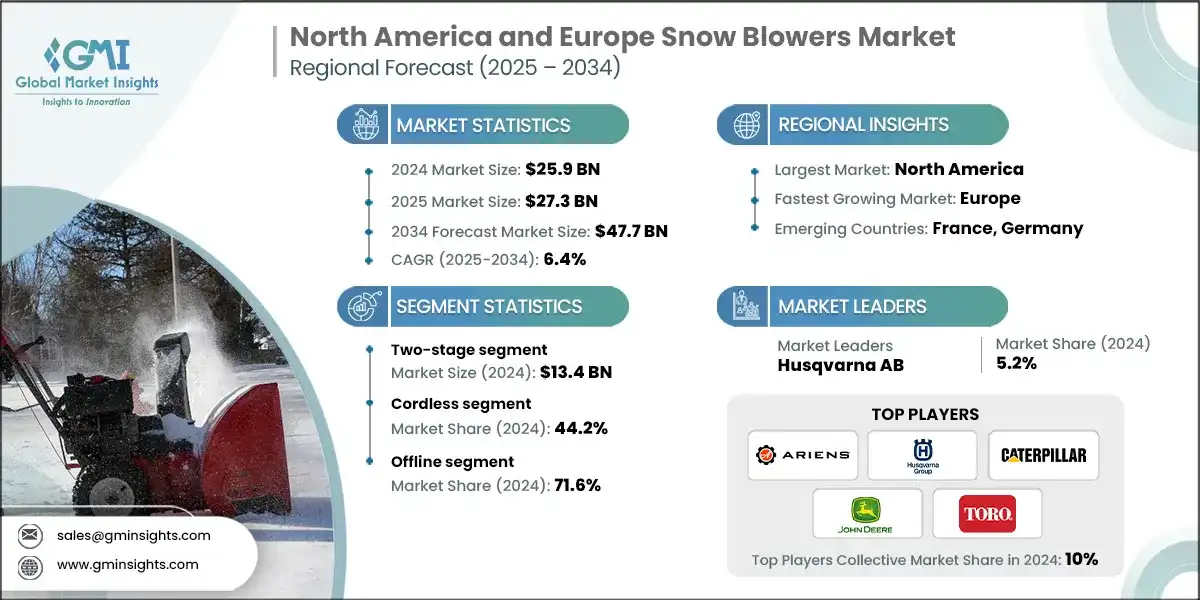
According to a recent study by Global Market Insights Inc., the North America & Europe snow blowers market was estimated at USD 25.9 billion in 2024, and the market is expected to grow from USD 27.3 billion in 2025 to USD 47.7 billion in 2034, at a CAGR of 6.4%.
To get key market trends
- The market for snow blowers is on the rise because of several factors that have heightened demand in residential, commercial, and municipal markets. A key driver is heightened snowfall and uncertain weather patterns.
- Winter storms in places such as North America and Northern Europe are increasingly becoming more frequent and intense. This has triggered demand for efficient snow management machines.
- Homes, businesses, and cities are using snow blowers to ensure safety, keep streets and sidewalks clear, and reduce disruptions. According to the National Oceanic and Atmospheric Administration (NOAA), the United States has seen a 20% increase in record-breaking snowfall occurrences over the past 50 years, thereby directly boosting demand for heavy-duty snow blowers with high capacity to move heavy snow effectively.
- Another important market force is the growing demand from homeowners. Those in snowy places require affordable and efficient snow-clearing tools for homes, driveways, and sidewalks. Rising homeownership rates and disposable incomes in industrialized countries have caused individuals to buy snow blowers.
- Portable and battery-powered units are especially very much in demand as they are convenient for transporting and efficient. Secondly, homeowners like maintaining property more compared to purchasing snow removal.
- This has created consistent demand for the entry-level single-stage models and the high-end two-stage ones, perfect for big estates. Home ownership in the United States was at 65.9% in the year 2023, as shown by the U.S. Census Bureau, and this reflects the rising sales of house snow blowers.
- Another prevailing trend is the shift towards green products, especially in Europe. Greenhouse emissions laws and growing eco-awareness have boosted the need for electric and battery-powered snow blower products.
- They are less polluting, quieter, and more eco-friendly than gas-powered models. Firms would prefer to develop the technology for batteries, reduce the weight of the product, and incorporate smart features to attract city consumers and environmentally aware businesses.
- The European Environment Agency (EEA) reveals that the operation of small engines like gas-powered snow blowers is a primary cause of air pollution and is one of the driving forces behind cleaner alternatives.
- Europe is the pioneer of snow blower markets for the North America & Europe markets about stringent environmental regulations, high disposable incomes, and a strong property maintenance focus.
- These include countries such as Germany, Switzerland, and the Nordic countries, which get frequent heavy snowfall and have lots of suburban houses, so there is always a demand for efficient and environmentally friendly snow blowers. Consumers in Europe are also more inclined towards buying green products, so the continent is even more dominant.
- Eurostat reveals that 75% of households in Europe reside in suburban or rural areas, where property maintenance with snow blowers is routine.
- Two-stage snow blower segment is the largest one in industry. They are driven using an auger and impeller system, which performs better in wet and deep snow removal than a single-stage system. They are adaptable and versatile to use on residential driveways, commercial property, as well as municipal grounds.
- They are therefore the first choice among users who require assured and high-performance equipment. Their high-performance capacity in coping with snow of intensive intensity has positioned the two-stage segment as a leading revenue earner worldwide in the world snow blower market.
North America & Europe Snow Blowers Market Report Attributes
| Key Takeaway | Details |
|---|---|
| Market Size & Growth | |
| Base Year | 2024 |
| Market Size in 2024 | USD 25.9 Billion |
| Market Size in 2025 | USD 27.3 Billion |
| Forecast Period 2025 - 2034 CAGR | 6.4% |
| Market Size in 2034 | USD 47.7 Billion |
| Key Market Trends | |
| Drivers | Impact |
| Rising snowfall & climate uncertainty | The increasing frequency of heavy snowfalls and unpredictable winter storms in North America and Europe is driving higher adoption of snow blowers for both residential and commercial use. |
| Growing residential demand | Homeownership in snowy regions (U.S. Midwest/Northeast, Canada, Northern Europe) fuels consistent sales, especially of single-stage and battery-powered snow blowers for DIY use. |
| Shift toward eco-friendly solutions. | Regulations in Europe and awareness in North America are pushing demand for battery-powered and electric snow blowers over polluting gas models. |
| Pitfalls & Challenges | Impact |
| High equipment cost | Two-stage and three-stage blowers are expensive ($800-$3000+), limiting adoption among price-sensitive residential users. |
| Maintenance & operational complexity | Gas-powered blowers require fuel, oil, and regular servicing, which discourages casual or first-time buyers. |
| Opportunities: | Impact |
| Battery-powered & Green Models | Increasing demand for cordless, quiet, and eco-friendly snow blowers creates strong opportunities for innovation and premium pricing. |
| Commercial & municipal contracts | Partnerships with governments, airports, and large facility operators present lucrative opportunities for heavy-duty three-stage blowers. |
| Market Leaders (2024) | |
| Market Leaders |
5.2% Market share |
| Top Players |
Collective market share in 2024 is 10% |
| Competitive Edge |
|
| Regional Insights | |
| Largest Market | North America |
| Fastest growing market | Europe |
| Emerging countries | France, Germany |
| Future outlook |
|
What are the growth opportunities in this market?
North America & Europe Snow Blowers Market Trends
- Battery and cordless snow blowers are increasingly used in Europe and North America. Consumers prefer eco-friendly, low-maintenance products to gas equipment. Owing to the emergence of lithium-ion batteries, longer durations of operation and quick charging facilities now offer greater convenience with electric models for household use.
- This is fueled by growing sensitivity to the environment and strict emissions regulations in these economies. The European Union is planning to reduce at least 55% of its greenhouse gases by 2030 under its "Fit for 55" plan, which will promote the use of cleaner technology.
- The sector is designing light-weight models with provisions such as LED lights and reversible chutes to meet the requirements of the customers. In North America, the market for snow blower batteries will be $782 million in 2025 with a 10% compound annual growth rate between 2025 and 2033.
- Even here, firms are being pushed by the need for environmentally friendly snow-clearing machines to design more efficient and sustainable products.
- Smart technology is increasingly becoming a standard component on snow blowers in North America and Europe. They want things that can be hooked up easily and automated. Remote start, app management, and GPS tracking are features being installed on snow blowers to enhance their usability.
- These also fit into the emerging trend of smart home appliances. Companies are attempting to manufacture snow blowers with wireless control functionalities, which are attractive to tech-savvy consumers.
- The trend will continue as the demand for smart outdoor equipment increases among consumers. Wireless power snow blower consumption in North America will grow to $250 million by 2025 with a 15% CAGR during 2025-2033. European players are introducing Bluetooth and mobile app-based control functionalities to enhance the user experience.
- As stated by the U.S. Department of Energy, smart technology in appliances can cut usage up to 30%, making it worth adopting this technology in snow blowers.
- Two-stage snow blowers are the best option in North America and Europe because they can handle heavy, wet snow. The models incorporate the use of an auger to scoop and an impeller to blast the snow and are therefore effective and efficient at clearing heavy snow. They are simple to operate and can be employed both commercially and in homes.
- Their efficiency in clearing tenacious snow without clogging makes them particularly so. With unpredictable winters, the need for dependable snow-clearing equipment like two-stage blowers is on the rise. In North America, the two-stage snow blower market was valued at $12.76 billion in 2023 and is expected to reach $20.20 billion by 2032.
- In Europe, the same market is increasing steadily, with gas and electric versions driving the market. In Europe, it has been revealed by the European Environment Agency that, increasingly often, there are extreme weather conditions like intense snowfalls, which are driving the demand for heavy-duty snow-clearing equipment.
North America & Europe Snow Blowers Market Analysis
Learn more about the key segments shaping this market
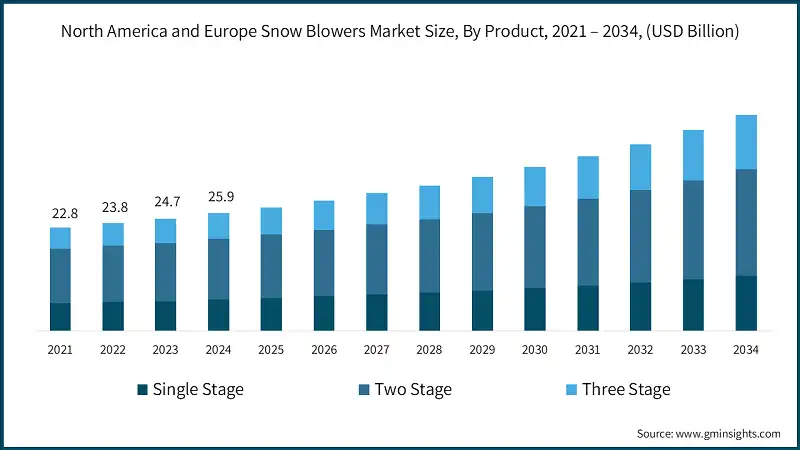
Based on product, the snow blowers market is segmented into single-stage, two-stage, three stage. The two-stage segment accounted for revenue of around USD 13.4 billion in 2024 and is estimated to grow at a CAGR of around 5.8% from 2025 to 2034.
- Single-stage snow blowers are lighter in weight and more maneuverable. They handle light snowfalls of 8 inches or less and small pavement well. These units range from $200 to $700 and are within reach of the residential customer who experiences moderate snowfall. Three-stage blowers, incorporating an accelerator, tend to shoot snow more quickly and farther than two-stage ones.
- They can deal with heavy snowfall and larger lots but are not very mobile. Their relatively high cost, ranging from $1,200 to more than $3,500, restricts them to commercial users and heavy snowplow operators.
- The demand for snow blowers comes from the reality that about 70% of United States citizens reside in areas that receive snowfall, based on the U.S. Census Bureau. Their cost reflects their application. Single-stage units are utilized in low-end home use, two-stage units in mid- to high-end home and light business use, and three-stage blowers for commercial use.
- The most prevalent in North American and European usage are two-stage snow blowers, particularly in regions of frequent heavy snowfall. They are easy to use, versatile, and inexpensive, and therefore the favorite among the majority of users.
Learn more about the key segments shaping this market
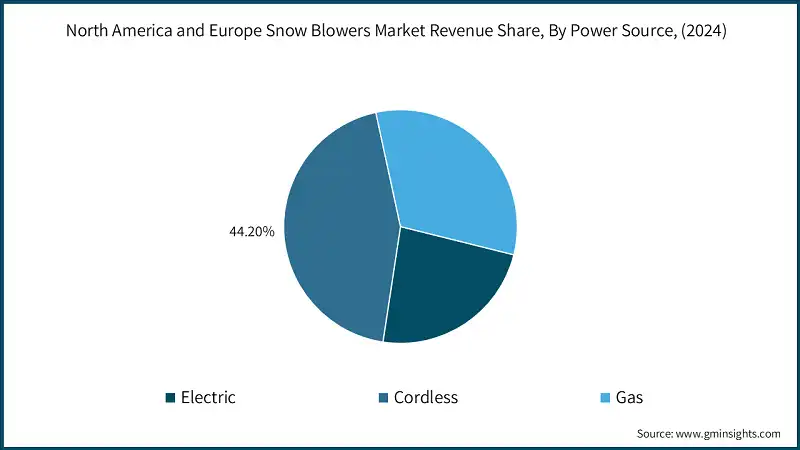
Based on the power source, the North America & Europe snow blowers’ market is categorized into electric, cordless, and gas. The cordless segment held around 44.2% of the total market share in 2024 and is anticipated to grow at a CAGR of 5.6% from 2025 to 2034.
- The battery-powered or cordless snow blower industry is driving market growth due to shifting customer behavior, stringent environmental regulations, and technological advancements. The reason that they do not emit gases while in use differentiates cordless snow blowers from gas-run versions.
- This aspect is greatly favorable in Europe and North America, where the government has stringent environmental regulations. For instance, the European Union has agreed to cut its greenhouse gas emissions by 55% by 2030, according to the European Green Deal.
- Likewise, the United States Environmental Protection Agency (EPA) has established rules to restrict small engine emissions, which are inducing the adoption of clean technologies. All these are fueling demand among homeowners, cities, and businesses for environmentally friendly equipment without sacrificing performance.
- Technological advancements have also sped up the use of cordless snow blowers. Advances in lithium-ion battery technology have made batteries longer, faster-charging, and stable power output.
- These innovations enable cordless snow blowers to manage medium snow depths efficiently. Improved versions currently have app control, LED lighting, and automatic power mode, thus being easier and more efficient to use.
- Government tax breaks to promote green technology and a transition towards ecologically responsible consumerism are also fueling such growth. For example, the U.S. government provides tax credits for energy-efficient appliances for homes under the Energy Policy Act.
- Consumers even pay a premium for cordless varieties since they are more environmentally friendly, cheaper to run, and more convenient to operate. These factors render cordless snow blowers the quickest-growing category in the market, attracting residential and light commercial customers and fueling technology development in snow throwers.
Based on the distribution channel, the North America & Europe snow blowers market is categorized as offline and online. The offline segment held around 71.6% of the total market share in 2024.
- The offline channel dominates the market of snow blowers because of people's shopping nature, the product itself, and the nature of the purchase. Snow blowers are costly, heavy, and often technical machines. Most of the customers would prefer to touch, feel, and experience the product before buying it.
- In brick-and-mortar stores, customers can try out the size, weight, quality of construction, ease of use, and power features, all of which are necessary for a unit that must function flawlessly in harsh winter conditions.
- This is not so easy to do in an online setting, so brick-and-mortar stores are perfect for first-time buyers or buyers of high-end two- or three-stage units.
- Offline stores offer technical guidance and post-sales assistance, critical for snow blowers. Store personnel assist buyers in selecting the appropriate model according to driveway size, land type, intensity of snowfall, and individual needs.
- Demonstrations of products, seasonal offers, and bundles of accessories such as replacement components, snow blades, or safety equipment are offered in the majority of stores, enhancing customer satisfaction.
- Logistics and installation requirements also contribute to offline shopping popularity. Snow blowers are not only heavy but also cumbersome, thereby avoiding shipping issues and delays via in-store purchase.
- Even stores provide delivery, installation, and maintenance services. This is particularly convenient in snow-belt regions, where the timely availability of equipment is an important consideration
Looking for region specific data?
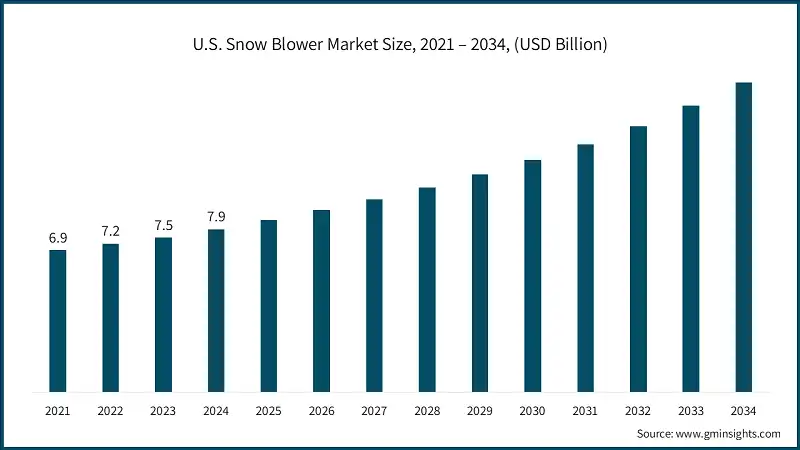
U.S. dominated the snow blowers market with around 74.9% share and generating around USD 7.9 billion in 2024.
- The U.S. dominates the North American snow blower industry because the nation's economy, climate, and infrastructure support it. The Northeast, Midwest, and states within the Great Lakes receive the most snow annually, and hence, a consistent demand for snow-moving machinery. American homes trend toward being larger with larger yards and driveways and thus needing more heavy-duty equipment than their European counterparts.
- The National Oceanic and Atmospheric Administration (NOAA) indicates that the U.S. Northeast receives an average of 40-60 inches of snow annually, with some areas exceeding 100 inches. High consumer income levels also support the purchase of advanced two-stage and cordless snow blowers, which save time and effort.
- Large retailers like Home Depot and Lowe’s, along with regional dealers, make these machines widely available. Furthermore, American consumers are looking for newer technology such as stand-alone units, intelligent controls, and environmentally friendly battery-powered units to boost market expansion.
- This mix of frequent snowfall occurrences, larger properties, and advanced technology demands positions the United States in the lead among North American snow blower markets.
The European Snow blower market in the Baltic is expected to experience significant and promising growth from 2025 to 2034.
- Their long and cold winters position the Baltic states of Estonia, Latvia, and Lithuania in the leading position of the market in Europe. These nations experience ample snowfall throughout multiple months; snow blowers are therefore unavoidable.
- Research from the European Environment Agency (EEA) indicates that the Baltic nations get approximately 50-70 inches of snow annually, which is much higher than in Europe. In comparison to Western or Southern Europe, where snow occurs less often, the Baltics are heavily dependent on snow removal machines at both residential and municipal levels.
- Governments within the region have also invested in developing infrastructure and winter mobility, raising demand for snow blowers. Even though geographically smaller than Western Europeans, the Baltics' dependency on snow blower equipment translates to a higher rate of market penetration.
- Two-stage and cordless snow blowers, that work extremely well under heavy use, are extremely well-liked within the area, thus the Baltics are Europe's top-ranked adoption subregion for snow blowers.
North America & Europe Snow Blowers Market Share
Husqvarna AB is leading with a 5.2% market share. Ariens Company, Husqvarna AB, Caterpillar, John Deere, and The Toro Company collectively hold 10%, indicating fragmented market concentration.
- The snow blower market is very fragmented, with no major companies having any level of dominance, although some of the biggest and most established manufacturers have developed leadership positions through brand strength, technological superiority, and penetration within local markets.
- Husqvarna AB, with 5.2%, is dominating mainly due to having a well-established brand name in outdoor power equipment and the fact that it can provide a wide range of products, ranging from single-stage, two-stage to battery-operated models.
- Husqvarna has utilized its Scandinavian heritage to establish itself as a durability and cold-climate reliability industry leader and has also invested heavily in green battery-powered technology as an innovator with Europe's focus on sustainability.
- Its vision is based on innovation, premium positioning, and geographic diversification with robust distribution networks in North America and Europe.
- Ariens Company, an American specialist, is equally a leader and is simply known as the "King of Snow" in North America. Its leadership is accessed through a heritage strategy, where it has gained credibility on the durability of snow blowers for decades.
- Ariens markets customer-oriented design, with two-stage and professional high-capacity machines serving large U.S. homes with big properties and municipalities. Its business strategy is based on having a Made in the USA reputation, emphasizing loyalty in its domestic market, and using dealer channels for effective after-sales service.
North America & Europe Snow Blowers Market Companies
Major players operating in the snow blowers industry are:
- Aebi
- Ariens
- Boschung
- Briggs and Stratton
- Caterpillar
- Honda
- Husqvarna
- John Deere
- Kubota
- MTD Holdings
- Overaasen
- RPM Tech
- Stiga
- The Toro Company
- Zhejiang Dobest Power Tools
- The international snow blower market is comprised of a combination of businesses serving residential and commercial needs. Aebi, Boschung, Overaasen, RPM Tech, Caterpillar, John Deere, and Kubota deal mainly with professional-level and municipal snow elimination solutions, such as heavy-duty airport blowers, tractor units, and truck-mounted machines for heavy-duty use.
- They serve airports, highways, and municipalities and focus on power, strength, and efficiency. Conversely, Ariens, Briggs & Stratton, Honda, Husqvarna, MTD Holdings, Stiga, Toro, and Zhejiang Dobest Power Tools focus on the homeowner and light commercial sector.
- Husqvarna and Stiga, well rooted in Scandinavian and European markets, focus on cordless and green models according to green modes. Briggs & Stratton uses its engine technology to produce under other consumer brands dependable snow blowers while MTD Holdings offers a broad range of beginners to expert three-stage models in Cub Cadet and Troy-Bilt.
- Zhejiang Dobest Power Tools competes in the low-end sector with electric as well as compact snow blowers, hence making them available in developing countries. Together, these corporations constitute a pattern of fragmentation in which the global brands are pitted against local specialists through diversification based on product types from home appliances to industrial airport equipment.
North America & Europe Snow Blowers Industry News
- In July 2025, Milwaukee unveiled the M18 FUEL™ 21” Auger Propelled Dual Battery Single Stage Snow Blower, setting a new benchmark in battery-powered outdoor equipment. This latest offering stands out as the most potent single-stage snow blower, allowing professionals to expedite their tasks, all while ensuring a quieter operation and enhanced visibility in challenging winter scenarios.
- In October 2023, Kress introduced a 24-inch, 2-stage self-propelled snow blower to its product range. It runs on Kress's 60V Max batteries and can clear up to eight inches of snow from a 21-car driveway on a single charge using two 5Ah batteries. The snow blower can throw snow up to 52 feet, making it a practical choice for homeowners. It offers a quieter and cleaner alternative to gas-powered equipment.
- In March 2023, John Deere acquired SparkAI Inc. (Spark AI) and Smart Apply, Inc. (Smart Apply) to accelerate the integration of smart technology innovation in its products.
The North America & Europe snow blowers market research report includes in-depth coverage of the industry with estimates & forecasts in terms of revenue ($ Bn) and volume (Thousand Units) from 2021 to 2034, for the following segments:
Market, By Product
- Single stage
- Two-stage
- Three stages
Market, By Power Source
- Electric
- Cordless
- Gas
Market, By End Use
- Residential
- Commercial
- Municipal/public sector
Market, By Distribution Channel
- Online
- Offline
The above information is provided for the following regions:
- North America
- U.S.
- Canada
- Europe
- UK
- Germany
- France
- Italy
- Baltic
- Russia
- Ukraine
- Iceland
Frequently Asked Question(FAQ) :
What are the upcoming trends in the snow blowers market?
Key trends include adoption of battery-powered models, smart technology integration with app control and GPS tracking, and increasing focus on lightweight designs with LED lights and reversible chutes.
Who are the key players in the snow blowers market?
Key players include Husqvarna AB, Ariens Company, Caterpillar, John Deere, The Toro Company, Honda, MTD Holdings, Stiga, Briggs and Stratton, Kubota, Aebi, Boschung, Overaasen, RPM Tech, and Zhejiang Dobest Power Tools.
What is the growth outlook for cordless snow blowers from 2025 to 2034?
Cordless solutions are projected to grow at a 5.6% CAGR till 2034, due to eco-friendly features, government incentives, and improved battery technology.
Which region leads the North America & Europe snow blowers market?
North America held the largest share with the U.S. dominating at 74.9% and generating USD 7.9 billion in 2024. Heavy snowfall regions and larger properties fuel the region's dominance.
What was the market share of the cordless power source segment in 2024?
Cordless snow blowers held 44.2% market share in 2024, driven by environmental regulations and technological advancements in lithium-ion battery technology.
What is the current North America & Europe snow blowers market size in 2025?
The market size is projected to reach USD 27.3 billion in 2025.
How much revenue did the two-stage snow blower segment generate in 2024?
Two-stage snow blowers generated USD 13.4 billion in 2024, leading the market as the largest segment with superior performance in wet and deep snow removal.
What is the projected value of the North America & Europe snow blowers market by 2034? The
snow blowers market is expected to reach USD 47.7 billion by 2034, propelled by increasing snowfall patterns, residential demand, and shift toward eco-friendly solutions.
What is the market size of the North America & Europe snow blowers in 2024?
The market size was USD 25.9 billion in 2024, with a CAGR of 6.4% expected through 2034 driven by rising demand across residential, commercial, and municipal sectors.
North America & Europe Snow Blowers Market Scope
Related Reports