Summary
Table of Content

North America Acoustic Panel Market
Get a free sample of this report
Form submitted successfully!
Error submitting form. Please try again.
Thank you!
Your inquiry has been received. Our team will reach out to you with the required details via email. To ensure that you don't miss their response, kindly remember to check your spam folder as well!
Request Sectional Data
Thank you!
Your inquiry has been received. Our team will reach out to you with the required details via email. To ensure that you don't miss their response, kindly remember to check your spam folder as well!
Form submitted successfully!
Error submitting form. Please try again.
North America Acoustic Panel Market Size
As workplaces, educational facilities, healthcare facilities and cities continue to densify and become more active, and as we continue to recognize how ambient noise is impacting our productivity, comfort and wellness, many organizations now recognize that excessive ambient noise contributes to fatigue and increases stress levels, as well as interferes with cognitive function, therefore, they are now incorporating noise control strategies into their design. The increased awareness around the relationship between noise and mental health has prompted an increased societal focus on supporting the mental well-being of all citizens. Creating noiseless & equally acoustic environment now represents an essential part in creating quality spaces, not only luxury spaces.
North America Acoustic Panel Market Key Takeaways
Market Size & Growth
- 2025 Market Size: USD 2.6 Billion
- 2026 Market Size: USD 2.7 Billion
- 2035 Forecast Market Size: USD 4.6 Billion
- CAGR (2026–2035): 6.2%
Regional Dominance
- Largest Market: U.S.
- Fastest Growing Country: U.S.
Key Market Drivers
- Rising awareness of noise control.
- Growth in commercial construction & renovation.
- Rising adoption of home theaters & remote workspaces.
Challenges
- High product & installation costs.
- Competition from low cost substitutes.
Opportunity
- Sustainable & eco‑friendly acoustic solutions.
- Customizable & aesthetic‑driven panel designs.
Key Players
- Market Leader: Armstrong World Industries led with over 11% market share in 2025.
- Leading Players: Top 5 players in this market include Armstrong World Industries, USG, Owens Corning, Rockfon, Auralex Acoustics, which collectively held a market share of 30% in 2025.
Get Market Insights & Growth Opportunities
Additionally, with hybrid work models and remote work experiences, individuals are becoming more aware of their choices when it comes to managing sound. More individuals are upgrading their homes to minimize echo while on video calls, while creating dedicated areas to work from home, therefore improving their home office experiences. Businesses are investing in acoustic improvement within their facilities to improve employee satisfaction and improve customer service experience. Consequently, there is an increase of awareness within these target markets, and therefore, increased demand for products within this market segment from individuals who would have typically not been considered traditional target consumers for sound treatments, i.e. facility managers, business owners and homeowners. all these target markets now view sound management as a key component of creating quality spaces.
The constant growth and development of commercial infrastructure throughout North America is a key factor driving demand for acoustical panels. Offices, retail shops, hotels and entertainment venues are being renovated, to create better user experience, meet new building code standards and utilize current interior design styles. Renovation projects often focus on providing better acoustics in older buildings, to conform to today’s expectations for comfort and performance. With many companies competing to create working environments that are more attractive, productive and functional than their competitors, acoustic treatments naturally become part of the overall renovations.
In addition, there is a growing trend towards creating flexible and multi-functional commercial space, which adds to the demand for adaptive acoustical systems. Although aesthetically pleasing, open ceilings, glass partitions and minimalism create difficult acoustic environments. To balance aesthetics with functionality, renovations now often include the incorporation of acoustic treatments. Early incorporation of acoustical systems into building design allows developers to position their buildings as modern and wellness supporting, in addition to enhancing productivity. These two construction and renovation trends will continue the long-term demand for acoustic panels within the commercial building environment.
The North America acoustic panel market was estimated at USD 2.6 billion in 2025. The market is expected to grow from USD 2.7 billion in 2026 to USD 4.6 billion in 2035, at a CAGR of 6.2% according to latest report published by Global Market Insights Inc.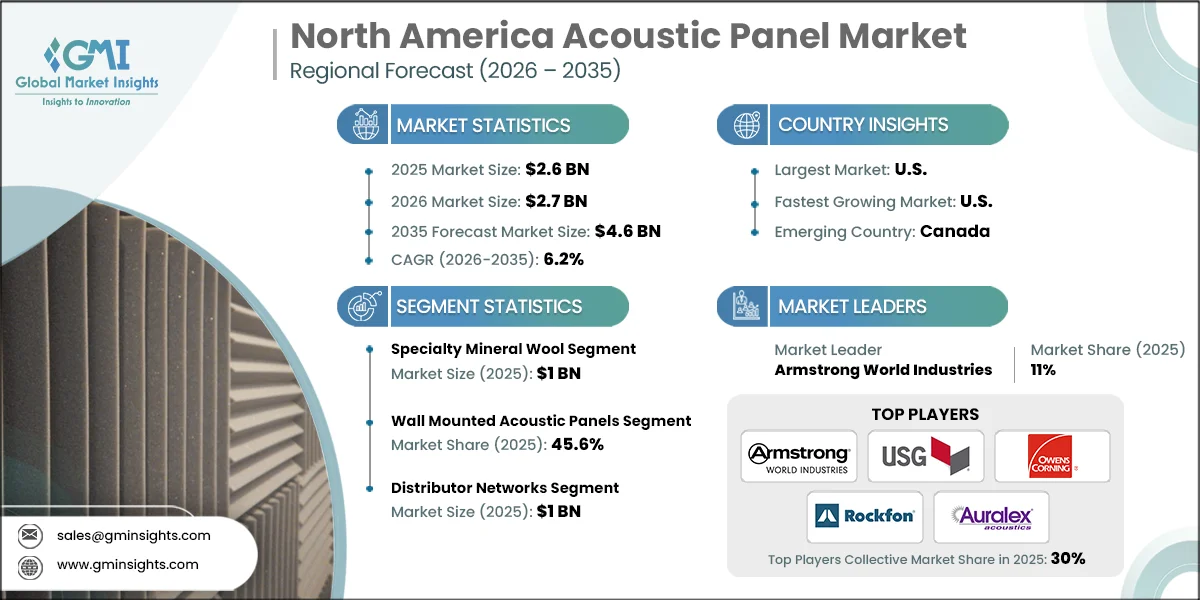
To get key market trends
North America Acoustic Panel Market Trends
The North American acoustic panel industry exhibits steady growth due to an increase in the number of companies, schools, and residents who now place a higher value on having a well-designed sound environment for their lives. The Architectural design trends of open concept designs, minimalist design, and flexible retail spaces have shown a very real increase in demand for acoustical products. Additionally, many homeowners and businesses are realizing that creating an acoustic balanced environment has many of the same benefits to their employees and visitors that provide them with a comfortable environment, improved concentration, and improved professional communication.
- The demand for an acoustically balanced environment is taking the same importance in the day-to-day operations of many businesses, schools, and hospitals as it does for music studios and performing arts theatres and has moved from a niche item to being a part of mainstream design in the building industry.
- In North America, green construction strategies are gaining popularity and promoting the use of recycled fibers, natural resources, and low-emission acoustic materials. Manufacturers are developing eco-friendly product lines with reduced environmental impact while also maintaining performance and creating products that go beyond what has traditionally been expected of a manufacturer's products.
- Acoustic panels are evolving from a functional item to an item used for decor within an architectural design. The increasing popularity of modern shapes, textures, and colors of acoustic panels makes it easier for designers and architects to incorporate acoustic panels into their designs without sacrificing style. The desire for customization printed acoustic panels, decorative baffles and integrated lighting is also leading to new and innovative ways of producing aesthetically appealing acoustic systems.
- As hybrid workplaces and multi-purpose commercial spaces gain popularity, so do technologically advanced types of acoustic products. Now, there is a wider availability of smart panels that include sensor-based monitoring for noise level, as well as modular acoustic system products designed to support flexible workspace layouts. The ability to incorporate these acoustical products with technology will allow greater flexibility for different space types while maintaining consistent high-quality sound performance in fluid-changing work settings.
North America Acoustic Panel Market Analysis
Learn more about the key segments shaping this market
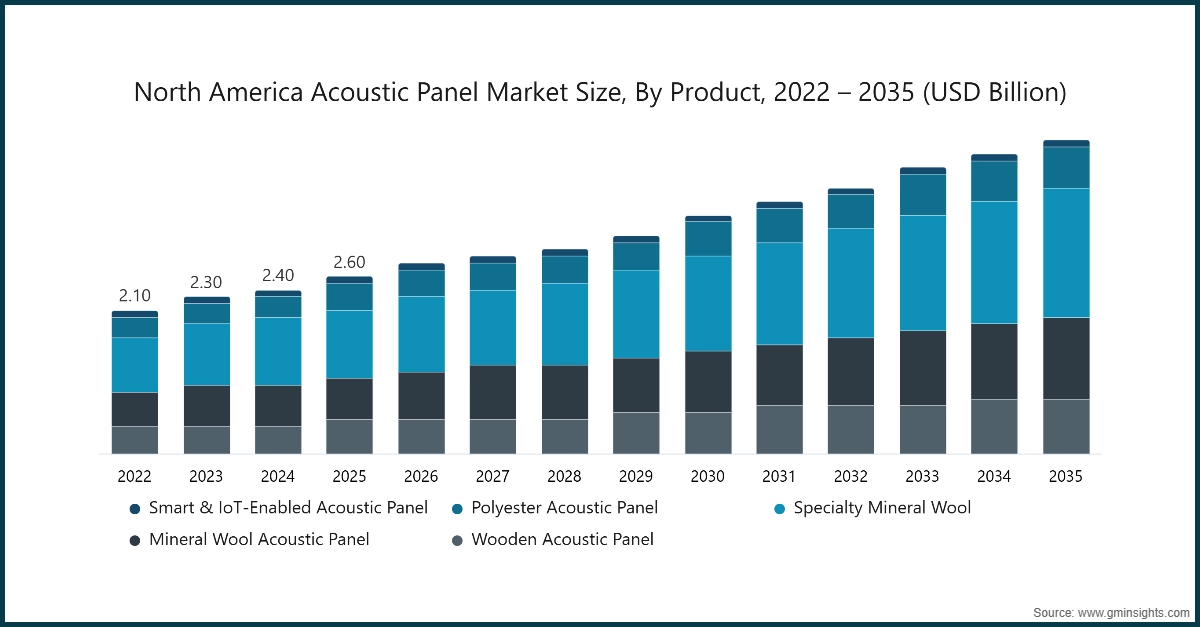
Based on product type, the market is divided into wooden acoustic panel, mineral wool acoustic panel, specialty mineral wool, polyester acoustic panel and smart & IoT enabled acoustic panel. In 2025, specialty mineral wool held the major market share, generating a revenue of USD 1 billion.
- Mineral wool is a specialty insulation and acoustical material that provides superior thermal performance and sound absorption properties. Made from natural minerals or recycled materials like basalt, slag and/or glass, mineral wool is a product engineered using controlled geothermal processes to create a dense network of interlocking fibers. This fiber interlocking gives mineral wool its primary benefits of excellent thermal resistance, sound absorption and fire safety. Because mineral wool does not melt down nor produce toxic vapors when subjected to high temperature scenarios, it is often selected when integrated durability/stability is one of the selection criteria.
- Mineral wool is used to absorb sound in the mid-to-high frequency spectrum. Therefore, it is used extensively in the manufacture of acoustic panels, baffles and sound control products. The open-fiber structure creates small pockets that trap sound waves and thus reduce reverberation, while also improving clarity in offices, schools, home recording studios, theatres, and manufacturing facilities. These consistent density and non-directional fiber orientation provide predictable performance regarding the acoustic properties of specialty mineral wool, enabling architects and engineers to design products capable of achieving desired levels of noise reduction.
- From a sustainability perspective, a large percentage of the raw materials used to create specialty mineral wool products are recycled, and specialty mineral wool is itself recyclable. Specialty mineral wool products are ideal for incorporation into green building products because of their long service life and resistance to moisture, pests, and microbial growth. As energy efficiency, indoor comfort and safety continue to become increasingly regulated, specialty mineral wool provides advantages to several other insulation types due to its multiple functional benefits. In terms of performance, durability, and environmental responsibility, mineral wool will play a vital role in the next generation of building systems.
Learn more about the key segments shaping this market
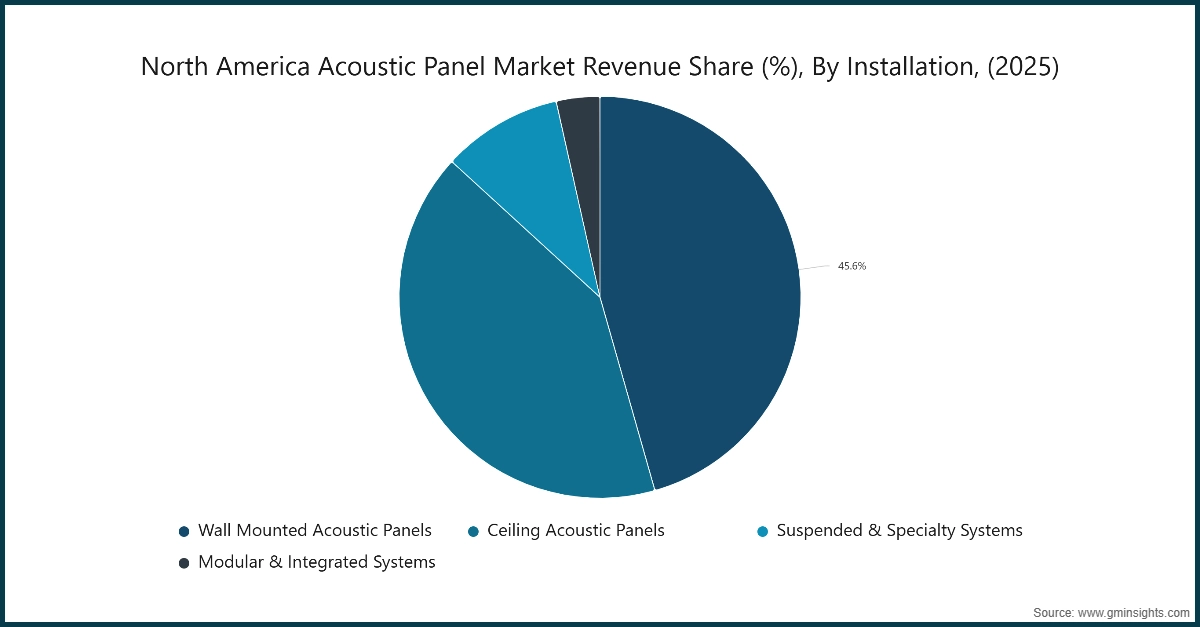
Based on installation, the market is segmented into wall mounted acoustic panels, ceiling acoustic panels, suspended & specialty systems and modular & integrated systems. The wall mounted acoustic panels segment held the largest share, accounting for 45.6% of the North America acoustic panel market in 2025.
- Wall-mounted acoustic panels are sound-absorbing structures, designed to be placed directly onto interior wall surfaces of buildings, that improve the acoustical quality of the space. Acoustic panels help to reduce unwanted noises and provide a clearer environment for listening. Acoustic panels are typically constructed using a combination of fabric-wrapped fiberglass, polyester fiber, foam or specialty mineral wool. The specific material used will depend on the frequency range that each product can absorb. Since wall-mounted acoustic panels are easy to install and are one of the most effective acoustic treatments available, they are frequently used to help control unwanted noise in offices, schools, recording studios and residential areas.
- In addition to improving sound quality, wall-mounted acoustic panels are being increasingly utilized within the field of interior design. Today's modern acoustic panels are available in a broad range of colors, shapes, textures and patterns. Therefore, it is common for an acoustic panel to be integrated into a room's overall aesthetic rather than simply enhancing the acoustics. This versatility has been instrumental in the increasing use of wall-mounted acoustic panel systems within hospitality, conference, entertainment and restaurant settings, where the aesthetics and performance of the products are of equal importance. Many designers are favoring the use of wall-mounted acoustic panels, not only to help create visual impact but also to create a better acoustical environment within their designs.
- Most surfaces can accommodate a mounting method of some type, and there are a variety of ways to install them. Wall-mounted acoustic panels are also very durable and long lasting, which means they will perform in high traffic situations. The modularity of wall-mounted acoustic panels gives flexibility for future scaling or for scaling back the number of panels. Overall, the versatility offered by wall-mounted acoustic panels makes them a relatively inexpensive and aesthetically flexible means for improving sound quality for residential, commercial, and institutional users.
Based on distribution channel, the North America acoustic panel market is segmented into direct sales, distributor networks, specialty retailers and online & digital channels. In 2025, distributor networks segment held the largest market share, generating a revenue of USD 1 billion.
- Distributors combine national and regional wholesalers, retail dealers, and manufacturer’s representatives to create a distribution model for the acoustic panel market that provides both reach and specification support. National wholesalers maintain inventories that cover all regions of the US and support contractors who may work in multiple states with predictable lead times and SKUs. Regional dealers provide dealers with project-specific support, such as samples, measuring materials, and installation coordination, to ensure that projects proceed smoothly. Manufacturer’s representatives establish relationships with architects, acoustical consultants, and general contractors; these relationships allow manufacturer’s representatives to register their products in project specifications and provide local stocking partners with the qualified demand resulting from these relationships.
- The pathways taken by companies when going to market usually include selling direct enterprise-style to large accounts such as corporate offices, education, and healthcare, channel sales through professional AV/Interior Dealers, e-commerce for small and DIY studio rooms, and through construction distributors. The direct sales force typically manages complex multi-site rollouts and provides negotiated pricing, mock-ups of products, and coordination of installation services. Channel partners generally have extensive expertise with providing design assist and bundled solution offerings together. E-commerce has been able to generate incremental volume using SKU standard panels, quick-ship programs, and configurators. Project distribution is typically aligned with bid cycles, submittals of required documents, and any associated compliance requirements.
Looking for region specific data?
U.S. Acoustic Panel Market
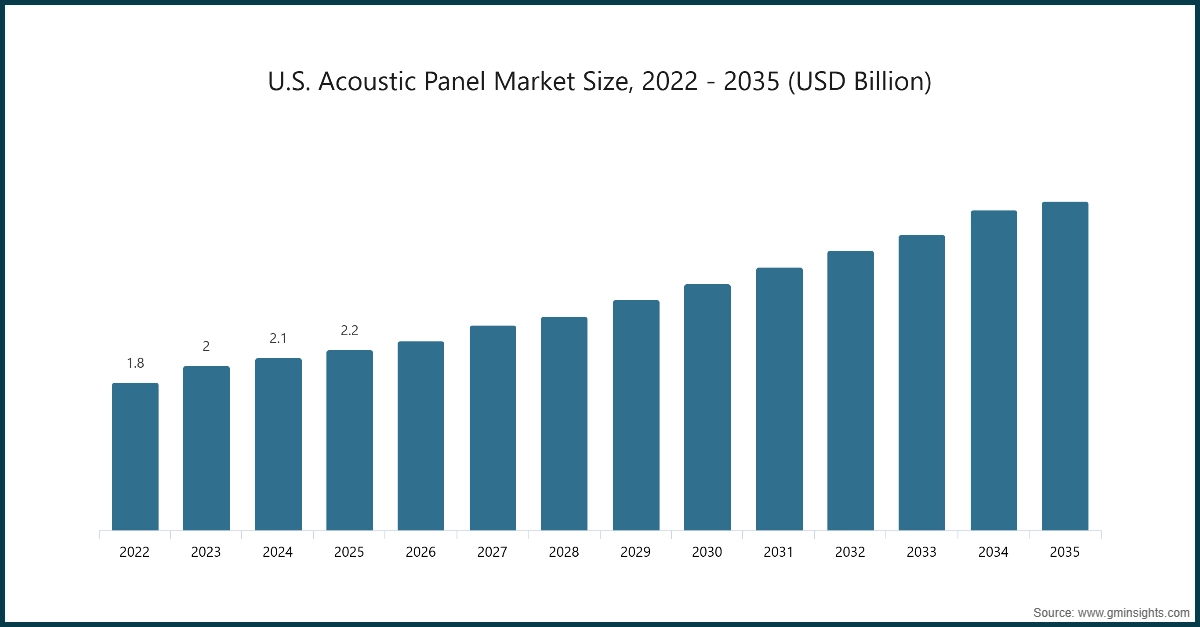
In 2025, the U.S dominated the North America acoustic panel market, accounting for around 86% and generating around USD 2.2 billion revenue in the same year.
- The U.S. acoustic panel market is very robustly growing due to the focus on improving sound quality and reducing noise in various settings from corporate work environments and educational institutions to homes. Acoustic panels are becoming more important as we see an increase in open office plans and collaborative spaces growing in major metropolitan areas in the U.S. Companies are now putting emphasis on creating an environment that helps their employees enjoy working, be more productive and have a more pleasant working atmosphere; therefore, companies are utilizing acoustic panels in their meeting rooms, their lobbies and their high-traffic areas. The increase in remote working has also contributed to the need for residential acoustic solutions, with homeowners upgrading their home office, home studio and entertainment areas to improve sound clarity and diminish echo in video conferencing and content creation.
- In the U.S., there is an increasing amount of renovation being done in public and private areas of commerce as well as in the infrastructure. This activity is being driven primarily by the consolidation of many older buildings into more modern facilities along with more stringent acoustic requirements in areas such as education, healthcare, and hospitality. Educational institutions, like schools and universities, have begun implementing acoustic enhancements to help enhance speech clarity, while hospitals are implementing panels to provide patients with enhanced comfort and privacy. In addition, hotels, restaurants, and retail establishments utilize acoustical applications to create atmosphere as well as enhance customer experience. Along with the previously mentioned trends, an increasing interest in sustainable building practices has prompted the use of greener, recycled, and low-VOC acoustic materials. As a result of these factors, the U.S. has evolved into one of the most exciting and innovative areas in the entire North American acoustic panel market.
North America Acoustic Panel Market Share
Armstrong World Industries is leading with 11% market share. Armstrong World Industries, USG, Owens Corning, Rockfon, Auralex Acoustics, Inc collectively hold around 30%, indicating moderately fragmented market concentration. These prominent players are proactively involved in strategic endeavors, such as mergers & acquisitions, facility expansions & collaborations, to expand their product portfolios, extend their reach to a broad customer base, and strengthen their market position.
Armstrong World Industries is a leading manufacturer of architectural acoustic solutions across a multitude of commercial, institutional, and public environments, it is known throughout the construction and architecture industry due to its extensive portfolio of ceiling, wall panel, and acoustical innovations. The company’s product line combines optimal sound performance with design flexibility, allowing the product to enhance noise control and still address modern aesthetic needs. As a result of its excellent relationships with construction and architectural firms, Armstrong is well known as a leader in large scale acoustical installations.
USG is a well-established manufacturer of commercial building materials with a wide variety of ceiling, drywall and acoustical systems that are used extensively throughout North America on commercial and residential projects. The company’s acoustic panels are known for their reliable and continuous performance and their ability to integrate with ceiling grid systems, making them an efficient and preferred selection for architects and contractors. Therefore, USG’s extensive distribution capabilities allow it to service many large construction projects with a standardized and reliable solution.
North America Acoustic Panel Market Companies
Major players operating in the North America acoustic panel industry are:
- Acoustical Solutions
- Acoustical Surfaces
- Acoustics First
- Acoustimac
- Armstrong World Industries
- Auralex Acoustics
- Carnegie Acoustic Solutions
- GIK Acoustics
- Kirei USA
- MCM Acoustical
- Owens Corning
- Primacoustic
- Rockfon
- Sound Seal
- USG
GIK Acoustics is the leading manufacturer of acoustic treatments for studios, home theatre, audiophile rooms and creative workspaces. GIK's product line includes bass traps, wall panels, and diffusion systems that provide optimal acoustical performance through technical design combined with a wide variety of aesthetic options. GIK focuses on providing solutions tailored specifically to the needs of its customers and works closely with both professionals and enthusiasts to provide guidance in the areas of design, layout and product selection to help customers achieve the best possible acoustics in their space.
Acoustical Surfaces manufactures a wide array of soundproofing and noise control products for commercial, industrial and architectural applications. Acoustical Surfaces product offerings include acoustic panels (both standard and engineered), vibration control products, specialty composite products, and architectural finishing materials designed for the more demanding types of environments. In addition, Acoustical Surfaces, Inc. has an extensive knowledge base and technical expertise; the company is involved in a significant amount of work with all types of acoustical requirements, as well as consulting with customers to identify appropriate product configurations to meet their acoustic performance, compliance or configuration needs.
North America Acoustic Panel Market Report Attributes
| Key Takeaway | Details |
|---|---|
| Market Size & Growth | |
| Base Year | 2025 |
| Market Size in 2025 | USD 2.6 Billion |
| Market Size in 2026 | USD 2.7 Billion |
| Forecast Period 2026-2035 CAGR | 6.2% |
| Market Size in 2035 | USD 4.6 Billion |
| Key Market Trends | |
| Drivers | Impact |
| Rising awareness of noise control | Increasing demand for acoustic panels means that there will be increased demand from organizations wanting to create better working environments that are quieter and healthier. |
| Growth in commercial construction & renovation | The rush to fill the new construction and renovation market with new builds and renovations creates large bulk opportunity orders for manufacturers providing acoustic solutions. |
| Rising adoption of home theaters & remote workspaces | Developing a new demographic to buy easy to install, décor friendly acoustic panels for use in home offices, music studios and entertainment rooms creates new opportunities for manufacturers of acoustic panels to expand the residential market. |
| Pitfalls & Challenges | Impact |
| High product & installation costs | Budget sensitive customers slow the evolution of the market by limiting their ability and willingness to invest in premium acoustic panels. As such, the growth rate of the acoustic panel market will be at a much lower rate for small businesses and residential customers. |
| Competition from low cost substitutes | Market pressures on price increase, causing some customers to gravitate to lower price and lower performance options, resulting in less premium panel sales. |
| Opportunities: | Impact |
| Sustainable & eco‑friendly acoustic solutions | Environmentally conscious customers and specifiers are driving greater demand for premium products in corporate, educational and publicly funded projects. |
| Customizable & aesthetic‑driven panel designs | By integrating acoustics into interior design, changing the acceptance of acoustics will help accelerate the growth of premium and design driven applications. |
| Market Leaders (2025) | |
| Market Leader |
11% market share |
| Top Players |
The collective market share in 2025 is 30% |
| Competitive Edge |
|
| Regional Insights | |
| Largest market | U.S. |
| Fastest growing market | U.S. |
| Emerging countries | Canada |
| Future Outlook |
|
What are the growth opportunities in this market?
North America Acoustic Panel Industry News
- In January 2026, Sound Seal enhances the acoustic architecture range by providing projects with improvements to the wall panels, ceiling clouds and composite noise barriers that have improved fire ratings and flexibility during installation, as well as providing a variety of finishes to provide a wide variety of solutions for architectural and industrial noise control needs.
- In November 2025, Rockfon launched a new linear metal ceiling baffle system for customers in North America, with the intent to provide greater acoustic absorption using stone wool infill. Features of this new system include enhanced modularity for large spaces and improved sustainability with a new material recovery and product recycling program in the U.S. and Canada.
- In August 2025, Armstrong World Industries announced improvements to their existing acoustic panel product line. The company offers wood-fiber and mineral materials with improved acoustic absorption performance; greater durability and impact resistance; and support for expanded custom sizing of panels specifically designed for use in educational, medical, and commercial applications with a high volume of foot-traffic.
- In August 2025, USG Corporation bolsters their Ceiling Acoustics line by producing improved performance in their Mineral Fiber Ceiling Panels with Performance Enhancements including Noise Reduction, Humidity Resistance, Long-Term Dimensional Stability so that they will meet the needs of healthy modern office, institutional, and healthcare designs.
The North America acoustic panel market research report includes in-depth coverage of the industry with estimates & forecasts in terms of revenue (USD Billion) & volume (Thousand Square Meters) from 2022 to 2035, for the following segments:
Market, By Product
- Wooden acoustic panel
- Perforated wood panels
- Wood fiber composite panels
- Mineral wool acoustic panel
- High-performance mineral wool (nrc >0.85)
- Standard performance mineral wool (nrc 0.65-0.85)
- Specialty mineral wool (Fire-rated, Moisture-resistant)
- Fabric acoustic panel
- Custom decorative systems
- Standard fabric-wrapped panels
- Polyester acoustic panel
- Smart and IoT-enabled acoustic panels
Market, By Installation
- Wall-mounted acoustic panels
- Direct-mount systems
- Floating panel systems
- Ceiling acoustic panels
- Drop-in ceiling tiles
- Direct-mount ceiling panels
- Suspended and specialty systems
- Hanging baffles and clouds
- Curved and sculptural systems
- Modular and integrated systems
- Demountable partition systems
- Integrated furniture solutions
Market, By Application
- Healthcare and medical facilities
- Hospitals and medical centers
- Diagnostic centers and laboratories
- Elderly care and rehabilitation facilities
- Education and learning environments
- K-12 schools and classrooms
- Higher education and universities
- Libraries and study centers
- Commercial and corporate
- Office buildings and workspaces
- Call centers and customer service
- Meeting and conference facilities
- Hospitality and entertainment
- Hotels and resorts
- Restaurants and dining
- Entertainment venues and theaters
- Industrial and manufacturing
- Manufacturing facilities
- Data centers and server rooms
- Research and development facilities
- Transportation infrastructure
- Airports and transit hubs
- Automotive and railway applications
Market, By Distribution Channel
- Direct sales
- Distributor networks
- Specialty retailers
- Online and digital channels
The above information is provided for the following countries:
- U.S.
- Canada
Frequently Asked Question(FAQ) :
What is the market size of the North America acoustic panel in 2025?
The North America acoustic panel market was valued at USD 2.6 billion in 2025, driven by rising awareness of noise control.
What is the projected value of the North America acoustic panel industry by 2035?
The North America acoustic panel market is projected to reach USD 4.6 billion by 2035, growing at a CAGR of 6.2% from 2026 to 2035, supported by expanding sustainable and eco-friendly acoustic solutions.
What is the North America acoustic panel industry size in 2026?
The North America acoustic panel market size is projected to reach USD 2.7 billion in 2026, fueled by continued commercial renovation activity, and increasing incorporation of acoustic treatments in open-concept building designs.
Which product segment dominated the North America acoustic panel market in 2025?
The specialty mineral wool segment generating revenue of USD 1 billion in 2025, driven by its superior sound absorption properties in the mid-to-high frequency spectrum.
Which installation segment led the North America acoustic panel market in 2025?
The wall-mounted acoustic panels segment accounting for 45.6% of the market share in 2025, driven by growing use in offices, schools, recording studios, and residential settings.
Which distribution channel dominated the North America acoustic panel market in 2025?
The distributor networks segment generating revenue of USD 1 billion in 2025, driven by their ability to combine national and regional wholesalers, retail dealers, and manufacturer's representatives to provide market reach and project specification support.
Which country leads the North America acoustic panel market?
U.S. dominated the North America acoustic panel market with around 86% share, generating approximately USD 2.2 billion in 2025, driven by increasing adoption of open office plans, rising renovation activity in commercial and public infrastructure.
What are the upcoming trends in the North America acoustic panel market?
Key trends include rising demand for smart and IoT-enabled acoustic panels with sensor-based noise monitoring, growing adoption of modular acoustic systems for flexible hybrid workspaces, and increasing integration of acoustic solutions.
Who are the key players in the North America acoustic panel market?
Key players include Armstrong World Industries, USG, Owens Corning, Rockfon, Auralex Acoustics, Acoustical Solutions, Acoustical Surfaces, Acoustics First, Acoustimac, Carnegie Acoustic Solutions, GIK Acoustics, Kirei USA, MCM Acoustical, Primacoustic, and Sound Seal.
North America Acoustic Panel Market Scope
Related Reports