Summary
Table of Content

Nickel Metal Hydride Battery Market
Get a free sample of this report
Form submitted successfully!
Error submitting form. Please try again.
Thank you!
Your inquiry has been received. Our team will reach out to you with the required details via email. To ensure that you don't miss their response, kindly remember to check your spam folder as well!
Request Sectional Data
Thank you!
Your inquiry has been received. Our team will reach out to you with the required details via email. To ensure that you don't miss their response, kindly remember to check your spam folder as well!
Form submitted successfully!
Error submitting form. Please try again.
Nickel Metal Hydride Battery Market Size
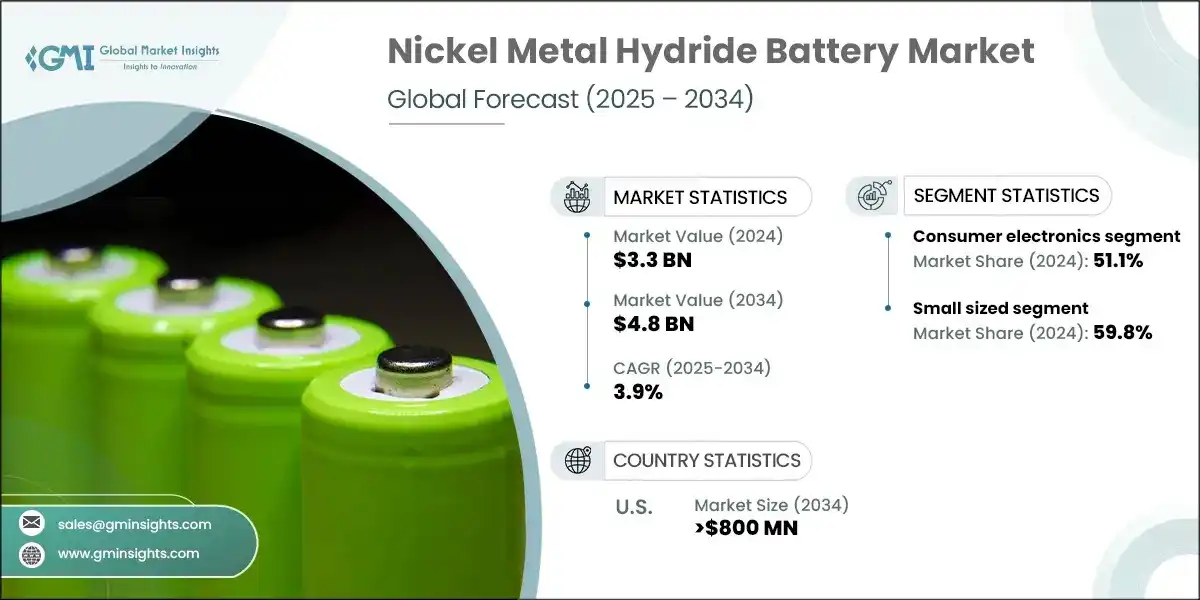
According to a recent study by Global Market Insights Inc., the global nickel metal hydride battery market was estimated at USD 3.3 billion in 2024. The market is expected to grow from USD 3.4 billion in 2025 to USD 4.8 billion in 2034, at a CAGR of 3.9%.
Nickel Metal Hydride Battery Market Key Takeaways
Market Size & Growth
- 2024 Market Size: USD 3.3 Billion
- 2034 Forecast Market Size: USD 4.8 Billion
- CAGR (2025–2034): 3.9%
Key Market Drivers
- Rising adoption of electric vehicles (EVs).
- Expanding consumer electronics market.
Challenges
- Lower energy density compared to lithium-ion.
- High self-discharge rate.
Opportunity
- Growing demand for hybrid vehicles.
- Rising focus on recycling and sustainability.
Key Players
- Market Leader: Panasonic Holdings Corporation led with over 19.9% market share in 2024.
- Leading Players: Top 5 players in this market include Panasonic Holdings Corporation, BYD Company, GS Yuasa, FDK CORPORATION, GP Batteries, which collectively held a market share of 46.3% in 2024.
Get Market Insights & Growth Opportunities
- The increasing focus of customers towards the adoption of affordable batteries compared to lithium-ion batteries is set to propel the product penetration, particularly for mid-capacity and consumer applications. The product offers benefits from decades of mass production, a mature supply chain, and well-optimized manufacturing processes, making it a cost-effective choice.
- A nickel-metal hydride (NiMH) battery is a type of rechargeable battery that uses a nickel oxyhydroxide positive electrode (cathode) and a hydrogen-absorbing metal alloy negative electrode (anode) with a potassium hydroxide electrolyte. These batteries offer higher energy density, a longer cycle life, and are more environmentally friendly than nickel-cadmium (NiCd) batteries, which they largely replaced. NiMH batteries are used in various applications, including hybrid and electric vehicles, cordless power tools, and consumer electronics.
- Companies are introducing new product lines of NiMH batteries with advanced features to target a wide customer range. For instance, FDK CORPORATION announced to launch of its "HR-AATU" nickel-metal hydride battery for Power Backup Markets in April 2024. It features a 1.2V Nominal Voltage, 1280mAh Nominal Capacity, and supports various backup applications. Additionally, the growing popularity of batteries offering safety advantages, especially in critical applications, further drives NiMH battery demand.
- The nickel metal hydride battery market was valued at USD 3.1 billion in 2021 and grew at a CAGR of 2.6% through 2024. Growing emphasis on environmental sustainability has boosted battery adoption as the product avoids some of the most toxic materials found in older nickel-cadmium batteries. Moreover, well-established recycling infrastructure, particularly in Japan and Europe, makes the battery a preferred choice.
- Asia Pacific is among the dominant regions, strongly driven by the dominance of hybrid electric vehicles, particularly in Japan, where automakers including Toyota and Honda continue to use NiMH technology for its proven reliability and thermal stability. Furthermore, the region benefits from a robust manufacturing ecosystem, with key producers such as FDK, GS Yuasa and Panasonic leading production, ensuring cost efficiencies and wide-scale availability.
- Japan holds a dominating share in the Asia Pacific nickel metal hydride battery market, majorly in terms of production. The presence of key players and the expanding production unit in the country are primary drivers for the product growth. For instance, Toyota Industries Corporation's Ishihama Plant in Japan began producing bipolar nickel-metal hydride batteries for hybrid vehicles in October 2022. With a capacity of 20,000 units per month, combined with the Kyowa Plant, total production now reaches 40,000 units per month.
- Rest of world is the fastest-growing region in the market due to rising product demand from off-grid and backup power systems, particularly in remote areas where grid instability drives interest in reliable rechargeable solutions. Additionally, growing use of hybrid vehicles in countries such as Brazil and Mexico sustains market prospects.
To get key market trends
Nickel Metal Hydride Battery Market Trends
- Government and manufacturers' efforts in emphasizing recycling programs to recover valuable materials, including nickel, cobalt and rare earth elements, have shown tremendous growth since the last decade. With global attention on circular economy practices, NiMH batteries are gaining traction as a more environmentally friendly alternative compared to lithium-ion, particularly in regions with stringent recycling regulations, including Europe, leading to escalate the nickel metal hydride battery market outlook.
- Continuous use of NiMH batteries in hybrid vehicles is set to influence the product growth due to their proven safety, durability and cost effectiveness. As per EIA, in Q1 2024, hybrid, battery electric, and plug-in hybrid vehicles made up 22% of U.S. light-duty vehicle sales, up from 18% in Q1 2023. Wards Intelligence reports that hybrid vehicles gained market share, while battery electric and plug-in hybrids remained stable. Additionally, growing initiatives promoting hybrid mobility as a transition toward full electrification, rising HEV sales, directly strengthening NiMH battery demand in the automotive sector.
- Manufacturers are investing in R&D to address the historical limitations of NiMH batteries, including high self-discharge rates and lower energy density, leading to propel the industry statistics. Ongoing innovations such as low self-discharge (LSG) NiMH batteries, which retain charge longer, are expanding their usability in consumer and industrial applications. Additionally, enhanced designs are also enabling better cycle life and faster charging, improving competitiveness against lithium-ion solutions in specific use cases, leading to stimulate the product growth.
- Consumer electronics growing requirement for batteries offering moderate power and rechargeability, including digital cameras, handheld gadgets, power tools and toys, creates lucrative opportunities for NiMH batteries. Their ability to deliver longer runtime than standard nickel-cadmium batteries and safer operation than lithium-ion in some applications ensures steady adoption. Additionally, companies such as Panasonic and GP Batteries are rolling out a diverse array of NiMH batteries, available in both AAAA and AA cell sizes. These batteries are designed for low self-discharge, ensuring superior charge retention. Furthermore, due to their intrinsically safe chemistry, NiMH batteries bypass the UN38.3 testing and encounter no air transport restrictions, leading to propel the nickel metal hydride battery market growth.
- Increasing demand for batteries with proven reliability, safety and ability to deliver stable power makes NiMH a suitable choice for medical devices, including infusion pumps, portable monitors and defibrillators. Additionally, these batteries are expected to show incremental growth in robotics, warehouse automation and portable industrial equipment due to their ability to provide consistent power output, handle frequent cycling and function in rugged conditions, leading to augment the business trend.
Nickel Metal Hydride Battery Market Analysis
Learn more about the key segments shaping this market
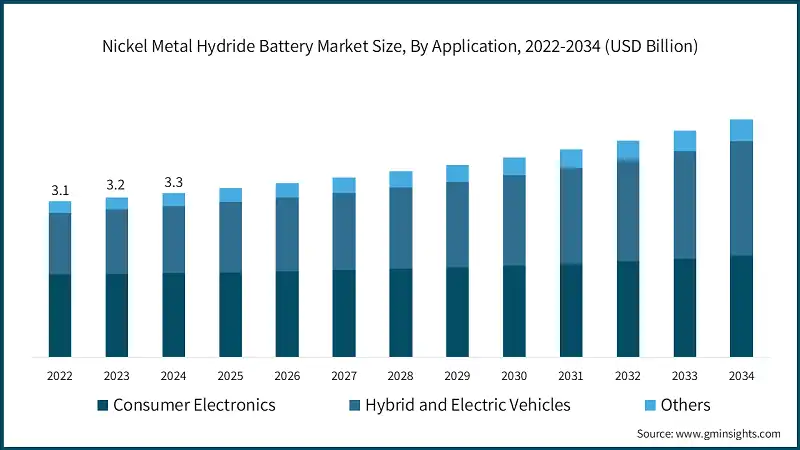
Based on application, the industry is segmented into consumer electronics, hybrid and electric vehicles and others. The consumer electronics segment dominated around 51.1% market share in 2024 and is expected to grow at a CAGR of 2% through 2034.
- Increasing demand for batteries with excellent rechargeability, affordability and compatibility with standard AA, AAA and other common formats in consumer electronics is augmenting the product growth. Consumers' rising preference for NiMH batteries over disposable alkaline batteries for devices such as toys, cameras and flashlights due to their high density and longer runtime further drives the product growth.
- Companies are offering advanced products with new features specifically for consumer electronics consumers to improve their business projections. For instance, VARTA offers NiMH cylindrical cells and battery packs, from 700 mAh AAA-size to 4500 mAh FA-size, for high-power applications like wireless routers, security backups, and smart toys. Additionally, easy availability, wide charger compatibility and cost effectiveness further strengthen NiMH’s presence in everyday electronic devices.
- The hybrid and electric vehicles market will grow at a CAGR of 5.6% through 2034 on account of NiMH batteries' ability to withstand frequent charge-discharge cycles and performance reliability across a wide temperature range, making them ideal for hybrid systems. Automakers value their long service life, resistance to overcharging and stable performance, which reduces maintenance costs, leading to uplift the battery penetration. Additionally, their recyclability and reduced reliance on critical minerals such as cobalt support a sustainable supply chain, thereby boosting the product growth.
- Increasing public and private entities' support in terms of funds and grants will encourage key players to invest in the business. For instance, in September 2023, Atlas Materials, a U.S.-based startup, clinched USD 27 million in funding, bolstering its ambitions in the electric vehicle nickel-based battery sector. This infusion of capital paves the way for Atlas's forthcoming manufacturing plant in North America. Furthermore, NiMH batteries are cheaper to mass produce than lithium-ion, supporting competitive vehicle pricing in cost-sensitive markets, leading to uplift the market growth.
Learn more about the key segments shaping this market
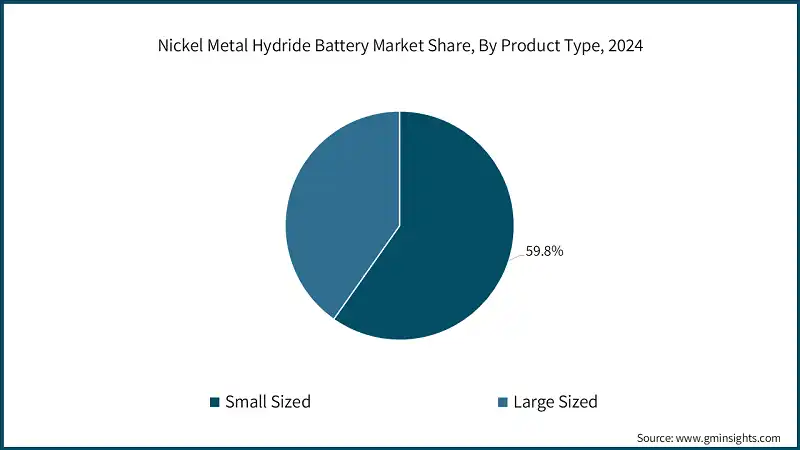
Based on product type, the nickel metal hydride battery market is segmented into small sized and large sized. The small sized dominated the market with a 59.8% share in 2024 and is expected to grow at a CAGR of 3.1% from 2025 to 2034.
- Increasing adoption of NiMH batteries in small-sized product types such as AA, AAA, C & D cells, due to their versatility, affordability and rechargeability, drives the business scenario. These compact formats are ideal for everyday consumer electronics, including toys, cameras, flashlights, remote controls and portable audio devices on account of their high energy density compared to traditional nickel-cadmium batteries, enabling longer runtimes without significantly increasing size or weight.
- Large sized is set to grow at a CAGR of 5% through 2034. NiMH batteries in large-sized product types, such as prismatic and cylindrical modules for hybrid vehicles, industrial equipment and backup systems, are gaining traction on account of their high cycle life, reliability, and durability under demanding conditions. These batteries' potential to withstand frequent deep charge-discharge cycles, making them ideal for applications requiring continuous power delivery, including hybrid EV drivetrains, warehouse automation and telecom backup systems.
Looking for region specific data?
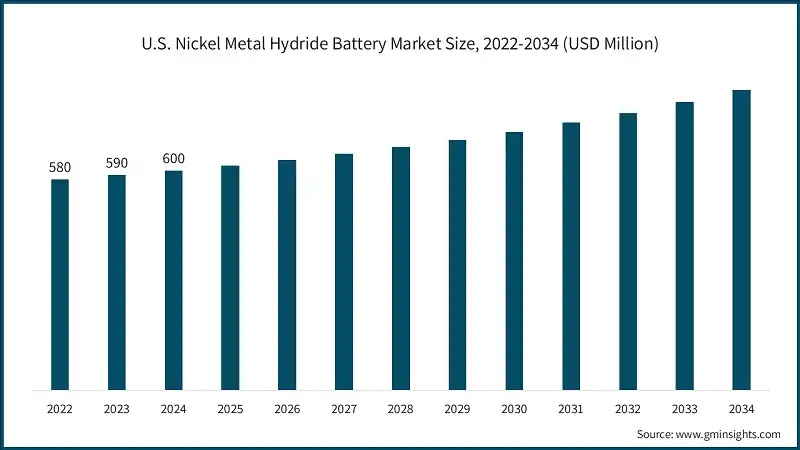
- The U.S. dominated the nickel metal hydride battery market in North America with around 96% share in 2024 and is expected to reach over USD 800 million by 2034. The presence of a strong hybrid vehicle market led by automakers such as Toyota and Ford, which continue to rely on NiMH batteries for their hybrid fleet on account of their safety, affordability, and reliability, is set to influence the business trend. Rising regulatory policies supporting lower-emission vehicles also encourage the use of NiMH batteries in hybrid vehicles as a proven, affordable option compared to lithium-ion.
- Canada is at an initial stage of product adoption, but growing demand from the automotive sector primarily drives the business outlook. In 2023, Canadian customers bought approximately 262,200 passenger cars, up from 258,500 units in 2022, as reported by the International Organization of Motor Vehicle Manufacturers (OICA). This uptick in sales signals a rebound in the automotive market, with consumers increasingly leaning towards sustainable vehicle options. Hybrid electric vehicles (HEVs), often powered by NiMH batteries, have surged in popularity, bolstered by government incentives and a growing consumer appetite for eco-friendly choices.
- The North America nickel metal hydride battery market size surpassed USD 600 million in 2024, supported by their established role in hybrid vehicles, where long service life, safety and affordability make NiMH batteries attractive for automakers aiming to balance performance with regulatory compliance. Additionally, beyond transportation, their use in backup power systems, renewable energy storage and portable medical devices is growing due to their resilience and low maintenance needs.
- The Asia Pacific nickel metal hydride battery market is anticipated to reach over USD 3.2 billion by 2034, fueled by rapid growth in consumer electronics, hybrid vehicles and industrial automation. Countries including Japan and China lead demand, with Japan being the home base for NiMH pioneers, including Panasonic and Toyota. Furthermore, hybrid vehicles remain a strong driver, as Japanese automakers continue to integrate NiMH packs due to their durability and cost advantages.
- Japan holds a significant share in the nickel metal hydride battery fueled by the nation’s robust battery manufacturing ecosystem, led by companies such as Panasonic and Primearth EV Energy, ensuring consistent supply and innovation. Furthermore, in 2022, TYCORUN, a global leader in battery swap solutions, reported that Japan produces over 85% of the world's nickel-hydrogen batteries annually. Moreover, when it comes to patented technology, Japan holds a technological edge over China.
- Rest of world market is set to grow at a CAGR of 4.8% till 2034. The category includes countries under the Middle East and Africa and Latin America. In MEA, increasing adoption of NiMH batteries in telecom backup systems, medical devices and renewable energy storage, where durability and low maintenance are critical, is set to augment the industry outlook. Additionally, harsh climates make the product attractive due to its wide operating temperature range and resilience compared to lithium-ion.
Nickel Metal Hydride Battery Market Share
- The top 5 companies, including Panasonic Holdings Corporation, BYD Company, GS Yuasa, FDK CORPORATION and GP Batteries, account for around 46.3% market share. Major companies focus on technological advancements, prioritizing research and development (R&D) to enhance battery performance, including energy density, cycle life, and charging speed.
- Companies are favoring the adoption of cost reduction techniques through efficient manufacturing processes, including automation and precision manufacturing. New players are forming strategic partnerships with OEMs and collaborating across the value chain to enable market penetration and expansion into emerging applications such as renewable energy storage and industrial sectors. Additionally, players are emphasizing sustainability, developing eco-friendly solutions and focusing on responsible sourcing of materials to meet consumer and regulatory demands.
- Major stakeholders are focusing on local sourcing within China or exploring partnerships in other Southeast Asian or Latin American countries to reduce reliance on potentially unstable supply chains. Companies are also developing specialized NiMH battery solutions for niche markets, such as aerospace and defense, where the unique features of NiMH are particularly valuable.
Nickel Metal Hydride Battery Market Companies
- Panasonic Holdings Corporation is a Japanese multinational electronics company. They are actively involved in the development, manufacture, and sale of electrical products, including NiMH batteries. Panasonic's NiMH batteries are known for their durability, long cycle life, wide temperature range and are used in applications such as HEVs, renewable energy systems, and industrial backup power. They have been mass-producing NiMH battery systems for HEVs since 2004, focusing on performance expansion for their eco-car battery business.
- FDK CORPORATION, a Japanese company, is a key player in the NiMH battery market, known for its focus on high durability and reliability. They develop NiMH batteries for diverse applications, including in-vehicle systems, medical devices, and industrial backup power. FDK also emphasizes developing batteries with a wide temperature range and long cycle life, suitable for demanding environments.
- GS Yuasa, offers NiMH batteries suitable for various applications, including industrial backup power, emergency lighting, and potentially also for certain types of hybrid vehicles. GS Yuasa focuses on developing durable, high-performance NiMH batteries with a long cycle life, suitable for a range of demanding uses where dependability is crucial. They have a history of developing and manufacturing batteries for diverse applications, including lead-acid and lithium-ion technologies.
- BYD Company, initially a battery manufacturer, continues to produce NiMH batteries alongside its dominant lithium-ion and Lithium Iron Phosphate (LFP) offerings. While primarily known for Li-ion in electric vehicles, BYD's NiMH cells are utilized in various applications, such as consumer electronics, emergency lighting, medical devices, and potentially some specialized industrial equipment.
- GP Batteries, a multinational company with a strong presence in China, is a major manufacturer of NiMH batteries. They specialize in high-speed automated production and offer a wide range of NiMH products for various applications, including consumer electronics, portable devices, and industrial uses. GP Batteries also focus on sustainability initiatives for NiMH batteries, including recycling and developing products with a longer lifespan.
Eminent players operating in the nickel metal hydride battery market are:
- Axiss Technology
- BYD Company
- Camelion Batterien GmbH
- Duracell
- DYNAMIS Batterien GmbH
- EPT Battery
- FDK CORPORATION
- GP Batteries
- Grepow Battery
- GS Yuasa
- Jauch Quartz
- NBCELL
- Panasonic Holdings Corporation
- RPC Corporation
- Saft Group
- Tenergy corporation
- Toshiba Lifestyle Products and Services Corporation
- Toyota Battery
- VARTA AG
- Zeus Battery
Nickel Metal Hydride Battery Market Report Attributes
| Key Takeaway | Details |
|---|---|
| Market Size & Growth | |
| Base Year | 2024 |
| Market Size in 2024 | USD 3.3 Billion |
| Forecast Period 2025 - 2034 CAGR | 3.9% |
| Market Size in 2034 | USD 4.8 Billion |
| Key Market Trends | |
| Drivers | Impact |
| Rising adoption of electric vehicles (EVs) | Growing EV adoption boosts NiMH battery demand, ensuring reliable performance and reducing dependency on fossil fuels. |
| Expanding consumer electronics market | Rising consumer electronics penetration drives NiMH adoption, offering cost-effective, safe, and long-lasting rechargeable power solutions. |
| Pitfalls & Challenges | Impact |
| Lower energy density compared to lithium-ion | NiMH batteries face limited competitiveness, as lower energy density restricts use in high-performance modern devices. |
| High self-discharge rate | Frequent recharging requirements reduce efficiency and consumer preference, impacting adoption across the portable electronics market. |
| Opportunities: | Impact |
| Growing demand for hybrid vehicles | NiMH batteries remain favored in hybrid vehicles, offering cost-effective, durable and environmentally safer alternatives |
| Rising focus on recycling and sustainability | Enhanced recycling initiatives boost NiMH adoption by supporting the circular economy and reducing environmental footprint. |
| Market Leaders (2024) | |
| Market Leaders |
19.9% market share |
| Top Players |
Collective market share in 2024 is 46.3% |
| Competitive Edge |
|
| Regional Insights | |
| Largest Market | Asia Pacific |
| Fastest Growing Market | Rest of World |
| Emerging Country | Canada, Italy, Japan & India |
| Future Outlook |
|
What are the growth opportunities in this market?
Nickel Metal Hydride Battery Industry News:
- In October 2024, Controlant, a global frontrunner in pharmaceutical supply chain monitoring and automation, signed a strategic alliance with FDK Corporation, a Fujitsu subsidiary celebrated for its prowess in battery technology. Through this partnership, Controlant will integrate FDK's advanced Nickel Metal Hydride (NiMH) batteries into its offerings, bolstering its dedication to reliability, sustainability, and top-tier performance.
- In March 2022, FDK Corporation unveiled its latest NiMH battery, the HR-AAUTEWM, designed for diverse applications. These range from security and medical uses to in-vehicle functionalities, encompassing tracking devices, e-calls, dashboard cameras, car alarms, and more.
- In June 2021, FDK Corporation unveiled its latest NiMH battery, the HR-AAUTEW, designed for tracking devices, e-calls, dashboard cameras, car alarms, and various in-vehicle applications.
This nickel metal hydride battery market research report includes an in-depth coverage of the industry with estimates & forecast in terms of revenue in “(USD Billion)” from 2021 to 2034, for the following segments:
Market, By Product Type
- Small sized
- Large sized
Market, By Application
- Consumer electronics
- Hybrid and electric vehicles
- Others
The above information has been provided for the following regions and countries:
- North America
- U.S.
- Canada
- Europe
- Germany
- Italy
- UK
- France
- Asia Pacific
- China
- India
- Japan
- South Korea
- Rest of world
Frequently Asked Question(FAQ) :
What is the market size of the nickel metal hydride battery in 2024?
The market size was USD 3.3 billion in 2024, with a CAGR of 3.9% expected through 2034 driven by increasing adoption of affordable batteries and growing hybrid vehicle demand.
What is the projected value of the nickel metal hydride battery market by 2034?
The nickel metal hydride battery market is expected to reach USD 4.8 billion by 2034, propelled by environmental sustainability focus and expanding consumer electronics applications.
How much market share did the consumer electronics segment hold in 2024?
Consumer electronics dominated with 51.1% market share in 2024, supported by excellent rechargeability and affordability.
What was the market share of small sized NiMH batteries in 2024?
Small sized batteries held 59.8% market share in 2024, fueled by their versatility in AA, AAA, C & D cell formats for everyday consumer electronics.
What is the growth outlook for hybrid and electric vehicles segment from 2025 to 2034?
The hybrid and electric vehicles segment is projected to grow at a 5.6% CAGR through 2034, due to NiMH batteries' proven safety, durability and cost-effectiveness in hybrid systems.
Which region leads the nickel metal hydride battery market?
The U.S. leads the nickel metal hydride battery market in North America, accounting for nearly 96% of the regional share in 2024. Strong demand across consumer electronics, automotive applications, and advanced energy storage, positioning the country as the key revenue contributor.
What are the key market trends in the nickel metal hydride battery industry?
Key trends include enhanced recycling programs for circular economy, continuous R&D investments to improve energy density and reduce self-discharge rates, and growing medical device applications.
Who are the top players in the nickel metal hydride battery market?
Key players include Axiss Technology, BYD Company, Camelion Batterien GmbH, Duracell, DYNAMIS Batterien GmbH, EPT Battery, FDK Corporation, GP Batteries, Grepow Battery, GS Yuasa, Jauch Quartz, NBCELL, Panasonic Holdings Corporation, RPC Corporation, Saft Group, Tenergy Corporation, Toshiba Lifestyle Products and Services Corporation, Toyota Battery, VARTA AG, Zeus Battery.