Summary
Table of Content

Needle Coke Market
Get a free sample of this report
Form submitted successfully!
Error submitting form. Please try again.
Thank you!
Your inquiry has been received. Our team will reach out to you with the required details via email. To ensure that you don't miss their response, kindly remember to check your spam folder as well!
Request Sectional Data
Thank you!
Your inquiry has been received. Our team will reach out to you with the required details via email. To ensure that you don't miss their response, kindly remember to check your spam folder as well!
Form submitted successfully!
Error submitting form. Please try again.
Needle Coke Market Size
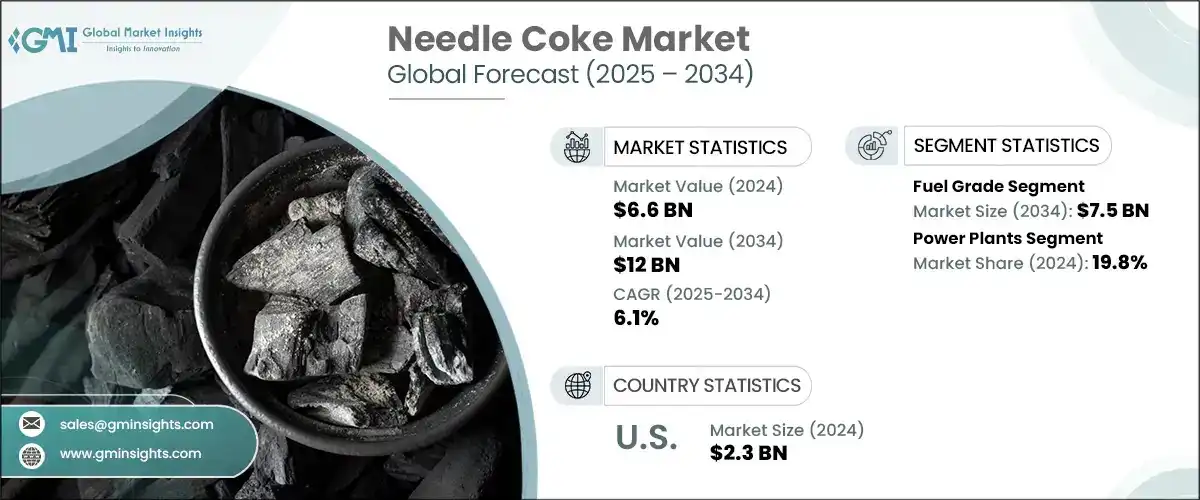
The global needle coke market size was estimated at USD 6.6 billion in 2024. The market is expected to grow from USD 7 billion in 2025 to USD 12 billion in 2034, at a CAGR of 6.1%.
To get key market trends
- The market growth is driven by its integral role in producing graphite electrodes for electric arc furnaces (EAFs) used in steelmaking. It has a high-value premium-grade petroleum coke characterized by its acicular structure and low coefficient of thermal expansion suitable for applications that demand high thermal and electrical conductivity.
- The growing shift toward electric arc furnace-based steel production due to its energy efficiency and lower carbon emissions compared to traditional blast furnace methods has intensified the demand for high-quality graphite electrodes thereby boosting the needle coke market.
- Industry shifts toward cleaner and more sustainable practices marking a pivotal change in raw material consumption patterns within the cement manufacturing process will augment the market landscape. For instance, in March 2024, the U.S. DOE allocated over USD 1.2 billion in funding to four companies aiming to accelerate decarbonization efforts within the cement sector. This initiative is expected to significantly influence the use of petroleum coke, a key raw material in cement production.
- The petroleum-based variant is widely preferred in the steel sector for graphite electrode production due to its high purity and superior structural characteristics. Additionally, coal tar pitch-based needle coke finds niche applications in the nuclear and aerospace industries, where ultra-high thermal stability and low ash content are paramount.
- In North America region, specifically the U.S. steel industry’s shift to electric arc furnace (EAF) technology is a major driver, increasing demand for graphite electrodes made from needle petcoke. Additionally, the EPA’s environmental regulations are encouraging cleaner production methods. Recent investments in refining and electrode manufacturing facilities are strengthening domestic supply chains and supporting the region’s growing energy storage and metallurgical sectors.
- Asia Pacific region is the highest growing market across the globe with countries including China, India, and Japan are leading due to rapid industrialization, EV adoption, and steel production. The region’s demand for ultra-high-power graphite electrodes and lithium-ion batteries is surging. Environmental reforms in China and India are pushing for low-sulfur, high-purity petcoke, while investments in refinery modernization and battery tech are fueling long-term growth.
Needle Coke Market Report Attributes
| Key Takeaway | Details |
|---|---|
| Market Size & Growth | |
| Base Year | 2024 |
| Market Size in 2024 | USD 6.6 Billion |
| Forecast Period 2025 - 2034 CAGR | 6.1% |
| Market Size in 2034 | USD 12 Billion |
| Key Market Trends | |
| Drivers | Impact |
| Positive outlook towards steel & aluminum industry | This leads to increased demand for needle coke, primarily due to its crucial role in producing graphite electrodes. |
| Stringent regulation towards coal adoption | Increase demand for petroleum-based needle coke and encourage innovation in cleaner production methods |
| Pitfalls & Challenges | Impact |
| Supply chain disruptions | Price volatility, production delays, and potential shortages |
| Opportunities: | Impact |
| Surge in Electric Arc Furnace (EAF) adoption | Growing steel production via EAFs increases demand for graphite electrodes made from needle coke. |
| Booming EV and battery market | Needle coke is a critical raw material for anode production in lithium-ion batteries. |
| Refinery upgrades and capacity expansion | Investments in refining technologies to produce low-sulfur, high-purity needle coke. |
| Market Leaders (2024) | |
| Market Leaders |
8% market share |
| Top Players |
Collective market share in 2024 is 30% |
| Competitive Edge |
|
| Regional Insights | |
| Largest Market | North America |
| Fastest Growing Market | Asia Pacific |
| Emerging Country | U.S., China, India, & Brazil |
| Future outlook |
|
What are the growth opportunities in this market?
Needle Coke Market Trends
- The needle coke industry has experienced a dynamic shift in demand and supply equilibrium, largely influenced by macroeconomic factors with industrial developments and geopolitical changes. The increasing urbanization and industrialization in emerging economies have led to a surge in infrastructure projects and automotive manufacturing. Additionally, the growing focus on sustainability and decarbonization of industrial processes is encouraging the adoption of electric arc furnaces thereby creating a favorable landscape for the needle coke market.
- The expanding steel manufacturing industry with the increased adoption of electric arc furnace (EAF) technology are crucial raw materials in the production of graphite electrodes, which are indispensable components in EAF steelmaking. As countries shift towards more energy-efficient and environmentally friendly steel production methods. The global emphasis on decarbonization and cleaner industrial practices has accelerated this shift thereby boosting needle coke market prospects.
- For instance, in February 2024, the Government of Canada announced a funding commitment of USD 50 million to advance clean and dependable nuclear energy projects. This investment supports the utilization of low-grade petroleum coke as a fuel source in power generation facilities, aligning with the objectives of the Federal Electricity Predevelopment Program. The initiative also involves the assessment of a project designed to supply electricity to as many as 4.8 million homes and businesses across Ontario.
- With the rising technological advancements are further influencing market dynamics. Moreover, refineries and carbon material producers are investing in innovation to enhance needle coke production efficiency and reduce environmental impacts. Process optimization and advanced feedstock treatment with sustainable production methods are being integrated to improve yield and quality while aligning tightening regulatory frameworks.
Needle Coke Market Analysis
Learn more about the key segments shaping this market
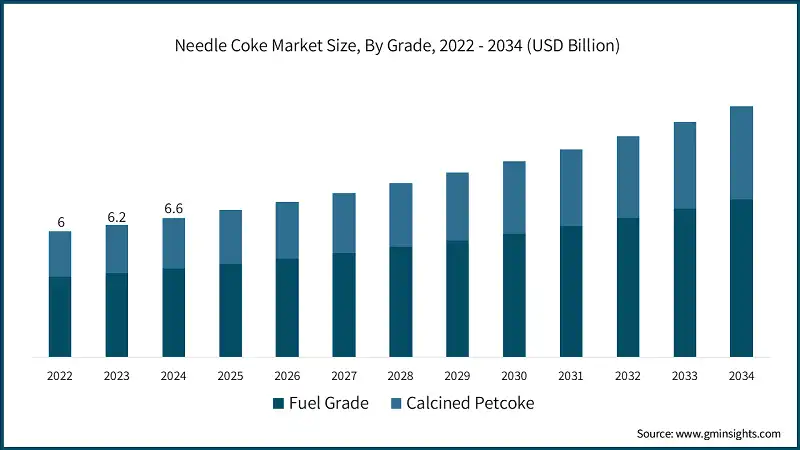
- Based on the grade, the market is bifurcated into fuel grade and calcinated petcoke. The fuel grade petcoke industry is projected to surpass USD 7.5 billion by 2034 and will grow at a CAGR of 6% till 2034.
- The fuel grade coke market is witnessing steady developments shaped by the dynamics of global energy demand, refinery operations, and environmental regulation. Rising technological innovations in emissions control and combustion efficiency are beginning to influence purchasing behavior, as industries look to optimize the use of fuel coke without breaching regulatory limits.
- The transition toward cleaner fuels and renewable energy sources is also beginning to edge out fuel grade coke. Moreover, the fuel grade coke market has a complex landscape where affordability, availability, and regulatory compliance intersect, and the future will depend on how producers and end users adapt to increasingly stringent energy and environmental frameworks.
- The calcinated petcoke market is projected to surpass over USD 4.4 billion by 2034, driven by the vital role in metallurgical and industrial processes, including aluminum smelting, titanium dioxide production, and steel foundries. The need for high-quality calcined coke continues to rise with the titanium dioxide industry utilizing calcined coke in chloride-process pigment manufacturing and contributes significantly to market growth.
Learn more about the key segments shaping this market
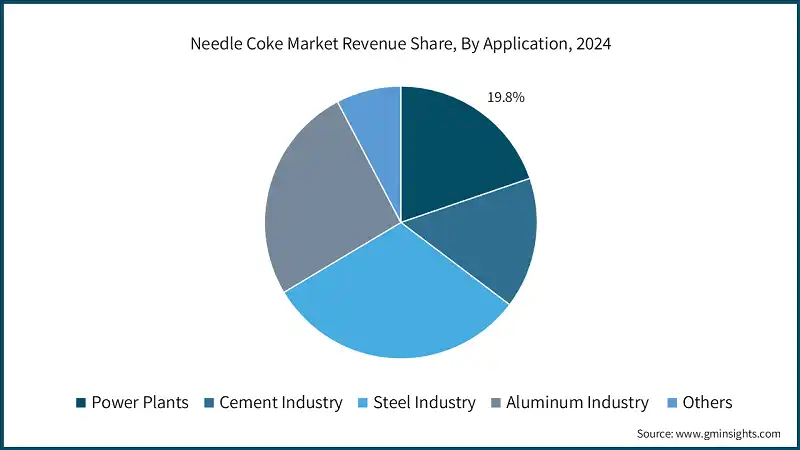
- Based on the application, the needle coke industry is segmented into power plants, cement industry, steel industry, aluminum industry and others. The power plants sector is set to lead with a major market share of 19.8% in 2024 and is set to grow at a CAGR of 6.1% through 2034. The use of needle coke in power plants in advanced energy storage and high-temperature applications is gaining traction amid the evolving energy landscape.
- The role of needle coke in facilitating high-efficiency energy systems has expanded significantly, which are essential for energy storage systems and other high-performance components, is especially relevant in power generation setups requiring high conductivity and thermal resistance. These systems often rely on advanced lithium-ion or alternative batteries where synthetic graphite made from needle coke, is used in anodes. The demand for enhanced thermal conductivity and minimal material degradation makes needle coke a preferred input for creating components resilient to such environments.
- The cement industry application sector continues to grow at a CAGR of 5.6% through 2034. The shift toward using alternative fuels and implementing waste heat recovery systems introduces new challenges in thermal management which further elevates the relevance of needle coke-derived components. Additionally, the integration of digitization and automation in cement manufacturing processes is enhancing the need for materials that offer high reliability and long life under continuous operation adding another layer of opportunity for needle coke applications.
- The steel industry sector is expected to grow at a CAGR of 5.6% till 2034, driven by its critical use in the production of graphite electrodes for electric arc furnaces (EAFs). The demand for high-quality needle coke continues to surge. Graphite electrodes manufactured from needle coke serve as key conduits for electricity in EAFs, enabling the melting of scrap steel and other raw materials with precision and minimal emissions. Additionally, the increasing focus on recycling in steel production which relies heavily on EAFs further drives needle coke consumption.
- The demand for ultra-high-power (UHP) electrodes, which require super-premium-grade needle coke, is expanding in tandem with the production of specialty steels used in aerospace, automotive, and high-tech applications. Innovations in electrode manufacturing with the advancements in coke purification techniques and strategic efforts to ensure feedstock security are shaping a highly dynamic market landscape.
- The aluminum industry is poised to have a steady growth rate and will exceed USD 3.2 billion by 2034, driven by the high purity and crystalline structure of needle coke-derived carbon materials ensure efficient energy transfer with minimal degradation and extended equipment life in aluminum smelting operations. Moreover, the industry's ongoing efforts to reduce environmental impact have prompted investments in advanced smelting technologies and low-carbon production methods, where durable, high-performance cathodes play an essential role.
Looking for region specific data?
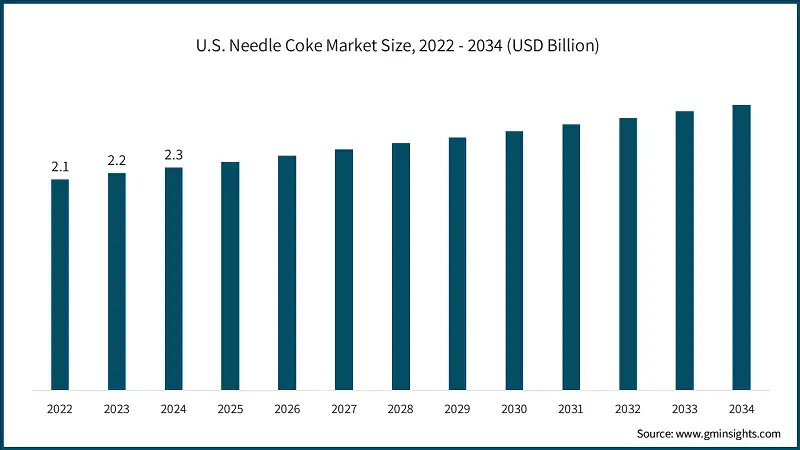
- The U.S. dominated the North America needle coke market with around 94% share and generated a revenue of USD 2.3 billion in 2024. The industry growth is driven by a convergence of industrial modernization, sustainability initiatives and emerging energy technologies. This demand is further reinforced by national energy policies aimed at reducing reliance on imports and accelerating clean energy adoption.
- The U.S.-based companies are investing in refining technologies and production upgrades along with production contracts to enhance output efficiency and quality while reducing environmental impact. For instance, in May 2023, Chevron Lummus Global LLC (CLGand Lummus Technology signed an agreement with TAQAT Development Company of Saudi Arabia, that received a contract to install a new 75,000 TPA needle coke/synthetic graphite complex in Rabigh, Saudi Arabia and the feedstock will be supplied by Rabigh Refining & Petrochemical Company (Petro Rabigh).
- The Europe needle coke market will exceed USD 1.3 billion by 2034, fueled by the focus toward cleaner production processes and energy-efficient technologies. The adoption of electric arc furnaces is gradually replacing older steelmaking methods, thereby maintaining demand for needle coke-based graphite electrodes. Moreover, Europe’s regulatory environment is emphasizing emissions control, resource efficiency, and sustainable supply chains to invest in greener production methods and advanced technologies.
- The Asia pacific needle coke market held a share of 34.7% in 2024, fueled by its industrial depth manufacturing scale and technological advancement. The explosive growth of the electric vehicle sector and renewable energy storage technologies has positioned the region as a key hub for lithium-ion battery manufacturing. Government support for energy transition and sustainable technologies is further strengthening the market's foundation. Additionally, partnerships between battery manufacturers, steel producers, and carbon material suppliers are becoming common, fostering a more integrated supply chain.
- The needle coke market in the Middle East and Africa is gaining momentum as industrialization accelerates and energy diversification strategies which are laying the groundwork for needle coke adoption. For instance, in May 2023, BP plc. had a strategic partnership with Emirates Global Aluminum (EGA) and signed a memorandum of understanding (MoM), to cater services catering to research & develop solutions for reducing the content of carbon dioxide with calcined petroleum coke needs.
- The expansion of steel manufacturing in the Gulf countries along with the plans to integrate electric arc furnace technologies is emerging as a significant demand driver. Moreover, government-led industrial diversification programs in the Gulf Cooperation Council (GCC) states are catalyzing the emergence of downstream industries including carbon materials.
- Latin America is expected to poise steady growth of 4.3% through 2034, driven by the modernization of industrial sectors and a growing emphasis on self-sufficiency in material supply chains. The transition toward more efficient and environmentally responsible production processes. The demand for graphite electrodes and by extension, the needle coke is witnessing steady growth. Moreover, governments across the region are recognizing the importance of advanced materials in supporting broader development goals, including energy infrastructure and electrification.
Needle Coke Market Share
- The top 5 leaders are Exxon Mobil, Valero, Indian Oil Corporation, BP plc, Shell plc are key players that dominate production and supply and caters to over 30% of market share. These companies hold a strong refining and coking infrastructure with a competitive edge, and they can ensure consistent output and meet the stringent purity requirements of end-use applications. Additionally, the growing prominence of regional players alongside traditional global producers and it is maintained through strategic investments in capacity expansion with innovation in production techniques and long-term supply agreements with key consumers.
- Manufacturers in the needle coke market are adopting a range of strategic initiatives to strengthen their market position and respond to shifting industry demands. BP is listed among the key players in the global market, actively investing in R&D and sustainable refining technologies. The rising technological innovation is another major strategy with producers investing in advanced processing techniques to enhance product purity, density, and performance for both electrode and battery-grade applications.
- Strategic partnerships and joint ventures are being formed with downstream users such as battery and electrode manufacturers to ensure long-term demand stability and collaborative product development. Additionally, manufacturers are expanding their global footprint by establishing production facilities or distribution networks in high growth in emerging markets.
Needle Coke Market Companies
- ExxonMobil's needle coke business is a specialized segment within its broader petroleum product portfolio focusing primarily on the production of high-quality, low-sulfur needle coke used in the manufacturing of graphite electrodes. The company leverages advanced refining technologies and delayed coking processes to ensure the consistency and purity of its needle coke output. With strategic investments in upgrading its refineries, the company aims to enhance production efficiency and meet the increasing global demand for premium-grade needle coke, especially from the steel and battery sectors. The annual revenue of the company is USD 339.2 billion in 2024.
- Reliance Industries Limited (RIL) operates in the needle coke business through its petrochemicals division, leveraging its advanced refining infrastructure. The company produces needle coke as a byproduct of its fluid catalytic cracking (FCC) and delayed coking units. The company operates with its broader strategy of value addition within the hydrocarbon chain enhancing integration across its refining and petrochemical segments.
- Chevron leverages its deep expertise in petroleum refining to produce high-quality needle coke used primarily in the manufacturing of graphite electrodes for electric arc furnaces in the steel industry. The company produces needle coke through a delayed coking process that transforms specific feedstocks into a dense low-impurity material with excellent electrical conductivity and thermal stability. The company's consistent focus on product quality with operational efficiency and strategic supply chain management has helped it maintain a strong position in the market. The annual revenue of the company is USD 193.4 billion in 2024.
Major industry players operating across needle coke market include:
- AMINCO RESOURCES
- Bharat Petroleum Corporation Limited
- BP plc
- Cenovus Inc
- Chevron Corporation
- Cocan graphite
- Exxon Mobil Corporation
- Fangda Carbon New Materials Technology Co., Ltd.
- GrafTech International
- Graphite India Limited
- Indian Oil Corporation
- Marathon Petroleum Corporation
- Mitsubishi Chemical Group Corporation
- Oxbow Corporation
- Reliance Industries Limited
- Rain Carbon Inc.
- Saudi Arabian Oil Company (Saudi Aramco)
- Shamokin Carbons
- Shell Plc
- Valero
Needle Coke Industry News
- In May 2025, Saudi Aramco, has announced the signing of 34 Memorandum of Understanding (MoUs) and agreements with major U.S. companies, representing a potential investment of around USD 90 billion. These strategic partnerships span a wide range of sectors including LNG, fuels, chemicals, emission-reduction technologies, manufacturing, and asset management. This move underscores the company’s commitment to strengthening its ties with U.S. firms while driving innovation, sustainability, and long-term value across the energy landscape.
- In February 2025, Saudi Aramco has signed multiple agreements to acquire a 25% equity holds in Unioil Petroleum Philippines, one of the country’s largest petroleum firms. This deal includes the growing high-value fuels market in the Philippines, the deal positions Aramco to secure additional channels for its refined products and reinforces its commitment to long-term growth in Southeast Asia.
- In January 2025, BP Industries has announced USD 20 million investment to restart operations at the Egyptian Anode Blocks Company, marking a strategic move to boost anode production capacity in the region. This revival is expected to drive increased demand for petroleum coke, a critical raw material in anode manufacturing. The facility’s restart not only strengthens the local supply chain but also positions Egypt as a key player in supporting aluminum and metallurgical industries that rely heavily on high-quality petcoke inputs.
- In December 2024, Exxon Mobil unveiled its growth strategy extending through 2030, targeting production of 5.4 million barrels of oil equivalent, with 60% projected to come from its upstream operations. The plan involves securing additional contracts in the Permian Basin and launching two new developments in Guyana. This expansion is expected to significantly boost the availability of fuel-grade petroleum coke which will be employed across various industrial applications throughout the forecast timeframe.
This needle coke market research report includes in-depth coverage of the industry with estimates & forecast in terms of volume (MT) and revenue (USD Billion) from 2021 to 2034 for the following segments:
Market, By Grade
- Fuel grade
- Calcinated petcoke
Market, By Application
- Power plants
- Cement industry
- Steel industry
- Aluminum industry
- Others
The above information has been provided for the following region & countries:
- North America
- U.S.
- Canada
- Europe
- UK
- Italy
- France
- Germany
- Spain
- Asia Pacific
- China
- India
- Japan
- Australia
- Middle East & Africa
- Tunisia
- Turkey
- Morocco
- Latin America
- Brazil
- Argentina
- Chile
- Mexico
Frequently Asked Question(FAQ) :
Who are the key players in the needle coke market?
Key players include AMINCO RESOURCES, Bharat Petroleum Corporation Limited, BP plc, Cenovus Inc, Chevron Corporation, Cocan Graphite, Exxon Mobil Corporation, Fangda Carbon New Materials Technology Co., Ltd., GrafTech International, Graphite India Limited, Indian Oil Corporation, Marathon Petroleum Corporatio.
Which region leads the needle coke market?
The U.S. led the North America needle coke market with a 94% share, generating USD 2.3 billion in 2024.
What are the upcoming trends in the needle coke market?
Key trends include advancements in low-sulfur refining, sustainability-focused production, and the growing EV battery market requiring needle coke for anodes.
What is the growth outlook for the steel industry from 2025 to 2034?
The steel industry is projected to grow at a 5.6% CAGR till 2034, fueled by demand for graphite electrodes in electric arc furnaces (EAFs).
What is the expected market size of the calcinated petcoke market by 2034?
The calcinated petcoke market is expected to exceed USD 4.4 billion by 2034, driven by demand in aluminum smelting, titanium dioxide production, and steel foundries.
What was the size of the global needle coke market in 2024?
The market size was USD 6.6 billion in 2024, with a CAGR of 6.1% expected through 2034, propelled by demand from steelmaking and energy storage sectors.
How much revenue is the fuel grade petcoke market expected to generate by 2034?
The fuel grade petcoke segment is projected to generate over USD 7.5 billion in revenue by 2034, growing at a CAGR of 6% from 2024.
What is the projected value of the needle coke market by 2034?
The needle coke market is projected to reach USD 12 billion by 2034, due to rising adoption of electric arc furnaces (EAFs) for steelmaking.
Needle Coke Market Scope
Related Reports