Summary
Table of Content

Natural Surfactant Market
Get a free sample of this report
Form submitted successfully!
Error submitting form. Please try again.
Thank you!
Your inquiry has been received. Our team will reach out to you with the required details via email. To ensure that you don't miss their response, kindly remember to check your spam folder as well!
Request Sectional Data
Thank you!
Your inquiry has been received. Our team will reach out to you with the required details via email. To ensure that you don't miss their response, kindly remember to check your spam folder as well!
Form submitted successfully!
Error submitting form. Please try again.
Natural Surfactant Market Size
- The market experiences growth because consumers now possess better environmental knowledge. The biodegradable and sustainably sourced ingredient demand is prompting manufacturers in cleaning and personal care and industrial sectors to adopt natural surfactants instead of traditional petrochemical surfactants. The production capacity for natural surfactants expands because corporate sustainability efforts and regulatory requirements create additional market demand which supports the industry growth of natural surfactants.
- The food and beverage sector is experiencing market growth because more natural surfactants are used in its processing operations. Food manufacturers use these ingredients as emulsifiers and stabilizers and dispersing agents because they meet safety standards and clean-label requirements. The rising consumer demand for natural and minimally processed food products is motivating manufacturers to use bio-based functional ingredients. The food processing and packaging industries need more natural surfactants because their applications continue to expand which drives up their market valuation.
- The natural surfactant market expands because the personal care and cosmetics sector uses more natural surfactants. The cosmetic industry uses plant-derived and mild surfactant ingredients because consumers demand ingredient transparency and skin-friendly products and sulfate-free options. Natural surfactants serve as essential components in shampoos and body washes and facial cleansers and skincare products because they provide gentle cleaning while supporting natural cosmetic trends. The market continues to grow because the global beauty and personal care industry keeps expanding.
The global natural surfactant market was estimated at USD 22.5 billion in 2025. It is expected to grow from USD 23.6 billion in 2026 to USD 38.1 billion by 2035, at a CAGR of 5.5%, according to latest report published by Global Market Insights Inc.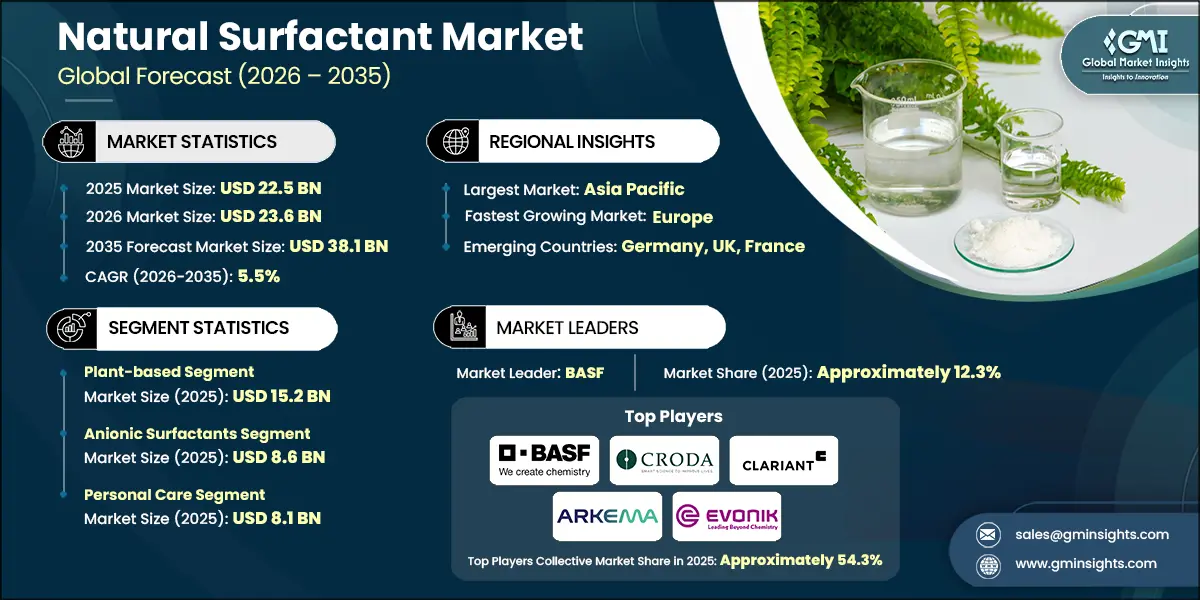
Natural Surfactant Market Key Takeaways
Market Size & Growth
- 2025 Market Size: USD 22.5 Billion
- 2026 Market Size: USD 23.6 Billion
- 2035 Forecast Market Size: USD 38.1 Billion
- CAGR (2026–2035): 5.5%
Regional Dominance
- Largest Market: Asia Pacific
- Fastest Growing Region: Europe
Key Market Drivers
- Growing consumer preference for eco-friendly products.
- Expanding applications in food and beverage sector.
- Rising demand in personal care and cosmetics industries.
Challenges
- High production costs.
- Limited availability of raw materials.
Opportunity
- Expansion of Biosurfactant Production through Biotechnology.
- Rising Demand for Sustainable Ingredients in Personal Care and Home Care Products.
Key Players
- Market Leader: BASF led with over 12.3% market share in 2025.
- Leading Players: Top 5 players in this market include BASF, Croda International, Clariant, Arkema Group, Evonik Industries, which collectively held a market share of 54.3% in 2025.
Get Market Insights & Growth Opportunities
To get key market trends
Natural Surfactant Market Trends
- Manufacturers are increasingly shifting toward plant-derived and biodegradable surfactants to address growing environmental concerns and regulatory requirements. The consumer market wants sustainable personal care and household cleaning products which compels companies to use natural surfactants from renewable vegetable oils and sugar feedstocks.
- Scientists now use advanced fermentation technology together with biotechnology methods to produce biosurfactants which include rhamnolipids and sophorolipids. Companies develop fermentation plants together with research partnerships to create products which have higher yield and lower production expenses and better product performance. Natural surfactants now find more industrial and consumer product applications because of these product innovations.
- The increased consumer understanding of product ingredients together with their interest in clean-label items leads to higher usage of natural surfactants in cosmetic products and shampoo formulas and body wash products and home cleaning materials. Manufacturers develop sulfate-free surfactant solutions which deliver skin-friendly environmental protection together with effective cleansing results.
Natural Surfactant Market Analysis
Learn more about the key segments shaping this market
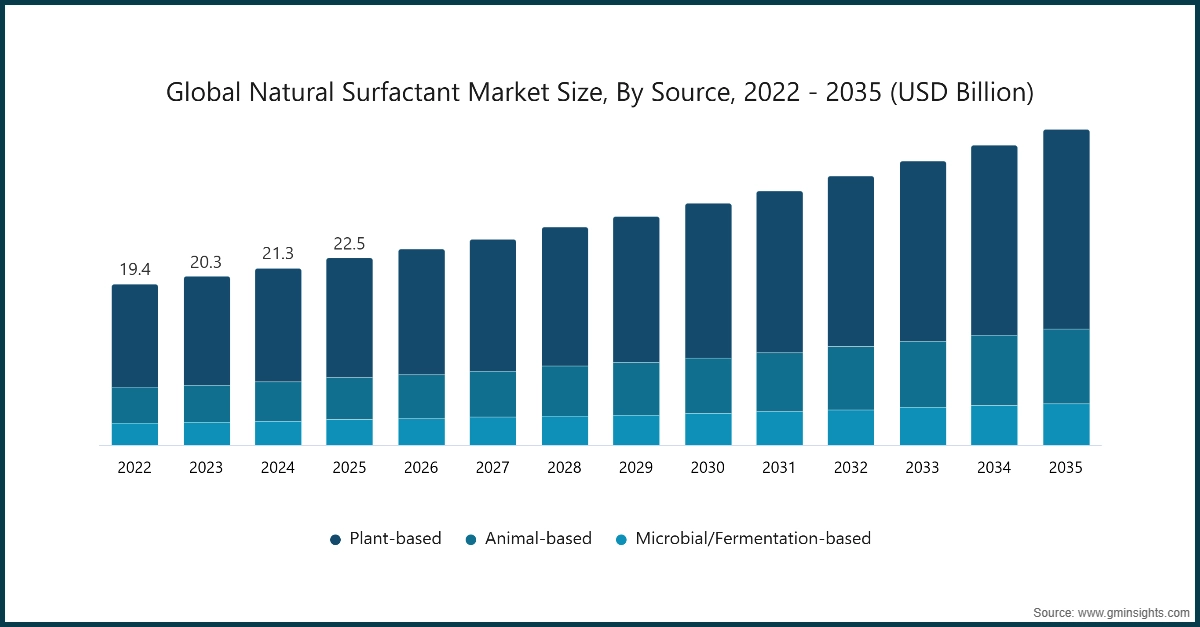
- The natural surfactant market shows strong preference for renewable raw materials because plant-based materials become popular due to their wide availability and affordable prices and their ability to meet sustainability targets. Surfactants from vegetable oils and coconut oil and sugar-based feedstocks find common usage in personal care products and household cleaning agents and industrial product development. The market for animal-derived products exists in specific applications which require them but their use remains restricted because regulations control their use and consumers increasingly choose products without animal testing and vegan certifications.
- The biotechnology field has developed fermentation production methods which now show increasing potential because of better scales of operation and enhanced production capabilities. Microbial processes enable the production of high-purity biosurfactants with strong biodegradability and low toxicity profiles. The fermentation technology continuous funding together with microbial strain research funding helps businesses grow their operations.
Based on Product, the natural surfactant market is segmented into anionic surfactants, cationic surfactants, nonionic surfactants, and amphoteric surfactants. Anionic surfactants holds a significant share at a valuation of USD 8.6 billion in 2025.
- The market demonstrates diverse demand patterns across surfactant chemistries, with anionic variants widely utilized due to their strong cleansing, foaming, and emulsifying properties. The surfactants serve as essential components in detergents and shampoos and industrial cleaning formulations which require their high surface activity. Nonionic surfactants are experiencing strong growth because they provide excellent stability and mildness while being compatible with various formulation systems for use in personal care products and agricultural products and industrial products.
- Cationic surfactants sustain their constant market demand because they provide conditioning properties and disinfectant capabilities which consumers need in fabric softeners and hair conditioners and antimicrobial products. The personal care industry increasingly adopts amphoteric surfactants because they deliver balanced performance which minimizes skin irritation while maintaining stable foam production. Product development across these surfactant categories receives a boost from ongoing formulation innovation and the rising need for multifunctional environmentally friendly ingredients which manufacturers now create.
Learn more about the key segments shaping this market
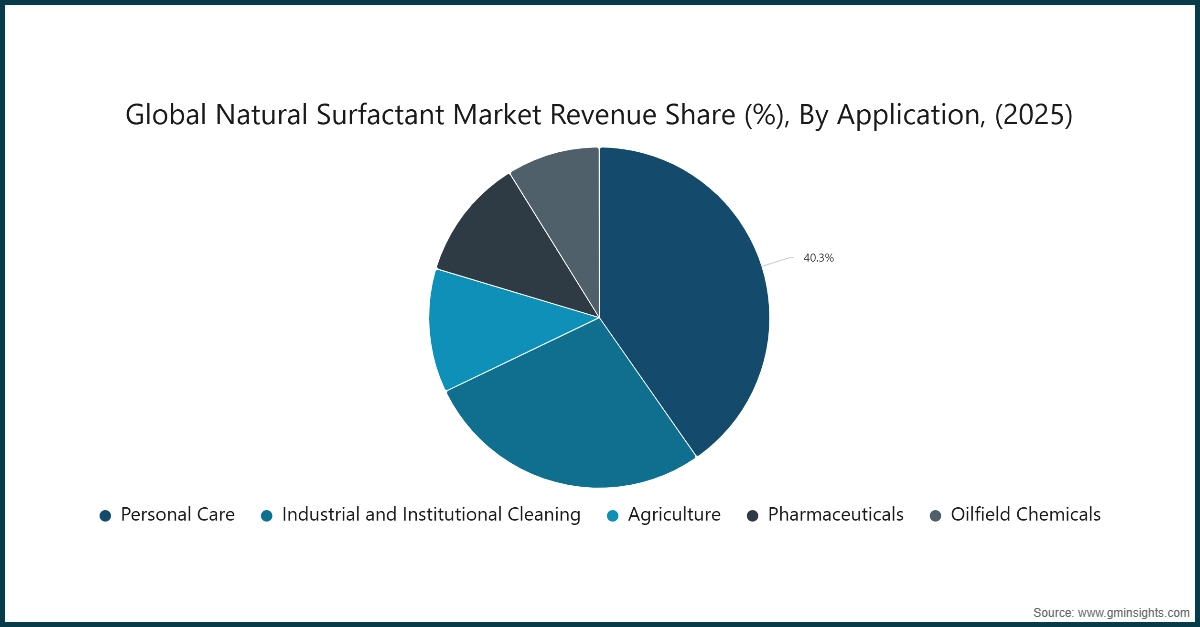
Based on application, the natural surfactant market is segmented into personal care, industrial and institutional cleaning, agriculture, pharmaceuticals, oilfield chemicals, others (textile, food & beverage). Personal care is estimated to grasp a value of USD 8.1 billion in 2025.
- The market shows high utilization levels across various application areas especially in personal care products where consumers seek gentle biodegradable materials for their shampoo and body wash and skincare product needs. The adoption of green cleaning methods by businesses leads to rising demand for industrial and institutional cleaning services which now include environmentally friendly solutions for commercial and medical and hospitality cleaning needs. Natural surfactants have found increasing usage in agriculture because they improve pesticide performance through their role as spreading and wetting and penetration agents in agricultural chemicals.
- Natural surfactants serve pharmaceutical applications as emulsifying and solubilizing agents for drug delivery systems and medical formulations. The oilfield chemicals segment is also exploring bio-based surfactants for enhanced oil recovery and environmentally compatible drilling fluids. The textile and food processing industries are now adopting these surfactants for their processing and cleaning needs because they want to use sustainable and biodegradable functional ingredients which have become popular across different industrial fields.
Looking for region specific data?
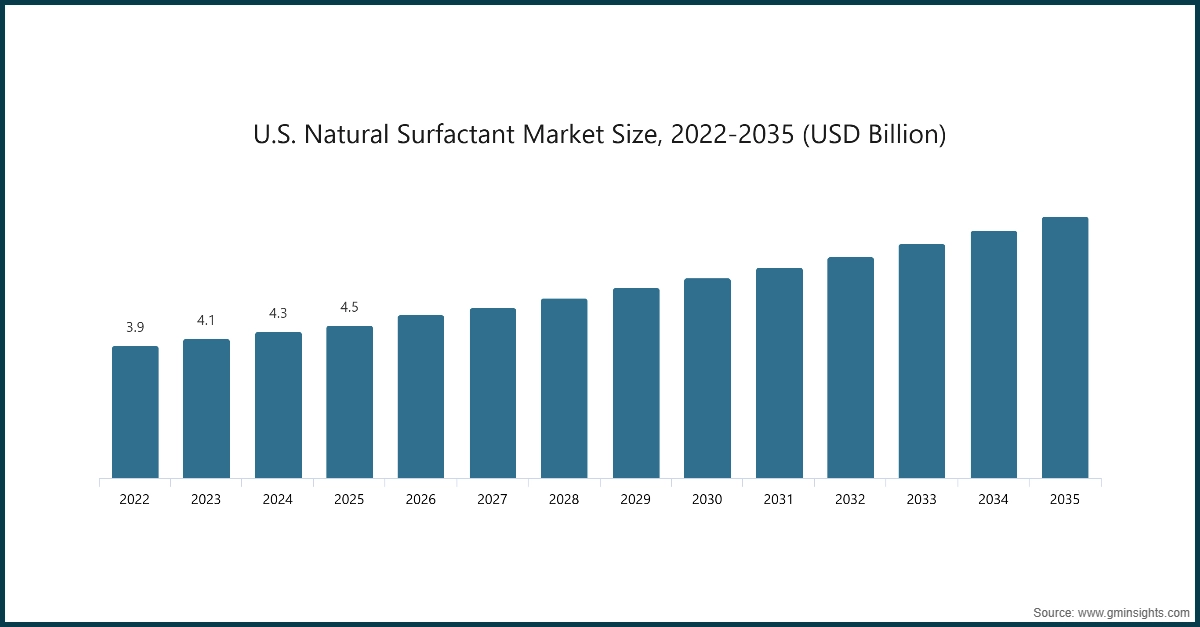
North America accounted for USD 5.5 billion in 2025 and is anticipated to show lucrative growth over the forecast period.
- The North American natural surfactant market shows continuous growth because people want sustainable biodegradable products which they can use in personal care and home care and industrial cleaning products. The United States holds the largest market share because consumers know about eco-friendly products and there are strict environmental laws and advanced chemical factories operate in the country. The plant-based surfactant market in Canada shows increasing growth because natural cosmetic brands become more popular and companies create eco-friendly products.
- Biotechnology investment growth together with fermentation-based surfactant production expansion drives the current regional growth momentum. Natural surfactants become more popular because their application range now includes household cleaning and oilfield chemicals and environmental remediation. Companies are working to create sustainable supply chains through which they can obtain renewable feedstock from sources like vegetable oils and bio-based materials. Chemical manufacturers and biotechnology companies increase their partnerships which leads to new product development and more production facilities that help all North American markets to grow.
Europe accounted for USD 7 billion in 2025 and is anticipated to show lucrative growth over the forecast period.
- The European natural surfactant market shows strong growth because sustainability regulations create market demand and green chemistry solutions become widely accepted by businesses. Germany holds a significant share in the region due to its well-established chemical manufacturing base, technological capabilities, and strong demand from detergents and personal care industries. The French and United Kingdom markets make significant market contributions because consumers increasingly prefer organic cosmetics and eco-friendly cleaning products which retail stores and industrial operations provide.
- The market benefits from regulatory frameworks which support the use of biodegradable and renewable chemical ingredients. The increasing funding for biosurfactant research and fermentation technology development leads to faster product innovation. Natural surfactants now find new applications in agricultural and cosmetic and industrial cleaning product markets. Sustainability initiatives which promote low-carbon production and renewable raw material usage drive continuous market growth across Europe.
Asia Pacific market accounted for USD 8 billion in 2025 and is anticipated to show lucrative growth over the forecast period.
- The natural surfactant market in Asia Pacific shows fast growth because industrial development increases and people want sustainable chemical ingredients. China holds a major market share because its chemical manufacturing industry produces large volumes of detergents while manufacturers increasingly use bio-based materials in their products. The growing urban population in India together with rising hygiene awareness and increased household and personal care product consumption leads to major market growth.
- The market grows because detergent manufacturers and agrochemical companies and personal care product makers need more products. Manufacturing natural surfactants through agricultural feedstock availability of vegetable oils becomes an economical process. Governments are implementing initiatives to promote sustainable chemical production and support biotechnology research and development.
Latin America market accounted for 5.5% market share in 2025 and is anticipated to show steady growth over the forecast period.
- The natural surfactant market in Latin America shows steady growth because agricultural and personal care and cleaning product industries demand more bio-based ingredients. Brazil maintains a significant market position because its agricultural sector produces sugarcane and vegetable oils which serve as renewable feedstocks. The household cleaning product manufacturing expansion together with the rising consumer preference for sustainable formulations leads to increased adoption in Mexico.
- Regional growth occurs because industries expand their production of bio-based chemicals and their physical manufacturing capabilities. The market will expand because agricultural adjuvants and personal care products and industrial cleaning products will increase their demand. Production capacity receives support from renewable raw materials and climate conditions which enable feedstock cultivation.
Middle East and Africa market accounted for 3.2% market share in 2025 and is anticipated to show steady growth over the forecast period.
- The natural surfactant market in the Middle East & Africa is expanding as businesses adopt chemical formulations that comply with environmental protection standards. South Africa accounts for a notable share due to its relatively developed chemical manufacturing sector and growing demand for biodegradable surfactants in detergents and industrial cleaning products. The United Arab Emirates and Saudi Arabia are also witnessing rising demand supported by expanding hospitality, healthcare, and infrastructure sectors.
- The region experiences growth because companies are increasing their investments in water treatment and environmental remediation and industrial cleaning services. The market experiences gradual development because oilfield operations and agriculture and institutional cleaning services need surfactants for their operations. The government initiatives focus on sustainability while they work to create better environmental management systems.
Natural Surfactant Market Share
The natural surfactant industry exhibits moderate consolidation because multiple global specialty chemical companies control most of the market revenue. The key players in the industry are BASF SE Croda International Plc Clariant AG Arkema Group and Evonik Industries AG. The top five companies together held about 54.3% market share in 2025 as their product lines and manufacturing skills and global distribution systems enabled them to compete effectively. Their research capabilities and their existing partnerships with major end-use industries which include personal care and detergents and industrial cleaning products strengthen their market position.
The companies maintain their market position by developing new bio-based surfactants and building sustainable production methods. Companies in the market are increasing their biotechnology investments as they pursue development of biodegradable surfactants through microbial fermentation and renewable raw material sourcing. The companies build their market position by establishing strategic partnerships and developing new products and expanding their production capacity and their partnerships with cosmetic and home-care manufacturers. The projects enable companies to create unique products while they build better supply chain operations to meet growing demand for eco-friendly surfactant products.
Natural Surfactant Market Companies
Major players operating in natural surfactant industry are:
- BASF
- Dow
- Croda International
- Clariant
- Stepan Company
- Kao Corporation
- WHEATOLEO
- Arkema Group
- Evonik Industries
- Innovative Chemical Technologies
- SEPPIC
BASF supplies natural and bio-based surfactants which serve personal care products home care items and industrial product development. The company provides plant-derived surfactants which include alkyl polyglucosides and palm-based ingredients obtained from certified sustainable feedstocks. The company develops biosurfactant technologies through partnership work and product launches which include Plantapon® Soy and sophorolipid-based ingredients. BASF allocates significant funding to sustainable production methods while developing fermentation-based surfactants which address increasing market demand for biodegradable cleaning products and cosmetic substances.
Croda International produces natural surfactants which have superior performance and use renewable raw materials that include vegetable oils and bio-ethanol. The ECO surfactant range provides fully bio-based surfactants which decrease fossil feedstock dependency while delivering exceptional performance for formulations. The company develops products for use in personal care products and home care products and industrial applications and coatings. Croda uses biotechnology together with renewable feedstocks to provide sustainable sulfate-free solutions which cosmetic and cleaning products require.
Clariant supplies personal care products and home care products and industrial applications with its natural and bio-based surfactants. The company uses rapeseed oil and castor oil to build its Vita surfactant range which has an elevated renewable carbon index and a smaller carbon footprint. Clariant develops sustainable chemistry solutions while sourcing bio-feedstocks from local regions to achieve emission reductions and supply chain improvements. The company increased its market share in green surfactants through its ongoing product development and building new facilities in Asia.
Arkema Group uses its specialty chemicals and advanced materials portfolio to compete in the natural surfactant industry through its green chemistry-focused business Kilo Tons and subsidiaries. The company creates surfactants and additives which originate from bio-based feedstocks to use in coatings and agrochemicals and personal care products. Arkema focuses on sustainable chemistry by using renewable materials and developing technologies which produce low carbon emissions. The company develops innovations which meet the rising demand for eco-friendly surfactants in industrial applications and consumer products.
Evonik Industries develops advanced biosurfactants which serve personal care products and cleaning products and industrial applications. The company develops microbial surfactants which include rhamnolipids and sophorolipids that result from fermentation-based production methods. Evonik built industrial biosurfactant production sites throughout the world with its main European facility to meet sustainable ingredient needs. The products provide an eco-friendly solution because they achieve high biodegradability and low toxicity while performing at a high level which replaces traditional synthetic surfactants.
Natural Surfactant Market Report Attributes
| Key Takeaway | Details |
|---|---|
| Market Size & Growth | |
| Base Year | 2025 |
| Market Size in 2025 | USD 22.5 Billion |
| Market Size in 2026 | USD 23.6 Billion |
| Forecast Period 2026-2035 CAGR | 5.5% |
| Market Size in 2035 | USD 38.1 Billion |
| Key Market Trends | |
| Drivers | Impact |
| Growing consumer preference for eco-friendly products | Accelerates adoption of biodegradable surfactants, expanding demand across consumer and industrial formulations. |
| Expanding applications in food and beverage sector | Broadens application scope, supporting incremental market growth through functional ingredient demand. |
| Rising demand in personal care and cosmetics industries | Strengthens consumption of mild and plant-derived surfactants in premium personal care formulations. |
| Pitfalls & Challenges | Impact |
| High production costs | Limits price competitiveness compared to synthetic surfactants, potentially restricting large-scale adoption. |
| Limited availability of raw materials | Creates supply chain constraints and price volatility for natural surfactant production. |
| Opportunities: | Impact |
| Expansion of Biosurfactant Production through Biotechnology | Enhances production efficiency and scalability, supporting wider commercial adoption. |
| Rising Demand for Sustainable Ingredients in Personal Care and Home Care Products | Drives product innovation and increases market penetration of natural surfactant formulations. |
| Market Leaders (2025) | |
| Market Leader |
Market Share Approximately 12.3% |
| Top Players |
Collective Market Share Approximately 54.3% |
| Competitive Edge |
|
| Regional Insights | |
| Largest Market | Asia Pacific |
| Fastest growing market | Europe |
| Emerging countries | Germany, UK, France |
| Future outlook |
|
What are the growth opportunities in this market?
Natural Surfactant Industry News
- In June 2023: BASF SE is set to start new production lines in Bangpakong, Thailand, and Cincinnati, Ohio, to meet rising global demand for bio-based and biodegradable surfactants.
- In February 2022: Clariant unveils its new Vita 100% bio-based surfactants and polyethylene glycols (PEGs) to help directly address climate change by helping remove fossil carbon from the value chain.
The natural surfactant market research report includes in-depth coverage of the industry with estimates & forecast in terms of revenue (USD Billion) & volume (Kilo Tons) from 2022 to 2035, for the following segments:
Market, By Source
- Plant‑based
- Animal‑based
- Microbial/Fermentation‑based
Market, By Product
- Anionic Surfactants
- Cationic Surfactants
- Nonionic Surfactants
- Amphoteric Surfactants
Market, By Application
- Personal Care
- Industrial and Institutional Cleaning
- Agriculture
- Pharmaceuticals
- Oilfield Chemicals
- Others (Textile, food & Beverage)
The above information is provided for the following regions and countries:
- North America
- U.S.
- Canada
- Europe
- UK
- Germany
- France
- Italy
- Spain
- Rest of Europe
- Asia Pacific
- China
- India
- Japan
- South Korea
- Australia
- Rest of Asia Pacific
- Latin America
- Brazil
- Mexico
- Argentina
- Rest of Latin America
- MEA
- UAE
- Saudi Arabia
- South Africa
- Rest of Middle East and Africa
Frequently Asked Question(FAQ) :
What is the market size of the natural surfactant in 2025?
The market size was USD 22.5 billion in 2025, with a CAGR of 5.5% expected through 2035. Increasing consumer awareness of environmental sustainability and demand for biodegradable surfactants are driving market growth.
What is the projected value of the natural surfactant market by 2035?
The market is poised to reach USD 38.1 billion by 2035, supported by advancements in biotechnology, regulatory mandates, and growing demand for eco-friendly products.
What is the expected size of the natural surfactant industry in 2026?
The market size is projected to reach USD 23.6 billion in 2026.
What was the valuation of the plant-based surfactant segment in 2025?
The plant-based surfactant segment was valued at USD 15.2 billion in 2025, led by its wide availability, cost-effectiveness, and alignment with sustainability goals.
What was the valuation of the anionic surfactant segment in 2025?
The anionic surfactant segment held a valuation of USD 8.6 billion in 2025, propelled by its strong cleansing, foaming, and emulsifying properties.
What is the growth outlook for the personal care application segment?
The personal care segment is projected to grow significantly, reaching a valuation of USD 8.1 billion in 2025, as consumers increasingly prefer gentle, biodegradable materials for personal care products.
Which region leads the natural surfactant sector?
North America leads the market, with a valuation of USD 5.5 billion in 2025. The United States dominates the region due to high consumer awareness, stringent environmental regulations, and advanced chemical manufacturing capabilities.
What are the upcoming trends in the natural surfactant market?
Advanced fermentation, sulfate-free solutions, biosurfactants, and plant-based products are driving market trends.
Who are the key players in the natural surfactant industry?
Key players include BASF, Dow, Croda International, Clariant, Stepan Company, Kao Corporation, WHEATOLEO, Arkema Group, Evonik Industries, Innovative Chemical Technologies, and SEPPIC.
Natural Surfactant Market Scope
Related Reports