Summary
Table of Content

Natural and Organic Cosmetics Market
Get a free sample of this report
Form submitted successfully!
Error submitting form. Please try again.
Thank you!
Your inquiry has been received. Our team will reach out to you with the required details via email. To ensure that you don't miss their response, kindly remember to check your spam folder as well!
Request Sectional Data
Thank you!
Your inquiry has been received. Our team will reach out to you with the required details via email. To ensure that you don't miss their response, kindly remember to check your spam folder as well!
Form submitted successfully!
Error submitting form. Please try again.
Natural and Organic Cosmetics Market Size
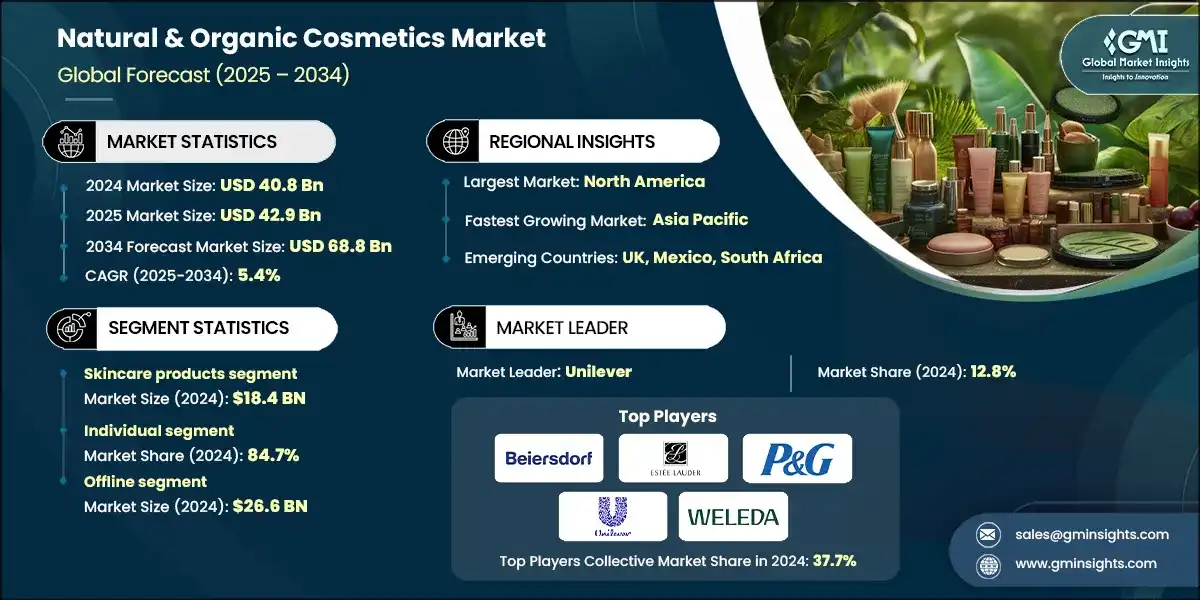
The global natural and organic cosmetics market was estimated at USD 40.8 billion in 2024. The market is expected to grow from USD 42.9 billion in 2025 to USD 68.8 billion in 2034, at a CAGR of 5.4% according to latest report published by Global Market Insights Inc.
Natural and Organic Cosmetics Market Key Takeaways
Market Size & Growth
- 2024 Market Size: USD 40.8 billion
- 2025 Market Size: USD 42.9 billion
- 2034 Forecast Market Size: USD 68.8 billion
- CAGR (2025–2034): 5.4%
Regional Dominance
- Largest Market: North America
- Fastest Growing Region: Asia Pacific
Key Market Drivers
- Increasing demand for clean-label and transparent ingredients.
- Growth of e-commerce and influencer marketing.
- Regulatory support for natural formulations.
Challenges
- High cost of natural ingredients and production.
- Limited shelf life and preservation issues.
Opportunity
- Expansion into emerging markets.
- Innovation in sustainable packaging and circular beauty.
Key Players
- Market Leader: Unilever led with over 12.8% market share in 2024.
- Leading Players: Top 5 players in this market include Beiersdorf, Estée Lauder, Procter & Gamble, Unilever, Weleda, which collectively held a market share of 37.7% in 2024.
Get Market Insights & Growth Opportunities
The market for natural and organic cosmetics is growing quickly in the global beauty and personal care industry, which is one of the strongest and most reliable markets around the world. This growth is because more people are choosing products that are clean, eco-friendly, and made with ethical practices. In 2023, the organic personal care market saw a 12% increase, showing that more people want products made with natural ingredients.
People are moving away from synthetic ingredients and are choosing products that match their health goals and care for the environment. Studies show that 63% of consumers think "clean beauty" is very or extremely important when buying cosmetics. Also, 68% of consumers look for products with clean ingredients, according to Elchemy. Plus, 47% of consumers are willing to pay more for sustainable products, as found by noissue. This change in how people shop is because they are more aware of health issues and want brands to be honest and transparent. Social media helps spread these ideas and makes companies more accountable, as noted by OSF Digital.
Rules and guidelines from governments and industry groups are also helping this market grow. They are creating clear standards to make sure products are safe and that companies do not make false claims. In the European Union, certifications like COSMOS and ECOCERT are commonly used for standards for natural and organic products. However, there is not one global standard, which makes it hard for companies to sell in different countries and can lead to different trust levels in various regions.
Even with these challenges, the market keeps growing because of several important reasons.
More consumers are thinking carefully about what they buy, and online platforms help them learn about a brand's values and how ingredients are used. This awareness is a big reason the market is expanding. Also, progress in green chemistry and biotechnology is helping by offering innovative solutions that make products better, longer-lasting, and more eco-friendly. Examples include better plant-based preservatives and bioengineered active ingredients, which let companies meet consumer needs without lowering quality or safety.
The trend of focusing on wellness, along with marketing by influencers, is also making natural and organic cosmetics more popular, especially among younger people. Governments are also actively helping the shift towards natural and organic cosmetics. Policy initiatives such as grants for sustainable packaging, funding for research and development in plant-based ingredients, and support for women-led beauty businesses help brands grow responsibly. For example, the European Commission has allocated USD 1.5 billion in 2023 by its Horizon Europe program to support sustainability-focused R&D projects, including those in the cosmetics sector.
To get key market trends
Natural and Organic Cosmetics Market Trends
The natural and organic cosmetics industry is witnessing a significant transformation in packaging approaches, driven by consumer demand for environmental responsibility.
- According to CleanHub, 81% of people think brands should use less plastic packaging, which has boosted the popularity with environmentally friendly materials like glass and biopolymers over traditional ones such as wood, aluminum, and plastic, according to ScienceDirect. There is a growing preference for products with simpler formulas that can serve multiple purposes
- This trend is driven by a desire for effective, ingredient-efficient products that reduce resource use. ScienceDirect highlights that this approach leads to better results while minimizing water and energy consumption. Brands are now offering 2-in-1 products that meet various beauty or skincare needs.
- E-commerce is allowing brands to provide personalized product options and custom formulas. Advances in manufacturing and ingredient extraction, along with digital tools that track a product’s journey, have made it easy with customers to understand exactly what they are purchasing, as reported by RTI International.
- Consumers are placing more emphasis on facial and body care products, especially those with transparent ingredient lists and natural components. The skincare segment is expanding due to increased awareness of harmful chemicals in conventional products and a desire for natural alternatives that address anti-aging concerns.
Natural and Organic Cosmetics Market Analysis

Learn more about the key segments shaping this market
Based on type, the natural and organic cosmetics market is divided into skincare products, haircare products, color cosmetics & makeup, oral care products and others (fragrances etc.). In 2024, skincare products held the major market share, generating a revenue of USD 18.4 billion.
- This shows a strong demand for natural alternatives to traditional haircare products like shampoos, conditioners, and styling items. People are choosing products that support healthy hair without the use of harsh chemicals. This segment includes various products designed for different hair types and concerns, often made with natural ingredients such as argan oil, coconut oil, and plant-based extracts.
- Skincare products are growing because people are more aware of health and sustainability. About 68% of people look for products that have clean, safe ingredients. This category includes items like facial cleansers, moisturizers, serums, and treatments made with natural ingredients like herbs, oils, and plant-based compounds. New products in this area often do more than one thing—like clean, moisturize, and treat the skin—while still using natural and safe formulas.
- Haircare products are the second biggest part of the market, with a 28.1% share and a 5.4% growth rate each year. This shows that more people want natural options for their hair instead of traditional shampoos, conditioners, and styling products. People are choosing products without harsh chemicals like sulfates and parabens because they want to keep their hair healthy without damage. This group has products tailored for diverse types of hair and concerns, using natural ingredients such as argan oil, coconut oil, and plant-based extracts.
Learn more about the key segments shaping this market
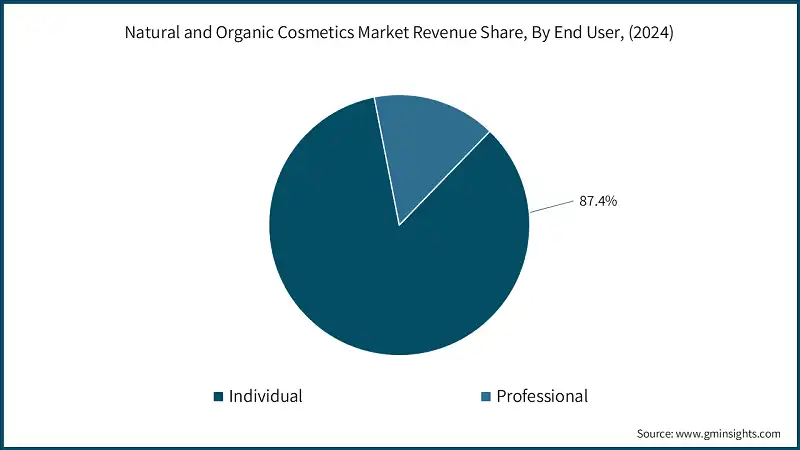
Based on end user, the natural and organic cosmetics market is segmented into individual and professional. The individual segment held the largest share, accounting for 84.7% of the market in 2024.
- In the field of natural and organic cosmetics, the individual end user assumes a prominent role in navigating product development and brand positioning. Contemporary consumers are no longer passive purchasers they are knowledgeable, value-driven participants seeking products that align with their individual beliefs about health, sustainability, and ethics. Many consumers are now searching for cosmetics that are free from synthetic chemicals, and cruelty-free, and utilize responsibly sourced ingredients. These shifts have created a demand for transparency in product claims, with users looking for easily interpreted labels, visible supply chains for ingredients, and certifications that substantiate natural or organic product claims.
- Individually engaged end users are also influenced by digital platforms, directed by peer reviews, influencers, and brand stories in their purchasing decisions. Consumers are searching for personalized solutions to suit their unique skin type, lifestyle, and values; as such, brands are more consistently pursuing more inclusive, customizable, and technologically enabled solutions where subscription-based "clean" beauty boxes or artificial intelligence skin diagnostic tools could become possibilities. As end-users become more engaged and discerning, those preferences continue to shape the industry towards more accountability, innovation, and authenticity.
Based on the distribution channel, the natural and organic cosmetics market is segmented into online and offline. In 2024, offline segment held a major market share, generating a revenue of USD 26.6 billion.
- Stores like beauty shops, department stores, pharmacies, and supermarkets help people in diverse ways. They let customers try products before buying, feel good about making a purchase right away, and talk to staff who know a lot about the products.
- Specialty natural and organic stores are especially helpful because they carefully choose their products and have staff who can teach customers about the brands and help them find the right items. According to the National Retail Federation, 78% of people still like shopping in stores for makeup because they can touch and see the products, which is a big part of their decision
- Online shopping is growing because of many reasons. It is easy to buy things from home, there are lots of products to choose from, and websites often suggest items you might like. Social media also plays a role by helping brands reach more people and letting customers connect with them. A report from the U.S. Census Bureau says that in 2023, online sales made up 15.4% of all retail sales, which is more than in earlier years. Younger generations, like Millennials and Gen Z, are driving this change because they like doing things online and prefer the convenience of shopping digitally.
Looking for region specific data?
North America Natural and Organic Cosmetics Market
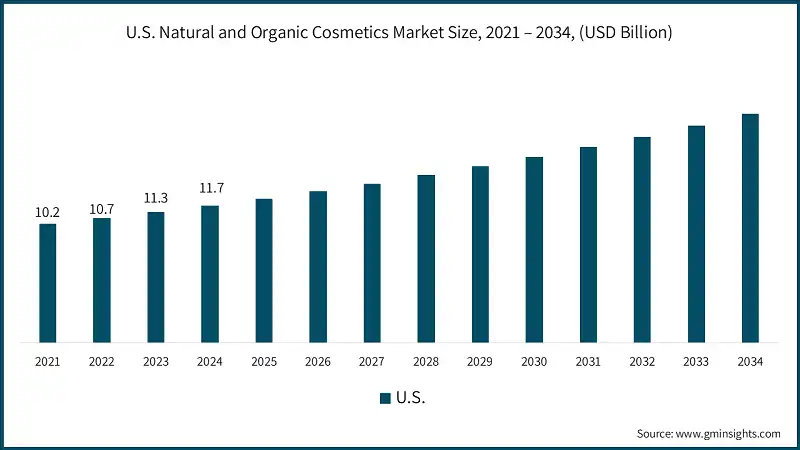
In 2024, the U.S. dominated the North America market, accounting for around 81.8% and generating around USD 11.8 billion revenue in the same year.
- The North American market for natural and organic cosmetics is one of the most mature and innovation-driven globally. Consumers in the U.S. and Canada are highly informed and increasingly demand transparency, sustainability, and ethical sourcing in their beauty products.
- This has led to a surge in clean beauty brands and a strong presence of certifications like USDA Organic and Leaping Bunny. The region benefits from advanced R&D capabilities and a robust retail infrastructure, including both brick-and-mortar and e-commerce channels. However, competition is intense, and brands must continuously innovate to maintain relevance in a market saturated with options.
Europe Natural and Organic Cosmetics Market
Europe market, Germany leads the market with 19.1% share in 2024 and is expected to grow at 6.3% during the forecast period.
- Europe is a leader in regulatory standards and consumer advocacy for natural and organic cosmetics. The market is shaped by stringent regulations such as COSMOS and ECOCERT, which have helped build consumer trust and set high benchmarks for product quality and sustainability.
- Countries like Germany, France, and the Nordics are particularly strong in this segment, with a long-standing cultural preference for herbal and botanical skincare. European consumers are also highly eco-conscious, driving demand for zero-waste packaging and ethical sourcing. The region’s regulatory rigor, combined with a sophisticated consumer base, makes it a hub for premium and certified organic beauty products.
Asia Pacific Natural and Organic Cosmetics Market
The Asia Pacific leads the market; China leads with market share of around 3% in 2024 and is anticipated to grow with a CAGR of around 6.1% from 2025 to 2034.
- Asia-Pacific is the fastest-growing market for natural and organic cosmetics, fueled by rising disposable incomes, urbanization, and a growing awareness of skin health. Countries like South Korea, Japan, and Australia are leading innovation in clean beauty, often blending traditional ingredients with modern formulations.
- In Southeast Asia and India, demand is also rising for Ayurvedic and herbal products, reflecting cultural preferences for natural remedies. While regulatory frameworks are still evolving, the region is seeing increased investment in certification and sustainable practices. The diversity of consumer needs and rapid digital adoption make Asia-Pacific a fertile ground for both global and local brands to expand.
Middle East and Africa Natural and Organic Cosmetics Market
Middle East and Africa markets are growing at a CAGR of 4.4% during the forecast period.
- The MEA market for natural and organic cosmetics is steadily gaining traction, shaped by a blend of cultural traditions, rising health awareness, and a growing preference for sustainable beauty.
- Consumers in countries like the UAE, Saudi Arabia, and South Africa are increasingly drawn to products that incorporate indigenous ingredients such as argan oil, black seed, and shea butter often rooted in local beauty rituals. The demand for halal-certified natural cosmetics is also a unique driver in the region, especially in Gulf countries, where religious compliance influences purchasing decisions.
Natural and Organic Cosmetics Market Share
Unilever are leading with 12.8% market share. Beiersdorf, Estée Lauder, Procter & Gamble, Unilever and Weleda collectively hold around 37.7%, indicating moderately fragmented market concentration. These prominent players are proactively involved in strategic endeavors, such as mergers & acquisitions, facility expansions & collaborations, to expand their product portfolios, extend their reach to a broad customer base, and strengthen their market position.
- Beiersdorf, known for brands like NIVEA and Eucerin, has been steadily expanding its natural skincare portfolio through innovation and acquisitions. Its competitive edge lies in dermatological expertise and a strong R&D foundation, which it leverages to create scientifically backed natural formulations.
- Estée Lauder stands out for its premium positioning and ability to blend luxury with clean beauty. Through brands like Origins and Aveda, it has built a strong foothold in the natural and organic segment. Its edge lies in brand storytelling, high-performance botanical ingredients, and a loyal global customer base.
Natural and Organic Cosmetics Market Companies
Major players operating in the natural and organic cosmetics industry are:
- Beiersdorf
- Burt's Bees
- Coty
- Dr. Hauschka
- Estée Lauder
- Haus Labs
- Herbivore Botanicals
- Johnson & Johnson
- Josie Maran Cosmetics
- L'Oréal
- Procter & Gamble
- True Botanicals
- Unilever
- Wala Heilmittel
- Weleda
P&G’s strength in the natural cosmetics space comes from its scale, marketing power, and ability to maintain clean beauty. With brands like Herbal Essences and Native, it has successfully introduced natural products to mass-market audiences.
Unilever has positioned itself as a sustainability leader in the beauty industry, with brands like Love Beauty and Planet and Simple driving its natural cosmetics strategy. Its edge lies in its deep commitment to environmental and social responsibility, backed by transparent sourcing and climate-conscious initiatives.
Weleda is a pioneer in the natural and organic cosmetics space, with a legacy rooted in holistic wellness and biodynamic farming. Its competitive edge lies in authenticity, certified organic formulations, and a loyal niche following.
Natural and Organic Cosmetics Market Report Attributes
| Key Takeaway | Details |
|---|---|
| Market Size & Growth | |
| Base Year | 2024 |
| Market Size in 2024 | USD 40.8 billion |
| Market Size in 2025 | USD 42.9 billion |
| Forecast Period 2025 - 2034 CAGR | 5.4% |
| Market Size in 2034 | USD 68.8 billion |
| Key Market Trends | |
| Drivers | Impact |
| Increasing demand for clean-label and transparent ingredients | The clean-label movement is fundamentally reshaping product formulations as consumers examine ingredient lists favoring organic and toxin-free formulations according to OSF Digital. Regulatory pressure from governments tightening restrictions on harmful ingredients is supporting this trend. |
| Growth of e-commerce and influencer marketing | E-commerce expansion is enabling global product availability and personalized recommendations, significantly amplifying market reach. Influencer marketing is playing a crucial role in increasing awareness and consumer acceptance of natural and organic cosmetics. |
| Regulatory support for natural formulations | Government initiatives are creating favorable conditions for natural cosmetics growth. The EUs comprehensive cosmetics regulation bans thousands of potentially harmful substances while the US maintains fewer restrictions as per Sustainable Closet. FDA guidance on natural and clean labeling, though not formally regulated, provides framework for market development according to RTI International. |
| Pitfalls & Challenges | Impact |
| High cost of natural ingredients and production | Natural ingredient production requires significant resource intensity, with examples like lavender oil production using approximately 20 liters of water and 4 megajoules of energy per gram according to Science Focus. |
| Limited shelf life and preservation issues | Preservation challenges arise as many effective preservatives as possible conflict with natural branding requirements. Microbiological contamination risk increases from biological burden in natural formulations as per Covalo, while raw material variability due to climate, soil, and seasonal factors affects product composition consistency. |
| Opportunities: | Impact |
| Expansion into emerging markets | Rising middle-class populations in regions like Asia-Pacific, Latin America, and Africa are increasingly seeking healthier lifestyle choices, including clean beauty products. |
| Innovation in sustainable packaging and circular beauty | As environmental concerns grow, consumers are demanding eco-friendly packaging and refillable solutions. Brands that invest in biodegradable materials, zero-waste systems, and closed-loop production models can differentiate themselves and build long-term loyalty. |
| Market Leaders (2024) | |
| Market Leaders |
12.8% market share |
| Top Players |
The collective market share in 2024 is 37.7% |
| Competitive Edge |
|
| Regional Insights | |
| Largest market | North America |
| Fastest growing market | Asia Pacific |
| Emerging countries | UK, Mexico, South Africa |
| Future outlook |
|
What are the growth opportunities in this market?
Natural and Organic Cosmetics Market News
- In 2025, Burt’s Bees deepened its sustainability efforts in 2025, focusing on zero-waste production, biotech-enhanced natural formulations, and regenerative agriculture. It partnered with rePurpose Global to tackle ocean plastic in Ghana and India and launched a new booster skincare line combining natural ingredients with biotech actives like niacinamide and ceramides.
- In September 2025, Coty announced a strategic overhaul in late 2025, integrating its Prestige and Mass Fragrance divisions to form a unified scenting powerhouse. It launched a strategic review of its Consumer Beauty segment, including brands like CoverGirl and Rimmel, exploring options such as divestitures or spin-offs. The company is doubling down on fragrance and skincare innovation, aiming to strengthen its clean beauty portfolio and improve profitability through focused brand elevation and operational efficiency.
- In October 2024, L'Oréal announces strategic partnership with Abolis Biotechnologies and Evonik focusing on sustainable ingredient development and biotechnology applications for natural cosmetics formulations.
- In July 2024, USDA reports certification of over 1,500 new organic personal care products in 2023, demonstrating robust market activity and regulatory compliance in North American natural cosmetics sector.
The natural and organic cosmetics market research report includes in-depth coverage of the industry with estimates & forecasts in terms of revenue (USD Billion) and volume (Million Units) from 2021 to 2034, for the following segments:
Market, By Product Type
- Skincare products
- Face creams & moisturizers
- Cleansers & makeup removers
- Serums & anti-aging
- Sunscreens & uv protection
- Toners & essences
- Others (exfoliators & scrubs etc.)
- Haircare products
- Shampoos & conditioners
- Hair oils
- Styling products
- Hair coloring & dyes
- Others (scalp care products etc.)
- Color cosmetics & makeup
- Lipsticks & lip care
- Foundations & concealers
- Eye makeup & mascara
- Nail polish
- Others (blushes & bronzers etc.)
- Oral care products
- Toothpaste & tooth powders
- Mouthwash & oral rinses
- Others (teeth whitening products etc.)
- Others (fragrances etc.)
Market, By Ingredients
- Plant-based & botanical
- Essential oils
- Plant extracts & herbal
- Fruit & vegetable derivatives
- Others (flower & petal extracts etc.)
- Mineral-based
- Clays & earth minerals
- Sea salts & mineral salts
- Mineral pigments & colorants
- Marine-derived ingredients
- Seaweed & algae extracts
- Others (marine collagen & proteins etc.)
- Biotechnology-derived natural ingredients
- Others (certified organic agricultural etc.)
Market, By Consumer Group
- Men
- Women
- Unisex
Market, By Price
- Low
- Medium
- High
- Premium
Market, By End Use
- Individual
- Professional
- Beauty salons
- Spa & wellness centers
- Medical professionals
- Hotel & resort
- Others (beauty institutes etc.)
Market, By Distribution Channel
- Online
- E-commerce
- Company website
- Offline
- Specialty Stores
- Pharmacies
- Others (departmental stores, etc.)
The above information is provided for the following regions and countries:
- North America
- U.S.
- Canada
- Europe
- Germany
- UK
- France
- Italy
- Spain
- Asia Pacific
- China
- India
- Japan
- Australia
- South Korea
- Latin America
- Brazil
- Mexico
- Argentina
- Middle East and Africa
- South Africa
- Saudi Arabia
- UAE
Frequently Asked Question(FAQ) :
What is the market size of the natural and organic cosmetics in 2024?
The market size was USD 40.8 billion in 2024, with a CAGR of 5.4% expected through 2034, driven by increasing consumer demand for environmentally friendly and multifunctional products.
What is the projected value of the natural and organic cosmetics market by 2034?
The market is expected to reach USD 68.8 billion by 2034, fueled by trends such as sustainable packaging and ingredient-efficient formulations.
What is the projected size of the natural and organic cosmetics market in 2025?
The market is expected to reach USD 42.9 billion in 2025.
How much revenue did the skincare products segment generate?
Skincare products generated USD 18.4 billion in 2024, holding the largest market share among product types.
What was the valuation of the offline distribution channel segment?
The offline distribution channel held a major market share, generating USD 26.6 billion in 2024.
Which region leads the natural and organic cosmetics market?
In 2024, the U.S. dominated the North American market, accounting for 81.8% of the regional share and generating USD 11.8 billion in revenue.
What are the upcoming trends in the natural and organic cosmetics industry?
Key trends include the adoption of sustainable packaging materials like glass and biopolymers, a preference for multifunctional products with simpler formulas, and a focus on reducing resource consumption in product development.
Who are the key players in the natural and organic cosmetics market?
Key players include Beiersdorf, Burt's Bees, Coty, Dr. Hauschka, Estée Lauder, Haus Labs, Herbivore Botanicals, Johnson & Johnson, and Josie Maran Cosmetics.
Natural and Organic Cosmetics Market Scope
Related Reports