Summary
Table of Content

Nasal Spray Market
Get a free sample of this report
Form submitted successfully!
Error submitting form. Please try again.
Thank you!
Your inquiry has been received. Our team will reach out to you with the required details via email. To ensure that you don't miss their response, kindly remember to check your spam folder as well!
Request Sectional Data
Thank you!
Your inquiry has been received. Our team will reach out to you with the required details via email. To ensure that you don't miss their response, kindly remember to check your spam folder as well!
Form submitted successfully!
Error submitting form. Please try again.
Nasal Spray Market Size
Growth is primarily driven by the rising burden of respiratory and allergic conditions, including allergic rhinitis and chronic sinusitis. Increasing pollution levels, rapid urbanization, and an aging population are contributing to a higher incidence of nasal congestion and allergy-related disorders, thereby increasing the demand for nasal spray therapies across both mature and emerging markets.
Comorbid respiratory diseases such as asthma and COPD are further boosting the adoption of nasal spray products. According to the WHO, asthma affects over 262 million people globally, reinforcing the need for intranasal therapies. Patients with these chronic conditions rely heavily on nasal sprays for symptomatic relief and management, supporting consistent demand for steroid and antihistamine-based products.
Nasal Spray Market Key Takeaways
Market Size & Growth
- 2025 Market Size: USD 28.1 Billion
- 2026 Market Size: USD 29.9 Billion
- 2035 Forecast Market Size: USD 60.4 Billion
- CAGR (2026–2035): 8.1%
Regional Dominance
- Largest Market: North America
Key Market Drivers
- Increase in prevalence of chronic respiratory diseases and nasal disorders.
- Rising demand for non-invasive drug delivery methods.
- Shift toward over the counter (OTC) products.
Challenges
- Risk of overuse leading to rebound congestion.
- Side effects and contraindications with prolonged use.
Opportunity
- Expansion of nasal delivery for systemic and CNS therapies.
- Rising focus on non-invasive pediatric drug delivery.
Key Players
- Market Leader: Haleon led with over 4.4% market share in 2025.
- Leading Players: Top 5 players in this market include Haleon, Bayer, Emergent BioSolutions, Cipla, Pfizer, which collectively held a market share of 12% in 2025.
Get Market Insights & Growth Opportunities
The nasal spray market encompasses products designed for intranasal delivery of medications or solutions, for treatment and management of respiratory conditions, allergies, congestion, and other nasal ailments, including both prescription and over-the-counter formulations. Key players operating in this market include Bayer, Cipla, Pfizer, Emergent BioSolutions, and Haleon. These players play an essential role in market growth by introducing innovative formulations, expanding therapeutic indications, and strengthening global accessibility through robust manufacturing and distribution networks. Their strategic focus on research and development has enabled the launch of advanced nasal spray technologies such as preservative-free systems, metered-dose devices, and intranasal biologics and vaccines. Additionally, collaborations, regulatory approvals, and geographic expansion initiatives undertaken by these companies enhance product availability, improve patient compliance, and support the overall growth and competitiveness.
The nasal spray market witnessed considerable growth between 2022 and 2024, growing from USD 23.8 billion to USD 26.5 billion. This growth was attributed to the rising global prevalence of allergic rhinitis and sinusitis, increasing incidence of respiratory infections, and growing patient preference for non-invasive drug delivery methods that offer rapid onset of action. Additionally, expanding availability of over-the-counter nasal sprays, continuous product innovation such as preservative-free and metered-dose formulations, and heightened awareness regarding self-care for cold and allergy management further supported market expansion during this period.
The global nasal spray market was estimated at USD 28.1 billion in 2025. The market is expected to grow from USD 29.9 billion in 2026 to USD 60.4 billion in 2035, growing at a CAGR of 8.1% during the forecast period, according to the latest report published by Global Market Insights Inc.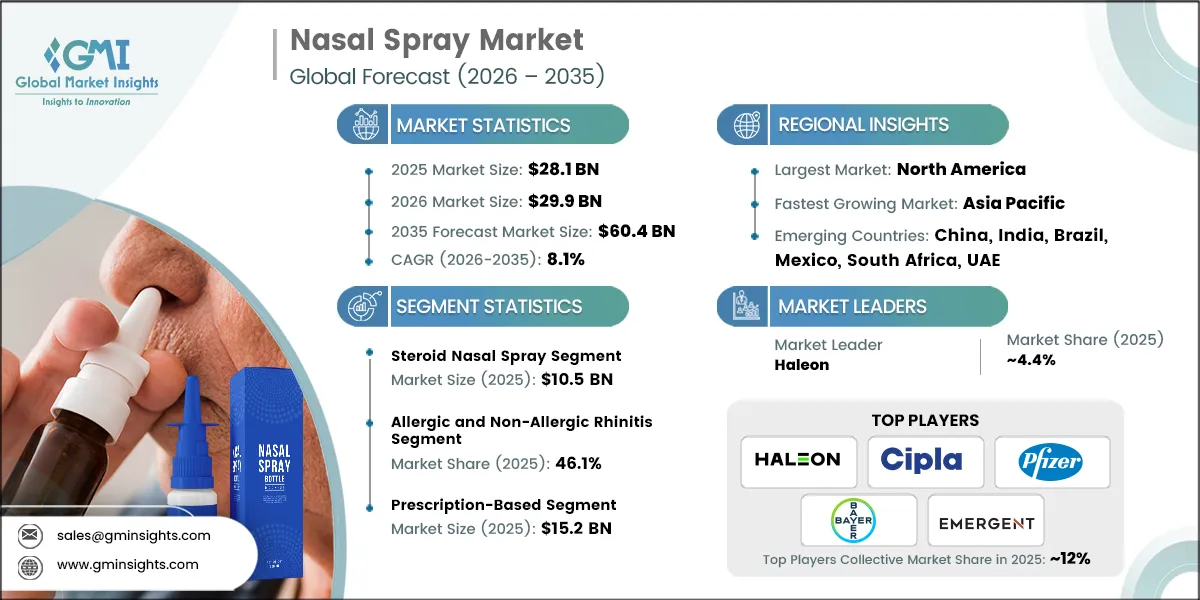
To get key market trends
Nasal Spray Market Trends
- The rising prevalence of chronic respiratory diseases and nasal disorders is a key driver of growth in the nasal spray industry. Conditions such as asthma, allergic rhinitis, sinusitis, and chronic obstructive pulmonary disease (COPD) require effective and accessible treatments, and nasal sprays provide a convenient, non-invasive method for symptom management.
- The Centers for Disease Control and Prevention (CDC) estimated that around 25 million citizens in the U.S. are living with asthma, out of which 5.1 million are children. Allergic rhinitis tends to affect almost 20 million adults on a yearly basis, which drives the need for respiratory-targeted therapies.
- Moreover, the World Health Organization (WHO) indicated that chronic respiratory diseases are affecting millions of people worldwide, which is mostly seen in low and middle-income countries, creating a need for effective and rapid inhalation nasal sprays. These systems deliver intranasal corticosteroids and antihistamines that are commonly used in allergic rhinitis.
- Furthermore, the nasal route is gaining attention in the treatment of neurological and psychiatric disorders due to its ability to bypass the blood-brain barrier. According to the National Institutes of Health (NIH), ongoing clinical studies are evaluating intranasal delivery of drugs such as sumatriptan and midazolam for conditions like Parkinson’s disease, epilepsy, and migraine, highlighting its potential as a less invasive alternative to traditional approaches.
- In the area of mental health, the intranasally administered form of esketamine, which was approved by the FDA in 2019, is actively being implemented for the treatment of resistant depression, signifying advancements made in nasal-targeted central nervous system drug delivery.
- Also, the WHO has pointed out the need for more research on the use of intranasal vaccines for respiratory viruses such as influenza, with multiple candidates in development for mucosal immunity enhancement.
- Lastly, improved patient and healthcare provider satisfaction, ease of use, rapid onset of action, and reduced systemic side effects make nasal sprays a preferred treatment option, thereby contributing to market growth.
Nasal Spray Market Analysis

Learn more about the key segments shaping this market
Based on the product type, the market is segmented into steroid nasal spray, antihistamine nasal spray, decongestion nasal spray, saline nasal spray, and other product types. The steroid nasal spray segment dominated the market with USD 10.5 billion in 2025.
- The steroid nasal spray category captures a notable share of the market because of its capability to treat inflammation-causing diseases such as allergic rhinitis, sinusitis, and nasal polyps.
- The National Institutes of Health (NIH) stated that allergic rhinitis affects between 10% - 30% of the world's population, which amplifies the importance of effective steroid nasal sprays for inflammation management.
- These corticosteroids containing sprays provide relief from irritation and swelling of the nose while having a minimal effect elsewhere in the body, making them helpful for long durations.
- On the other hand, the antihistamine nasal spray segment is anticipated to witness growth at a CAGR of 8.4% over the analysis period.
- This growth is attributed to the increasing prevalence of allergic rhinitis, rapid onset of symptom relief offered by intranasal antihistamines, rising patient preference for targeted local therapy with fewer systemic effects, and expanding availability of combination antihistamine formulations that enhance treatment efficacy and convenience.

Learn more about the key segments shaping this market
Based on the application, the market is divided into sinusitis, allergic and non-allergic rhinitis, nasal polyps, and other applications. The allergic and non-allergic rhinitis segment accounted for a significant market share of 46.1% in 2025.
- The allergic and non-allergic rhinitis segment accounted for a high share of the nasal spray market due to the substantial global disease burden and the chronic, recurrent nature of these conditions, requiring ongoing symptom management.
- Allergic rhinitis affects nearly 400 million people worldwide, with prevalence continuing to rise due to urbanization, environmental pollution, and climate change, which lengthen pollen seasons and increase allergen exposure. The Global Asthma Network estimates that allergic rhinitis impacts 10%–30% of adults and up to 40% of children, reinforcing the strong need for effective intranasal treatments.
- Nasal sprays represent a first-line therapeutic approach for both allergic and non-allergic rhinitis because they provide targeted local drug delivery, rapid relief from nasal congestion, itching, and rhinorrhea, and reduced systemic side effects compared with oral therapies.
- In addition, strong clinical guideline support for intranasal corticosteroids, antihistamines, and combination sprays, along with widespread OTC availability and high patient awareness, further reinforces the dominant contribution of this segment to overall market revenue.
- The sinusitis segment captures the second highest share of the nasal spray market citing the high rates of acute and chronic sinus infections worldwide. For example, the CDC states that around 28.9 million adults in America suffer from sinusitis, highlighting the rising need for more effective therapies in this area.
- Sinusitis, characterized by inflammation of the sinus lining, often requires localized treatment for symptom relief and infection control.
- The use of corticosteroids, saline solutions, and other decongestant nasal sprays enables effective inflammation control, nasal clearing, and congestion relief, which provides non-invasive relief.
- Further, innovation in drug formulation and delivery systems has improved treatment outcomes and compliance among patients, which contributes positively to market expansion.
Based on the patient type, the nasal spray market is segmented into adults, pediatrics, and infants. The adult segment dominated the market in 2025 and is expected to reach 36.9 billion by 2035.
- The adult segment in the nasal spray industry represents a significant share, due to rising cases of allergic rhinitis, sinusitis, and nasal obstruction in adults. This segment benefits from the high demand for over-the-counter (OTC) nasal sprays, offering convenience and immediate relief from symptoms.
- Adults often seek formulations targeting seasonal allergies, chronic sinus conditions, or colds, including decongestants, antihistamines, and corticosteroid sprays.
- Additionally, changing lifestyles combined with worsening pollution in urban areas intensifies the respiratory problems, which in turn, promotes market expansion.
Based on the type, the market is divided into prescription-based, and over-the-counter (OTC). The prescription-based segment dominated the market with USD 15.2 billion in 2025.
- The prescription-based segment in the nasal spray market includes treatments requiring medical authorization such as chronic or severe cases, such as allergic rhinitis, sinusitis, and nasal obstruction.
- These sprays are usually a mix of corticosteroids and decongestants or antihistamines that are used for symptom management. Prescription sprays are favored for their efficacy and long-term use in controlled environments.
- Growth in this segment is driven by the increasing prevalence of respiratory diseases, greater access to healthcare, and improvements in systems for administering drugs through the nose.
- The OTC segment, on the other hand, is expected to witness rapid growth at a CAGR of 8.6% over the forecast period. This growth is driven by increasing consumer preference for self-medication, easy accessibility of OTC nasal sprays through pharmacies and retail channels, rising awareness of allergy and cold management, and continuous product innovation, such as preservative-free and combination formulations that enhance convenience and patient adherence.
Based on the distribution channel, the nasal spray market is divided into retail pharmacies, hospital pharmacies, and online pharmacies. The retail pharmacies segment dominated the market with USD 13.5 billion in 2025.
- Retail pharmacies play a significant role in the market by ensuring accessibility and convenience for consumers. These outlets, including standalone and chain pharmacies, cater to the growing demand for nasal sprays for allergies, colds, and sinusitis.
- Retail pharmacies offer both prescription and over-the-counter (OTC) drugs and often serve as the first point of contact for patients seeking symptomatic relief.
- Their widespread presence, coupled with pharmacists' advice, enhances market penetration and supports the growth of this distribution channel.

Looking for region specific data?
North America Nasal Spray Market
The North America held the largest market share of 35% in 2025 in the global nasal spray industry and is anticipated to expand at 7.7% CAGR over the forecast period.
- North America held a high share in the nasal spray market owing to the region’s high prevalence of allergic rhinitis, sinusitis, and respiratory disorders, coupled with strong awareness regarding early symptom management and self-care.
- The presence of well-established healthcare infrastructure and establishment of strong distribution channels by market players, extensive availability of both prescription and OTC nasal spray products, and favorable reimbursement frameworks further support market dominance.
- Additionally, advanced healthcare infrastructure, strong retail pharmacy networks, and continuous product innovation, including combination sprays and preservative-free formulations, contribute to sustained adoption and revenue generation across the region.
The U.S. nasal spray market was valued at USD 7.8 billion and USD 8.2 billion in 2022 and 2023, respectively. The market size reached USD 9.1 billion in 2025, growing from USD 8.6 billion in 2024.
- The U.S. market for nasal sprays is fueled by the high incidence of allergic rhinitis, sinusitis, and other respiratory ailments. The strategic ease of access to both prescription and OTC nasal sprays, coupled with advanced healthcare solutions, is driving market growth.
- Moreover, the presence of developed healthcare systems alongside the popularity of drug delivery devices in the form of nasal sprays further enhances market growth.
- Additionally, innovative corticosteroid-based and saline spray formulations fulfil varied consumer needs.
- Further, the shift toward self-care and non-invasive procedures boosts demand, strengthening the U.S. position as a leader in the global market.
Europe Nasal Spray Market
The Europe market was valued at USD 8.3 billion in 2025 and is anticipated to witness strong growth over the forecast period.
- Europe accounts for a significant share of the nasal spray market, supported by the high prevalence of allergic rhinitis affecting approximately 20–30% of the European population, creating sustained demand for intranasal therapies.
- In addition, widespread availability of OTC nasal sprays across community pharmacies, strong clinical guideline recommendations for intranasal corticosteroids as first-line treatment, and high healthcare expenditure in countries such as Germany, France, and the UK contribute to regional dominance.
- The presence of leading pharmaceutical manufacturers, robust regulatory frameworks ensuring product quality, and growing adoption of advanced formulations further reinforce Europe’s substantial revenue contribution to the global market.
The Germany nasal spray market is experiencing robust growth in Europe.
- The advancement in the pharmaceutical industry, along with the high spending on various healthcare services in the country, drives the growth in Germany’s nasal spray market.
- Additionally, the growing prevalence of seasonal allergies and respiratory disorders in the older generations drives the demand for nasal sprays.
- Moreover, with a strong retail pharmacy network and growing e-commerce channels, Germany continues to lead in European nasal spray sales, emphasizing non-invasive, easy-to-use solutions to address respiratory and nasal issues.
Asia Pacific Nasal Spray Market
The Asia Pacific market is expected to witness strong growth, growing at a CAGR of 8.9% between 2026 - 2035.
- The Asia Pacific region is projected to witness high growth in the nasal spray market due to the rapidly increasing prevalence of allergic rhinitis, sinusitis, and air pollution-related respiratory conditions across densely populated countries such as China and India.
- Expanding healthcare infrastructure, rising disposable incomes, and improving access to OTC medications are enabling greater adoption of nasal spray therapies.
- Additionally, growing awareness of self-care practices, increasing penetration of retail pharmacy chains and e-commerce platforms, and the presence of cost-effective regional manufacturers are further supporting strong market expansion across the region.
India is expected to witness notable growth in the nasal spray market, driven by the substantial burden of allergic and respiratory conditions and supportive public health trends.
- Government-linked evidence indicates that allergic rhinitis affects a considerable proportion of the population, with studies reporting a prevalence of approximately 20–30% in India, while pediatric data show 11% prevalence in children aged 6–7 years and about 24% in adolescents, highlighting a large patient pool.
- In addition, India faces a significant respiratory disease burden with an estimated 37.5 million asthma cases, further reinforcing demand for intranasal therapies for symptom management.
- Coupled with increasing urbanization, air pollution exposure, expanding pharmacy access, and rising awareness of allergy management, these factors collectively support the expanding adoption of nasal sprays across the country.
Latin America Nasal Spray Market
The Brazil market is experiencing robust growth in Latin America nasal spray market.
- In Brazil, the growth is driven by increased urban pollution, tropical climate conditions, and the large number of people suffering from sinus problems.
- Increased use of nasal sprays as an OTC medicine and improved healthcare services also contribute to market growth.
- Pharmaceutical companies provide an array of low-cost products to consumers through retail pharmacy chains.
- Increased awareness of preventive healthcare, especially in addressing pollution-related disorders, further contributes to the expansion of nasal spray usage across different demographics in Brazil.
Middle East and Africa Nasal Spray Market
The Saudi Arabia market is witnessing substantial growth in Middle East and Africa during the analysis period.
- The Saudi Arabian nasal spray market is supported by increased focus on respiratory health in dry regions with high dust and allergens. The growth of the market is driven by the increased use of OTC nasal sprays and saline solutions to treat dryness and irritation.
- Additionally, the government’s investment in healthcare infrastructure and rising per capita healthcare expenditure enhanced access to modern nasal care products.
- Moreover, the popularity of online retail channels expands market reach, further driving the adoption of nasal sprays in the country.
Nasal Spray Market Share
The competition landscape of the nasal spray industry is highly fragmented, with top 5 companies in the market, such as Bayer, Cipla, Pfizer, Emergent BioSolutions, and Haleon, accounting for approximately 12% of the market share in 2025. These companies have maintained their dominance through innovations in intranasal drug delivery, fast-acting formulations, and expanding therapeutic applications, addressing the rising demand for efficient, non-invasive treatments.
Additionally, firms are broadening their portfolios with preservative-free systems, CNS-targeted sprays, and precision dosing technologies to enhance treatment outcomes and patient compliance. For example, Pfizer and Novartis focus on developing advanced nasal therapies for neurological disorders and migraines, while Haleon and Bayer lead in allergies and decongestant sprays. Companies are also investing in novel excipient systems to improve safety and efficacy. These strategic advancements are fueling market expansion and intensifying competition across the global nasal spray industry.
Nasal Spray Market Companies
Prominent players operating in the nasal spray industry are as mentioned below:
- ARS Pharmaceuticals
- AstraZeneca
- Aurena Laboratories
- Bayer
- Church & Dwight
- Cipla
- COSWELL
- Dr. Reddy’s Laboratories
- EMERGENT
- Haleon
- J Pharmaceuticals
- Leeford Healthcare
- Pfizer
- Sanofi
- Sun Pharmaceutical
- Teva Pharmaceutical
- Viatris
Haleon is a key player in the nasal spray market, accounting for ~4.4% of the market. Haleon plays a key role in the nasal spray market through its strong consumer healthcare portfolio and widely recognized OTC allergy and cold relief brands, supported by extensive retail and pharmacy distribution networks that enhance product accessibility and adoption.
Bayer contributes to market growth with its diversified consumer health offerings and established presence in cold and allergy management, leveraging strong brand equity and pharmacy channel penetration to maintain steady demand for nasal spray products.
Nasal Spray Market Report Attributes
| Key Takeaway | Details |
|---|---|
| Market Size & Growth | |
| Base Year | 2025 |
| Market Size in 2025 | USD 28.1 Billion |
| Market Size in 2026 | USD 29.9 Billion |
| Forecast Period 2026-2035 CAGR | 8.1% |
| Market Size in 2035 | USD 60.4 Billion |
| Key Market Trends | |
| Drivers | Impact |
| Increase in prevalence of chronic respiratory diseases and nasal disorders | Expands the patient pool requiring symptomatic relief and maintenance therapy, thereby driving higher nasal spray demand. |
| Rising demand for non-invasive drug delivery methods | Encourages adoption of nasal sprays as convenient, painless alternatives to injectable or oral therapies, supporting market growth. |
| Shift toward over the counter (OTC) products | Improves product accessibility and self-medication trends, leading to increased sales volumes and market penetration. |
| Pitfalls & Challenges | Impact |
| Risk of overuse leading to rebound congestion | Limits long-term use and clinician recommendation due to rebound congestion risk, thereby moderately restraining sustained product adoption. |
| Side effects and contraindications with prolonged use | Raises safety concerns and regulatory scrutiny, potentially limiting sustained adoption of certain formulations. |
| Opportunities: | Impact |
| Expansion of nasal delivery for systemic and CNS therapies | Creates new therapeutic applications and pipeline innovation, opening high-value growth avenues for the market. |
| Rising focus on non-invasive pediatric drug delivery | Supports development of child-friendly formulations and widens the addressable population, boosting future market potential. |
| Market Leaders (2025) | |
| Market Leader |
Market share is ~4.4% |
| Top Players |
Collective market share is ~12% |
| Competitive Edge |
|
| Regional Insights | |
| Largest Market | North America |
| Fastest-growing market | Asia Pacific |
| Emerging countries | China, India, Brazil, Mexico, South Africa, UAE |
| Future outlook |
|
What are the growth opportunities in this market?
Nasal Spray Industry News
- In August 2024, the FDA approved neffy 2 mg for the emergency treatment of allergic reactions and anaphylaxis in adults and children weighing 30 kg or more. This approval allowed ARS Pharmaceuticals to introduce its first product to the U.S. market, creating a new revenue stream and establishing its presence in emergency allergy care.
- In September 2024, the FDA approved FluMist Quadrivalent for self-administration, enabling greater convenience and accessibility for seasonal influenza vaccination. This milestone supports broader adoption of needle-free flu immunization among eligible individuals aged 2 to 49 years.
- In August 2023, Emergent BioSolutions launched NARCAN Nasal Spray as an over-the-counter product, enabling wider access for individuals to respond to opioid overdose emergencies, significantly contributing to the growth and accessibility of the nasal spray market.
- In March 2023, Pfizer’s Zavzpret got FDA approval, which is a nasal spray used for the treatment of migraine. This approval has added value to the company’s business portfolio.
- In October 2021, Cipla launched Naselin, an antiviral nasal spray aimed at protecting against respiratory tract infections caused by coronaviruses, offering a preventive solution to reduce viral load in the nasal passage.
The nasal spray market research report includes in-depth coverage of the industry with estimates and forecast in terms of revenue in USD Million from 2022 - 2035 for the following segments:
Market, By Product Type
- Steroid nasal spray
- Antihistamine nasal spray
- Decongestion nasal spray
- Saline nasal spray
- Other product types
Market, By Application
- Sinusitis
- Allergic and non-allergic rhinitis
- Nasal polyps
- Other applications
Market, By Patient Type
- Adults
- Pediatrics
- Infants
Market, By Type
- Prescription-based
- Over-the-counter (OTC)
Market, By Distribution Channel
- Retail pharmacies
- Hospital pharmacies
- Online pharmacies
The above information is provided for the following regions and countries:
- North America
- U.S.
- Canada
- Europe
- Germany
- UK
- France
- Spain
- Italy
- Netherlands
- Asia Pacific
- China
- Japan
- India
- Australia
- South Korea
- Latin America
- Brazil
- Mexico
- Argentina
- Middle East and Africa
- South Africa
- Saudi Arabia
- UAE
Frequently Asked Question(FAQ) :
What is the market size of the nasal spray in 2025?
The market size was USD 28.1 billion in 2025, growing at a CAGR of 8.1% through 2035 driven by rising prevalence of allergic rhinitis, chronic sinusitis, and increasing demand for non-invasive drug delivery methods.
What is the projected value of the nasal spray market by 2035?
The nasal spray market is expected to reach USD 60.4 billion by 2035, propelled by expanding therapeutic applications in CNS drug delivery, growing OTC product adoption, and continuous innovation in preservative-free and metered-dose formulations.
What is the nasal spray industry size in 2026?
The market size is projected to reach USD 29.9 billion in 2026, supported by rising respiratory disease burden and growing consumer preference for self-medication through accessible OTC nasal spray products.
How much revenue did the steroid nasal spray segment generate in 2025?
The steroid nasal spray segment generated USD 10.5 billion in 2025, leading the market due to its effectiveness in treating allergic rhinitis, sinusitis, and nasal polyps, with minimal systemic side effects for long-term use.
What was the market share of the allergic and non-allergic rhinitis application segment in 2025?
The allergic and non-allergic rhinitis segment accounted for 46.1% market share in 2025, driven by its massive global patient base of nearly 400 million people and strong clinical guideline support for intranasal therapies as first-line treatment.
What was the valuation of the prescription-based segment in 2025?
The prescription-based segment dominated with USD 15.2 billion in 2025, driven by increasing prevalence of chronic respiratory diseases and growing physician preference for corticosteroid-combination sprays for controlled long-term symptom management.
What is the growth outlook for the Asia Pacific nasal spray market from 2026 to 2035?
Asia Pacific is projected to grow at a CAGR of 8.9% through 2035, driven by rising allergic rhinitis and air pollution-related conditions in China and India, expanding healthcare infrastructure, and growing penetration of OTC retail and e-commerce platforms.
Which region leads the nasal spray market?
North America held the largest share of 35% in 2025, supported by high prevalence of allergic rhinitis and sinusitis, strong retail pharmacy networks, and widespread availability of both prescription and OTC nasal spray products.
Who are the key players in the nasal spray market?
Key players include ARS Pharmaceuticals, AstraZeneca, Aurena Laboratories, Bayer, Church & Dwight, Cipla, Coswell, Dr. Reddy’s Laboratories, Emergent BioSolutions, Haleon, J Pharmaceuticals, Leeford Healthcare, Pfizer, Sanofi.
Nasal Spray Market Scope
Related Reports