Summary
Table of Content

Motorcycle Carbon Ceramic Brake Rotors Market
Get a free sample of this report
Form submitted successfully!
Error submitting form. Please try again.
Thank you!
Your inquiry has been received. Our team will reach out to you with the required details via email. To ensure that you don't miss their response, kindly remember to check your spam folder as well!
Request Sectional Data
Thank you!
Your inquiry has been received. Our team will reach out to you with the required details via email. To ensure that you don't miss their response, kindly remember to check your spam folder as well!
Form submitted successfully!
Error submitting form. Please try again.
Motorcycle Carbon Ceramic Brake Rotors Market Size
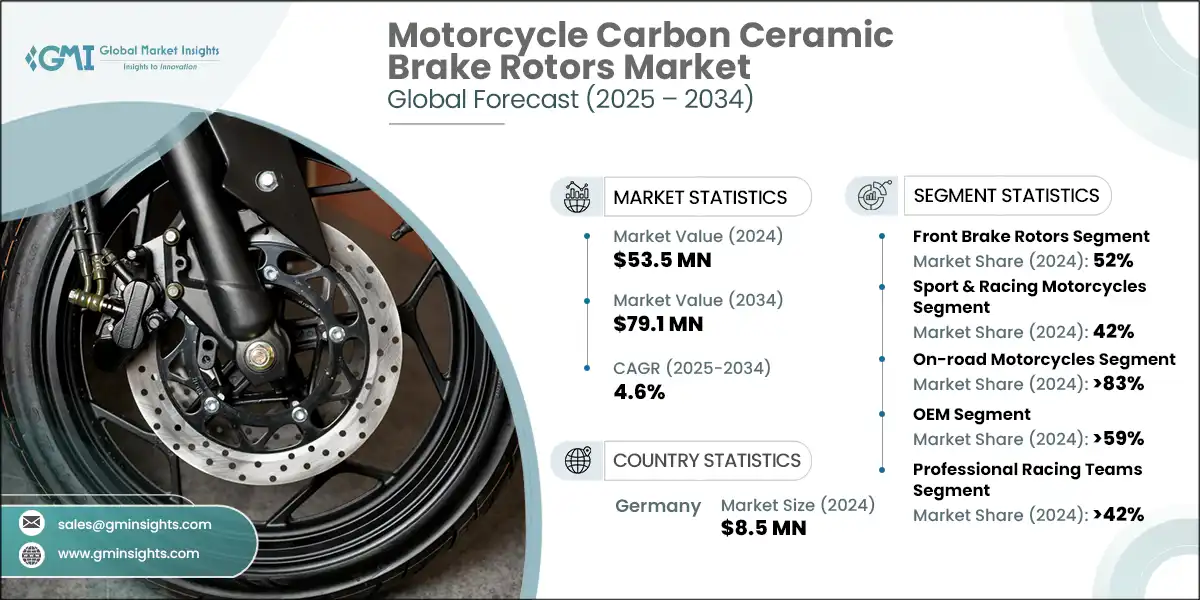
The global motorcycle carbon ceramic brake rotors market size was estimated at USD 53.5 million in 2024. The market is expected to grow from USD 55.2 million in 2025 to USD 79.1 million in 2034, at a CAGR of 4.6%.
Motorcycle Carbon Ceramic Brake Rotors Market Key Takeaways
Market Size & Growth
- 2024 Market Size: USD 53.5 Million
- 2034 Forecast Market Size: USD 79.1 Million
- CAGR (2025–2034): 4.6%
Regional Dominance
- Largest Market: Germany
- Fastest Growing Region: Asia Pacific
Key Market Drivers
- Rising demand for high-performance motorcycles.
- Superior heat resistance & reduced brake fade.
- Rising popularity of motorsport & track racing.
- Technological advancements in rotor manufacturing.
- Lightweight and improved handling.
Challenges
- High cost of carbon ceramic rotors.
- Limited compatibility with standard motorcycles.
Opportunity
- Expansion into mid-range motorcycles.
- Growth in electric motorcycles (EVs).
- Technological advancements in material science.
- Growth in emerging markets.
Key Players
- Market Leader: Brembo S.p.A. led with over 20% market share in 2024.
- Leading Players: Top 5 players in this market include AP Racing, Braketech, Brembo S.p.A., EBC Brakes, Galfer Brakes, which collectively held a market share of 21% in 2024.
Get Market Insights & Growth Opportunities
- The motorcycle carbon ceramic brake rotors market is growing steadily, fueled by rising demand for high performance and premium motorcycles. Particularly in racing and sport bikes, these rotors provide increased braking efficiency, reduced weight, and superior heat resistance. In areas with strong motorsport cultures, such as North America and Europe, adoption is growing. In response to consumer demand for low-maintenance, safer braking systems, manufacturers are coming up with new innovations.
- Consumers are drawn to carbon ceramic rotors for superior braking power, fade resistance, and long lifespan. When it comes to sport or touring motorcycles, these advantages are essential. Composite technology is being improved by manufacturers to increase durability under harsh conditions. They are significant in safety driven sectors due to their high heat tolerance.
- The market is expected to grow from its 2022–2023 valuation of approximately USD 50–51 million to nearly USD 64 million by 2029. The demand for lightweight, high- performance braking in high speed and long-distance applications is driving growth. Both OEMs and riders find them appealing due to their superior heat dissipation and endurance. Motorsports and high-end motorcycles are becoming more prevalent.
- With next-generation carbon ceramic rotors designed for road-legal sport motorcycles, Brembo went beyond racing in 2024. These advancements, which include better cooling and modular construction, give regular riders track-level performance while enhancing OEM relationships.
- In response to the growing demand for high-end motorcycles, suppliers such as BrakeTech and LEMYTH are developing carbon ceramic rotor designs with improved cooling and slotting. OEM and motorsport collaborations are accelerating up adoption, particularly in the U.S. and Europe.
To get key market trends
Motorcycle Carbon Ceramic Brake Rotors Market Trends
- Since 2018, interest in carbon ceramic brake rotors has increased due to the growing demand for high-performance motorcycles in North America and Europe. This is due to the ceramic's superior heat resistance and low weight. These rotors are a popular part in the sport and touring segments since they drastically lessen brake fade, particularly while riding aggressively.
- Braketech introduced carbon ceramic rotors with enhanced cooling and racing inspired slot patterns for road legal sport and touring motorcycles in early 2024. The action demonstrates a trend toward equipping high-end consumer models with track-grade braking. Braketech aims to broaden its market reach by venturing into mid-range motorcycles by 2026.
- Carbon ceramic rotor demand increased in 2023 because of premium bike customizing trends, driving the USD 125 billion motorcycle parts market. Through 2030, continued adoption is anticipated to be fueled by growing interest in safety and performance enhancements, particularly in North America and Europe.
- The use of carbon ceramic rotors is being accelerated by OEM collaborations and motorsport alliances. By 2025, over 30% of superbikes sold in Europe and the U.S. feature carbon-based braking, driven by demand for lightweight, high-performance, and sustainable systems.
- Demand for carbon ceramic brake rotors increased in aftermarket segments between 2019 and 2024 due to growing performance improvements and customization. Heat resistance and less brake fade are top priorities for riders, particularly when riding at high speeds. In response, producers are releasing modular rotor kits to increase compatibility. Through 2030, replacement demand is anticipated to be driven by ongoing innovation.
Motorcycle Carbon Ceramic Brake Rotors Market Analysis
Learn more about the key segments shaping this market
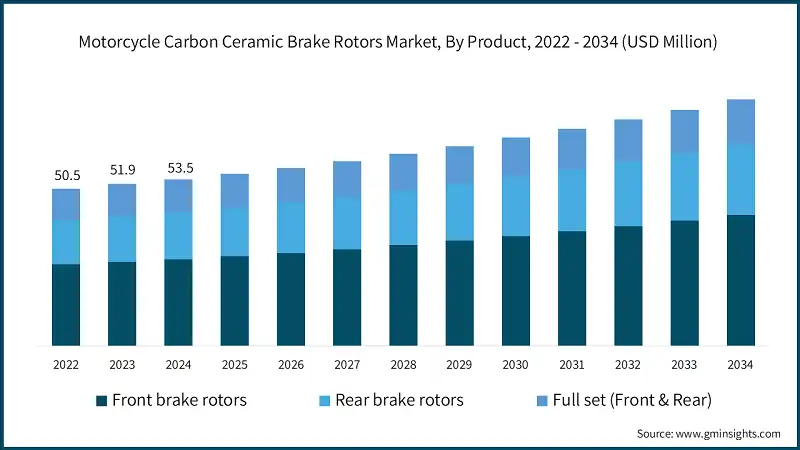
Based on product, the motorcycle carbon ceramic brake rotors market is divided into front brake rotors, rear brake rotors, and full set (front & rear). The front brake rotors segment dominated the market, accounting for more than 52% market share in 2024 and is expected to grow at a CAGR of around 5% from 2025 to 2034.
- The front brake rotors dominated the motorcycle carbon ceramic brake rotors market in 2024, accounting for over 52% of total revenue. Since 70% to 80% vehicle braking force is handled by front systems, they are anticipated to grow gradually through 2034. Ventilated and slotted front rotor technology is being introduced by major players such as Brembo and Galfer. Superbikes and performance touring motorcycles are becoming prevalent.
- For instance, in April 2025, BrakeTech introduced a modular carbon-ceramic front rotor with adaptive cooling vanes, claimed to cut brake fade by 15% and weight by 20% versus conventional steel units, targeting premium sport and touring motorcycles.
- Rear brake rotors hold a smaller but stable share, driven by steady upgrades in mid-range and commuter motorcycles. Carbon-ceramic materials are being used to increase heat resistance and decrease weight. Growth is still modest, with the highest demand for lightweight components in Asia and Europe.
- Full rotor sets are increasingly favored by high-performance motorcycle OEMs and aftermarket buyers. Sportbike and touring riders will discover these sets appealing because they guarantee improved compatibility and performance balance. Complete carbon-ceramic kits for road-legal superbikes are now offered from companies like BrakeTech and EBC Brakes.
Learn more about the key segments shaping this market
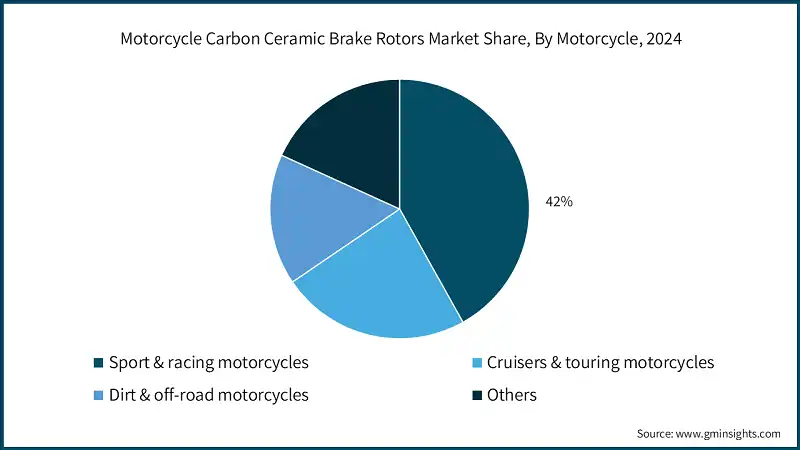
Based on motorcycles, the motorcycle carbon ceramic brake rotors market is segmented into sport & racing motorcycles, cruisers & touring motorcycles, dirt & off-road motorcycles, and others. The sport & racing motorcycles segment held around 42% of the market share in the motorcycle carbon ceramic brake rotors market and generated revenue of over USD 22 million in 2024.
- The sport & racing motorcycles segment dominated in 2024, capturing over 50% of total rotor sales due to demand for precision braking in high-speed conditions. Carbon-ceramic rotors are favored for their fade resistance and thermal control. In August 2024, BrakeTech launched AXIS/RR Supersport Race rotors, which include improved ventilation and a revolutionary floating design for increased thermal stability, were introduced.
- Cruisers & touring motorcycles are witnessing rising demand for carbon-ceramic rotors, growing steadily at around 4.9% annually through 2034. Long-distance riders value heat stability and smoother braking, which increases adoption. Companies such as EBC Brakes provide rotor sets specifically designed for this market.
- Dirt & off-road motorcycles are gradually adopting carbon-ceramic rotors for their lightweight and fade resistant performance. On rugged terrain and lengthy trails, riders appreciate reliable braking and thermal stability. Manufacturers are being compelled by this increasing need to create off-road rotor systems that are more robust and effective.
- For instance, in April 2025, Galfer Brakes and Triumph teamed up to provide Wave style carbon ceramic discs for the new TF 250 E enduro models, which are designed to manage heat and provide stability in challenging circumstances. With adventure riders taking on longer off-road trips, these improvements are becoming prominent.
Based on application, the motorcycle carbon ceramic brake rotors market is segmented into on-road motorcycles and off-road motorcycles. The on-road motorcycles segment dominates the market with over 83% share in 2024, and the segment is expected to grow at a CAGR of around 5% from 2025 to 2034.
- On-road motorcycles dominate the carbon ceramic brake rotors market in 2024 and are projected to grow at a CAGR of around 5% from 2025 to 2034. The necessity for high-performance brakes in high-speed and urban environments is what drives demand. These rotors are valued by riders due to their low maintenance requirements, fade resistance, and thermal stability.
- Strong OEM interest is driving up demand for carbon-ceramic rotors in on-road motorcycles. In April 2025, Brembo added MotoGP-derived rotor technology to its lineup of original equipment for mid-range and high-end road bikes. This meets the needs of riders who want lightweight handling and performance for daily usage.
- Off-road motorcycles are gradually entering the carbon-ceramic rotor space, though adoption is slower due to cost and durability concerns. Lightweight, fade-resistant brake solutions are what riders tackling rugged terrain are looking for. Investment in hybrid composite rotors that balance resilience and performance is being driven by this.
- For instance, Moto-Master unveiled upgraded Flame rotors for adventure and dual-sport bikes in March 2025. To provide reliable braking, these rotors make use of strengthened materials and precise venting. Under load stress and heat, the invention facilitates prolonged off-road excursions.
Based on sales channel, the motorcycle carbon ceramic brake rotors market is segmented into OEM and aftermarket. The OEM segment held over 59% of the market share and generated revenue of around USD 32 million in 2024.
- The OEM segment dominates the motorcycle carbon ceramic brake rotors market in 2024, accounting for over 59% of total sales. Motorcycle manufacturers' integration of high-performance braking systems into luxury and performance models is driving OEM demand. This includes carbon-ceramic rotors that are factory-fitted and made to be lightweight, thermally efficient, and have steady consistent power.
- In February 2025, SICOM Brakes secured a new OEM partnership with Bimota to supply carbon-ceramic rotors for its latest supercharged touring motorcycles. These factory-fitted systems are designed to dissipate heat and reduce weight. The collaboration demonstrates the growing OEM interest in high-end braking enhancements for high-end, limited-edition motorcycles.
- The aftermarket segment is gaining momentum as over 40 million motorcycles globally are set to cross the 5-year mark by 2026. Carbon-ceramic rotors are becoming increasingly popular among riders, particularly in the sport and touring segments, due to their improved braking response, increased heat resistance, and decreased weight.
- The increasing availability of model specific upgrade kits through both online and physical retail channels is contributing to this demand. In 2024, aftermarket carbon-ceramic rotor sales topped USD 150 million, with Europe and Asia emerging as major growth regions. The aftermarket is growing in importance for rotor producers as consumer awareness of high-end braking systems increases.
Based on End Use, the motorcycle carbon ceramic brake rotors market is segmented into professional racing teams, individual motorcycle owners, motorcycle manufacturers. The professional racing teams segment held over 42% of the market share in the motorcycle carbon ceramic brake rotors market and generated revenue of around USD 22 million in 2024.
- Professional racing teams continue to be early adopters and key influencers in the carbon ceramic rotor space. These teams demand peak braking performance under extreme heat and speed, driving continuous innovation in rotor materials and design. This area is crucial for influencing rotor development trends since insights from race situations frequently result in OEM-grade solutions.
- In March 2025, Galfer Brakes, which uses its Disc Wave and Disc Shark brake discs for exceptional stopping power in competitive racing, was named the only supplier of braking systems for the Ducati Factory MX Team in the MXGP World Championship.
- In 2024, individual motorcycle owners and motorcycle manufacturers held more than 75% of the global market for carbon-ceramic brake rotors. As owners increasingly look for aftermarket improvements for improved braking and durability, OEMs are incorporating these rotors into premium models to meet performance and safety requirements. The adoption of both new and used motorcycles is being accelerated by this dual demand.
- For instance, in March 2025, Stark Future, an electric motorcycle brand, teamed up with Spanish producer NG Brakes to provide carbon-ceramic rotors for its VARG off-road model. While NG also provides aftermarket kits aimed at individual riders modifying mid-life motorcycles, the partnership indicates rising OEM interest in high-performance braking solutions.
Looking for region specific data?
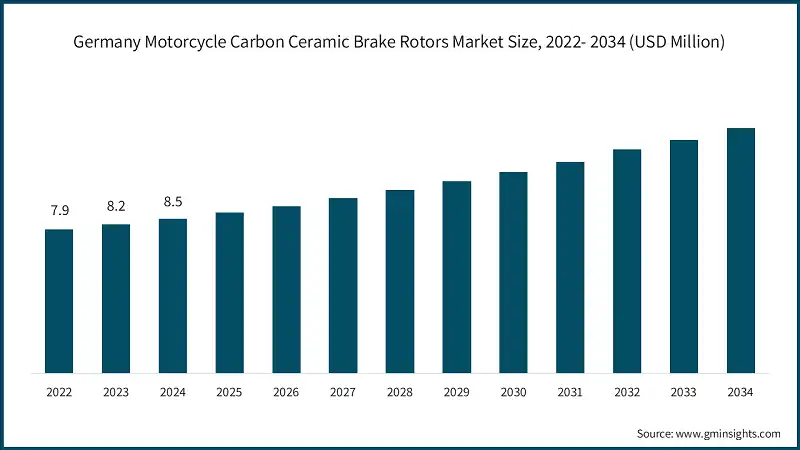
Germany accounted for over 50% share in Europe motorcycle carbon ceramic brake rotors market, generating revenue of USD 8.5 million in 2024.
- In 2024, Germany dominance stems from a strong premium motorcycle sector, led by BMW Motorrad and a rising demand for high-performance braking systems, especially in electric two-wheelers.
- With the help of its world-class technical and motorsport background, Germany is a center for braking innovation. German OEMs are working with suppliers like SICOM and Brembo, and new testing facilities in Bavaria are concentrating on next-generation carbon ceramic technology.
- German consumers place a high value on energy efficiency, safety, and durability, which forces rotor manufacturers to use lighter, more advanced materials. This change encourages the use of ceramic composites, which enhance performance and heat resistance, particularly in electric motorcycles.
- More than 220,000 motorcycles were sold in Germany in 2024, with EV bike sales increasing 19% annually. It remains at the forefront of premium mobility, safety standards, and clean tech integration as the largest motorcycle market in Western Europe.
- In March 2023, TRW Automotive GmbH expanded its line of motorcycle brake discs by introducing new high-precision floating disc models that are approved for touring and sport bikes. With their improved heat resistance and precise machining tolerances, these cutting-edge rotors prioritize reliable performance and safety.
- Italy, the UK, France, and Spain drive the rest of Europe market with strong racing heritage and premium OEMs like Brembo and AP Racing. Growing adoption of ceramic composite rotors, fueled by motorsport culture and aftermarket upgrades, is boosting demand for lightweight, heat-resistant solutions for both conventional and electric motorcycles.
The motorcycle carbon ceramic brake rotors market in the US is expected to experience significant and promising growth from 2025 to 2034.
- The US motorcycle carbon ceramic brake rotors market was valued at approximately USD 14 million in 2024 and is projected to double to around USD 21 million by 2033, reflecting a 5% CAGR from 2025 to 2034. The expanding coverage in the aftermarket business and the growing demand for high-performance braking in premium bikes are the main drivers of this expansion.
- Due to their lightweight design and thermal efficiency, carbon ceramic rotors are becoming increasingly popular among American riders and OEMs, particularly in sport and electric motorcycle applications. As durability and safety emerge as crucial differentiators in the urban and performance riding markets, adoption is quickening.
- With stronger environmental regulations and consumer interest in lightweight, safety-oriented components, the U.S. leads North America’s rotor market through both OEM and aftermarket channels. The United States' market supremacy, which includes the greatest share in the two-wheeler braking segment, is a reflection of its superior infrastructure and performance heritage.
- In March 2024, Braketech, a leader in high-performance braking with headquarters in the United States, extended their line of carbon ceramic rotors to accommodate electric and hybrid motorcycles. Designed to reduce unsprung weight and enhance heat dissipation, the redesigned rotors are perfect for electric vehicle applications.
- Canada’s market is growing steadily, fueled by demand for durable, high-performance carbon-ceramic rotors in premium and electric motorcycles, with rising aftermarket upgrades and motorsport activities boosting adoption.
The motorcycle carbon ceramic brake rotors market in the China is expected to experience significant and promising growth from 2025 to 2034.
- China holds the largest share of the Asia-Pacific motorcycle carbon ceramic brake rotors market, with revenues estimated at USD 2 million in 2024. This is an estimated 5% compound annual growth rate (CAGR) between 2025 and 2034, propelled by the country's thriving luxury motorbike market and rising electric two-wheeler adoption.
- To cater to both domestic and international markets, Chinese OEMs and Tier-1 suppliers are making significant investments in rotor R&D and domestic manufacturing capability. For instance, in December 2023, BeijingWest Industries (BWI Group) increased the range of brake systems it offered, offering cutting-edge rotor solutions to motorcycle OEMs in Europe and Asia.
- Carbon-ceramic rotors, which offer superior thermal performance, durability, and decreased unsprung weight, perfect for EV motorcycles and sport applications have become more popular locally. Advanced ceramic composites are being used by manufacturers, especially for urban models, to satisfy OEM requirements and legal requirements.
- Growing exports and ecosystem support have further bolstered China's ascent, positioning it as a regional center for innovation. In the carbon-ceramic rotor market, its extensive supply chain from sourcing materials to high-speed manufacturing is establishing standards for quality and scalability.
The motorcycle carbon ceramic brake rotors market in Brazil (Latin America) is expected to experience significant and promising growth from 2025 to 2034.
- Brazil’s motorcycle carbon ceramic brake rotors market reached approximately USD 3 million in 2024, driven by rising demand for premium and performance bikes. Advanced braking systems are becoming more popular in urban areas like Sao Paulo and Rio de Janeiro, particularly among sports and electric motorbike riders.
- Brazilian producers and local suppliers are concentrating more on high-performance rotors with long lifespans and heat resistance. As demand for better safety and braking control increases, these parts are being included into performance bikes from both domestic and foreign companies.
- In November 2023, Fras-le collaborated with regional OEMs to introduce carbon ceramic rotor solutions for next-gen motorcycles. This action reflects the country's developing advanced brake technology capabilities and its increasing contribution to the global supply chain for motorcycle components.
- Argentina, Mexico, and Chile are emerging markets for carbon-ceramic brake rotors, with growing demand driven by premium bikes, motorsports, and improving aftermarket availability.
The motorcycle carbon ceramic Brake rotors market in MEA (Saudi Arabia) is expected to experience significant and promising growth from 2025 to 2034.
- Saudi Arabia’s motorcycle carbon ceramic brake rotors market reached an estimated USD 2 million in 2024, driven by a growing demand for high-performance and electric motorcycles. Riders in Riyadh, Jeddah, and Dammam are showing increased preference for premium bikes equipped with advanced braking systems that offer enhanced heat resistance and control.
- As local producers and importers work together to launch carbon ceramic rotors designed for desert and high temperature environments, technological investments are accelerating. The car industry is upgrading quickly with the help of Saudi Arabia's Vision 2030 project, which promotes the use of lightweight, EV-ready braking systems.
- In July 2023, Al Watania Automotive, in partnership with a UAE-based supplier, began trials of carbon ceramic brake systems on electric police motorbikes in Riyadh. The initiative highlights Saudi Arabia's expanding leadership in performance-oriented transportation innovation by aiming to increase safety and dependability in challenging situations.
- The UAE, Qatar, and South Africa are emerging markets for carbon-ceramic rotors, with rising demand from premium and electric motorcycles and growing investments in advanced braking technologies.
Motorcycle Carbon Ceramic Brake Rotors Market Share
- The top 7 companies in the motorcycle carbon ceramic brake rotors industry are Brembo S.p.A., EBC Brakes, Galfer Brakes, Braketech, SICOM Brakes, AP Racing, and Sunstar engineering contributing over 22% of the market in 2024.
- Brembo leads the premium motorcycle brake segment with carbon ceramic rotors trusted by top racing teams. It increased OEM partnerships in Japan and Europe in 2024. Lighter, more thermally resistant parts for next-generation EV motorcycles are the focus of its research and development in Italy.
- EBC Brakes is the second top player in the aftermarket, offering high-performance carbon ceramic rotors. Across all motorcycle categories, its products are renowned for their dependability, resistance to fading, and versatility. It introduced a lightweight line of adventure and dual sport motorcycles in 2024.
- Galfer Brakes' distinctive wave shaped carbon ceramic rotors, which are well-liked in custom builds and sports, set them apart. In 2024, it expanded its distribution network throughout Latin America and North America. Rotor composites, which improve cooling and grip, are another example of the brand's ongoing innovation.
- Braketech is known for high-end floating rotor systems made with advanced ceramic matrix composites. Due to its thermal stability, it became well-known in the electric motorbike market in 2024. Track riders like its equipment because they provide precise braking under heavy loads.
- SICOM Brakes specializes in handcrafted carbon-ceramic rotors for racing and high-performance motorcycles. It serves championship teams and top European OEMs. In 2024, it increased the size of custom orders to satisfy the need for racing solutions that were low wear and lightweight.
- AP Racing supplies motorsport-grade carbon ceramic rotors designed for superbikes and high-speed street machines. It increased partnerships with race teams and niche brands in 2024. Delivering steady lever feel and quick heat dissipation are still the major priorities.
- Sunstar Engineering provides mainstream OEMs with long-lasting carbon ceramic rotors by utilizing Japanese quality and scale. In 2024, it expanded production in Southeast Asia to help the expansion of EV motorcycles in the region. It caters to mid segment brands and is renowned for its dependability and affordability.
Motorcycle Carbon Ceramic Brake Rotors Market Companies
Major players operating in the motorcycle carbon ceramic brake rotors industry are:
- AP Racing
- Braketech
- Brembo
- Brembo S.p.A.
- Carbon Lorraine
- EBC Brakes
- EBC Brakes
- Galfer Brakes
- SICOM Brakes
- Sunstar engineering
- Brembo S.p.A., EBC Brakes, and Galfer Brakes are adapting their carbon ceramic rotor technologies for high-performance and electric motorcycles. Brembo is utilizing motorsport grade innovation to create lightweight, thermally efficient rotors. EBC Brakes provides both city and sportbike riders with adaptable, fade-resistant options. Galfer uses composites to improve the cooling and braking stability of their wave rotors.
- Carbon ceramic rotor technologies are being advanced by Braketech, SICOM Brakes, and AP Racing to meet the demands of contemporary motorcycles. For both ICE and electric bikes, Braketech provides lightweight, heat-resistant rotors. SICOM Brakes offers premium OEMs and racers handcrafted, long-lasting solutions. AP Racing produces reliable, high-performing rotors that are perfect for EV platforms and superbikes.
- Sunstar Engineering produces carbon ceramic rotors in accordance with OEM and regional requirements. It provides long-lasting, reasonably priced rotors for commuter motorcycles thanks to its strong Asian production base. In value driven markets, it is a crucial supplier of EV ready brake systems due to its dependability and scalability.
Motorcycle Carbon Ceramic Brake Rotors Market Report Attributes
| Key Takeaway | Details |
|---|---|
| Market Size & Growth | |
| Base Year | 2024 |
| Market Size in 2024 | USD 53.5 Million |
| Forecast Period 2025 - 2034 CAGR | 4.6% |
| Market Size in 2034 | USD 79.1 Million |
| Key Market Trends | |
| Drivers | Impact |
| Rising demand for high-performance motorcycles | Driving adoption of carbon ceramic rotors for better braking precision and fade resistance. |
| Superior heat resistance & reduced brake fade | Enhancing rider safety and control, especially in sport and touring motorcycle segments. |
| Rising popularity of motorsport & track racing | Accelerating demand for advanced rotor technology adapted from competitive racing applications. |
| Technological advancements in rotor manufacturing | Making high performance rotors more accessible through improved production efficiency and design. |
| Lightweight and improved handling | Supporting fuel efficiency and agility, making them appealing for premium and performance bikes. |
| Pitfalls & Challenges | Impact |
| High cost of carbon ceramic rotors | Limits adoption in mid-range motorcycles, reducing market penetration in cost-sensitive regions. |
| Limited compatibility with standard motorcycles | Requires additional customization or upgrades, deterring widespread usage across general consumers. |
| Opportunities: | Impact |
| Expansion into mid-range motorcycles | Enables wider adoption, fosters product differentiation, and enhances brand visibility across new segments. |
| Growth in electric motorcycles (EVs) | Aligns with sustainability goals, offering lightweight and efficient braking solutions for EV platforms. |
| Technological advancements in material science | Promotes cost reduction and performance improvements, making rotors more accessible to broader markets. |
| Growth in emerging markets | Creates untapped demand as premium and sports bike ownership rises in Asia, Latin America, and Eastern Europe. |
| Market Leaders (2024) | |
| Market Leaders |
20% market share |
| Top Players |
Collective market share in 2024 is 21% |
| Competitive Edge |
|
| Regional Insights | |
| Largest Market | Germany |
| Fastest growing market | Asia Pacific |
| Emerging countries | India, Brazil, Thailand, Vietnam, Indonesia, UAE, South Africa |
| Future outlook |
|
What are the growth opportunities in this market?
Motorcycle Carbon Ceramic Brake Rotors Industry News
- In July 2025, EBC Brakes Racing introduced its “CC Series” carbon ceramic-to-iron conversion kits, blending lightweight hubs with cast-iron rotor rings. The kits offer performance braking at a reduced cost compared to full carbon systems. This launch targets riders seeking high end upgrades without premium pricing.
- In June 2025, Brembo showcased its latest range of carbon ceramic rotors and pads at Automechanika Birmingham 2025, presenting its new aftermarket product families for motorcycles. This action signifies its entry into wider consumer markets, going beyond OEM supply.
- In June 2025, According to LeMyth Technology Co. Ltd., their GTS C-SiC carbon-ceramic rotors reached a working temperature threshold of 1,750 °C, which is about 2.5 times greater than that of conventional steel discs. With a predicted operating lifespan of up to 300,000 km, these designed rotors are a top option for performance motorcycle applications requiring durability and exceptional thermal stability.
- In May 2025, Surface Transforms introduced its next generation carbon-ceramic brake disc. It is designed to reduce unsprung weight by up to 20 kg, making it over 70% lighter than conventional options. This innovation, which aims to improve handling and fuel efficiency, is attracting a lot of interest from investors and OEMs, putting the business at the forefront of high-performance braking development.
- In May 2025, Galfer unveiled its new Floatech brake disc technology, MotoGP-derived and featuring a patented pin-and-groove floating design to enhance thermal dissipation and maintain pad alignment for street applications.
- In May 2024, Revolution Race Cars and EBC Brakes Racing teamed up to provide customized race grade brake pad compounds for Revolution's track and race vehicle series. This technical partnership increases EBC's visibility and provides more possibilities for product demonstrations while improving braking performance for motorsport applications.
The motorcycle carbon ceramic brake rotors market research report includes in-depth coverage of the industry with estimates & forecasts in terms of revenue ($ Mn) and shipments (Units) from 2021 to 2034, for the following segments:
Market, By Product
- Front brake rotors
- Rear brake rotors
- Full set (Front & Rear)
Market, By Motorcycle
- Sport & racing motorcycles
- Cruisers & touring motorcycles
- Dirt & off-road motorcycles
- Others
Market, By Application
- On-road
- Off-road
Market, By Sales Channel
- OEM
- Aftermarket
Market, By End Use
- Professional racing teams
- Individual motorcycle owners
- Motorcycle manufacturers
The above information is provided for the following regions and countries:
- North America
- U.S.
- Canada
- Europe
- Germany
- UK
- France
- Italy
- Spain
- Russia
- Nordics
- Asia Pacific
- China
- Japan
- India
- South Korea
- ANZ
- Southeast Asia
- Latin America
- Brazil
- Mexico
- Argentina
- MEA
- UAE
- Saudi Arabia
- South Africa
Frequently Asked Question(FAQ) :
What is the market size of the motorcycle carbon ceramic brake rotors in 2024?
The market size was estimated at USD 53.8 million in 2024, with a CAGR of 4.6% expected through 2034. The market is driven by increasing demand for high-performance and premium motorcycles.
What is the projected value of the motorcycle carbon ceramic brake rotors market by 2034?
The market is poised to reach USD 79.1 million by 2034, fueled by advancements in braking technology, rising adoption in sport and racing motorcycles.
How much revenue did the sport & racing motorcycles segment generate in 2024?
The sport & racing motorcycles segment generated over USD 22 million in revenue in 2024, accounting for approximately 42% of the market share.
What was the market share of the on-road motorcycles segment in 2024?
The on-road motorcycles segment dominated over 83% market share in 2024 and is set to expand at a CAGR of around 5% from 2025 to 2034.
What is the growth outlook for the front brake rotors segment from 2025 to 2034?
The front brake rotors segment, which held over 52% of the market share in 2024, is expected to showcase around 5% CAGR till 2034.
Which region leads the motorcycle carbon ceramic brake rotors sector?
Germany market accounting for over 50% of the regional share and generating USD 8.5 million in revenue in 2024. This leadership is attributed to a strong premium motorcycle sector and rising demand for high-performance braking systems.
What are the upcoming trends in the motorcycle carbon ceramic brake rotors market?
Trends include high-end track-grade brakes, OEM and motorsport partnerships, modular rotor kits, mid-range innovations, and rising demand for customized, lightweight, heat-resistant solutions.
Who are the key players in the motorcycle carbon ceramic brake rotors industry?
Key players include AP Racing, Braketech, Brembo, Brembo S.p.A., Carbon Lorraine, EBC Brakes, Galfer Brakes, SICOM Brakes, and Sunstar Engineering.
Motorcycle Carbon Ceramic Brake Rotors Market Scope
Related Reports