Summary
Table of Content

Motorcycle and Scooter Market
Get a free sample of this report
Form submitted successfully!
Error submitting form. Please try again.
Thank you!
Your inquiry has been received. Our team will reach out to you with the required details via email. To ensure that you don't miss their response, kindly remember to check your spam folder as well!
Request Sectional Data
Thank you!
Your inquiry has been received. Our team will reach out to you with the required details via email. To ensure that you don't miss their response, kindly remember to check your spam folder as well!
Form submitted successfully!
Error submitting form. Please try again.
Motorcycle and Scooter Market Size
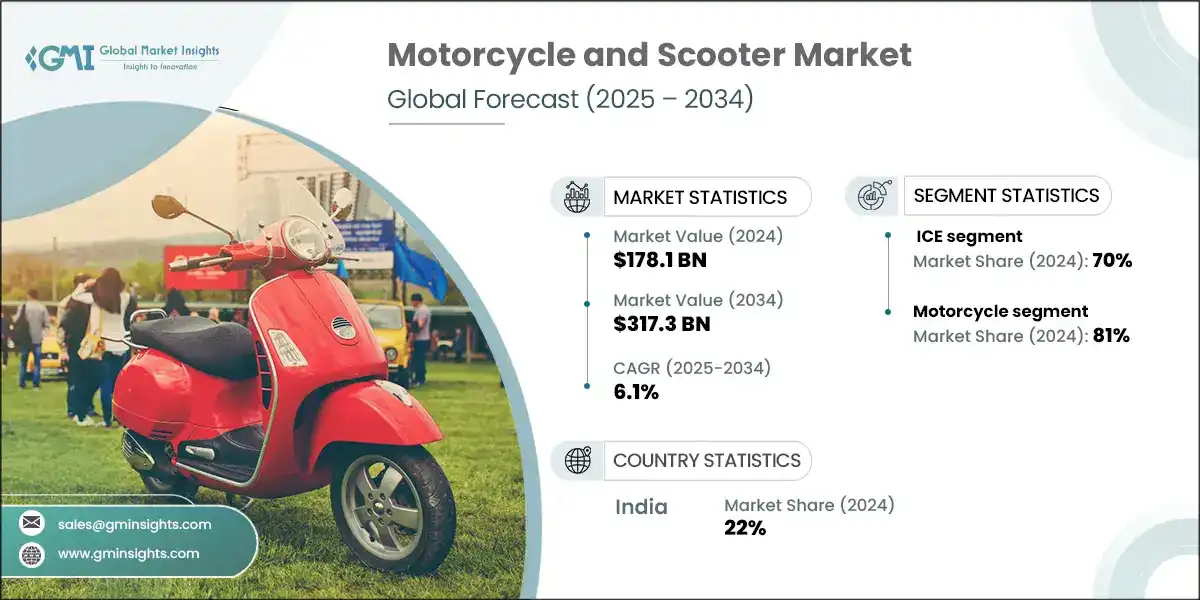
A comprehensive report by Global Market Insights Inc. projects the global motorcycle and scooter market size was estimated at USD 178.1 billion in 2024. The market is expected to grow from USD 186.1 billion in 2025 to USD 317.3 billion in 2034, at a CAGR of 6.1%.
Motorcycle and Scooter Market Key Takeaways
Market Size & Growth
- 2024 Market Size: USD 178.1 Billion
- 2034 Forecast Market Size: USD 317.3 Billion
- CAGR (2025–2034): 6.1%
Regional Dominance
- Largest Market: India
- Fastest Growing Region: Australia
Key Market Drivers
- Rising urbanization and traffic congestion.
- Expansion of e-commerce and last-mile delivery.
- Increasing fuel prices.
- Rapid adoption of electric two-wheelers.
- Growing middle-class population in Asia.
Challenges
- Safety concerns and rising accident rates.
- Inadequate charging infrastructure.
- Supply chain disruptions.
- Rising raw material costs.
Opportunity
- Electrification and EV penetration.
- Connected and smart mobility solutions.
- Subscription and leasing models.
- Market expansion in Africa and Southeast Asia.
- Strategic partnerships with delivery platforms.
Key Players
- Market Leader: Honda led with over 31% market share in 2024.
- Leading Players: Top 5 players in this market include Bajaj Motorcycles, Hero, Honda, TVS, Yamaha, which collectively held a market share of 59% in 2024.
Get Market Insights & Growth Opportunities
- The motorcycle and scooter market are undergoing remarkable transformation due to shifting consumer patterns, issues of urban mobility, and adoption of new technology. The electric motorcycle and scooters are gaining momentum due to factors that include rising environmental awareness and favorable government policies, which facilitate green mobility.
- The need of urban centers and traffic jams is further contributing to flaunting compact, maneuverable and economical cars, as the motor cycle and scooters are finding favor as a means of everyday transportation.
- INIRX reports show American drivers spent 43 hours in traffic jams, one hour more than what they spent in 2023. That amounts to time wasted, which is equivalent to around a whole working week of about USD 771. In sum, congestion in the U.S. was associated with less than four billion hours lost or a whopping USD 74 billion in time.
- The connected capabilities are increasingly common and with manufacturers introducing smart technologies like GPS, or the ability to connect with mobile apps, and vehicle diagnostics. Innovation in design is also picking up with cosmetics, lightweight and ergonomics becoming more popular in design as companies target a younger population. Also, there is a slow introduction of ridesharing and, more frequently, subscription concepts, particularly in urban environments, which transform the way consumers utilize personal mobility.
- In August 2025, Oben Electric unveiled Rorr EZ Sigma. It is equipped with reverse mode, a 5-inch TFT colour display and intelligent navigation, calls, message and music alerts. New ergonomic seat and graphics with an electric red version of the new colour.
- The aftermarket segment has started to evolve to create greater customization abilities, performance-related components, and safety equipment as consumers are increasingly interested in personalization and rider experiences. Older manufacturers also develop strategic partnerships with startups to hasten innovation and remain competitive. Generally, the motorcycle and scooter industry are swinging away its legacy of a simple means of transportation towards an integrated lifestyle solution through the force of innovation, sustainability, and changing urban transportation trends.
- Petrol motorcycles and scooter market still continue to be popular because of structured infrastructure, faster fuel up, and solid brand loyalty. It is preferred by consumers on long distance travel and cheapness among rural consumers. Innovations in the design of the engine is being improved by manufacturers to keep up in a world increasingly aware of its environmental impact.
- Electric scooters are becoming popular, as driven by environmentally regulated users and convenient travel into urban areas. Adoption is being boosted by government support and expansion into charging infrastructure. Young demographics and city commuters are attracted to stylish designs and low-noise, low-maintenance operations.
- In November 2023, Pure EV has launched the “Pure EcoDryft 350” electric scooter. This electric scooter is considered at least one of the most functional eco-friendly electric scooters available, traveling 171 Kms on a single charge. It also helps to support the trend of eco responsible mobility by sustaining the need for electric motorcycles that are green and efficiently usable.
- Asia Pacific dominates the motorcycle and scooter market with the largest market share as a result of the high domestic demand, low interest rate of financing two wheelers, and high manufacturing abilities. The market enjoys a large rural base of customers, high rates of urbanization, and low consumption fuel models, in line with creating production and selling centers.
- Europe is the fastest-growing region in the motorcycle and scooter market, driven by surging demand for electric two-wheelers, urban mobility solutions, and eco-friendly transport alternatives. Supportive EU regulations, expanding charging infrastructure, and innovations in performance and design are boosting adoption, especially in cities. Rising fuel costs and micro-mobility trends are further propelling market growth across the continent.
To get key market trends
Motorcycle and Scooter Market Trends
- The great challenges of urban mobility result in significant demand of two-wheelers solutions, especially in the face of rapid urbanization of most parts of the world and increasing traffic congestion in cities and the major metropolitan regions. As more than 60 percent of Europeans reside in cities, urban cogs can be greatly reduced by two-wheel-driven propulsion, which generates 40% of the total CO2 emissions produced during road transport. Research has shown that two-wheeler vehicles are 26% faster than cars at peak times, which saves much time for the urbanites and lowers the traffic congestion and environmental degradation.
- Individual economic benefits of adopting two-wheelers in urban settings emerge beyond personal savings of time to the economy at large. Motorcycling and its allied activities ranked as part of the outdoor recreation economy of the U.S. with a 2.2 percent contribution to GDP in direct gross output of 778 billion dollars and 5.2 million jobs supported. Motorcycling, All-terrain vehicle use and side-by-side vehicle operation specifically brought USD 9.1 billion to their economy, and the outdoor recreation sector overall expanded by 3.9% in actual GDP in 2017 compared to overall employment, which averaged 2.9%. This indicates that the two-wheeler uses lead to high economic multiplier effects in terms of productivity and service industries that thrive on effective transportation mechanisms in urban centers.
- Avid market growth can also be spurred on by government initiatives on various policy systems establishing positive regulatory conditions and economic incentives to adoption. Indian government targets 30% of electric car sales in 2030 and is backed by a FAME (Faster Adoption and Manufacturing of Electric Vehicles) scheme and the state-wide incentives. The critical inhibitor of expensive upfront investment is met by this policy framework where electric two-wheelers normally need high upfront investment although they have a lower total cost of ownership during their operating life cycle.
- The emerging markets are shown to have substantial growth prospects due to expanding purchasing power of middle-class population and the expanding demand of feasible, efficient transportation options. In India, 2-wheelers constitute more than 80 percent of automobile sales of which 85 percent are motorcycles with 125cc and below, which is a vote of confidence in a low-cost mobility option.
- The market forces indicate that perceived economic advantage is the first driving force among the consumers with women having an increased preference to buy the electric two-wheeler as a sign of change in buying behaviour/tendencies and preferences based on demographics.
- Differences in purchasing power also underpin different market opportunities and the leading one is provided by Asia where 131 units per 10,000 citizens are sold, whereas Europe is positioned in the next place with 23 units per 10,000 citizens. The markets of Southeast Asia, especially Thailand, Indonesia, and Vietnam have a very high potential of growth since they feature dense urban areas, increasing levels of middle-income earners, and positive policies made by the government to support the growth of enterprises.
- The economic multiplier effects are strong as seen through Honda operations in the United States whereby as of 2007, the operations had created 367,683 jobs in the private sector in the United States, with an annual payroll of 17 billion dollars, direct jobs created by the manufacturing activity being 24,669 and 62,172 jobs created by the dealerships.
Motorcycle and Scooter Market Analysis
Learn more about the key segments shaping this market
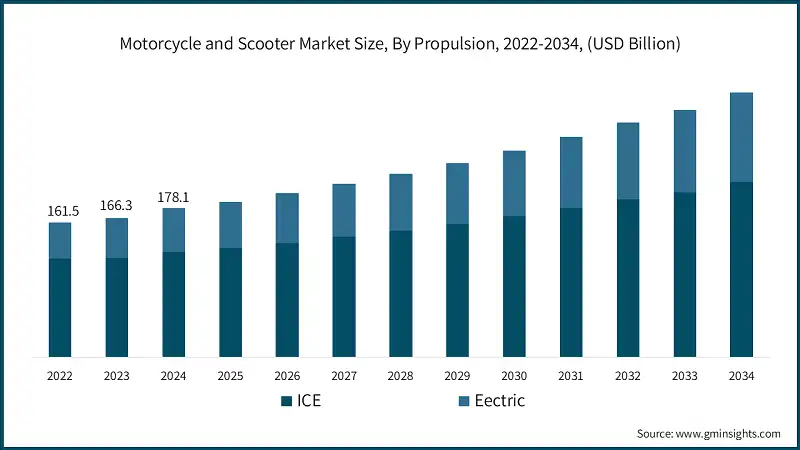
Based on propulsion, the motorcycle and scooter market is divided into ICE and electric. The ICE segment dominated the market accounting for around 70% in 2024 and is expected to grow at a CAGR of over 5% from 2025 to 2034.
- Although electric motorcycles are gaining popularity, the majority of consumers prefer petrol engines. It is so due to the advantage in providing well-developed refueling network, known technology and greater range with long-distance travels. The international motorbike market is experiencing record sales, and this indicates that petrol engines are adequately satisfying the consumers.
- The two-wheelers with petrol have a very large advantage in refueling. Gas filling stations are everywhere as opposed to electric charging stations, which are yet to take off. The benefit of several years of technological advancements have also provided reliability, easier maintenance, a well-developed aftermarket support structure, and therefore this has made their ownership handled on the side of the consumers.
- Nevertheless, the petrol segment is experiencing various issues that may alter its future. The trend in fuel prices has seen petrol cars become too costly to own and this has prompted price-sensitive drivers mostly in the urban areas to look towards electric vehicles to accommodate short trips. Meanwhile, more rigorous ecological regulations across the planet are compelling the manufacturers to invest on cleaner engine designs to comply with emerging emissions standards.
- Petrol two-wheeler manufacturers are aiming at innovation to remain competitive. They are also coming up with engines that consume less fuel, increasing emission control technologies, and investing in alternative fuels such as blends of ethanol. In India, which accounts about 94% of the sales of petrol two-wheelers, the companies are investing heavily in conquering new regulations by enhancing the fuel efficiency and emissions. The future of the petrol two-wheelers will be based on their quality of maintaining affordable nature amid stricter environmental regulations in the light of the more affordable and efficient electric vehicles.
- Such vehicles not only have benefits to the environment, but they are economical as well. As fuel prices continue to increase and electricity remains constant, there is approximately 55 percent saving on the electric two-wheelers compared to petrol powered two wheelers. The electric motorcycle currently sells a total of 10 million units every year in the world market, which means that these cars have won their place as a convenient and efficient transportation option.
Learn more about the key segments shaping this market
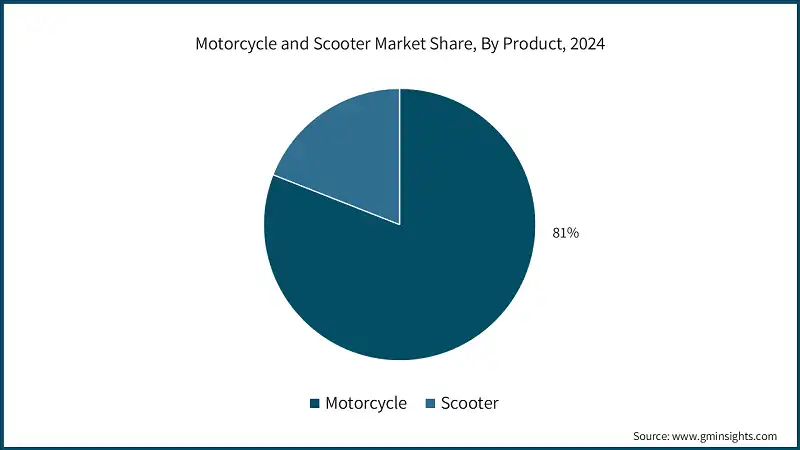
Based on product, the motorcycle and scooter market is segmented into motorcycle and scooter. The motorcycle segment dominates the market with 81% share in 2024, and the segment is expected to grow at a CAGR of over 6% from 2025 to 2034.
- The global two-wheeler markets rely heavily on standard motorcycles particularly in developing nations where cost-effectiveness and convenience are appreciated. Upright-seating, 100cc to 250cc, these bikes are the main form of transport of millions. India, in particular, is a significant player in this segment and manufactures around 28 million 2-wheelers each year, or 15-20 percent of the world production as of FY 2024.
- Standard motorcycles are popular because they are highly fuel-efficient with 65-70 kilometers per liter and affordable to maintain. This positions them as a default target of middle-income consumers in emerging markets. The production of motorcycles worldwide in 2023 was approximately 57 million units, indicating high demand in the face of economic issues.
- Even the regular motorcycle market is gradually evolving with electric ones beginning to gain popularity. In a world where traditional bikes run on fuel, electric vehicles are growing attractive, particularly in urban areas where city governments are promoting their use due to incentives and tougher environmental regulations. The international motorbike market has just recorded all-time sales with high demand, but now the market is drawing more attention to the electric models in response to regulations and emerging customer demands.
- Firms such as Hero MotoCorp are considering introducing low-cost electric scooters because they see opportunity in this transition. The ability of the manufacturers to maintain affordability and reliability of these bikes and incorporate new technologies and environmental regulations will determine the future of this segment.
- Sports motorcycle business serves enthusiasts and younger professionals who prefer performance, style and technology over utility. They are bikes with engines of at least 300cc but at greater than 1000cc, sleek appearances, and track-readiness that earn more profits despite their low sale to regular motorcycles.
Based on engine displacement, the motorcycle and scooter market is segmented into Under 250cc, 250cc–500cc, 500cc–1000cc, and Above 1000cc. The Under 250cc two-wheeler segment forms the cornerstone of global personal mobility, particularly in developing nations where cost-efficiency and fuel economy are critical. This category includes entry-level motorcycles, mopeds, and scooters, commonly achieving fuel efficiency between 60 and 80 kilometers per liter. Such vehicles are essential to low-income users who rely on affordable transport for daily commuting.
- This segment's significance is highlighted by global production trends. For instance, India alone produced nearly 28 million two-wheelers in FY 2024, with a substantial volume comprising models under 150cc. These vehicles act as vital enablers of socio-economic access, supporting millions by facilitating travel to workplaces, schools, and essential services in cost-constrained settings.
- Nonetheless, this segment is undergoing transformative disruption from electric alternatives. Battery-powered scooters and motorcycles in this range are increasingly favored due to their cost advantages, low upkeep, and zero-emission operation. These factors, especially appealing in dense urban environments, are reshaping consumer preferences at a fast pace.
- Furthermore, shifting consumer expectations in markets like India and Southeast Asia are introducing additional challenges. Rising disposable incomes are encouraging a move towards higher-performance models. In response, manufacturers are enhancing sub-150cc offerings with improved features such as fuel injection systems, digital displays, and smartphone integration. Going forward, the segment's resilience will depend on how effectively it balances cost competitiveness with upgraded value propositions to appeal to a more performance- and tech-conscious customer base.
Based on distribution channel, the motorcycle and scooter market is segmented into offline and online. Incentives like showroom-only discounts, exchange offers, free accessories, and festive promotions draw customers to offline dealerships. These time-sensitive deals create urgency and boost footfall. Sales executives use these events to upsell premium models and convert hesitant prospects. Offline promotions remain a key tactic for brands targeting volume sales in tier 2 and tier 3 cities.
- Dealer networks have been put in place where test rides can be made and financing is made easier in urban and rural locations. Local activities and presence that develop trust enhance offline buying as much as in areas that do not have a high degree of digitalization. The physical stores can be useful in converting the first time or doubtful purchasers with demonstration as well as post-sale assurance.
- Customers usually like to look at motorbikes and scooters with their own eyes before buying. Confidence and purchase behaviors are instilled through the use of test rides, physical feedback and personal sales consultations. This real-life feel of offline channels is essential during market testing of comfort, handling and brand feel especially in the first-time consumer or potential up-grade model markets.
- There are offline dealerships, and they usually are tied up with local financial institutions that provide tailor made EMI plans and easy money loans which is also difficult to get in the semi-urban and rural areas. Numerous consumers utilize the dealership services in processing loan, registration, and insurance services. This explains why the offline channel is very important in entering into price-sensitive markets with low financial literacy or no access to the internet.
- The buyer gets confidence of services such as bundle after sales, warranty and maintenance programs which are commonly offered in offline outlets. Co-location provides a guaranty of quick booking of repair and service, spare parts, and warranty claims, which are important aspects of long-term use of a vehicle. This would create a situation where brand relationships are enhanced, and customer satisfaction is improved, which influences offline purchases more than the online-only platform.
Looking for region specific data?
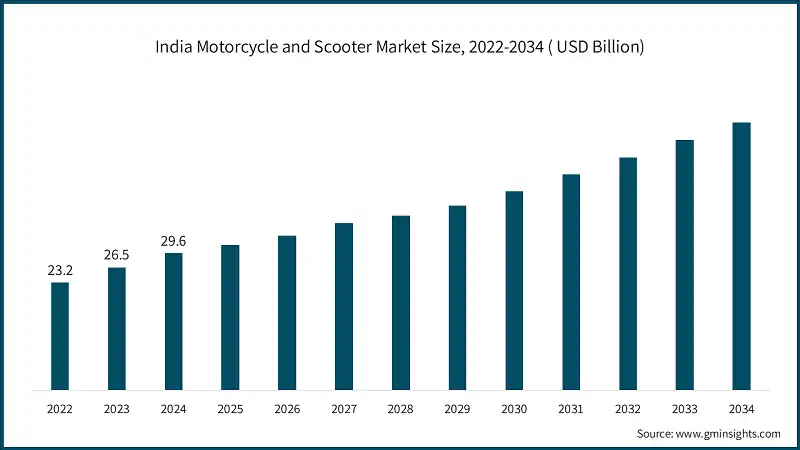
India dominated the motorcycle and scooter market in Asia Pacific with around 22% share and generated USD 29.6 billion in revenue in 2024.
- India is the largest motorcycle manufacturer in the world and the second-largest motorcycle market among the global markets, producing 15-20 percent of the world motorcycle population with an annual production rate of around 28 million motorcycles in FY 2024. Indian market can be described as having large scale and fast rate of growth with production reaching 21.47 million units (up by 10.3%) in 2023 and 17.97 million units (up by 13.3%) are sold including one million electric motorcycles.
- The motorcycle and scooter market characteristics of India are completely contrast to those of the developed markets where two wheelers are not as recreational products, but rather as main means of transportation and thus affordability, fuel efficiency, and reliability are the factors that matter to an Indian customer in deciding to buy a particular two-wheeler. There are local manufacturers who have dominated their market such as Hero MotoCorp, Honda, and Bajaj who have designed products that are intrinsically made, suited within the Indian consumer pocket and needs.
- Electric mobility is facing a paradigm shift in the Indian market where sales of electric two-wheelers recorded a phenomenal 33 percent growth in 2024, amounting to 59 percent in the total electric vehicle market. Distinct brands such as Ola Electric have already secured high market share and Ola, in particular, has managed to sell more than 400,000 units and get a 35 percent market share within the electric segment.
- Its economics, as operating costs of the electric two-wheelers are about 55 percent lower than the petrol ones with the increasing costs of fuels and constant costs of electricity, is becoming the driving force behind the transformation. Ongoing governmental support initiatives such as FAME-II scheme along with a rising number of charging stations and a lower cost of the batteries is accelerating the pace of adoption. Industry estimates indicate that by 2030, the idea of two-wheelers without engines may lead to the rise of a quarter of all two-wheeler sales selling electric models which is a paradigm shift in the world largest motorcycles market.
The motorcycle and scooter market of US is steadily growing. The United States represents the largest and most mature motorcycle market in North America, characterized by a strong preference for premium motorcycles, recreational riding, and iconic American brands like Harley-Davidson.
- There are various trends which can be considered as distinctive in the American market when compared to the global trends, and these trends are the emergence of electric motorcycles, custom bikes, and urban mobility solutions. The growth in the market can be attributed to surge in fuel prices, as well as urbanization in big cities, government support on electric cars and technological innovations that meet the needs of American consumers in terms of preferences on innovation and performance.
- The identification of the product categories in the market is associated with the taste of the Americans; Americans prefer big bikes especially those with big displacement, touring bike and cruiser that fits the long distances and the traveling attitude of riding on the highways of America. Nevertheless, the market is also impacted other challenges such as the high risk of accidents related to riding a motorcycle, high insurance charges, and the presence of other categories of recreational vehicles that pose competition to their expansion in a wider market that is not composed of core enthusiasts only.
- Canadian motorcycle industry is part of the smaller but important sector of the North American two-wheeler business with most of the issues being common to the U.S. market but with distinct climate and seasonality riding habits. The motorcycle market in Canada has been enjoying such demographic and economic advantages as the United States, such as, high end expendable incomes, built up motorcycle culture as well as preference to larger displacement motorcycles used in touring and all-around riding and so on.
- The massive Canada landscape and tourism roads more especially the tourism scenic routes are a contributing influence in the market which then enhances the need to acquire adventure and touring motorcycles that can endure such a journey through the various terrain and weather conditions.
The motorcycle and scooter market in Germany is projected to witness strong and sustained growth throughout the forecast period from 2025 to 2034.
- Germany is Europe largest motorcycle market as well as a major hub of premium motorcycle production and hosts manufacturing of legendary brands such as BMW Motorrad which are global leaders in motorcycle manufacturing in terms of engineering perfection and technology advancement. The German market happens to be one of the most important markets of high performance and premium motorcycle sales since the market has highly sophisticated customers who value quality, performance and highly technological products.
- The likes of touring bike, adventure as well as sport-touring models are very highly demanded by the German riders due to the high-quality road structure and the vicinity to a wide variety of European touring points of interest on offer. High disposable incomes, good motorcycle culture and well-established dealer networks to serve premium motorcycles are positive enablers to the market.
- The European leader of electric motorcycle adoption is the German market, where the environmental awareness, government stimulation and customer willingness to experiment with a new technology drives progress in the market. Electric motorcycles have been developed by German Manufacturers such as BMW who focus more on the environmental friendliness performance, and technology features, as opposed to the environmental advantages only.
- Strict emissions regulations and the urban mobility policies, with a preference of cleaner transportation alternatives, are also quite familiar in the market. Germany is the heart of Europe hence an essential market to manufacturers who want to expand to Europe, its consumers are also early users of new technologies and models which then tend to spread to other European markets.
The motorcycle and scooter market in Brazil is projected to witness a notable increase in market share from 2025 to 2034. Brazil represents a significant and growing motorcycle market within Latin America, established manufacturing presence, and increasing urbanization that drives demand for personal mobility solutions.
- Brazil is the biggest motorcycle market in Latin America on a homologous basis where motorcycles are extensively used by individuals as personal transportation as well as in business transactions like delivery people and ride-hailing companies. Brazil market has the benefits of having a large populated market, increasing trend of urban population, and economical factors that encourage many consumers to use a motorcycle rather than own a car.
- The mid-displacement motorcycles towards achieving balance between performance and fuel consumption have been controlled by the Brazilian consumers since they have practical transportation needs, that views motorcycles as utility rather than recreation. Extensive delivery economy also affects Brazil greatly, and motorcycles are the vehicles that all commercial businesses use when conducting e-commerce or food delivery services, which have grown tremendously in recent years.
- Brazilian market has its peculiar challenges such as economic volatility that affects discretionary importance, infrastructure constraints in the countryside, and security risks of motorcycle use in urban conditions. Nevertheless, the market offers great opportunities as well due to the persistence of urbanization, rising middle-income population, and the increasing need in the efficient method of transportation.
- There is currently very low adoption of electric motorcycles in Brazil but its future looks promising when battery costs decline and when there is more charging infrastructure. The future of the market is associated with economic stability, infrastructure investment, and capacity of manufacturers to provide products that tend to satisfy unique needs of Brazilian consumers who want reliable and low-cost transportation system.
The motorcycle and scooter market in Saudi Arabia is anticipated to capture a growing share of the regional market between 2025 and 2034. Saudi Arabia represents a rapidly growing motorcycle market within the Middle East, driven primarily by tourism, with over 60 million visitors annually, and the growing popularity of desert bike racing and recreational riding activities.
- The market is also defined by high demand of superior motorcycle especially those that surpass 500cc of engine capacity that dominated the market with a share of 35.37 in 2021. Western region of Saudi Arabia comprises the largest market share of 39.32%, according to the high-income disposables and active e-commerce shops that facilitate motorcycles-based delivery services.
- Saudi motorcycle market is driven by high economic factors, state encouragement of tourism and recreational activities, and increased impetus of the young market in purchasing of premium motorcycles as a recreational product. In the market, motorcycles dominate with a share of 98 out of the total market share of two wheelers, a factor that has been contributed by the consumer preferences that made people prefer bigger and more powerful machines that can navigate through the desert areas and tour in distant areas.
- Mounting disposable incomes, growing number of young people taking recreational biking, and the growth in e-commerce trades necessitating the delivery motorcycles are a few of the factors that have been enabling the market to grow. Nevertheless, it is an import-based market, and it has to compete with four-wheeled vehicles, which can shape the further direction of growth. Additional economic growth, tourism, and government sector actions focused on the promotion of sports activities and recreation will aid the development of the market.
Motorcycle and Scooter Market Share
- The top 7 companies in the motorcycle and scooter industry are Honda, Hero, Yamaha, TVS, Bajaj Motorcycles, Piaggio, and Suzuki, contributing around 62% of the market in 2024.
- The backbone of Honda is its innovation, brand trust, and a broader product base that includes scooters, premium bikes, and so on make Honda one of the leaders. Its sophisticated engines, great mileage, low-cost of maintenance all strike a chord with the urban and rural consumer. The penchant of the company towards advanced technology with hybrid and electric vehicle models and the wide network of its dealership and service stations also contribute to its supremacy
- Hero is the leader in volume sales, which fits the mass market, particularly, the commuter segment. It is also renowned to offer bikes that are very economical on fuel consumption, durable, economical hence suitable to rural and semi-urban markets. Its post-sales support and market penetration support in the rural areas are powerful accomplishments by Hero that consolidates its market position
- Yamaha is market leader at premium and sports two-wheeler segment. Yamaha bikes are well known in terms of performance, styling and novelty, and thus focused at the youthful by nature and performance motorcyclists. It has established the company as a sporty performance and leading-edge features company brand.
- TVS is reputed as the company balancing price, performance and innovativeness. It has a well-diversified portfolio with scooters, commuters and high-performance bikes. The corporation spends most of its investments on research and development and alliances to improve technology and products and achieve a competitive advantage at all levels.
Motorcycle and Scooter Market Companies
Major players operating in the motorcycle and scooter industry are:
- ATHER
- Bajaj Motorcycles
- Classic Legends
- Hero
- Honda
- OLA
- Piaggio
- Suzuki
- TVS
- Yamaha
- The motorcycles and scooters market is fiercely competitive as well as dynamic owing to the changing consumer trend, mobility in cities and technological transition. Mass market and premium brands dominate it similarly to a wide range of customer segments, including the ones with a tight budget and interested only in commuter performance seekers. The factors of competitiveness include fuel efficiency, design and engine performance, after sales service, and technological advancements among the key ones. Commuter bikes and scooters also have a great share with high demand in the rural and metropolitan regions due to their low-priced nature, convenience, and navigability amidst traffic jam.
- Product differentiation based on smart functions, sporty design, and greater safety technologies is becoming the main concern of brands. The EV sector of electric motorcycle and scooter is also changing the competitive Buddha as some of them have invested in EV development to meet the sustainability trend. Cozying up through strategic partnerships, strong distribution channels and localization of manufacturing has proved to be extremely vital to secure competitive advantage and consumer loyalty in this rapidly changing environment.
Motorcycle and Scooter Market Report Attributes
| Key Takeaway | Details |
|---|---|
| Market Size & Growth | |
| Base Year | 2024 |
| Market Size in 2024 | USD 178.1 Billion |
| Forecast Period 2025 – 2034 CAGR | 6.1% |
| Market Size in 2034 | USD 317.3 Billion |
| Key Market Trends | |
| Drivers | Impact |
| Rising urbanization and traffic congestion | Increases demand for two-wheelers as a convenient and economical urban mobility solution |
| Expansion of e-commerce and last-mile delivery | Boosts demand for scooters and motorcycles for commercial delivery purposes |
| Increasing fuel prices | Encourages shift to fuel-efficient two-wheelers, especially in emerging economies |
| Rapid adoption of electric two-wheelers | Drives market growth with government subsidies and improved battery tech |
| Growing middle-class population in Asia | Expands the consumer base for affordable and commuter-friendly two-wheelers |
| Pitfalls & Challenges | Impact |
| Safety concerns and rising accident rates | Limits adoption in some demographics, leading to stricter regulations |
| Inadequate charging infrastructure | Slows growth of electric two-wheeler adoption in emerging markets |
| Supply chain disruptions | Affects availability of key components, leading to production delays and increased costs |
| Rising raw material costs | Impacts pricing and profitability of manufacturers |
| Opportunities: | Impact |
| Electrification and EV penetration | Enables real-time, decentralized defect detection and system optimization at the device level |
| Connected and smart mobility solutions | Drives premiumization with features like GPS, app integration, and remote diagnostics |
| Subscription and leasing models | Attracts younger, urban consumers preferring access over ownership |
| Market expansion in Africa and Southeast Asia | Creates new demand in underpenetrated regions |
| Strategic partnerships with delivery platforms | Strengthens B2B revenue streams through fleet sales and servicing contracts |
| Market Leaders (2024) | |
| Market Leaders |
31% market share |
| Top Players |
Collective market share in 2024 is Collective Market Share is 59% |
| Competitive Edge |
|
| Regional Insights | |
| Largest Market | India |
| Fastest Growing Market | Australia |
| Emerging Countries | Thailand, Vietnam, UAE, Malaysia, South Africa |
| Future outlook |
|
What are the growth opportunities in this market?
Motorcycle and Scooter Industry News
- In May 2025, BMW Motorrad unveiled the Concept RR at the Concorso d'Eleganza Villa d'Este in May 2025. This concept bike showcases the brand's vision for future superbike performance, blending cutting-edge technology with striking design.
- In March 2025, Niu launched the NX Pro Electric Motorcycle, featuring advanced technologies like millimeter-wave radar and AI connectivity, catering to premium riders seeking high-performance electric mobility solutions.
- In November 2023, Pure EV has launched the “Pure EcoDryft 350” electric scooter. This electric scooter is considered at least one of the most functional eco-friendly electric scooters available, traveling 171 Kms on a single charge. It also helps to support the trend of eco responsible mobility by sustaining the need for electric motorcycles that are green and efficiently usable.
- In October 2023, Kawasaki, a renowned motorcycle company from Japan, set up a manufacturing facility in Nuevo Leon, Mexico, and spent USD 200 million on it. Accomplishing this will enable Kawasaki to enhance their production capabilities and further land themselves strategically in the region.
The motorcycle and scooter market research report includes in-depth coverage of the industry with estimates & forecasts in terms of revenue ($ Mn/Bn) and shipment (Units) from 2021 to 2034, for the following segments:
Market, By Product
- Motorcycles
- Cruiser motorcycles
- Sport motorcycles
- Touring motorcycles
- Standard/naked motorcycles
- Adventure/dual-sport motorcycles
- Off-road/dirt motorcycles
- Scooters
- Traditional gasoline scooters
- Electric scooters
- Maxi scooters
- Moped-style scooters
Market, By Propulsion
- Internal combustion engine (ICE)
- Electric vehicles (EVs)
Market, By Engine Displacement
- Under 250cc
- 250cc–500cc
- 500cc–1000cc
- Above 1000cc
Market, By Distribution Channel
- Offline
- Online
Market, By End Use
- Personal
- Commercial
The above information is provided for the following regions and countries:
- North America
- US
- Canada
- Europe
- UK
- Germany
- France
- Italy
- Spain
- Russia
- Nordics
- Asia Pacific
- China
- India
- Japan
- South Korea
- ANZ
- Southeast Asia
- Latin America
- Brazil
- Mexico
- Argentina
- MEA
- South Africa
- Saudi Arabia
- UAE
Frequently Asked Question(FAQ) :
What is the market size of the motorcycle and scooter in 2024?
The market size was USD 178.1 billion in 2024, with a CAGR of 6.1% expected through 2034. Increasing urbanization, traffic congestion, and demand for cost-effective transportation solutions are driving market growth.
What is the projected value of the motorcycle and scooter market by 2034?
The market is poised to reach USD 317.3 billion by 2034, driven by rising adoption of two-wheelers in emerging markets and supportive government policies for electric vehicles.
What was the market share of the ICE segment in 2024?
The ICE segment dominated the market with a 70% share in 2024 and is expected to witness over 5% CAGR till 2034.
What was the market share of the motorcycle segment in 2024?
The motorcycle segment held an 81% share of the market in 2024 and is set to expand at a CAGR of over 6% up to 2034.
Which region leads the motorcycle and scooter sector?
The India market size was USD 29.6 billion in 2024, with holding a 22% share.
What are the key trends in the motorcycle and scooter market?
Key trends include urbanization, two-wheeler affordability, electric vehicle growth, and rising female ownership.
Who are the key players in the motorcycle and scooter industry?
Key players include ATHER, Bajaj Motorcycles, Classic Legends, Hero, Honda, OLA, Piaggio, Suzuki, TVS, and Yamaha.
Motorcycle and Scooter Market Scope
Related Reports