Summary
Table of Content

Mobility Payment Integration Platforms Market
Get a free sample of this report
Form submitted successfully!
Error submitting form. Please try again.
Thank you!
Your inquiry has been received. Our team will reach out to you with the required details via email. To ensure that you don't miss their response, kindly remember to check your spam folder as well!
Request Sectional Data
Thank you!
Your inquiry has been received. Our team will reach out to you with the required details via email. To ensure that you don't miss their response, kindly remember to check your spam folder as well!
Form submitted successfully!
Error submitting form. Please try again.
Mobility Payment Integration Platforms Market Size
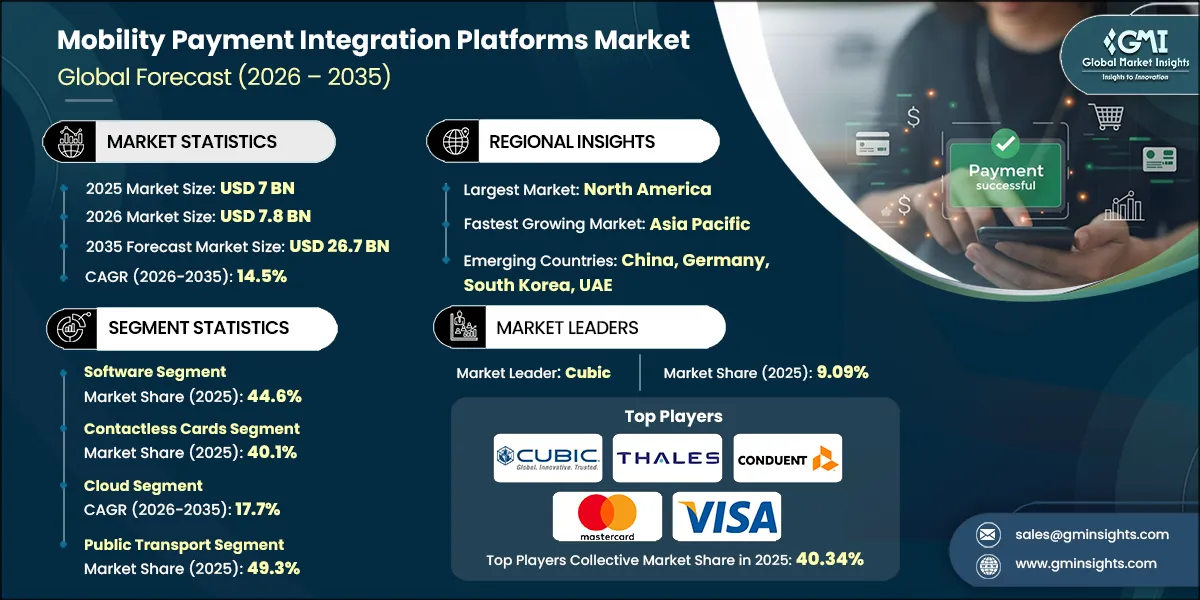
The global mobility payment integration platforms market size was estimated at USD 7 billion in 2025. The market is expected to grow from USD 7.8 billion in 2026 to USD 26.7 billion in 2035, at a CAGR of 14.5% according to latest report published by Global Market Insights Inc.
Mobility Payment Integration Platforms Market Key Takeaways
Market Size & Growth
- 2025 Market Size: USD 7 Billion
- 2026 Market Size: USD 7.8 Billion
- 2035 Forecast Market Size: USD 26.7 Billion
- CAGR (2026–2035): 14.5%
Regional Dominance
- Largest Market: North America
- Fastest Growing Region: Asia Pacific
Key Market Drivers
- Shift toward cashless and frictionless public transit.
- Acceleration of Mobility-as-a-Service (MaaS) ecosystems.
- Global adoption of Account-Based Ticketing (ABT).
- Urbanization and smart city investments.
- Rise of mobile-first travel behavior.
Challenges
- High integration complexity across legacy transit systems.
- Fragmented payment standards and regional regulations.
Opportunity
- Expansion of integrated multimodal platforms (MaaS 2.0).
- Open-loop EMV expansion in emerging markets.
- AI-powered fare optimization and real-time analytics.
- Growth in micromobility and last-mile transport.
Key Players
- Market Leader: Cubic led with over 9.09% market share in 2025.
- Leading Players: Top 5 players in this market include Cubic, Thales, Conduent, Mastercard, Visa, which collectively held a market share of 40.34% in 2025.
Get Market Insights & Growth Opportunities
Transit agencies around the world are swiftly adopting cashless systems: contactless cards, mobile wallets and QR-based ticketing. Besides efficiency and reduction in operational costs, the increasing consumer demand for frictionless travel, quicker boarding lanes and hygienic transactions post-COVID-19 is pushing agencies to modernize their fare systems with integrated, real-time payment platforms.
Cities are combining public transport, micromobility, ride-hailing and parking into unified Mobility-as-a-Service (MaaS) ecosystems. This approach needs a central payment system that can handle multimodal ticketing, fare capping and account-based billing. As single-app mobility experiences become more popular, the demand for platforms that work across various operators and transport modes is increasing.
Account-based ticketing (ABT) systems allow travelers to pay for their journeys using bank cards, mobile devices or digital accounts without needing special cards. Governments and operators are adopting ABT to cut hardware expenses, implement fare caps and facilitate multimodal integration. This shift toward cloud-based adaptable real-time fare management is boosting platform adoption worldwide.
Smart city initiatives and public funding programs are speeding up this digital change in mobility. Cities are modernizing fare collection, integrating multimodal networks and deploying smart transport systems with real-time data analysis. This regulatory and financial support is significantly helping the spread of integrated mobility payment platforms that connect public transport and new mobility services.
Additionally, the shift to mobile-first behavior especially among younger and urban populations is changing transit payment preferences. Users increasingly use apps to book and pay for their trips. The rise in smartphone and mobile wallet use enables operators to move from physical ticketing systems to digital app-based platforms that provide easy validation, personalized fares and real-time journey updates.
To get key market trends
Mobility Payment Integration Platforms Market Trends
In early 2024, Transit agencies globally are transitioning from closed-loop cards to open-loop EMV payments. This allows people to use their bank cards and mobile wallets directly. This trend boosts interoperability, lowers operational costs and ensures global compatibility. Cities are adopting EMV to make travel simpler for tourists, infrequent riders and multimodal commuters.
Shared scooters, bikes, and e-mopeds are now part of citywide payment platforms. Operators are connecting micromobility with public transport apps to support unified payments, real-time availability, and dynamic pricing. This enhances last-mile connectivity, encourages sustainable travel, and expands the purpose of payment platforms beyond traditional transit systems.
Mobile technology is becoming the main way to handle ticketing, fare payments, validation, and travel planning. Wallet integration, QR codes and NFC-based in-app payments are replacing physical tickets. This strengthens mobile ecosystems for tailored offers, subscription models, and loyalty rewards in unified mobility apps.
Transit authorities are increasingly ditching on-premise fare collection systems in favor of more scalable cloud platforms. Cloud ABT provides real-time fare calculations, remote system updates, fraud detection, and smooth integration with various mobility providers. This trend supports faster deployment, lower maintenance costs, and ongoing innovation in payment infrastructure.
Mobility payment platforms are increasingly based on open APIs and standard frameworks that enable interoperability between transit agencies, micromobility operators, payment processors, and MaaS providers. API-first architectures allow for easy integrations, reduce dependency on single vendors, support shared ticketing across different modes, and speed up the growth of integrated urban mobility ecosystems.
Mobility Payment Integration Platforms Market Analysis
Learn more about the key segments shaping this market
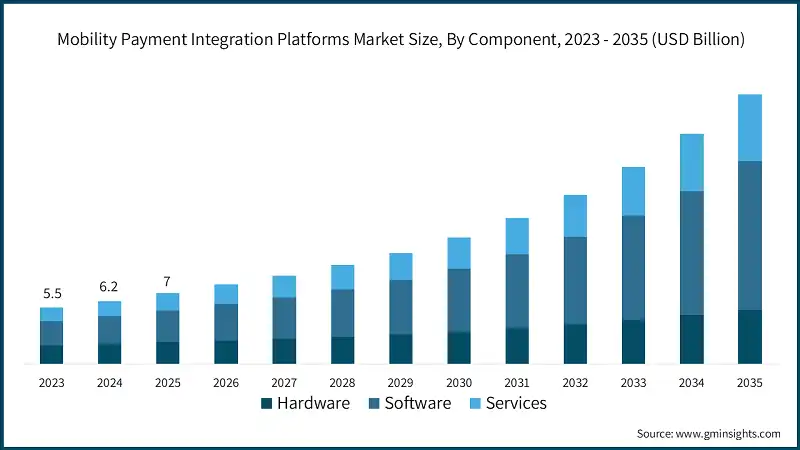
- Software platforms are quickly moving to cloud-native ABT and MaaS structures, allowing for real-time fare processing, multimodal integration and open-loop support. Flexible APIs, mobile-friendly interfaces, and data-driven fare optimization are top priorities for agencies.
- Both validators and terminals are becoming EMV-certified, compact, and equipped with IoT capabilities. The trend in hardware favors multimodal compatibility, quicker tap responses, and remote management features, supporting the industry's shift to open-loop and mobile-focused ticketing environments.
- As agencies shift from outdated AFC systems to cloud ABT and open-loop models, the demand for integration and consulting services is rising. Operators are relying on service providers for tasks like system integration, cybersecurity, customization, and streamlining multimodal payment processes.
Learn more about the key segments shaping this market
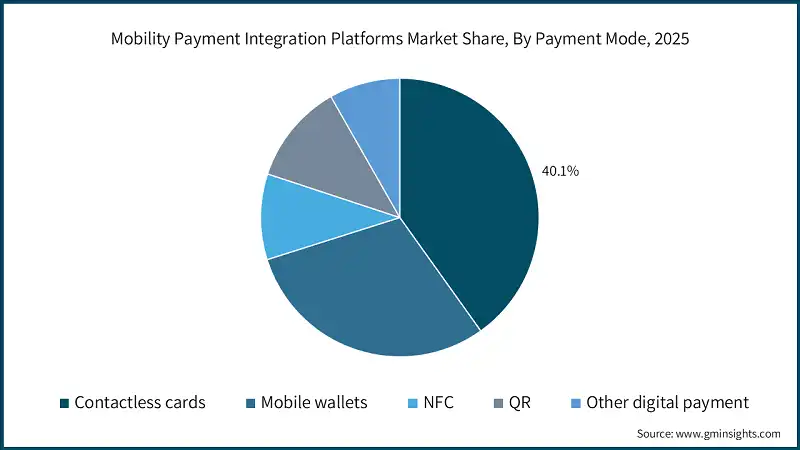
- The adoption of EMV tap-to-pay continues to accelerate because of convenience, speed and global interoperability. Agencies prefer contactless cards because they reduce cash handling, improve rider throughput and enable seamless multimodal travel.
- The adoption of mobile wallets increases with increased utilization of smartphones. They may allow for app-based ticketing, real-time top-ups, tokenized payments and integration with journey planning.
- NFC supports secure mobile validation and wearable payments. Trends are centered on advanced tokenization, quicker authentication and compatibility with legacy readers for smooth transitions.
- QR ticketing is expanding owing to its low cost, ease of deployment and wide compatibility. It is now also supporting micromobility and developing markets where NFC use is limited, offering flexible app-based validation.
- In mixed-banking-access regions, digital wallets, vouchers, prepaid transit accounts and tokenized IDs are on the rise, allowing for inclusive, varied fare options across diversified multimodal systems.
Based on deployment, the mobility payment integration platforms market is segmented into cloud and on-premises. Cloud segment is projected to dominate the market with a CAGR of 17.7% from 2026 to 2035.
- Scalability, lower maintenance and suitability for ABT and MaaS platforms are some of the reasons cloud deployment dominates. With cloud systems, real-time fare calculation, analytics, OTA updates and fast integration with third-party mobility operators are possible.
- Growth in cloud deployment is driven by increasing comfort with cloud security among transit agencies and mobility operators, maturation of cloud service provider offerings-including those with transit-specific compliance certifications-and the emergence of hybrid cloud architectures that combine the scalability of public clouds with on-premises control for sensitive data and critical systems.
- On-premises models remain but largely in agencies with strict control or legacy systems. In applications, public transit leads overall adoption, while ride-hailing, car-sharing, and micromobility increasingly tied into unified payment apps. Parking also benefits from mobile-first payments, which create smoother daily travel experiences.
Based on application, the mobility payment integration platforms market is divided into public transport, ride-hailing, bike-sharing, car-sharing, parking and micromobility. Public transport segment dominated the market accounting around 49.3% in 2025 and is expected to grow at a CAGR of 13.6% from 2026 to 2035.
- Public transit is the largest sector, supported by the expansion of ABT, EMV adoption and multimodal integration. Agencies are focused on ensuring seamless payment across buses, metro, and rail systems with real-time account linking.
- Payment integration in public transport has certain unique challenges, including high volumes of transactions a need for sub-second processing to maintain passenger flow, complex fare structures incorporating zones, transfers and discounts, the ability to operate offline for underground metro systems and interoperability across many operators and modes.
- Ride-hailing apps are increasingly integrating with the MaaS applications through unified payments, digital receipts and in-app multimodal planning. Partnerships with transit agencies ensure comprehensive mobility options.
- Bike-sharing systems favor affordable rentals by QR and mobile payments. Integration with citywide mobility applications can provide for seamless trip planning and dynamic pricing.
Looking for region specific data?
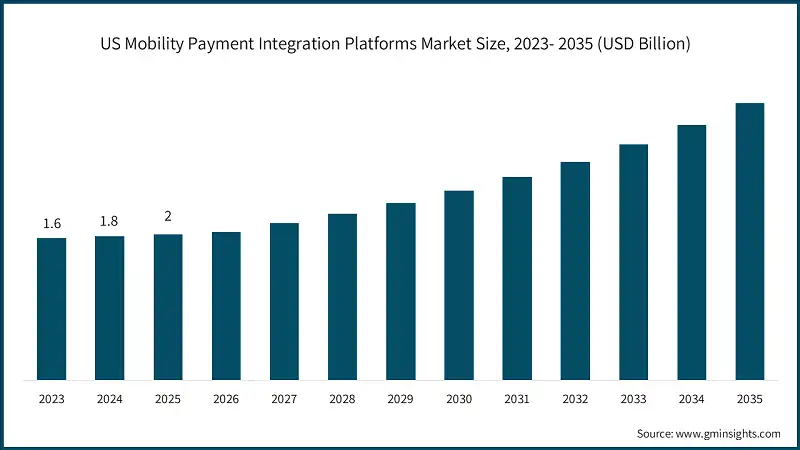
- In North America, there continues to be rapid adoption of contactless and open-loop transit payments due to the mature banking system and high familiarity with EMV cards. More cities are moving away from outdated fare systems to deploy tap-to-ride solutions that alleviate speed and lower dependency on cash.
- Mobile wallet payments also grow fast due to the integration of Apple Pay and Google Wallet and digital identity. For commuters, using phones for everything-from buses and metros to parking and micromobility-driving demand for unified fare systems across cities.
- Government funding also plays a major role, as federal and state programs work to encourage the modernization of the digital infrastructure of transit agencies. This reduces many barriers for smaller or mid-size cities lacking resources to upgrade their fare systems.
- The increasing focus on smart mobility ties digital payments to EV charging, smart parking, ride-hailing and micromobility hubs. Seamless traveling experiences are in demand by cities and payment integration is becoming key in the development of cleaner more efficient urban mobility ecosystems.
Europe mobility payment integration platforms market accounted for USD 1.8 billion in 2025 and is anticipated to show growth of 13.7% CAGR over the forecast period.
- Europe remains the global leader in account-based ticketing and integrated mobility. The region's strong regulatory push for interoperability encourages cities to connect buses, metros, trains, and micromobility under unified mobility platforms that support cross-border travel.
- Contactless cards, NFC-enabled phones, and wearables have become highly common among European commuters. The convenience and security of these technologies are driving smooth adoptions supported by one of the world's strongest digital payment infrastructures.
- Another influential element in the setting of mobility payment trends across Europe is environmental policies. Most cities in Europe are encouraging digital mobility systems to promote public transit, bikes, scooters and electric vehicle sharing as part of broader sustainability goals.
- European cities are increasingly adopting cloud-based systems for fare collection management, data flow optimization, and support for multimodal traveling. In return, digital mobility platforms are becoming intelligent, better-connected, and friendlier for the traveler.
The Asia Pacific mobility payment integration platforms market is anticipated to grow at a CAGR of 17% during the analysis timeframe.
- The Asia-Pacific region is the fastest-growing owing to rapid urbanization and strong government support for digitization. In addition, megacities in China, India, Southeast Asia, and Japan have begun deploying modern fare collection systems to optimize mobility.
- Daily mobility payments are dominated by mobile wallets and QR codes because of the prevalence of smartphones and the popularity of super-apps; these wallets currently support all aspects, from transit fares to ride-hailing and bike-sharing, in many cities.
- Regional governments invest heavily in national mobility cards, metro systems, and digital payment frameworks in order to reduce congestion and modernize public services. This forms a base for large-scale mobility payment integrations.
- Cross-border digital travel is growing, creating interest in interoperable payment systems across airports, regional railways, express buses, and tourism-focused mobility services. The region is rapidly moving towards unified travel experiences.
Latin American mobility payment integration platforms market, exhibiting remarkable growth of 15.8% during 2026 to 2035.
- The trend in Latin America is increasingly shifting from cash to digital transit payments. Cities increasingly choose QR and mobile wallet solutions because they are affordable, scalable, and easy for both operators and riders to adopt.
- Fintech companies serve as a catalyst to this shift by providing various digital wallet services that will be highly accessible to a population with high unbanked and underbanked segments. These wallets carve out new avenues for inclusive, low-cost access to mobility.
- The new fare modernization using digital payment methods is supported by governments in Brazil, Mexico, Chile, and Colombia to enhance transportation efficiency and reduce fare evasion. In addition, BRTs and metro line expansions are creating increasing demand for digital payments.
- Micromobility and ride-hailing continue to grow and both depend heavily on digital payments. As these services are integrated into public transit apps, cities come closer to being able to offer seamless door-to-door mobility journeys.
Middle East and Africa to experience substantial growth in the mobility payment integration platforms market in 2025.
- The Middle East is fast embracing smart city concepts, with integrated mobility systems connecting metro lines, bus routes, ride-hailing, and parking payments under one platform. Large-scale digital infrastructure projects are driving this change in the Gulf countries.
- African cities embrace mobile money and QR-based systems as base mobility payment tools. These solutions allow millions to access transit without bank accounts and make mobility more inclusive. These are investments in expanding metro and BRT systems and in digital ticketing initiatives to enhance urban mobility.
- Digital payments further streamline fare collection and increase transparency, especially in cash-dominated transport systems. Ride-hailing platforms like Careem, Uber, and local startups fuel the need for integrated payment ecosystems. As these services grow, cities are increasingly moving toward unified mobility apps that support various transport modes on a single payment framework.
Mobility Payment Integration Platforms Market Share
- The top 7 companies in the mobility payment integration platforms industry are Cubic, Masabi, Siemens Mobility, Thales, Conduent, Mastercard and Visa contributed around 40.9% of the market share in 2025.
- Cubic is a world leader in integrated payment and information technology solutions for transportation, with 9.1% market share. Cubic's Umo Mobility platform serves transit agencies from all over the world, offering flexible models of payment: open loop, closed loop, and hybrid. The company launched Open Payments on Umo in September 2024 to make contactless bank cards, mobile wallets, and smartwatches available for fare payment, hence its support for small and mid-size transit agencies.
- Thales is a French multinational with 8.7% of market share, dealing in ticketing, payment, and transit management systems in more than 300 cities around the world. Thales applies its expertise in contactless technologies, biometrics, and cybersecurity to provide safe, dependable mobility payment solutions. The company portfolio includes comprehensive fare collection hardware, software platforms, and managed services.
- Conduent a business process services company that provides transportation management and payment processing to some of the largest transit agencies and toll authorities in the world. The company offers an integrated fare collection, revenue management, customer service and analytics solution for transportation systems. Conduent serves its clients in North America and other international locations.
- Mastercard which holds 7.8% market share, represents a global payment network in mobility payment enablement. Mastercard provides the underlying payment processing infrastructure, along with tokenization services, fraud detection, and settlement capabilities that support contactless card acceptance and mobile wallets in various transit systems globally. The company partners with transit agencies, mobility operators, and platform providers to drive seamless payment experiences.
- Visa is leading payment network with 6.4 percent market share, providing contactless and digital wallet payments across all mobility platforms worldwide. In an example of innovation in commercial mobility payments, Visa announced in July 2025 integration with Google Pay for fleet cards. This reduces provisioning time from 7-14 days to hours. The business says 92% of smartphones worldwide now have NFC capability, enabling mobile wallet adoption.
- Scheidt & Bachmann is a German technology company with 4.3% market share, specializes in fare collection systems, parking management solutions, and integrated mobility platforms. Scheidt & Bachmann has a major presence in the European transit markets with an extensive portfolio of hardware and software.
- INIT is a German technology provider of mobility, holding 2.1% market share and mainly small and mid-size transit agencies with modular, scalable solutions for planning, dispatching, ticketing and passenger information. The solutions offered by INIT are characterized by ease of implementation and operational efficiency.
- Siemens offering comprehensive mobility solutions including ticketing, payment processing, and transit management systems. Siemens leverages its broader transportation portfolio of rail vehicles, signaling and infrastructure to provide integrated solutions for transit agencies globally.
Mobility Payment Integration Platforms Market Companies
Major players operating in the mobility payment integration platforms industry are:
- Cubic
- Masabi
- Siemens Mobility
- Thales
- Conduent
- Mastercard
- Visa
- Scheidt & Bachmann
- INIT Innovations
- NXP Semiconductors
- As the mobility ecosystem rapidly evolves with transit operators, payment providers and MaaS platforms pursuing aggressive strategies to strengthen their competitive edge, innovation is accelerating around uniform fare systems, real-time transaction processing, account-based ticketing and universal interoperability across transport modes.
- Next-generation payment engines are also in development, along with advanced risk-management layers, lightweight cloud-native transaction routing systems and higher-capacity data pipelines specifically designed for large-scale mobility payment integration. Other developments include multi-modal digital wallets, enhanced fraud prevention algorithms, lifecycle management for stored-value and subscription products, and increased support for features like cross-border payments, loyalty integration and V2X-enabled mobility payment capability.
- Competition in the integration of mobility payments is becoming increasingly collaborative through partnerships between transit agencies, payment networks, MaaS operators, fintech providers and hardware manufacturers. Such alliances accelerate the deployment of interoperable payment frameworks via co-developments in back-office systems, shared standards for real-time validation, and joint testing of multi-operator acceptance across various transit and mobility services. This cross-industry cooperation allows organizations to offer end-to-end mobility payment solutions, expand into new geographic markets and bring next-generation integrated mobility platforms to users much more quickly than they could by acting alone.
Mobility Payment Integration Platforms Market Report Attributes
| Key Takeaway | Details |
|---|---|
| Market Size & Growth | |
| Base Year | 2025 |
| Market Size in 2025 | USD 7 Billion |
| Market Size in 2026 | USD 7.8 Billion |
| Forecast Period 2026 - 2035 CAGR | 14.5% |
| Market Size in 2035 | USD 26.7 Billion |
| Key Market Trends | |
| Drivers | Impact |
| Shift toward cashless and frictionless public transit | Rapid adoption of EMV contactless, mobile wallets, QR-based ticketing, and open-loop payments is driving mass upgrades of fare collection systems across global transit agencies. |
| Acceleration of Mobility-as-a-Service (MaaS) ecosystems | Integration of multimodal mobility public transport, micromobility, ride-hailing, and parking requires centralized payment platforms capable of real-time clearing and interoperability. |
| Global adoption of Account-Based Ticketing (ABT) | Transit operators are transitioning from card-centric to cloud-managed accounts, enabling fare capping, flexible tariffs, and seamless multimodal travel. |
| Urbanization and smart city investments | Large-scale city initiatives are supporting integrated mobility platforms that unify digital payments, real-time passenger information, and intelligent transport systems. |
| Rise of mobile-first travel behavior | Smartphones are becoming the primary interface for travel planning, ticketing, validation, and in-app payments, pushing operators toward mobile-centric payment ecosystems. |
| Pitfalls & Challenges | Impact |
| High integration complexity across legacy transit systems | Migrating from closed-loop, on-premise hardware to cloud-based ABT platforms requires technical coordination, infrastructure upgrades, and long deployment timelines. |
| Fragmented payment standards and regional regulations | Differences in EMV certification, data privacy laws, and transport regulations slow deployment and increase vendor compliance costs. |
| Opportunities: | Impact |
| Expansion of integrated multimodal platforms (MaaS 2.0) | Unified payment engines that cover transit, micro-mobility, ride-hailing, tolling, and parking will create high-value platforms for cities and private operators. |
| Open-loop EMV expansion in emerging markets | Developing regions adopting bank-card tap systems provide rapid growth potential for validators, mobile ticketing, and cloud back-office providers. |
| AI-powered fare optimization and real-time analytics | Predictive analytics, fraud detection, dynamic pricing, and improved traffic forecasting enhance platform value for operators. |
| Growth in micromobility and last-mile transport | E-bikes, scooters, and shared mobility providers increasingly integrate payment functions into unified travel and rental apps. |
| Market Leaders (2025) | |
| Market Leaders |
9.09% Market Share |
| Top Players |
|
| Competitive Edge |
|
| Regional Insights | |
| Largest Market | North America |
| Fastest growing market | Asia Pacific |
| Emerging countries | China, Germany, South Korea, UAE |
| Future outlook |
|
What are the growth opportunities in this market?
Mobility Payment Integration Platforms Industry News
- In November 2025, Verra Mobility and Stellantis Launch AutoKinex In-Vehicle Payment Platform. Verra Mobility Corporation announced the launch of AutoKinex, a secure in-vehicle payment platform developed in partnership with Stellantis, enabling automated toll, parking, and mobility service payments directly from vehicle infotainment systems.
- In November 2025, JPMorgan Announces Closure of VW Pay Mobility Payment Platform. JPMorgan announced the shutdown of its VW Pay mobility payment platform, acquired from Volkswagen in 2021, citing lack of profitability despite revenue growth.
- In September 2024, Cubic Transportation Systems Launches Open Payments on Umo Mobility Platform. Cubic Transportation Systems launched Open Payments on the Umo Mobility platform, enabling contactless bank cards, mobile wallets (Apple Pay, Google Pay, Samsung Pay), and smartwatches for fare payment across small and mid-size transit agencies.
- In October 2024, Hitachi Rail Completes Acquisition of Omnicom Digital Rail Monitoring. Hitachi Rail completed the acquisition of Omnicom from Balfour Beatty to enhance its HMAX digital asset management platform with train-mounted monitoring technology.
The mobility payment integration platforms market research report includes in-depth coverage of the industry with estimates & forecasts in terms of revenue (USD Mn) from 2022 to 2035, for the following segments:
Market, By Component
- Software
- Hardware
- Validators
- NFC terminals
- Services
- Integration
- Consulting
Market, By Payment Mode
- Contactless cards
- Mobile wallets
- NFC
- QR
- Other digital payment
Market, By Deployment
- Cloud
- On-premises
Market, By Application
- Public transport
- Ride-hailing
- Bike-sharing
- Car-sharing
- Parking
- Micromobility
The above information is provided for the following regions and countries:
- North America
- US
- Canada
- Europe
- Germany
- UK
- France
- Italy
- Spain
- Russia
- Nordics
- Portugal
- Croatia
- Asia Pacific
- China
- India
- Japan
- Australia
- South Korea
- Singapore
- Thailand
- Indonesia
- Latin America
- Brazil
- Mexico
- Argentina
- MEA
- South Africa
- Saudi Arabia
- UAE
- Turkey
Frequently Asked Question(FAQ) :
What is the market size of the mobility payment integration platforms in 2025?
The market size was USD 7 billion in 2025, with a CAGR of 14.5% expected through 2035. The adoption of cashless systems, including contactless cards, mobile wallets, and QR-based ticketing, is driving market growth.
What is the projected value of the mobility payment integration platforms market by 2035?
The market is poised to reach USD 26.7 billion by 2035, driven by the transition to open-loop EMV payments, cloud-based fare systems, and integrated urban mobility ecosystems.
What is the expected size of the mobility payment integration platforms industry in 2026?
The market size is projected to reach USD 7.8 billion in 2026.
How much revenue did the software segment generate in 2025?
The software segment generated approximately 44.6% of the market share in 2025 and is expected to grow at a CAGR of over 16.9% up to 2035.
What was the valuation of the contactless cards segment in 2025?
The contactless cards segment accounted for around 40.1% of the market share in 2025 and is set to expand at a CAGR of 11.4% till 2035.
What is the growth outlook for the public transport segment from 2026 to 2035?
The public transport segment is anticipated to observe around 13.6% CAGR through 2035, maintaining its dominance with a 49.3% market share in 2025.
Which region leads the mobility payment integration platforms sector?
The United States leads with 84% of the market share in 2025. The market is led by the rapid adoption of contactless and open-loop transit payments, supported by a mature banking system and widespread familiarity with EMV cards.
What are the upcoming trends in the mobility payment integration platforms market?
Key trends include open-loop EMV payments, integrated micromobility, cloud-based fare systems, API-first interoperability, and expanding mobile ecosystems with wallets, QR codes, and NFC payments.
Who are the key players in the mobility payment integration platforms industry?
Key players include Cubic, Masabi, Siemens Mobility, Thales, Conduent, Mastercard, Visa, Scheidt & Bachmann, INIT Innovations, and NXP Semiconductors.
Mobility Payment Integration Platforms Market Scope
Related Reports