Summary
Table of Content

Mobility Data Analytics Platforms Market
Get a free sample of this report
Form submitted successfully!
Error submitting form. Please try again.
Thank you!
Your inquiry has been received. Our team will reach out to you with the required details via email. To ensure that you don't miss their response, kindly remember to check your spam folder as well!
Request Sectional Data
Thank you!
Your inquiry has been received. Our team will reach out to you with the required details via email. To ensure that you don't miss their response, kindly remember to check your spam folder as well!
Form submitted successfully!
Error submitting form. Please try again.
Mobility Data Analytics Platforms Market Size
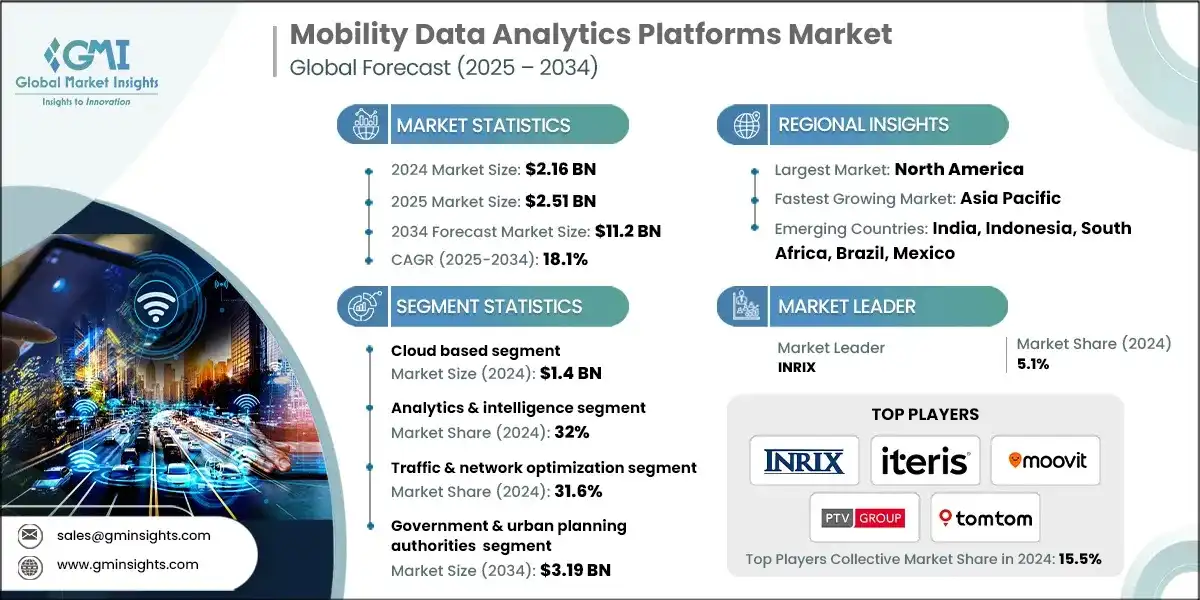
The global mobility data analytics platforms market size was estimated at USD 2.16 billion in 2024. The market is expected to grow from USD 2.51 billion in 2025 to USD 11.2 billion in 2034, at a CAGR of 18.1% according to latest report published by Global Market Insights Inc.
Mobility Data Analytics Platforms Market Key Takeaways
Market Size & Growth
- 2024 Market Size: USD 2.16 Billion
- 2025 Market Size: USD 2.51 Billion
- 2034 Forecast Market Size: USD 11.2 Billion
- CAGR (2025–2034): 18.1%
Regional Dominance
- Largest Market: North America
- Fastest Growing Region: Asia Pacific
Key Market Drivers
- Urban Congestion and Population Growth.
- Rising congestion pushes cities to adopt advanced analytics for traffic optimization, resulting in stronger platform demand, improved urban mobility and greater integration of multimodal transport data into city operations..
- Surge in Connected Vehicles and IoT Devices.
- Growth of Public Transit Digitization.
- Corporate Demand for Fleet and Logistics Optimization.
Challenges
- Data Privacy and Security Concerns.
- High Integration and Deployment Costs.
Opportunity
- Growth of Autonomous and Advanced Driver Assistance Systems (ADAS).
- Expansion of EV Infrastructure and Charging Analytics.
- Sustainable Mobility and Emissions Monitoring.
- Stricter sustainability goals create opportunities for platforms to offer emission tracking, eco-routing and environmental forecasting, helping cities and enterprises meet regulatory targets and optimize cleaner mobility strategies..
Key Players
- Market Leader: INRIX led with over 5.1% market share in 2024.
- Leading Players: Top 5 players in this market include INRIX, Iteris, PTV Planung Transport Verkehr, TomTom, which collectively held a market share of 15.5% in 2024.
Get Market Insights & Growth Opportunities
Real-time multi-modal mobility intelligence allows for real-time monitoring of traffic, transit, freight and micro-mobility networks. It enhances operational decision-making, provides dynamic signal adjustments, improves incident response and delivers comprehensive traveler information all contributing to reduced congestion, enhanced reliability in transport services, improved safety and overall improved network functionality.
AI-enabled predictive analytics with mobility digital twins provide increased insight into future travel behavior, congestion hotspots and infrastructure performance. They provide scenario simulation, optimize long-range planning, improve proactive safety interventions and improve asset utilization. This ultimately results in prioritizing smart capital investments, responding to operational asset risk more efficiently and creating more resilient mobility systems for the future.
The growing number of connected vehicles, IoT devices and advanced roadside sensors produces a dramatic increase in data and data granularity. As a result, analytics become more precise, enable real-time risk detection, allow for predictive maintenance and advance multimodal coordination. The expanded data ecosystem improves smart city capabilities, enhances traveler experience and accelerates deployment of autonomous and intelligent mobility solutions.
Mobility data analytics, once confined to only several cases, have quickly been adopted across the Asia Pacific region with the considerable forces of urbanization, smart city initiatives from the government, large-scale deployments of intelligent transport systems (ITS)and significant growth in connected vehicles and micromobility contributing to this growth. From countries such as China, Japan, Singapore, India and South Korea, we see sensor networks, telematics and artificial intelligence (AI) enabled platforms converging to manage congestion, improve public transport system efficiencies and generally enable sustainable urban mobility.
In September 2025, Nexar, a mobility and vehicle data analytics company from the United States, received the TechForward Award by SiliconANGLE in the Data Platform Tech Real Time and Streaming Analytics category. This award demonstrates Nexar’s stature in AI Mobility Intelligence and highlights the increasing relevance of real-time data platforms in U.S street work and a smart city environment.
To get key market trends
Mobility Data Analytics Platforms Market Trends
Real-time, multi-modal mobility intelligence allows for the ongoing observance of traffic, transit, freightand micromobility systems. The information assists in improving operational decision making, dynamically adjusting traffic signal operations, providing superior incident managementand offering seamless traveler information. The advantages associated with mobility intelligence are decreased congestion, improved service reliability, increased safetyand increased efficiency of the whole network.
AI-based predictive analytics and mobility digital twins create better visibility into future travel behavior, congestion hubsand infrastructure performance. These technologies enable the ability to simulate various scenarios, create a better long-term performance framework, extend proactive safety measuresand enhance asset utilization. All of these enable entities to better invest in mobility and can reduce operational risks, while preparing mobility systems for a future where technology is more intertwined with everyday passenger experiences.
The continued growth of connected vehicles, IOTsand advanced roadside sensors leads to a significantly greater volume of data, more detail in data collection and analysis reduces risk exposure in forecasting, creates precise algorithms to continuously detect real-time emergent risks, provides improved predictive maintenanceand coordination across multimodal risks and planning efforts. New and expand data ecosystem will enhance what cities can mobilize via smart cities, improve traveler experiencesand promote more rapid deployment of autonomous and intelligent mobility technology.
More stringent sustainability targets create possibilities for platforms to offer emission tracking, eco-routingand environmental forecasting solutions to help cities and enterprises meet regulatory compliance targets while refining strategies for cleaner mobility. Environmental regulations and carbon targets will increase the uptake of analytics for eco-routing, congestion reduction, electric vehicle mobility planning and emission monitoring and make platform solutions central to sustainable mobility strategies.
Mobility Data Analytics Platforms Market Analysis
Learn more about the key segments shaping this market
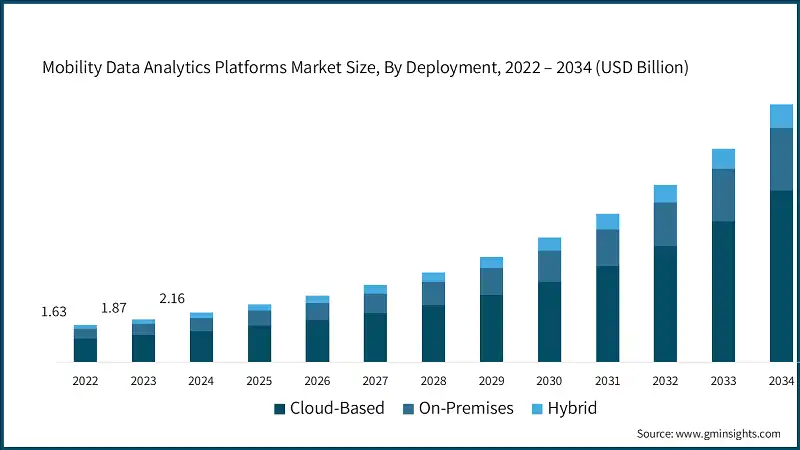
Based on deployment, the mobility data analytics platforms market is bifurcated as cloud-based and on-premises. Cloud based accounted for USD 1.4 billion in 2024 and is anticipated to grow at a CAGR of 18.9% from 2025 to 2034.
- Cloud-enabled mobility analytics platforms occupy a leading position within the marketplace as they provide scalability, reduced costs for capital investments and the capability to quickly access advanced AI. They enable rapid deployment and remote access with software as a service or platform as a service infrastructure providing reduced financial risk. Strong adoption has been rapid with smaller agencies where resources to operate on-premises infrastructure and high-performance computing are scarce.
- The Wisconsin DOT states that cloud platform benefits improve storage, model training and collaborative analytics capacity of agencies with limited IT. Privacy, compliance and sensitive data issues have the demand for on-premises systems or private clouds intact, for federal agencies, defense and regulatory governing.
- On-premise deployment is maintained and essential when complete data sovereignty is required, ultra-low latency, or integrated with legacy systems or organizational infrastructure. On-premise remains prevalent in traffic centers, control rooms and fleet operations. Hybrid systems continue to emerge, adding immediate and local processing edge technology for real-time needs and deploying cloud for scalability, analysis of historical data and access to multi-agency data.
Learn more about the key segments shaping this market
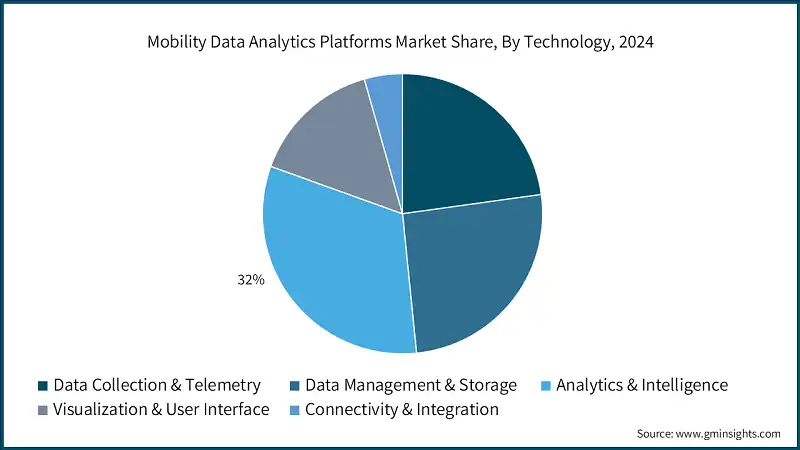
Based on technology, the mobility data analytics platforms market is segmented into data collection & telemetry, data management & storage, analytics & intelligence, visualization & user interface, connectivity & integration. Analytics & intelligence segment dominates the market with 32% share in 2024 and is projected to grow at a CAGR of 21.2% from 2025 to 2034.
- The number of connected vehicles, IoT sensors and telematics has contributed to a boom in mobility data generation. New data ingestion pipelines and streaming technologies enable the collection of data to be accurate, timely and real-time for time-sensitive planning and deployment for traffic, fleet and transit analytics, predictive modeling and situational awareness regarding urban mobility operations and management.
- In dealing with heterogeneous mobility data, ensuring appropriate data governance and scalable data storage solutions are important. Cloud-based data lakes, time series databases and metadata catalogs allow for easier access, ease of interoperability and compliance across complex historical and real time transportation data analytics platforms.
- Platforms are increasingly relying on AI, machine learning and predictive modeling. The advanced analytics capabilities allow decision-makers and planners to turn mobility data into actionable intelligence (such as forecasting traffic patterns, predicting demand for services, reviewing safety impacts, or optimizing fleet deployment) and to develop proactive strategies to test financial and operational scenarios and planning for short - and long-term initiatives and strategies across public and private mobility entities.
- Dashboards, geospatial mapping and interactive user interfaces convert complex analytics into actionable insights. Mobility platforms place particular emphasis on being mobile responsive, allowing users to drill down and simulate scenarios to help planners, operators and policymakers monitor KPIs, optimize operations and engage stakeholders in data-driven mobility management.
- APIs, standardized protocols and secure data-sharing allow for interoperability across traffic systems, transit platforms and third-party applications. Integration technologies allow for federated access, cross-agency collaboration and multi-modal coordination needed by cities, mobility operators and enterprises seeking real-time, connected and unified mobility systems.
- For example, the City of San José publicly highlights performance and project transparency that can lead to urban transformation. Separately, planning platforms combining visualizations and scenario modeling deliver additional strategic planning value and public engagement benefits.
Based on application, the mobility data analytics platforms market is classified into traffic & network optimization, fleet & asset management, public transit & shared mobility analytics, safety, compliance & incident management, revenue, pricing & demand forecasting, sustainability, emissions & environmental monitoring. Traffic & network optimization held the largest share in 2024 at 31.6% and is projected to grow at around 17.2% CAGR from 2025 to 2034.
- Predictive traffic modeling, adaptive signaling and congestion management platforms can turn into an increase in throughput, delay and traveler experience. Real-time and historical analytics support scenario testing, infrastructure scoping and resilience planning for cities and are essential for modern municipal traffic authorities and smart city programs.
- Telematics-based predictive maintenance, route optimization and asset tracking can achieve operational efficiency and cost savings. Mobility platform solutions allow logistics companies, ride-hailing operators and commercial transportation companies to dynamic dispatch, monitor fleet utilization and benchmark performance.
- Data-driven technology improves scheduling, forecasting ridership and managing mode-shift strategies. It also allows analytics platforms to leverage multi-modal travel patterns, micro-mobility usage and real-time operational data to improve service reliability, lower congestion and support urban sustainable mobility schemes.
- Mobility analytics platforms can be used to identify hazards, predict incidents and help with enforcement and mitigation of risk. Examples include crash hotspot analysis, identifying vulnerable road users and monitoring regulatory compliance, which ultimately helps to improve public safety, reduce incidents and support Vision Zero and fleet safety efforts.
- Mobility analytics platforms provide predictive insights related to fare structures, dynamic pricing and demand models. Analytics support transit agencies, shared mobility operators and logistics companies to optimize revenue, allocate resources and balance capacity with demand, all of which support financial returns and customer satisfaction.
- Mobility data platforms can quantify, model and reduce their environmental impact. Applications include emissions monitoring, energy consumption, low emissions zones and carbon footprint; all of which support cities and companies to achieve climate targets, regulations and corporate sustainability commitments.
Based on end use, the mobility data analytics platforms market is segmented into government & urban planning authorities, public transportation agencies, mobility & shared transport operators, logistics & fleet-based enterprises, automotive OEMS & tier-1 tech providers, research, policy & academic institutions. Government & urban planning authorities held the largest share in 2024 at 31% and is projected to reach around USD 3.19 billion by 2034.
- Analytics platforms allow for the development of data-driven policies for infrastructure planning and urban mobility management. Governments leverage predictive and prescriptive insights to mitigate congestion, integrate multimodal transport and prepare for emergencies, assisting them in making decisions regarding smarter and more resilient city planning and transport governance.
- Transit authorities use analytics to drive schedule optimization, fleet utilization, ridership forecasting and service performance. Platforms help transit authorities be more efficient, reliable and equitable, while also supporting investment in digital infrastructure and evidence-based decision-making on urban mobility services.
- Ride-hailing, car-sharing and micro-mobility providers use real-time analytics for dynamic pricing, demand forecasting, fleet redistribution and service optimization. Data-driven platforms enhance customer experience, operational efficiency and integration with urban mobility ecosystems.
- Analytics support companies and other fleet-based enterprises with predictive maintenance, route optimization and resource allocation. Fleet operators and logistics companies leverage data-informed operational decisions to improve delivery efficiency and reduce operational costs and to increase sustainability performance.
- OEMs and technology suppliers leverage mobility data to develop solutions for connected vehicle services, autonomous vehicle use cases, predictive maintenance and telematics-based business models. Analytics platforms support product innovation and fleet intelligence and facilitate integration into the smart mobility ecosystem.
Looking for region specific data?
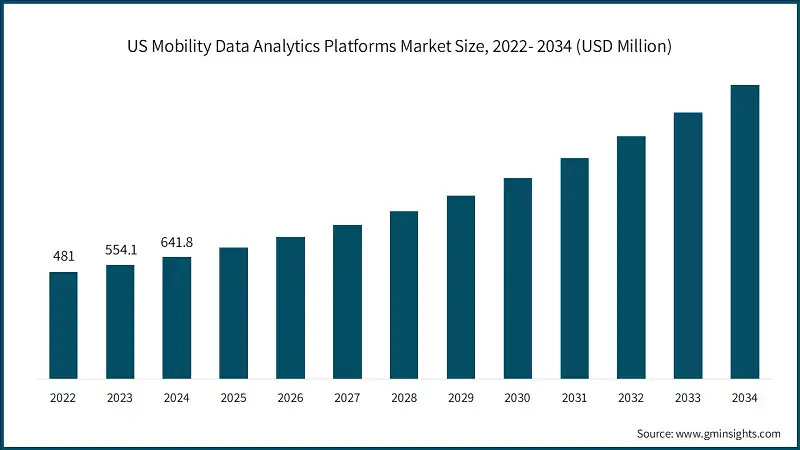
The US mobility data analytics platforms market dominates regional revenue with approximately 87% share in 2024. The market in US held a revenue of USD 641.8 million in 2024 and is expected to experience significant and promising growth from 2025 to 2034.
- The quick rollout of real-time traffic management and vehicle-to-everything (V2X) systems deepens integration of vehicles, infrastructure and edge analytics, allowing for faster response to incidents; adaptive signal control; and connected safety among new services, boosting investments in low-latency platforms and public–private investment deployments across cities, highways and original equipment manufacturer (OEM) telematics programs that support scaled cloud-native operational analytics and research.
- Expanded EV charging networks support increased integration of mobility analytics with grid management functions to support demand forecasting, load balancing and site selection, using telematics and telematics-informed charging behavior. Utilities, cities and private operators deploy mobility analytics platforms to support predictive analytics; vehicle-to-grid (V2G) demonstration pilots; and coordinated planning for infrastructure investments and policy alignment within mobility solutions.
- Increased federal funding and regulatory attention support standardized data governance, recommended privacy frameworks and open-data initiatives that work in favor of adoption of mobility analytics. Department of Transportation (DOT) grants, pilot programs and interoperability standards foster cross-jurisdictional data sharing, explainable artificial intelligence projects and procurement of cloud-native platforms encouraging scale deployment across metropolitan and statewide transportation systems that coordinate.
North America accounts for 34% mobility data analytics platforms market share in 2024 and is expected to reach USD 3,799.7 million by 2034.
- North America is the second largest market, primarily driven by the United States, which has 87% of the market share in the region in 2024. Growth is driven by federal initiatives, including the DOT Smart City Challenge and the DOE EEMS initiative, which expedites municipal adoption of mobility analytics and data platforms and spur public and private sector innovation partnerships across large metropolitan areas.
- The rapid growth in the United States is also bolstered by investments at the state and local level in traffic management, transit analytics and connected vehicle infrastructure. Emerging initiatives such as the Lawrence Berkeley National Laboratory's Mobility indicate the federal research investment supportive of energy related applications, while the private sector engagement with technology firms, OEMs and mobility startups provides opportunities for advanced analytics, automation and large-scale commercialization.
- In Canada, growth is happening at an incremental pace, spurred by similar smart-city programming initiatives in Toronto, Vancouver and lastly Montreal. In addition, increased investment in public transit modernization, active transportation, multimodal integration and open-data ecosystems reinforces the regional demand for mobility analytics, supporting ongoing adoption and innovation in data driven urban mobility planning in the region.
The mobility data analytics platforms market in Europe is expected to reach USD 2,660 million by 2034. The region held 26% market share in 2024 with 17% CAGR from 2025 to 2034.
- The mobility analytics market in Europe is heavily influenced by regulatory factors associated with emissions reduction, GDPR guidance for data governance policy on sustainable urban mobility. The largest share is in Germany where the investment in electrification, digital twins and development of automated vehicles, along with the emphasis on smart transport systems, has a direct tie-in to the robust automotive sector.
- The European Union's Urban Data Platform opens opportunities for data sharing and research collaboration between cities and engages with data sharing through increased interoperability and cross-border usage. Some of the countries that show strong adoption are the United Kingdom, France, Italy, Spain and the Netherlands due to their solid public transport networks of their public systems, pricing programs for congestion and actively advancing smart cities in response to climate objectives.
- The remaining market in Europe will continue to expand in various regions based on multimodal integration of services, further mandates for sustainability and the digitalization of mobility innovations. There will be continued investment in connected infrastructure, monitoring for emissions and pollution next generation planning tools, enabling ongoing market growth, until 2034.
Germany mobility data analytics platforms market leads European growth, accounting for approximately 34.5% of regional revenue in 2024.
- Germany is showcasing advanced implementations of multimodal integration to revitalize public transportation. This includes initiatives such as digital bus and rail timetabling, creation of mobility hubs and mobility as service (MaaS) pilots that include regional rail, bus services and micromobility and pedestrian infrastructure. Federal and city initiatives also support the modernization of data-related platforms for operationalizing local mobility data and interoperability through data exchanges that extend timetables, to focus on service frequency, accessibility, equity and optimizing modal shifts for sustainable transportation across an increasingly complex urban and intercity network of mobility services.
- Germany's data protection and sovereignty regulations are highly regulated on the national and European level and contribute to a strong preference for private or hybrid enterprises and data governance. Agencies and data private/public partners utilize the importance of preserving local data residency, data anonymization and explainable AI in their plans to build secure and federated mobility platforms that meet the needs of the local community and citizens and that of European Union-wide data governance requirements and ultimately, increased acceptance and privacy of mobility data.
- Germany's strong integration of the transportation system with the automotive and industrial ecosystem generates Unicorn-like pilots for Vehicle-to-Everything (V2X) applications, shared vehicle data platforms and possibly smart infrastructure initiatives. Original Equipment Manufacturers (OEMs), Tier-1 automotive suppliers and cities continue to build out vehicle analytics applications for early autonomous trials, predictive maintenance and street traffic optimization. Germany will leverage the manufacturing community to provide a strong foundation to develop and scale commercially robust mobility data applications in domestic and across European markets.
Asia Pacific held a value of USD 699.7 million in 2024 and is expected to experience significant and promising growth from 2025 to 2034.
- The mobility data analytics platforms market in the Asia Pacific region is the largest and fastest growing in the world due to urbanization, smart city initiatives and technology-rich intelligent transportation systems in China, India, Japan, South Korea and Southeast Asia. The growth has been provided by strong public sector investment and expanding digital infrastructure as it relates to public transit, traffic management and connected mobility ecosystems.
- China is the largest market with a 46% market share attributed to citywide smart city strategies in cities characterized by a high degree of integration of AI, IoT and big data into urban mobility operations. The rapid deployment of digital twins connected vehicle ecosystems and citywide arterial optimization strategies continue to facilitate market growth through 2034.
- India, Japan South Korea will also be major markets in the region. India is driving significant demand through its Smart Cities Mission and modernization of transit systems initiatives. Japan and South Korea have longstanding initiatives related to connected vehicles and autonomous transportation systems. With dense city populations, continued mobility demand and government support in the adoption of newer technologies, Asia Pacific will serve as a regional growth engine in the mobility analytics market.
The mobility data analytics platforms market in China is estimated to hold market revenue of USD 322.1 million in 2024 and is expected to experience significant and promising growth from 2025 to 2034.
- The fast pace of urbanization and the presence of national smart-city initiatives create huge scale for mobility analytics concerning transit, payment and sensor networks. Municipal mobility platforms ingest vast amounts of probe and CCTV data to support traffic control, multimodal transportation planning and public safety, with local cloud service providers and a strong municipal procurement approach benefitting the large-scale implementation of innovations in analytics.
- Strong adoption of EVs and rollout of national charging infrastructure will drive mobility analytics focused on forecasting charging demand, site selection and grid resiliency. Utilities and original equipment manufacturers (OEMs) along with cities will utilize telematics and payment data to mitigate load, develop V2G pilots and to drive urban design to support EV loads- with mobility analytics supporting the potential for heavy investment in electrification and coordination efforts by the government.
- Data localization laws, domestic cloud providers and the consolidation of vendor mobility platforms will shape mobility analytics in China. Regulators and cities will rely on homegrown vendors capable of secure data pipelines, their own approved artificial intelligence models, to provide vertically integrated mobility platforms that bring together mapping, payments and surveillance solutions that can be quickly deployed but with evolving compliance to rigorous guidelines on cyber security and data usage along with oversight measures.
Latin America held mobility data analytics platforms market revenue of USD 99 million in 2024 and is expected to experience significant and promising growth from 2025 to 2034.
- Latin America is a rising market in mobility analytics due to a rapid increase in urbanization, more BRT networks and an increasing desire to implement smart city technologies. Demand is increasing across primary metropolitan areas as governments strive to utilize data-driven approaches to provide mobility management to address issues like congestion, safety and efficiency of public transportation.
- Brazil comprises 25.8% of the market share in 2024 as they lead the region as a primary market for investments in intelligent transportation systems in São Paulo, Rio de Janeiro Brasília. Governments remain focused on traffic optimization, real-time transit tracking and digital urban management thus, the demand is increasing strongly toward 2034.
- The rest of LATAM- Mexico, Argentina, Colombia and Chile makes up most of the regional demand. Despite challenges, including budgetary constraints, widespread decentralized governance and data gaps, these markets still have significant potential in the long run as cities build out their digital infrastructure and transit systems and leverage analytics to meet sustainable urban mobility.
The MEA mobility data analytics platforms market is projected to grow at a CAGR of 12.5% from 2025 to 2034 and held a market share of around 2.7% in 2024.
- Middle East and Africa is the smallest but is a growing mobility analytics market, driven by key smart city initiatives in the GCC and rapid urbanization in cities across Africa. Governments have embraced digital mobility systems to solve existing congestion, safety and long-term infrastructure planning issues.
- The United Arab Emirates is set to dominate the region in 2024 because of large-scale investments in Dubai and Abu Dhabi. These destinations are actively developing autonomous mobility trials, integrated platforms and smart city ecosystems of the next generation, helping to establish the UAE as a regional innovation hub through 2034.
- The remaining MEA (including Saudi Arabia, South Africa, Egypt and others), accounts for most of the MEA regional market. Growth in the region is expected to come from megaprojects, national digital transformation programs and modernization of urban mobility still, with challenges from complex governance, limited data infrastructure and wider economic volatility.
Mobility Data Analytics Platforms Market Share
- The top 7 companies in the mobility data analytics platforms industry are INRIX, PTV Planung Transport Verkehr, TomTom, Iteris, Moovit, Siemens Mobility, HERE Technologies, Teralytics, Streetlight Data, Cubic Transportation Systems, contributing around 20.3% of the market in 2024.
- Iteris provides advanced smart mobility infrastructure consisting of sensors, analytics and cloud software for traffic management, transit operations and roadway safety. Iteris' ClearMobility Platform enables all forms of data to be used to provide real-time information. The strength of Iteris is its unique combination of hardware - software solutions and strong established relationships with North American transportation agencies.
- Moovit is a multimodal mobility-as-a-service platform that provides real-time transit information, trip planning and analytics. Moovit ingests data from transit agencies, ride-hailing services, micro mobility and crowdsourced data as part of its offering. Moovit delivers differentiated value by having a large user base, a multimodal approach and helping agencies continue to build a better experience for passengers as planned.
- INRIX provides mobility intelligence and offers real-time traffic data, predictive analytics and a vast amount of coverage from connected vehicles, mobile devices and sensors throughout the world. INRIX is particularly strong in real-time processing, supports vast data networks and top-tier integration with navigation, automotive and fleet systems and all of this is reinforced through collaboration with transportation agencies and OEMs.
- PTV Planung Transport Verkehr has a long, established position as an innovator in transportation planning and simulation with its two flagship products PTV Visum and PTV Vissim. PTV offers real-time analytics, digital twins and cloud-based platforms. PTV has a strong competitive position with deep domain expertise, trusted institutional relationships with planning agencies and comprehensive integrated tool domain capabilities for strategic planning and operational optimization / optimization phenomena.
- TomTom is global mapping, navigation and real-time traffic intelligence provider. TomTom provides mobility analytics including traffic flow data, travel times, route and location insights. Strengths include a proprietary global database of maps, a large volume of probe data and a seamless alignment with automotive navigation, logistics platform design and consumer mobility applications.
Mobility Data Analytics Platforms Market Companies
Major players operating in the mobility data analytics platforms industry are:
- Cubic Transportation Systems
- HERE Technologies
- INRIX
- Iteris
- Moovit
- PTV Planung Transport Verkehr
- Siemens Mobility
- Streetlight Data
- Teralytics
- TomTom
- INRIX delivers global mobility analytics and connected car offerings, using its large database of vehicles, devices and sensor data to bring insight into the traffic, parking and roadway planning spaces. INRIX solutions are utilized by government, automotive OEMs and enterprises. INRIX differentiates itself based on extensive data coverage, strong predictive potential and establishing partnerships and relationships to enhance its position in the emerging mobility ecosystem.
- PTV Group is focused on transportation planning and simulation. It provides tools for strategic modeling, microscopic simulation and real-time traffic management. PTV has cloud-based analytics, digital twins and AI optimization as part of their planning process to increase accuracy. PTV Group has a deep understanding and established relationships in this space, providing a strong competitive advantage and positioning, as well as the potential for expansion by integrating real-time data into its planning and advanced simulation capacity.
- TomTom provides mapping, navigation and real-time traffic intelligence with a huge underlying probe data set from its connected devices. TomTom provides analytics as part of their services to automotive, enterprises and government clients. TomTom provides strong competitive advantages due to its overall quality of maps, strong consistency of traffic information and established relationships, while simultaneously positioning itself for future growth by aligning itself to autonomous vehicle mapping services and a direction toward growing its SaaS (software as a service) offerings.
- Iteris provides smart mobility infrastructure solutions consisting of sensors, analytics and cloud platforms for real-time traffic, safety and transit optimization. The ClearMobility Platform provides predictive decision-making by utilizing diverse data sources in a single decision-making engine. Iteris benefits from significant relationships with public sector agencies, end-to-end solutions and recurring software revenue growth, further establishing a leadership position in the North American intelligent transportation systems market.
- Moovit is a global mobility-as-a-service platform that provides real-time transit information, multimodal trip planning and metrics and analytics for agencies and cities. Moovit leverages a large customer base of millions of users who provide crowdsourced data which enables detailed insights pertaining to mobility. Moovit’s competitive advantages include multimodal integration and a global scale, and the combination of these advantages have lengthy engaged synergies with technology and innovations in autonomous mobility, following its integration into one of the dominant automotive technology ecosystems.
Mobility Data Analytics Platforms Market Report Attributes
| Key Takeaway | Details |
|---|---|
| Market Size & Growth | |
| Base Year | 2024 |
| Market Size in 2024 | USD 2.16 Billion |
| Market Size in 2025 | USD 2.51 Billion |
| Forecast Period 2025 – 2034 CAGR | 18.1% |
| Market Size in 2034 | USD 11.2 Billion |
| Key Market Trends | |
| Drivers | Impact |
| Urban Congestion and Population Growth | Rising congestion pushes cities to adopt advanced analytics for traffic optimization, resulting in stronger platform demand, improved urban mobility and greater integration of multimodal transport data into city operations. |
| Rising congestion pushes cities to adopt advanced analytics for traffic optimization, resulting in stronger platform demand, improved urban mobility and greater integration of multimodal transport data into city operations. | Government modernization programs accelerate deployment of real-time analytics tools, boosting adoption across transportation agencies and enabling coordinated, data-backed planning, resulting in wider digital transformation of mobility networks. |
| Surge in Connected Vehicles and IoT Devices | Connected vehicles and IoT sensors generate continuous mobility data, increasing the need for platforms to manage, integrate and analyse information for safety, operational efficiency and predictive insights. |
| Growth of Public Transit Digitization | Transit agencies are digitizing fare systems, operations and passenger services, driving demand for analytics platforms that enhance reliability, scheduling, fleet performance and evidence-based decision-making across transit networks. |
| Corporate Demand for Fleet and Logistics Optimization | Enterprises increasingly need real-time routing, fuel optimization and driver performance insights, boosting adoption of mobility analytics platforms to improve cost efficiency and strengthen competitive logistics capabilities. |
| Pitfalls & Challenges | Impact |
| Data Privacy and Security Concerns | Strict data protection rules and heightened privacy concerns slow platform implementation, limiting access to sensitive mobility datasets and complicating cross-agency data sharing required for comprehensive analytics. |
| High Integration and Deployment Costs | Complex integration with legacy systems increases costs and slows adoption, especially for small agencies and operators, reducing scalability and postponing long-term digital mobility modernization. |
| Opportunities: | Impact |
| Growth of Autonomous and Advanced Driver Assistance Systems (ADAS) | Autonomous systems require high-resolution mobility data, creating opportunities for platforms to provide predictive insights, training datasets and real-time road intelligence supporting emerging vehicle technologies. |
| Expansion of EV Infrastructure and Charging Analytics | EV adoption increases demand for analytics on charging behaviour, grid load and location planning, enabling platforms to support utilities, cities and operators with actionable electrification insights. |
| Sustainable Mobility and Emissions Monitoring | Stricter sustainability goals create opportunities for platforms to offer emission tracking, eco-routing and environmental forecasting, helping cities and enterprises meet regulatory targets and optimize cleaner mobility strategies. |
| Stricter sustainability goals create opportunities for platforms to offer emission tracking, eco-routing and environmental forecasting, helping cities and enterprises meet regulatory targets and optimize cleaner mobility strategies. | Growing MaaS ecosystems require unified analytics on micromobility, transit and ride-hailing, enabling platforms to deliver real-time performance insights and power personalized mobility services across diverse modes. |
| Market Leaders (2024) | |
| Market Leaders |
held 5.1% market share in 2024 |
| Top Players |
Collective market share in 2024 is 15.5% |
| Competitive Edge |
|
| Regional Insights | |
| Largest Market | North America |
| Fastest growing market | Asia Pacific |
| Emerging countries | India, Indonesia, South Africa, Brazil, Mexico |
| Future outlook |
|
What are the growth opportunities in this market?
Mobility Data Analytics Platforms Industry News
- In January 2024, the U.S. Department of Transportation created a national sandbox environment for states and cities to trial AI-driven mobility analytics platforms utilizing integrated datasets (i.e., connected vehicles, transit feeds, freight telemetry and roadway sensors). The department's initiative seeks to facilitate the accelerated deployment of predictive mobility and safety analytics.
- In December 2024, Alibaba Cloud partnered with the China Transport Institute to launch a cloud-native analytics engine synthesizing ride-hailing data; public transit data; camera-based, DNN traffic data; and electric vehicle telematics. The platform will support live congestion prediction, multimodal optimization and city digital twin deployments in multiple regions across China's major metro regions.
- In January 2025, Siemens Mobility launched a major update on its Sitraffic analytics ecosystem, allowing for the integration of machine-learning models for predicting incidents, optimizing adaptive signal control and forecasting emissions. The new models will provide support for German cities implementing climate targets, operating automated traffic control strategies and navigating multimodal mobility management.
- The Center for Secure Water at the University of Illinois rolled out an AI-enhanced digital twin to foster resilience for mobility and emergency planning. The platform leverages Graph Neural Networks in order to simulate dynamic traffic flows and evacuation routing as part of its disaster response strategy. The platform has demonstrated strong potential for flood response as well as urban resilience planning in a pilot demonstration in both Manhattan and Hillsborough County.
- Harvard's Data-Smart City Solutions released an updated catalog for 2025 featuring fascinating use cases of advanced civic mobility analytics in action in cities across the United States. These use cases included micro-mobility regulation, curb and parking management, intersection risk prediction, transit disruption modeling, Vision Zero safety assessment and planning, fare equity evaluation, electric vehicle charging planning and fleet telematics.
The mobility data analytics platforms market research report includes in-depth coverage of the industry with estimates & forecasts in terms of revenue ($Mn), from 2021 to 2034, for the following segments:
Market, By Deployment
- Cloud-based
- On-premises
- Hybrid
Market, By Technology
- Data collection & telemetry
- Data management & storage
- Analytics & intelligence
- Visualization & user interface
- Connectivity & integration
Market, By Application
- Traffic & network optimization
- Fleet & asset management
- Public transit & shared mobility analytics
- Safety, compliance & incident management
- Revenue, pricing & demand forecasting
- Sustainability, emissions & environmental monitoring
Market, By End Use
- Government & urban planning authorities
- Public transportation agencies
- Mobility & shared transport operators
- Logistics & fleet-based enterprises
- Automotive OEMs & tier-1 tech providers
- Research, policy & academic institutions
The above information is provided for the following regions and countries:
- North America
- US
- Canada
- Europe
- Germany
- UK
- France
- Italy
- Spain
- Russia
- Nordics
- Netherlands
- BENELUX
- Asia Pacific
- China
- India
- Japan
- ANZ
- Singapore
- Thailand
- Vietnam
- South Korea
- Latin America
- Brazil
- Mexico
- Argentina
- MEA
- South Africa
- Saudi Arabia
- UAE
Frequently Asked Question(FAQ) :
What is the market size of the mobility data analytics platforms in 2024?
The market size was USD 2.16 billion in 2024, with a CAGR of 18.1% expected through 2034. The growth is driven by advancements in real-time multi-modal mobility intelligence and increasing adoption of connected vehicles and IoT technologies.
What is the projected value of the mobility data analytics platforms market by 2034?
The market is poised to reach USD 11.2 billion by 2034, fueled by AI-based predictive analytics, mobility digital twins, and sustainability-driven solutions.
What is the expected size of the mobility data analytics platforms industry in 2025?
The market size is projected to reach USD 2.51 billion in 2025.
How much revenue did the cloud-based segment generate in 2024?
The cloud-based segment generated approximately USD 1.4 billion in 2024 and is anticipated to grow at a CAGR of 18.9% up to 2034.
What was the market share of the analytics & intelligence segment in 2024?
The analytics & intelligence segment dominated the market with a 32% share in 2024 and is set to expand at a CAGR of 21.2% till 2034.
What is the growth outlook for the traffic & network optimization segment from 2025 to 2034?
The traffic & network optimization segment held the largest share in 2024 at 31.6% and is likely to showcase around 17.2% CAGR through 2034.
Which region leads the mobility data analytics platforms sector?
The U.S. leads the market, accounting for approximately 87% of regional revenue in 2024, with a valuation of USD 641.8 million. Growth is driven by the rapid deployment of real-time traffic management systems and vehicle-to-everything (V2X) technologies.
What are the upcoming trends in the mobility data analytics platforms market?
Key trends include AI-driven predictive analytics, mobility digital twins, emission tracking, eco-routing, environmental forecasting, and enhanced connectivity between vehicles, IoT, and advanced roadside sensors.
Who are the key players in the mobility data analytics platforms industry?
Key players include Cubic Transportation Systems, HERE Technologies, INRIX, Iteris, Moovit, PTV Planung Transport Verkehr, Siemens Mobility, Streetlight Data, Teralytics, and TomTom.
Mobility Data Analytics Platforms Market Scope
Related Reports