Summary
Table of Content

Military Tent & Shelter Market
Get a free sample of this report
Form submitted successfully!
Error submitting form. Please try again.
Thank you!
Your inquiry has been received. Our team will reach out to you with the required details via email. To ensure that you don't miss their response, kindly remember to check your spam folder as well!
Request Sectional Data
Thank you!
Your inquiry has been received. Our team will reach out to you with the required details via email. To ensure that you don't miss their response, kindly remember to check your spam folder as well!
Form submitted successfully!
Error submitting form. Please try again.
Military Tent & Shelter Market Size
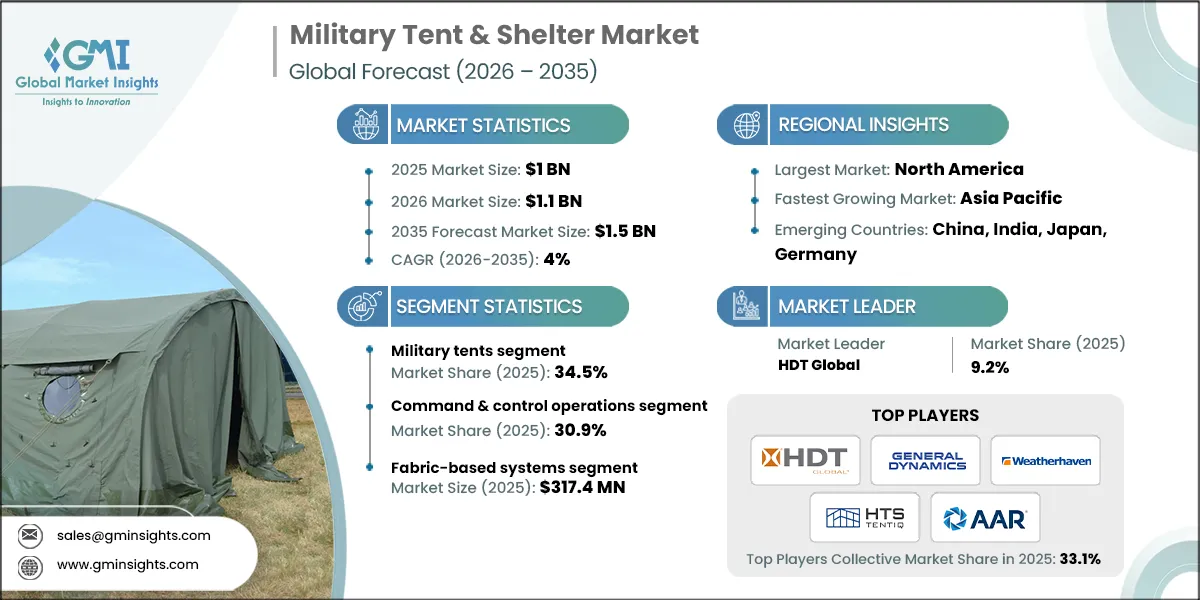
The global military tent & shelter market was valued at USD 1 billion in 2025. The market is expected to grow from USD 1.1 billion in 2026 to USD 1.3 billion in 2031 & USD 1.5 billion in 2035, at a CAGR of 4% during the forecast period according to the latest report published by Global Market Insights Inc.
Military Tent & Shelter Market Key Takeaways
Market Size & Growth
- 2025 Market Size: USD 1 Billion
- 2026 Market Size: USD 1.1 Billion
- 2035 Forecast Market Size: USD 1.5 Billion
- CAGR (2026–2035): 4%
Regional Dominance
- Largest Market: North America
- Fastest Growing Region: Asia Pacific
Key Market Drivers
- Rising global defense budgets increasing shelter procurements.
- Need for rapid deployment infrastructure in expeditionary missions.
- Technological advancements in modular and smart shelters.
- Dual-use shelters for military and emergency applications.
- Interoperability demand from joint/coalition military forces.
Challenges
- High procurement, maintenance and lifecycle costs.
- Complex logistics in remote or harsh environments.
Opportunity
- Custom modular designs for mission‑specific needs.
- Integration of renewable energy systems into shelters.
Key Players
- Market Leader: HDT Global led with over 9.2% market share in 2025.
- Leading Players: Top 5 players in this market include HDT Global, General Dynamics, Weatherhaven, HTS TENTIQ, AAR Mobility, which collectively held a market share of 33.1% in 2025.
Get Market Insights & Growth Opportunities
The military tent & shelter market is growing due to rising global defense budgets that lead to more shelter purchases. Need of rapid deployment setups for expeditionary missions, and technological progress being made in modular and smart shelters is accelerating this trend. Additionally, there is a growing demand for shelters that are dual-use for military and emergency response applications, which is driving more adoption.
The military tent & shelter market is growing owing to the increasing military expenditure budgets around the world for the procurement of more shelters, with countries increasingly allocating budgets towards mobile infrastructure to support their operations. According to SIPRI, military expenditure worldwide reached a record high in 2024 amounting to USD 2.7 trillion. The military expenditure has seen an increase of 9.4%, marking the largest increase in military expenditure since the end of the Cold War. This rise in spending allows governments to spend significantly on shelters, deployable systems, or expeditionary infrastructure.
Technological advancements in modular and smart shelters are reshaping military infrastructure design, as governments prioritize energy-efficient, rapidly deployable systems. Governments are focusing on energy-efficient, quickly deployable systems. For instance, HDT Global received USD 432 million from the U.S. Army for the Army Standard Family of Rigid Wall Shelters Phase 1 that includes both expandable and non-expandable shelters. This shows advancements in shelter technology enhance operational flexibility and help in executing expeditionary missions in addition to reducing costs by addressing military requirements in challenging environments.
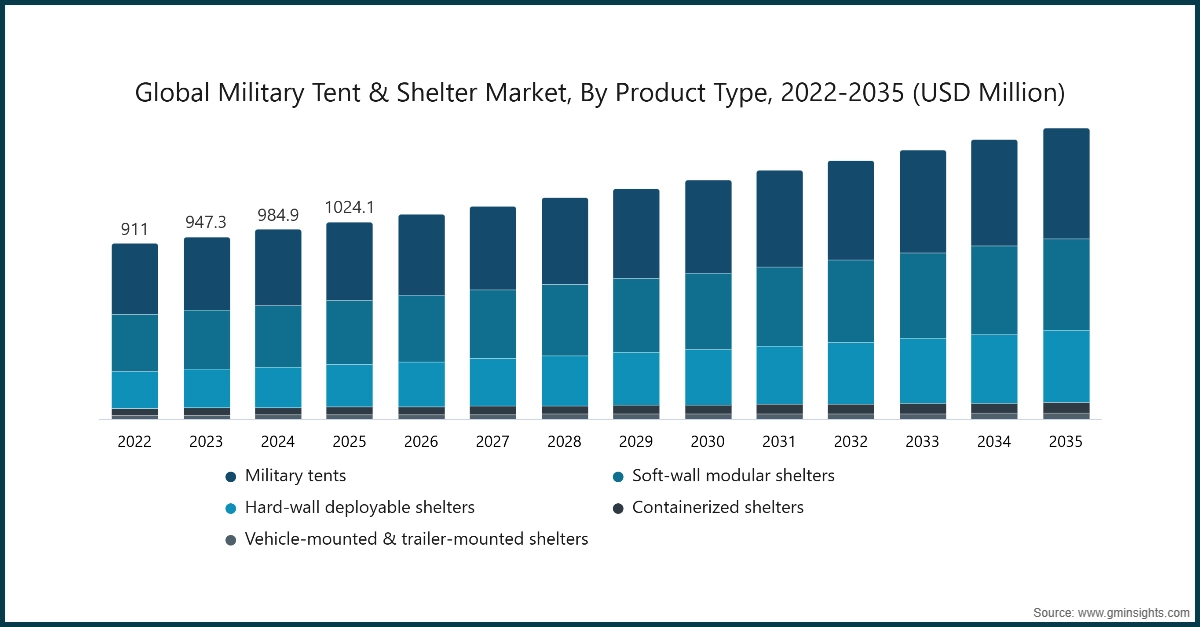
Between 2022 and 2024, the market witnessed considerable growth, increasing from USD 911 million in 2022 to USD 984.9 million in 2024. Primary factor for this growth has been increased defense budgets, due to geopolitical tensions and modernization activities, along with improved emphasis on rapid deployment and expeditionary infrastructure. The growth was also triggered by an increasing adoption of modular & smart sheltering systems, usage of field shelters for humanitarian & disaster relief purposes, & an increasing need for networks of systems for joint & coalition forces.
To get key market trends
Military Tent & Shelter Market Trends
- Lightweight materials such as high-strength fabrics, polymers, and carbon-based frames are replacing traditional steel to lower transportation weight and setup time. This shift began notably in 2021, when defense modernization efforts focused on expeditionary readiness. This trend is likely to continue until 2032 as material science keeps progressing. The result is better rapid deployment capability and logistical efficiency, especially for remote forward operating bases.
- Shelters are now equipped with smart HVAC solutions, environmental sensors and automatic control units to improve internal conditions and reduce fuel consumption. This notion has seen increased momentum in 2023, where all armed forces were moving towards energy conservation and making their soldiers comfortable as well as ensuring lower operation costs. It is expected to become mainstream by 2029, leading to better operational sustainability. This means improved troop readiness and a reduced energy logistics burden in extreme climates.
- Military tents and shelters are increasingly bought for non-combat uses such as disaster response and humanitarian aid, expanding market demand. Initial cross-sector adoption accelerated around 2020 with the rise in natural disasters and complex emergencies. This trend will continue to grow through 2030 as defense agencies integrate logistics planning for dual-use scenarios. The outcome is enhanced civil‑military operational support and improved rapid crisis response capacity.
Military Tent & Shelter Market Analysis
Learn more about the key segments shaping this market
- Military tents segment accounted for 34.5% of the market share in 2025. They currently dominate the market due to their portability, easy setup, and cost-efficiency for military and defense-related activities. Tent shelters are employed in military camps for troop lodging, as well as for military exercises and temporary military camps. They remain very essential for military missions because of their modularity and suitability for various terrains, ensuring sustained demand across defense forces.
- The containerized shelters segment is projected to register at a CAGR of 5.1% over the forecast period. The growing demand for strong, safe, and long-lasting infrastructure for advanced military operations is encouraging the growth of the market. Containerized shelters possess better protection, insulation, and the facility to connect various systems such as command & control, medical, and communications. Their adaptability in harsh conditions and semi-permanent/ permanent usage is leading to remarkable growth in modern military tactics.
Learn more about the key segments shaping this market
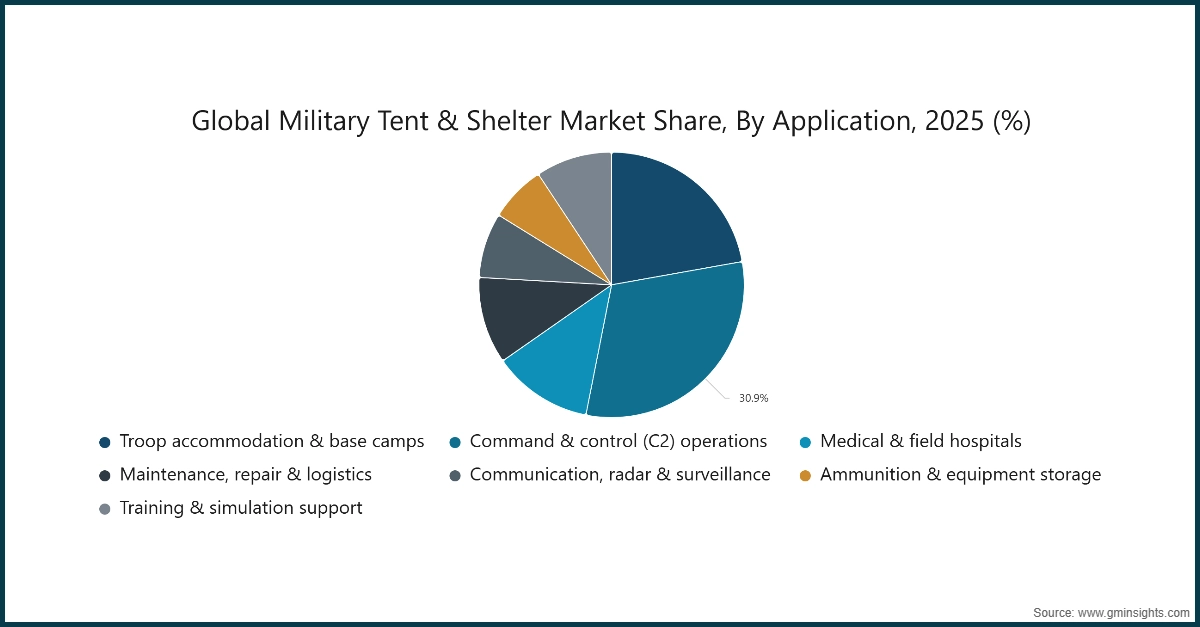
Based on the application, the military tent & shelter market is divided into troop accommodation & base camps, command & control (C2) operations, medical & field hospitals, maintenance, repair & logistics, communication, radar & surveillance, ammunition & equipment storage, and training & simulation support.
- The command & control operations segment led the market in 2025 with a revenue share of 30.9%. This is because command & control centers play vital roles in the military for command, control, and execution of various missions. Command & control centers are widely required in the military for the accommodation of communication devices, data processing units, and operation personnel. The demand for command control shelter arises due to the need for secure, reliable, and technologically integrated operating environments.
- The medical & field hospital shelters segment is expected to register at a CAGR of 5.3% during the forecast period. This growth is due to a greater focus on quick medical response, disaster relief operations, and forward-deployed healthcare infrastructure. Medical shelters are designed to support surgical units, isolation wards, and emergency treatment facilities in remote or conflict-prone areas. Increased investments in military healthcare readiness and humanitarian missions are driving demand for advanced, quickly deployable medical shelter solutions.
Based on the material type, the military tent & shelter market is divided into fabric-based shelters, metal-frame shelters, composite-based shelters, and hybrid construction shelters.
- The fabric-based systems segment dominated the market with USD 317.4 million in 2025 supported by widespread use of materials such as polyester, vinyl, PVC, and aramid cloth. Fabric-based shelters are preferred due to their flexibility, lightweight nature, ease of transport, and rapid setup capabilities. Their applications in temporary operational bases, training camps, and emergency shelters keep the market demand healthy. Moreover, the durability and weather resistance offered due to the enhancement of coated and flame-resistant fabrics keep the market at the leadership position.
- The composite materials segment is expected to grow at a CAGR of 5.8% during the forecast period. This is due to the rising demand for materials with a high strength-to-weight ratio, which can provide improved thermal performance in state-of-the-art military shelters. Composite materials are highly resistant to ballistic attacks, provide a good structure, can withstand extreme environmental conditions, and are suitable for usage in military command posts, hospitals, among other applications. Increasing investments in state-of-the-art military infrastructure are accelerating the use of these materials.
Looking for region specific data?
North America Military Tent & Shelter Market
The North America held a market share of 39.9% of military tent & shelter in 2025.
In the North American region, military tent and shelter systems have experienced an increasing trend, primarily driven by growing defense expenditure and interest in expeditionary infrastructure development by the U.S. and Canadian armies. Both modular and intelligent shelter systems are gaining popularity providing climate control solutions, power, and rapid-deployment systems.
- Governments and defense companies are investing in next-generation deployable shelters intended for military as well as relief operations. The area is set to remain at the cutting edge of technology development. Military modernization projects, joint military exercises, and operations will fuel a sustainable growth rate up to 2035.
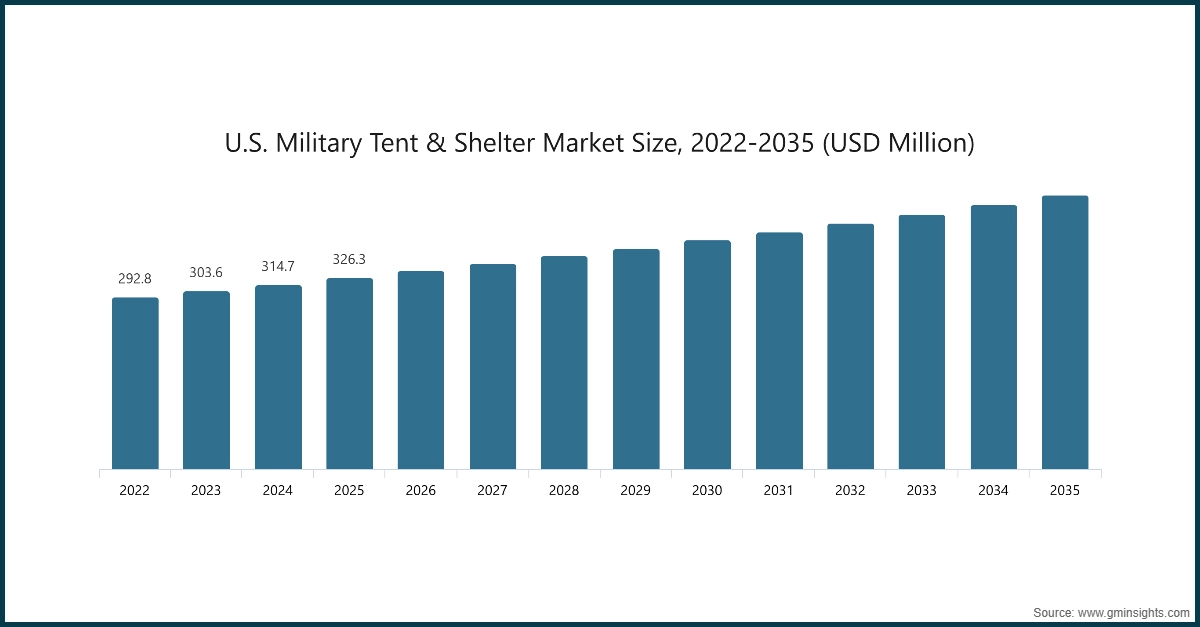
The U.S. military tent & shelter was valued at USD 292.8 million and USD 303.6 million in 2022 and 2023, respectively. The market size reached USD 326.3 million in 2025, growing from USD 314.7 million in 2024.
- The growth of the military tent & shelter market in the United States is supported by strategic defense modernization initiatives and priorities for expeditionary infrastructure. The U.S. Army’s investment in the Army Standard Family of Rigid Wall Shelters (ASF‑RWS) program aims to standardize modular, energy-efficient, and easily transportable shelters. These shelters will support various operations worldwide, including command posts, medical facilities, and support units, which will improve deployment and teamwork across missions.
- Additionally, the Army Corps of Engineers’ role in developing and maintaining deployable infrastructure highlights the Department of Defense's focus on support structures that can be quickly set up and reconfigured for different operational environments, such as humanitarian efforts and disaster relief missions. These government-led infrastructure strategies help the U.S. lead the market in North America, driven by defense readiness, quick response capabilities, and potential dual-use applications.
Europe Military Tent & Shelter Market
Europe military tent & shelter accounted for USD 331.9 million in 2025 and is anticipated to show lucrative growth over the forecast period.
The market is expanding as key European nations strengthen their deployable infrastructure to manage geopolitical uncertainty and meet NATO modernization goals. Major countries like Germany, France, and the United Kingdom are emphasizing rapid-deployment command centers, mobile medical units, and climate-adaptive shelters as part of wider defense reforms.
- The INDY project under the European Defence Fund, supported by more than nine defense ministries, is working on energy-independent and energy-efficient deployable military camps. The main idea of this collaboration is to make military forces more resilient and reduce logistic chains in joint military interventions in various global regions. Furthermore, it promotes cooperation for innovation in military shelter systems at the European level.
Germany dominates the Europe military tent & shelter, showcasing strong growth potential.
- Germany is at the forefront of adopting military tents and shelters in Europe. This is due to defense modernization programs, commitments to NATO, and increased investments in field infrastructure. The industrial and defense sectors, including mobile command centers, field hospitals, and logistics support units, make extensive use of modular soft-wall, hard-wall, and containerized shelters.
- Participation in NATO exercises like DEFENDER-Europe drives the need for rapidly deployable, interoperable, and scalable shelter systems that can handle multi-functional missions. Germany's emphasis on dual-use infrastructure, including civil protection initiatives, increases the use of mobile shelters for emergency response and crisis management in turn strengthening its position as a key growth market in Europe’s military shelter sector.
Asia Pacific Military Tent & Shelter Market
The Asia Pacific military tent & shelter is anticipated to grow at the highest CAGR of 5.3% during the forecast period.
- This market is rapidly expanding due to increasing defense modernization programs and rising regional security concerns. Countries like China, India, Japan, and South Korea are leading the procurement of modular, quickly deployable shelter systems for border security and forward command bases. China focuses on next-generation deployable infrastructure, while India pushes for high-altitude field shelters in mountainous areas. Japan is integrating disaster response capabilities into military logistics, driving demand for strong and multifunctional shelters.
- Escalating geopolitical tensions, frequent natural disasters, and cooperative defense efforts in ASEAN further support investment in robust. These shelters enhance operational readiness and humanitarian response skills throughout the Indo-Pacific.
India military tent & shelter is estimated to grow with a significant CAGR, in the Asia Pacific market.
- India is witnessing accelerating demand for military tent and shelter systems driven by ongoing defense modernization programs, border infrastructure development, and enhanced field readiness initiatives. The expansion of forward operational bases along the northern and eastern borders, along with frequent joint exercises with allied forces, boosts the procurement of quickly deployable accommodation, command posts, and logistics shelters.
- Defense procurement reforms such as “Make in India” and strategic partnerships with original equipment manufacturers promote local manufacturing, technology transfer, and improvements in modular shelter design, supporting both domestic production and export opportunities.
Middle East and Africa Military Tent & Shelter Market
UAE military tent & shelter to experience substantial growth in the Middle East and Africa military tent & shelter.
The United Arab Emirates is seeing steady growth in its military tent & shelter market due to government initiatives that promote local defense manufacturing. The Tawazun Economic Program and EDGE Group are enhancing the ability to produce mission-critical deployable shelters and support infrastructure components.
- Defense trade events like IDEX and participation in joint procurement agreements increase access to advanced modular shelter technologies. This makes the UAE an important growth market for military tent and shelter solutions in the Middle East and Africa.
Military Tent & Shelter Market Share
The military tent & shelter industry is led by players such as HDT Global, General Dynamics, Weatherhaven, HTS TENTIQ, and AAR Mobility. Together, they accounted for 33.1% of the global market in 2025. Their strong presence across defense, security, and overseas infrastructure programs worldwide supports their position. These players have a strong business base with their diverse shelter offerings, expertise in engineering, and established connections with the military and government organizations in North America, Europe, Asia Pacific, and the Middle East.
Their extensive offerings include troop accommodation tents, modular soft-wall shelters, hard-wall deployable systems, containerized shelters, and vehicle-mounted solutions that enable them to address different mission requirements such as command and control, medical support, logistics, and rapid deployment missions. They keep themselves ahead in the market with rapid deployment solutions, modular configurations, and the integration of power, HVAC, and communications systems, all within the tightest military requirements. Furthermore, continued investments in lightweight materials, enhanced protection features, and shelter system modernization strengthen their ability to capture market share amid rising demand for expeditionary, mobile, and resilient military infrastructure across multiple geographies.
Military Tent & Shelter Market Companies
Prominent players operating in the military tent & shelter industry are as mentioned below:
- AAR Mobility Systems
- ADS Inc. (Advanced Deployable Systems)
- Celina Military Shelters (Celina Tent, Inc.)
- General Dynamics Mission Systems
- HDT Global
- ZTS TENTIQ GmbH
- Losberger De Boer
- M. Schall
- Outdoor Venture Corp
- Rekord Structures Company (RDS)
- Shelter Structures
- Tentora / New Tents Manufacturing
- UTS Systems LLC
- Veldeman
- Weatherhaven
HDT Global provides deployable military shelters and expeditionary infrastructure. They offer advanced soft-wall, hard-wall, and containerized shelter systems for troop accommodation, command and control, medical, and logistics uses. The company focuses on lightweight materials, rapid-deployment designs, and integrated power, HVAC, and environmental control solutions, enabling reliable operations across combat, humanitarian, and disaster-response missions worldwide.
General Dynamics provides durable, ready-to-use deployable shelter solutions for defense and security applications, including command posts, communication hubs, and medical facilities.
Weatherhaven focuses on quickly deployable soft-wall and modular shelter systems suited for extreme climates and expeditionary operations. Their shelter solutions are designed for fast setup, thermal efficiency, and logistical simplicity. The company’s success in NATO, UN, and coalition missions adds value to its participation in rapid response and temporary infrastructure projects.
HTS TENTIQ provides modular, frame-supported, and soft-wall shelter systems that can be used for both military and civilian defense purposes. The company focuses on flexible shelter solutions that can support semi-permanent and expeditionary setups.
AAR Mobility provides deployable shelter and mobility solutions to support quick military deployment and ongoing field operations. Their rugged shelter systems, along with logistics, maintenance, and lifecycle support services, help armed forces to improve readiness while managing overall costs during training, expeditionary, and contingency missions.
Military Tent & Shelter Market Report Attributes
| Key Takeaway | Details |
|---|---|
| Market Size & Growth | |
| Base Year | 2025 |
| Market Size in 2025 | USD 1 Billion |
| Market Size in 2026 | USD 1.1 Billion |
| Forecast Period 2026-2035 CAGR | 4% |
| Market Size in 2035 | USD 1.5 Billion |
| Key Market Trends | |
| Drivers | Impact |
| Rising global defense budgets increasing shelter procurements | Drives 25% growth by increasing defense procurement budgets globally, leading to accelerated purchase cycles for rapid-deployment shelters and strategic infrastructure stockpiling. |
| Need for rapid deployment infrastructure in expeditionary missions | Supports 20% growth by prioritizing expeditionary forces and expedition-ready units, which demand fast-erect shelters for field camps, FOBs (forward operating bases), and mobility-centric missions. |
| Technological advancements in modular and smart shelters | Contributes 18% growth as modular and smart shelter technologies like rapid-setup frames, integrated wiring and climate controls enhance operational capability and lifecycle value. |
| Dual-use shelters for military and emergency applications | Adds 17% growth through dual-use demand by military units and civil authorities both acquiring shelters for disaster response, pandemic facilities, and refugee housing. |
| Interoperability demand from joint/coalition military forces | Accounts for 20% growth by requiring interoperable designs that seamlessly integrate with allied and coalition logistics, communication, and base infrastructure standards. |
| Pitfalls & Challenges | Impact |
| High procurement, maintenance and lifecycle costs | Restrains growth as advanced materials, ballistic-grade fabrics, and modular support systems command high initial acquisition prices, increasing budgetary pressure on defense capital programs. |
| Complex logistics in remote or harsh environments | Constrains deployment since transporting oversized or heavy shelter modules to arctic, desert, or high-altitude theaters requires specialized air/sea lift, inflating operational logistics costs. |
| Opportunities: | Impact |
| Custom modular designs for mission‑specific needs | Presents growth opportunity by enabling tailored shelter systems for distinct missions (medical triage, C2 centers, radar enclosures), increasing procurement relevance across force elements. |
| Integration of renewable energy systems into shelters | Offers growth potential by embedding solar panels, battery systems, and micro‑grid solutions into shelter roofs and frames, reducing dependence on fossil fuel generators. |
| Market Leaders (2025) | |
| Market Leader |
9.2% Market Share in 2025 |
| Top Players |
Collectively Top 5 Market Share is 33.1% in 2025 |
| Competitive Edge |
|
| Regional Insights | |
| Largest Market | North America |
| Fastest growing market | Asia Pacific |
| Emerging countries | China, India, Japan, Germany |
| Future outlook |
|
What are the growth opportunities in this market?
Military Tent & Shelter Industry News
- In March 2025, HDT Global established a partnership with Northrop Grumman to co-develop next-generation expeditionary shelter systems that integrate rapid deployment shelters with advanced modular power and communications capabilities, enabling more resilient field infrastructure for joint operations.
- In August 2024, Losberger De Boer announced a partnership with a leading composites manufacturer to co-develop lightweight rigid-wall panels for modular military camp systems. The aim was to reduce logistical burden and improve deployability for NATO forward presence missions.
- In September 2024, AAR Corp shifted focus to expand its core defense infrastructure portfolio, divesting non-core business units to enhance operational efficiency and allocate more resources to modular shelter manufacturing and integrated logistics solutions that support mobile forces and expeditionary deployments.
The military tent & shelter industry market research report includes in-depth coverage of the industry with estimates and forecast in terms of revenue (USD Million) from 2022 – 2035 for the following segments:
Market, By Product Type
- Military tents
- Troop accommodation tents
- Lightweight combat tents
- Rapid-deployment & inflatable tents
- Soft-wall modular shelters
- Frame-supported fabric shelters
- Expandable soft-wall systems
- Hard-wall deployable shelters
- Rigid panel shelters
- Insulated hard-wall shelters
- Containerized shelters
- ISO container shelters (20-ft / 40-ft)
- Expandable containerized shelters
- Vehicle-mounted & trailer-mounted shelters
- Mobile command shelters
- Transportable mission shelters
Market, By Deployment Type
- Rapid-deployment
- Semi-permanent
- Relocatable / mobile
Market, By Protection Level
- Non-protected (environmental protection only)
- Ballistic-resistant
- Blast-resistant
- CBRN / NBC-protected
- EMP / EMI-shielded
- Signature-Reduction
Market, By Material Type
- Fabric-based
- Metal-frame
- Composite-based
- Hybrid construction
Market, By Mobility Platform
- Ground-deployable (man-portable / air-portable)
- Vehicle-mounted
- Trailer-mounted
- Container-transportable
Market, By Application
- Troop accommodation & base camps
- Command & control (C2) operations
- Medical & field hospitals
- Maintenance, repair & logistics
- Communication, radar & surveillance
- Ammunition & equipment storage
- Training & simulation support
The above information is provided for the following regions and countries:
- North America
- U.S.
- Canada
- Europe
- Germany
- UK
- France
- Spain
- Italy
- Russia
- Asia Pacific
- China
- India
- Japan
- Australia
- South Korea
- Latin America
- Brazil
- Mexico
- Argentina
- Middle East and Africa
- South Africa
- Saudi Arabia
- UAE
Frequently Asked Question(FAQ) :
What is the market size of the military tent & shelter in 2025?
The market size was USD 1 billion in 2025, with a CAGR of 4% expected through 2035 driven by rising global defense budgets, rapid deployment needs for expeditionary missions, and technological advancements in modular and smart shelters.
What is the projected value of the military tent & shelter market by 2035?
The military tent & shelter market is expected to reach USD 1.5 billion by 2035, propelled by defense modernization initiatives, dual-use applications for emergency response, and adoption of energy-efficient shelter systems.
What is the current military tent & shelter market size in 2026?
The market size is projected to reach USD 1.1 billion in 2026.
What was the market share of military tents segment in 2025?
Military tents accounted for 34.5% of the market share in 2025, driven by their portability, easy setup, cost-efficiency, and modularity for various terrains and military operations.
What was the valuation of fabric-based systems segment in 2025?
Fabric-based systems dominated the market with USD 317.4 million in 2025, supported by materials such as polyester, vinyl, PVC, and aramid cloth offering flexibility, lightweight nature, and rapid setup capabilities.
What is the growth outlook for the containerized shelters segment from 2026 to 2035?
Containerized shelters are projected to grow at a CAGR of 5.1% till 2035, due to demand for strong, secure, and durable infrastructure with better protection, insulation, and system integration capabilities.
Which region leads the military tent & shelter market?
North America held 39.9% market share in 2025. Growing defense expenditure, expeditionary infrastructure development by U.S. and Canadian armies, and adoption of modular intelligent shelter systems fuel the region's dominance.
What are the upcoming trends in the military tent & shelter market?
Key trends include adoption of lightweight materials, integration of smart HVAC solutions with environmental sensors, automatic control units for energy conservation, and increasing dual-use procurement for disaster response and humanitarian aid applications.
Who are the key players in the military tent & shelter market?
Key players include HDT Global, General Dynamics Mission Systems, Weatherhaven, HTS TENTIQ, AAR Mobility Systems, ADS Inc., Celina Military Shelters, Losberger De Boer, M. Schall, Outdoor Venture Corp, Rekord Structures Company, Shelter Structures, Tentora/New Tents Manufacturing, UTS Systems LLC, and Veldeman.
Military Tent & Shelter Market Scope
Related Reports