Summary
Table of Content

Military Satellite Market
Get a free sample of this report
Form submitted successfully!
Error submitting form. Please try again.
Thank you!
Your inquiry has been received. Our team will reach out to you with the required details via email. To ensure that you don't miss their response, kindly remember to check your spam folder as well!
Request Sectional Data
Thank you!
Your inquiry has been received. Our team will reach out to you with the required details via email. To ensure that you don't miss their response, kindly remember to check your spam folder as well!
Form submitted successfully!
Error submitting form. Please try again.
Military Satellite Market Size
The growth of the market is attributed to current geopolitical trends resulting in an increase in demand for satellite-based secure communications, space satellites for missile warning and detection, small satellite and launch technology, military satellite-based missile defense systems, and satellite-based military intelligence, surveillance, and reconnaissance (ISR) systems.
Military Satellite Market Key Takeaways
Market Size & Growth
- 2025 Market Size: USD 40.8 Billion
- 2026 Market Size: USD 47.1 Billion
- 2035 Forecast Market Size: USD 190.4 Billion
- CAGR (2026–2035): 16.4%
Regional Dominance
- Largest Market: North America
- Fastest Growing Region: MEA
Key Market Drivers
- Rising geopolitical tensions driving secure military satellite communications.
- Expansion of space-based missile warning and detection capabilities.
- Advancements in small satellites and reusable launch technologies.
- Integration of satellites into multi-domain military operations.
- Growing reliance on satellite-based intelligence surveillance and reconnaissance.
Challenges
- High costs for satellite development launch and maintenance.
- Threats from cyberattacks, jamming and anti-satellite weapons.
Opportunity
- Rising adoption of low earth orbit defense constellations.
- Growing public-private partnerships in military satellite programs.
Key Players
- Market Leader: Lockheed Martin led with over 15.8% market share in 2025.
- Leading Players: Top 5 players in this market include Airbus SE, Thales, Lockheed Martin, Northrop Grumman, Boeing, which collectively held a market share of 53.2% in 2025.
Get Market Insights & Growth Opportunities
The military satellite market growth is predominantly driven by an increase in geopolitical tensions. As a direct result of this, nations are investing thoroughly in secure and resilient communication systems. For example, in 2025, the U.S. Department of Defense was allocated with nearly USD 4.53 billion for space‑based missile warning and tracking satellites including secure tracking and information systems to counter adversary threats and ensure global situational awareness. The global defense market highlights the importance of secure satellite communications, given the increasing global tensions and defense strategies, the need to streamline command and control, real time communication and tactical moves.
Integration of satellites into multi‑domain military operations is increasing rapidly as part of modern defense strategies. This can be witnessed in the U.S. Department of Defense’s emphasis on the Joint All‑Domain Command and Control (JADC2) framework. The central goal of JADC2 is to integrate combat systems via space, ground, air, and cyber systems. This system’s approach aims to achieve high levels of interoperability and rapid response across the domain of space.
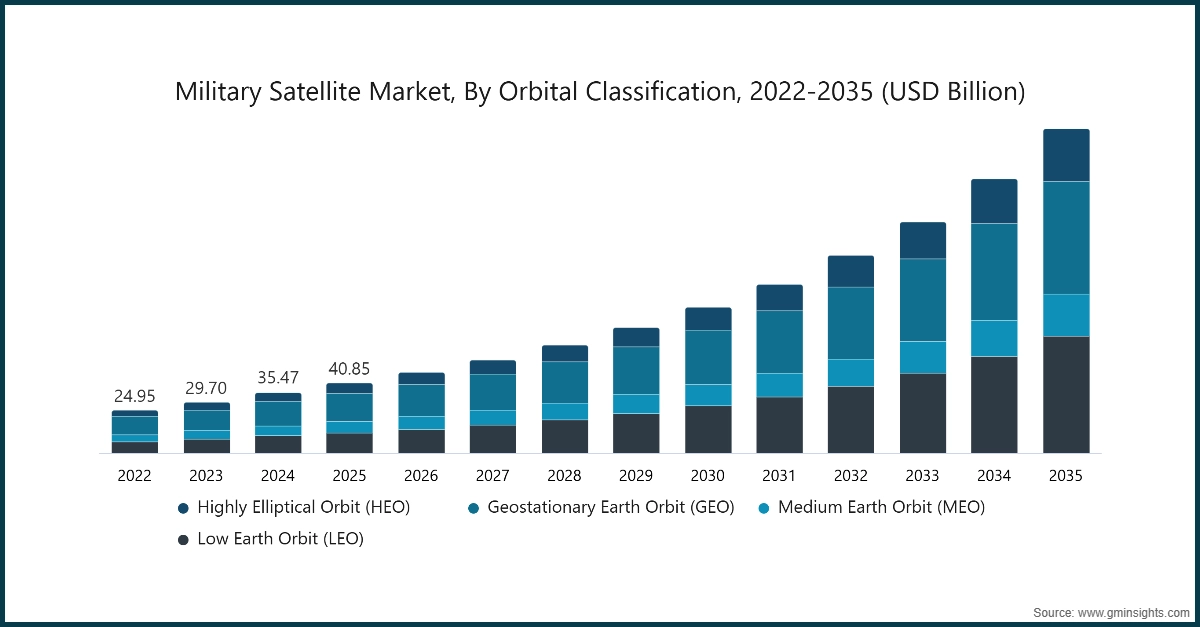
Between 2022 and 2024, the market witnessed considerable growth, increasing from USD 25 billion in 2022 to USD 35.5 billion in 2024. The main factors driving this growth include the expansion of space-based missile warnings, the adoption of low Earth satellite constellations, and the integration of satellites into multi-domain military operations, which bolstered global situational awareness, strategic decision-making, and operational readiness. Other factors contributing to market growth include increasing geopolitical tensions, modernization of military and defense programs, and an improved need for secure and resilient space-based communication systems.
The global military satellite market was valued at USD 40.8 billion in 2025. The market is expected to grow from USD 47.1 billion in 2026 to USD 99.2 billion in 2031 & USD 190.4 billion in 2035, at a CAGR of 16.4% during the forecast period according to the latest report published by Global Market Insights Inc.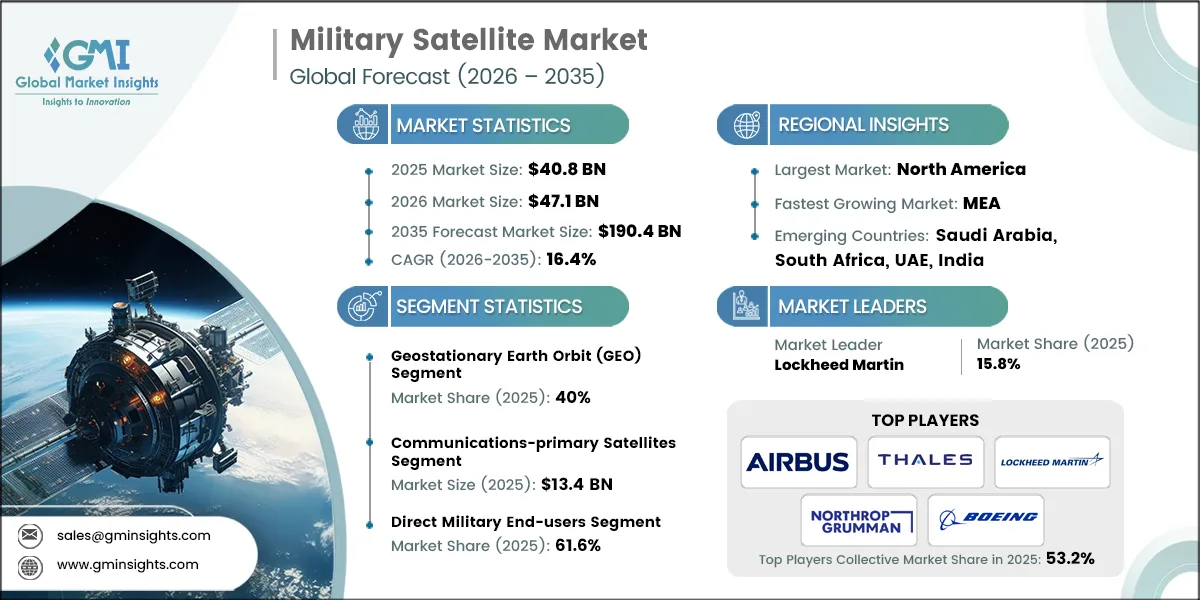
To get key market trends
Military Satellite Market Trends
- The increasing number of reprogrammable and software-defined satellites is changing military space architecture. This trend has accelerated since 2021 resulting from the armed forces needing the ability to change missions after launch. This trend is expected to continue through to 2030 due to the fast pace of threat evolution. The increased capability upgrades, enhanced responsiveness to changing operational needs, and lower lifecycle costs.
- There is greater emphasis on space domain awareness and the ability of satellites to survive and operate in the congested, contested orbital environment. The trend from 2022, particularly in the satellite domain, has been the result of increased satellite congestion and contested spaces. Military satellite operators are expected to continue to focus on tracking, monitoring, and protection of military satellites till 2035 to improve detection, survive and support better decisions in contested spaces.
- Integration of artificial intelligence for onboard data processing is increasing. This trend first started accelerating in 2022 to help reduce the reliance on ground systems and eliminate latency. This trend is expected to continue beyond 2030 with the improvement of edge processing. It will result in faster processing of intelligence, a decrease in the use of bandwidth, and an increase in the autonomy of satellites, especially when the satellites are working in environments that have been denied or degraded.
Military Satellite Market Analysis
Learn more about the key segments shaping this market
Based on the orbital classification, the military satellite market is divided into low earth orbit (LEO), medium earth orbit (MEO), geostationary earth orbit (GEO), and highly elliptical orbit (HEO) satellites.
- The geostationary earth orbit (GEO) segment accounted for 40% of the market in 2025. Geo satellites are leading the market of military satellites due to their ability to cover vast and persistent global reach over the communications, intelligence, navigation, and missile warning domains. With their fixed orbit, they are also able to provide enduring support to surveillance and control missions for military command and control operations and provide support to pivotal strategic operations.
- The Low Earth Orbit (LEO) segment is anticipated to grow at a CAGR of 19.6% over the forecast period. This growth is driven by the increasing use of LEO satellite-based systems, coupled with the need for responsive, low latency, near real-time intelligence, and multi-domain operational polices. LEO satellites are increasingly being adopted by contemporary militaries due to their rapid, low-cost, satellite deployment and the ability to provide real-time, command and control situational awareness, and streamlined decision control processes.
Based on primary mission, the global military satellite market is divided into communications-primary satellites, intelligence & surveillance-primary satellites, navigation & timing-primary satellites, missile warning-primary satellites, space situational awareness-primary satellites, and others.
- The communications-primary satellites segment dominated the market in 2025 and was valued at USD 13.4 billion due to the indispensable functions it serves in secure military communications, command-and-control networks, and data relay support globally. Their reliability, wide coverage, and integration with multi-domain operations make them critical for defense forces. Furthermore, the need for encrypted, jam-resistant, and continuous communication channels in modern military strategies increases growth of this segment.
- The missile warning-primary satellites segment is expected to witness growth at a CAGR of 18.7% during the forecast period. This growth is driven by the widespread investment within early warning systems, global missile detection, and strategic defense and support. The need for rapid and accurate threat detection, real-time reporting, and defense-associate networks amplifies the need for such systems. In addition, improved sensor systems, high-resolution infrared imaging, and rapid (low) latency data streams are a few of the elements that drive growth in this sector.
Learn more about the key segments shaping this market
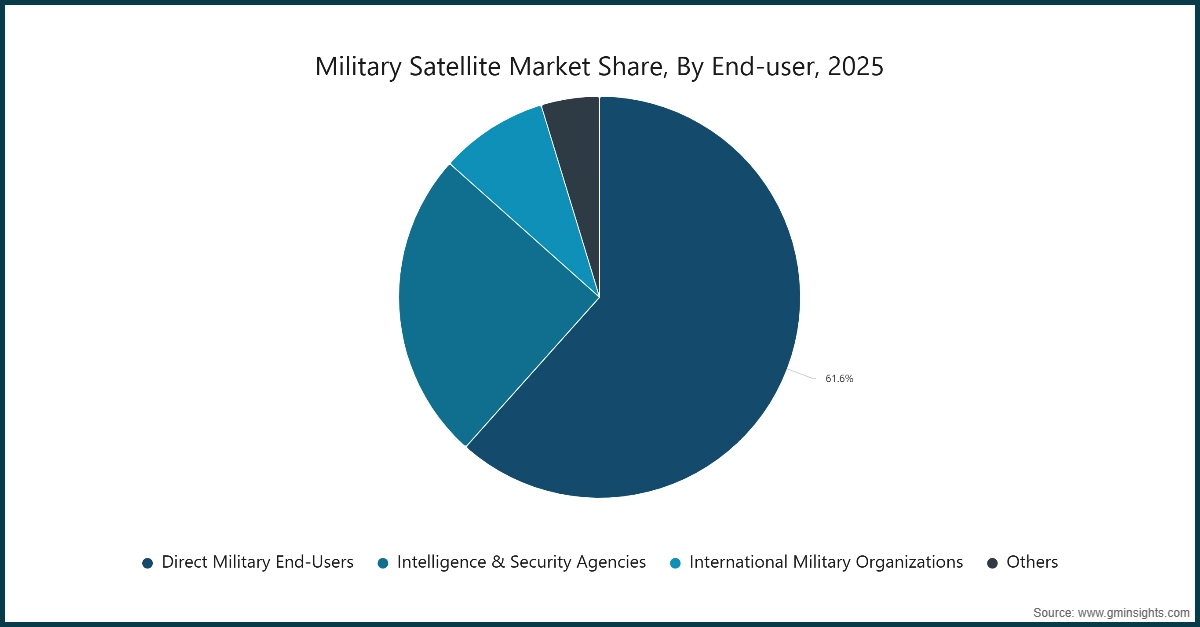
- The direct military end-users segment led the market in 2025 with a market share of 61.6% as armed forces heavily rely on secure satellite communication for the command and control, the changing battlefield coordination, and the multi-domain operational functionalities of the satellite. With the global, encrypted, and resilient coverage coupled with the demand for satellite communications, defense budgets and modernization programs sustain the direct military end users lead in the market.
- The intelligence & security agencies segment is expected to witness growth at a CAGR of 19.2% during the forecast period. The growth is driven by the need for real-time intelligence, ISR, and threat analysis, surveillance and reconnaissance. Increased geopolitical tensions, border security fights, and satellite analytics coupled with Artificial Intelligence also accelerates the movement to fusion analytics.
Looking for region specific data?
North America Military Satellite Market
North America held a market share of 42.2% of military satellite industry in 2025.
- In North America, the growth of market is attributed to increased military expenditure, growing global conflict and the need for secure and resilient space-based communication. Moreover, investments in low Earth orbit constellations, secure communications, and space situational awareness are driving robust market expansion.
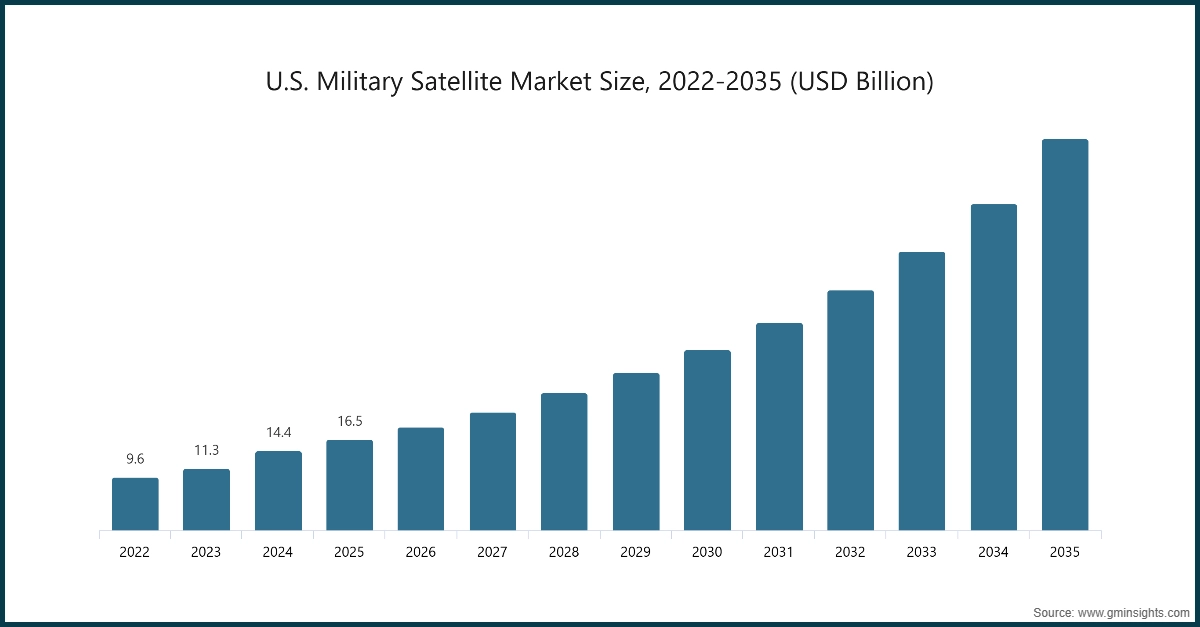
The U.S. military satellite market was valued at USD 9.6 billion and USD 11.3 billion in 2022 and 2023, respectively. The market size reached USD 16.5 billion in 2025, growing from USD 14.4 billion in 2024.
- The growth of the market in the U.S. is particularly strong because of government investments in next-generation space architectures, global secure military communication networks, and satellites for missile tracking and defense. For example, in December 2025, the U.S. Space Development Agency announced USD 3.5 billion contract award for the construction of 72 infrared satellites, enhancing missile warning and tracking capabilities, in accordance with the U.S. National Defense Authorization Act (NDAA) Tranche 3 military satellite procurement plan.
- The investments in strategic defense space integration satellite systems to provide advanced resilient military satellite systems across secure communications, ISR, and missile defense are increasing adoption of military satellite in the U.S. This consolidated government backing and industry expansion make the U.S. the leader in the North American market, poised for continued growth through 2035.
Europe Military Satellite Market
Europe military satellite industry accounted for USD 10.2 billion in 2025 and is anticipated to show lucrative growth over the forecast period.
- The increasing investment across Europe in areas such as secured satellite communications, space situational awareness, and constellation-based defense systems are contributing to the region’s military satellite market expansion. The region focuses on the integration of satellites with multi domain military operations (air, naval, and cyber defense). Europe is also advancing the development of protective encryption for resilient satellite systems in order to protect space assets/facilities from emerging threats.
- Countries such as Germany, France, and the United Kingdom are investing in the modernization of satellites, new secured communications, and AI-based ISR payloads. These initiatives are facilitating the incorporation of improved next-gen military satellites systems and enhancing continental defense, interoperability with NATO allies, and rapid regional defense response.
Russia dominates the Europe Military Satellite market, showcasing strong growth potential.
- Russia leads Europe in military satellite deployment due to its focus on secure communications, missile detection, warning systems, along with intelligence, surveillance, reconnaissance (ISR) systems. Russia uses satellites incorporated with the capabilities of multi-domain military operations, national defense monitoring, and space situational awareness with investments in resilient architectures and strategic capabilities enhanced with constellation-based systems.
- Russia’s state-funded initiatives in the modernization of defense and the military support expansion in satellites in communications, navigation, and missile tracking. The integration of artificial intelligence, advanced payload technology and real time data analytics enhances operational preparedness. Russia is a major growth market due to its focus on global surveillance, defense interoperability, and space resilience.
Asia Pacific Military Satellite Market
The Asia Pacific region shows substantial growth in the Asia Pacific military satellite industry.
- The market in the Asia-Pacific region is being driven by the increasing provisional security complexities and modernization of armed forces coupled with the improvement of regional strategic space programs. The region is deploying safe communication satellites in Advanced Satellite constellations which assist in ISR, missile warning, navigation, and with a focus on multi-orbit deployment and heterogeneous architecture to strengthen regional defense systems.
- Countries such as China, India and Japan are increasing the budget for local satellite systems, AI driven battlefield intelligence, and space situational awareness. The strategic integration of defense systems and the collaboration with private aerospace companies and foreign allies will lead to the rapid deployment of military satellites in the region during the stated forecast period.
India military satellite market is estimated to grow with a significant CAGR, in the Asia Pacific market.
- India is witnessing rapid growth in the military satellite industry due to the country’s focus on enhancing space-based defense capabilities. For instance, in 2025, India accelerated the deployment of 52 defense dedicated satellites under the Space Based Surveillance (SBS) program and prepare to launch by 2029. This will greatly improve India’s border and key maritime space surveillance, secure communications, and real-time cross-border intelligence collection capabilities.
- This integration of space assets into multi-domain operations to the national security challenges of the present time is improving India’s defense readiness and situational awareness. India is emerging as one of the fastest‑growing military satellite markets in the Asia‑Pacific region by investing in indigenous satellite infrastructure, public‑private partnerships, and advanced payload technologies providing with sustained long‑term growth potential.
Latin America Military Satellite Market
Brazil leads the Latin American market, exhibiting significant growth during the 2026-2034.
- Brazil is increasing military satellite programs with the development of Intelligence, Surveillance, and Reconnaissance (ISR) for ensuring encrypted, sovereign communications with armed forces. Specific military satellites provide real-time border monitoring, maritime domain awareness, and command-and-control robustness independent from foreign systems.
- Sustained government funding, partnerships with international players, and institutions like the Brazilian Space Agency are strengthening domestic satellite manufacturing and integration capabilities. This ecosystem development, combined with dual-use civil–military programs, is accelerating Brazil’s participation and growth in the market.
Middle East and Africa Military Satellite Market
Middle East and Africa military satellite industry is anticipated to grow at a significant CAGR during the forecast period.
Saudi Arabia market shows substantial growth during the forecast period.
- Saudi Arabia is witnessing rapid growth in the military satellite industry driven by the country’s focus on modernizing defense capabilities, improving space situational awareness, and protecting communication networks. Development of satellite-based integrated ISR (Intelligent Surveillance and Reconnaissance) systems, missile warning systems, and secure communication systems is contributing to the development of the country’s defense infrastructure across the air, land, and naval domains.
- Government initiatives such as the Saudi Space Commission’s national space program are driving satellite development, payload integration, and multi-domain operational readiness. Furthermore, the emphasis on domestic capabilities, public-private partnerships, and regional defense collaboration is driving adoption of advanced military satellites in Saudi Arabia and positioning it as one of the fastest-growing markets in the MEA region.
Military Satellite Market Share
The military satellite industry is led by players such as Airbus SE, Thales, Lockheed Martin, Northrop Grumman, and Boeing. These five companies collectively accounted for a 53.2% share of the market in 2025 due to their technological and operational diversification of satellite offering along with the global presence. These companies offer a wide portfolio that includes secure communications, missile warning, ISR, navigation, and multi-mission satellites that helps them to dominate the market.
These companies maintain a competitive edge by providing sophisticated satellite technologies, constellation management, and integration with multi-domain defense systems. The market players’ investment in R&D, artificial intelligence, and the deployment of satellites in low Earth orbit combined with strategic alliances and defense contracts positions them to meet the anticipated increase in the demand for military satellite systems.
Military Satellite Market Companies
Prominent players operating in the miliary satellite market are as mentioned below:
- Airbus
- BAE Systems
- Boeing
- China Aerospace Science and Technology Corporation
- Elbit Systems
- General Dynamics Mission Systems, Inc.
- Israel Aerospace Industries
- Lockheed Martin
- Northrop Grumman
- SpaceX
- Thales
- Viasat
- Airbus SE
Airbus SE offers a broad portfolio of military satellite solutions that includes secure communications, intelligence, surveillance, reconnaissance (ISR), and multi-mission platforms. The company’s systems support multi-orbit capabilities ensuring reliable performance in military, defense, and strategic operations.
Thales supports integrated military satellite systems in secure communications, navigation, ISR, and space situational awareness. The company focuses on advanced satellite payloads and seamless integration of the ground segment for the support of defense and intelligence agencies globally.
Lockheed Martin offers high performance military satellites for communications, missile warning, ISR, and navigation. The company’s systems are integrated in strategic U.S. and allied defense programs and deploy best in class advanced payloads and resilient spacecraft design.
Northrop Grumman builds next-generation military satellites for secure communications, ISR, space situational awareness, and missile warning systems. The company serves defense agencies with mission operations support and satellite systems.
Boeing develops and delivers dependable military satellite systems for communication, ISR, navigation, and missile warning applications. The company emphasizes operational reliability and integrates allied defense network satellites with advanced payloads and flexible architecture.
Military Satellite Market Report Attributes
| Key Takeaway | Details |
|---|---|
| Market Size & Growth | |
| Base Year | 2025 |
| Market Size in 2025 | USD 40.8 Billion |
| Market Size in 2026 | USD 47.1 Billion |
| Forecast Period 2026-2035 CAGR | 16.4% |
| Market Size in 2035 | USD 190.4 Billion |
| Key Market Trends | |
| Drivers | Impact |
| Rising geopolitical tensions driving secure military satellite communications | Drives 24% growth in command-and-control operations during conflicts through secure, uninterrupted transmission, and remote control of data operations. |
| Expansion of space-based missile warning and detection capabilities | Supports 21% growth enhancing national security through continuous global surveillance, improving early threat identification, and strategic defense readiness. |
| Advancements in small satellites and reusable launch technologies | Contributes 19% growth with a major decrease in deployment costs, improved replacement cycles, and modern military space program accessibility. |
| Integration of satellites into multi-domain military operations | Adds 14% growth enhanced operational control and coordination across land, air, sea, cyber, and space for improved mission outcome and decision speed. |
| Growing reliance on satellite-based intelligence surveillance and reconnaissance | Accounts for 22% growth through increased real-time awareness on the battlefield, improved situational intelligence of defense forces, and targeting precision. |
| Pitfalls & Challenges | Impact |
| High costs for satellite development launch and maintenance | Restrains market growth due to procurement flexibilities and the slowing of adoption, particularly budget constraints in the defense programs and the emerging military space capabilities the markets growth will be further restrained. |
| Threats from cyberattacks, jamming and anti-satellite weapons | Limits growth as it raises operational risks, increases the urge to incorporate costly countermeasures, and adds uncertainty around satellite survivability and mission continuity. |
| Opportunities: | Impact |
| Rising adoption of low earth orbit defense constellations | Significant growth potential can be delivered for time-sensitive military actions with the addition of global coverage, increased resilience, rapid critical military actions, and low-latency communications. |
| Growing public-private partnerships in military satellite programs | With the defense agencies, pioneering satellite technologies can be advanced by accelerating innovations, reducing development costs, and providing greater availability to satellite systems. Offers opportunity for defense agencies by rapidly increasing innovation, reducing development costs, and expanding access to advanced satellite technologies. |
| Market Leaders (2025) | |
| Market Leader |
15.8% market share |
| Top Players |
Collective market share in 2024 is 53.2% |
| Competitive Edge |
|
| Regional Insights | |
| Largest Market | North America |
| Fastest growing market | MEA |
| Emerging countries | Saudi Arabia, South Africa, UAE, India |
| Future outlook |
|
What are the growth opportunities in this market?
Military Satellite Industry News
- In October 2025, Airbus announced the successful launch of SpainSat NG-II, Spain's Ministry of Defence Next Generation Military Communications Satellite. The satellite will provide advanced, resilient and global satcom capabilities for defense operational needs.
- In December 2025, the U.S. Space Development Agency awarded Lockheed Martin, Northrop Grumman, and partners contract of worth USD 3.5 billion to construct 72 satellites for missile warning and tracking, considerably increasing defense in the space domain under the Proliferated Warfighter Space Architecture.
- In July 2025, the U.S. Space Systems Command awarded Boeing a USD 2.8 billion contract to deliver the first satellites for the Evolved Strategic Satellite Communications (ESS) programme, modernizing nuclear command, control, and communications capabilities for the Space Force.
The military satellite market research report includes in-depth coverage of the industry with estimates and forecast in terms of revenue (USD Million) from 2022 – 2035 for the following segments:
Market, By Orbital Classification
- Low earth orbit (LEO)
- Medium earth orbit (MEO)
- Geostationary earth orbit (GEO)
- Highly elliptical orbit (HEO)
Market, By Primary Mission
- Communications-primary satellites
- Intelligence & surveillance-primary satellites
- Navigation & timing-primary satellites
- Missile warning-primary satellites
- Space situational awareness-primary satellites
- Multi-mission satellites
Market, By End-user
- Direct military end-users
- Intelligence & security agencies
- International military organizations
- Others
The above information is provided for the following regions and countries:
- North America
- U.S
- Canada
- Europe
- UK
- Germany
- France
- Italy
- Spain
- Russia
- Asia Pacific
- China
- India
- Japan
- South Korea
- Australia
- Latin America
- Brazil
- Mexico
- Argentina
- Middle East and Africa
- UAE
- Saudi Arabia
- South Africa
Frequently Asked Question(FAQ) :
What was the market size of the military satellite in 2025?
The market size was valued at USD 40.8 billion in 2025, at a CAGR of 16.4% till 2035. The market is driven by increasing demand for secure communications, missile warning systems, and ISR capabilities.
What is the projected value of the military satellite market by 2035?
The market is poised to reach USD 190.4 billion by 2035, supported by advancements in satellite technology, AI integration, and growing defense budgets.
What is the expected size of the military satellite industry in 2026?
The market size is projected to reach USD 47.1 billion in 2026.
How much revenue did the geostationary earth orbit (GEO) segment generate in 2025?
The GEO segment accounted for 40% of the market in 2025, led by its ability to provide global coverage and support for military operations.
What was the valuation of the communications-primary satellites segment in 2025?
The communications-primary satellites segment was valued at USD 13.4 billion in 2025, owing to its critical role in secure military communications and command networks.
Which region leads the military satellite sector?
North America leads the market with a 42.2% share in 2025, fueled by increased military expenditure, investments in low Earth orbit constellations, and space situational awareness initiatives.
What are the upcoming trends in the military satellite market?
Trends include the rise of reprogrammable satellites, AI integration for onboard data processing, enhanced space domain awareness, and the growing adoption of GEO satellites for strategic operations.
Who are the key players in the military satellite industry?
Key players include Airbus, BAE Systems, Boeing, China Aerospace Science and Technology Corporation, Elbit Systems, General Dynamics Mission Systems, Inc., Israel Aerospace Industries, Lockheed Martin, Northrop Grumman, SpaceX, Thales, and Viasat.
Military Satellite Market Scope
Related Reports