Summary
Table of Content

Military Embedded Systems Market
Get a free sample of this report
Form submitted successfully!
Error submitting form. Please try again.
Thank you!
Your inquiry has been received. Our team will reach out to you with the required details via email. To ensure that you don't miss their response, kindly remember to check your spam folder as well!
Request Sectional Data
Thank you!
Your inquiry has been received. Our team will reach out to you with the required details via email. To ensure that you don't miss their response, kindly remember to check your spam folder as well!
Form submitted successfully!
Error submitting form. Please try again.
Military Embedded Systems Market Size
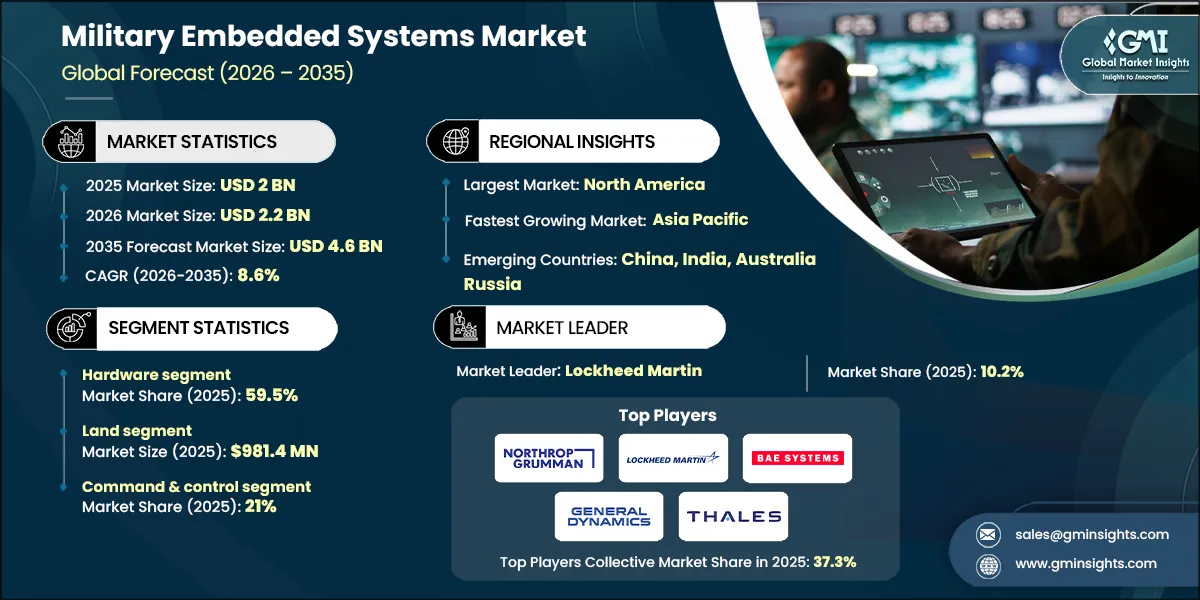
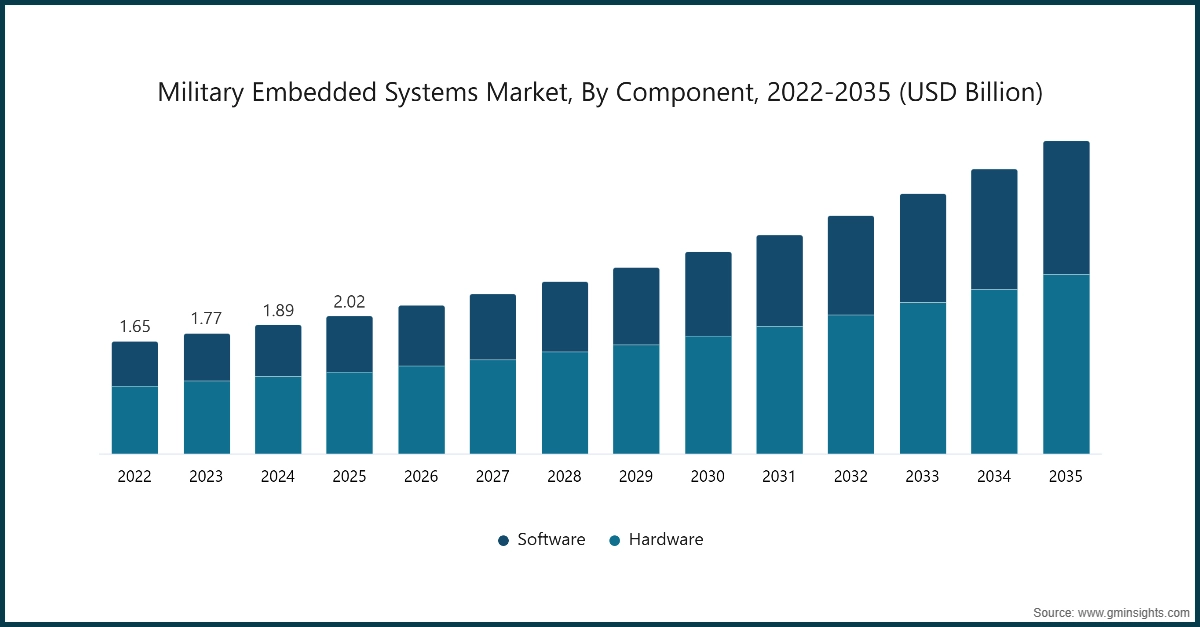
The global military embedded systems market was valued at USD 2 billion in 2025. The market is expected to grow from USD 2.2 billion in 2026 to USD 3.2 billion in 2031 & USD 4.6 billion in 2035, at a CAGR of 8.6% during the forecast period according to the latest report published by Global Market Insights Inc.
Military Embedded Systems Market Key Takeaways
Market Size & Growth
- 2025 Market Size: USD 2 Billion
- 2026 Market Size: USD 2.2 Billion
- 2035 Forecast Market Size: USD 4.6 Billion
- CAGR (2026–2035): 8.6%
Regional Dominance
- Largest Market: North America
- Fastest Growing Region: Asia Pacific
Key Market Drivers
- Rising demand for real-time data processing in mission-critical military operations.
- Growing adoption of embedded systems in unmanned platforms and autonomous weapons.
- Increasing defense modernization and digital battlefield initiatives.
- Advancements in AI-enabled and edge-processing military electronics.
- Rising defense budgets across major military powers and allied nations.
Challenges
- Complex certification and compliance requirements for military-grade embedded systems.
- Vulnerability to cyber threats and electronic warfare environments.
Opportunity
- Growing integration of artificial intelligence in next-generation defense platforms.
- Rising adoption of embedded systems in space-based and missile defense programs.
Key Players
- Market Leader: Lockheed Martin led with over 10.2% market share in 2025.
- Leading Players: Top 5 players in this market include Northrop Grumman Corporation, Lockheed Martin Corporation, BAE Systems plc, General Dynamics Corporation, Thales Group, which collectively held a market share of 37.3% in 2025.
Get Market Insights & Growth Opportunities
The growth of the market is attributed to the increased need for the rapid processing of in-field data for critical military actions, increased use of embedded systems in unmanned systems and autonomous combat systems, modernization of the military, digital battlefield initiatives, new-aged AI and edge processing military systems, and increased defense spending of many military powers and their allies.
The military embedded systems market is influenced by the need for embedded computing systems that provide accurate and rapid situational awareness on the military battlefield. Based on the U.S. Department of Defense (DoD) adoption strategy, the Pentagon is placing emphasis on AI to foster decision-making superiority and operational precision in combat. This focus on data driven decision making enhances sensor fusion in real time, decreases lag, and strengthens command-and-control effectiveness.
The growth of military embedded systems is also driven by the embedded systems technology in unmanned systems and the autonomous weapon systems. Demand for robust embedded systems continues to rise as defense forces prioritize unmanned and autonomous capabilities to reduce risk to personnel and enhance operational reach. For instance, The U.S. government has committed USD 33 billion on direct spending for drones and artificial intelligence for the Department of Defense, which includes USD 13.5 billion for unmanned systems and USD 16 billion for government-funded programs, which reinforce funding for drones and autonomous systems. Such funding will promote a fast adoption of embedded computing for navigation, sensor fusion, target tracking, and secure communications systems on unmanned military systems.
Between 2022 and 2024, the market witnessed considerable growth, increasing from USD 1.6 billion in 2022 to USD 1.9 billion in 2024. Such growth can be attributed to increased defense modernization and advancements in digital battlefield technologies. The period from 2022-2024 has also shown an increased focus on network-centric warfare and the integration of AI-enabled embedded systems and unmanned defense platforms, which has also attributed to the growth of the market. Additional factors attributed to the growth of the market were increased defense spending and advancements in secure embedded computing solutions, which contributed to the adoption of systems across land, air, sea, and space military systems.
To get key market trends
Military Embedded Systems Market Trends
- The systems used in combat platforms are changing because of AI-enabled autonomous decision-making technology. This change has been developing since 2021, as the armed forces have need to provide faster situational awareness and threat responses. With the continuing integration of AI in systems such as drones, vehicles, and naval systems, the adoption rate will continue to accelerate until 2030. The benefits of the technology include improved real-time situational awareness on the battlefield, reduced risk to personnel, and increased mission success.
- Integration of modular, upgradeable embedded systems is enhancing platform flexibility. The trend started in 2020 as the militaries of the world needed scalable solutions for vehicles and vessels with long operational lifecycles. The integration of flexible, modular, and upgradable embedded systems will continue to change flexibility until 2032, driven by the need to reduce system obsolescence. These systems will provide improved upgrades for systems they are integrated with, and will be operational at a reduced cost, and will provide interoperability for a wide range of platforms.
- Military electronics incorporating systems-level edge computing have seen a rise in demand for real-time data processing and analytics. In 2020, the need to minimize the latency of sensor data and the communication nodes of the battlefield networks initiated a trend that is expected to continue till 2032. The result will be advanced command and control, improved coordination among multiple systems, and dependable performance even in constrained or contested environments.
Military Embedded Systems Market Analysis
Learn more about the key segments shaping this market
Based on the component, the military embedded systems market is divided into hardware and software.
- The hardware segment accounted for 59.5% of the market in 2025. Hardware leads the market because it is the backbone of all mission critical operations, from navigation, sensor processing, communication, and control, to unmanned platforms and combat vehicles. Its high reliability, ruggedized designs, and real-time performance make it essential for operations across land, air, naval, and space applications.
- The software segment is anticipated to grow at a CAGR of 9.2% over the forecast period. This growth is attributed to high demand for aid, edge processing, and cyber security solutions in defense operations. As mission specific configurations and predictive maintenance are features of software, and because it can also accommodate secure communication and autonomous decision making, it is highly flexible, and along with embedded systems, it services digital battlefields and defense platforms of the future.
Based on the platform, the military embedded systems market is segmented into land, airborne and naval.
- The land segment dominated the market in 2025 and valued at USD 981.4 million owing to a widespread amount of land systems such as tanks, armored vehicles, and each of the operational unmanned systems. The extensive embedded systems integration with navigation, processing, and communication functions of the systems foster real-time and situational awareness mission reliability along with optimal efficiency on the battlefield.
- The airborne segment is expected to witness growth at a CAGR of 8.9% during the forecast period due to rising adoption in drones, fighter jets, and helicopters. Increasing demand for autonomous flight, real-time data processing, and advanced avionics drives growth. Lightweight, AI-enabled, and edge-processing embedded systems enhance operational efficiency, surveillance accuracy, and secure communication across airborne defense missions.
3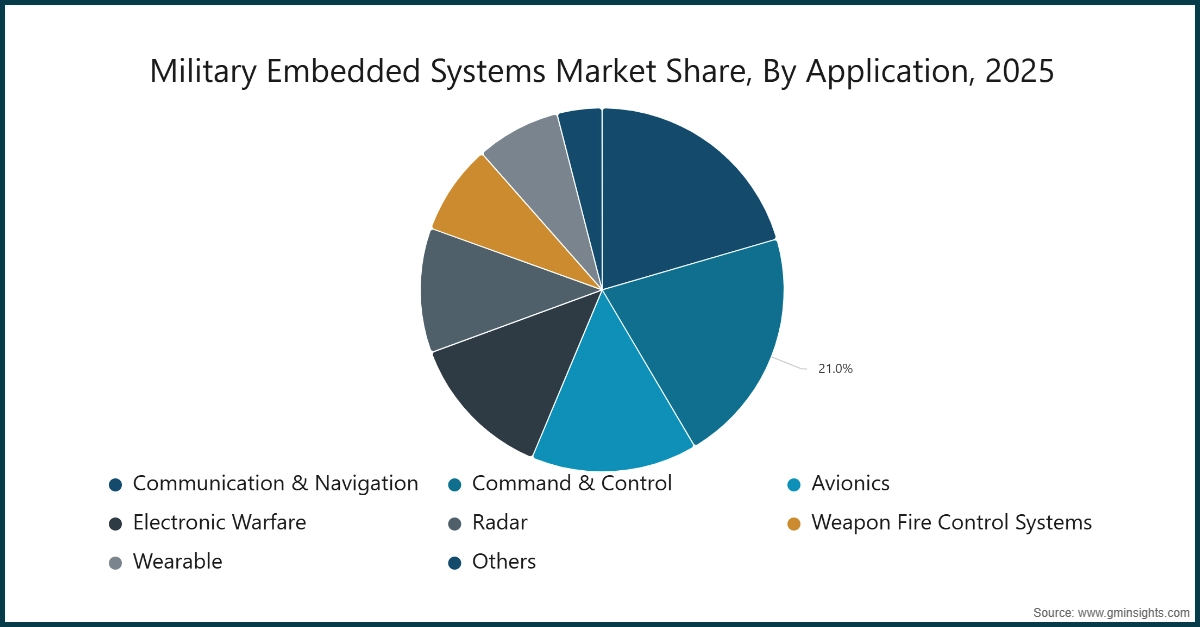
Learn more about the key segments shaping this market
Based on the application, military embedded systems market is classified into communication & navigation, command & control, avionics, electronic warfare, radar, weapon, fire control systems, wearable, and others.
- The command & control segment led the market in 2025 with a market share of 21%. This is attributed to embedded systems facilitating the command and control of systems in the operational battleground, communication, and intelligence systems. Systems in the land, air, and sea domains, while battling, process real-time data, secure communications, and utilize AI analytics to improve situational awareness and decision-making. Because of the high degree of -strategic- relevance, the command-and-control sector continues to be the largest share application segment.
- The radar segment is expected to witness growth at a CAGR of 9% during the forecast period as the growth is driven by the increasing requirement of enhanced surveillance, threat detection, and tracking. The incorporation of AI, edge-processing, and embedded high-speed electronics improves radar efficiency, real-time computing and analysis, and multi-platform compatibility.
Looking for region specific data?
North America Military Embedded Systems Market
North America held a market share of 42.6% of market in 2025.
- In North America, embedded defense systems market is growing rapidly driven by the spending on advanced technology, defense budgets, and modernization programs. This market is benefiting from the integration of AI driven processing, secure communications, autonomy, and advanced sensors at the air, land, and sea unmanned levels. This clearly shows the militaries interests for the future with high level combat environments and real time information processing.
- The investment by defense contractors and government agencies in North America propels the embedded systems market growth in the defense industry for systems with AI, hardened cyber security, and net centric systems for ISR, EW, and C2 systems. The region is expected to continue being the embedded systems market leader from further innovations in computing, industrial framework, and embedded IoT.
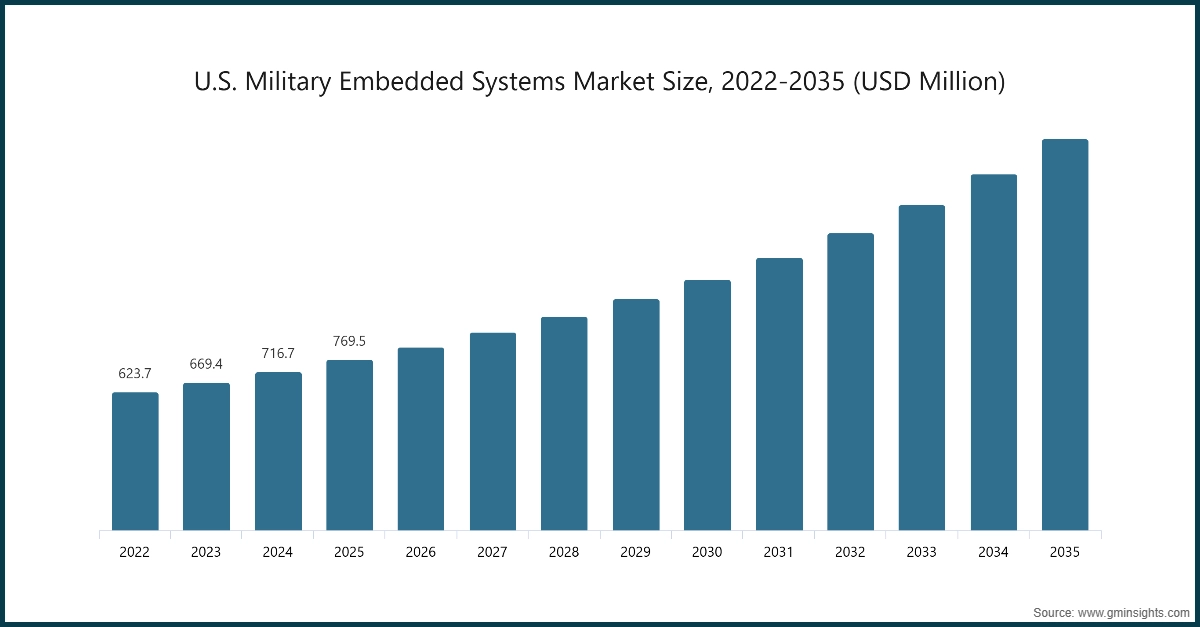
The U.S. military embedded systems market was valued at USD 623.7 million and USD 669.4 million in 2022 and 2023, respectively. The market size reached USD 769.5 million in 2025, growing from USD 716.7 million in 2024.
- The U.S. market for military embedded systems continues to expand because of strong defense modernization spending and related investments in sensors and monitoring technologies. The U.S. military market will continue to expand over the next few years as modernization and technological innovation drive growth. Advanced embedded systems are being more widely utilized for autonomous systems and ISR (intelligence, surveillance, and reconnaissance) and secure communications across the Army, Air Force, Navy, and space systems.
- Significant U.S. defense investments in foundational hardware capabilities are bolstering the embedded systems ecosystem. The Department of Defense has launched multiple programs under the CHIPS and Science Act framework, including awarding USD 269 million to expand microelectronics manufacturing and related secure semiconductors critical to the embedded systems for defense resilient comms and autonomous systems.
Europe Military Embedded Systems Market
Europe market accounted for USD 437 million in 2025 and is anticipated to show lucrative growth over the forecast period.
- Europe’s market is expanding due to increase in defense modernization, collaborative funding initiatives, and the drive for technological autonomy. Regional geopolitical pressures including the ongoing focus on deterrence and readiness in response to the security environment are driving demand for rugged, real-time embedded computing in applications such as secure communications, command & control, autonomous systems, and advanced airborne platforms.
- Significant funding from the European Union’s European Defense Fund and joint procurement initiatives are supporting the cross-border collaboration of defense R&D and the embedding of systems within advanced and interoperable defense technologies, including embedded systems that improve real-time computing, edge processing, and mission processing across land, sea, air, and unmanned platforms.
Russia dominates the Europe military embedded systems market, showcasing strong growth potential.
- Russia’s market is growing due to prioritization of military R&D for rugged embedded computing systems sustained, due to the defense spending increases, state-led technology programs focusing on autonomous systems, the integration of AI, and newer combat platforms such as UAVs and electronic warfare systems, technological programs, coupled with the rapid expansion of the market within Russia.
- Support from the government and subsidies for the high-tech defense sectors encourage the adoption of embedded solutions in mission computers, command systems, and autonomous weapons. Increased investment in domestic semiconductor and software development to reduce reliance on import increases demand for advanced, secure embedded systems across the Russian armed forces.
Asia Pacific Military Embedded Systems Market
The Asia Pacific market is anticipated to grow at the highest CAGR of 9.1% during the forecast period.
- The Asia Pacific military embedded systems market is expanding with increase in defense modernization, rise in ruggedized computing systems, and substantial investments are made in autonomous and unmanned systems. Rapid urban and industrial growth along with smart infrastructure programs accelerates demand for advanced, secure embedded processing technologies.
- China, Japan, and India are focusing on upgraded defense technologies that increases the adoption rate for these systems. Government and private investments in national semiconductor development, edge computing, and secure communication systems support the overall growth of the region and it is projected to grow significantly during the forecast period.
China military embedded systems market is estimated to grow with a significant CAGR, in the Asia Pacific market.
- China, along with the rest of the Asia Pacific region is experiencing a significant growth due to the rapid adoption of military embedded systems caused by the increasing China’s defense modernization initiatives which enhance demand for high-performance mission computers and real-time processing platforms supporting autonomous and network-centric capabilities.
- China’s government program for domestic self-reliance and military-civil fusion as well as the use of advanced technologies creates greater demand for the systems in command-and-control unmanned systems. China’s investments in secure computing, AI decision making, and domestic hardware manufacturing keeps China as the leader in growth for embedded systems in the Asia Pacific region.
Middle East and Africa Military Embedded Systems Market
Israel market to experience substantial growth in the Middle East and Africa market.
- Israel is experiencing steady growth in military embedded systems driven by strategic security concerns and regional threats that further increase demand for IoT-enabled, networked, and portable embedded solutions. Israel’s advancements in autonomous technologies and dual-use technologies for smart infrastructure strengthens its position in the Middle East and Africa market.
- In Israel, the defense tech sectors are the main end users of embedded systems coupled with AI and edge-computing for real-time processing across the command and control, surveillance, and electronic warfare domains. This bolsters Israel’s standing as a center of cutting-edge military embedded systems.
Military Embedded Systems Market Share
The market is led by players such as Northrop Grumman Corporation, Lockheed Martin Corporation, BAE Systems plc, General Dynamics Corporation, Thales Group, and Renesas. These six companies cumulatively accounted for 32.4% share of the market in 2025. They have strong market positions due to their diversified business activities, advanced technology, and global reach and presence across all three defense sectors, land, air, and sea. They are able to provide a variety of products and solutions to the market including embedded systems, software, artificial intelligence-based computing, and autonomous systems.
These companies provide high-performance, rugged, and secure embedded systems, solutions that incorporate artificial intelligence and edge computing, and systems that meet multi-domain operational needs. Their investment in research and development autonomous systems, and advanced sensor systems enables them to meet the growing demand for mission-critical integrated defense systems and maintain their market leadership.
Military Embedded Systems Market Companies
Prominent players operating in the military embedded systems industry are as mentioned below:
- ABB Ltd.
- BAE Systems plc
- Boeing Defense, Space & Security
- Collins Aerospace (a Raytheon Technologies company)
- Curtiss-Wright Corporation
- Elbit Systems Ltd.
- General Dynamics Corporation
- Harris Corporation
- Honeywell International Inc.
- Intel Corporation
- L3Harris Technologies, Inc.
- Leonardo S.p.A.
- Lockheed Martin Corporation
- Northrop Grumman Corporation
- Raytheon Technologies Corporation
- Renesas Corporation
- Rheinmetall AG
- Saab AB
- Thales Group
- Northrop Grumman Corporation
Northrop Grumman builds advanced embedded systems for automated defense systems and command and control systems. The systems are combined with high performance computing, AI real time analytics, and secure real-time processing across land, air, sea, and naval operations to improve situational awareness and operational reliability for mission critical functions of the military.
- Lockheed Martin Corporation
Lockheed integrates embedded electronics and software systems in fighters, drones, in missile defense and naval systems. The company provides AI based solutions for avionics, secure fusion of communications and sensor fusion systems that promotes rapid situational awareness and mission effectiveness, and seamless integration across multiple defense systems and domains.
- BAE Systems plc
BAE Systems provides rugged embedded systems for the ground, air, and maritime defense systems. These systems feature Real-time Processing and Autonomous Navigation and Electronic Warfare (EW) support which offer improved resilience and mission success, as well as greater situational awareness in critical operations in military theater environments.
- General Dynamics Corporation
General Dynamics specializes in embedded computing systems for armored vehicles and naval ships and autonomous systems. The company focuses on integrating high reliability hardware and secure software and supports command and control functions for Real-time Processing, AI-based Threat Assessment, and mission-critical Decision Support for modern defense forces.
- Thales Group
Thales Group integrates software and embedded electronics for radars, surveillance, and command-and-control systems. They incorporate AI, edge-processing, and cybersecurity for multi-domain operational command, threat detection, and secure communication in complex and contested battle spaces.
- Renesas
Renesas provides microcontrollers and embedded semiconductors for military use in autonomous vehicles, drones, and naval systems that support real-time processing and mission-critical secure operations in extreme environments.
Military Embedded Systems Market Report Attributes
| Key Takeaway | Details |
|---|---|
| Market Size & Growth | |
| Base Year | 2025 |
| Market Size in 2025 | USD 2 Billion |
| Market Size in 2026 | USD 2.2 Billion |
| Forecast Period 2026-2035 CAGR | 8.6% |
| Market Size in 2035 | USD 4.6 Billion |
| Key Market Trends | |
| Drivers | Impact |
| Rising demand for real-time data processing in mission-critical military operations | Drives ~24% growth attributing to need for real-time data processing in critical military operations where rapid decision-making, situational awareness, and threat response are critical. |
| Growing adoption of embedded systems in unmanned platforms and autonomous weapons | Contributes to ~21% growth as the drones, unmanned ground vehicles, and autonomous naval systems largely depend on embedded computing for navigation, targeting, sensor fusion, and secure communications, expanding the demand for those defense platforms. |
| Increasing defense modernization and digital battlefield initiatives | Accounts for ~20% growth as armed forces are upgrading their legacy systems with advanced embedded electronics focused on network-centric warfare, integrated communications, and interoperable combat systems. |
| Advancements in AI-enabled and edge-processing military electronics | Supports ~18% growth driven by the integration of artificial intelligence with embedded systems allows on-device analytics, less latency, and the ability to make autonomous decisions on the device, which is operationally effective in contested and bandwidth-limited. |
| Rising defense budgets across major military powers and allied nations | Adds ~17% growth as rapid increase in military spending allows the acquisition of advanced embedded systems for land, air, naval, and space systems, guaranteeing constant enhancements and prolonged market growth. |
| Pitfalls & Challenges | Impact |
| Complex certification and compliance requirements for military-grade embedded systems | Restrains growth as complex certification and compliance requirements increase development timelines and costs. |
| Vulnerability to cyber threats and electronic warfare environments | Limits growth as cyber threats pose significant risks and it is crucial for embedded systems to operate reliably under jamming, hacking, and signal disruption in contested battlefield environments. |
| Opportunities: | Impact |
| Growing integration of artificial intelligence in next-generation defense platforms | Presents significant growth potential as defense platforms become more intelligent by enabling smarter, autonomous defense platforms improving real-time decision-making, predictive maintenance, and threat detection through advanced embedded computing capabilities. |
| Rising adoption of embedded systems in space-based and missile defense programs | Offers opportunity by creating new demand for high-performance, radiation-hardened embedded systems for surveillance, tracking, guidance, and secure communication. |
| Market Leaders (2025) | |
| Market Leader |
10.2% market share |
| Top Players |
Collective market share in 2024 is 37.3% |
| Competitive Edge |
|
| Regional Insights | |
| Largest Market | North America |
| Fastest growing market | Asia Pacific |
| Emerging countries | China, India, Australia, Russia |
| Future outlook |
|
What are the growth opportunities in this market?
Military Embedded Systems Market Industry News
- In October 2025, BAE Systems secured a USD 22 million contract from the U.S. Department of Defense for the STEAM PIPE microelectronics to build prototypes of advanced chiplets for military system. The contract supports the microelectronics modernization for defense embedded systems to improve performance by reducing size, weight, and power (SWaP) while broadening power augments in electronic warfare and avionics.
- In March 2025, Lockheed Martin showcased its CJADC2 Interoperability Factory software stack. It is designed to integrate advanced weapon systems, and for US and allied forces to accelerate real time Combined Joint All Domain Command and Control (CJADC2). The systems improve vertical and horizontal data sharing to strengthen situational awareness and decision action velocity in multidomain operations.
- In May 2025, L3Harris Technologies received a U.S. government contract to develop a next-generation security processor to strengthen the worldwide secure communications hardware infrastructure. This development improves embedded cybersecurity and secure data management in defense communications and mission-critical systems.
The military embedded systems market research report includes in-depth coverage of the industry with estimates and forecast in terms of revenue (USD Million) from 2022 – 2035 for the following segments:
Market, By Component
- Hardware
- Software
Market, By Platform Type
- Land
- Airborne
- Naval
Market, By Application
- Communication & navigation
- Command & control
- Avionics
- Electronic warfare
- Radar
- Weapon
- Fire control systems
- Wearable
- Others
The above information is provided for the following regions and countries:
- North America
- U.S.
- Canada
- Europe
- Germany
- UK
- France
- Spain
- Italy
- Russia
- Asia Pacific
- China
- India
- Japan
- Australia
- South Korea
- Latin America
- Brazil
- Mexico
- Argentina
- Chile
- Columbia
- Middle East and Africa
- South Africa
- Saudi Arabia
- UAE
- Egypt
- Israel
- Turkey
Frequently Asked Question(FAQ) :
What was the market size of the military embedded systems market in 2025?
The market size was USD 2 billion in 2025, with a CAGR of 8.6% projected during the forecast period, driven by advancements in AI-enabled technologies and modular embedded systems.
What is the projected value of the military embedded systems market by 2035?
The market is expected to reach USD 4.6 billion by 2035, fueled by the increasing adoption of AI, modular systems, and the need for scalable solutions in military platforms.
What is the projected size of the military embedded systems market in 2026?
The market is expected to grow to USD 2.2 billion in 2026.
What was the market share of the hardware segment in 2025?
The hardware segment accounted for 59.5% of the market in 2025, driven by its critical role in mission-critical operations such as navigation, sensor processing, communication, and control.
What was the market share of the command & control segment in 2025?
The command & control segment held a 21% market share in 2025, attributed to its strategic importance in facilitating real-time data processing, secure communications, and AI-driven analytics for situational awareness and decision-making.
Which region led the military embedded systems market in 2025?
North America dominated the market with a 42.6% share in 2025, supported by strong defense investments and technological advancements in embedded systems.
What are the upcoming trends in the military embedded systems industry?
Key trends include the integration of AI-enabled autonomous decision-making technologies, adoption of modular and upgradeable embedded systems, and the increasing focus on reducing system obsolescence while enhancing platform flexibility.
Who are the key players in the military embedded systems market?
Prominent players include ABB Ltd., BAE Systems plc, Boeing Defense, Space & Security, Collins Aerospace (a Raytheon Technologies company), Curtiss-Wright Corporation, Elbit Systems Ltd., General Dynamics Corporation, Harris Corporation, Honeywell International Inc., and Intel Corporation.
Military Embedded Systems Market Scope
Related Reports