Summary
Table of Content

Military & Defense Semiconductor Market
Get a free sample of this report
Form submitted successfully!
Error submitting form. Please try again.
Thank you!
Your inquiry has been received. Our team will reach out to you with the required details via email. To ensure that you don't miss their response, kindly remember to check your spam folder as well!
Request Sectional Data
Thank you!
Your inquiry has been received. Our team will reach out to you with the required details via email. To ensure that you don't miss their response, kindly remember to check your spam folder as well!
Form submitted successfully!
Error submitting form. Please try again.
Military & Defense Semiconductor Market Size
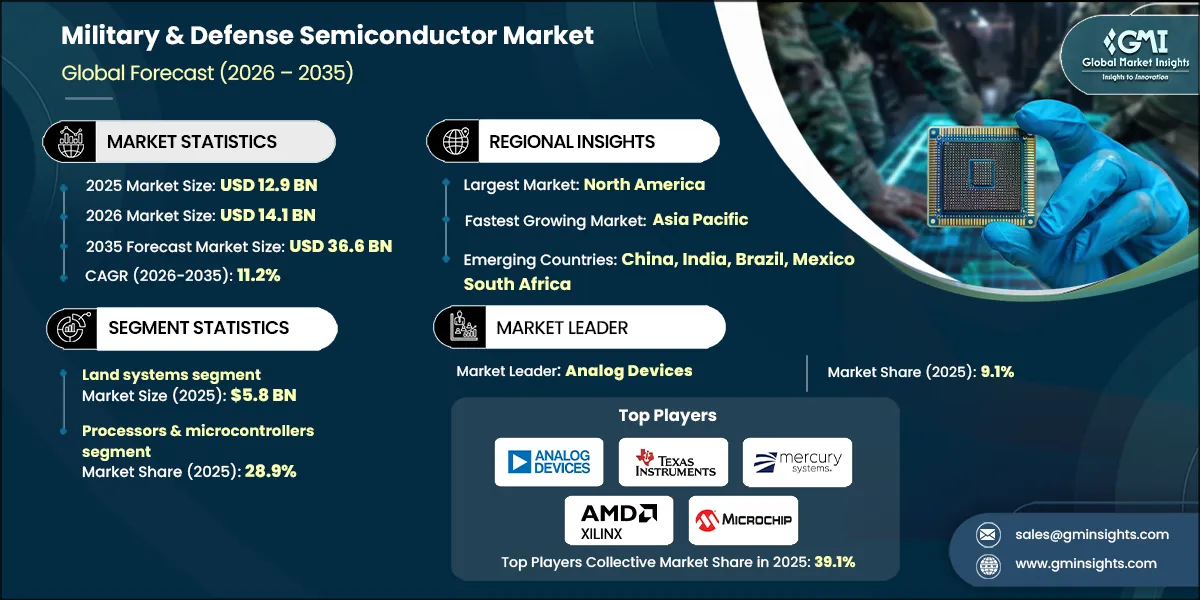
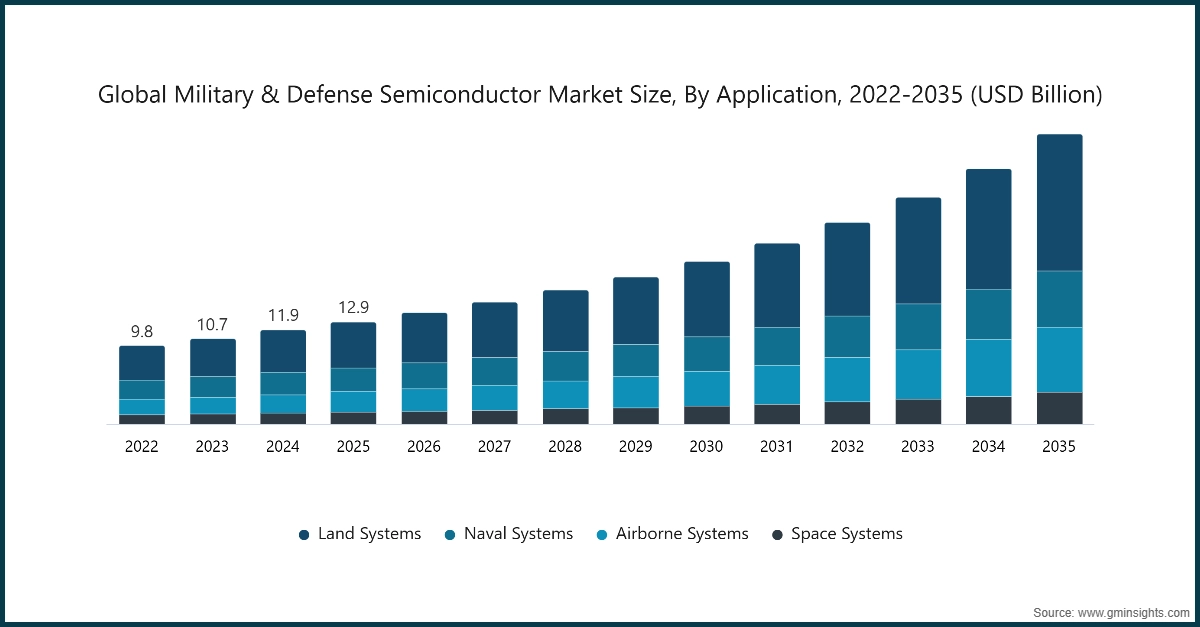
The global military & defense semiconductor market was valued at USD 12.9 billion in 2025. The market is expected to grow from USD 14.1 billion in 2026 to USD 36.6 billion in 2035, at a CAGR of 11.2% during the forecast period according to the latest report published by Global Market Insights Inc.
Military & Defense Semiconductor Market Key Takeaways
Market Size & Growth
- 2025 Market Size: USD 12.9 Billion
- 2026 Market Size: USD 14.1 Billion
- 2035 Forecast Market Size: USD 36.6 Billion
- CAGR (2026–2035): 11.2%
Regional Dominance
- Largest Market: North America
- Fastest Growing Region: Asia Pacific
Key Market Drivers
- Increasing government investments in military.
- Utilization of radiation-tolerant semiconductor components.
- Increasing aircraft upgrades and modernization programs.
- Growing demand for advanced semiconductor technologies.
- Increasing use of Artificial Intelligence (AI) and Machine Learning (ML) in military operations.
Challenges
- High cost and long development cycles.
- Export restrictions and geopolitical tensions.
Opportunity
- Advancements in electronic warfare and communication systems.
- High-performance computing for defense simulation and command systems.
Key Players
- Market Leader: Analog Devices led with over 9.1% market share in 2025.
- Leading Players: Top 5 players in this market include Analog Devices, Texas Instruments, Mercury Systems, AMD (Xilinx), Microchip Technology, which collectively held a market share of 39.1% in 2025.
Get Market Insights & Growth Opportunities
Government investments in the military sector are driving growth in the defense semiconductor market by fostering technological advancements. The increased defense budgets enable research and development, resulting in the use of advanced semiconductor technologies for communication, surveillance, and weapon systems. The demand for cutting-edge semiconductor components, such as microprocessors and sensors, rises as governments enhance their defense capabilities. This investment-driven technological evolution boosts the industry expansion. For instance, the U.S. Department of Defense's (DoD) budget for Fiscal Year (FY) 2026 is approximately USD 961 billion as a part of the overall national defense budget request exceeding USD 1 trillion.
Semiconductors in military and defense are electronic components with conductivity between conductors and insulators. Semiconductors, such as microprocessors and sensors, are an important part of modern technologies such as communication, monitoring, and defense systems. The semiconductors are important for the development of advanced electronic systems which can increase the effectiveness of military systems.
Export restrictions and geopolitical issues limit the semiconductor industry in military & defense due to restrictions on the free mobility of essential technology across borders. Additionally, governments use a rigid policy to protect strategic technologies, hindering easy mobility of semiconductor components. Geopolitics may further exacerbate these limitations and create uncertainties in the overall supply chain network for military & defense applications.
To get key market trends
Military & Defense Semiconductor Market Trends
- The military & defense semiconductor industry is experiencing a steady rise as the defense forces across the world are upgrading their equipment. This has led to a rise in demand for reliable semiconductor components with a high-performance capability. An increased budget for defense along with the procurement of new-generation military equipment is a major factor adding to this rise.
- Integration of AI, autonomous solutions, as well as advanced communication solutions, is driving the semiconductor demand. Semiconductors that support data processing, fast networking, as well as secure communication are gaining increased popularity.
- Radiation-hardened and ruggedized semiconductors are gaining traction due to harsh operational environments, including space and battlefield applications. Miniaturization and power consumption are becoming increasingly important for portable and multi-functional defense systems.
- New opportunities will emerge with the rising of unmanned and hybrid-electric platforms for semiconductors that support electric propulsion, energy management, and advanced sensor integration.
- Aftermarket and retrofitting activities, coupled with predictive maintenance systems, are encouraging recurring demand related to defense application-specific semiconductors.
- New technologies in the areas of directed energy weapons, hypersonic systems, and advanced radar technology are creating a need for semiconductors with high frequency and reliability along with the ability to work in extreme conditions.
- Cybersecurity and encrypted communication requirements are accelerating the adoption of secure semiconductors, including trusted platform modules and tamper-resistant ICs, ensuring data integrity and operational safety across critical defense networks and command systems.
Military & Defense Semiconductor Market Analysis
Learn more about the key segments shaping this market
On the basis of application, the market is divided into land systems, naval systems, airborne systems, and space systems.
- The land systems segment was valued at USD 5.8 billion in 2025 and is anticipated to grow at a CAGR of 11.8% during the forecast period 2026‑2035. Semiconductor technology is being increasingly adopted in land systems with the growing incorporation of autonomous, sensing, and semiconductor technologies into tanks, tactical vehicles, and mobile command centers. The real-time processing and communication feature is an important requirement fueling the semiconductor technology market.
- Energy-efficient as well as rugged semiconductors are being used in mobile land systems as part of the effort to ensure system-level reliability, regardless of the environments encountered on demanding terrains. This is a positive factor for modernization as well as system life-extension programs.
- The airborne systems segment is anticipated to grow at a CAGR of 12.4% during 2026‑2035. Airborne systems are driving demand for high-performance semiconductors to support avionics, navigation, and radar operations. Lightweight, energy-efficient components are critical for modern fighter jets, helicopters, and unmanned aerial vehicles (UAVs).
- Integration of advanced processors, memory, and RF components in airborne platforms is enabling real-time data processing, predictive maintenance, and enhanced situational awareness. This trend is fueling innovation in next-generation military aircraft and drone technologies.
Learn more about the key segments shaping this market
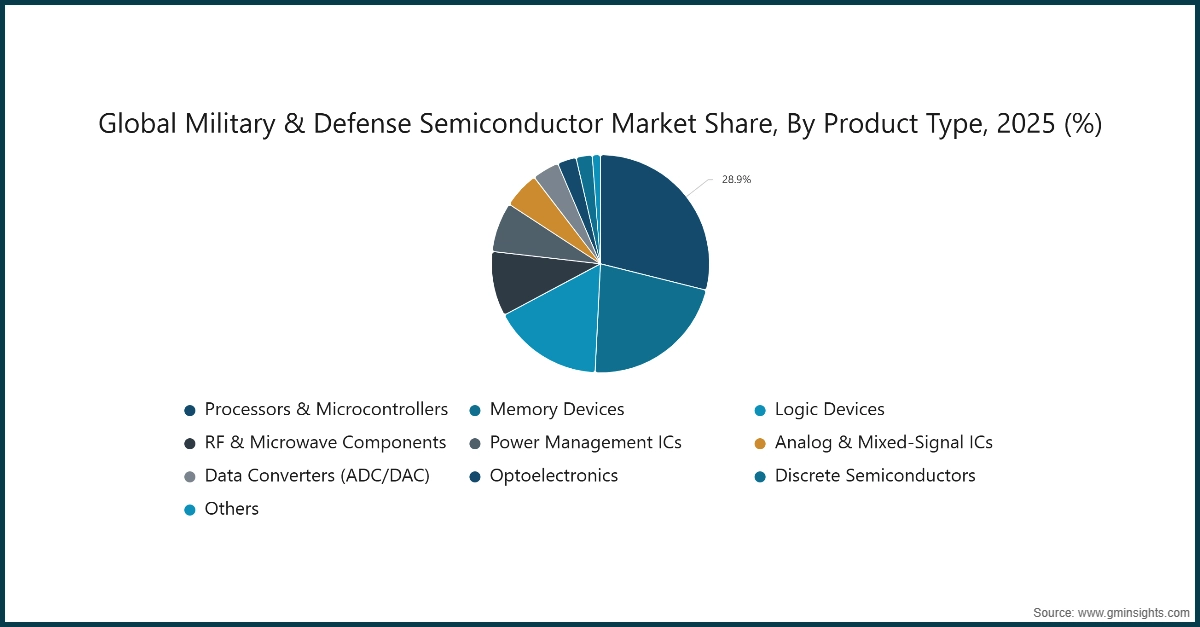
On the basis of product type, the military & defense semiconductor market is segmented into processors & microcontrollers, memory devices, logic devices, RF & microwave components, power management ICs, analog & mixed-signal ICs, data converters (ADC/DAC), optoelectronics, discrete semiconductors, and others.
- The processors & microcontrollers held a market share of 28.9% in 2025. The demand for processor and microcontrollers within the military and defense semiconductor market is rising as a result of the increased demand for high-performance computing within modern defense systems. Advanced processor technology with AI, encryption, and communication features is gaining popularity within the military and defense sectors.
- Ruggedized and low-power microcontrollers have also emerged as a new trend in the military sector, being adopted for use in combat environments and in the construction of small electronic modules. This technology enhanced control of unmanned vehicles, drones, along with portable military devices.
- The memory devices segment held a market share of 21.9% in 2025. Robust demand for memory devices has arisen, driven by the increasing demand in defense applications for rapid data storage and retrieval. High-speed, non-volatile memory solutions are of immense importance to radar systems, avionics, and command-and-control platforms.
- Radiation-hardened memory devices are emerging as an integral part of satellites and space-based defense systems. These memory devices provide reliability in terms of data integrity even in harsh environments.
Looking for region specific data?
North America Military & Defense Semiconductor Market
The North America market dominated the global military & defense semiconductor industry with a market share of 45.1% in 2025.
The military and semiconductor industry in North America is growing rapidly due to modernization, especially in the areas of air, land, naval, and space platforms. Rising requirements for AI, autonomy, and communication technology are fueling the demand for high-performance semiconductor technology.
- Opportunities that arise regularly such as retrofitting, maintenance, and upgrade are also driving sustained demand. The government's efforts concerning the promotion of local semiconductor production are also helping develop local competence and reduce reliance on foreign companies for critical defense components.
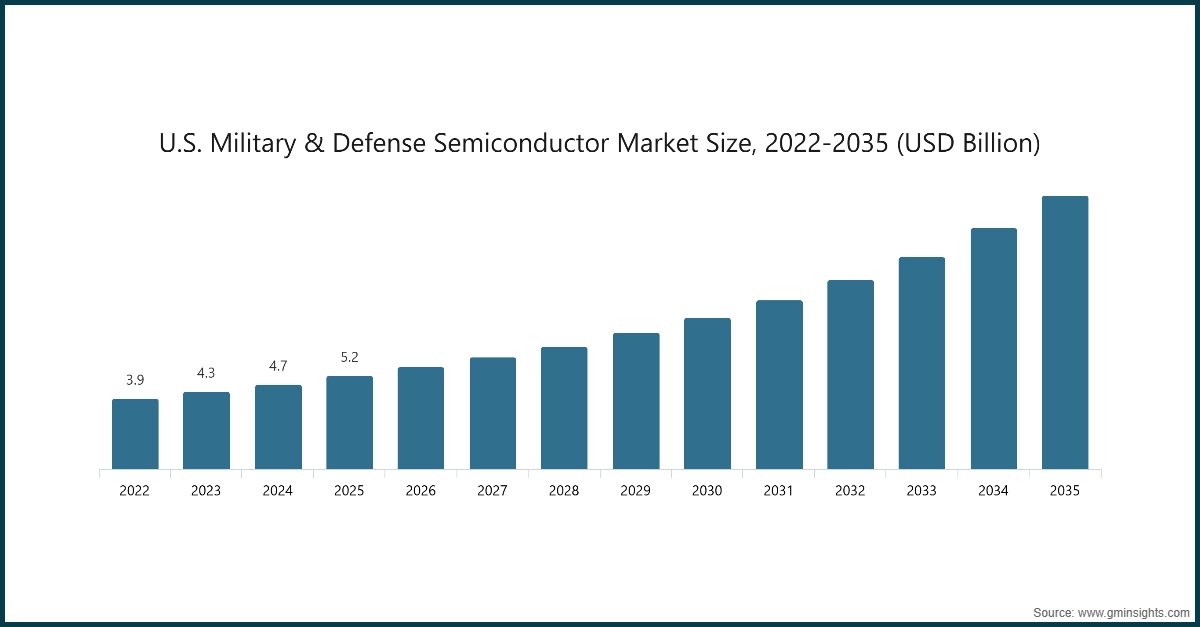
The U.S. military & defense semiconductor market was valued at USD 3.9 billion and USD 4.3 billion in 2022 and 2023, respectively. The market size reached USD 5.2 billion in 2025, growing from USD 4.7 billion in 2024.
- Strategic partnerships and investments are propelling the domestic manufacturing aspect of the industry. In September of 2024, a strategic partnership was established between Intel and Qualcomm for the production of sophisticated chips for the DoD in relation to the advancement of technologies in the 7nm and sub-7nm category; in a separate investment, a grant of USD 3 billion was received by Intel for the production of military-grade chips.
- In United States, there is a rising need for processors and memory as well as RF solutions designed for future military systems. Growing integration of AI and autonomous solutions in unmanned systems and advanced aircraft is fueling the demand for military semiconductors.
Europe Military & Defense Semiconductor Market
The Europe defense semiconductor market will continue to develop with increased investments in AI-enabled autonomous systems, electronic warfare, and advanced radar technologies. Governments are focusing on strengthening domestic capabilities to reduce reliance on external suppliers.
Collaboration projects with the private semiconductor manufacturers are aiding the creation of secure and efficient components. The focus of the region has shifted to rugged components with low power consumption for complex defense systems and warfare solutions, designed for the future.
Germany dominated the Europe’s military & defense semiconductor market, with a share of 32.4% in 2025.
- Germany's military and defense semiconductor market is also being propelled by its new focus on self-guided systems, AI-related robotics, and intelligent surveillance solutions. Rising R&D in high-performance, durable, and power-saving semiconductors are supporting modernization across airborne, land, and naval platforms.
- In July 2025, a radical shift in defense strategy was unveiled by the German government, pivoting away from traditional heavy machinery in favor of a "hyperwar" and a future led by autonomous AI robotics and bio-hybrid surveillance technology, such as remote-control spy cockroaches.
Asia Pacific Military & Defense Semiconductor Market
The Asia Pacific market is anticipated to grow at the highest CAGR of 12.6% during the analysis timeframe.
The military & defense semiconductor industry in the Asia Pacific is growing in response to increased military spending, military modernization efforts, and rising demand for UAVs, AI-driven surveillance systems, and electronic warfare systems in the region.
- Local R&D programs, collaborations, and technology transfers are accelerating adoption of high-performance, ruggedized, and energy-efficient semiconductors for airborne, naval, land, and space defense platforms.
China military & defense semiconductor market is estimated to grow with a significant CAGR, in the Asia Pacific market.
- China is rapidly developing its domestic microprocessor technology for supporting sensor, unmanned, and EW technologies. There is increasing demand for microprocessors, memory devices, and radio frequency components.
- Integration of artificial intelligence, unmanned systems, and space defense systems is developing a considerable demand for reliable, radiation-hardened, and miniaturized semiconductors that can perform in extreme conditions.
Latin American Military & Defense Semiconductor Market
The Brazilian military is upgrading its infrastructure with investments made in their naval, aerial, as well as ground systems, contributing to an increased demand for ruggedized processors, memory devices, and management ICs.
Government-supported ventures and partnerships are improving local semiconductor production, thus supporting advanced systems in avionics, radar technologies, and secure communication in military affairs.
Middle East and Africa Military & Defense Semiconductor Market
South Africa’s military semiconductor demand is increasing due to upgrades across airborne, naval, and land platforms. Ruggedized analog and mixed-signal ICs, optoelectronics, and data converters are in strong demand.
Investments made in autonomous systems, communication security, and electronic warfare are driving adoption, additionally, technology transfer efforts are enhancing regional defense capabilities.
Military & Defense Semiconductor Market Share
The competitive landscape of the military & defense semiconductor industry is driven by continuous technological innovation and strategic collaborations among leading semiconductor and defense system providers. Major players in this market, such as Analog Devices, Texas Instruments, Mercury Systems, AMD (Xilinx), and Microchip Technology, have an estimated market share of 39.1% in the global market. Major companies in this domain are investing significantly in R&D for improving performance, creating high reliability and rugged devices, increasing the efficiency of systems, and incorporating new processing, memory, and sensor technologies into their offerings.
The market is currently experiencing a high level of activity in terms of strategic alliances, joint ventures, acquisitions, product line expansions, and regional capacity growth, in response to growing demand from aerospace, defense, and emerging unmanned systems and hybrid-electric segments. Furthermore, new entrants and niche technology providers are contributing to market dynamics with innovative developments such as high-performance processors, RF and microwave technology, power management devices, and intelligent semiconductors, thus contributing to overall market advancement and growth.
Military & Defense Semiconductor Market Companies
Prominent players operating in the military & defense semiconductor industry are as mentioned below:
- Analog Devices
- BAE Systems
- Boeing
- General Dynamics
- Infineon Technologies
- L3Harris Technologies
- Lockheed Martin
- Microchip Technology
- Northrop Grumman
- Raytheon Technologies
- STMicroelectronics
- Texas Instruments
Analog Devices: Analog Devices accounted for a market share of 9.1% in 2025. The company is recognized for its high-performance analog, mixed-signal, and RF semiconductor solutions for military and defense applications. It focuses on enhancing reliability, ruggedness, and system efficiency across airborne, land, naval, and space platforms.
Texas Instruments: Texas Instruments accounted for a market share of 8.2% in 2025. The company is known for its broad portfolio of processors, analog, and power management ICs tailored for defense systems. TI emphasizes innovation, low-power designs, and integration of advanced sensor and data processing technologies.
Mercury Systems: Mercury Systems accounted for a market share of 7.9% in 2025. The company specializes in secure processing modules, high-reliability memory, and sensor integration for aerospace and defense platforms. Mercury Systems invests heavily in R&D to support ruggedized, high-performance semiconductor solutions and next-generation electronic warfare and autonomous systems.
Military & Defense Semiconductor Market Report Attributes
| Key Takeaway | Details |
|---|---|
| Market Size & Growth | |
| Base Year | 2025 |
| Market Size in 2025 | USD 12.9 Billion |
| Market Size in 2026 | USD 14.1 Billion |
| Forecast Period 2026-2035 CAGR | 11.2% |
| Market Size in 2035 | USD 36.6 Billion |
| Key Market Trends | |
| Drivers | Impact |
| Increasing government investments in military | Increased government investments are driving higher demand for cutting-edge military semiconductor solutions. |
| Utilization of radiation-tolerant semiconductor components | Utilization of radiation-tolerant semiconductor components enhances the reliability and survivability of defense systems in harsh environments. |
| Increasing aircraft upgrades and modernization programs | Aircraft upgrades and modernization programs create continuous opportunities for advanced semiconductor integration in avionics. |
| Growing demand for advanced semiconductor technologies | Growing demand for advanced semiconductor technologies accelerates innovation and adoption of next-generation defense electronics. |
| Increasing use of Artificial Intelligence (AI) and Machine Learning (ML) in military operations | Integration of AI and ML in military operations improves decision-making, situational awareness, and operational efficiency. |
| Pitfalls & Challenges | Impact |
| High cost and long development cycles | High cost and long development cycles limit rapid deployment of new semiconductor technologies in defense applications. |
| Export restrictions and geopolitical tensions | Export restrictions and geopolitical tensions constrain international collaboration and market expansion. |
| Opportunities: | Impact |
| Advancements in electronic warfare and communication systems | Advancements in electronic warfare and communication systems strengthen defense capabilities against emerging threats. |
| High-performance computing for defense simulation and command systems | High-performance computing for defense simulation and command systems enhances strategic planning and mission-critical operations. |
| Market Leaders (2025) | |
| Market Leader |
9.1% Market Share |
| Top Players |
Top 5 Players Collective Market Share: 39.1% |
| Competitive Edge |
|
| Regional Insights | |
| Largest Market | North America |
| Fastest growing market | Asia Pacific |
| Emerging countries | China, India, Brazil, Mexico, South Africa |
| Future outlook |
|
What are the growth opportunities in this market?
Military & Defense Semiconductor Industry News
- In January 2026, Paras Defence and Space Technologies Ltd plans to invest approximately USD 55.3 million USD to establish a new semiconductor production facility focused on defence applications.
- In November 2024, the Department of Commerce announced finalized CHIPS Incentives Program awards for BAE Systems Electronic Systems and Rocket Lab, with a combined value of up to USD 59.4 million in direct funding.
The military & defense semiconductor market research report includes in-depth coverage of the industry with estimates and forecast in terms of revenue in USD Million from 2022 – 2035 for the following segments:
Market, By Product Type
Processors & microcontrollers
- General-purpose processors
- AI/ML processors
- Cryptographic processors
- Digital signal processors
- Microcontrollers
- Memory devices
- SRAM (static RAM)
- DRAM (dynamic RAM)
- Flash memory (NAND, NOR)
- MRAM (magnetoresistive RAM)
- EEPROM/NVRAM
- Logic devices
- ASICs (application-specific integrated circuits)
- FPGAs (field-programmable gate arrays)
- PLDs (programmable logic devices)
- CPLDs (complex programmable logic devices)
- RF & microwave components
- MMICs (monolithic microwave ICs)
- T/R modules (transmit/receive modules)
- RF power amplifiers
- Others
- Power management ICs
- DC-DC converters (buck, boost, buck-boost, isolated)
- LDOs (low-dropout regulators)
- Power MOSFETs & gate drivers
- Others
- Analog & mixed-signal ICs
- Operational amplifiers
- Comparators
- Analog switches & multiplexers
- Others
- Data converters (ADC/DAC)
- Optoelectronics
- Discrete semiconductors
- Others
Market, By Application
Land systems
- Combat vehicles (tanks, IFVs, APCs)
- Tactical vehicles (HMMWVs, MRAPs, trucks)
- Artillery systems
- Ground-based air defense
- Others
- Naval systems
- Surface combatants
- Aircraft carriers
- Submarines
- Amphibious warfare ships
- Others
- Airborne systems
- Fighter aircraft
- Transport & tanker aircraft
- Helicopters
- UAVs
- Others
- Space systems
- Military communications satellites
- Reconnaissance & surveillance satellites
- Navigation satellites
- Missile warning satellites
- Space situational awareness
- Others
The above information is provided for the following regions and countries:
- North America
- U.S.
- Canada
- Europe
- Germany
- UK
- France
- Spain
- Italy
- Netherlands
- Asia Pacific
- China
- India
- Japan
- Australia
- South Korea
- Latin America
- Brazil
- Mexico
- Argentina
- Middle East and Africa
- South Africa
- Saudi Arabia
- UAE
Frequently Asked Question(FAQ) :
What is the military & defense semiconductor market size in 2025?
The market size for military & defense semiconductor was valued at USD 12.9 billion in 2025. Increased government investments and advancements in semiconductor technologies are driving market growth.
What is the market size of the military & defense semiconductor industry in 2026?
The market size for military & defense semiconductors reached USD 14.1 billion in 2026, reflecting steady growth driven by modernization programs and rising demand for advanced defense electronics.
What is the projected value of the military & defense semiconductor market by 2035?
The market size for military & defense semiconductors is expected to reach USD 36.6 billion by 2035, growing at a CAGR of 11.2%. This growth is fueled by increased adoption of AI/ML technologies, radiation-tolerant components, and advancements in electronic warfare systems.
How much revenue did the land systems segment generate in 2025?
The land systems segment was valued at USD 5.8 billion in 2025, making it a significant contributor to the market. Its growth is supported by rising investments in ground-based defense systems and modernization initiatives.
What was the market share of processors & microcontrollers in 2025?
Processors & microcontrollers held a market share of 28.9% in 2025, driven by their critical role in enabling advanced functionalities in defense applications.
What is the growth outlook for the land systems segment from 2026 to 2035?
The land systems segment is projected to grow at a CAGR of 11.8% during the forecast period (2026-2035). Increasing focus on ground-based defense capabilities and technological advancements are driving this growth.
Which region leads the military & defense semiconductor market?
North America dominated the global market with a 45.1% share in 2025. The region's leadership is attributed to significant defense budgets, technological advancements, and strong presence of key market players.
What are the upcoming trends in the military & defense semiconductor industry?
Key trends include the integration of AI and ML in military operations, adoption of radiation-tolerant components, advancements in electronic warfare systems, and increasing use of high-performance computing for defense simulations. The growing demand for next-generation semiconductor technologies is also shaping the market.
Who are the key players in the military & defense semiconductor market?
Key players include Analog Devices, Texas Instruments, Mercury Systems, AMD (Xilinx), Microchip Technology, BAE Systems, Boeing, General Dynamics, Infineon Technologies, L3Harris Technologies, Lockheed Martin, Northrop Grumman, Raytheon Technologies, and STMicroelectronics.
Military & Defense Semiconductor Market Scope
Related Reports