Summary
Table of Content

Middle East Water Heater Market
Get a free sample of this report
Form submitted successfully!
Error submitting form. Please try again.
Thank you!
Your inquiry has been received. Our team will reach out to you with the required details via email. To ensure that you don't miss their response, kindly remember to check your spam folder as well!
Request Sectional Data
Thank you!
Your inquiry has been received. Our team will reach out to you with the required details via email. To ensure that you don't miss their response, kindly remember to check your spam folder as well!
Form submitted successfully!
Error submitting form. Please try again.
Middle East Water Heater Market Size
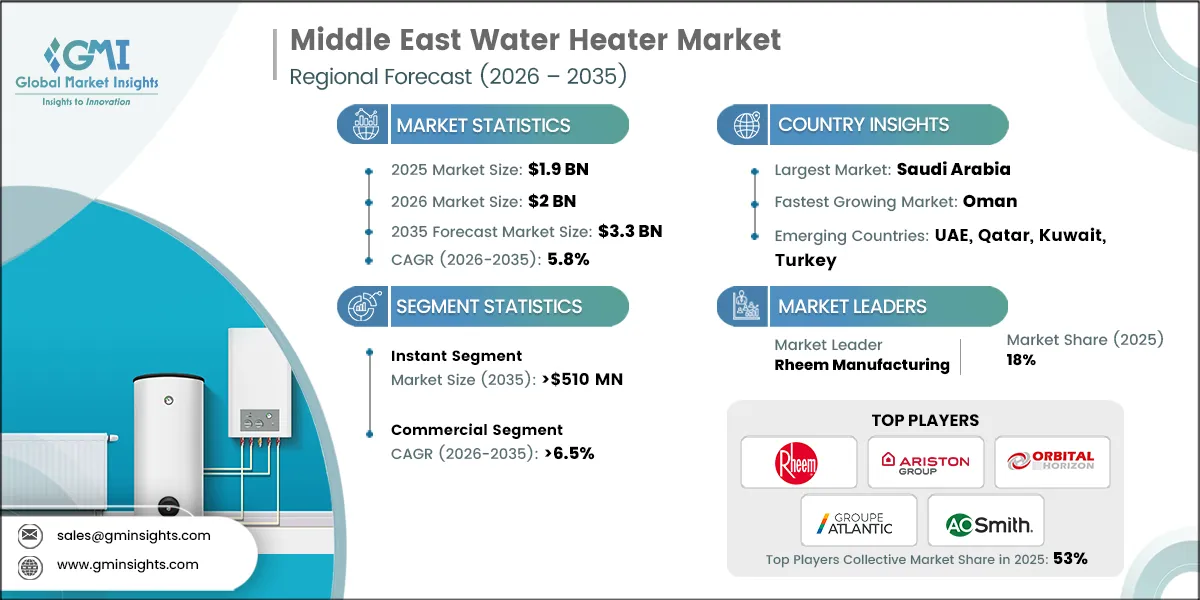
Middle East water heater market size was valued USD 1.9 billion in 2025. The market is anticipated to grow from USD 2 billion in 2026 to USD 3.3 billion in 2035, at a CAGR of 5.8%, according to Global Market Insights, Inc.
Middle East Water Heater Market Key Takeaways
Market Size & Growth
- 2025 Market Size: USD 1.9 Billion
- 2026 Market Size: USD 2 Billion
- 2035 Forecast Market Size: USD 3.3 Billion
- CAGR (2026–2035): 5.8%
Regional Dominance
- Largest Market: Saudi Arabia
- Fastest Growing Country: Oman
Key Market Drivers
- Growing demand for energy efficient products.
- Technology advancement and rising emission standards.
- Rapid urbanization and rising demand for product customization.
Challenges
- High Energy Costs and Volatility.
- Intense Competition and Market Fragmentation.
Opportunity
- Adoption of Energy-Efficient and Smart Water Heaters.
- Integration of Renewable Energy and Hybrid Systems.
Key Players
- Market Leader: Rheem Manufacturing led with over 18% market share in 2025.
- Leading Players: Top 5 players in this market include Rheem Manufacturing Company, Ariston Holding, A.O. Smith, Orbital Horizon, Groupe Atlantic, which collectively held a market share of 53% in 2025.
Get Market Insights & Growth Opportunities
- Growing disposable incomes, coupled with extreme climatic conditions in GCC countries, will push consumers and businesses to adopt electric, and gas water heaters, as well as smart and heat-pump technologies for enhanced energy savings, leading to market growth. Regional infrastructure projects, hospitality developments, and government initiatives promoting energy efficiency will stimulate the product demand.
- Rising energy costs and concerns over water scarcity are driving demand for energy-efficient and sustainable water heating solutions. This trend is further supported by government initiatives aimed at lowering electricity consumption, with certain regions providing incentives to encourage the adoption of eco-friendly appliances.
- The adoption of digital and smart water heaters equipped with IoT technology is rising, particularly in urban centers. Additionally, the growing installation of these systems in both residential and commercial settings is expanding market opportunities.
- Commercial and industrial sectors are progressively choosing hybrid water heaters that integrate renewable energy sources, like solar, with electric or gas backups. Smart IoT-enabled systems facilitate predictive maintenance and optimize energy efficiency.
- Governments across the region are actively promoting energy-efficient infrastructure, frequently offering incentives to support environmentally friendly upgrades, which boosts adoption in commercial and industrial sectors. In addition, numerous new developments in the region are incorporating advanced water heating solutions, including solar and hybrid systems, as part of their smart building initiatives from the planning stage.
To get key market trends
Middle East Water Heater Market Trends
- Gaining popularity of smart water heaters particularly in commercial establishments and urban residences, owing to their energy efficiency, convenience, and cost-saving features, will complement the business landscape. Key features including advanced connectivity and technology enable these systems to deliver a seamless user experience while optimizing energy usage, contributing to business momentum. In addition, many models offer detailed analytics on energy consumption, thereby helping users to understand the usage patterns and costs, to make informed adjustments to lower energy bills.
Middle East Water Heater Market Analysis
Learn more about the key segments shaping this market
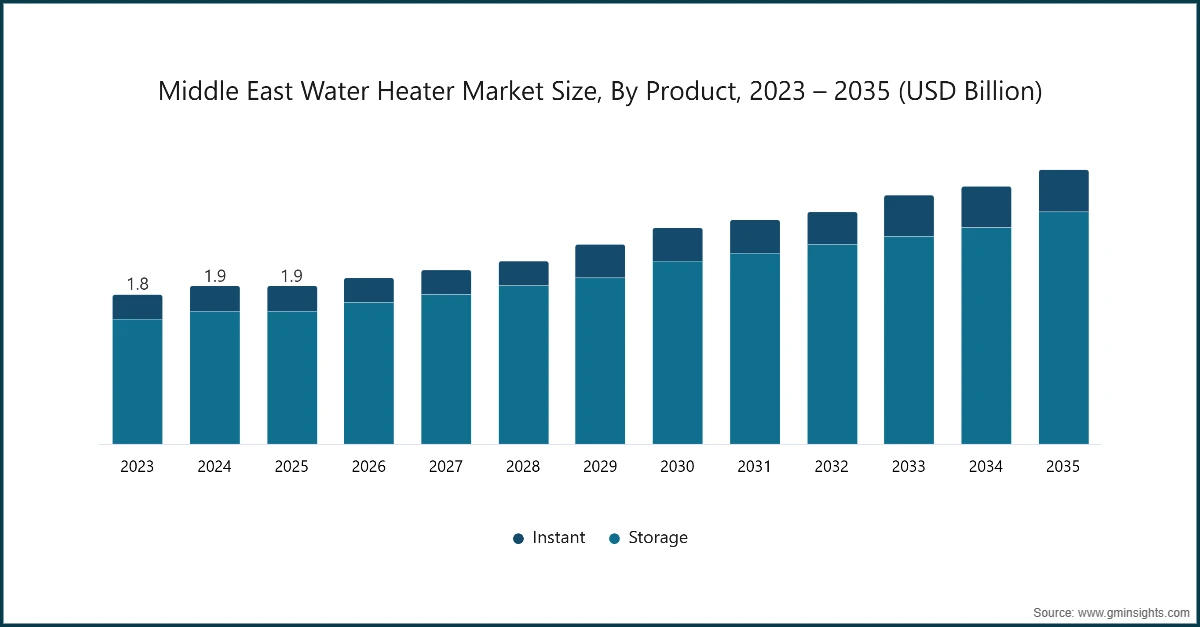
Based on product, the Middle East water heater market is segmented into instant and storage.
- Instant is anticipated to grow more than USD 510 million by 2035 owing to growing energy efficiency awareness, rising urbanization and increasing preference for compact and convenient solutions in the region. Introduction of initiatives by Middle Eastern governments, particularly in the UAE and Saudi Arabia, to encourage energy-efficient appliances will drive the market outlook.
- Rapidly expanding urban housing sector along with introduction of compact designs well-suited for modern apartments and smaller homes, will lead to market growth. Significant real estate and infrastructure growth in cities consisting of Riyadh, Dubai, and Abu Dhabi, coupled with increasing preference of tankless water heaters across many new residential and commercial projects on account of their space-saving design and superior efficiency, will complement the product demand.
Learn more about the key segments shaping this market
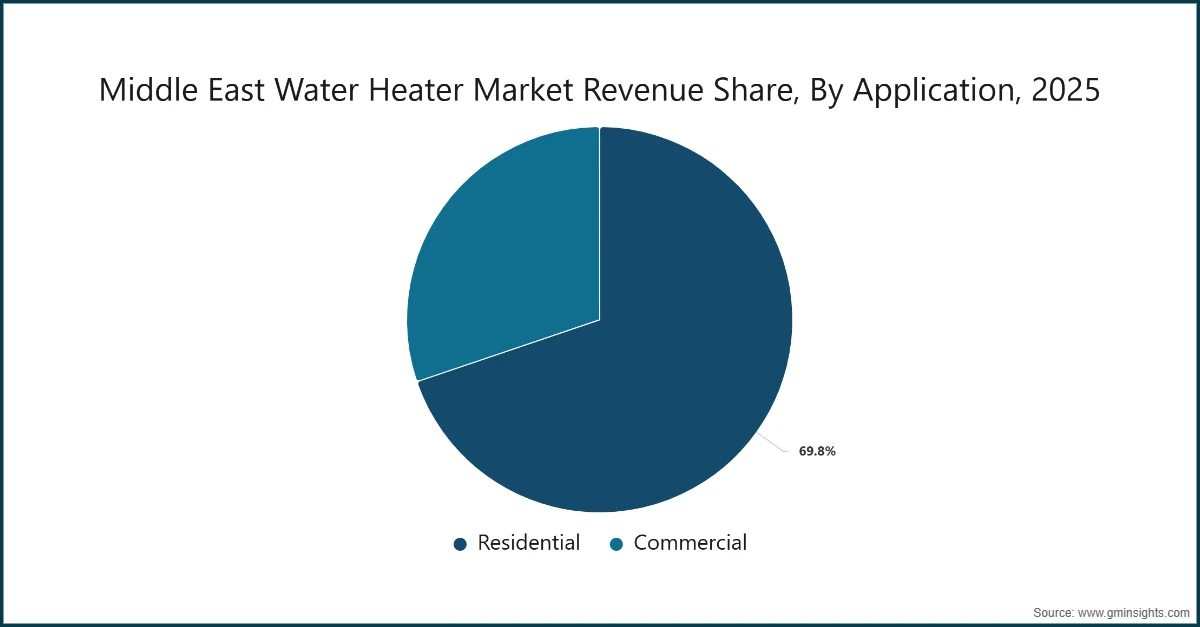
Based on application, the Middle East water heater market is segmented into commercial and residential.
- Commercial is anticipated to grow more than CAGR 6.5% by 2035 on account of Industries that demand large quantities of hot water and focus on energy efficiency and cost savings are increasingly adopting advanced water heating systems. In the hospitality sector, efficient systems, often equipped with smart monitoring capabilities, that play a key role in lowering operational expenses, particularly in regions with high energy costs.
- Healthcare facilities are placing greater emphasis on energy-efficient and low-emission water heating solutions, driven by the increasing adoption of green building standards and sustainable hospital designs. At the same time, rising energy costs are encouraging manufacturing industries to switch to more efficient water heating systems, helping lower both expenses and carbon emissions, and boosting market growth.
Looking for region specific data?
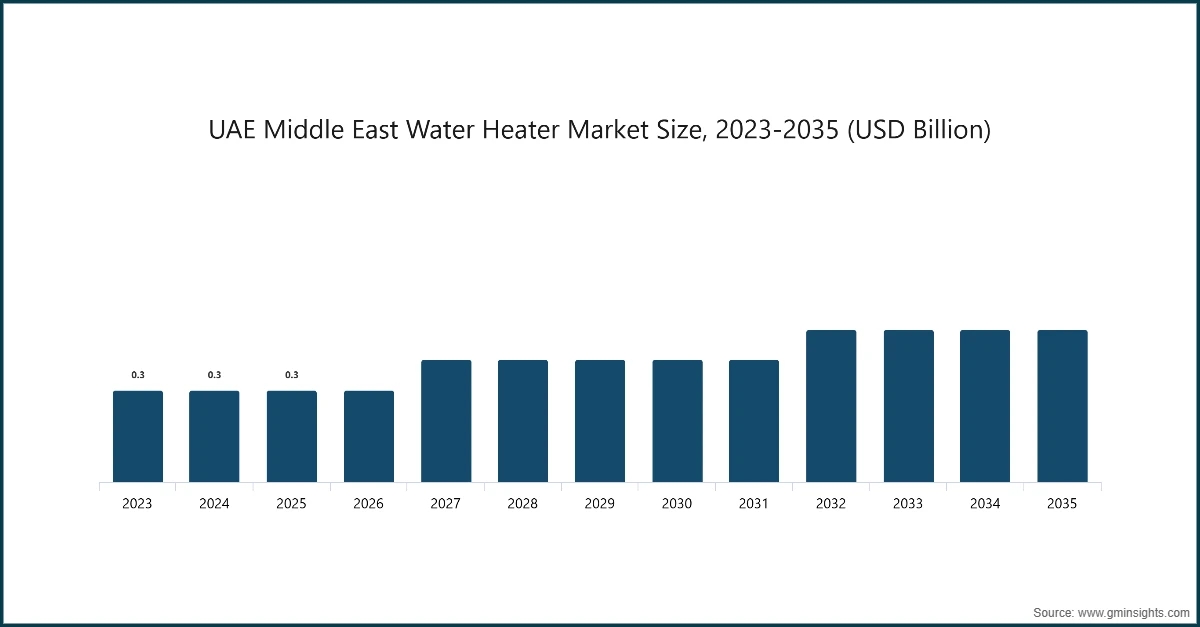
UAE water heater market is anticipated to grow over USD 500 million by 2035 on account of by the country’s focus on sustainable construction, energy efficiency, advanced technology integration and urbanization.
- High-efficiency water heaters, particularly those carrying ENERGY STAR or equivalent certifications, are becoming increasingly favored as they help meet national efficiency targets, driving stronger product demand.
- Rising incentives for eco-friendly solutions in both residential and commercial sectors are encouraging the adoption of energy-efficient water heaters, supporting industry growth. In addition, rapid urbanization in the UAE, with premium real estate projects in cities like Dubai and Abu Dhabi, is boosting demand for compact, efficient water heating systems that offer easy integration into modern building designs.
Middle East Water Heater Market Share
- The Middle Eastern water heater market is highly competitive, with both regional and global companies providing a wide array of products for residential, commercial, and industrial applications. Local manufacturers, such as Saudi Ceramics and National Heaters Industries, are strengthening their presence by producing locally, which offers advantages in cost efficiency, product customization, and flexible distribution.
- Companies are steadily aligning with evolving regulations, particularly in markets such as the UAE, Saudi Arabia, and Qatar, which enforce strict standards. Brands that integrate energy-efficient and environmentally friendly technologies ahead of requirements are better positioned to gain a competitive advantage.
Middle East Water Heater Market Companies
Eminent players operating in the Middle East water heater industry are:
- A. O. Smith Corporation
- Al Jawdah Electric Water Heaters
- Ariston Holding
- Atmor Industries Ltd.
- Bosch Thermotechnology
- Bradford White Corporation
- ELCO Burner
- Ferroli S.p.A
- Groupe Atlantic
- Haier Group Corporation
- Jaquar Group
- Midea Group
- Navien Inc.
- Orbital Horizon
- Panasonic Corporation
- Powrmatic
- Rheem Manufacturing Company
- Rinnai Corporation
- Stiebel Electron
- Vaillant Group
Middle East Water Heater Market Report Attributes
| Key Takeaway | Details |
|---|---|
| Market Size & Growth | |
| Base Year | 2025 |
| Market Size in 2025 | USD 1.9 Billion |
| Market Size in 2026 | USD 2 Billion |
| Forecast Period 2026-2035 CAGR | 5.8% |
| Market Size in 2035 | USD 3.3 Billion |
| Key Market Trends | |
| Drivers | Impact |
| Growing demand for energy efficient products | Increasing energy costs, coupled with concerns about environmental impact and water scarcity, are prompting consumers and businesses to adopt high-efficiency and low-consumption water heating solutions. Residential users prefer compact, energy-saving systems to lower utility bills, while commercial and industrial facilities seek products that reduce operational costs. Government incentives and policies promoting energy-efficient appliances further encourage the adoption of such products, making energy efficiency a key driver for market growth. |
| Technology advancement and rising emission standards | Technological innovation is reshaping the water heater market as manufacturers introduce smart, connected, and hybrid systems that optimize energy use and offer predictive maintenance. IoT-enabled heaters allow users to monitor consumption, adjust settings remotely, and integrate with smart building systems. The convergence of advanced technology and rising standards is driving demand for modern water heating solutions that comply with regulations while improving performance and sustainability. |
| Rapid urbanization and rising demand for product customization | Modern apartments, hotels, and offices require compact, efficient, and customizable water heating systems that can be integrated into smart building infrastructure. Manufacturers offering localized solutions, flexible designs, and tailored features are well-positioned to capitalize on this trend, as developers and end-users increasingly prioritize functionality, space-saving installations, and energy-efficient solutions in line with the region’s fast-paced urbanization. |
| Pitfalls & Challenges | Impact |
| High Energy Costs and Volatility | Fluctuating energy prices across the Middle East can impact the total cost of ownership for water heaters, particularly for electricity-dependent systems. While energy-efficient and smart water heaters help reduce consumption, high utility costs may discourage adoption among price-sensitive residential or small commercial customers. |
| Intense Competition and Market Fragmentation | The water heater market in the Middle East is highly competitive, with both global brands and strong regional players operating in overlapping segments. Market fragmentation, combined with differing regulatory standards across countries, creates challenges in brand differentiation, distribution network optimization, and achieving economies of scale, particularly for new entrants or smaller manufacturers trying to expand their regional presence. |
| Opportunities: | Impact |
| Adoption of Energy-Efficient and Smart Water Heaters | Governments across the Middle East, particularly in the UAE, Saudi Arabia, and Qatar, are promoting energy efficiency through regulations and incentive programs, encouraging both residential and commercial users to adopt eco-friendly technologies. Companies that offer advanced, energy-saving products tailored to the region’s climate and regulatory requirements can capture a larger market share and position themselves as leaders in sustainable solutions. |
| Integration of Renewable Energy and Hybrid Systems | Presence of abundant solar resources make solar water heaters and hybrid systems highly attractive for new residential and commercial developments, especially high-end real estate projects, hotels, and hospitals that prioritize sustainability. Manufacturers and distributors who can provide innovative hybrid solutions that are easy to integrate into modern building designs are well-positioned to complement the market landscape. |
| Market Leaders (2025) | |
| Market Leader |
18% market share |
| Top Players |
Collective market share in 2025 is 53% |
| Competitive Edge |
|
| Regional Insights | |
| Largest Market | Saudi Arabia |
| Fastest growing market | Oman |
| Emerging countries | UAE, Qatar, Kuwait, Turkey |
| Future outlook |
|
What are the growth opportunities in this market?
Middle East Water Heater Industry News
- In May 2025, Ariston Middle East launched an advanced water heating system to support the UAE’s Energy Strategy 2050 with up to 40 % better energy efficiency. This further aims at reducing energy use and emissions, aligning with the regional sustainability goals.
- In September 2024, Rheem Middle East inaugurated its new regional headquarters in Saudi Arabia. This development comes after the opening of Rheem’s first Innovation and Learning Center (ILC) in Riyadh earlier in the year, further underscoring the company’s commitment to strengthening its footprint across the region.
- In March 2024, Ariston introduced the Electric Water Heater BLU R equipped with precision and finesse, optimizing efficiency, reliability, and aesthetic refinement. This launch represents a significant leap in redefining the home comfort into the Saudi market.
- In July 2023, Ariston Middle East has launched a loyalty program called myAriston Rewards, a new initiative that offers significant rewards to members who register on the myAriston.com site. The unique initiative is to demonstrate the company’s long-term vision, commitment to the trade and reward the most valued installers.
- In April 2023, Ariston Holdings rolled out its water heaters for over 750 residents at a Construction Labour Camp in the Middle East. The company upgraded the camp's 18 washrooms by replacing the old units with Ariston Blu R models. This initiative not only supports the workers but also enhances their quality of life, health, hygiene, and overall well-being. With this innovative move, Ariston has solidified its foothold in the region.
Middle East Water Heater market research report includes an in-depth coverage of the industry with estimates & forecast in terms of volume and revenue in “(USD Billion and ‘000 Units)” from 2022 to 2035, for the following segments:
Market, By Product
Instant
- Electric
- Gas
- Storage
- Electric
- Gas
Market, By Application
Residential
- Commercial
- College/University
- Offices
- Government/Military
- Others
Market, By Capacity
< 30 Liters
- 30 – 100 Liters
- 100 – 250 Liters
- 250 – 400 Liters
- > 400 Liters
Market, By Fuel
Natural Gas
- LPG
The above information has been provided for the following countries:
- Saudi Arabia
- UAE
- Qatar
- Kuwait
- Oman
- Turkey
- Iraq
- Israel
Frequently Asked Question(FAQ) :
What is the market size of the Middle East water heater market in 2025?
The Middle East water heater market was valued at USD 1.9 billion in 2025. The growth is supported by rising urbanization, infrastructure expansion, and increasing demand for energy-efficient water heating solutions across residential and commercial sectors.
What is the current Middle East water heater market size in 2026?
The market size is projected to reach USD 2 billion in 2026. Continued investments in smart buildings, hospitality projects, and government-backed sustainability initiatives are expected to strengthen industry expansion across key regional economies.
What is the projected value of the Middle East water heater market by 2035?
The Middle East water heater industry is expected to reach USD 3.3 billion by 2035, growing at a CAGR of 5.8% from 2026 to 2035, driven by rising energy efficiency demand, urbanization, and smart technology adoption.
How much revenue is the instant product segment expected to generate by 2035?
The Middle East water heater market from instant segment is anticipated to grow to more than USD 510 million by 2035, supported by increasing awareness of energy efficiency and demand for compact water heating solutions across urban residential and commercial projects.
What is the growth outlook for the commercial application segment in Middle East water heater industry through 2035?
The commercial segment is projected to grow at over 6.5% CAGR by 2035. Rising demand from hospitality, healthcare, and industrial facilities for energy-efficient and cost-saving water heating systems is accelerating segment growth.
Which country shows significant growth potential in the region?
The UAE water heater market is expected to exceed USD 500 million by 2035. Growth is driven by sustainable construction initiatives, energy efficiency regulations, premium real estate development, and rapid urbanization in cities such as Dubai and Abu Dhabi.
What are the key trends shaping the Middle East water heater industry?
Key trends in the market include rising adoption of smart IoT-enabled systems, integration of renewable energy and hybrid technologies, increasing preference for compact instant heaters, and growing demand for energy-efficient appliances aligned with regional sustainability goals.
Who are the key players in the Middle East water heater market?
Leading companies in the Middle East water heater industry include Rheem Manufacturing Company, Ariston Holding, A. O. Smith Corporation, Orbital Horizon, and Groupe Atlantic, collectively accounting for a significant share of the regional market.
Middle East Water Heater Market Scope
Related Reports