Summary
Table of Content

Middle East & Africa Subsea Risers Market
Get a free sample of this report
Form submitted successfully!
Error submitting form. Please try again.
Thank you!
Your inquiry has been received. Our team will reach out to you with the required details via email. To ensure that you don't miss their response, kindly remember to check your spam folder as well!
Request Sectional Data
Thank you!
Your inquiry has been received. Our team will reach out to you with the required details via email. To ensure that you don't miss their response, kindly remember to check your spam folder as well!
Form submitted successfully!
Error submitting form. Please try again.
Middle East & Africa Subsea Risers Market Size
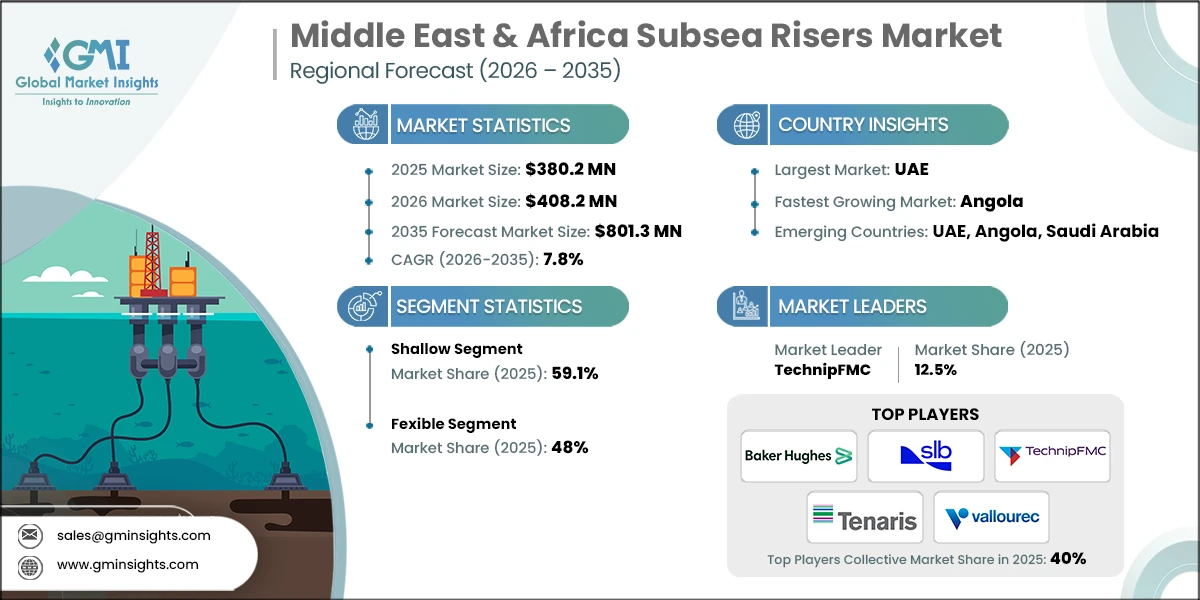
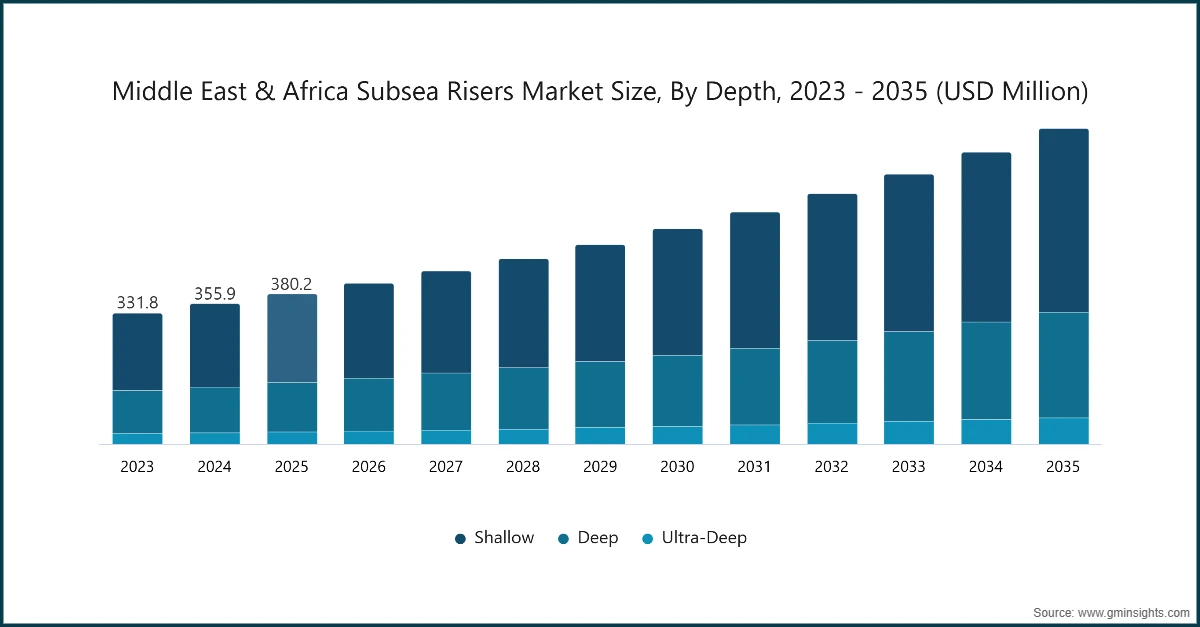
According to a recent study by Global Market Insights Inc., the Middle East & Africa subsea risers market was estimated at USD 380.2 million in 2025. The market is expected to grow from USD 408.2 million in 2026 to USD 801.3 million in 2035, at a CAGR of 7.8%.
Middle East & Africa Subsea Risers Market Key Takeaways
Market Size & Growth
- 2025 Market Size: USD 380.2 Million
- 2026 Market Size: USD 408.2 Million
- 2035 Forecast Market Size: USD 801.3 Million
- CAGR (2026–2035): 7.8%
Regional Dominance
- Largest Market: UAE
- Fastest Growing Country: Angola
Key Market Drivers
- Increasing investments for exploration of deep and ultra-deep oil reserves.
- Shifting focus towards development of marginal fields.
- Rapidly increasing energy demand.
Challenges
- High cost associated with offshore drilling operations.
Opportunity
- Expansion of deepwater & ultra-deepwater exploration.
- Ongoing development of marginal offshore fields.
- Rising offshore production & growing energy demand.
- Technological advancements in flexible & rigid riser designs.
Key Players
- Market Leader: TechnipFMC led with over market share of: 12.5% in 2025.
- Leading Players: Top 5 players in this market include Baker Hughes, SLB, TechnipFMC, Tenaris plc, Vallourec, which collectively held a market share of 40% in 2025.
Get Market Insights & Growth Opportunities
Ongoing expansion of offshore oil‑field operations along with ongoing exploration of hydrocarbons across deep-water and ultra-deep-water depths across challenging sea environments is significantly shaping the industry dynamics. Increasing energy consumption, fluctuations in oil prices have led to expansion of offshore oil fields to transport oil and gas across processing facilities will further augment industry outlook.
For instance, in August 2025, Sonadrill, a joint venture between Seadrill and Sonangol announced to launch a new offshore drilling program scheduled between late 2025 and early 2026. As part of this initiative, Sonangol contracted the West Gemini rig for 284 days, while Azule Energy awarded a 525‑day firm commitment for the Sonangol Libongos rig. Despite declining national output, these agreements expanded Sonadrill’s deepwater activities in Angola, including operations involving subsea systems.
Flourishing investments toward deployment of floating rigs along with rising need for advanced and reliable riser systems that can transfer hydrocarbons from reservoirs to processing facilities will positively influence business dynamics. Moreover, rising energy demand, decreasing number of accessible oil reserves along with favorable policies toward adoption of advanced materials that reduce maintenance intervention and minimize failure risk will contribute to industry growth.
For instance, in July 2025, Nabors Industries’ Sanad joint venture with Saudi Aramco received a new order for five additional newbuild rigs in Saudi Arabia. Four of these rigs are scheduled to commence operations in 2026, with the final unit entering service in 2027. This represents the fourth set of rigs awarded under the long‑term 50‑rig program where Sanad runs 12 rigs, with two more planned to begin operation in 2025.
Growing inclination toward retrofitting of aging oil & gas infrastructure along with significant initiatives toward marginal field development will contribute to industry growth. Flourishing investments toward expansion of oil fields and exploration of new reserves along with implementation of stringent regulatory mandates for reducing emissions from oil and gas infrastructure will complement industry landscape.
For instance, in January 2026, Saudi Aramco initiated a new phase of offshore investment by issuing tenders for a series of maintenance and brownfield projects valued in the billions. These packages, released to its long‑term agreement contractors, form part of the company’s broader capital‑expenditure strategy aimed at strengthening upstream capacity and advancing ongoing offshore asset‑enhancement programs.
UAE leads the subsea risers market owing to robust offshore hydrocarbon reserves the continuous expansion of offshore production activities and operators aiming to tap additional oil & gas reserves to enhance long‑term output. Flourishing investments in deep and ultra‑deepwater exploration, rising deployment of floating rigs, new offshore developments, growing regional energy demand, and large-scale energy initiatives under major national programs are contributing to industry growth.
For instance, in January 2026, ADNOC approved the Final Investment Decision for the SARB Deep Gas Development within the offshore Ghasha Concession in UAE. The Hail and Ghasha development’s Package 1 include installing over 300 km of subsea pipelines and 212 km of subsea cables, along with umbilicals, risers, and offshore structures. The project will deliver 200 million scfd of gas by decade’s end, integrating advanced AI and remote operations from Arzanah Island.
To get key market trends
Middle East & Africa Subsea Risers Market Trends
The Middle East & Africa subsea risers market is anticipated to grow owing to flourishing investments toward deep offshore developments and increasing offshore exploration of hydrocarbons across water bodies. Increasing capital expenditure toward development of marginal oil fields along with upgradation of oil and gas infrastructure with continuous innovation in both flexible and rigid riser technologies, is shaping industry landscape.
For instance, in May 2025, TotalEnergies planned to commence offshore drilling in South Africa in 2026, pending final regulatory clearance, at the Invest in African Energy Forum, aligned with its multi‑energy expansion in Africa. This announcement follows South Africa’s release of draft regulations for the Upstream Petroleum Resources Development Act, aimed at creating a more modern, investor‑focused framework for exploration and production.
Operators are increasingly focusing on adopting advanced risers engineered to withstand extreme pressures, severe operating conditions, and the dynamic loads associated with floating production units further contributing to industry growth. Ongoing integration of advanced materials and digital monitoring technologies to expand riser lifespan and lower operational exposure coupled with growing inclination on retrofitting oil & gas infrastructure to enhancing oil field performance, will augment industry outlook.
For instance, in February 2026, Expro introduced Solus, a single‑valve subsea access solution that replaces dual‑valve systems, reducing complexity and improving subsea intervention efficiency. Certified to API 17G and NACE standards, it provides reliable shear‑and‑seal capability for wire and coiled tubing. Designed for both riser‑based and open‑water operations, Solus supports the full well lifecycle and is now incorporated into Expro’s intervention riser systems.
Continuous research and development initiatives across offshore projects is driving advancements in subsea processing, autonomous operations, and integrated offshore systems to reach greater depths and more remote locations. Moreover, stringent emissions mandates and growing inclination for technologies that enhance hydrocarbon flow to processing facilities will further contribute to industry growth.
For instance, in January 2026, Sonatrach and Ghana National Petroleum Corporation entered an MoU to advance joint R&D efforts aimed at strengthening upstream capabilities across Africa. The partnership, supported by APPO, focuses on technical collaboration in seismic imaging, digital subsurface analysis, AI‑driven interpretation, reservoir management, enhanced recovery, integrity solutions, and emissions‑reduction technologies to improve operational efficiency and support energy‑transition goals.
Middle East & Africa Subsea Risers Market Analysis
Learn more about the key segments shaping this market
Based on depth, the industry is segmented into shallow, deep and ultra deep. The shallow segment leads the subsea risers market accounting for approximately 59.1% market share in 2025 and is anticipated to grow at a CAGR of 7.6% from 2026 to 2035.
The shallow depth segment is set to grow owing to operators increasingly focus on redeveloping aging offshore assets and pursuing more affordable exploration programs. Rising investments in near‑shore oil blocks to boost energy security, coupled with shifting focus toward early‑production schemes and the development of newly discovered offshore projects, will augment industry outlook.
For instance, in March 2025, Aquaterra Energy secured a multi‑year, multi‑million‑dollar contract with Intrepid Energy Limited to supply a tailored subsea well‑intervention package for a project in Nigeria. The scope covers a complete seabed‑to‑surface system, including TRT tieback tooling, a lightweight pressure‑control system, and an ISO‑qualified open‑water intervention riser. The company will also provide ongoing offshore engineering support, reinforcing its commitment to efficient, cost‑effective shallow‑water operations.
Deep water depth segment across Middle East & Africa subsea risers market is anticipated to grow at a CAGR of over 7.9% by 2035. Flourishing investments toward development of oil fields in deep water depths along with expanding oil reserves and ongoing extraction of hydrocarbons by oil & gas operators will shape industry dynamics. Furthermore, significant efforts to reduce reliance on imported fuels coupled with increasing capital expenditures by various governments toward discovery of new reserves will augment industry outlook.
For instance, in April 2025, TotalEnergies’ Angolan subsidiary begun converting a VLCC into the FPSO Kaminho, marking a major milestone for Block 20/11 and the first development in the emerging Kwanza Basin. Situated about 150 km southwest of Luanda in waters 300–2,000 meters deep, the project is operated by TotalEnergies (40%), Petronas (40%) and Sonangol (20%) where FPSO will support new deepwater production phase scheduled toward 2028.
Ultra-deep segment was evaluated at around USD 29.6 million in 2025. Rising offshore oil‑field development, growing investment in hydrocarbon exploration, and increased deployment of floating rigs to support deepwater projects is contributing to industry growth. Operators pursuing untapped reserves in ultra deep-water basins, where high‑pressure and high‑temperature conditions require specialized riser technologies capable of supporting complex, long‑distance subsea production will shape business dynamics.
For instance, in February 2026, Tenaris awarded a contract to supply critical equipment for Phase III of the Sakarya gas field development in the Black Sea, operating at depths of 2,150 meters. The order includes nearly 88,000 tons of welded pipe for a 180 km export line, along with seamless pipes, production riser line pipe, and casing, incorporating advanced anticorrosion coatings and integrity enhancing features.
Learn more about the key segments shaping this market
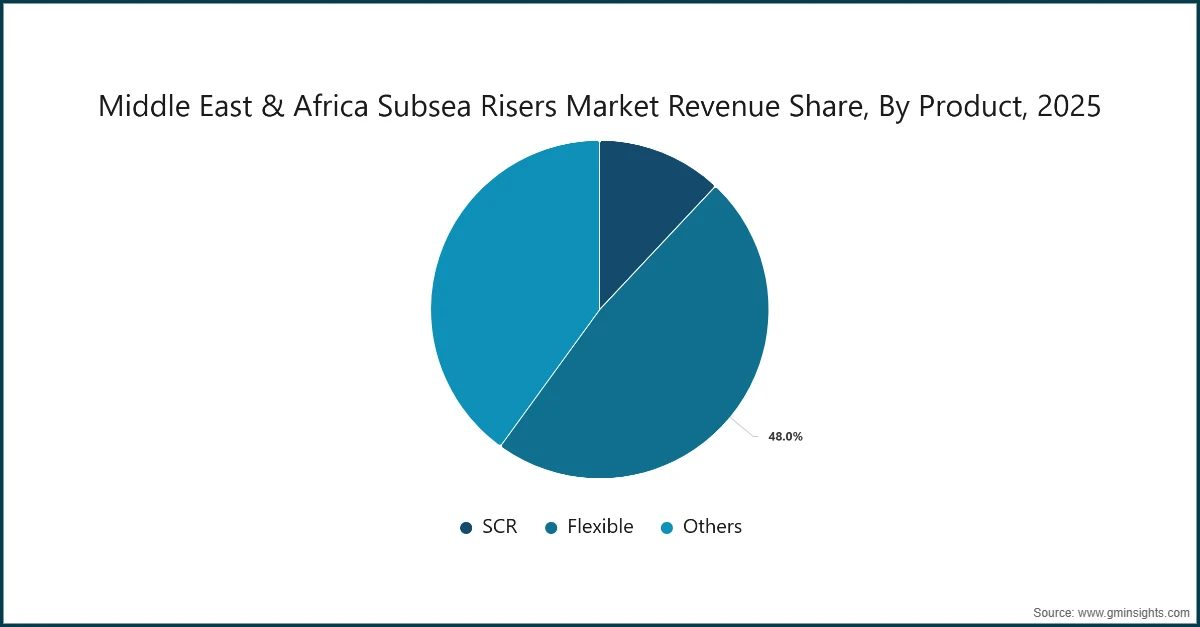
Based on product, the Middle East & Africa subsea risers market is bifurcated into SCR, Flexible and others. The flexible segment accounted for 48% of the market share in 2025 and is set to grow at a CAGR of 7.5% from 2026 to 2035.
Operators prioritizing advanced riser technologies to enhance reliability, support higher production rates, and sustain long‑term operations along with continuous technological improvements and favorable regulatory environments are contributing to industry growth. Active offshore fields increase demand for adaptable, corrosion‑resistant, and easily installable risers that perform efficiently in dynamic subsea environments, particularly during natural‑gas and deepwater activities will accelerate product deployment.
For instance, in March 2025, DOF Group ASA secured a major SURF contract in the Atlantic region, valued between USD 100–200 million. The scope includes full project management, engineering, logistics, and installation of flexible flowlines, risers, cables, and subsea structures in Africa, along with deploying a floating production unit. Offshore execution was scheduled for late 2025 and is anticipated to utilize six vessels for more than 450 vessel days.
The SCR segment was evaluated at around USD 45.6 million in 2025. Operators prioritizing durable, fatigue‑resistant, and cost‑effective solutions capable of withstanding high‑pressure, high‑current conditions typical of deepwater fields will augment product deployment. Increasing offshore oil‑field development, rising investment in deep and ultra‑deepwater exploration, and ongoing upgrades to regional hydrocarbon infrastructure will positively influence business dynamics.
For instance, in May 2025, Stolt Offshore implemented advanced steel catenary riser (SCR) technology for the first time on a ship‑shaped FPSO at Shell’s Bonga project, in Nigeria despite significant technical challenges. Successful execution has led to the same approach being adopted for ExxonMobil’s Erha development and potentially Total’s Akpo project, marking growing confidence in SCR applications for offshore production systems.
Looking for region specific data?
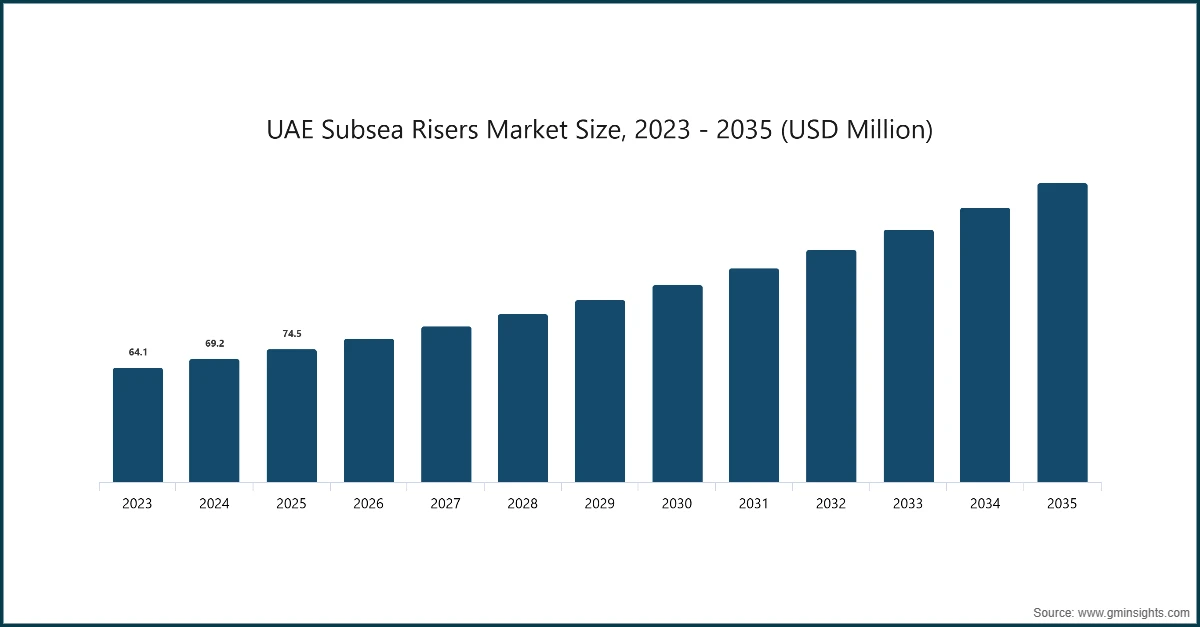
UAE dominated the Middle East & Africa subsea risers market with around 19.6% market share in 2025 and generated around USD 74.5 million in revenue. Abundant availability of offshore oil and gas reserves and active exploration and production efforts will contribute to industry growth. Investments in hydrocarbon development, deep‑offshore field expansion, and infrastructure upgrades, technological advancements in rigid and flexible riser systems, along with increasing installation of floating rigs and advanced recovery techniques, to enhance operational efficiency and reliability will augment industry outlook.
For instance, in April 2025, three international engineering firms were awarded PMC contracts for a major offshore expansion in Persian Gulf oilfield involving comprehensive EPC and installation activities. The program covers new top sides, drill pads, riser platforms, flare systems, dehydration and compression units, along with seven wellhead towers, subsea pipelines, cables, additional riser infrastructure, and onshore processing facilities.
Angola subsea risers market was evaluated at USD 39.2 million and is set to grow driven by flourishing offshore investments, increasing deepwater exploration activities, and shifting focus on subsea tie‑backs and FPSO‑linked developments. Accelerating large‑scale deepwater and ultra‑deepwater projects, supported by strong geological potential and increased participation from international operators, major subsea contracts, new production systems, and expanding natural‑gas infrastructure will shape industry dynamics.
For instance, in October 2025, TotalEnergies increased output from an Angolan FPSO by investing in a new subsea tieback to extend its operational life. The Begonia field, linked to the Pazflor FPSO through subsea flowlines, risers, and umbilicals, began producing in July 2025 at around 30,000 barrels per day. McDermott executed the project, installing over 40 km of rigid pipelines and managed full EPC, installation and commissioning responsibilities.
Saudi Arabia subsea risers market is set to grow over USD 55.2 million by 2035. Rising energy demand has led to introduction of significant offshore investment programs and continuous expansion of offshore and maintenance activities across the nation, contributed to industry growth. Ongoing efforts to maintain maximum sustainable capacity, extend life of mature offshore fields, and introduction of multi‑billion‑dollar offshore tenders covering pipeline replacement, subsea interventions, and infrastructure upgrades, driving demand for advanced riser systems.
For instance, in July 2025, Nabors Industries announced that its Sanad joint venture with Saudi Aramco secured an additional order for five newbuild rigs in Saudi Arabia. Four units are expected to begin operations in 2026, with the final rig following in 2027. This marks the fourth batch awarded under the long‑term 50‑rig programme with Sanad currently operating 12 rigs, with two more were scheduled to start in 2025.
Middle East & Africa Subsea Risers Market Share
Major 5 players operating across the subsea Middle East & Africa risers industry include Baker Hughes, SLB, TechnipFMC, Tenaris and Vallourec contribute around 40% of the market share in 2025.
Key players operating across the industry are aiming for strategic collaborations, joint ventures for projects across various countries, partnerships and integrating advanced technologies to strengthen competitive edge over the others. Major players are expanding through capacity expansions along with mergers & acquisitions, to accelerate technological advancements, improve operational efficiency, for development and modernization of offshore field infrastructure.
SLB delivers comprehensive marine drilling riser solutions spanning the drill floor to the BOP stack, incorporating high‑capacity handling equipment, split‑section configurations, and shock‑absorbing gimbal systems to enhance operational flexibility and safety. Its Robo‑Spider technology automates riser flange bolt tightening, cutting task duration by up to 70% while improving rig‑floor safety, where each component is designed for long‑term durability and efficient performance in challenging offshore conditions.
TechnipFMC is a provider of subsea infrastructure solutions and its dedicated SURF division specializes in umbilicals, risers, and flowlines. The company delivers comprehensive design and installation services for rigid and flexible pipelines, as well as the connection systems essential for offshore production facilities. With strong expertise in control systems, TechnipFMC offers advanced technologies that enhance asset reliability and improve overall operational performance.
Baker Hughes offers comprehensive drilling and production riser solutions, supplying key components including buoyancy modules, strakes, fairings, and cathodic protection systems. The company also offers complete handling and operational support, including spiders, lifting and handling equipment, testing systems, transport baskets, and storage solutions, ensuring efficient riser management throughout all phases of offshore operations.
Vallourec provides an extensive range of seamless pipe solutions engineered for multiple riser configurations, offering exceptional reliability and cost‑efficient performance. These riser systems are designed to endure harsh offshore conditions, including extreme pressures, elevated temperatures, dynamic motion, and sour service environments. The portfolio includes steel catenary and hybrid risers for rigid applications, each built to meet rigorous durability and performance requirements in deep‑water operations.
Middle East & Africa Subsea Risers Market Companies
Major players operating in the Middle East & Africa subsea risers industry are:
Aker Solutions
Alleima
Aquaterra Energy
ArcelorMittal
Baker Hughes
Butting Group
Dril-Quip
Expro Holdings
Hunting
John Wood Group
NOV
Oil States
OneSubsea
SLB
Subsea 7
TechnipFMC
Tenaris
Vallourec
Weatherford
Worldwide Oilfield Machine (WOM)
Baker Hughes delivers high‑performance riser solutions designed to offer exceptional fatigue resistance for both drilling and production applications. The portfolio includes single‑ and dual‑barrier system designs, complete assemblies of joints and connectors, as well as integrated riser‑tensioning and guidance technologies. The company also provides surface drilling wellhead systems, ensuring dependable operation and enhanced efficiency in demanding offshore environments. The company’s revenues for nine months of 2025 were reported at USD 20.3 billion and revenue of USD 27.8 billion was recorded for 2024.
SLB delivers a unique deepwater Managed Pressure Drilling (MPD) solution as the only OEM offering a fully integrated MPD system that incorporates an MPD‑ready riser joint. This configuration includes components such as the Cameron riser gas‑handling system with an annular BOP and flow spool, along with the BT Ring RCD. Seamlessly integrated into the LoadKing riser platform, the system enhances deepwater drilling safety, precision, and operational efficiency. The company’s half yearly revenues for the year 2025 was reported at USD 25.9 billion.
TechnipFMC provides an all‑inclusive integrated offering by combining its subsea production systems with its umbilical, riser, and flowline expertise. This unified approach allows the company to provide a complete water‑column solution, ensuring efficient connectivity across subsea infrastructure and supporting optimized performance throughout offshore development projects. The company’s half yearly revenues for the year 2025 was reported at around USD 7.4 billion.
TENARIS offer Blue Riser, designed to deliver outstanding fatigue resistance, suitable for deepwater, top‑tensioned, and high‑pressure drilling applications. Its connection system provides strong sealing capability and long‑term durability, having undergone rigorous testing to API 5C5:2017 CAL IV and offshore performance standards. Widely utilized by major operators, it has consistently demonstrated dependable performance in challenging subsea conditions. The company’s revenue for nine months of 2025 was reported USD 8.9 billion and revenue of USD 12.5 billion for the complete year 2024.
Middle East & Africa Subsea Risers Market Report Attributes
| Key Takeaway | Details |
|---|---|
| Market Size & Growth | |
| Base Year | 2025 |
| Market Size in 2025 | USD 380.2 Million |
| Market Size in 2026 | USD 408.2 Million |
| Forecast Period 2026-2035 CAGR | 7.8% |
| Market Size in 2035 | USD 801.3 Million |
| Key Market Trends | |
| Drivers | Impact |
| Increasing investments for exploration of deep and ultra-deep oil reserves | Growing capital allocation to deep and ultra‑deepwater exploration increases demand for robust subsea risers capable of withstanding extreme operating conditions, directly accelerating market expansion across regional offshore developments. |
| Shifting focus towards development of marginal fields | Shifting focus on development of marginal oil fields drives demand for cost efficient, flexible riser solutions that enable rapid deployment and production enhancement, supporting industry growth in regional subsea infrastructure. |
| Rapidly increasing energy demand | Rising regional energy consumption led operators to expand offshore production capacity, accelerating installation of new riser systems to ensure reliable transport of oil and gas from subsea wells to processing facilities. |
| Pitfalls & Challenges | Impact |
| High cost associated with offshore drilling operations | High offshore drilling costs limit project feasibility, delay investment decisions, and reduce inclination to pursue new deepwater developments, impacting subsea risers’ deployment and overall industry growth. |
| Opportunities: | Impact |
| Expansion of deepwater & ultra-deepwater exploration | Growing deepwater and ultra‑deepwater exploration increases demand for advanced riser systems capable of operating in extreme conditions, significantly boosting market adoption across major MEA offshore developments. |
| Ongoing development of marginal offshore fields | Rising focus on marginal field development creates opportunities for cost efficient, modular riser solutions that enable rapid deployment and production enhancement, supporting sustained offshore activity in the region. |
| Rising offshore production & growing energy demand | Increasing regional energy requirements prompt operators to expand offshore production capacity, increasing installation of riser systems needed for efficient hydrocarbon transport from subsea wells to processing facilities. |
| Technological advancements in flexible & rigid riser designs | Innovations in riser materials, corrosion resistance, and digital monitoring enhance operational reliability and performance, encouraging operators to upgrade existing assets and integrate advanced riser technologies. |
| Market Leaders (2025) | |
| Market Leader |
Market Share of: 12.5% |
| Top Players |
Collective Market Share of: 40% |
| Competitive Edge |
|
| Regional Insights | |
| Largest Market | UAE |
| Fastest growing market | Angola |
| Emerging countries | UAE, Angola, Saudi Arabia |
| Future outlook |
|
What are the growth opportunities in this market?
Middle East & Africa Subsea Riser Industry News
In August 2025, Subsea7 received a major contract from the Turkish Petroleum Offshore Technology Center for Phase 3 of the Sakarya gas field development in the Black Sea. The scope covers full EPCI delivery of subsea umbilicals, risers, and flowlines. Project management and engineering will begin immediately through Subsea7’s Istanbul office, continuing the strong partnership following an earlier inspection and maintenance award at the same field.
In July 2025, Aquaterra Energy received a two‑year extension to its offshore analysis services contract in Egypt, supporting a major operator’s subsea well operations. The company performed integrity evaluations for risers, subsea wells, and conductors across seven offshore sites. Under the renewed scope, Aquaterra will continue providing assessments for wells drilled using a semi‑submersible rig, ensuring structural assurance, optimizing casing configurations, and upholding key technical and operational standards.
In April 2025, Ocean Installer and Oceaneering completed a major offshore Angola life‑extension campaign involving the replacement of nine risers and one umbilical identified as integrity risks on an FPSO. The partners executed the full work scope including removal, installation, tie‑in, and pre‑commissioning, supported by saturation diving, surface diving, and ROV operations, ensuring continued safe and reliable field performance for the operator.
In September 2024, Saipem awarded a major EPC contract for the North Field Production sustainability offshore compression program, from QatarEnergy LNG, valued at around USD 4 billion. The scope includes six platforms, extensive subsea pipelines and cables, and the installation of five large offshore riser platforms alongside a wellhead platform. This project supports Qatar’s long‑term strategy to sustain North Field gas output through critical offshore compression infrastructure.
The Middle East & Africa subsea risers market research report includes in-depth coverage of the industry with estimates & forecast in terms of volume “000 Feet” and revenue “USD Million” from 2022 to 2035, for the following segments:
Market, By Depth
Shallow
SCR
Flexible
Others
Deep
SCR
Flexible
Others
Ultra-Deep
SCR
Flexible
Others
Market, By Product
SCR
Flexible
Others
The above information has been provided for the following regions and countries:
Angola
Nigeria
Egypt
Qatar
Saudi Arabia
UAE
Frequently Asked Question(FAQ) :
What is the market size of the Middle East & Africa subsea risers in 2025?
The market size was estimated at USD 380.2 million in 2025, with a CAGR of 7.8% expected through 2035. The expansion of offshore oil-field operations and hydrocarbon exploration in challenging sea environments is driving market growth.
What is the projected value of the Middle East & Africa subsea risers market by 2035?
The market is poised to reach USD 801.3 million by 2035, driven by investments in deep offshore developments, advancements in riser technologies, and upgrades to oil and gas infrastructure.
What is the expected size of the Middle East & Africa subsea risers industry in 2026?
The market size is projected to reach USD 408.2 million in 2026.
How much revenue did the shallow segment generate in 2025?
The shallow segment accounted for approximately 59.1% of the market share in 2025, led by its widespread application in offshore oil and gas operations.
What was the valuation of the flexible segment in 2025?
The flexible segment held 48% of the market share in 2025 and is expected to grow at a CAGR of 7.5% till 2035.
What is the growth outlook for the SCR segment from 2026 to 2035?
The SCR segment, valued at approximately USD 45.6 million in 2025, due to its durability, fatigue resistance, and cost-effectiveness in deepwater fields.
Which country leads the Middle East & Africa subsea risers sector?
The UAE leads the market with a 19.6% share, generating around USD 74.5 million in revenue in 2025.
What are the upcoming trends in the Middle East & Africa subsea risers market?
Trends include advanced riser technologies, digital monitoring integration, oil and gas infrastructure retrofitting, progress in subsea processing, and stricter emissions compliance.
Who are the key players in the Middle East & Africa subsea risers industry?
Key players include Aker Solutions, Alleima, Aquaterra Energy, ArcelorMittal, Baker Hughes, Butting Group, Dril-Quip, Expro Holdings, Hunting, John Wood Group, NOV, and Oil States.
Middle East & Africa Subsea Risers Market Scope
Related Reports