Summary
Table of Content

Middle East and Africa Automatic Door Market
Get a free sample of this report
Form submitted successfully!
Error submitting form. Please try again.
Thank you!
Your inquiry has been received. Our team will reach out to you with the required details via email. To ensure that you don't miss their response, kindly remember to check your spam folder as well!
Request Sectional Data
Thank you!
Your inquiry has been received. Our team will reach out to you with the required details via email. To ensure that you don't miss their response, kindly remember to check your spam folder as well!
Form submitted successfully!
Error submitting form. Please try again.
Middle East and Africa Automatic Door Market Size
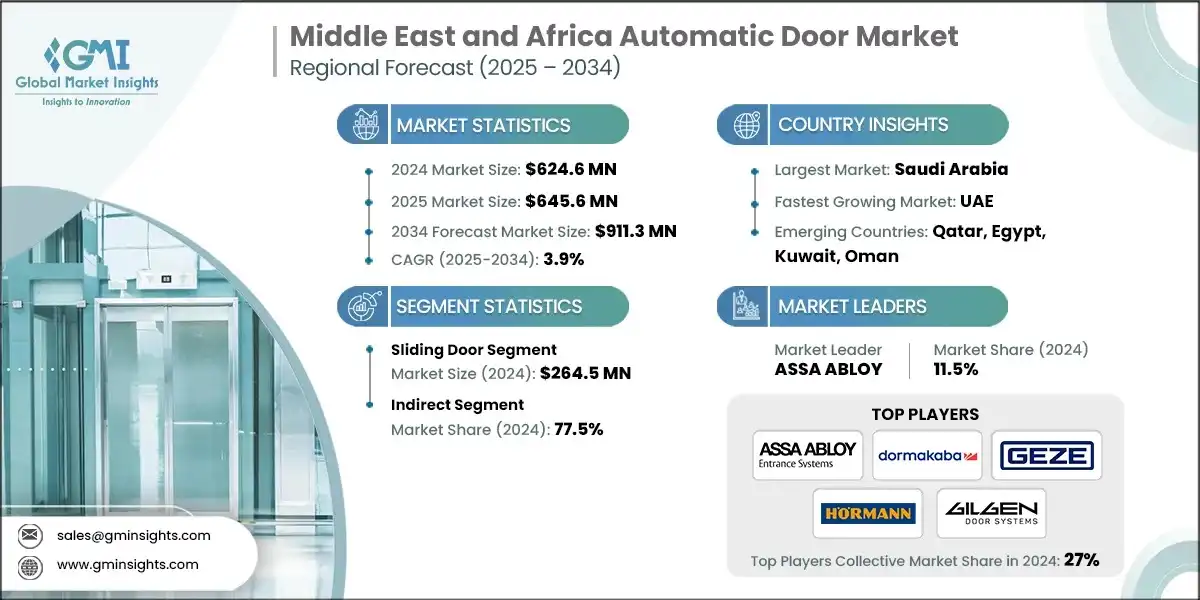
The Middle East and Africa automatic door market size was valued at USD 624.6 million in 2024. The market is expected to grow from USD 645.6 million in 2025 to USD 911.3 million in 2034, at a CAGR of 3.9%, according to latest report published by Global Market Insights Inc.
To get key market trends
Over the next five years, the Middle East and Africa (MEA) region is expected to experience a significant construction boom, which will drive strong demand for automatic door systems across residential, commercial, and institutional projects. For example, under Vision 2030, Saudi Arabia has already committed USD 319 billion to transformational projects, one of which is NEOM, a project requiring advanced infrastructure solutions. With this rapid expansion, there is also a market for companies such as Dormakaba, Assa Abloy, and others to provide automatic door systems for the projects.
Healthcare infrastructure expansion in the MEA region is driving demand for automatic doors sectors as these doors are vital in infection control, accessibility, and operational efficacy. For example, in Saudi Arabia there are plans to build 40 new hospitals and construct 550 primary health care centers by 2030. With health care budgets predicted to be USD 70 billion per year in Saudi Arabia, companies like Horton Automatics are providing automatic door solutions for various applications, including patient rooms, operating theatres, and emergency departments.
The retail sector in the MEA region is also experiencing rapid grow, alongside the commercial real estate sector, which is also driving the demand for automatic door systems in sophisticated commercial developments. For example, in Dubai, which recently welcomed 20 million tourists to its commercial venues in 2023 (with a target of 25 million by 2025), this public growth is gauging the need for automatic doors to be included in retail and hospitality projects. Companies like Boon Edam are already providing automatic solution for busy retail areas. Rapid retail expansion is anticipated across the MEA region.
The MEA region is being driven by the implementation of strict accessibility regulations and policies related to disability inclusion, which is increasing the use of automatic doors for public/shared and commercial buildings. For instance, requirements are set forth in Dubai’s Universal Design Code for automatic doors to be located at elevator entrances and accessible entrances. The Gulf Cooperation Council (GCC) member states have adopted GSO ISO 21542:2016 standards which govern access for automatic doors, thereby creating a uniform accessibility requirement across the members. Companies like ASSA ABLOY have developed compliant automatic door solutions, consistent with these regulations.
Demand for connected automatic door solutions is being driven by the adoption of smart building technologies and integrated management/technical systems in the MEA region. The NEOM project in Saudi Arabia, projected at USD 500 Billion, is integrating advanced building automation systems into the development. Smart City projects, such as Dubai’s Dubai Smart City Strategy which has earmarked USD 1 billion for digitizing government services, are further stimulating demand for automatic doors as devices used by automated ecosystems.
Middle East and Africa Automatic Door Market Report Attributes
| Key Takeaway | Details |
|---|---|
| Market Size & Growth | |
| Base Year | 2024 |
| Market Size in 2024 | USD 624.6 Million |
| Market Size in 2025 | USD 645.6 Million |
| Forecast Period 2025 - 2034 CAGR | 3.9% |
| Market Size in 2034 | USD 911.3 Million |
| Key Market Trends | |
| Drivers | Impact |
| Urbanization & smart infrastructure | Rapid urban development and large-scale infrastructure projects in Middle East and Africa are fueling demand for automated entrances in airports, malls, and commercial complexes. Smart city initiatives in UAE, Saudi Arabia, and South Africa are accelerating adoption of intelligent door systems integrated with IoT and building automation. |
| Improving focus on hygiene & contactless access | Post-pandemic hygiene awareness has increased demand for touchless entry solutions in healthcare, hospitality, and retail sectors. Automatic doors reduce physical contact, supporting infection control and compliance with health safety standards. |
| Energy efficiency & security | Automatic doors with advanced sensors and insulation features help maintain indoor climate, reducing energy costs in hot Middle East and Africa climates. Integration with access control systems enhances security for high-traffic facilities like airports and government buildings. |
| Pitfalls & Challenges | Impact |
| Large up-front installation and maintenance costs | High initial investment and ongoing maintenance expenses can deter adoption, especially among small businesses and budget-sensitive projects in emerging Middle East and Africa markets. |
| Cybersecurity threats associated with smart door | As automatic doors become connected to building networks, they face risks of hacking and data breaches. This raises concerns about critical infrastructure and demands robust cybersecurity protocols. |
| Opportunities: | Impact |
| Growth of smart building and smart city initiatives | Middle East and Africa governments are investing heavily in smart city projects (e.g., NEOM in Saudi Arabia, Smart Dubai), creating strong demand for automated, connected door systems integrated with building management platforms. |
| Unrealized opportunities in developing economies | Countries in North and Sub-Saharan Africa present untapped potential for automatic door adoption in healthcare, education, and commercial sectors, driven by urbanization and modernization trends. |
| Market Leaders (2024) | |
| Market Leaders |
11.5% market share |
| Top Players |
The collective market share in 2024 is 27% |
| Competitive Edge |
|
| Regional Insights | |
| Largest Market | Saudi Arabia |
| Fastest Growing Market | UAE |
| Emerging Country | Qatar, Egypt, Kuwait, Oman |
| Future Outlook |
|
What are the growth opportunities in this market?
Middle East and Africa Automatic Door Market Trends
Technological advancements are reshaping the market fueled by innovations that help in the development of automatic doors in the region.
- The MEA region is engaging in a major construction project that is fueling demand for automated door systems. With its projected USD 500 billion expenditure in NEOM, Saudi Arabia's Vision 2030 also points toward a rising requirement for cutting-edge infrastructure solutions. With 39% of the USD 3.9 trillion worth of projects in the region, Saudi Arabia now leads the area with USD 1.5 trillion projects.
- In Saudi Arabia, the residential sector has 1.14 million units under development, and the tourism industry is developing another 358,500 hotel keys. Dormakaba and other suppliers are providing solutions for these projects. In the UAE, as there continues to be a push for mixed use and new commercial successes, the demand for automatic doors is also increasing, with GEZE supplying innovative systems that work within contemporary architecturally designed spaces.
- The expansion of healthcare facilities in the MEA region will also be driven demand for automatic doors in order to ensure infection control and accessibility. Saudi Arabia is set to build 40 new hospitals and 550 primary healthcare facilities by 2030, with total annual healthcare expenditure estimated to be USD 70 billion. Horton Automatics is supplying solutions for patient rooms and operating theaters across the region.
- An increased level of activity in the retail and commercial real estate sectors is in part driving demand for modern automatic door systems. Saudi Arabia's Vision 2030 aims to attract 100 million visitors by 2030, and an effect of this is myriad shopping center and mixed-use complex developments. In addition to Saudi Arabia, the UAE is contributing to growth. For example, the UAE expects to have 25 million tourists by 2025, and firms like Boon Edam are providing solutions for these high traffic areas.
- Accessibility regulations and disability inclusion efforts are accelerating the adoption of automatic doors in the MEA region. For example, Dubai's Universal Design Code and the GCC's GSO ISO 21542:2016 standards ensure their compliance across GCC member states. Companies like Assa Abloy are making major personnel investments in developing businesses that respond to the needs of around 60 million people with disabilities in the region.
Middle East and Africa Automatic Door Market Analysis

Learn more about the key segments shaping this market
Based on product type segments, the market is sliding door, swinging door, folding door, revolving door, bi-fold doors and others. The sliding door category held the largest share of the market and generated revenue of USD 264.5 million in 2024, owing to their wide utilization in the automatic door
- The residential market in the Middle East and Africa (MEA) is starting to embrace sliding doors due not only to their stylish appearance but also because they save space. Saudi Arabia's Vision 2030 plan will involve the construction of over 1.14 million residential units, which means that companies like Dormakaba will be supplying sliding door options and solutions for higher-end residential projects. Sliding doors are commonly used in high-end residential projects, particularly luxury villas and apartments, as they create a feeling of openness and convenience while enhancing an overall design aesthetic.
- The commercial market in the MEA region has also embraced sliding doors, most directly due to the design aesthetic and efficiency sliding doors provide for entrances. The ever-expanding retail sector of Dubai is an example where sliding doors can be found, with abundant new shopping malls (e.g., Dubai Mall) providing opportunities for companies like Boon Edam to supply advanced systems with their updated sliding door options. Sliding doors can also be found in office buildings, with sliding doors providing unique access options while providing better energy efficiency. GEZE has developed a strong client base for their sliding door options in healthy commercial buildings in the UAE.
- Sliding doors are also a dominant door type in healthcare facilities in the MEA region, for contributing to infection control and providing access to healthcare. Saudi Arabia plans to build up to 40 new hospitals. Hospitality sector in the MEA region is a significant driver for sliding doors, as hotels and resorts prioritize modern and functional entrance solutions. For example, Dubai’s hospitality sector, which targets 25 million tourists by 2025, is also driving demand for sliding doors. Hörmann Group and Gilgen Door Systems AG have been providing advanced sliding door solutions to luxury hotels in the region, focusing on energy efficiency and aesthetic appeal.
- The adoption of smart building technologies in the MEA region is driving demand for automated sliding doors that integrate with building management systems Dubai’s Smart City Strategy, which has allocated USD 1 billion for digitizing government services, is further boosting demand for sliding doors that interface seamlessly with automation ecosystems Deper and DNG (Dongbang Automatic Door Co., Ltd.), and FAAC Group have been delivering innovative automated sliding door systems that cater to the growing need for smart and secure building solution.
Learn more about the key segments shaping this market
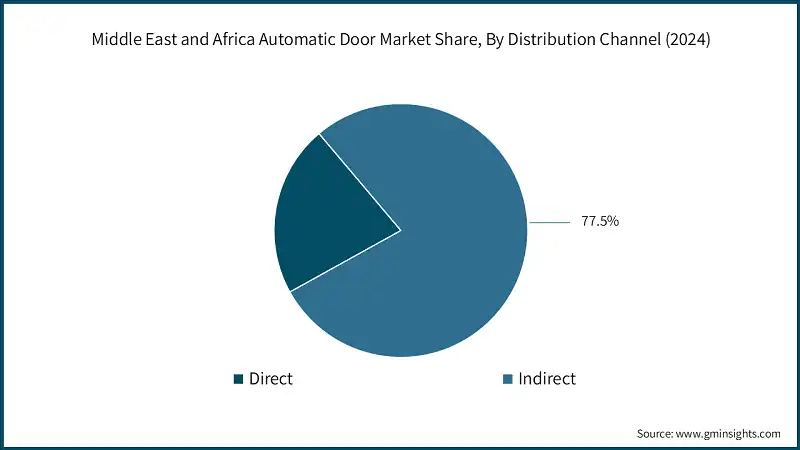
Based on distribution channel, the Middle East and Africa automatic door market is segmented into direct and indirect. The indirect segment held the largest share, accounting for 77.5% of the Middle East and Africa market in 2024.
- In the MEA region, there exists a range of building codes and product standards, like GSO in the GCC, SANS in South Africa, and SON in Nigeria. Manufacturers find it difficult to navigate more than 50 different regulatory frameworks. Indirect channels can help brands navigate and sell those products to market (GCC Standardization Organization, South African Bureau of Standards).
- Automatic doors require regular servicing, including calibration of sensors and diagnostic assessments. With Saudi Arabia's objective of building 40 hospitals by 2030, and the UAE's commitment to adding over 10,000 hospital beds (Saudi Ministry of Health, UAE Ministry of Health), the need for localized after-sales support is growing. Indirect channels efficiently address this service need.
- The compliance requirements can vary piece by piece across the MEA region, like Dubai's Universal Design Code and Saudi SASO (Dubai Municipality, SASO). Distributors can specialize in navigating compliance standards guaranteeing products are within the standards. This creates an opportunity for a trusted sales channel which upgrades indirect channels to preferred channel partners for manufacturers.
- Manufacturers find the fragmented MEA market difficult to manage for sales and service. Indirect channels utilize their local knowledge and networks to address fragmented markets. Their local compliance handling and serviced model have improved their indirect channels within the automatic door market.
Looking for region specific data?
Saudi Arabia Automatic Door Market
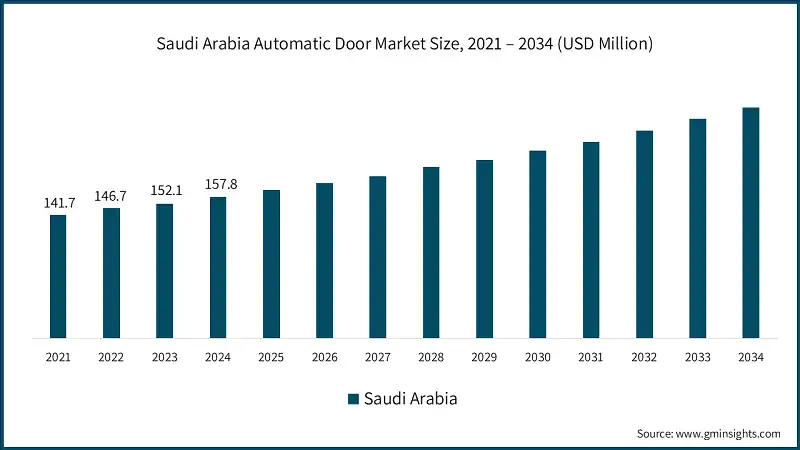
In 2024, the Saudi Arabia contributed 157.8 million to the Middle East and Africa automatic door market. The companies are leveraging advanced technologies to modernize manufacturing processes as well as the quality and functionality of automatic doors.
- The government's Vision 2030 initiative, which prioritizes infrastructure development and urban development, has driven growth. As noted by the Ministry of Investment in Saudi Arabia, the construction sector is anticipated to grow rapidly, creating markets for advanced technologies such as automatic doors.
- Companies in Saudi Arabia are adopting new technologies to improve the quality and functionality of automatic doors. For example, Dormakaba and Assa Abloy have built a strong and continuous presence in the region, providing tailored solutions for commercial and residential buildings. These improvements are directly connected to the growing focus on smart infrastructure and energy-efficient building solutions.
UAE Automatic Door Market
In 2024, the UAE market holds second largest share in 2024 and is expected to grow at 4.2% during the forecast period.
- The UAE is significant growth in the Middle East and Africa Automatic Door Market, driven focuses on sustainable urban development, fueling the demand for automatic doors in high-traffic areas such as airports, shopping malls, and metro stations. For instance, Dubai International Airport has incorporated advanced automatic door systems to enhance passenger convenience and operational efficiency. Additionally, organizations like the Emirates Green Building Council (EGBC) are promoting energy-efficient building practices, further encouraging the adoption of automated solutions.
Qatar Automatic Door Market
In 2024, the UAE market is expected to grow at 3.9% during the forecast period.
- The growth is driven by The Qatari government prioritizes smart and sustainable infrastructure, leading to increased adoption of automatic doors in projects like stadiums and metro stations, particularly those developed for the FIFA World Cup 2022 legacy. Additionally, organizations such as the Qatar Green Building Council (QGBC) are promoting energy-efficient construction practices, further boosting the demand for automated solutions.
Middle East and Africa Automatic Door Market Shares
The top companies in the Middle East and Africa market ASSA ABLOY, Dormakaba Group, S EZE GmbH, Hörmann Group and Gilgen Door Systems AG and collectively hold a share of 27% in the market. These prominent players are proactively involved in strategic endeavors, such as mergers & acquisitions, facility expansions & collaborations, to expand their product portfolios, extend their reach to a broad customer base, and strengthen their market position.
- ASSA ABLOY delivers advanced automatic door systems through its global brands, offering sliding, swing, and revolving doors tailored for high-traffic environments in Middle East and Africa. Its solutions integrate IoT, AI-driven access control, and energy-saving technologies, supporting smart building and sustainability objectives. With strong regional presence and partnerships, ASSA ABLOY ensures compliance with safety standards while enabling seamless connectivity for airports, healthcare, and commercial projects.
- DormaKaba provides intelligent entrance automation for Middle East and Africa markets, combining automatic sliding and swing doors with cloud-based access management platforms. Its focus on MotionIQ technology and EntriWorX ecosystem enhances energy efficiency and predictive maintenance, aligning with green building mandates. DormaKaba’s regional strategy emphasizes digital integration and tailored solutions for smart cities and critical infrastructure.
- GEZE offers smart automatic door systems designed for interoperability with building automation platforms in Middle East and Africa. Its myGEZE Control solution enables centralized monitoring and remote management, improving safety and operational efficiency. GEZE prioritizes sustainability through energy-efficient drives and retrofit programs, supporting modernization of hospitals, airports, and commercial complexes across the region.
Middle East and Africa Automatic Door Market Companies
Major players operating in the MEA automatic door market are:
- Al Adel Automatic Doors
- Al Arabia Automatic Doors
- ASSA ABLOY Group
- Boon Edam
- Deper
- DNG (Dongbang Automatic Door Co., Ltd.)
- DormaKaba Holding AG
- FAAC Group
- GEZE GmbH
- Gilgen Door Systems AG
- Hörmann Group
- Ningbo Ownic Automatic Door Co., Ltd.
- Record Group
- Stanley Access Technologies
- TORMAX
Hörmann delivers automatic entrance solutions and high-performance doors for Middle East and Africa’s industrial and commercial sectors. Its portfolio includes fire-rated and multipurpose doors integrated with smart access and climate control features, ensuring compliance with international safety standards. Hörmann’s regional operations focus on local manufacturing and quick delivery, supporting large-scale infrastructure and green building initiatives.
Gilgen specializes in automatic sliding and swing door systems engineered for durability and energy efficiency in Middle East and Africa’s demanding climates. Its solutions incorporate IoT-enabled monitoring and adaptive control technologies, enhancing security and user convenience. Gilgen’s regional partnerships and service networks enable rapid customization for airports, healthcare facilities, and smart city projects.
Middle East and Africa Automatic Door Industry News
- In October 2025, GEZE Middle East rolled out myGEZE Control, a BACnet-based platform for centralized management of automatic doors and windows. Targeting airports, hospitals, and commercial complexes in UAE and Saudi Arabia, this solution enhances interoperability with building automation systems, supporting Middle East and Africa’s smart infrastructure initiatives.
- In October 2025, FAAC showcased advanced automatic door solutions including AIRSLIDE sliding doors with integrated air curtain technology at Intersec Saudi Arabia 2025. These innovations aim to improve energy efficiency and dust control in high-traffic environments like malls and airports, reinforcing FAAC’s commitment to smart infrastructure in Middle East and Africa.
- In May 2025, FAAC S.p.A acquired CENTURION Systems, a leading South African manufacturer of gate operators and automatic barriers, strengthening its footprint in Africa’s access automation market. This move enhances FAAC’s ability to deliver advanced automatic door solutions across Middle East and Africa.
- In March 2025, ASSA ABLOY showcased its latest automatic door and smart access solutions at Intersec Dubai under the theme “Digital with Confidence”. The company emphasized cloud-based ecosystems, wireless access control, and sustainable door technologies tailored for Middle Eastern infrastructure projects. This move strengthens its leadership in smart building integration across Middle East and Africa.
- In January 2025, Dormakaba introduced MotionIQ, an intelligent door control system designed to reduce energy loss by up to 50%, supporting green building standards in Middle East and Africa. The solution integrates with automatic sliding and swing doors, enabling predictive maintenance and smart building connectivity. This innovation aligns with regional sustainability and smart city goals.
The Middle East and Africa automatic door market research report includes in-depth coverage of the industry, with estimates & forecasts in terms of revenue (USD Million) and Volume (Thousand Units) from 2021 to 2034, for the following segments:
Market, By Product type
- Sliding door
- Swinging door
- Folding door
- Revolving door
- Bi-fold doors
- Others
Market, By Function
- Sensor based
- Motion based
- Push button
- Access control
Market, By End Use
- Residential
- Commercial
- HoReCa
- Shopping malls
- Airports
- Hospitals
- Others (Retail stores, etc.)
- Industrial
- Warehouse
- Manufacturing facilities
Market, Distribution Channel
- Direct sales
- Indirect sales
The above information is provided for the following countries:
- Middle East and Africa
- Saudi Arabia
- UAE
- Qatar
- Oman
- Kuwait
- Bahrain
- Egypt
- Rest of Middle East and Africa
Frequently Asked Question(FAQ) :
What are the latest developments in the automatic door industry (2025)?
In 2025, companies introduced innovative smart-access solutions—GEZE launched the myGEZE Control platform, FAAC showcased AIRSLIDE doors with air curtain tech, and Dormakaba released MotionIQ, an intelligent energy-saving door control system designed for green buildings.
Who are the leading companies in the Middle East & Africa automatic door market?
Major players include ASSA ABLOY Group, DormaKaba Holding AG, GEZE GmbH, Hörmann Group, and Gilgen Door Systems AG, collectively holding 27% of the market in 2024.
What are the key trends shaping the Middle East & Africa automatic door market?
Key trends include integration of IoT and AI for smart buildings, energy-efficient door systems, contactless access for hygiene, and strong demand from healthcare, airports, retail, and hospitality projects.
Which country is expected to grow the fastest through 2034?
The UAE is expected to grow at 4.2% CAGR, driven by smart city initiatives, sustainable building regulations, and major commercial and tourism developments.
Which country leads the Middle East & Africa automatic door industry?
Saudi Arabia leads the regional market with USD 157.8 million in 2024, boosted by Vision 2030 megaprojects, major healthcare expansions, and large-scale residential development.
Which distribution channel held the largest share in 2024?
The indirect distribution channel held 77.5% of the market in 2024, supported by the need for localized distribution, regulatory navigation, and strong after-sales service networks.
What is the market valuation for 2025?
The MEA automatic door market is projected to reach USD 645.6 million in 2025, reflecting early-stage momentum from construction, retail expansion, and modernization of public infrastructure.
Which product type segment led the Middle East & Africa automatic door industry in 2024?
The sliding doors segment dominated with USD 264.5 million in 2024, driven by widespread use in residential, commercial, healthcare, and hospitality sectors for efficiency, space-saving, and hygiene benefits.
What is the projected value of the Middle East and Africa automatic door market by 2034?
The market is expected to reach USD 911.3 million by 2034, growing at a CAGR of 3.9%, supported by smart city initiatives, increased investment in healthcare infrastructure, and rising demand for contactless access solutions.
What is the market size of the Middle East and Africa automatic door market in 2024?
The market size was USD 624.6 million in 2024, driven by rapid urbanization, large-scale construction projects, and adoption of smart infrastructure across the region.
Middle East and Africa Automatic Door Market Scope
Related Reports