Summary
Table of Content

Metal-Organic Frameworks (MOFs) for Gas Separation Market
Get a free sample of this report
Form submitted successfully!
Error submitting form. Please try again.
Thank you!
Your inquiry has been received. Our team will reach out to you with the required details via email. To ensure that you don't miss their response, kindly remember to check your spam folder as well!
Request Sectional Data
Thank you!
Your inquiry has been received. Our team will reach out to you with the required details via email. To ensure that you don't miss their response, kindly remember to check your spam folder as well!
Form submitted successfully!
Error submitting form. Please try again.
Metal-Organic Frameworks (MOFs) for Gas Separation Market size
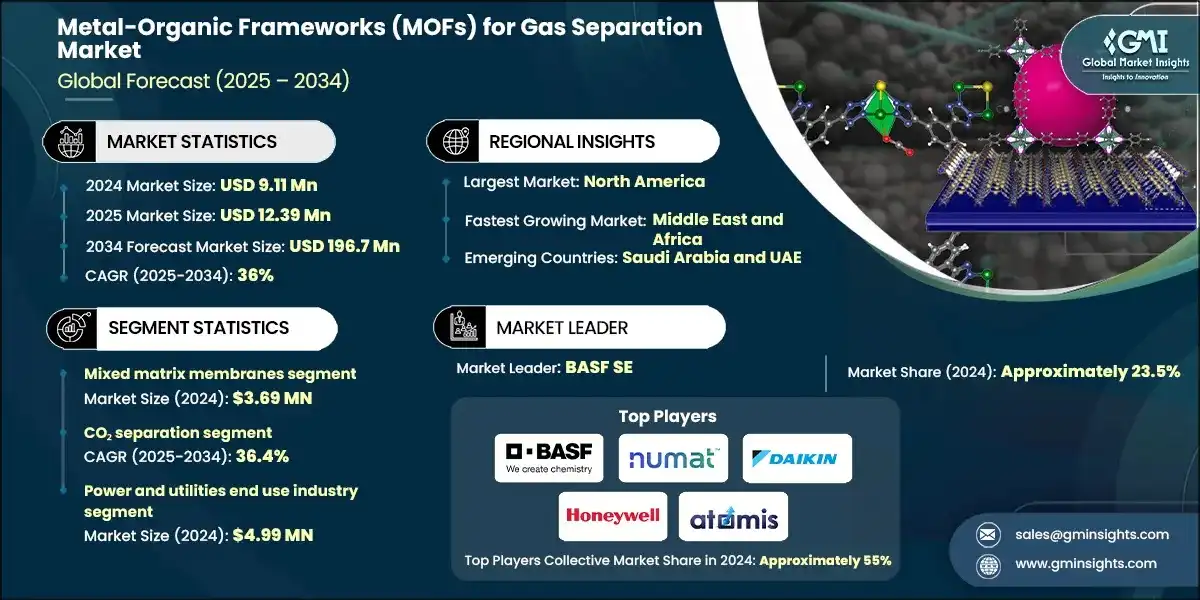
The global metal-organic frameworks (MOFs) for gas separation market was valued at USD 9.11 million in 2024. It is projected to grow from USD 12.39 million in 2025 to USD 196.70 million by 2034, representing a 36% CAGR from 2025 to 2034, according to latest report published by Global Market Insights Inc.
Metal-Organic Frameworks (MOFs) for Gas Separation Market Key Takeaways
Market Size & Growth
- 2024 Market Size: USD 9.11 Million
- 2025 Market Size: USD 12.39 Million
- 2034 Forecast Market Size: USD 196.70 Million
- CAGR (2025–2034): 36%
Regional Dominance
- Largest Market: North America
- Fastest Growing Region: Middle East and Africa
Key Market Drivers
- Rising demand for low-energy gas separation.
- Increasing focus on carbon capture technologies.
- Expanding applications in industrial gas purification.
- Advancements in MOF synthesis and scalability.
Challenges
- High cost of MOF production.
- Limited long-term stability in harsh environments.
- Slow commercialization and adoption.
Opportunity
- Growth in direct air capture systems.
- Use in hydrogen purification and clean energy.
- Development of hybrid MOF-based membranes.
- Expansion into electronics and pharmaceutical sectors.
Key Players
- Market Leader: BASF SE led with over 23.5% market share in 2024.
- Leading Players: Top 5 players in this market include BASF SE, Numat Technologies, Daikin Industries, Honeywell International, Atomis Inc, which collectively held a market share of 55% in 2024.
Get Market Insights & Growth Opportunities
- Metal-organic frameworks (MOFs) for gas separation market are emerging with great potential owing to the increasing trend in the demand for low-energy gas separation technologies. Conventional separation techniques like cryogenic distillation and pressure swing adsorption are very energy-demanding, and thus, industries have turned to the use of MOF-based separation systems which are more selective and efficient at reduced energy roll.
- The other key force that is pushing the market is the growing attention to carbon capture technologies. Amidst the increased need to curb climate change, power generation, cement, and oil and gas industries are spending significantly in carbon capture, utilization, and storage (CCUS). MOFs also have high surface area and tunable pore architecture, which renders them suitable to be used in the adsorption of CO2 and selective separation.
- In addition, the technology of MOFs is evolving in terms of growth and scalability, leading to the growing pace of the market. Currently, solvothermal process, mechanochemical, and microwave assisted synthesis techniques have enhanced yields of production and minimized the fabrication expenses. More stable MOFs which can be recycled are also being developed by researchers, making them appropriate to use on an industrial scale. The latter technological advances are closing the divide between lab research and commercial implementation and allowing using MOFs in a broader range of gas separation and environmental management market.
- North America had the largest market share in the metal-organic frameworks (MOFs) of gas separation with a market share of 39.8% due to the high rate of research, early technology adoption, and increasing investments in carbon capture and clean energy technologies.
- Based on technology, the most popular in the market with the highest market share of 40.5% is the mixed matrix membrane due to improved performance, structural stability, and compatibility with MOFs to enable them to achieve effective and scalable gas separation.
- Based on application, CO2 separation dominates the market with a market share of 48.4% as the demand of carbon capture solutions increases in the power generation, cement, and industrial industry with an aim of achieving emission reduction goals.
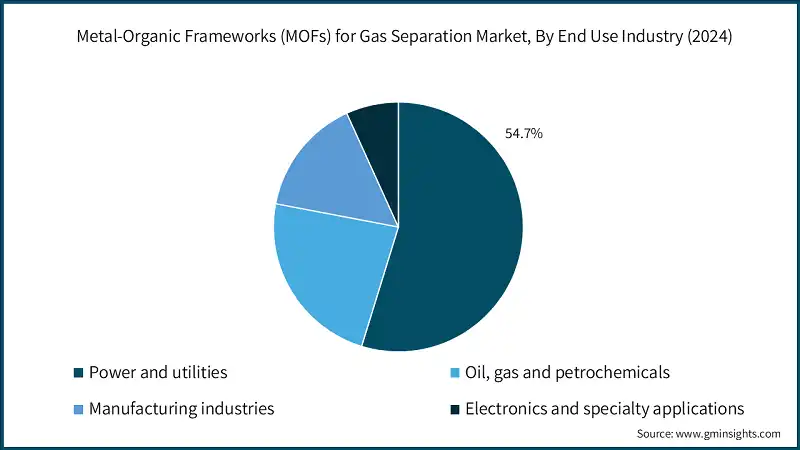
- Based on end-use industry, power and utilities are the largest market segment with a market share of 54.7%, which is supported by the fact that the industry is in dire need of carbon capture and energy efficient gas separation technology in order to contain emission and regulatory standards.
To get key market trends
Metal-Organic Frameworks (MOFs) for Gas Separation Market Trends
- Artificial intelligence and computational material discovery are becoming more and more important in the Metal-organic frameworks (MOFs) market in terms of gas separation. Created modern models and machine learning systems are allowing researchers to anticipate forward working of new MOF forms prior to synthesis, which accelerates development procedures and also lowers expenses.
- Digital transformation enables more specific design of MOFs with pore sizes and stability optimized, which results in the rapid commercialization of this technology and optimization of the processes of gas separation.
- The industry is also being transformed by an increasing movement associated with sustainable and eco-friendly synthesis approaches. To reduce waste and environmental impact manufacturers are looking at making their production methods greener by using solvent free synthesis, reactions using water, and recyclable linkers. This is in line with the global sustainability objectives and the pressure towards low-carbon production which makes MOF production more scalable and in line with the environmental requirements.
- Industrial collaborations and pilot-scale commercialization are also on the increase in the market. Collaborations between the developers of MOF, chemical manufacturers, and energy corporations are assisting in the transfer of lab studies and practice input.
- Carbon capture and natural gas purification Pilot projects are proving the technical and economic viability of MOFs on a large scale, building investor confidence and competitors are hastening to adopt them in industry.
- The other trend that has arisen is the emergence of hybrid and composite MOF materials. Researchers are using MOFs with polymers, graphene, or inorganic frameworks to develop mechanical strength, flexibility, and processability.
- Hybrid architecture enhances the operation of challenging gas separation settings and allows the incorporation into the existing membrane and adsorption platforms and therefore improves the functional breadth and business prospects of MOF-based technologies.
Metal-Organic Frameworks (MOFs) for Gas Separation Market Analysis
Learn more about the key segments shaping this market
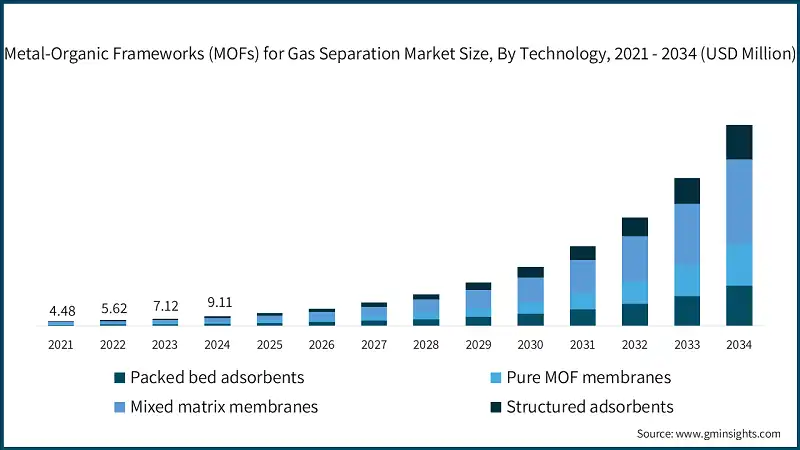
Metal-organic frameworks (MOFs) for gas separation industry based on technology segmented into packed bed adsorbents, pure MOF membranes, mixed matrix membranes, and structured adsorbents. The mixed matrix membranes segment was valued at USD 3.69 million in 2024, and it is anticipated to expand to 36.5% of CAGR during 2025-2034.
- The packed bed adsorbents segment still enjoys a leading position in the Metal-Organic Frameworks (MOFs) Gas Separation Market because it is already used in large-scale industrial gas purification and separation systems. These adsorbents have high adsorption capacity and selectivity which is tunable making them suitable in the capture of CO2, hydrogen purification and separation of hydrocarbons. The market potential of this segment is based on the industries that are interested in the cost effective retrofitting of the current gas separation infrastructure using MOFs as the drop-in replacement of the traditional adsorbents such as zeolites and activated carbon.
- The pure MOF membrane part is experiencing a sudden development boom due to new methods of making membranes increasing the stability of the membranes as well as their ability to be scaled up. The growing use of MOF membranes in processes of clean energy and carbon management is driving their commercialization. Moreover, continuous R&D of solvent-resistant and thermally stable MOF membranes is expanding their areas of use in petrochemical and refining sectors.
- The structured adsorbents segments and the mixed matrix membranes (MMMs) are provoking important spheres of technological development. Mixed matrix membranes (a combination of MOFs and polymers) provide a compromise between mechanical strength and selectivity, which is why they are used in the purification of gases and biogas upgrading. In the meantime, structured adsorbents are becoming popular because of their increased mass transfer rate and reduced pressure drop than the conventional packed beds.
Metal-organic frameworks (MOFs) for gas separation market based on application segmented into CO2 separation, hydrocarbon separation, light gas separation, and specialty gas separation. The CO2 separation segment was valued at USD 4.41 million in 2024, and it is anticipated to expand to 36.4% of CAGR during 2025-2034.
- The CO2 separation unit has the highest proportion of the Metal-Organic Frameworks (MOFs) to the Gas Separation Market due to the increased amount of the world focusing on the carbon capture, utilization, and storage (CCUS). The high surface area and porosity of MOFs allow their use in adsorption of CO2 in flue gases and natural gas streams with high selectivity. The fact that more and more power generation, cement production, and industrial manufacturing companies are utilizing MOF-based CO2 capture systems is strengthening the growth of this segment.
- The hydrocarbon separation unit is experiencing gradual growth owing to the increasing demand for effective purification and separation of petrochemical and natural gas products. MOFs are selective adsorbents in the separation of light olefins and paraffins, and purification of hydrocarbon mixtures. This has the benefit of lowering operational expenses and improving process efficiency as opposed to the traditional cryogenic processes.
- There is a high potential market in the light gas separation and specialty gas separation segments. The separation of light gases, specifically hydrogen and helium recovery, is becoming increasingly popular as the hydrogen economy and energy transition programs expand. The selectivity of MOFs in gases of similar molecular sizes offers a significant advantage to the use of MOFs. In the meantime, the specialty gas separation business unit is enjoying improved demand of ultra-pure gases in the electronic, pharmaceutical, and environmental monitoring industries.
Learn more about the key segments shaping this market
Power and utilities end use industry segment was valued at USD 4.99 million in 2024, and it is anticipated to expand with a CAGR of 35.8% and holding a market share of 54.7% during 2025-2034.
- A significant end use industry in the Metal-Organic Frameworks (MOFs) market in Gas Separation is the power and utilities industry, and it is mainly related to the increasing attention to capture carbon present in the power plant emissions. Post-combustion CO2 capture systems are currently employing MOFs, owing to their great selectivity and regeneration efficiency.
- The oil, gas, and petrochemical market is experiencing a high growth rate because MOFs provide effective solutions in the separation of hydrocarbons, purification of natural gas and the elimination of impurities like H2S and CO2. Refiners and petrochemical facilities are taking advantage of MOFs to enhance efficiency, purity of products and energy conservation in comparison with the traditional processes.
- The manufacturing industries and electronics and specialty application segments are also growing out to be high growth sectors. The manufacturing industries are using MOFs to cleanse hydrogen, extract nitrogen and specialty gases that improve efficiency and save energy. In semiconductors, optical fibers, and other specialty uses of the gases, the need to achieve the highest purity is driving the use of MOF. High selectivity, tunability, and scalability of MOFs make them very useful to match the high-end requirements of these niche industrial uses.
Looking for region specific data?
North America Metal-Organic Frameworks (MOFs) for Gas Separation Market
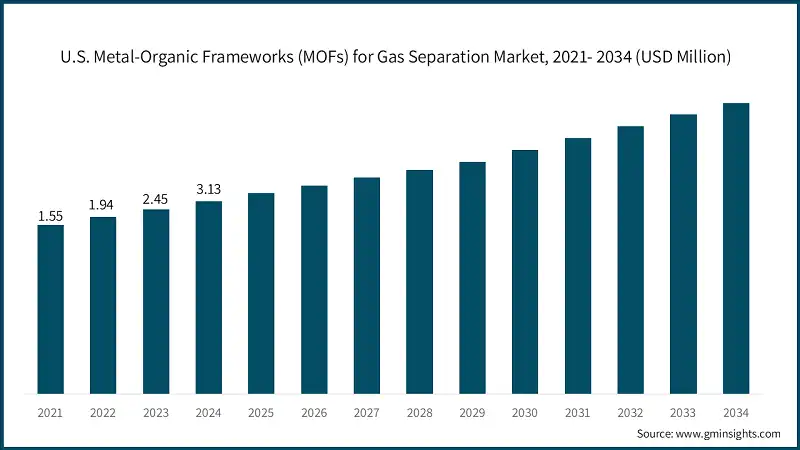
The North America market dominated the global Metal-organic frameworks (MOFs) for gas separation industry with a market share of 39.8% in 2024.
North American Metal-Organic Frameworks (MOFs) market on Gas Separation enjoys a strong growth, as a result of the growing investments made on carbon capture programs and clean energy technologies. Power and petrochemicals are among industries in the region, which have introduced MOF-based gas separation systems as a solution to energy consumption reduction and ensuring high levels of compliance to environmental laws. The presence of technological innovations and continuous research and development in the field of MOF synthesis and membranes construction only enhances the adoption in the region.
U.S. dominates the North America metal-organic frameworks (MOFs) for gas separation market, showcasing strong growth potential.
The U.S. being the swiftest developing nation in North America enjoys the lead in MOF adoption owing to the vehement government endorsement of carbon capture and decarbonization efforts. CO2 capture of industrial and power plant emissions and initiatives by MOF developers to have large energy companies participate in its projects are driving commercialization. The emphasis on the clean energy shift and regulatory incentive turns the U.S. into an important center of MOF-based gas separation technologies.
Europe Metal-Organic Frameworks (MOFs) for Gas Separation Market
The Europe market accounted for USD 2.57 million in 2024 and is anticipated to show lucrative growth over the forecast period.
The MOF market in Europe is growing consistently, and the region is focused on sustainable industrial activities and low-carbon technologies. Stringent EU emission standards are making the power and utilities sector, petrochemical, and manufacturing industries resort to the use of MOFs to capture and purify CO2 gases. The development of mixed matrix membranes and structured adsorbents is facilitating the adoption and working efficiency of the industry in the region.
Germany dominates the Europe metal-organic frameworks (MOFs) for gas separation market, showcasing strong growth potential.
Germany is the fastest growing economy in Europe and is leading this trend with good policies by the government aimed at supporting the development of carbon capture and hydrogen economy. Innovative gas separation uses MOFs are being incorporated by industrial players to separate CO2, remove hydrogen and in specialty gas applications, and this allows Germany to continue to be a strategic market of innovative gas separation solutions.
Asia Pacific Metal-Organic Frameworks (MOFs) for Gas Separation Market
The Asia Pacific metal-organic frameworks (MOFs) for gas separation is anticipated to grow at a CAGR of 35.5% during the analysis timeframe.
The market of Asia-Pacific MOFs Separators is developing at a high rate based on the development of industries, the growth of energy requirements, and the growth of environmental consciousness. The region is spending on MOF technology to separate hydrocarbons, capture CO2 and separation of industrial gases, due to the motivation of energy efficiency and regulation requirements. The market is also backed up by the fact that MOF membranes and adsorbents in petrochemical and manufacturing industries are rapidly commercialized.
China Asia Pacific metal-organic frameworks (MOFs) for gas separation market is estimated to grow with a significant CAGR, in the Asia Pacific Metal-Organic Frameworks (MOFs) for Gas Separation.
China, the fastest developing nation in APAC is becoming a strong force because of massive industrialization and vigorous decarbonization strategies. The demand of MOF-based gas separation systems is fueled by government-sponsored research activities, the growing use of technology in power, chemical, and specialty gas production. The nation is also considering the increased output potential to address the local as well as the international demand.
Latin America Metal-Organic Frameworks (MOFs) for Gas Separation Market
The Latin America market accounted for 6.8% in 2024 and is anticipated to show lucrative growth over the forecast period.
Moderate growth is being exhibited in the Latin American market which is based on the rising industrial activities and implementation of MOFs in the energy and petrochemical industry. Nations are slowly adopting MOF-based remedies in order to enhance the performance of gas division, lessen energy use, and increase process dependability, particularly in CO2 capture and purification of hydrocarbon methods.
Brazil leads the Latin American metal-organic frameworks (MOFs) for gas separation market, exhibiting remarkable growth during the analysis period.
Having been the most rapidly developing country in the region, Brazil is experiencing significant use of MOF technologies in its rapidly developing oil and gas industry. Industrial imperative and government effort towards improving energy efficiency and minimizing emissions is facilitating the use of MOFs in natural gas purification, CO2 separation, and hydrogen recovery.
Middle East and Africa Metal-Organic Frameworks (MOFs) for Gas Separation Market
Middle East & Africa market accounted for 6.3% in 2024 and is anticipated to show lucrative growth over the forecast period.
The development of the Middle East and Africa (MEA) MOFs market is due to the requirement of the oil and gas industry and petrochemical industry to be preferably treated through efficient gas separation technologies. The interest of the region in minimizing energy-intensive energy-consuming separation processes and satisfying the environmental criteria is driving the utilization of MOFs in the CO2 capture and hydrocarbon purification processes.
South Africa metal-organic frameworks (MOFs) for gas separation market to experience substantial growth in the Middle East and Africa market in 2024.
South Africa, the fastest-growing state in MEA, is becoming interested in MOF-based gas division, especially in terms of industrial gas purification and CO2 control. Local adoption is being facilitated by pilot projects and such partnerships with international MOF developers making South Africa a major source of new advanced gas separation technologies in the region.
Metal-Organic Frameworks (MOFs) for Gas Separation Market Share
- The players in the market are investing in the creation of high-performance MOFs that are more selective, stable (thermal and chemical) and with scalable synthesis procedures. These companies can satisfy the changing needs of various industries such as power generation, petrochemicals and specialty gases because of the continuous introduction of innovative products such as pure MOF membranes, mixed matrix membranes and structured adsorbents and thus maintain a competitive advantage.
- The strategic alliances, partnerships, and joint ventures are significant towards market leadership. The corporations are aggressively collaborating with industrial players, research centers, and technology developers in order to commercialize MOF-based gas separation solutions faster.
- Collaboration allows companies to accelerate pilot testing, deploy it to industrial scale and integrate with existing systems to make their products reliable and applicable. This strategy does not only enhance their standing in the market but also creates performance and operational efficiency benchmarks in the industry.
- Besides the innovation of the products, the firms in this market focus on intellectual property control and patent collections to achieve technological exclusivity. They keep their competitive advantages and provide new competitors with barriers by securing proprietary MOF structures, membrane fabrication techniques, and hybrid materials. Such emphasis on IP also enables such firms to shape their market standards and trends to see to it that their solutions to the market are at the forefront of gas separation technology development.
- The other important strategy is expansion and localization of manufacturing capacities geographically. The market leaders are setting up production plants, pilot plants, and research and development centers in key areas so as to maintain a supply on time, achieve lower costs, and satisfy local regulations. Meeting regional-specific demands, e.g., carbon capture in North America or hydrocarbon purification in APAC, these companies are able to stay close to major industrial customers, improve their efficiency in service, and ensure long-term relations, which fix the position of these companies in the market.
Metal-Organic Frameworks (MOFs) for Gas Separation Market Companies
The top prominent players in the market companies are:
- BASF SE
- Numat Technologies
- Daikin Industries
- Honeywell International
- Atomis Inc
- Others
- BASF SE continues to compete in the MOFs in Gas Separation market by enjoying the effective R&D to produce high-performance adsorbents and membranes of CO2 capture and purifying industrial gases. Third, their specialization in scalable production and partnership with energy and chemical firms makes them self-enforced in the industrial adoption.
- Numat Technologies enhances its market competitiveness through the provision of highly selective and stable advanced MOF membrane and structured adsorbents. Constant material design and collaborative relation with research institutes will keep them a choice in the industrial gas separation.
- Daikin Industries has incorporated MOF-based separation solutions into the HVAC and industrial gas operations with a focus on energy-efficient and low-cost operations. They have their hybrid MOF technologies and world production capabilities that ensure a steady market leadership.
- Honeywell International uses its technological and industrial base to offer MOF-based gas purification systems to petrochemical and specialty gas usage. They concentrate on pilot projects, industrial-scale applications, and technical support as a way of preserving market leadership.
- Atomis Inc has been able to stay competitive through the development of custom MOF membranes and adsorbents that are used in light gas and specialty gas separation. High adoption and relevance in the market are guaranteed by their focus on R&D, flexibility in their production, and partnership with industrial partners.
Metal-Organic Frameworks (MOFs) for Gas Separation Market Report Attributes
| Key Takeaway | Details |
|---|---|
| Market Size & Growth | |
| Base Year | 2024 |
| Market Size in 2024 | USD 9.11 Million |
| Market Size in 2025 | USD 12.39 Million |
| Forecast Period 2025 - 2034 CAGR | 36% |
| Market Size in 2034 | USD 196.70 Million |
| Key Market Trends | |
| Drivers | Impact |
| Rising demand for low-energy gas separation | MOFs reduce energy use, making gas separation more cost-efficient. |
| Increasing focus on carbon capture technologies | MOFs support selective CO2 capture, aiding emission reduction efforts. |
| Expanding applications in industrial gas purification | MOFs enable cleaner gas streams across multiple industrial sectors |
| Advancements in MOF synthesis and scalability | Improved methods make MOFs more viable for large-scale deployment. |
| Pitfalls & Challenges | Impact |
| High cost of MOF production | Expensive synthesis limits MOF adoption in price-sensitive industries. |
| Limited long-term stability in harsh environments | MOFs may degrade under extreme industrial conditions, reducing reliability. |
| Slow commercialization and adoption | Industry uptake is slow due to performance and scale-up concerns. |
| Opportunities: | Impact |
| Growth in direct air capture systems | MOFs enhance CO₂ removal from ambient air for climate solutions. |
| Use in hydrogen purification and clean energy | MOFs help isolate hydrogen, supporting clean fuel technologies. |
| Development of hybrid MOF-based membranes | Combining MOFs with polymers improves gas separation efficiency. |
| Expansion into electronics and pharmaceutical sectors | MOFs offer precise gas control for sensitive, high-value applications. |
| Market Leaders (2024) | |
| Market Leaders |
Market Share Approximately 23.5% |
| Top Players |
Collective market share in 2024 is Collective Market Share Approximately 55% |
| Competitive Edge |
|
| Regional Insights | |
| Largest Market | North America |
| Fastest growing market | Middle East and Africa |
| Emerging countries | Saudi Arabia and UAE |
| Future outlook |
|
What are the growth opportunities in this market?
Metal-Organic Frameworks (MOFs) for Gas Separation Industry News
- In July 2025, Numat Technologies made a collaboration with Nitto to achieve the faster development of next generation decarbonization technologies. This partnership aims at developing MOF solutions in separation, dealing with important issues of energy efficiency in major industries, and strengthening the role of Numat in the MOF market.
- In June 2025, Nuada was able to test its second pilot plant, Nuada Scout, in the University of Sheffield at the Energy Innovation Centre. This progress will testify to Nuada in its pursuit of ultra-efficient carbon capture technologies based on the MOF filters, which strengthens its status in the MOF market.
- In April 2025, novoMOF increased CHF 4.4 million to scale CO2 -capture materials. This investment will facilitate the creation and commercialisation of the innovative MOF materials in the separation of gases which will make novoMOF a significant player in the MOF market.
- In February 2025, Air Liquide declared that it would construct, own and operate a massive Air Separation Unit (ASU) in Naoshima Island in Japan to meet the increasing energy demand. Such an investment will boost the Air Liquide capacities in the gas separation technologies, which will strengthen its market positions across the globe.
- In January 2024, Daikin Industries declared the creation of a refrigerant reclamation procedure that utilizes MOF-based separation technologies that could be used to separate refrigerants that could not be separated previously. Not only does this development help in achieving environment sustainability but it also makes Daikin a leader in new gas separation technology in HVAC.
- In 2024, Atomis Inc., a start-up-based company at Kyoto University declared that it developed a next-generation gas tank with MOF adsorbents as support to facilitate storage. The innovation will allow reducing the tank size by 75%, which will yield profound benefits in the sphere of gas storage and transportation and will increase the size of the Atomis market in the market of gas separation based on MOFs.
The metal-organic frameworks (MOFs) for gas separation market research report includes in-depth coverage of the industry with estimates & forecast in terms of revenue (USD Million) & volume (Kilo Tons) from 2021 to 2034, for the following segments:
Market, By Technology
- Packed bed adsorbents
- Pressure swing adsorption applications
- Temperature swing adsorption systems
- Vacuum swing adsorption implementations
- Pure MOF membranes
- Mixed matrix membranes
- Structured adsorbents
- Monolith and honeycomb coating technologies
- Heat and mass transfer optimization
Market, By Application
- CO2 separation
- Post-combustion capture applications
- Pre-combustion and industrial process integration
- Direct air capture technology integration
- Hydrocarbon separation
- Natural gas sweetening and processing
- Olefin/paraffin separation technologies
- C2/C3 recovery and purification systems
- Light gas separation
- Hydrogen purification and recovery
- Oxygen/nitrogen separation technologies
- Noble gas recovery and recycling
- Specialty gas separation
- Toxic gas capture and neutralization
- Refrigerant recovery and recycling systems
- Trace contaminant removal technologies
Market, By End Use Industry
- Power and utilities sector
- Coal-fired power plant retrofit applications
- Natural gas combined cycle integration
- Grid-scale energy storage applications
- Utility-scale direct air capture projects
- Oil, gas and petrochemicals sector
- Refinery gas processing applications
- Natural gas treatment and sweetening
- Petrochemical process integration
- Manufacturing industries sector
- Cement industry CO2 capture applications
- Steel and aluminum process integration
- Ammonia and hydrogen production purification
- Chemical manufacturing process optimization
- Electronics and specialty applications sector
- Semiconductor toxic gas handling
- Pharmaceutical process applications
- Research and laboratory systems
- Specialty chemical production
The above information is provided for the following regions and countries:
- North America
- U.S.
- Canada
- Europe
- UK
- Germany
- France
- Italy
- Spain
- Rest of Europe
- Asia Pacific
- China
- India
- Japan
- South Korea
- Australia
- Rest of Asia Pacific
- Latin America
- Brazil
- Mexico
- Argentina
- Rest of Latin America
- MEA
- UAE
- Saudi Arabia
- South Africa
- Rest of Middle East and Africa
Frequently Asked Question(FAQ) :
What is the market size of MOFs for gas separation industry in 2024?
The market size was USD 9.11 million in 2024, with a CAGR of 36% expected through 2034, driven by rising demand for low-energy gas separation and adoption of carbon capture solutions.
What is the current metal-organic frameworks (MOFs) for gas separation market size in 2025?
The MOFs for gas separation market is projected to reach USD 12.39 million in 2025.
What is the projected value of the MOFs for gas separation market by 2034?
The market is anticipated to reach USD 196.70 million by 2034, supported by rapid innovation in MOF materials, expansion into new industries, and scaling of pilot projects.
How much revenue did the mixed matrix membranes segment generate in 2024?
Mixed matrix membranes generated USD 3.69 million in 2024, leading all technologies due to improved performance and compatibility in scalable gas separation systems.
What was the valuation of CO₂ separation applications in 2024?
CO₂ separation applications held a market value of USD 4.41 million in 2024, representing 48.4% share, made possible by the surging demand for industrial carbon capture and flue gas treatment.
Which region leads the metal-organic frameworks (MOFs) for gas separation market?
North America led the market in 2024 with a 39.8% share, and the U.S. dominated regional growth with swift adoption owing to active government support for carbon capture, decarbonization incentives, and rapid industrial uptake.
What are the upcoming trends in the MOFs for gas separation industry?
Key trends include the use of artificial intelligence for MOF design, green and scalable synthesis, emergence of hybrid MOF materials, commercial pilot projects for carbon capture, and innovation in polymer composites for high-selectivity membranes.
Who are the key players in the metal-organic frameworks (MOFs) for gas separation market?
Key players include BASF SE, Numat Technologies, Daikin Industries, Honeywell International, and Atomis Inc, with market leadership established through advanced material design, strategic partnerships, and global plant localization.
Metal-Organic Frameworks (MOFs) for Gas Separation Market Scope
Related Reports