Summary
Table of Content

Metal Bonding Adhesives Market
Get a free sample of this report
Form submitted successfully!
Error submitting form. Please try again.
Thank you!
Your inquiry has been received. Our team will reach out to you with the required details via email. To ensure that you don't miss their response, kindly remember to check your spam folder as well!
Request Sectional Data
Thank you!
Your inquiry has been received. Our team will reach out to you with the required details via email. To ensure that you don't miss their response, kindly remember to check your spam folder as well!
Form submitted successfully!
Error submitting form. Please try again.
Metal Bonding Adhesives Market Size
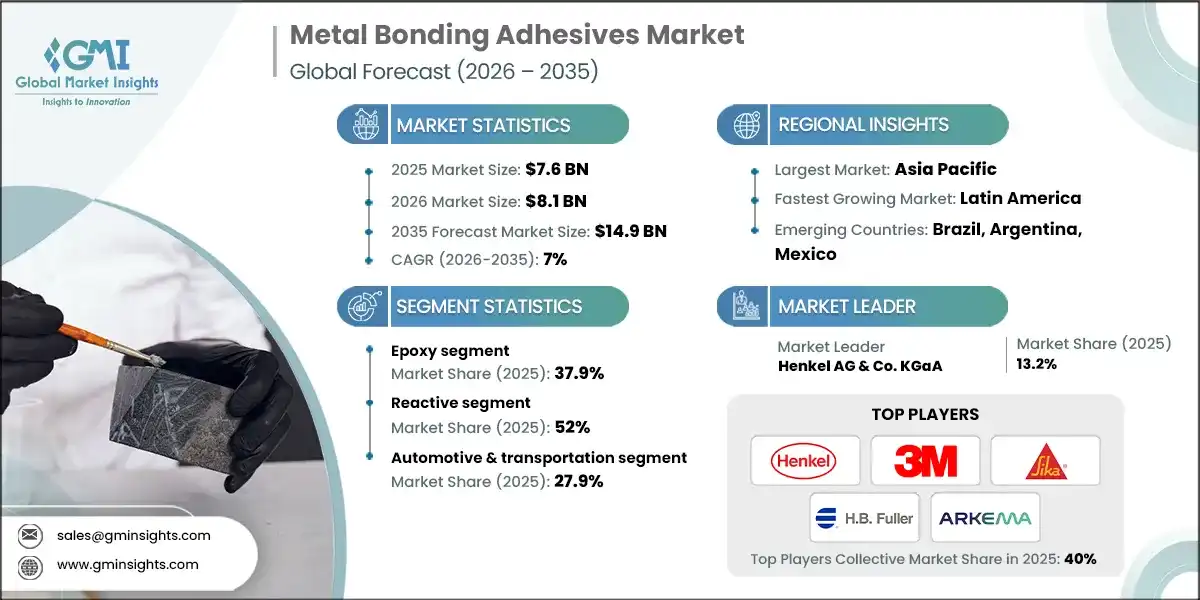
The global metal bonding adhesives market was valued at USD 7.6 billion in 2025. The market is expected to grow from USD 8.1 billion in 2026 to USD 14.9 billion in 2035, at a CAGR of 7% according to latest report published by Global Market Insights Inc.
Metal Bonding Adhesives Market Key Takeaways
Market Size & Growth
- 2025 Market Size: USD 7.6 Billion
- 2026 Market Size: USD 8.1 Billion
- 2035 Forecast Market Size: USD 14.9 Billion
- CAGR (2026–2035): 7%
Regional Dominance
- Largest Market: Asia Pacific
- Fastest Growing Region: Latin America
Key Market Drivers
- Surge in Electric Vehicle Production.
- Expanding Electronics Manufacturing Base.
- Infrastructure Modernization Initiatives.
Challenges
- Volatile Raw Material Prices.
- Limited Adhesion on Certain Metal Surfaces.
Opportunity
- Penetration in Emerging Markets.
- Hybrid & High-Performance Formulations.
Key Players
- Market Leader: Henkel AG & Co. KGaA led with over 13.2% market share in 2025.
- Leading Players: Top 5 players in this market include Henkel AG & Co. KGaA, 3M Company, Sika AG, H.B. Fuller Company, Arkema Group, which collectively held a market share of 40% in 2025.
Get Market Insights & Growth Opportunities
- The rapid growth of the market is attributable to the increasing number of applications in which adhesives are replacing traditional mechanical fasteners and welding methods, specifically where the requirement for strength, flexibility and weight reduction are paramount.
- The automotive and transportation sectors are driving forces behind the growth of the adhesive market, primarily through the adoption of electric vehicles and light-weighting initiatives. Adhesives are performing a vital function in the bonding of dissimilar substrates; for example, aluminum, magnesium and composite materials are bonded using adhesives since mechanical fastening methods are often too heavy or do not provide adequate support.
- Another key sector that contributes to the adhesive market is the aerospace and defense industry. High-performance metal bonding adhesives are critical for many aspects of manufacturing airplanes, including producing the fuselage and for bonding structures and damping vibrations. More recently (post-COVID) there has been a significant rebound in commercial aviation traffic in Asia and North America, as well as increased spending by defense agencies, which has given the aerospace and defense industry renewed energy. To meet the growing demand for airplanes, both Boeing and Airbus invested in additional production facilities in 2024 and 2025, thereby supporting the adhesive supply chain.
- The increase in demand for electronics and home appliances has created a fast-growing product segment. In this market, there has been a rapid adoption of thermally and electrically conductive adhesives as most heat sinks, heat exchangers, and PCB enclosures are made from metal. Trends in the electronics and consumer electronics industry, including the rise of 5G-enabled devices and the introduction of miniaturized electronics, have also increased the need for specialized bonding solutions that traditional methods cannot provide.
- Hybrid adhesives (hybrid epoxy-containing adhesive products and hybrid epoxy-acrylic-based adhesives) and nanotechnology-based adhesive products will continue to gain popularity because of trends in the technology industry. Hybrid adhesives offer superior bonding strength and corrosion resistance in challenging conditions (e.g. when used with metals) compared to traditional adhesives. There is also a growing trend toward the use of bio-based adhesive products that meet the requirements of REACH and have low levels of volatile organic compounds (VOCs). Bio-based adhesives are also compatible with the global sustainable development goals.
- Recent developments in the adhesive industry have included the Parker Hannifin acquisition of LORD Corporation and the increasing capacities of Henkel, Sika and H.B. Fuller to respond to market demand for high-growth categories. The number of product introductions from 2023 to the present includes a broad range of multi-substrate adhesive products, rapid curing adhesives and high temperature resistant adhesives.
To get key market trends
Metal Bonding Adhesives Market Trends
- The market for metal bonding adhesives has undergone a major change in recent years; the most notable change is the rapid growth of hybrid adhesive technology. Hybrid adhesive formulations combine many of the benefits of epoxy/acrylate adhesives and polyurethane/epoxy adhesives into one product that meets the demands of a variety of end-use markets, including the automotive, electronics, and aerospace industries. For instance, hybrid adhesives are frequently used in the assembly of electric vehicle (EV) batteries, where they provide an effective solution for metal-to-metal bonding under conditions of thermal stress and extended vibrational cycles.
- At the same time, the United States Environmental Protection Agency (EPA) and the European Union’s REACH (Registration, Evaluation, Authorization and Restriction of Chemicals) regulatory frameworks—together with new and developing regulatory frameworks from the Asian continent—have increasingly restricted the use and manufacturing of chemical adhesives due to increasing restrictions on the amount of VOCs (volatile organic compounds) and/or hazardous substances that can be present in a product. As a result, manufacturers have reformulated many existing solvent-based adhesives to comply with these new regulations using environmentally friendly alternatives.
- While significant advancements have been made, the gap exists in the development of adhesives capable of bonding dissimilar substrates (i.e., metal-to-plastic or metal-composite) in extreme thermal, chemical, and mechanical conditions, with special emphasis placed upon the defense, oil & gas and aerospace.
- R&D teams across a wide variety of industries are now focused on developing multi-functional adhesives that offer dual-functionality through the development and utilization of graphene, nanomaterials and smart polymers that can respond to mechanical and/or environmental conditions.
- There is currently a high level of interest in developing multi-functional adhesives and an increasing level of R&D activity that is focusing on these areas of development. Governments across Asia, Africa, and South America are heavily investing in industrial manufacturing, transportation infrastructure and renewables.
- Policies such as “Made in China 2025” and India’s PLI programs, as well as the EU’s Green Deal are driving the use of adhesives for metal-intensive applications. For example, metal bonding adhesives are being used in solar panel mounting systems, wind turbine blade frames and urban rail transport systems, all of which are seeing increased acceptance. These policy-based mega-projects create stable, long-term demand for industrial-grade adhesives that provide both performance and scalability.
Metal Bonding Adhesives Market Analysis
Learn more about the key segments shaping this market
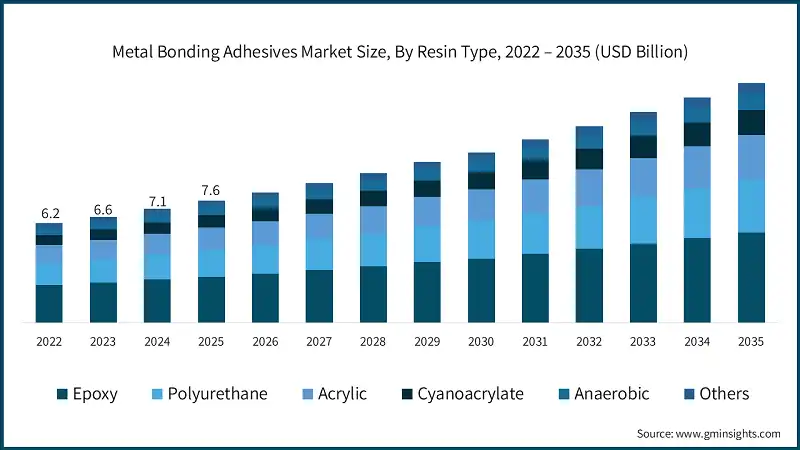
Based on resin type, the market is segmented into epoxy, polyurethane, acrylic, cyanoacrylate, anaerobic, and others. Epoxy dominated the market with an approximate market share of 37.9% in 2025 and is expected to grow with a CAGR of 6.9% by 2035.
- The leading players of the epoxy-based adhesive category attribute their success to the high-performance physical properties of the product, including excellent mechanical performance, high bond strength, and superior resistance to heat, chemicals, and environmental conditions.
- High-performance features and characteristic versatility make this type of adhesive ideal for automotive, aerospace, and industrial machinery assemblies, in addition to their wide-ranging application capabilities. Because of this capability, epoxy adhesives have become the default adhesive choice for many manufacturers who need reliable, high-performance bonding solutions for load-bearing applications.
- Additionally, the growth potential for epoxy-based bonding products is driven by the continuous development of innovative products by some of the leading companies in the bonding industry, including Henkel and 3M, which are developing low-curing-temperature and nano-enhanced epoxy formulations specifically designed for applications in automotive, electric vehicles, and battery systems.
Based on technology, the metal bonding adhesives market is segmented into solvent-based, water-based, reactive, and hot melt. Reactive dominated the market with an approximate market share of 52% in 2025 and is expected to grow with a CAGR of 7.1% by 2035.
- The market will continue to be led by reactive adhesives technology due to their ability to create high strength and durable bonds using chemical cross-linking, thus providing the needed level of structural reliability with extreme forces of pressure and durability.
- Reactive adhesive technology consists of several types of industrial adhesives, including epoxy, polyurethane, and anaerobic systems; all types have been specifically designed for use in a variety of industries.
- The unique properties associated with these types of adhesives, such as the ability to create bonds with minimal surface preparation, heat resistance, chemical resistance, and fatigue resistance will continue to make reactive adhesive technology an important play in automotive, aerospace, and heavy equipment manufacturing. One of the major drivers for the success of the reactive segment is the continual technological innovations regarding curing technologies.
Learn more about the key segments shaping this market
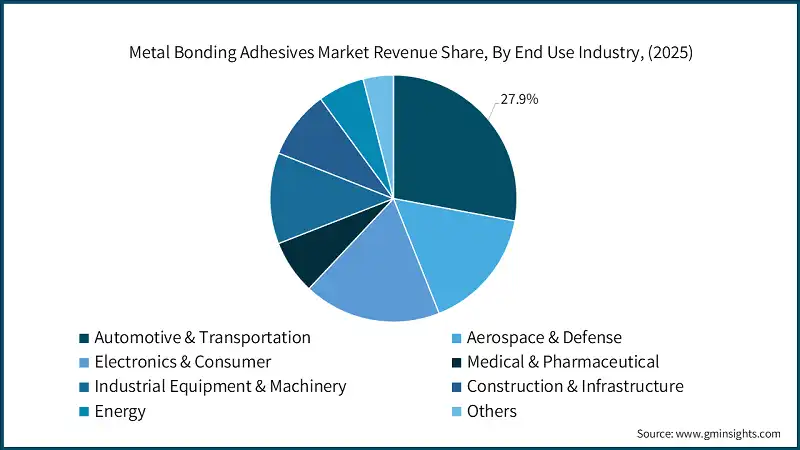
Based on end use industry, the metal bonding adhesives market is segmented into automotive & transportation, aerospace & defense, electronics & consumer, medical &, pharmaceutical, industrial equipment & machinery, construction & infrastructure, energy, and others. Automotive & transportation held the largest market share of 27.9% in 2025 and is expected to grow at a CAGR of 6.8% during 2026-2035.
- Extensive applications of metal bonding adhesives are seen in vehicle chassis, body parts, and structural areas with aluminum, steel, and composite materials. Using adhesives rather than spot welds/riveting allows distribution of stress over a larger area and enhances crash worthiness and the ability to join dissimilar metals without seams.
- Innovation is the defining characteristic of this product category. As a result, manufacturers have developed more effective solutions with crash-durable, high-strength epoxy systems, corrosion-resistant polyurethane systems, and structural acrylics designed to cure faster and to perform consistently over time under varying temperatures, vibration, and environment—to be an essential characteristic for many high-mileage and electric vehicle platforms.
- From a comparison of performance and price, premium-grade adhesives may carry a higher price tag; however, they ultimately lead to a reduction in total manufacturing costs because of the ability to produce lighter-weight products, simplified assembly processes, and fewer defects after the manufacturing process. Over the long run, their overall value makes premium-grade adhesives a logical choice for Original Equipment Manufacturers (OEMs) seeking to create cost-effective, high-performing products.
Looking for region specific data?
The North America metal bonding adhesives industry is growing rapidly on the global level with a market share of 24.3% in 2025.
- The rise in automotive, aerospace, and defense industries is driving the increase in metal adhesives market in North America. Furthermore, recent manufacturing reshoring trends along with the continued growth of regional supply chains have helped spur the adoption of advanced adhesives to aid local production.
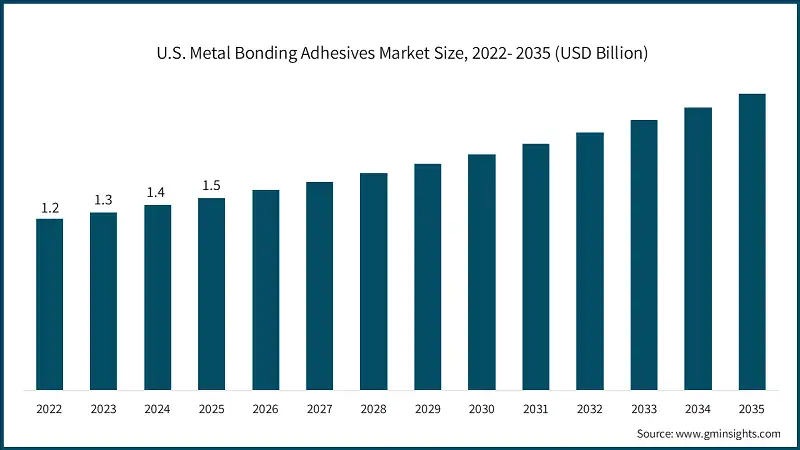
U.S. dominates the North America metal bonding adhesives market with a market of USD 1.5 billion in 2025, showcasing strong growth potential.
The U.S. through investments made by the U.S. Department of Energy into EV manufacturing & battery infrastructure, adding to the need for lightweight bonds. Additionally, Washington and California have increased the demand for high-performance adhesive products due to their leading aerospace hubs with respect to FAA and military specifications.
Europe market leads the industry with revenue of USD 1.6 billion in 2025 and is anticipated to show lucrative growth over the forecast period.
- Europe continues to see consistent growth in the Adhesives Market because of strict environmental regulations and a strong focus on sustainable mobility and green construction. The European Union’s Green Deal and Repower EU plan have catalyzed investment into wind power, hydrogen infrastructure and electric vehicle production, all of which require durable and efficient metal bonds. The focus of Germany, France, and Sweden on expanding their domestic production capacity for electric vehicles and energy storage systems has further increased the demand for thermally conductive and corrosion resistant adhesives.
The Asia Pacific metal bonding adhesives market is anticipated to grow at a CAGR of 7.3% during the analysis timeframe.
- The Asia-Pacific region is the largest regional contributor, driven by fast-paced industrialization, urbanization, and rapid growth in manufacturing across China, India, South Korea, and Japan. China is the world leader in the manufacture of electronics, using significant amounts of advanced adhesives in its semiconductor, consumer appliance and metal-cased device industries. Additionally, the PLI (Production Linked Incentive) programs established by India to promote the manufacture of vehicles and batteries have attracted many of the major original equipment manufacturers (OEMs) and component suppliers to this market, leading to a boost in usage of metal bonding adhesives for structural bonding applications in electric vehicle (EV) modules.
Latin America metal bonding adhesives market accounted for 6.3% market share in 2025 and is anticipated to show highest growth over the forecast period.
- Latin America is experiencing a gradual evolution of its adhesive technology market, primarily led by automotive activities taking place in Brazil and Mexico, in addition to public sector funded infrastructure projects which are associated with the continued urbanization of the region. As manufacturers of lightweight transport and localized manufacture solutions adopt adhesive technology, this will produce a favorable situation for adhesive manufacturers, but the economies of the region and currency fluctuations will be significant issues to overcome.
Middle East & Africa metal bonding adhesives accounted for 2.6% market share in 2025 and is anticipated to show lucrative growth over the forecast period.
- There have been promising early developments in the Middle East and Africa (MEA) region in the renewable energy sector, especially in the construction market. For example, countries such as the United Arab Emirates and Saudi Arabia are actively promoting the use of wind turbine and metal-based infrastructure through broad industrial diversification programs, such as Saudi Arabia's Vision 2030 Program.
Metal Bonding Adhesives Market Share
The global metal bonding adhesives industry has several international players who dominate it, because of their strong technical skills, broad product portfolios, and well-established supply chains. The leading five companies in the market Henkel AG & Co. KGaA, 3M Company, H.B. Fuller, Sika AG, and Arkema account for over 40% of the global market share in 2025.
Henkel remains the largest player in the market and continues to grow by using their LOCTITE brand of metal bonding adhesives to create a wide variety of adhesive products for automotive and industrial applications. Henkel's growth is due to their commitment to innovation, aggressive research and development efforts, and strong global distribution channels. In addition, 3M has established itself as a leader in material sciences and integrates across multiple industries with its innovative products and applications for high-performing, multi-functional adhesives.
Companies compete based on product performance, cure speed, product pricing, and sustainability. Most companies are developing lower-VOC formulation; biodegradable adhesive products; and hybrid technology as they respond to the changing needs of their clients and regulatory agencies.
- Henkel AG & Co. KGaA: Henkel’s flagship LOCTITE brand is the leader in the market for adhesives that bond metal together with many options offered including epoxies, acrylics, and anaerobic. With a strong history of involvement in deep integration of the various industries Henkel serves, the company is positioned to offer customers the best adhesive solutions for the automotive, aerospace, and industrial sectors.
- 3M Company: 3M is leveraging its capabilities in materials science and its presence in many markets to develop and supply innovative and high-performance structural adhesives. In addition to its broad portfolio of metal bonding adhesive products, most of which are used in the transportation, electronics and signage industries, 3M has positioned itself at the forefront of this rapidly growing segment of the adhesives market with a focus on innovative, fast-curing, lightweight bonding solutions that meet the specific requirements of the automotive and EV markets.
- H.B. Fuller: H.B. Fuller’s strategies consist of focusing on providing customer-focused solutions for industrial adhesives. H.B. Fuller has a comprehensive portfolio of metal bonding adhesives that are particularly strong in the automotive & appliance markets. H.B. Fuller is currently developing its presence throughout Asia and Latin America through a combination of customer support through formulation centers and a commitment to a sustainable innovative adhesive solution.
- Sika AG: Sika has combined their Sikaflex line of products with their SikaPower product lines to build a robust structural adhesive business across multiple different markets such as electric vehicle (EV) manufacturing, industrial equipment, and construction. More recently, the acquisition of MBCC Group will enhance Sika's ability to compete on an aggressive level within both formulation performance and global visibility.
- Arkema Group: Arkema has focused its efforts on gaining momentum in metal bonding through Bostik's development of intelligent adhesive products that are designed to provide both high thermal conductivity and low viscosity. The majority of Arkema's current focus is directed toward the Asia Pacific region and to the development of specialized applications in both clean energy and electronic devices.
Metal Bonding Adhesives Market Companies
Major players operating in the metal bonding adhesives industry include:
- 3M Company
- Arkema Group
- Ashland Inc.
- BASF SE
- DELO Industrie Klebstoffe GmbH & Co KGaA
- DuPont
- Dymax Corporation
- Evonik Industries
- H.B. Fuller
- Henkel AG & Co. KGaA
- Huntsman Corporation
- ITW Performance Polymers
- L&L Products
- LORD Corporation
- Panacol-Elosol GmbH
- Parson Adhesives Inc.
- Permabond LLC
- Sika AG
- Solvay S.A.
- Toagosei Co., Ltd.
Metal Bonding Adhesives Market Report Attributes
| Key Takeaway | Details |
|---|---|
| Market Size & Growth | |
| Base Year | 2025 |
| Market Size in 2025 | USD 7.6 Billion |
| Market Size in 2026 | USD 8.1 Billion |
| Forecast Period 2026 - 2035 CAGR | 7% |
| Market Size in 2035 | USD 14.9 Billion |
| Key Market Trends | |
| Drivers | Impact |
| Surge in Electric Vehicle Production | Boosts adhesive demand for battery enclosures, metal-to-composite bonding, and thermal needs. |
| Expanding Electronics Manufacturing Base | Increases precision adhesive usage for bonding metal in microelectronics and devices. |
| Infrastructure Modernization Initiatives | Spurs demand in construction steel bonding and HVAC systems across emerging economies. |
| Pitfalls & Challenges | Impact |
| Volatile Raw Material Prices | Cuts into manufacturer profit margins and impacts pricing consistency across regions. |
| Limited Adhesion on Certain Metal Surfaces | Requires surface treatment and specialty formulations, increasing production complexity. |
| Opportunities: | Impact |
| Penetration in Emerging Markets | Offers revenue growth in Asia, Africa, and LATAM due to industrialization and urbanization. |
| Hybrid & High-Performance Formulations | Opens new application areas in aerospace, defense, and renewable energy. |
| Market Leaders (2025) | |
| Market Leaders |
Approximate Market Share of 13.2% in 2025 |
| Top Players |
|
| Competitive Edge |
|
| Regional Insights | |
| Largest Market | Asia Pacific |
| Fastest growing market | Latin America |
| Emerging countries | Brazil, Argentina, Mexico |
| Future outlook |
|
What are the growth opportunities in this market?
Metal Bonding Adhesives Industry News
- In August 2024, Henkel's LOCTITE range of crash-resistant epoxy adhesives for electric vehicle battery pack housings has been expanded further across Asia Pacific.
- In June 2024, Sika opened an adhesive manufacturing site in Mexico to support regional automotive and commercial vehicle manufacturers with structural and metal bonding technology.
- In March 2024, New low-VOC, fast-cure acrylic adhesives, developed by 3M for use on rolling stock, buses, and specialty vehicles, were launched in Europe.
- In October 2023, H.B. Fuller upgraded its technology center located in Pune, India, to collaborate with local automotive, appliance and engineering manufacturers in the development of high-performance metal bonding adhesives.
- In May 2023, Bostik, a division of Arkema, launched a dedicated line of high-temperature adhesives to be utilized in the assembly of fuel cell stacks and hydrogen storage systems.
This metal bonding adhesives market research report includes in-depth coverage of the industry, with estimates & forecasts in terms of revenue (USD Billion) and volume (Kilo Tons) from 2022 to 2035, for the following segments:
Market, By Resin Type
- Epoxy
- Polyurethane
- Acrylic
- Cyanoacrylate
- Anaerobic
- Others
Market, By Technology
- Solvent-Based
- Water-Based
- Reactive
- Hot Melt
Market, By End Use Industry
- Automotive & Transportation
- Passenger Cars
- Commercial Vehicles
- Railways & Metro Systems
- Electric Vehicles (EVs)
- Marine
- Specialty Vehicles
- Aerospace & Defense
- Commercial Aviation
- Military Aircraft & Equipment
- Spacecraft & Satellites
- Unmanned Aerial Vehicles
- Electronics & Consumer
- Printed Circuit Boards (PCBs)
- Semiconductors & Microelectronics
- Smartphones & Wearables
- Televisions & Displays
- Home Appliances
- Batteries & Electrical Assemblies
- Medical & Pharmaceutical
- Medical Equipment
- Dental Instruments & Devices
- Surgical Tools & Implants
- Drug Delivery Systems
- Wearable Health Devices
- Industrial Equipment & Machinery
- Heavy Machinery
- General Manufacturing Equipment
- Robotics & Automation Systems
- Pumps, Valves & Compressors
- HVAC Systems
- Construction & Infrastructure
- Structural Steel Bonding
- Façade & Curtain Walls
- Metal Frame Assembly
- Architectural Panels
- HVAC Ducts/Pipe Bonding
- Energy
- Wind Turbine Blade Assembly
- Solar Panel Framing
- Battery Systems
- Fuel Cells
- Power Transmission Equipment
- Others
The above information is provided for the following regions and countries:
- North America
- U.S.
- Canada
- Europe
- Germany
- UK
- France
- Spain
- Italy
- Rest of Europe
- Asia Pacific
- China
- India
- Japan
- Australia
- South Korea
- Rest of Asia Pacific
- Latin America
- Brazil
- Mexico
- Argentina
- Rest of Latin America
- Middle East and Africa
- Saudi Arabia
- South Africa
- UAE
- Rest of Middle East and Africa
Frequently Asked Question(FAQ) :
What is the market size of the metal bonding adhesives market in 2025?
The market was valued at USD 7.6 billion in 2025 and is expected to grow at a CAGR of 7% during 2026–2035, driven by rising electric vehicle production and lightweighting trends across automotive and aerospace industries.
What is the current metal bonding adhesives market size in 2026?
The market size is projected to reach USD 8.1 billion in 2026, supported by increasing adoption of structural adhesives in automotive, electronics, and industrial manufacturing applications.
What is the projected value of the metal bonding adhesives market by 2035?
The market is expected to reach USD 14.9 billion by 2035, expanding at a CAGR of 7% due to growing demand for hybrid, high-performance, and sustainable adhesive technologies across end-use industries.
How much revenue did the epoxy resin segment generate in 2025?
Epoxy-based metal bonding adhesives dominated the market with a 37.9% share in 2025, supported by strong demand from automotive, aerospace, and industrial machinery applications requiring high strength and thermal resistance.
What was the valuation of the reactive technology segment in 2025?
Reactive adhesive technology accounted for approximately 52% of the metal bonding adhesives industry in 2025, driven by its superior bonding strength, durability, and suitability for structural metal applications.
What is the growth outlook for the automotive & transportation end-use industry from 2026 to 2035?
The automotive & transportation segment is expected to grow at a CAGR of 6.8% through 2035, fueled by electric vehicle manufacturing, lightweight vehicle design, and increased use of adhesives over welding and mechanical fasteners.
Which region leads the metal bonding adhesives industry?
Asia Pacific is the largest regional market, driven by rapid industrialization and strong manufacturing growth across China, India, Japan, and South Korea. The region’s dominance is supported by expanding electronics, automotive, and EV battery manufacturing ecosystems.
What is the U.S. metal bonding adhesives market size in 2025?
The U.S. metal bonding adhesives industry was valued at USD 1.5 billion in 2025. Growth is driven by investments in EV manufacturing, aerospace production hubs, and rising demand for high-performance adhesives meeting FAA and defense specifications.
What are the key trends shaping the metal bonding adhesives industry?
Key trends include the growing adoption of hybrid and nano-enabled adhesives, increasing focus on low-VOC and bio-based formulations, and rising use of metal bonding solutions in EV batteries, renewable energy systems, and advanced electronics.
Who are the key players in the metal bonding adhesives market?
Major players include Henkel AG & Co. KGaA, 3M Company, Sika AG, H.B. Fuller Company, and Arkema Group, collectively accounting for over 40% of the global metal bonding adhesives industry share in 2025.
Metal Bonding Adhesives Market Scope
Related Reports