Summary
Table of Content

Menstrual Pain Products Market
Get a free sample of this report
Form submitted successfully!
Error submitting form. Please try again.
Thank you!
Your inquiry has been received. Our team will reach out to you with the required details via email. To ensure that you don't miss their response, kindly remember to check your spam folder as well!
Request Sectional Data
Thank you!
Your inquiry has been received. Our team will reach out to you with the required details via email. To ensure that you don't miss their response, kindly remember to check your spam folder as well!
Form submitted successfully!
Error submitting form. Please try again.
Menstrual Pain Products Market Size
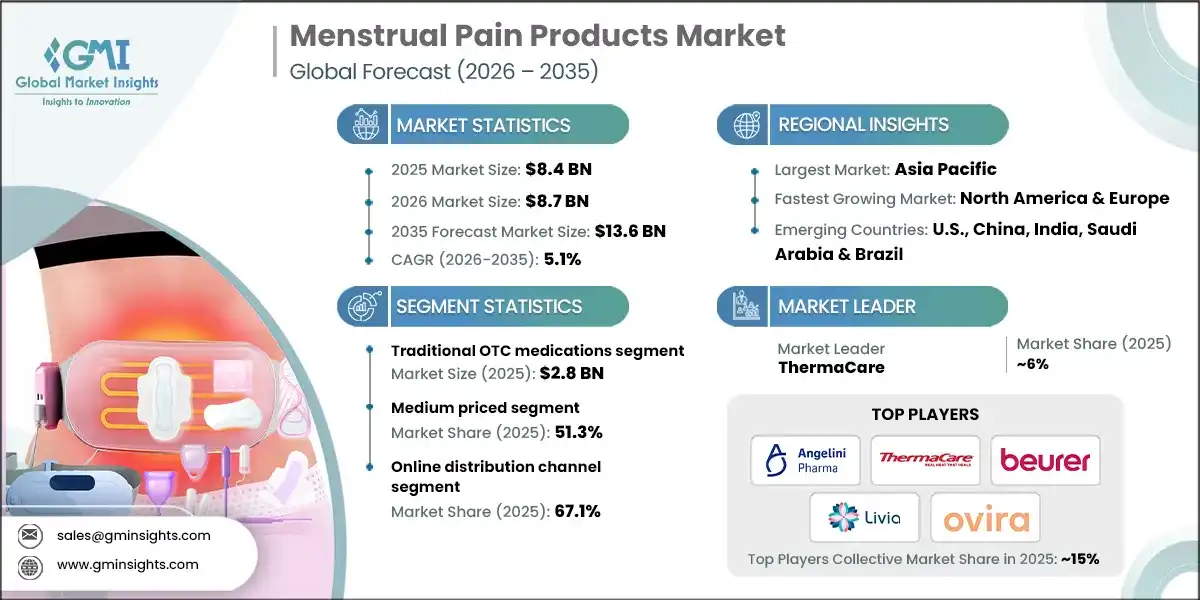
The global menstrual pain products market was estimated at USD 8.4 billion in 2025. The market is expected to grow from USD 8.7 billion in 2026 to USD 13.6 billion in 2035, at a CAGR of 5.1%, according to latest report published by Global Market Insights Inc.
Menstrual Pain Products Market Key Takeaways
Market Size & Growth
- 2025 Market Size: USD 8.4 Billion
- 2026 Market Size: USD 8.7 Billion
- 2035 Forecast Market Size: USD 13.6 Billion
- CAGR (2026–2035): 5.1%
Regional Dominance
- Largest Market: Asia Pacific
- Fastest Growing Region: North America & Europe
Key Market Drivers
- Rising dysmenorrhea prevalence & health awareness.
- Shift toward non-pharmaceutical & natural solutions.
- Increasing inclination towards adoption of organic and eco-friendly menstrual products.
Challenges
- Social challenges associated with menstruation and its products in developing countries.
- Adverse effects of menstrual products on the environment.
Opportunity
- Natural, herbal & eco-friendly products.
- Personalized & digital health integration.
Key Players
- Market Leader: ThermaCare led with over 6% market share in 2025.
- Leading Players: Top 5 players in this market include Angelini Pharma, ThermaCare, Beurer, Livia (iPulse Medical), Ovira, which collectively held a market share of 15% in 2025.
Get Market Insights & Growth Opportunities
- Multiple aspects are leading to the growth of the menstrual pain products market, including changes in consumer behavior and health focus over time. The most significant contributing factor is the rise in the incidence of dysmenorrhea reported in women worldwide. The American College of Obstetricians and Gynecologists (ACOG) estimates that dysmenorrhea occurs in approximately 50% to 90% of menstruating women. Many women are now affected by conditions related to their menstrual cycles, such as having extreme cramps during their periods, endometriosis and fibroids, which has created an increase in women looking for effective means to reduce their menstrual pain.
- Additionally, increased awareness around health issues related to" menstruation, combined with ongoing efforts to educate women about their bodies and the stigma associated with menstruation, has led to women feeling empowered to take responsibility for their menstrual care and overall menstrual health through using specialty products that provides pain relief related to their menstrual experiences.
- Additionally, as consumers grow increasingly aware of the health consequences associated with pharmaceuticals, more people are seeking natural and non-drug therapies to relieve pain. A number of products, including heat packs, transcutaneous electrical nerve stimulation (TENS) devices which are worn on the body, herbal products, as well as other non-drug methods are becoming increasingly popular. Consumers are looking for safe and convenient way to relieve pain that match their desire for an individualized approach to wellness. For example, current research published in the Journal of Pain Research indicates that TENS therapy can reduce menstrual discomfort by up to 50%.
- In addition, there has been an increase in demand for eco-friendly and organic menstrual supplies due to the uptick in environmental awareness and the desire for more sustainable products. Consumers are looking for products made of biodegradable materials as well as organic and clean-label ingredients. Each year there is over 200,000 tons of waste created by menstrual products according to the United Nations Environmental Programme (UNEP), so it is important to create sustainable options. Products that use plant-based components and have eco-friendly packaging will have the competitive advantage as sustainability will be a key factor for consumers when they decide what products to purchase along with comfort and effectiveness. Young consumers are driving this change because they are likely to make purchases based on the impact that their purchases have on the Earth's environment.
- Ultimately, there is continued support for growth in the market because of the increase in health consciousness, the trend from chemical-based to natural alternatives as well as the increased demand by consumers for sustainable choices. All of these elements together with continued innovation and the increasing awareness of consumers will continue to drive the growth of this market through the forecast period.
To get key market trends
Menstrual Pain Products Market Trends
- Technological advancements and an increased focus on sustainability are changing the way we think about the market. However, arguably the biggest trend in this sector is the increasing use of transcutaneous electrical nerve stimulation (TENS) and other wearable bio electrotherapy solutions. These innovative and non-invasive products offer women an alternative to the use of medications for relieving menstrual pain by providing drug-free options for relief.
- Manufacturers have incorporated a variety of features into their devices to maximize the user experience, such as a compact and portable size, a design that allows you to wear it under normal clothing, and the ability to link functionality with applications on your phone or tablet. Users can set the level of stimulation they wish to receive, and this instills a sense of trust and confidence in the customer when they purchase a device that meets their needs.
- At the same time, there is an increase in the interest by women in the use of organic and eco-friendly menstrual products. As our society has become more cognizant of the harmful effects that typical menstrual products have on the environment, and with more attention focused on our own personal health than before, women have begun to look for biodegradable and organic certified menstrual product options. And because of this growing demand, many companies have begun producing menstrual care products that contain more sustainable packaging and use plant-based components to keep in step with the global trend toward environmentally friendly living.
- This new trend to use eco-friendly and organic ingredients and sustainable packaging not only helps to solve some of the most urgent environmental challenges of today, but it also serves the needs of the growing segment of consumers who prioritize safety and natural formulations for their menstrual care products. Companies' focus on using “clean-label” formulations and renewable resources emphasizes their commitment to keeping pace with changing consumer expectations and providing the best products for environmentally and health-conscious consumers.
Menstrual Pain Products Market Analysis
Learn more about the key segments shaping this market
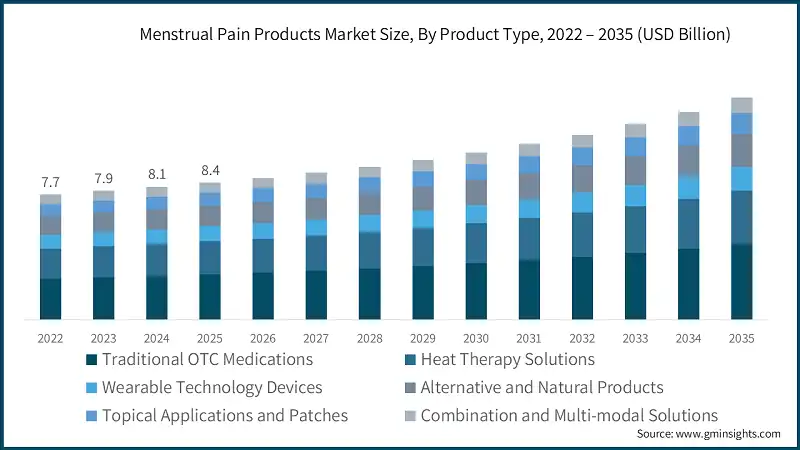
Based on product type, the menstrual pain products market is categorized into traditional OTC medications, heat therapy solutions, wearable technology devices, alternative and natural products, topical applications and patches along with combination and multi-modal solutions. The traditional OTC medications accounted for revenue of around USD 2.8 billion in 2025 and is anticipated to grow at a CAGR of 5.5% from 2026 to 2035.
- These products, including nonsteroidal anti-inflammatory drugs (NSAIDs) and analgesics, remain the first line of treatment for menstrual cramps due to their proven efficacy and quick relief. High consumer trust established brand presence, and easy accessibility through pharmacies and retail channels further reinforce their dominance.
- Additionally, OTC medications benefit from strong regulatory acceptance and minimal barriers to purchase compared to prescription drugs or advanced devices. In emerging markets, where awareness of alternative solutions is still developing, OTC painkillers continue to be the most preferred option. The convenience of self-administration and the ability to manage symptoms without medical consultation also contribute to sustained demand.
Based on price of menstrual pain products market consists of low, medium and high. The medium priced emerged as leader and held 51.3% of the total market share in 2025 and is anticipated to grow at a CAGR of 5.8% from 2026 to 2035.
- These products typically offer better durability, comfort, and effectiveness compared to low-priced alternatives, while remaining accessible to price-sensitive buyers who may not opt for premium solutions. Medium-priced options often include advanced features such as reusable heat therapy patches, basic wearable devices, and herbal-based topical applications, which provide added value without the high cost of premium products.
- Additionally, this segment benefits from strong distribution through retail and e-commerce channels, as well as effective marketing strategies that position these products as reliable yet reasonably priced solutions. Consumers seeking a combination of performance, convenience, and cost-effectiveness tend to gravitate toward this category, ensuring its continued leadership and steady growth in the forecast period.
Learn more about the key segments shaping this market
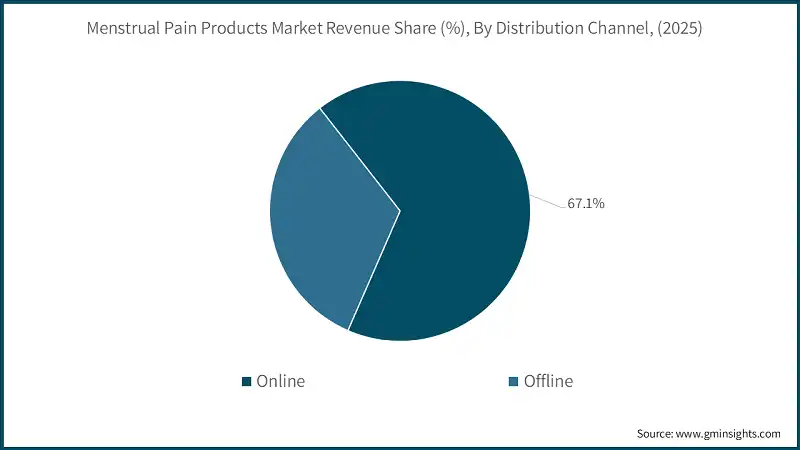
Based on distribution channel of menstrual pain products market consists of online and offline. The online distribution channel emerged as leader and held 67.1% of the total market share in 2025 and is anticipated to grow at a CAGR of 6% from 2026 to 2035.
- The rapid growth of e-commerce platforms and digital marketplaces has significantly improved accessibility, allowing consumers to purchase a wide range of products conveniently from home. Online channels offer extensive product variety, competitive pricing, and attractive discounts, which appeal to cost-conscious buyers.
- Additionally, the rise of direct-to-consumer brands and subscription models has strengthened the online presence of menstrual pain products, providing personalized solutions and recurring delivery options. Enhanced digital marketing strategies, influencer collaborations, and social media campaigns have further boosted consumer engagement and trust in online platforms.
Looking for region specific data?
North America Menstrual Pain Products Market
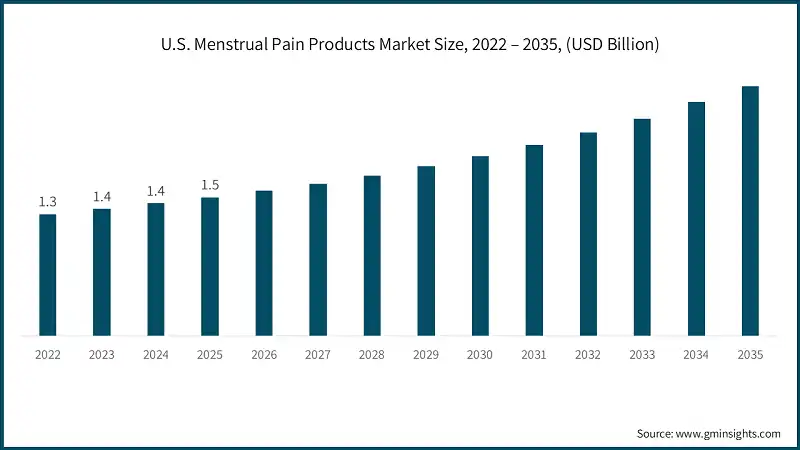
The U.S. dominates an overall North America market and valued at USD 1.5 billion in 2025 and is estimated to grow at a CAGR of 6.2% from 2026 to 2035.
- A high prevalence of menstrual disorders such as dysmenorrhea, combined with growing health awareness, has led to increased demand for effective pain management solutions. Consumers are increasingly opting for non-pharmaceutical alternatives like TENS devices, heat therapy patches, and wearable technologies, driven by concerns over medication side effects and a preference for holistic care. The country’s advanced healthcare infrastructure and strong purchasing power further support the adoption of innovative products.
- Additionally, the rise of e-commerce platforms, telehealth services, and app-integrated smart devices has improved accessibility and personalized user experiences. Continuous technological advancements, supported by robust R&D and strategic collaborations among med-tech companies and healthcare providers, are introducing feature-rich, convenient, and eco-conscious solutions.
Europe Menstrual Pain Products Market
In the European market, Germany is expected to experience significant and promising growth from 2026 to 2035.
- The country’s advanced healthcare infrastructure and high per-capita healthcare expenditure have laid a solid foundation for adopting innovative wellness solutions tailored to women. Within the vibrant FemTech ecosystem, Germany stands out with robust investments in digital health, thanks to supportive regulatory frameworks like the Digital Health Care Act and reimbursement pathways for approved medical devices. This environment nurtures the introduction of innovative technologies such as wearable TENS pain relief devices and app-integrated heat therapy systems. German consumers, increasingly health-conscious and tech-savvy, show strong preference for personalized, non-pharmaceutical pain management tools, creating demand for convenient, discreet, over-the-counter devices.
- Furthermore, Germany’s leadership in digital menstruation tracking with one of Europe’s fastest-growing menstrual health app markets reflects a receptive audience for connected products that enhance user experience and engagement.
Asia Pacific Menstrual Pain Products Market
In the Asia Pacific market, the China held 31.4% market share in 2025 and is anticipated to grow at a CAGR of 6.3% from 2026 to 2035.
- The country has a large population of women of reproductive age, creating a substantial consumer base for menstrual health solutions. Rising awareness about menstrual wellness, supported by government initiatives and social campaigns, is reducing stigma and encouraging adoption of pain relief products. Rapid urbanization and increasing disposable incomes have boosted demand for premium and innovative solutions, including wearable devices, heat therapy patches, and herbal remedies.
- Additionally, China’s strong e-commerce ecosystem and digital health platforms make menstrual pain products easily accessible, while tech-savvy consumers are embracing smart, app-connected devices for personalized care. The growing preference for natural and eco-friendly products aligns with broader sustainability trends, prompting brands to introduce organic and biodegradable options.
Middle East and Africa Menstrual Pain Products Market
In the Middle East and Africa market, Saudi Arabia held 25.9% market share in 2025 promising growth from 2026 to 2035.
- Increasing awareness about women’s health and wellness, supported by government initiatives and educational campaigns, is reducing cultural stigma around menstruation and encouraging adoption of pain relief solutions. Rising disposable incomes and a growing urban population are driving demand for premium and innovative products such as heat therapy patches, wearable TENS devices, and herbal remedies. The country’s strong digital infrastructure and rapid expansion of e-commerce platforms make these products more accessible, while tech-savvy younger consumers are showing preference for smart, connected devices that offer convenience and personalization.
Menstrual Pain Products Market Share
- In 2025, the prominent manufacturers in market are Angelini Pharma, ThermaCare, Beurer, Livia (iPulse Medical) and Ovira collectively held the market share of ~15%.
- Angelini Pharma maintains its competitive edge by leveraging its extensive pharmaceutical expertise and dedicating significant resources to developing evidence-based solutions specifically tailored for menstrual pain. The company actively invests in research and development initiatives aimed at improving the efficacy of its analgesic products while simultaneously expanding its consumer healthcare portfolio to address a broader range of needs. By fostering strategic collaborations and forming partnerships with key stakeholders, Angelini Pharma successfully integrates innovative therapies into its offerings, ensuring a strong and consistent presence in both the prescription and over-the-counter markets. This approach enables the company to meet evolving consumer demands while maintaining its leadership position in the industry.
- ThermaCare continues to lead the market by consistently innovating within the realm of heat therapy technology, setting a benchmark for effective pain relief solutions. The brand’s patented air-activated heat wraps are designed to provide prolonged and deep heat, delivering targeted relief for menstrual pain. By focusing on enhancing product comfort, improving flexibility, and creating discreet designs, ThermaCare ensures its products align with consumer preferences and expectations. Additionally, the brand invests in refining its heat-cell formulations and developing ergonomic packaging solutions, further solidifying its reputation as a trusted name in menstrual pain management. These ongoing advancements enable ThermaCare to remain a preferred choice for consumers seeking reliable and effective pain relief options.
Menstrual Pain Products Market Companies
Major players operating in the menstrual pain products market include:
- Angelini Pharma
- Beurer
- Bridges CHC
- Chiaro Technology
- Cora
- Livia by iPulse Medical
- Matri
- Meyer Organics
- Nua
- Ovira
- Sirona Hygiene
- SteadySense
- Sumitomo Pharma America
- ThermaCare
- Thermaissance
- Welme
Beurer distinguishes itself in the market by offering innovative multifunctional devices that combine TENS electrotherapy with heat therapy, providing comprehensive solutions for pain relief. Products such as the EM 50 “Menstrual Relax” are equipped with features like adjustable intensity levels, rechargeable batteries, and intuitive, user-friendly designs, making them accessible and convenient for a wide range of users. Beurer places a strong emphasis on integrating smart technology and ensuring clinical validation for its products, which underscores its commitment to delivering safe, drug-free alternatives for pain management. This focus on innovation and reliability positions Beurer as a prominent leader in the wellness technology space, catering to the growing demand for advanced and effective solutions.
Livia differentiates itself in the competitive landscape through its proprietary SmartWave technology, which is engineered to deliver rapid and clinically validated pain relief. The wearable device is designed with a compact and discreet form factor, ensuring convenience and ease of use for consumers. Key features such as extended battery life and portability further enhance its appeal, making it a practical choice for individuals seeking non-invasive solutions. Livia strengthens its market position by securing regulatory approvals, offering subscription-based models, and implementing a branding strategy that emphasizes empowerment and innovation. By focusing on these aspects, Livia successfully addresses the needs of modern consumers while establishing itself as a leader in the menstrual pain management market.
Menstrual Pain Products Market Report Attributes
| Key Takeaway | Details |
|---|---|
| Market Size & Growth | |
| Base Year | 2025 |
| Market Size in 2025 | USD 8.4 Billion |
| Market Size in 2026 | USD 8.7 Billion |
| Forecast Period 2026 - 2035 CAGR | 5.1% |
| Market Size in 2035 | USD 13.6 Billion |
| Key Market Trends | |
| Drivers | Impact |
| Rising dysmenorrhea prevalence & health awareness | Boosts demand for effective pain relief solutions and accelerates adoption of specialized menstrual care products globally. |
| Shift toward non-pharmaceutical & natural solutions | Drives innovation in wearable devices, heat therapy, and herbal remedies, reducing reliance on traditional medications. |
| Increasing inclination towards adoption of organic and eco-friendly menstrual products | Encourages brands to invest in sustainable materials and clean-label formulations, creating strong differentiation in the market. |
| Pitfalls & Challenges | Impact |
| Social challenges associated with menstruation and its products in developing countries | Limits product penetration and awareness, slowing growth in emerging markets despite rising health needs. |
| Adverse effects of menstrual products on the environment | Pushes companies to rethink packaging and materials, increasing production costs and regulatory scrutiny. |
| Opportunities: | Impact |
| Natural, herbal & eco-friendly products | Opens new premium segments and strengthens brand loyalty among health-conscious and sustainability-driven consumers. |
| Personalized & digital health integration | Creates scope for smart, app-connected devices and subscription models, enhancing user engagement and recurring revenue. |
| Market Leaders (2025) | |
| Market Leaders |
Market share of ~6% |
| Top Players |
|
| Competitive Edge |
|
| Regional Insights | |
| Largest Market | Asia Pacific |
| Fastest growing market | North America & Europe |
| Emerging countries | U.S., China, India, Saudi Arabia & Brazil |
| Future outlook |
|
What are the growth opportunities in this market?
Menstrual Pain Products Industry News
- In January 2025, Ovira broadened its offerings with the Noha wearable TENS device, which boasts dual electrode pads for pinpointed pain relief, a lightweight design for discreet use, and a 100-day trial to foster consumer trust and engagement.
- In March 2024, Angelini Pharma bolstered its consumer pain-relief segment by acquiring global rights to the ThermaCare heat-wrap portfolio, excluding North America. The acquisition encompassed advanced heat-cell technology and manufacturing capabilities, paving the way for product innovation and broader distribution.
- In July 2024, ThermaCare revamped its Menstrual Pain Therapy HeatWraps, introducing an ultra-thin design, a stronger adhesive for better placement, and an extended heat duration of eight hours, ensuring discreet and comfortable use throughout daily activities.
- In September 2024, Beurer unveiled the EM 50 and EM 55 Menstrual Relax devices, merging adjustable heat therapy with TENS electrostimulation. These portable, rechargeable devices boast multiple intensity settings, ergonomic pads, and a compact design for added convenience.
- In November 2024, Livia rolled out its next-gen wearable device, featuring advanced micro-pulse technology, longer battery life, and a subscription model for gel pad refills. The redesigned device prioritizes comfort, portability, and syncs with mobile health apps for tailored pain management.
The menstrual pain products market research report includes in-depth coverage of the industry, with estimates & forecast in terms of revenue (USD Billion) and volume (Million Units) from 2022 to 2035, for the following segments:
Market, By Product Type
- OTC pharmaceuticals
- NSAIDs
- Analgesics
- Antispasmodics
- Topical pain relief
- Menthol-based creams and gels
- Lidocaine creams
- Capsaicin patches
- CBD-infused balms and roll-ons
- Heat therapy products
- Disposable heat patches
- Microwaveable heat packs
- Electric heating pads
- Wearable heat belts
- Wearable pain relief devices
- TENS units
- Smart belts with heat/vibration
- App-connected devices
- Herbal & natural remedies
- Herbal teas
- Essential oil roll-ons
- Supplements
- Combination & multi-modal solutions
Market, By Usage
- Preventive use
- Acute pain relief
- Chronic pain management
- On-the-go relief
Market, By Price
- Low
- Medium
- High
Market, By Age Group
- Adult women
- Teen girls
Market, By Distribution Channel
- Online
- E-commerce
- Company website
- Offline
- Mega retail stores
- Health & wellness stores
- Subscription services
- Pharmacies and drugstores
- Others
The above information is provided for the following regions and countries:
- North America
- U.S.
- Canada
- Europe
- Germany
- UK
- France
- Italy
- Spain
- Asia Pacific
- China
- Japan
- India
- South Korea
- Australia
- Indonesia
- Malaysia
- Latin America
- Brazil
- Mexico
- Argentina
- MEA
- Saudi Arabia
- UAE
- South Africa
Frequently Asked Question(FAQ) :
What was the market size of the menstrual pain products market in 2025?
The market size was USD 8.4 billion in 2025, with a CAGR of 5.1% expected through 2035, driven by technological advancements and increasing demand for sustainable and innovative solutions.
What is the projected value of the menstrual pain products market by 2035?
The market is expected to reach USD 13.6 billion by 2035, fueled by the adoption of wearable bioelectrotherapy devices and the rising preference for organic and eco-friendly menstrual products.
What was the revenue generated by traditional OTC medications in 2025?
Traditional OTC medications generated approximately USD 2.8 billion in 2025 and are anticipated to grow at a CAGR of 5.5% from 2026 to 2035.
What was the market share of the online distribution channel in 2025?
The online distribution channel held 67.1% of the total market share in 2025 and is projected to grow at a CAGR of 6% through 2035.
Which region dominated the menstrual pain products market in 2025?
The U.S. dominated the North American market, valued at USD 1.5 billion in 2025, and is estimated to grow at a CAGR of 6.2% from 2026 to 2035.
What are the key trends in the menstrual pain products market?
Key trends include the increasing adoption of wearable bioelectrotherapy devices, a shift towards organic and biodegradable menstrual products, and the integration of mobile app connectivity in pain relief devices.
Who are the major players in the menstrual pain products market?
Major players include Angelini Pharma, Beurer, Bridges CHC, Chiaro Technology, Cora, Livia by iPulse Medical, Matri, Meyer Organics, Nua, and Ovira.
Menstrual Pain Products Market Scope
Related Reports