Summary
Table of Content

Men’s Luxury Bag Market
Get a free sample of this report
Form submitted successfully!
Error submitting form. Please try again.
Thank you!
Your inquiry has been received. Our team will reach out to you with the required details via email. To ensure that you don't miss their response, kindly remember to check your spam folder as well!
Request Sectional Data
Thank you!
Your inquiry has been received. Our team will reach out to you with the required details via email. To ensure that you don't miss their response, kindly remember to check your spam folder as well!
Form submitted successfully!
Error submitting form. Please try again.
Men’s Luxury Bag Market Size
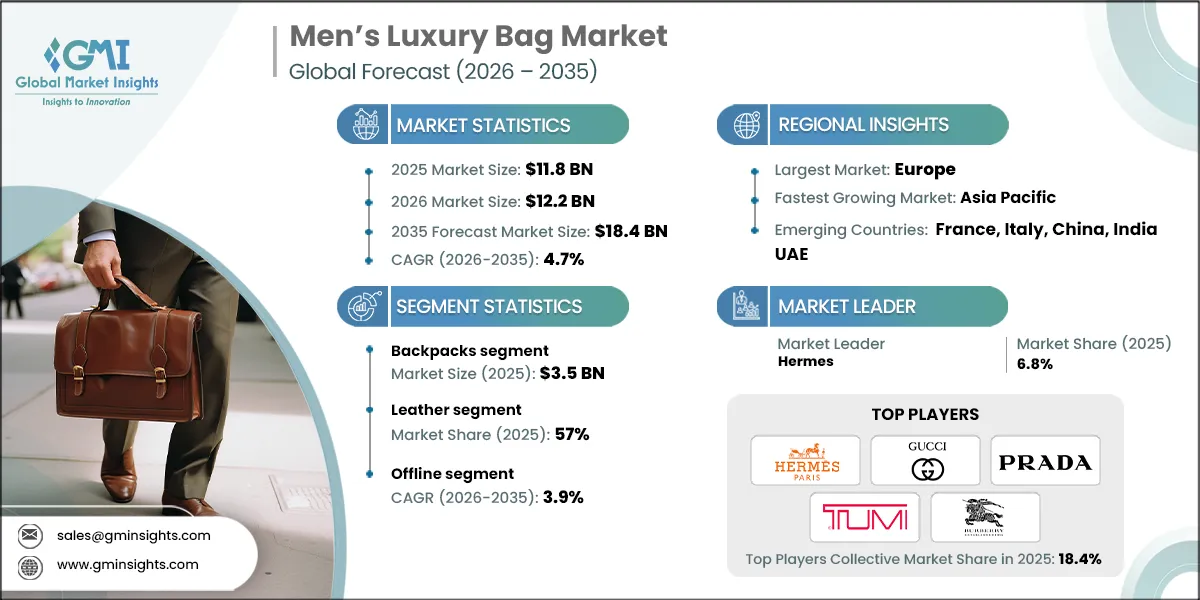
The global men’s luxury bag market was estimated at USD 11.8 billion in 2025. The market is expected to grow from USD 12.2 billion in 2026 to USD 18.4 billion in 2035, at a CAGR of 4.7% according to latest report published by Global Market Insights Inc.
Men’s Luxury Bag Market Key Takeaways
Market Size & Growth
- 2025 Market Size: USD 11.8 Billion
- 2026 Market Size: USD 12.2 Billion
- 2035 Forecast Market Size: USD 18.4 Billion
- CAGR (2026–2035): 4.7%
Regional Dominance
- Largest Market: Europe
- Fastest Growing Region: Asia Pacific
Key Market Drivers
- Increasing disposable income among consumers, particularly in emerging economies.
- Expanding product portfolios by luxury brands to cater to male consumers.
Challenges
- The high cost of luxury bags limits their affordability, restricting market penetration among middle-income groups.
- Counterfeit products in the market pose a significant challenge to brand reputation and revenue generation.
Opportunity
- Rising e-commerce platforms provide a convenient channel for luxury bag brands to reach a broader audience.
- Customization and personalization trends.
Key Players
- Market Leader: Hermes led with over 6.8% market share in 2025.
- Leading Players: Top 5 players in this market include Hermes, Gucci, Prada, Tumi, Burberry, which collectively held a market share of 18.4% in 2025.
Get Market Insights & Growth Opportunities
The market for luxury bags in men is growing because of the change in consumer behavior and increased expenditure. It has been observed that over the years, luxury bags have shifted from a female-dominated item to a unisex item in which men have also actively opted for luxury bags to express style and utility. This has paved the way for luxury brands to enter the market with collections specific to men.
Increased urbanization and the popularity of social media have also contributed to the growing demand for luxury baggage for men. Social media sites have significantly influenced the behavior of the modern-day consumer, as celebrities endorse high-end brands, leading to heightened popularity among the generation.
LoopMe, an advertising performance upgrade firm for brands, discovers that a significant number (70%) of American consumers purchase luxury goods or clothing every year, with a third of them spending over $1000.
However, further analysis also shows that for such luxury consumers, an experience in the shop will be most desirable as 57% want to purchase luxury products from an actual shopping store. Even though companies such as Amazon have penetrated the market for luxury products, it has been found that 30% of customers want to purchase luxury products directly from the retailer themselves, along with 27% wanting to purchase products through department stores/secondary retailers.
In addition, the rising awareness about sustainability has resulted in more luxury bags made using eco-friendly materials, thus attracting more sustainable-conscious customers. Technological advancements, especially related to e-commerce, have also positively affected this market as customers can now access a broad range of luxury bags through online shopping platforms. The online shopping experience, coupled with exclusive deals, has made this market even more alluring.
To get key market trends
Men’s Luxury Bag Market Trends
- Among the recent fashion trends that are currently trending within the luxury bags for men industry is the increase in popularity of gender-neutral designs. Gender-neutral designs are mostly focused on functionality and style, which appeals to the upward mobile consumer who is looking at versatility.
- Another trend that is worth mentioning is the increasing attention given to sustainability. Luxury brands have started incorporating eco-friendly practices such as the use of recycled materials and eco-friendly production processes, giving increasing awareness towards the conservation of the planet on the part of the targeted market.
- Customization and personalization are also emerging trends within the market. Customers are looking for customized products that showcase their personality, thereby encouraging companies to provide these customized services, which include monogramming and customized designs.
- In addition, the incorporation of technology into high-end bags is emerging as one of the important trends. Tech bags that come equipped with functionalities such as wireless charging, GPS tracking, and anti-theft are finding favor with tech-friendly consumers.
- Technology and design come together as the bags have been designed keeping in mind the requirements of the technologically advanced lifestyle of the consumers.
- Influence associated with social media as well as celebrity endorsement has been affecting consumer behavior. Celebrity collaborations and endorsements associated with luxury brands have been acting as drivers of the luxury shopping scene. Additionally, the development of e-commerce sites has ensured that luxury handbags become more accessible to the target audience.
Men’s Luxury Bag Market Analysis
Learn more about the key segments shaping this market
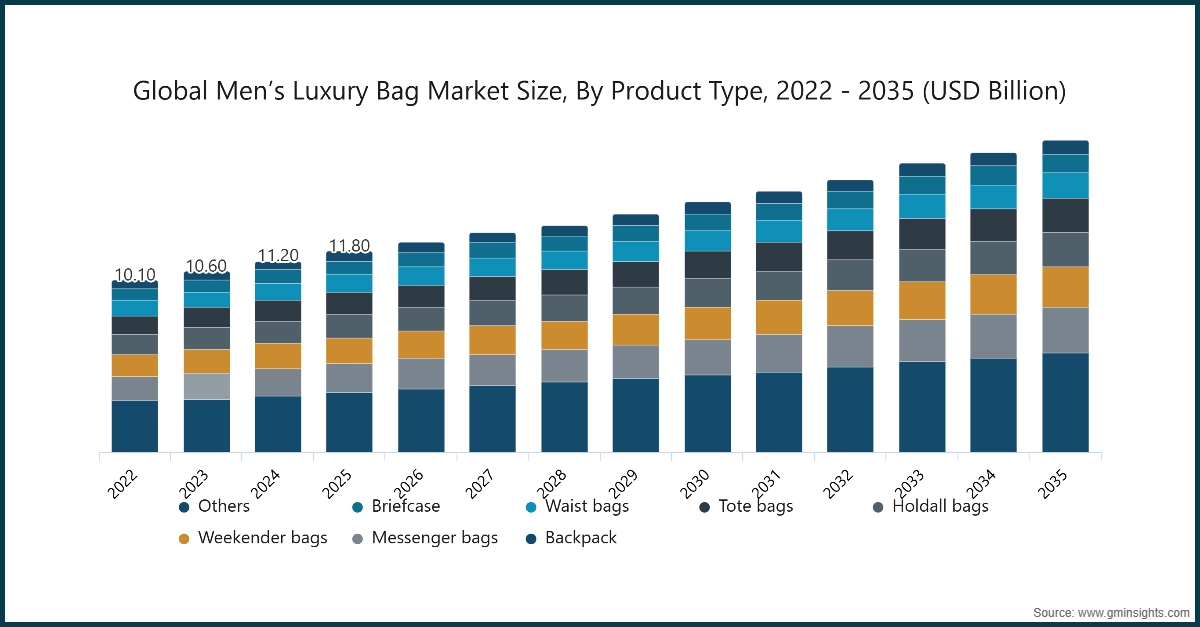
Based on the product type, the men’s luxury bag market is divided into backpacks, messenger bags, weekender bags, holdall bags, tote bags, waist bags, briefcase and others. In 2025, backpacks dominated the market generating revenue of USD 3.5 billion and expected to grow at a CAGR of 5.3% during the forecast period.
- The demand for luxury backpacks is growing, thanks to their versatility and their acceptance among the youth crowd. Luxury backpacks use both function and style, making them a popular choice for both professional and casual use.
- The messenger bags segment is also growing significantly because of its utility and fashionable looks. These are preferred by professionals and students for their ability to hold their required accessories while having a slim look.
- The luxury tote bag category is growing at a fast rate because of its versatility. The demand for such bags is rising as they are able to transform from formal to informal functions. The increasing demand for gender-neutral designs and eco-friendly material has also added to their popularity.
Learn more about the key segments shaping this market
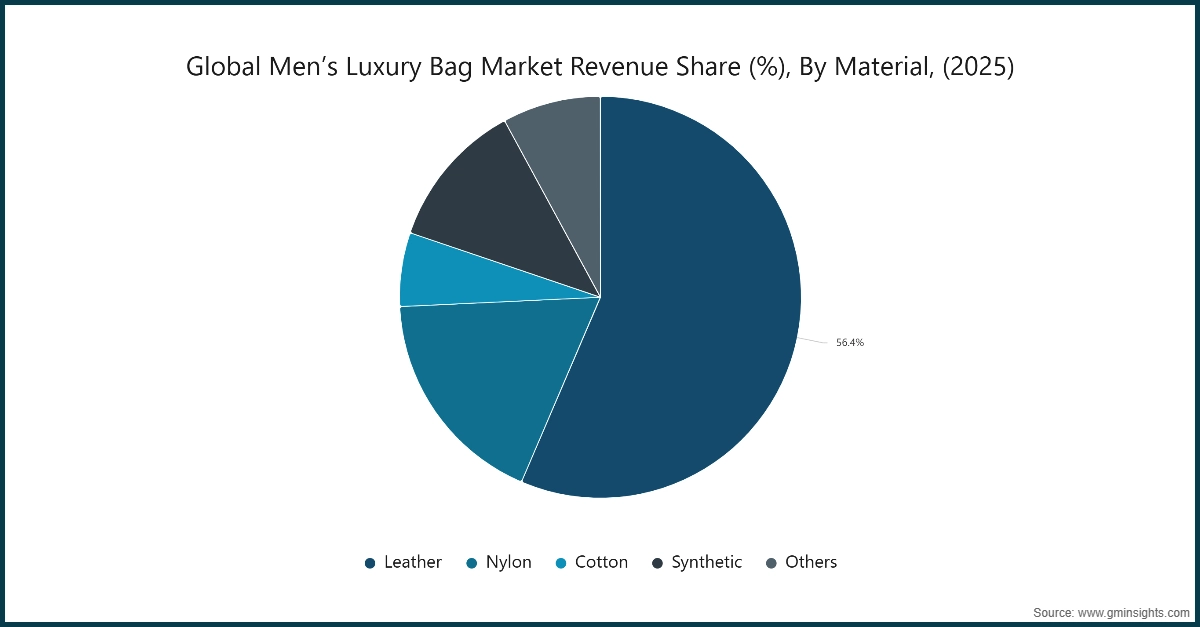
Based on material, the men’s luxury bag market is segmented into leather, nylon, cotton, synthetic and others. In 2025, leather segment dominates the market with 57% market share, and the segment is expected to grow at a CAGR of 4.9% from 2026 to 2035.
The leather category has been and still is the leader in the market for men's luxurious bags because of the quality and appeal associated with leather bags. It is also very long-lasting and stylish as compared to other bags.
- The nylon segment has been gaining momentum in the luxury bags for men category owing to its light, water-resistant, as well as versatile features. The nylon segment is also likely to experience growth as a result of demands for functionality as well as style in bags that can also cater to daily needs.
- Nylon handbags are also gaining traction among younger generations, as they value convenience without having to comprise on designs. The rising demand for recyclable nylon luxury handbags is also helping to drive this market.
Based on distribution channel, the men’s luxury bag market is segmented into online and offline. In 2025, the offline segment dominates the market and is expected to grow at a CAGR of 3.9% from 2026 to 2035.
- The offline retail industry remains an important part of the luxury bags market among men, where consumers like to check the merchandise physically prior to making the purchase. The luxury shopping experience provided by the retail stores and branded outlets of the products is an added advantage to the consumers.
- The online portion of the men’s luxury handbag industry is experiencing strong growth due to the rising adoption of e-commerce platforms. The adoption of advanced technologies such as augmented reality (AR) for try-on purposes is further bolstering its growth.
Looking for region specific data?
North America Men’s Luxury Bag Market
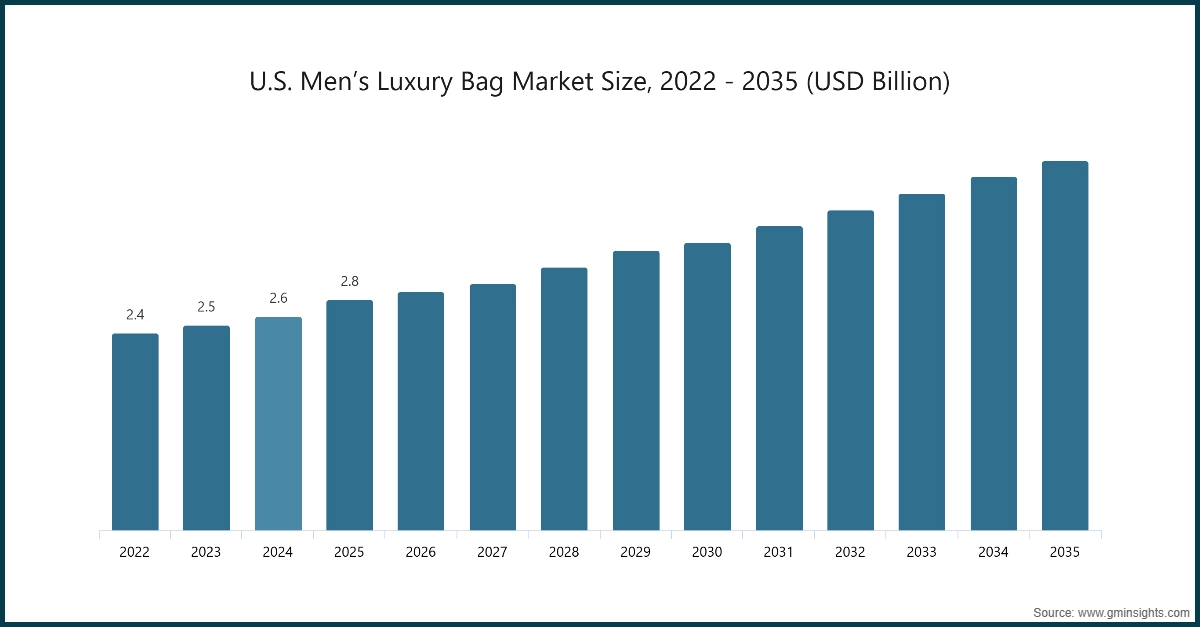
In terms of country, the U.S. led the men’s luxury bag industry with 80% of the North American market share and estimated USD 2.8 billion in revenue during 2025.
- Factors which drive the growth of the luxury bag market for men in the U.S. include consumer behavior as well as increased spending capability. The demand for luxury and quality products has significantly increased, especially among the young generation.
- Cities like New York, Los Angeles, and Chicago are at the forefront of this growth, due to their concentrated wealthy consumer base as well as their fashion-conscious culture. Online shopping portals have also increased the accessibility of luxury bags, allowing brands to reach a wider consumer base across the country.
- Regional growth is also aided by the rise of influence marketing through social networks as this has contributed to greater visibility for the brand.
- The Southern and Western parts of the United States of America are also experiencing steady growth due to increased urbanization and an increasing trend towards luxury products.
Europe Men’s Luxury Bag Market
The Europe market was valued at USD 3.7 billion in 2025 and is projected to grow at a CAGR of 4.5% between 2026 and 2035.
- The market for luxury bags among European males is growing steadily with growing expenditure on high-quality products and a rise in demand for high-quality fashion accessories. Western Europe is a significant market for luxury bags in men's accessories due to the popularity of luxury brands in this region.
Asia Pacific Men’s Luxury Bag Market
The Asia Pacific market was valued at USD 3.1 billion in 2025 and is projected to grow at a CAGR of 5.1% between 2026 and 2035.
- Rise in disposable income, fashion trends, and the increasing desire for luxury products among male consumers are boosting this market. The rise in awareness of luxury brands in nations such as China, India, and Japan has also proved to be an important factor in increasing demand for luxury male grooming products in these markets.
Middle East and Africa Men’s Luxury Bag Market
The Middle East and Africa market was valued at USD 698.3 million in 2025 and is projected to grow at a CAGR of 3.8% between 2026 and 2035.
- Regions such as the UAE, Saudi Arabia, and South Africa are important participants in this growth, with a rising demand for quality and branded luxury handbags. The development of the retail environment within the region, combined with the impact of global fashion trends, also contributes to this growth.
Men’s Luxury Bag Market Share
- The top 5 companies in the men’s luxury bag industry are Hermes, Gucci, Prada, Tumi, and Burberry collectively hold a share of 18.4% in the market.
- These companies continue to acquire and merge with others, expand facilities, and make various collaborations to increase their product offerings, access customer bases, and secure their market positions.
- The market position of Hermès is maintained by its skills and classic designs. The company puts more focus on exclusiveness by limiting production and providing customized designs. Additionally, Hermès maintains its position in the market by increasing distribution in strategic markets and positioning iconic products like Birkin and Kelly bags among males.
- Prada improves its market share through innovation and sustainability in its men's luxury bags. Prada uses eco-friendly materials and innovative designs to capture the hearts of environmentally concerned consumers. Prada also invests in digital marketing campaigns and unique in-store experiences to boost client loyalty and brand awareness.
Men’s Luxury Bag Market Companies
Major players operating in the men’s luxury bag industry are:
- Bottega Veneta
- Burberry
- Chanel
- Fendi
- Gucci
- Hermes
- Louis Vuitton
- Prada
- Ralph Lauren
- Salvatore Ferragamo
- Tumi
- Valentino
- Versace
- Yves Saint Laurent (YSL)
- Zegna
To improve the product and market share key players are constantly investing in technological activities and are also entering into partnerships to provide improved and better solutions for the customers. These investments are benefiting both companies and customers as they help develop and offer solutions as per the changing technological trends and thus the customer requirements.
Chanel is a well-known luxury brand that has a reputation for its timeless designs and exquisite craftsmanship. The brand provides a variety of luxury bags for men that are a blend of functionality, sophistication, and cater to the demands of a contemporary consumer. The brand is also famous for its logo, luxury materials, and has always set a trend in the luxury industry.
Fendi is a renowned Italian luxury fashion house that is highly admired for its sophisticated designs and craftsmanship. The brand’s men’s luxury bags are made with finesse. They provide a perfect amalgamation of sophistication and functionality. The trademark elements, such as the FF logo, on the brand’s products make them highly desirable.
The House of Hermès is a French luxury goods brand that is known for sophistication, quality, and exclusivity. Hermès is famous for its hand-crafted men's luxury bags. These products are crafted from the finest materials available. However, Hermès always focuses on timeless design that appeals to their high-end clientele. This luxury goods maker is known for their focus on quality. Louis Vuitton is an established player in the luxury segment; it has an iconic monogram and unmatched quality. The company designs luxury bags for men that cater to consumers' needs of style and functionality. Louis Vuitton relies on its rich history and innovative designs to sustain itself as the leader in the market. The company focuses on marketing and expansion to ensure that it has a strong global footprint.
Men’s Luxury Bag Market Report Attributes
| Key Takeaway | Details |
|---|---|
| Market Size & Growth | |
| Base Year | 2025 |
| Market Size in 2025 | USD 11.8 Billion |
| Market Size in 2026 | USD 12.2 Billion |
| Forecast Period 2026-2035 CAGR | 4.7% |
| Market Size in 2035 | USD 18.4 Billion |
| Key Market Trends | |
| Drivers | Impact |
| Increasing disposable income among consumers, particularly in emerging economies | This is expected to significantly boost market growth as more consumers can afford premium products |
| Expanding product portfolios by luxury brands to cater to male consumers | This diversification is anticipated to attract a broader customer base, strengthen market presence, and improve revenue streams |
| Pitfalls & Challenges | Impact |
| The high cost of luxury bags limits their affordability, restricting market penetration among middle-income groups | This could slow down market expansion, particularly in price-sensitive regions, and limit the customer base |
| Counterfeit products in the market pose a significant challenge to brand reputation and revenue generation | This issue may erode consumer trust, reduce sales for authentic brands, and increase competition from fake products |
| Opportunities: | Impact |
| Rising e-commerce platforms provide a convenient channel for luxury bag brands to reach a broader audience | This is expected to enhance market accessibility, expand customer reach, and drive online sales growth |
| Customization and personalization trends | This could lead to higher customer loyalty, increased brand differentiation, and improved profit margins |
| Market Leaders (2025) | |
| Market Leader |
6.8% market share |
| Top Players |
Collective market share in 2025 is 18.4% |
| Competitive Edge |
|
| Regional Insights | |
| Largest Market | Europe |
| Fastest growing market | Asia Pacific |
| Emerging countries | France, Italy, China, India, UAE |
| Future outlook |
|
What are the growth opportunities in this market?
Men’s Luxury Bag Industry News
- In October 2025, Prada launched a metallic men's tote bag in India that went viral for its design, which closely resembles the flooring of Indian trains and buses, despite its INR 2.73 lakh price tag (USD 3,200).
- In July 2025, Louis Vuitton introduced an Indian auto rickshaw-shaped handbag. Part of its Men’s Spring/Summer 2026 collection has gone viral from Paris Fashion Week. The luxury item, estimated at INR 35 lakh (approx. USD 42,000) is sparking humorous online reactions for transforming a common utilitarian symbol into a high-fashion piece.
- In September 2024, Ralph Lauren introduces the ralph bag collection at its spring 25 show. This new family grabs inspiration from Ralph Lauren’s other passion, vintage cars. In fact, Lauren had a smattering of his personal collection outside of the show, tying the entire theme and inspiration together.
The men’s luxury bag market research report includes in-depth coverage of the industry with estimates & forecasts in terms of revenue (USD Billion) and volume (Thousand Units) from 2022 to 2035, for the following segments:
Market, By Product Type
- Backpack
- Messenger bags
- Weekender bags
- Holdall bags
- Tote bags
- Waist bags
- Briefcase
- Others (duffel bags etc.)
Market, By Material
- Leather
- Nylon
- Cotton
- Synthetic
- Others
Market, By Bag Size
- Small
- Medium
- Large
Market, By Bag Design
- Plain
- Printed
Market, By Distribution Channel
- Online
- E-commerce
- Company websites
- Offline
- Supermarkets/hypermarkets
- Specialty stores
- Others (mega retail stores, etc.)
The above information is provided for the following regions and countries:
- North America
- U.S.
- Canada
- Europe
- UK
- Germany
- France
- Italy
- Spain
- Netherlands
- Asia Pacific
- China
- India
- Japan
- South Korea
- Australia
- Latin America
- Brazil
- Mexico
- Argentina
- MEA
- South Africa
- Saudi Arabia
- UAE
Frequently Asked Question(FAQ) :
What is the men’s luxury bag market size in 2025?
The market size for men’s luxury bag was valued at USD 11.8 billion in 2025. The market's growth is driven by increasing disposable income and expanding product portfolios targeting male consumers.
What is the market size of the men’s luxury bag industry in 2026?
The market size for men’s luxury bags reached USD 12.2 billion in 2026, reflecting steady growth supported by rising demand for premium products and innovative designs.
What is the projected value of the men’s luxury bag market by 2035?
The market size for men’s luxury bags is expected to reach USD 18.4 billion by 2035, growing at a CAGR of 4.7%. This growth is fueled by increasing consumer awareness of branded products and the adoption of sustainable materials.
How much revenue did the backpack segment generate in 2025?
The backpack segment generated USD 3.5 billion in revenue in 2025, making it the leading product category. Its dominance is attributed to its versatility and growing popularity among younger consumers.
What is the growth outlook for the leather segment from 2026 to 2035?
The leather segment is projected to grow at a CAGR of 4.9% from 2026 to 2035. Increasing demand for high-quality materials and luxury craftsmanship is expected to drive this growth.
Which country led the men’s luxury bag market in North America in 2025?
The U.S. led the North American market in 2025, accounting for 80% of the regional market share and generating USD 2.8 billion in revenue. Its dominance is driven by high consumer spending on luxury goods and strong brand presence.
What are the upcoming trends in the men’s luxury bag industry?
Key trends include the rise of e-commerce platforms, customization and personalization of products, and the use of sustainable materials. Innovations in design and marketing strategies, such as celebrity endorsements, are also shaping the market.
Who are the key players in the men’s luxury bag market?
Key players include Hermes, Gucci, Prada, Tumi, and Burberry. These companies maintain a competitive edge through high-quality materials, innovative designs, and effective marketing strategies.
Men’s Luxury Bag Market Scope
Related Reports