Summary
Table of Content

Mediterranean Atmospheric Water Generator Market
Get a free sample of this report
Form submitted successfully!
Error submitting form. Please try again.
Thank you!
Your inquiry has been received. Our team will reach out to you with the required details via email. To ensure that you don't miss their response, kindly remember to check your spam folder as well!
Request Sectional Data
Thank you!
Your inquiry has been received. Our team will reach out to you with the required details via email. To ensure that you don't miss their response, kindly remember to check your spam folder as well!
Form submitted successfully!
Error submitting form. Please try again.
Mediterranean Atmospheric Water Generator Market Size
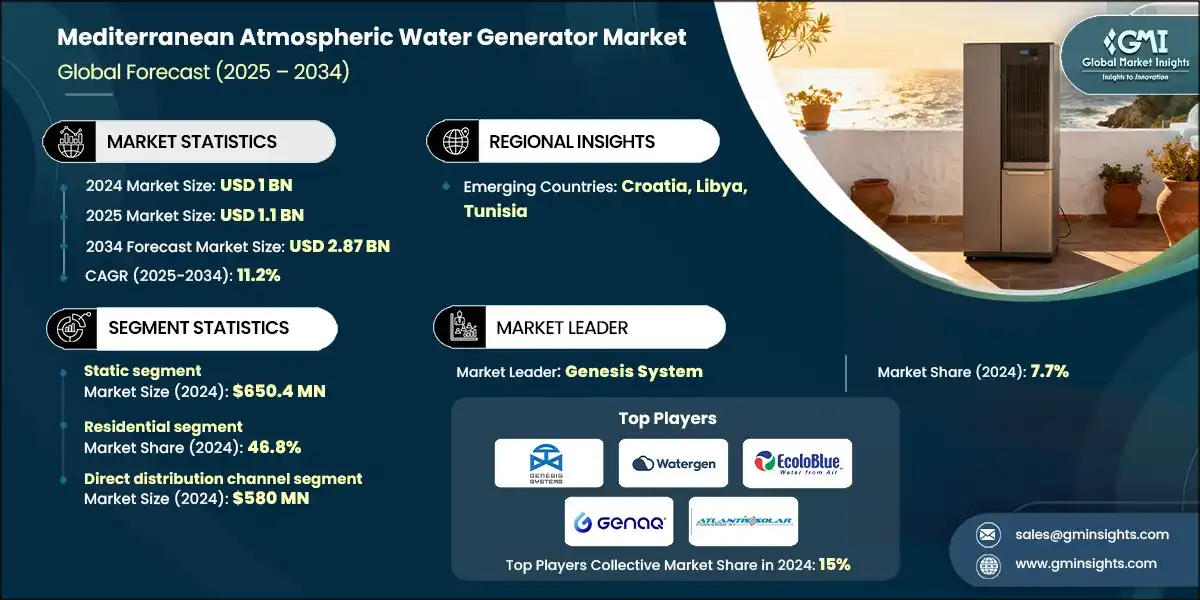
The Mediterranean atmospheric water generator market was estimated at USD 1 billion in 2024. The market is expected to grow from 1.1 billion in 2025 to USD 2.87 billion in 2034, at a CAGR of 11.2%.
Mediterranean Atmospheric Water Generator Market Key Takeaways
Market Size & Growth
- 2024 Market Size: USD 1 Billion
- 2025 Market Size: USD 1.1 Billion
- 2034 Forecast Market Size: USD 2.87 Billion
- CAGR (2025–2034): 11.2%
Key Market Drivers
- Acute freshwater scarcity.
- Mature cooling-condensation technology.
- Supportive regulatory environment.
Challenges
- High capital and energy requirements.
- Technical complexity and maintenance.
Opportunity
- Smart-home integration.
- Hybrid and renewable-powered systems.
Key Players
- Market Leader: Genesis System led with over 7.7% market share in 2024.
- Leading Players: Top 5 players in this market include Genesis System, Watergen, EcoloBlue, Genaq Technologies, Atlantis Solar, which collectively held a market share of 15% in 2024.
Get Market Insights & Growth Opportunities
The Mediterranean region deals with continuous water stress due to increasing temperature, unpredictable rainfall, and depleted aquifers. Countries including Spain, Italy, and Greece often face drought that burden civic water systems and food supply chains. The increase in water scarcity due to population growth and tourism creates a need to identify alternative water sources. Atmospheric water generators (AWGs) offer a decentralized way to produce drinking water from air, providing an alternative to conventional regional water systems.
Additionally, freshwater scarcity has become a strategic issue for both governments and businesses. Policy frameworks to encourage water sustainability and climate resilience are contributing to the growing adoption of AWGs in homes, hospitality, and industrial settings. As traditional water sources become more unreliable, AWGs provide a safeguard against supply shortages and are fast becoming a vital technology for addressing water security in the Mediterranean region.
Cooling-condensation continues to be AWG's leading technology based on performance and scalability. This technology uses refrigeration cycles to condense moisture from air and provides consistent water output in moderate to high humidity regions, which is often the case along the Mediterranean coast. Its maturity provides reliable operation, low operational risks possible with newly developed technologies, and the ease of integration with existing HVAC systems which are attractive attributes in both commercial and residential applications.
Ongoing advances in compressor design, heat exchange efficiency, and smart controls have further enhanced the optimization of cooling-condensation systems to further reduce energy use and increase cost efficiencies. As the manufacturers' advances incorporate IoTs for real-time monitoring and predictive maintenance these both improve convenience for the user and longevity of the system. These innovations solidify the relevant technology’s position in the marketplace and thus continue to support the technology's de facto role of AWG deployment in Mediterranean countries.
To get key market trends
Mediterranean Atmospheric Water Generator Market Trends
The Mediterranean atmospheric water generator (AWG) industry is experiencing gradual growth fueled by sustainability needs, technological innovation, and increasing concerns about water scarcity across the region. Manufacturers are emphasizing energy efficiency, renewable-powered systems, and smart integration to accommodate the region's environmental and infrastructure-related factors. Demand is shifting beyond residential applications into areas such as hospitality, agriculture, and disaster preparedness, which reflects growth of hybrid solutions and a diversified application.
- Energy use is likely the largest obstacle to AWG adoption in the Mediterranean, where electricity prices can be steep. To counter this, manufacturers are designing AWG systems that incorporate or are bundled with PV solar panels or wind turbines. A solar-assisted AWG can reduce energy usage by as much as 50%, providing an even more cost-effective and a greener solution. This correlates with EU and national renewable energy generation objectives and has become attractive to off-grid resorts, rural communities, and agricultural enterprises seeking independent water solutions with no carbon emissions.
- The market for atmospheric water generation (AWG) is transitioning into the world of digitalization, with the addition of Internet of things (IoT) enabled systems as a key differentiator among equipment types or brands. Smart units will allow for monitoring water quality, humidity levels, and system diagnostics and performance in real-time via mobile or cloud applications. Predictive maintenance capabilities could also significantly lower downtime and extend equipment lifetime for manufactures, which is especially important for commercial and hospitality as reliability is crucial. This trend supports premiumization because modern consumers are attracted and will pay for the convenience of automation and data that address sustainability issues.
- Cooling-condensation technologies are most effective in coastal areas with average humidity, while the interior Mediterranean region can experience very dry conditions. To improve water yield in low-humidity conditions, manufacturers are working on hybrid atmospheric water generation that pairs a condensation technology with desiccant-based absorption. To meet water needs at scale, industrial-grade AWG capacities are being developed that can produce thousands of liters of water per day for agricultural operations, manufacturing facilities, and larger hotels. Once these types of high-capacity solutions are developed, they tap into other revenue opportunities as well as support water scarcity factors on a larger scale.
- Portable atmospheric water generators (AWGs) are becoming more prominent within emergency response strategies for humanitarian assistance and disaster management. These small, mobile units can provide immediate access to potable water in emergencies, making them essential for NGOs, government agencies, and military use. This can be seen as a developing, niche but important market, that also enhances the role of AWGs in resilience planning and disaster management.
Mediterranean Atmospheric Water Generator Market Analysis

Learn more about the key segments shaping this market
Based on type, the market is divided into static and mobile. In 2024, static type held the major market share, generating a revenue of USD 650.4 million.
- Static atmospheric water generators are set up in fixed locations and are not portable units, which are designed to extract moisture from the ambient air, turning it into drinkable water. These atmospheric water generators differ from portable AWGs in that they will be permanently affixed into a home, office, hotel, or industrial premise. The standard AWG utilizes a cooling-condensation method which involves cooling the air below the dew point to condense the moisture in the air into drinkable water. Because AWGs have more output capacity and sustained output capability, they are a preferred option in areas that exhibit moderate humidity, such as the Mediterranean.
- Static AWGs are built to last and designed for operational efficiency. Most static AWGs have strong compressors, adequate filtration systems, and built-in storage tanks. Static AWGs can produce water production from 20 liters to thousands of liters of water per day depending on their size and the ambient conditions. Static AWGs have many designs that add smart controls, IoT connectivity, and energy saving capabilities to enhance operation. Because of the fixed state on the building roof, many units can be connected to a renewable energy source like solar panels leading to reduced electricity costs and lower environmental impact.
- The static AWG branch is becoming more popular in residential, commercial, and industrial aspects due to increasing water shortages and sustainability issues. Hotels, resorts, and even office buildings in water-stressed Mediterranean areas are installing static AWGs to maintain a reliable source of water independent from the municipal framework. Additionally, static systems are finding application in agricultural and manufacturing environments where large quantities of clean water are necessary. Static systems are a scalable, adjustable resource that serve as the third main element of long-term water security strategies.
Learn more about the key segments shaping this market
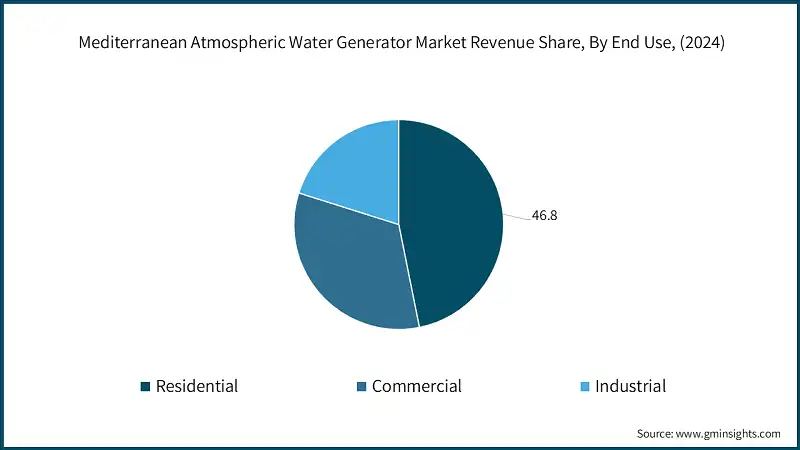
Based on end use, the Mediterranean atmospheric water generator market is segmented into residential, commercial and industrial. The residential segment held around 46.8% of the market share in 2024.
- The residential market segment is becoming a growing portion of the Mediterranean AWG market, due to increasing amounts of water scarcity and consumer preference for sustainability. Homeowners want reliable alternatives to municipal water systems, especially in areas experiencing chronic drought and interruptions to supply. Residential AWG systems can offer a decentralized source of potable water, giving an independence from municipal water systems and resilience against supply limitations.
- Residential AWGs are usually compact, energy-efficient devices which are suited for regular household use, generating 20–100 liters of water each day, depending on the humidity and temperatures. Many new systems offer advanced filtration, mineralization and smart monitoring features for water quality and convenience. The option for an employee to use renewable energy through methods like the use of solar panels installed on rooftops is attractive to households wanting to save costs and to be environmentally conscious.
- Increasing urbanization, home demand stimulated by tourism, and sustainability plans are driving residential AWG adoption in the Mediterranean. More consumers are becoming aware of water security issues and are willing to invest in technologies that provide a reliable supply of safe drinking water. Government incentives for green technologies and the emergence of smart homes increasingly facilitate market penetration, making residential AWGs a significant piece to the water resilience solution.
Based on distribution channel, the Mediterranean atmospheric water generator market is segmented into direct and indirect. The direct distribution channel held the major market share accounting for USD 580 million in 2024.
- The direct distribution route includes manufacturers selling AWG units to end-users directly, without any distributors or retailers involved in the process. This route is gaining traction in the regional Mediterranean market, with companies trying to build meaningful relationships with customers by being more service-oriented and providing value-added solutions. Direct sales of units commonly involve co-owned company shops, company-specific sales teams, and company-official websites. Direct sales provide manufacturers and companies with the ability to control pricing, branding, and after-sales service are often better with indirect channels.
- Direct distribution allows manufacturers to retain more profit by eliminating middlemen and reducing reliance on third-party networks. It also provides an opportunity for manufacturers to customize their offering (e.g., AWG units for residential or commercial use) and creates a faster loop for consumers to interact with manufacturers for improved products. In areas where water scarcity is a major concern, manufacturers can educate consumers on AWG technology when they are directly engaged with consumers. This process establishes trust and speeds adoption efforts.
Looking for region specific data?
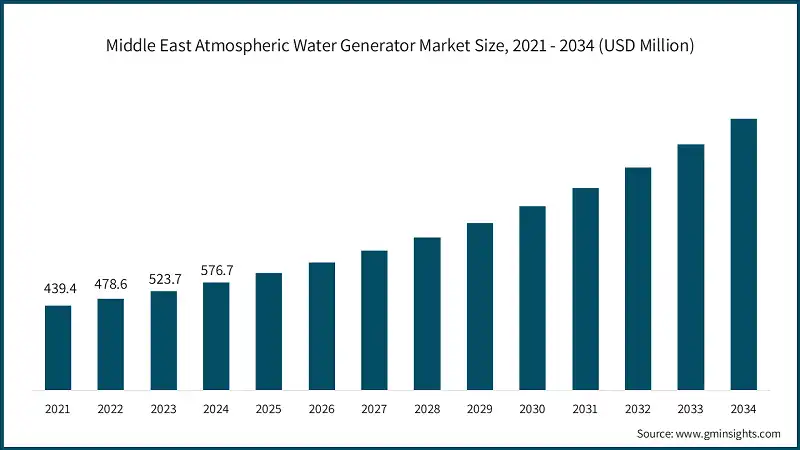
Middle East dominated the Mediterranean atmospheric water generator market, accounted for around 57.2% market share and generating around USD 576.7 million revenue in 2024.
- The AWG market in the Middle East is growing quickly primarily because of dire water shortages and reasonable demand for reliable, sustainable water solutions. Countries like Saudi Arabia, UAE, and Qatar already have chronic shortages of freshwater due to an arid climate and limited natural resources. AWGs provide a decentralized and reliable alternative to traditional forms of desalination which use a large amount of energy and are costly. This form of technology is increasingly recognized as a strategic part of water security planning, throughout the region.
- Government-led programs for water sustainability, as well as technological advancements, are the primary engines of growth. The pre-existing strong solar energy infrastructure in the Middle East supports the adoption of AWG, as renewable powered technology will provide potentially substantial reductions in operational costs. Rapid urbanization and expansion in the hospitality sector further solidify demand for AWG adoption and for smaller units for event venues both residentially and commercially. In addition to water sustainability and cost, the AWG market growth will also be driven by concerns for emergency preparedness and military applications.
- Although the potential is promising, further progress is limited by high energy consumption and dependency on humidity levels in areas which are extremely dry inland. While hybrid AWG systems and solar integration have critical resource potential, the priority is that the region is working to establish green technologies and smart infrastructure improvements that position AWG as a crucial technology for long-term water resilience, also allowing opportunities for AGW manufacturers globally and governments in the Middle East to partner.
Mediterranean Atmospheric Water Generator Market Share
Genesis System is leading with a 7.7% market share. Genesis System, Watergen, EcoloBlue, Genaq Technologies and Atlantis Solar hold 15%, indicating moderately consolidated market concentration.
These prominent players are proactively involved in strategic endeavors, such as mergers & acquisitions, facility expansions & collaborations, to expand their product portfolios, extend their reach to a broad customer base, and strengthen their market position.
Watergen is well known as the world's leader in atmospheric water generation technology. Using the company's proprietary GENius technology, Watergen can extract water from the air efficiently and with minimal costs of energy, which makes the technology an ideal solution for areas with moderate humidity, such as the Mediterranean. Watergen has a diverse product line including residential units, commercial systems, and an emergency product for humanitarian disaster relief. The company has established strong relationships with governments and NGOs and positions itself as the industry leader in water security.
A1RWATER concentrates on providing compact, cost-effective AWG solutions for residential and small-scale commercial use. The company's designs are easy to use, incorporate advanced filtration systems, and contain mineralization features to promote safe drinking water. A1RWATER's products are especially beneficial for households and environmentally aware communities living in water-scarce areas. The company utilizes direct distribution channels and online platforms to foster customer engagement and offer customized solutions. The company's approach is based on affordability and accessibility, which positions it to compete in developing Mediterranean markets.
Mediterranean Atmospheric Water Generator Market Companies
Major players operating in the Mediterranean atmospheric water generator industry are:
- A1RWATER
- Agua De Sol
- Airwater Company
- Aquasol
- Atlantis Solar
- Beyond Water
- EcoloBlue
- Genaq Technologies
- Genesis Systems
- HAZAGUA
- Island Sky Corp
- Saba Technology
- SolarDew
- Source Global
- Watergen
Genesis Systems produces large-capacity AWG machines suitable for industrial, agricultural, and municipal use. Its technology incorporates renewable energy sources, such as solar energy, for reduced operational costs and carbon emissions. Genesis Systems focuses on expansive scalability, with solutions that can produce thousands of litres of water per day suitable for large-scale water security initiative.
Island Sky is a leading rimmed AWG manufacturer in the category of premium and high-performance cooling-condensation systems. The company is pursuing growth opportunities among hospitality, residential, and emergency service markets, to tackle the clean water generation crisis for coastal and island communities where reliable water generation is a necessity. Island Sky technology emphasizes quality, durability, and an advanced filtration standard to produce safe, clean, and reliable water generation capabilities.
Mediterranean Atmospheric Water Generator Market Report Attributes
| Key Takeaway | Details |
|---|---|
| Market Size & Growth | |
| Base Year | 2024 |
| Market Size in 2024 | USD 1 Billion |
| Market Size in 2025 | USD 1.1 Billion |
| Forecast Period 2025 - 2034 CAGR | 11.2% |
| Market Size in 2034 | USD 2.87 Billion |
| Key Market Trends | |
| Drivers | Impact |
| Acute freshwater scarcity | Continued droughts and increasing demand present challenges in Mediterranean settings and make AWGs a viable measure for securing water, which has encouraged even faster adoption in home, business, and municipal settings. |
| Mature cooling-condensation technology | Observed reliability mitigates technical risk and accelerates deployment process of AWG while also providing incentive to invest from both private and public investment. |
| Supportive regulatory environment | Government incentives and sustainability mandates provide favorable conditions for AWG adoption in either water infrastructure projects. |
| Pitfalls & Challenges | Impact |
| High capital and energy requirements | The initial installation costs and energy use of AWGs (Atmospheric Water Harvesters) are still key challenges limiting adoption among small businesses and individual households. |
| Technical complexity and maintenance | Regular maintenance and specialized parts lead to increased operating costs and the need for qualified technicians and supply chains. |
| Opportunities: | Impact |
| Smart-home integration | AWGs that are IoT-enabled offer an attractive solution to environmentally conscious consumers by allowing for improved performance monitoring and automated performance optimization. |
| Hybrid and renewable-powered systems | Coupling AWGs with solar or wind energy resources can drastically lower operating costs and carbon footprint to make these systems attractive options for off-grid locations in the Mediterranean, and rural areas. |
| Market Leaders (2024) | |
| Market Leaders |
7.7% market share |
| Top Players |
Collective market share in 2024 is 15% |
| Competitive Edge |
|
| Emerging countries | Croatia, Libya, Tunisia |
| Future outlook |
|
What are the growth opportunities in this market?
Mediterranean Atmospheric Water Generator Market News
- In November of 2025, Airwater Company proved its technology's resilience by deploying a solar-powered atmospheric water generation unit in Jamaica following Hurricane Melissa. The unit can generate about 400 gallons (about 1,514 liters) of clean drinking water each day, serving as an essential water source for disaster recovery efforts while demonstrating the efficacy of renewable-powered AWG solutions in extreme conditions.
- In August 2025, Genaq Technologies launched its next generation of atmospheric water generators (AWGs), featuring advanced models to work in low-humidity conditions. The portfolio including a new compact home unit called the Stratus S20, capable of generating 20 litres of water a day, and innovative designs to directly couple the devices to the solar panels without batteries. These advances demonstrate Genaq’s commitment to increasing energy independence and highlight implications for the market in adaptability and reliability, establishing the company as an industry leader of sustainable technology for both residence and off grid styled applications.
- In July 2025, Agua De Sol accelerated advancements in the development of its solar-powered atmospheric water generation technology with its new initiative, Sun4Water. In February, the company obtained Eurostars funding to facilitate the new development of a system called SunAir Fountain, which consists of a solar-powered atmospheric water generator. In July, the company began crowdfunding to engage supporters throughout the world. Together, this dual approach demonstrates Agua De Sol’s commitment to scaling sustainable water solutions by combining solar-powered atmospheric water generation technology with crowdsourced investment.
- In September 2024, A1RWATER achieved an important milestone with the commissioning of a world-class facility in Dubai Industrial City, underscoring its commitment to sustainable water solutions in arid areas. The facility contains 50 state-of-the-art A1R3000 atmospheric water generators that draw moisture from the atmosphere and produce drinking water. These machines produce collectively over 100,000 liters of safe drinking water per day, providing a flexible alternative to conventional water sources, amid concerns over water scarcity in the Middle East.
- On January 2024, Genesis Systems launched the WaterCube portable atmospheric water generator at the Consumer Electronics Show (CES). The WaterCube is a portable device that uses the humidity in the atmosphere and converts it back into clean drinking water, furthering the Genesis Systems vision of a sustainable and decentralized water solution. The compact WaterCube is a viable solution for households and remote locations. Genesis Systems is seeking to be one of the leaders in next generation water technology.
The Mediterranean atmospheric water generator market research report includes in-depth coverage of the industry with estimates & forecasts in terms of revenue (USD Million) and volume (Thousand Units) from 2021 to 2034, for the following segments:
Market, By Type
- Static
- Mobile
Market, By Technology
- Condensation-based systems
- Desiccant-based systems
- Advanced technologies
- MOF technology
- Solar-thermal integration
- Integrated water-agriculture systems
Market, By Energy Source
- Solar-powered
- Grid-connected
- Hybrid renewable
- Carbon negative systems
Market, By Capacity
- 1L-500L
- 500L-1000L
- 1000L-5000L
- Above 5000L
Market, By Application
- Standalone water generation
- Agriculture-integrated systems
- Food production facilities
- Greenhouse applications
Market, By End Use
- Residential
- Commercial
- Industrial
Market, By Distribution Channel
- Direct
- Indirect
The above information is provided for the following regions and countries:
- Europe
- Italy
- Spain
- France
- Croatia
- North Africa
- Morocco
- Algeria
- Libya
- Tunisia
- Egypt
- Middle East
- Cyprus
- Israel
- Lebanon
- Palestine
- Syria
- Turkey
Frequently Asked Question(FAQ) :
What is the market size of the Mediterranean atmospheric water generator in 2024?
The market size exceeded USD 1 billion in 2024, with a CAGR of 11.2% expected through 2034 driven by persistent drought conditions and rising water demand accelerating AWG adoption across residential, commercial, and municipal applications.
What is the projected value of the Mediterranean atmospheric water generator market by 2034?
The Mediterranean atmospheric water generator market is expected to reach USD 2.87 billion by 2034, propelled by acute freshwater scarcity, mature cooling-condensation technology, and supportive regulatory environments promoting water sustainability.
What is the current Mediterranean atmospheric water generator market size in 2025?
The market size is projected to reach USD 1.1 billion in 2025.
How much revenue did the static type segment generate in 2024?
Static type atmospheric water generators generated USD 650.4 million in 2024, holding the major market share.
What was the valuation of the residential segment in 2024?
The residential segment held approximately 46.8% of the market share in 2024.
What is the growth outlook for direct distribution channel from 2025 to 2034?
The direct distribution channel held the major market share accounting for USD 580 million in 2024, fueled by manufacturers' ability to control pricing, branding, and provide better after-sales service while retaining higher profit margins.
Which region leads the Mediterranean atmospheric water generator market?
The Middle East dominated with 57.2% market share generating USD 576.7 million in 2024. Dire water shortages, government-led sustainability programs, and strong solar energy infrastructure fuel the region's dominance.
What are the upcoming trends in the Mediterranean atmospheric water generator market?
Key trends include IoT-enabled smart monitoring systems, solar-powered and hybrid renewable integration, development of high-capacity industrial units, portable AWGs for emergency response, and advanced desiccant-based systems for low-humidity conditions.
Who are the key players in the Mediterranean atmospheric water generator market?
Key players include Genesis Systems, Watergen, EcoloBlue, Genaq Technologies, Atlantis Solar, A1RWATER, Agua De Sol, Airwater Company, Aquasol, Beyond Water, HAZAGUA, Island Sky Corp, Saba Technology, SolarDew, and Source Global.
Mediterranean Atmospheric Water Generator Market Scope
Related Reports