Summary
Table of Content

Medical Equipment Maintenance Market
Get a free sample of this report
Form submitted successfully!
Error submitting form. Please try again.
Thank you!
Your inquiry has been received. Our team will reach out to you with the required details via email. To ensure that you don't miss their response, kindly remember to check your spam folder as well!
Request Sectional Data
Thank you!
Your inquiry has been received. Our team will reach out to you with the required details via email. To ensure that you don't miss their response, kindly remember to check your spam folder as well!
Form submitted successfully!
Error submitting form. Please try again.
Medical Equipment Maintenance Market Size
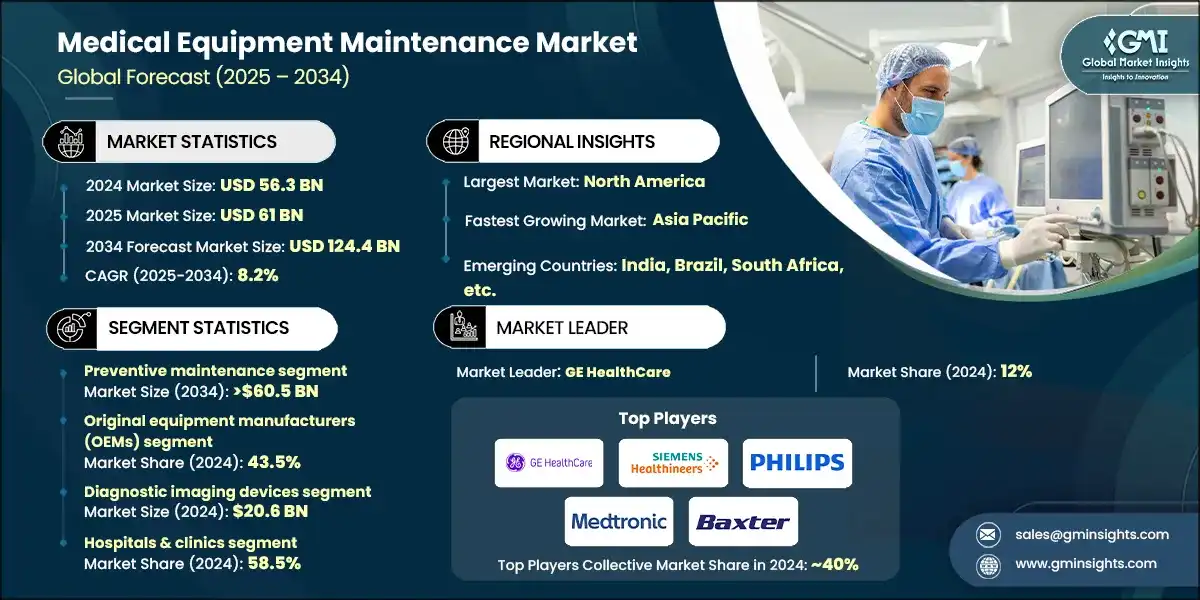
The global medical equipment maintenance market was estimated at USD 56.3 billion in 2024. The market is expected to grow from USD 61 billion in 2025 to USD 124.4 billion in 2034, at a CAGR of 8.2% during the forecast period, according to the latest report published by Global Market Insights Inc. The medical equipment maintenance market is driven by growing focus on patient safety and equipment uptime, high adoption of refurbished medical equipment, surging prevalence of chronic disorders, increase in adoption of advanced medical devices, and regulatory compliance requirements for medical device maintenance, among other contributing factors.
Medical Equipment Maintenance Market Key Takeaways
Market Size & Growth
- 2024 Market Size: USD 56.3 Billion
- 2025 Market Size: USD 61 Billion
- 2034 Forecast Market Size: USD 124.4 Billion
- CAGR (2025–2034): 8.2%
Key Market Drivers
- Rising adoption of advanced medical devices.
- Surging prevalence of chronic diseases.
- Growing focus on patient safety and equipment uptime.
- Regulatory compliance requirements for medical device maintenance.
- High adoption of refurbished medical equipment.
Challenges
- High cost of maintenance services and contracts.
- Shortage of skilled technicians for complex devices.
Opportunity
- Predictive maintenance using AI and IoT.
- Remote monitoring solutions for cost efficiency.
Key Players
- Market Leader: GE HealthCare led with over 12% market share in 2024.
- Leading Players: Top 5 players in this market include GE HealthCare, SIEMENS Healthineers, PHILIPS, Medtronic, Baxter, which collectively held a market share of 40% in 2024.
Get Market Insights & Growth Opportunities
Rising healthcare investments globally, multi-vendor service contracts reducing complexity for hospitals, and demand for properly functioning medical devices are among the key factors propelling the industry demand. GE HealthCare, SIEMENS Healthineers, PHILIPS, Medtronic, and Baxter are among the leading players operating in the market. These players mainly focus on geographic expansion, collaboration with local or regional healthcare providers, regular training programs for skilled technicians, and integrating advanced technologies, among others.
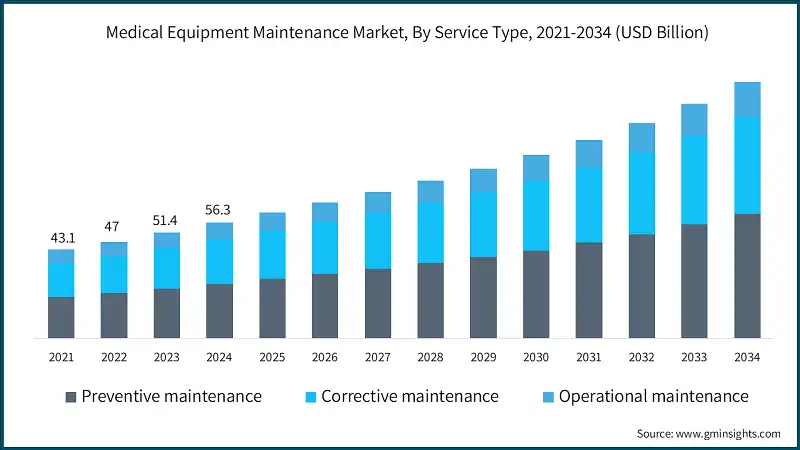
The market reached USD 51.4 billion in 2023 from USD 43.1 billion in 2021. High adoption of advanced medical devices with the latest technologies, including imaging systems and surgical robots, requires the need for specialized maintenance to be performed regularly to maintain higher levels of precision and reliability. Such medical devices often come with a high price tag, and therefore, predictive & preventative maintenance is required to protect investments and reduce downtime. In addition, the requirement for comprehensive maintenance services is expected to continue to grow as hospitals upgrade their infrastructure as part of improving diagnostic accuracy and delivering better treatment outcomes.
Additionally, the growing prevalence of chronic illnesses such as diabetes, cardiovascular disorders, and cancer typically requires ongoing diagnostic testing and continuous monitoring. For instance, according to data from the WHO’s International Agency for Research on Cancer (IARC), the number of new cancer cases is expected to reach approximately 35 million per year, up from around 20 million in 2022. This high testing volume results in substantial usage of medical devices, which undergo wear and tear over time, leading to reduced life expectancy. Consequently, timely maintenance becomes essential to prevent device failure. Healthcare providers increasingly focus on maximizing device uptime, further driving the need for regular maintenance to ensure continuity of care.
Further, as hospitals and clinics seek to further minimize risks posed by equipment failure, it can place both patient safety and quality of care at risk. Preventive maintenance programs ensure that all devices are being operated within established safe parameters, which reduces the risk of error. The focus on reliability and oversight compliance is driving healthcare providers towards opting for planned maintenance solutions, which is propelling the market growth.
Maintenance of medical equipment refers to the systematic process of inspecting, servicing, repairing, and calibrating medical devices to ensure maximum performance, safety, compliance with regulations, and increased service life of equipment in healthcare facilities.
To get key market trends
Medical Equipment Maintenance Market Trends
Predictive maintenance adoption, multi-vendor service models, outsourcing of maintenance services, and digitalization and remote monitoring are among the key trends shaping the market growth in an upward trajectory.
- Healthcare organizations are increasingly adopting AI- and IoT-enabled predictive maintenance to identify equipment faults before they take place. Improvement in this capacity leads to a reduction in downtime, optimization of costs, and an assurance of undisturbed patient care delivery, thus making it a key growth trend.
- Additionally, the introduction of digital platforms and remote monitoring tools enables operators to provide options for tracking equipment function in real time. Such systems improve workflow efficiency, prevent delays in servicing equipment, and can support proactive maintenance plans, especially across multi-location healthcare systems.
- Hospitals and clinics are opting for multi-vendor maintenance contracts to streamline operations and reduce costs. In this arrangement, facilities can manage multiple pieces of equipment from different manufacturers with one service agreement, thus encouraging growth in demand.
- Further, there is increasing focus on greener maintenance solutions, including refurbishing and recycling medical equipment, which supports global initiatives while helping healthcare providers manage costs and lower their environmental footprint.
Medical Equipment Maintenance Market Analysis
Learn more about the key segments shaping this market
In 2021, the market was valued at USD 43.1 billion and grew to USD 47 billion in 2022, reaching USD 51.4 billion by 2023. Outsourcing maintenance services to specialized providers and integration of remote monitoring and diagnostics are among the key variables contributing to industry growth.
Based on service type, the global medical equipment maintenance market is segmented into preventive maintenance, corrective maintenance, and operational maintenance. The preventive maintenance segment accounted for a leading share of 47.2% in 2024. Development of cost-effective maintenance packages for smaller facilities is anticipated to fuel the segmental growth. The segment is expected to exceed USD 60.5 billion by 2034, growing at a CAGR of 8.6% during the forecast period.
- Preventive maintenance covers regular inspections, calibration, and servicing of medical devices that minimize unplanned device failure and ensure the optimal performance of that device. This method reduces device downtime, extends the life of a device, and promotes patient safety by recognizing or fixing issues before they become challenging.
- Additionally, this practice of preventive maintenance has been adopted increasingly by hospitals and clinics to meet regulatory compliance and decrease expensive emergency repairs. It also enhances operational efficiency by maintaining a consistent device availability, making it especially important for devices subject to high demand, such as imaging systems and life-support equipment.
- Further, the increasing focus on reliability and cost savings has made preventive maintenance a leading industry segment in the market.
- The corrective maintenance segment was valued at USD 21.5 billion in 2024. Corrective maintenance involves repairing or restoring the medical equipment after breakdown or failure. This is important to maintain continuity of care when devices fail unplanned. Corrective maintenance services often include troubleshooting, part replacement, and recalibration to ensure the equipment is back to operational standards.
- Furthermore, corrective maintenance is reactive maintenance, but it is critically important for healthcare facilities that cannot afford extended downtime. My experience is that it does cost more and impact operations more than preventive strategies.
- Moreover, corrective maintenance incurs additional costs and is used when a preventive program is not available or feasible economically.
Based on service provider, the global medical equipment maintenance market is segmented into original equipment manufacturers (OEMs), in-house maintenance, and independent service organizations (ISOs). The original equipment manufacturers (OEMs) segment accounted for a leading share of 43.5% in 2024.
- OEMs control the maintenance market by providing tailored service, specification-based parts, and their technical know-how. These original equipment manufacturers strategies include long-term service contracts, predictive maintenance, and remote monitoring capabilities, often with a digital service platform, as solutions.
- OEMs guarantee compliance with regulatory guidelines and provide high-standard maintenance, which results in an increased preference for critical and high-value equipment.
- In addition, a strong brand reputation and the ability to provide upgrades and further software support also help maintain OEM positioning.
- Additionally, the in-house maintenance segment was valued at USD 18 billion in 2024. Large hospitals and healthcare organizations often have an in-house maintenance team to manage equipment maintenance and repair internally. This allows for better control over maintenance schedules and immediate response for equipment issues.
- Further, while this method is considered the preferred approach for high-volume facilities, in-house maintenance is not easy, and at various instances healthcare providers may need to outsource equipment maintenance for more complex and specialized equipment.
- Furthermore, the independent service organizations (ISOs) segment is anticipated to record the fastest growth with a CAGR of 8.5% over the forecast period. ISOs offer flexible and cost-effective maintenance solutions, adaptable to multi-vendor environments. These organizations are becoming more common in healthcare facilities interested in optimizing costs and simplifying management aspects of service.
- ISOs are able to offer competitive price structures, speedy response times, and tailored conditions, which appeal to less complex environments such as smaller hospitals and clinics.
- Moreover, ISOs can service different types of equipment without reliance on the original equipment distributor (OEM), making them effective competitors.
Based on equipment, the global medical equipment maintenance market is segmented into diagnostic imaging devices, electromedical devices, surgical instruments, patient monitoring and life support devices, dental equipment, endoscopic devices, laboratory equipment, and other equipment. The diagnostic imaging devices segment accounted for a leading share and was valued at USD 20.6 billion in 2024.
- To ensure the diagnostic accuracy of MRI, CT scanners, and X-ray machines, imaging equipment requires frequent calibration and preventive maintenance. All imaging equipment is sensitive and strictly regulated, highlighting the importance of uptime for patient care.
- Additionally, maintenance consists of working on software, quality control of images, and mechanical issues to avoid costs due to breakdowns. The complexity of these imaging systems, along with high costs, drives the demand for both OEM-led and predictive maintenance models.
- Further, the electromedical devices segment was valued at USD 15.7 billion in 2024. Electromedical devices include infusion pumps, defibrillators, and electrosurgical units that are used for therapeutic or life-support purposes. All devices require documented calibration standards and service to ensure safety.
- Maintenance includes checking for electrical safety, performing software diagnostics, and replacing deteriorated components. All these devices are extensively used in hospitals, ambulatory surgical centers, and specialty clinics, resulting in a demand for corrective and preventive maintenance services.
- Furthermore, the surgical instruments segment is expected to record the fastest growth with a CAGR of 9.2% over the forecast period. Surgical instruments, from basic surgical tools to robotic-assisted surgical systems, require thorough cleaning, sterilization, and inspection for proper working conditions.
- In addition, advanced robotic systems often require specialized service and updated software programming, increasing the opportunity for original equipment manufacturers (OEMs) and independent service organizations (ISOs) to provide maintenance service and programming as high-tech manufacturers.
- Moreover, the patient monitoring and life support devices segment was valued at USD 3.8 billion in 2024. Devices, such as ventilators, ECG monitors, and anesthesia machines, among others, are crucial in supporting continuous patient care. The devices maintenance involves proper calibration of sensors, battery inspection, and software upgrades, all of them contributing to uninterrupted operationability of the devices.
Learn more about the key segments shaping this market
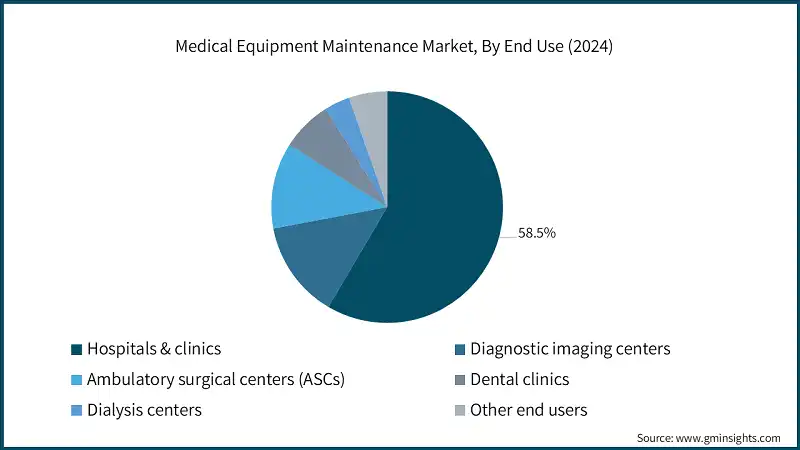
Based on end use, the medical equipment maintenance market is segmented into hospitals & clinics, diagnostic imaging centers, ambulatory surgical centers (ASCs), dental clinics, dialysis centers, and other end users. The hospitals & clinics segment accounted for the leading market share of 58.5% in 2024 as it records high patient footfall including both public and private hospital settings.
- Hospitals and clinics dominate end-user segment because of their significant equipment inventory and high patient volumes. These facilities require continuous working and maintenance of equipment for diagnostic imaging, surgical tools, and life support devices to maintain a steady flow of care.
- Hospitals adhere to strict regulatory standards and provide efficient care, which is expected to drive them to opt for preventive and predictive maintenance programs. Large healthcare networks often combine in-house teams with OEM or ISO contracts for specialized service.
- Additionally, the diagnostic imaging centers segment was valued at USD 7.6 billion in 2024. Diagnostic imaging centers utilize advanced imaging equipment, including MRI, CT, and X-ray machines, which is important in providing accurate diagnostics. Due to the need for precise results, these centers have processes and procedures in place regarding preventive maintenance and calibrating imaging equipment to avoid expensive downtime.
- Further, owing to the high cost of imaging systems, service contracts with OEMs (original equipment manufacturers) or ISOs (independent service organizations) become a preferred option to ensure functional reliability and safety compliance.
- On the other hand, the ambulatory surgical centers segment is expected to record the highest growth with a CAGR of 9.1% over the forecast period. ASCs focus on surgical procedures performed on an outpatient basis and require surgical instruments, endoscopic devices, and patient monitoring devices to be properly maintained.
- Furthermore, ASCs typically prefer cost-effective service delivery models and multi-vendor contracts that enable effective management of diverse equipment ranges in these settings.
Looking for region specific data?
North America Medical Equipment Maintenance Market
North America market accounted for majority share of 40.7% in 2024 in the global medical equipment maintenance industry and is anticipated to show notable growth over the forecast period.
- North America is the leading region for medical equipment maintenance, primarily due to advanced healthcare systems and the high adoption of novel medical technologies. Regional hospitals and clinics prefer preventive and predictive maintenance to meet strict regulatory standards and to ensure patient safety.
- Additionally, the presence of major OEMs with integrated service contracts and digital platforms supports the market growth. There is a growing trend toward independent service organizations (ISOs) that offer cost savings through maintenance outsourcing.
- Furthermore, investment in predictive analytics driven by AI and Internet of Things (IoT)-enabled monitoring systems is accelerating uptake, minimizing downtime, and improving operational efficiency. These trends are anticipated to further support long-term growth in the region with increased emphasis on value-based care and sustainability initiatives.
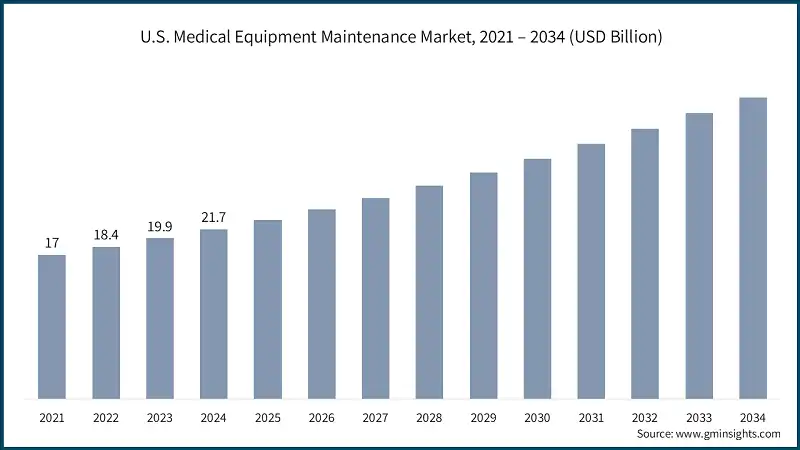
The U.S. medical equipment maintenance market was valued at USD 17 billion and USD 18.4 billion in 2021 and 2022, respectively. In 2024 the market size was valued at USD 21.7 billion from USD 19.9 billion in 2023. The significant focus on infection prevention practices along with high hospitalization rate in the country is projected to fuel the market growth.
- The U.S. is the leading country in the global market because of the established healthcare delivery system and its image as an early adopter of new diagnostic and therapeutic technologies.
- Additionally, tighter regulations specified under FDA and Joint Commission guidelines push hospitals and other facilities to implement necessary maintenance programs. Predictive maintenance using AI and IoT has contributed significantly to eliminating unwanted failures and also provides cost optimization.
- Further, large hospital systems tend to use their own teams, while smaller facilities outsource to an Independent Service Organization (ISO) to gain flexibility and save on expenses. Furthermore, the increased focus on patient safety and higher overall healthcare spending ensure demand for maintenance services at all price points and for any type of equipment.
Europe Medical Equipment Maintenance Market
Europe accounted for a significant share in the global medical equipment maintenance industry and was valued at USD 16.2 billion in 2024.
- The European market growth is driven by strong regulations and modernization of healthcare facilities throughout the region. Preventative maintenance programs operate widely to fit licensing requirements and minimize operational risk.
- Germany and France rank among the highest in initiating digital solutions for equipment reliability, including remote monitoring and predictive analytics. Sustainability initiatives for refurbishment and recycling of medical devices are witnessing notable growth promoting maintenance programs.
- In addition, the region is expected to record increasing demand for multi-vendor service contracts, specifically from hospitals seeking cost optimization. OEMs maintain a strong market share, whereas ISOs are rapidly growing by providing competitive pricing and localized service.
UK held significant share of the European medical equipment maintenance market, showcasing strong growth potential.
- The UK features a strict regulatory environment along with a fast-paced digital transformation driven by the National Health Service (NHS) and private hospitals. There is a continuous focus on preventative maintenance to stay compliant and keep patients safe, while the trend towards predictive solutions for cost-effective maintenance is also gaining traction.
- In addition, hospitals are opting for multi-vendor service models to manage diverse equipment portfolios. Smaller facilities are expected to often outsource maintenance contracts to independent service organizations (ISOs), while original equipment manufacturers (OEMs) typically service their high-value equipment directly.
- Further, a shift towards sustainability and energy-efficient practices is shaping maintenance strategies that present an opportunity for providers with eco-friendly maintenance offerings. Hence, digital platforms and remote monitoring systems are expected to fuel future growth.
Asia Pacific Medical Equipment Maintenance Market
The Asia Pacific market accounted for a substantial share of the market and was valued at USD 12.5 billion in 2024.
- The Asia Pacific region is witnessing significant growth due to rapidly developing healthcare infrastructure and rising investment in advanced medical technology. India and Southeast Asian countries focus on maintenance costs, providing room for ISOs and local service providers. OEMs are expanding their presence through partnerships and localized hubs to meet the increased demand for preventive maintenance.
- Additionally, digitalization is increasing, and hospitals are adopting IoT-enabled monitoring and predictive analytics to increase equipment uptime.
- Further, government investment in strengthening healthcare systems and increasing prevalence of chronic diseases is another factor driving market expansion, making Asia Pacific a key growth market.
China medical equipment maintenance market is estimated to grow with a robust CAGR in the Asia Pacific market.
- China’s market expansion is driven by growth in newly built high-capacity hospitals and government initiatives to improve the quality of healthcare. The increased adoption of sophisticated diagnostic imaging systems and life-support equipment underlines the strong demand for structured maintenance services.
- As hospitals increasingly turn to OEM contracts for high-end equipment maintenance, ISOs have emerged as a notable option to support smaller facilities with lower-cost alternatives.
- Tele-monitoring digital platforms and predictive maintenance monitoring tools are being increasingly adopted in hospitals. This trend is being supported with strong funding in healthcare technology investments.
- Further, the significant focus on refurbished equipment in smaller hospitals is also pushing the demand for maintenance in the healthcare industry. China’s emphasis on smart healthcare and AI initiatives promotes its future growth in the regional market.
Latin America Medical Equipment Maintenance Market
Brazil leads the Latin American market, exhibiting remarkable growth during the analysis period.
- Brazil’s medical equipment maintenance industry is expanding due to rising healthcare investments and modernization of hospitals. Preventive maintenance programs are becoming essential to ensure compliance with safety standards and reduce operational risks.
- Additionally, the growing prevalence of chronic diseases and increased use of diagnostic imaging devices drive demand for reliable maintenance services.
- Further, digitalization is gradually gaining traction, with hospitals exploring remote monitoring tools to improve efficiency. In addition, the economic constraints encourage adoption of refurbished equipment, further boosting maintenance needs across the country.
Middle East and Africa Medical Equipment Maintenance Market
Saudi Arabia market to experience substantial growth in the Middle East and Africa medical equipment maintenance industry in 2024.
- Saudi Arabia’s market growth is fueled by government-backed healthcare infrastructure projects under Vision 2030. Hospitals are investing in advanced medical devices, creating strong demand for preventive and predictive maintenance services.
- OEMs hold a significant share due to their ability to provide specialized servicing and compliance support. Digital platforms and IoT-enabled monitoring solutions are being adopted to enhance operational efficiency and reduce downtime.
- Moreover, the country’s focus on quality healthcare and patient safety drives structured maintenance programs, while outsourcing to ISOs is emerging as a cost-effective option for smaller facilities.
Medical Equipment Maintenance Market Share
The medical equipment maintenance industry is competitive in nature and includes global OEMs, independent service organizations (ISOs), and in-house maintenance operators. Major players in the market, such as GE HealthCare, Siemens Healthineers, Philips, Medtronic, and Baxter, lead with comprehensive service portfolios, strong brand recognition, and advanced technological capabilities.
In addition, OEMs have a competitive advantage with proprietary parts, integrated digital platforms, and predictive maintenance to maximize equipment uptime and to comply with regulatory agencies. ISOs are becoming increasingly popular by offering flexible service contracts at reasonable rates and multi-vendor support to healthcare facilities that aim to control costs. In-house maintenance is an emerging variable in large hospitals that have dedicated technical assistance and expertise in handling complex equipment.
Further, the market is rapidly evolving with a high adoption of digitally driven tools and solutions, along with investments in IoT, AI-based predictive analysis, and remote monitoring to reduce downtime and increase efficiency. Companies focusing on growth strategies through partnerships, mergers, and acquisitions in the medical equipment maintenance market are expected to enhance their service offerings, improve geographic coverage, and develop complementary service capabilities.
Moreover, sustainability and value-based care are emerging differentiators, helping companies that plan to differentiate themselves by committing to sustainable business practices and outcome-based services to support future growth plans.
Medical Equipment Maintenance Market Companies
A few of the prominent players operating in the global medical equipment maintenance industry include:
- Alliance Medical CORPORATION
- ALTHEA
- Aramark
- Baxter
- Drive DeVilbiss HEALTHCARE
- FUJIFILM
- GE HealthCare
- GETINGE
- Hitachi High-Tech
- Medtronic
- PHILIPS
- Probo MEDICAL
- Resmed
- SIEMENS Healthineers
- STERIS HEALTHCARE
- GE HealthCare
GE HealthCare focuses on expanding service portfolios through predictive maintenance and remote monitoring solutions. Invests heavily in AI-driven diagnostics and partnerships with hospitals to strengthen aftermarket services and improve equipment uptime.
Philips prioritizes connected care and cloud-based maintenance solutions. Implements subscription-based service models and predictive analytics to reduce downtime, while driving sustainability initiatives and enhancing customer experience through digital engagement.
Baxter expands aftermarket services through flexible maintenance packages and digital tools. Concentrates on cost-effective solutions for dialysis and infusion systems, while leveraging data analytics to improve operational efficiency and patient safety.
Medical Equipment Maintenance Market Report Attributes
| Key Takeaway | Details |
|---|---|
| Market Size & Growth | |
| Base Year | 2024 |
| Market Size in 2024 | USD 56.3 Billion |
| Market Size in 2025 | USD 61 Billion |
| Forecast Period 2025 - 2034 CAGR | 8.2% |
| Market Size in 2034 | USD 124.4 Billion |
| Key Market Trends | |
| Drivers | Impact |
| Rising adoption of advanced medical devices | Healthcare facilities are investing in high-tech equipment, increasing demand for specialized maintenance services to ensure optimal performance and compliance. |
| Surging prevalence of chronic diseases | Higher patient volumes and frequent use of diagnostic and therapeutic devices drive the need for regular maintenance to avoid service disruptions. |
| Growing focus on patient safety and equipment uptime | Hospitals prioritize preventive maintenance to minimize risks and ensure uninterrupted care, making up time a critical operational metric. |
| Regulatory compliance requirements for medical device maintenance | Strict regulations mandate timely servicing and documentation, compelling healthcare providers to adopt structured maintenance programs. |
| High adoption of refurbished medical equipment | Cost-conscious facilities increasingly use refurbished devices, creating demand for reliable maintenance to extend equipment life and maintain safety standards. |
| Pitfalls & Challenges | Impact |
| High cost of maintenance services and contracts | Budget limitations in smaller healthcare facilities restrict adoption of comprehensive maintenance plans, slowing market penetration. |
| Shortage of skilled technicians for complex devices | Advanced equipment requires specialized expertise, and workforce gaps lead to delays and increased operational challenges. |
| Opportunities: | Impact |
| Predictive maintenance using AI and IoT | Will significantly reduce downtime and costs by enabling real-time diagnostics and proactive servicing, transforming maintenance into a data-driven process. |
| Remote monitoring solutions for cost efficiency | Expected to streamline maintenance workflows, minimize on-site visits, and improve service responsiveness, especially for multi-location healthcare networks. |
| Market Leaders (2024) | |
| Market Leaders |
Around 12% |
| Top Players |
Collective market share in 2024 is ~ 40% |
| Competitive Edge |
|
| Regional Insights | |
| Largest Market | North America |
| Fastest Growing Market | Asia Pacific |
| Emerging Country | India, Brazil, South Africa, etc. |
| Future Outlook |
|
What are the growth opportunities in this market?
Medical Equipment Maintenance Industry News
- In January 2025, Sutter Health and GE HealthCare announced a seven-year strategic partnership, termed the Care Alliance, which aims to improve access to innovative imaging services and create a seamless and coordinated experience for clinicians and patients across the Sutter Health system. This development is expected to further consolidate GE Healthcare's key industry position.
- In December 2023, Probo Medical, a global provider of medical imaging equipment, parts, repair, and service, signed a definitive purchase agreement to acquire Alpha Source Group. This deal substantially expands Probo's diagnostic imaging solutions platform and its sales prospects.
- In May 2023, Siemens Healthineers and CommonSpirit Health agreed to acquire Block Imaging. This acquisition may assist the companies in providing more sustainable options and support increasing demand from the U.S. hospitals, health systems, and other care sites for multi-vendor imaging parts and services.
The global medical equipment maintenance market research report includes an in-depth coverage of the industry with estimates and forecasts in terms of revenue in (USD Million) from 2021 - 2034 for the following segments:
Market, By Service Type
- Preventive maintenance
- Corrective maintenance
- Operational maintenance
Market, By Service Provider
- Original equipment manufacturers (OEMs)
- In-house maintenance
- Independent service organizations (ISOs)
Market, By Equipment
- Diagnostic imaging devices
- Electromedical devices
- Surgical instruments
- Patient monitoring and life support devices
- Dental equipment
- Endoscopic devices
- Laboratory equipment
- Other equipment
Market, By End Use
- Hospitals & clinics
- Diagnostic imaging centers
- Ambulatory surgical centers (ASCs)
- Dental clinics
- Dialysis centers
- Other end use
The above information is provided for the following regions and countries:
- North America
- U.S.
- Canada
- Europe
- Germany
- UK
- France
- Spain
- Italy
- Netherlands
- Asia Pacific
- China
- Japan
- India
- Australia
- South Korea
- Latin America
- Brazil
- Mexico
- Argentina
- MEA
- South Africa
- Saudi Arabia
- UAE
Frequently Asked Question(FAQ) :
What is the market size of the medical equipment maintenance industry in 2024?
The market size was USD 56.3 billion in 2024, with an 8.2% CAGR driven by rising adoption of advanced medical devices and increasing regulatory focus on equipment safety.
What is the current medical equipment maintenance market size in 2025?
The market size is projected to reach USD 61 billion in 2025, supported by growing hospital investments and higher demand for preventive maintenance programs.
What is the projected value of the medical equipment maintenance market by 2034?
The medical equipment maintenance industry is expected to reach USD 124.4 billion by 2034, propelled by AI-enabled predictive maintenance and expansion of multi-vendor service models.
How much revenue did the preventive maintenance segment generate in 2024?
The preventive maintenance segment accounting for a 47.2% share and reflecting its critical role in reducing equipment downtime and meeting compliance needs.
What was the valuation of the diagnostic imaging devices maintenance segment in 2024?
The diagnostic imaging devices segment was valued at USD 20.6 billion in 2024, driven by the high maintenance requirement of MRI, CT, and X-ray systems to ensure diagnostic accuracy.
What is the growth outlook for independent service organizations (ISOs) from 2025 to 2034?
The ISO segment is projected to grow at 8.5% CAGR through 2034, supported by demand for cost-efficient multi-vendor maintenance and flexible service contracts across healthcare facilities.
Which region leads the medical equipment maintenance market?
The U.S. market was valued at USD 21.7 billion in 2024, making it the dominant regional market. Growth is driven by stringent FDA/JCAHO compliance norms, high technology adoption, and strong investments in advanced healthcare systems.
What are the upcoming trends in the medical equipment maintenance industry?
Key industry trends include predictive maintenance using AI and IoT, rapid adoption of digital and remote monitoring platforms, multi-vendor service models, and rising focus on sustainability via refurbishment and recycling of medical devices.
Who are the key players in the medical equipment maintenance market?
Major players include GE HealthCare, Siemens Healthineers, Philips, Medtronic, Baxter, FUJIFILM, Getinge, Hitachi High-Tech, ResMed, Probo Medical, STERIS Healthcare, Aramark, Althea, Drive DeVilbiss Healthcare, and Alliance Medical Corporation.
Medical Equipment Maintenance Market Scope
Related Reports