Summary
Table of Content

Middle East and Africa Bulk Material Handling Equipment Market
Get a free sample of this report
Form submitted successfully!
Error submitting form. Please try again.
Thank you!
Your inquiry has been received. Our team will reach out to you with the required details via email. To ensure that you don't miss their response, kindly remember to check your spam folder as well!
Request Sectional Data
Thank you!
Your inquiry has been received. Our team will reach out to you with the required details via email. To ensure that you don't miss their response, kindly remember to check your spam folder as well!
Form submitted successfully!
Error submitting form. Please try again.
Middle East and Africa Bulk Material Handling Equipment Market Size
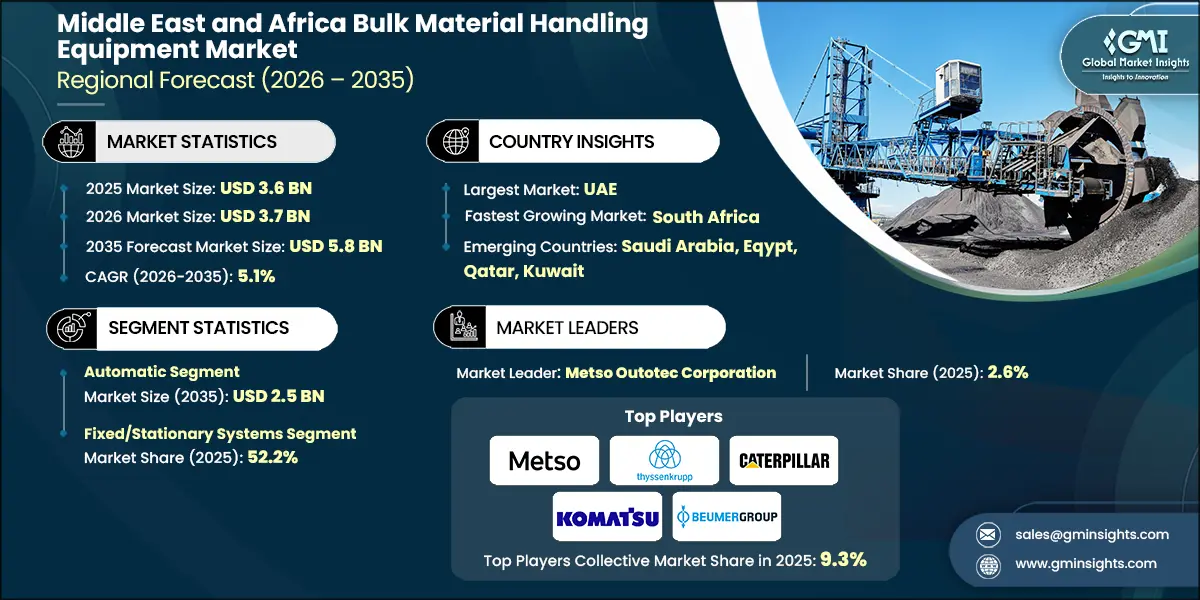
The Middle East and Africa bulk material handling equipment market was valued at USD 3.6 billion in 2025. The market is expected to grow from USD 3.7 billion in 2026 to USD 5.8 billion in 2035, at a CAGR of 5.1%, according to latest report published by Global Market Insights Inc.
Middle East and Africa Bulk Material Handling Equipment Market Key Takeaways
Market Size & Growth
- 2025 Market Size: USD 3.6 Billion
- 2026 Market Size: USD 3.7 Billion
- 2035 Forecast Market Size: USD 5.8 Billion
- CAGR (2026–2035): 5.1%
Regional Dominance
- Largest Market: UAE
- Fastest Growing Country: South Africa
Key Market Drivers
- Rapid Industrialization and Infrastructure Development.
- Automation and Technological Integration.
- Expansion of Mining and Energy Sectors.
Challenges
- High Initial Installation and Maintenance Costs.
- Environmental and Regulatory Compliance.
Opportunity
- Integration of Smart Technologies and Predictive Analytics.
- Sustainability and Energy-Efficient Solutions.
Key Players
- Market Leader: Metso Outotec Corporation led with over 2.6% market share in 2025.
- Leading Players: Top 5 players in this market include Metso Outotec Corporation, thyssenkrupp AG, Caterpillar Inc., Komatsu Ltd., BEUMER Group GmbH & Co. KG, which collectively held a market share of 9.3% in 2025.
Get Market Insights & Growth Opportunities
The rapidly growing bulk material handling equipment (BMHE) market across the Middle East and Africa has been largely influenced by an increase in automating labour through advancements made in automated technologies as well as new requirements placed on supply chains due to global changes in manufacturing, transportation, logistics, etc. With these new applications there has been a significant shift in how BMHE is being used, from large manufacturers producing high volume to small businesses using BMHE as an intermediate solution between the manufacturer and consumer.
Also, the growth of e-commerce has created opportunities for many manufacturers and logistics providers to expand their markets, including the ability to manage the increased volume of packaging materials that eCommerce generates. For example, eCommerce companies such as Amazon have opened several fulfilment centres located in South Africa and other countries in the region, and those centres are equipped with some of the latest bulk handling technologies available.
Sustainable practices are driving innovation within the bulk material handling sector. More manufacturers and logistics providers want to apply energy-efficient and environmentally friendly methods of operating their businesses and to meet the expectations set forth by society globally. For example, the UAE has established a national strategy called the "UAE Green Economy for Sustainable Development," and companies such as Siemens are producing electrically powered conveyors and closed-loop recycling processes while working towards reducing their carbon footprint.
Egypt’s Vision 2030 & Saudi Arabia's expansion of their industrial zones creates a need for bulk material handling equipment among users in these two regions. Additionally, the use of public-private partnerships will help to establish and build large-scale projects, increasing the industrial capabilities of this region. These activities will create new opportunities for manufacturers of bulk material handling equipment to satisfy the needs of a growing worldwide market.
Thus, automation, e-commerce, and sustainability has created a strategic opportunity for the bulk material handling equipment markets of the Middle East & Africa. Companies like ABB and Caterpillar have developed innovative solutions that have been created specifically for the needs of the regional market. Businesses that focus on efficiency and are environmentally responsible will lead to an increase in the growth of this market, making it an integral component of both industrial and logistics functions.
To get key market trends
Middle East and Africa Bulk Material Handling Equipment Market Trends
Changing innovation and technology transformation are important for the growth of the Middle East and Africa bulk material handling equipment industry.
- The adoption of automation and digitization by organizations within the Middle East and Africa is accelerating across many sectors in their respective markets for bulk material handling equipment. For example, the industries located in the United Arab Emirates (UAE) are using IoT enabled systems to help reduce downtime and allow for better decision-making capabilities during the execution of complex operational tasks within their respective organizations, in line with governmental initiatives; specifically, UAE Vision 2031.
- In addition to automation and digitization, sustainability represents another key focus within the bulk material handling equipment market, which has led manufacturers to develop energy efficient designs and equipment. Energy savings associated with many of the current technologies include the use of low-power motors, innovative regenerative braking systems, and designs that minimize spills. As an example, the mining sector in South Africa has initiated the implementation of greener solutions to reduce their environmental impact and their operational costs; however, these modifications are made possible by government policies designed to foster energy efficiency.
- The trend towards an increasing demand for modular and reconfigurable equipment continues to grow, which provides users with greater flexibility for future site layouts and production requirements. To support this trend, manufacturers have developed modular products that can quickly adapt to fluctuating client demands without having to undergo extensive design changes. Example the construction industry's rapid growth and urbanization in Saudi Arabia has driven Saudi Arabian firms to adopt modular equipment to address these areas of infrastructure development.
- Manufacturers are continuing to ensure worker safety by developing more advanced safety features such as Collision Avoidance Systems and Remote Operation capabilities to meet OSHA-equivalent requirements for their regions. For example, many companies operating in Egypt are using new technologies to provide increased safety for workers and reduced likelihood of damage to materials.
- More companies are utilizing smart sensors and analytical software for predictive maintenance. These technologies help organizations monitor equipment performance and improve operational efficiency; in fact, many mining companies in Ghana are using predictive analytics in an attempt to reduce the occurrence of equipment failures, which is consistent with government efforts to modernize mining in Ghana.
Middle East and Africa Bulk Material Handling Equipment Market Analysis
Learn more about the key segments shaping this market
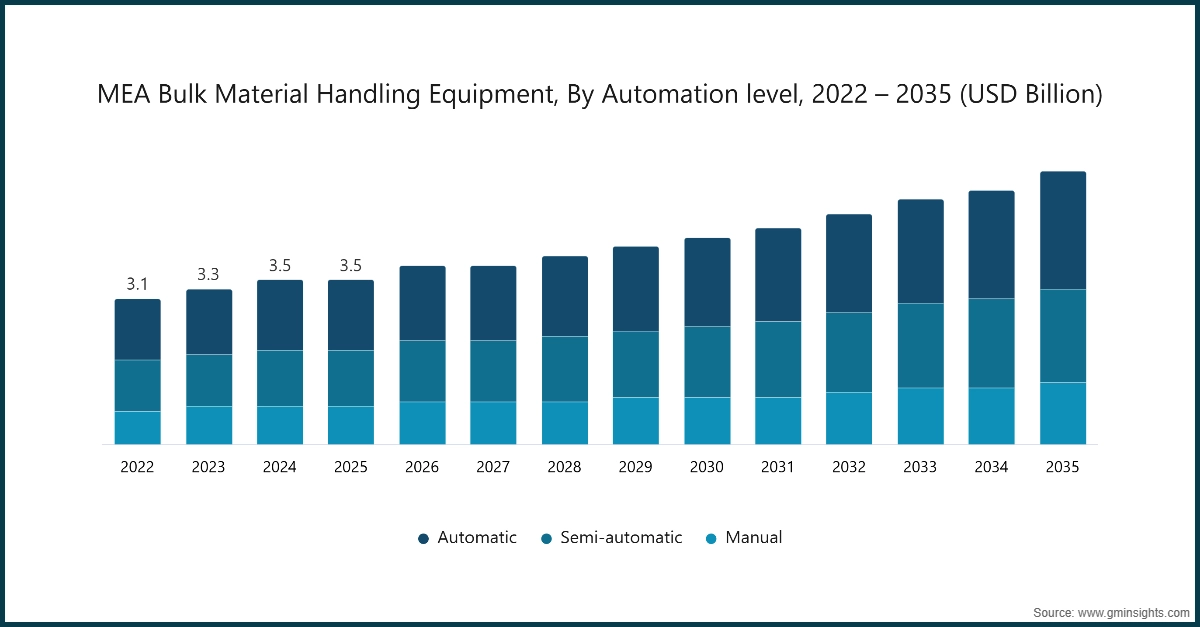
Based on automation level, the Middle East and Africa bulk material handling equipment market is segmented automatic, semi-automatic and manual. The automatic segment accounts for revenue of around USD 1.5 billion in the year 2025 and is expected to reach USD 2.5 billion by 2035.
- The leading position of the automated segment is based on the increased efficiency and decrease in cost due to the application of automated systems, including robotic conveyor systems, automated guided vehicles and smart sorters. These systems maximize the efficiency of material handling through accurate order and delivery of items. Thyssenkrupp, for instance, has adopted automated systems to enhance productivity at its mining operations. The World Bank predicts that industrial automation in the region will continue to grow by 15% annually through 2030.
- The ability of automation to reduce human error and to maintain a high speed of operation continuously is crucial for industries such as mining and manufacturing. Improved asset management and reduced risk of equipment failure allow for significant cost savings over the life of the asset. For example, Rio Tinto's use of automated haulage systems has resulted in major improvements in operational performance.
- Safety and compliance are two of the major reasons for adopting automation in the workplace. By utilizing automated systems to remove the risks associated with working with heavy or hazardous materials, it is possible to create a safer work environment. For example, DP World, located in the United Arab Emirates, has installed automated cranes at its ports to increase safety and productivity. Legal frameworks, such as the South African Occupational Health and Safety Act, are creating opportunities for increased automation as a way of meeting safety requirements.
- Although automation can enhance a business’s productivity and profitability, it can introduce a variety of problems, including a need for greater attention on safety and enhancing a business's ability to address the operational liabilities caused by the malfunction of automated equipment. To adequately address these challenges, a company must also provide its employees with adequate training and must also invest in maintaining equipment on a regular basis and must develop and implement better safety strategies.
- Automation is also changing how bulk material handling equipment is designed, manufactured, and sold in the Middle East and Africa. A growing need for more efficient, safer, and compliant bulk material handling devices is one of the many factors influencing the application of automated technologies by companies such as Caterpillar and Sandvik.
Learn more about the key segments shaping this market
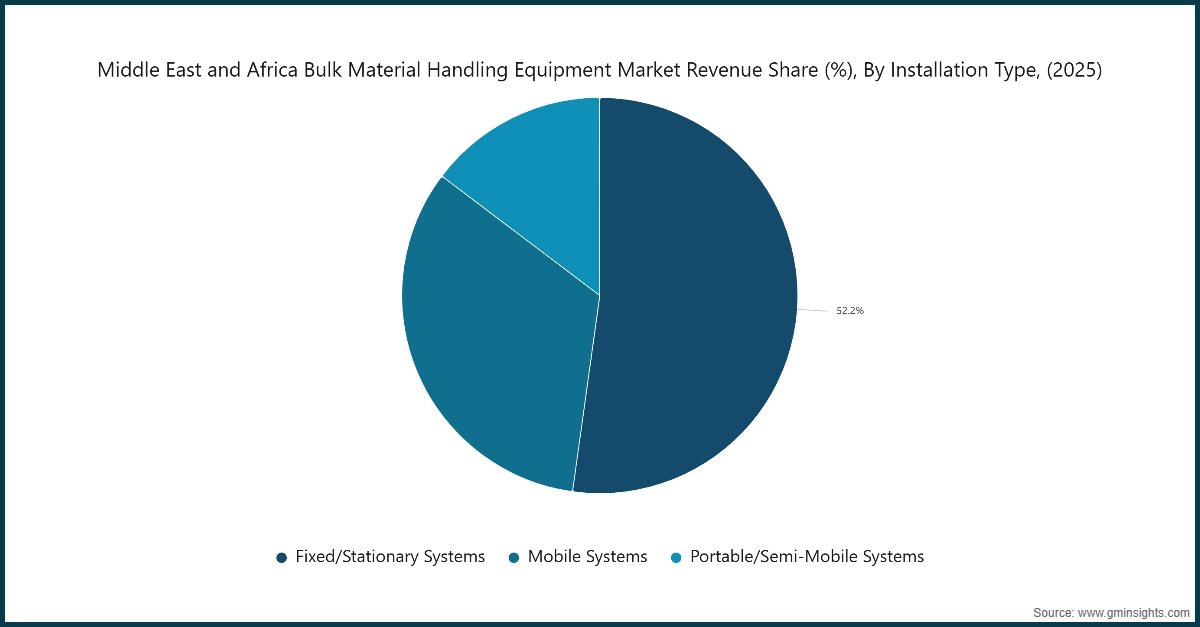
Based on the installation type, the Middle East and Africa bulk material handling equipment market is bifurcated into fixed/stationary systems, mobile systems and portable/semi-mobile systems. The fixed/stationary systems segments held the largest share, accounting for 52.2% of the market in 2025.
- Fixed/stationary systems are particularly dominant in high-volume industries due to their ability to handle continuous operations. These types of systems such as conveyors, hoppers and stacker system are vital in industries such as mining, cement and port terminals. Investments in infrastructure within Africa are estimated by The African Development Bank to increase by 4.5% per year; thus, driving the requirement for these types of systems even more.
- The growing use of fixed/stationary systems for long-term infrastructure development is one trend influencing the market. Durable and easy to integrate into larger scale operations, fixed/stationary systems tend to be the equipment of choice. A prime example of this would be the project in South Africa where Metso Outotec's Conveyor Systems were supplied for material handling over extended periods.
- Government Initiatives are also an influential factor in market growth. The Kingdom of Saudi Arabia's Vision 2030 emphasizes the growth of infrastructure development thus opening a number of doors for fixed/stationary systems. In addition, Government policy and vision with regard to South Africa's efforts around the modernisation of mining will also push for the use of advanced material handling equipment to enhance safety and overall operational efficiencies. Therefore, a significant amount of growth will remain in this area of the Market for the foreseeable future.
- The existence of fixed/stationary systems is prevalent throughout many industries, especially those with high volume production. These fixed/stationary systems provide continuous operation such as cement plants and port terminals without any interruption of material flow. Additionally, there have been significant investments by companies, such as FLSmidth, into developing innovative solutions to provide customers with reliable equipment that meets their growing demand for productivity improvements.
The fixed/stationary system will continue to dominate the bulk material handling equipment marketin the Middle East and Africa as infrastructure investments, government policies, and technology advances support the success of the fixed/stationary system market. As companies continue to innovate their products and support governments in developing a modernized bulk material handling equipment (bme), this market will see sustained growth over the period.
Looking for region specific data?
UAE Bulk Material Handling Equipment Market
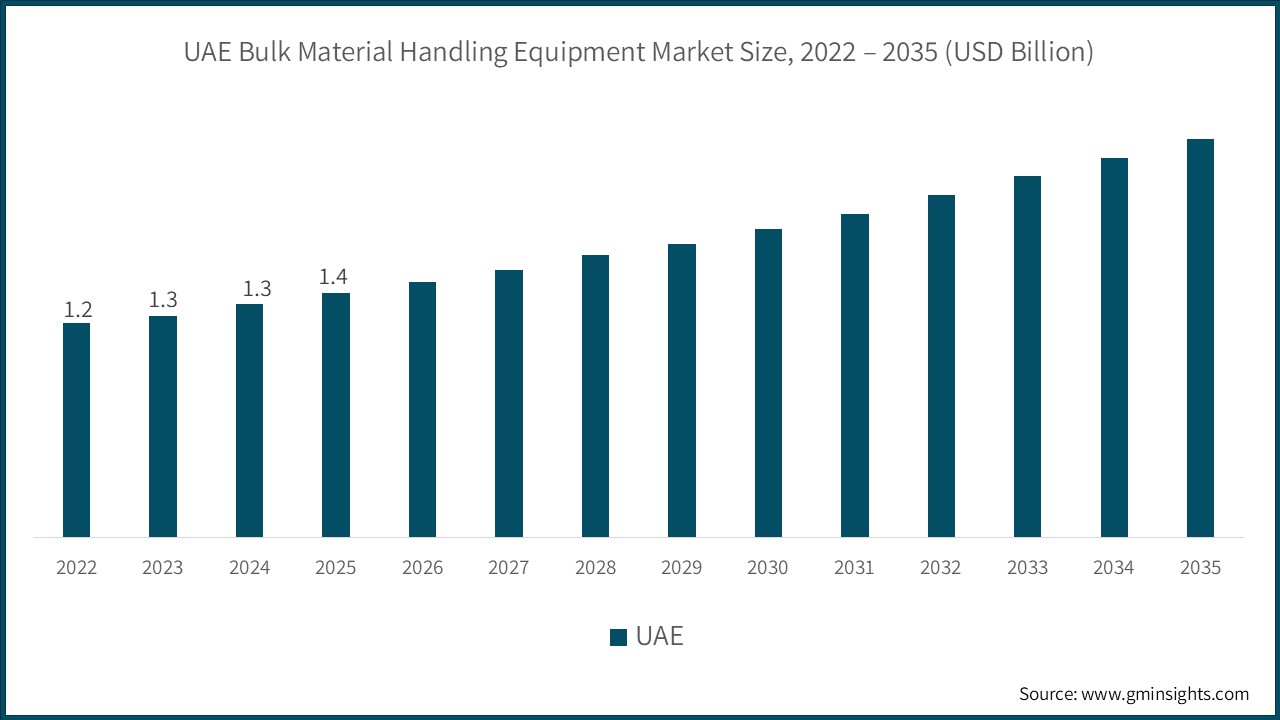
In 2025, the UAE in the Middle East and Africa bulk material handling equipment industry growth accounted for 39.2% of the share in the region.
- The market is driven by rapid industrialization and infrastructure development. The country’s strategic focus on logistics and port modernization under initiatives like UAE Vision 2031 and Operation 300bn has significantly boosted demand for advanced handling systems. Additionally, strong investments in construction and mining sectors have accelerated equipment adoption, supporting efficient material movement and storage.
- The government’s commitment to becoming a global logistics hub is evident through projects such as Etihad Rail and expansions at Jebel Ali Port, which handled over 19 million TEUs in 2024 (Dubai Ports Authority). Furthermore, the UAE’s industrial sector contributed 11.7% to GDP in 2024, reflecting sustained growth in manufacturing and warehousing activities. These developments align with national strategies to enhance supply chain resilience and automation, creating a favorable environment for bulk material handling equipment.
Saudi Arabia Bulk Material Handling Equipment Market
Saudi Arabia bulk material handling equipment industry is expected to grow at 5.3% during the forecast period.
- The Saudi market is primarily growing due to large-scale infrastructure projects under Vision 2030. The Kingdom’s investments in mining, cement production, and logistics corridors are driving demand for efficient handling solutions. Additionally, the expansion of industrial cities and smart warehousing facilities is fostering automation and advanced equipment adoption, ensuring operational efficiency and cost optimization.
Middle East and Africa Bulk Material Handling Equipment Market Share
The top companies in the Middle East and Africa bulk material handling equipment industry include Metso Outotec Corporation, thyssenkrupp AG, Caterpillar Inc., Komatsu Ltd and BEUMER Group GmbH & Co. KG and collectively hold a share of 9.3% of the market in 2025. These prominent players are proactively involved in strategic endeavors, such as mergers & acquisitions, facility expansions & collaborations, to expand their product portfolios, extend their reach to a broad customer base, and strengthen their market position.
Metso Outotec offers a comprehensive range of overland and in-plant conveyor solutions across MEA’s mining and aggregate sectors, boasting capacities up to 20,000 t/h and energy-saving idlers that reduce power usage by approximately 30%. Their systems- engineering through to installation and maintenance and are tailored for MEA’s open-pit, quarry, and mineral-processing operations.
Thyssenkrupp through its industrial solutions arm, delivers end-to-end bulk handling systems—including crushing, grinding, conveyors, and automation—to MEA mines and plants in UAE, Saudi Arabia, South Africa, Egypt, and Morocco. Emphasizing digitalization and sustainable operations, they integrate digital twins and BIM into systems for enhanced process control and lifecycle efficiency.
Caterpillar supports the MEA region with a broad portfolio of mining and material-handling equipment (e.g., excavators, wheel loaders, and material handlers), backed by a strong support network from its Dubai Middle East Distribution Center. The company focuses on optimizing operations in ports, quarries, and mega construction sites, leveraging its infrastructure to support rapid regional growth.
Middle East and Africa Bulk Material Handling Equipment Market Companies
Major players operating in the Middle East and Africa bulk material handling equipment industry are:
- AUMUND Group
- BEUMER Group GmbH & Co. KG
- Caterpillar Inc.
- CITIC Heavy Industries Co., Ltd.
- Continental AG
- KOCH Solutions GmbH
- Komatsu Ltd.
- Liebherr Group
- Metso Outotec Corporation
- Sandvik AB
- Siwertell AB
- TAKRAF GmbH
- Tenova S.p.A.
- thyssenkrupp AG
- Vigan Engineering S.A.
Komatsu delivers rugged bulk material systems for MEA mining, including Joy-branded armored-face and longwall conveyors, integrated crushing and conveying setups,as well as electric and diesel forklifts and telehandlers. The company enhances site performance through its Komtrax fleet management platform and pioneered autonomous haulage systems to meet regional labor and safety demands.
BEUMER Group delivers long-distance belt and pipe conveyors, stacker/reclaimer systems, and dust-controlled ship loading/unloading solutions tailored for MEA’s ports, cement, and mining operations. Their turnkey installations—from design to freight handling—are designed for high capacity (up to 15,000 t/h) and flexible terrain, supporting MEA’s large-scale bulk terminals.
Middle East and Africa Bulk Material Handling Equipment Market Report Attributes
| Key Takeaway | Details |
|---|---|
| Market Size & Growth | |
| Base Year | 2025 |
| Market Size in 2025 | USD 3.6 Billion |
| Market Size in 2026 | USD 3.7 Billion |
| Forecast Period 2025-2035 CAGR | 5.1% |
| Market Size in 2035 | USD 5.8 Billion |
| Key Market Trends | |
| Drivers | Impact |
| Rapid Industrialization and Infrastructure Development | MEA’s industrial growth and large-scale infrastructure projects, such as ports and rail networks, are driving demand for bulk material handling equipment. Government initiatives like UAE Vision 2031 and Saudi Vision 2030 are accelerating construction and logistics investments. |
| Automation and Technological Integration | Automation and IoT adoption in ports, warehouses, and industrial hubs are improving operational efficiency. Smart conveyors and predictive maintenance systems are gaining traction, reducing downtime and labor dependency. |
| Expansion of Mining and Energy Sectors | Mining and energy projects in Saudi Arabia and mineral-rich African regions are fueling equipment demand. Investments in oil, gas, and mineral extraction require heavy-duty handling systems for efficient material transport. |
| Pitfalls & Challenges | Impact |
| High Initial Installation and Maintenance Costs | Bulk handling systems involve significant upfront investment and ongoing maintenance, limiting adoption among small enterprises. This challenge is more pronounced in emerging African markets with budget constraints. |
| Environmental and Regulatory Compliance | Strict regulations on emissions, noise, and energy efficiency increase operational costs. Compliance with sustainability mandates in GCC countries often requires additional investment in eco-friendly technologies. |
| Opportunities: | Impact |
| Integration of Smart Technologies and Predictive Analytics | IoT-enabled monitoring and AI-driven predictive maintenance offer efficiency gains and cost savings. Ports and industrial hubs in UAE and Saudi Arabia are leading this trend, creating strong growth potential. |
| Sustainability and Energy-Efficient Solutions | Green logistics initiatives and carbon reduction goals are driving demand for energy-efficient equipment. Programs like UAE Net Zero 2050 and Saudi Circular Carbon Economy support eco-friendly innovations. |
| Market Leaders (2025) | |
| Market Leader |
2.6% market share |
| Top Players |
Collective market share in 2025 is 9.3% |
| Competitive Edge |
|
| Regional Insights | |
| Largest Market | UAE |
| Fastest growing market | South Africa |
| Emerging countries | Saudi Arabia, Eqypt, Qatar, Kuwait |
| Future outlook |
|
What are the growth opportunities in this market?
Middle East and Africa Bulk Material Handling Equipment Industry News
- In October 2025, Bruks Siwertell delivered a Siwertell 10 000 S road-mobile ship unloader to West Africa. The unit offers 300 t/h capacity with advanced dust-control and remote monitoring. This deployment supports cleaner and flexible bulk handling in regional ports. It reflects growing demand for mobile, eco-efficient solutions in MEA.
- In August 2025, Sandvik secured a major mining equipment contract in Botswana, reinforcing its regional footprint. The deal includes advanced bulk handling and automation systems for mining operations. It supports efficiency and safety in large-scale mineral projects. This order highlights MEA’s rising investment in modern mining technologies.
- In July 2025, CITIC Heavy Industries won an order for six wet grinding rod mills for Wengfu Phosphate Mine Phase II in Saudi Arabia. The mills (Ø 4.6 × 6.7 m) will boost processing capacity for fertilizer production. This project strengthens CITIC’s role in MEA’s mining and chemical sectors. It reflects growing demand for high-capacity bulk handling solutions.
- In June 2025, AUMUND expanded its portfolio by acquiring ESI Eurosilo, adding vertical storage systems to its bulk handling solutions. This move strengthens its presence in MEA’s mining and fertilizer sectors. The integration focuses on eco-friendly storage and efficient material flow. It positions AUMUND as a key player in sustainable bulk handling.
- In April 2025, Liebherr introduced two electric material handlers for port operations: LH 40 M Port E and LH 60 M High Rise Port E. These zero-emission machines provide extended reach and modular grabs. Designed for bulk terminals, they reduce carbon footprint and operating costs. The launch aligns with MEA’s sustainability goals in logistics.
The Middle East and Africa bulk material handling equipment market research report includes in-depth coverage of the industry, with estimates & forecasts in terms of revenue (USD Billion) and volume (Thousand Units) (from 2022 to 2035), for the following segments:
Market, By Equipment Type
- Conveyor systems
- Belt conveyor systems
- Pipe conveyor systems
- Drag chain conveyor systems
- Screw conveyor systems
- Stacker-reclaimer systems
- Circular stacker-reclaimers
- Linear stacker-reclaimers
- Combined stacker-reclaimers
- Shiploader & shipunloader systems
- Continuous shiploaders
- Grab-type shipunloaders
- Pneumatic shipunloaders
- Bucket wheel excavators
- Lignite mining applications
- Iron ore applications
- Overburden removal applications
- Feeders & feeding equipment
- Vibratory feeders
- Belt feeders
- Apron feeders
- Crushers & size reduction equipment
- Jaw crushers
- Cone crushers
- Impact crushers
- Hammer mills
- Screening & separation equipment
- Vibrating screens
- Classifiers & separators
- Storage systems
- Hoppers & bins
- Silos & storage facilities
- Auxiliary & support equipment
- Belt cleaners & scrapers
- Take-up systems
- Transfer equipment & chutes
- Dust collection systems
- Magnetic separators
Market, By Capacity
- Small capacity systems (under 1,000 tph)
- Medium capacity systems (1,000-5,000 tph)
- High-capacity systems (5,000-8,000 tph)
- Ultra-high-capacity systems (8,000+ tph)
Market, By Installation Type
- Fixed/stationary systems
- Mobile systems
- Portable/semi-mobile systems
Market, By Automation Type
- Manual
- Semi-automatic
- Automatic
Market, By Commodity Type
- Iron ore
- Coal
- Copper
- Fertilizers & chemicals
- Multi-commodity systems
- Other bulk commodities
Market, By End Use
- Mining operations
- Port & terminal operations
- Power generation
- Cement manufacturing
- Steel & metals processing
- Agriculture & food processing
- Construction & aggregates
- Logistics & distribution centers
- Other end-use industries
Market, By Distribution Channel
- Direct
- Indirect
The above information is provided for the following countries:
- Saudi Arabia
- UAE
- South Africa
- Nigeria
- Egypt
- Algeria
- Qatar
- Kuwait
- Rest of MEA
Frequently Asked Question(FAQ) :
What was the market size of the Middle East and Africa bulk material handling equipment in 2025?
The market size was USD 3.6 billion in 2025, with a CAGR of 5.1% expected through 2035. Growth is driven by advancements in automation technologies and evolving supply chain demands.
What is the projected value of the Middle East and Africa bulk material handling equipment market by 2035?
The market is poised to reach USD 5.8 billion by 2035, fueled by sustainability initiatives, modular equipment adoption, and increased automation.
What is the expected size of the Middle East and Africa bulk material handling equipment industry in 2026?
The market size is projected to reach USD 3.7 billion in 2026.
How much revenue did the automatic segment generate in 2025?
The automatic segment generated approximately USD 1.5 billion in 2025 and is expected to reach USD 2.5 billion by 2035.
What was the market share of the fixed/stationary systems segment in 2025?
The fixed/stationary systems segment held the largest share, accounting for 52.2% of the market in 2025, led by its dominance in high-volume industries like mining, cement, and port terminals.
What was the UAE's share in the Middle East and Africa bulk material handling equipment sector in 2025?
The UAE accounted for 39.2% of the market share in 2025. The market is propelled by rapid industrialization, infrastructure development, and initiatives.
What are the key trends in the Middle East and Africa bulk material handling equipment market?
Key trends include the adoption of IoT-enabled systems, energy-efficient designs, modular and reconfigurable equipment, advanced safety features, and predictive maintenance technologies.
Who are the major players in the Middle East and Africa bulk material handling equipment industry?
Major players include AUMUND Group, BEUMER Group GmbH & Co. KG, Caterpillar Inc., CITIC Heavy Industries Co., Ltd., Continental AG, Liebherr Group, Metso Outotec Corporation, Sandvik AB, Siwertell AB, and TAKRAF GmbH.
Middle East and Africa Bulk Material Handling Equipment Market Scope
Related Reports