Summary
Table of Content

Mass Flow Controller Market
Get a free sample of this report
Form submitted successfully!
Error submitting form. Please try again.
Thank you!
Your inquiry has been received. Our team will reach out to you with the required details via email. To ensure that you don't miss their response, kindly remember to check your spam folder as well!
Request Sectional Data
Thank you!
Your inquiry has been received. Our team will reach out to you with the required details via email. To ensure that you don't miss their response, kindly remember to check your spam folder as well!
Form submitted successfully!
Error submitting form. Please try again.
Mass Flow Controller Market Size
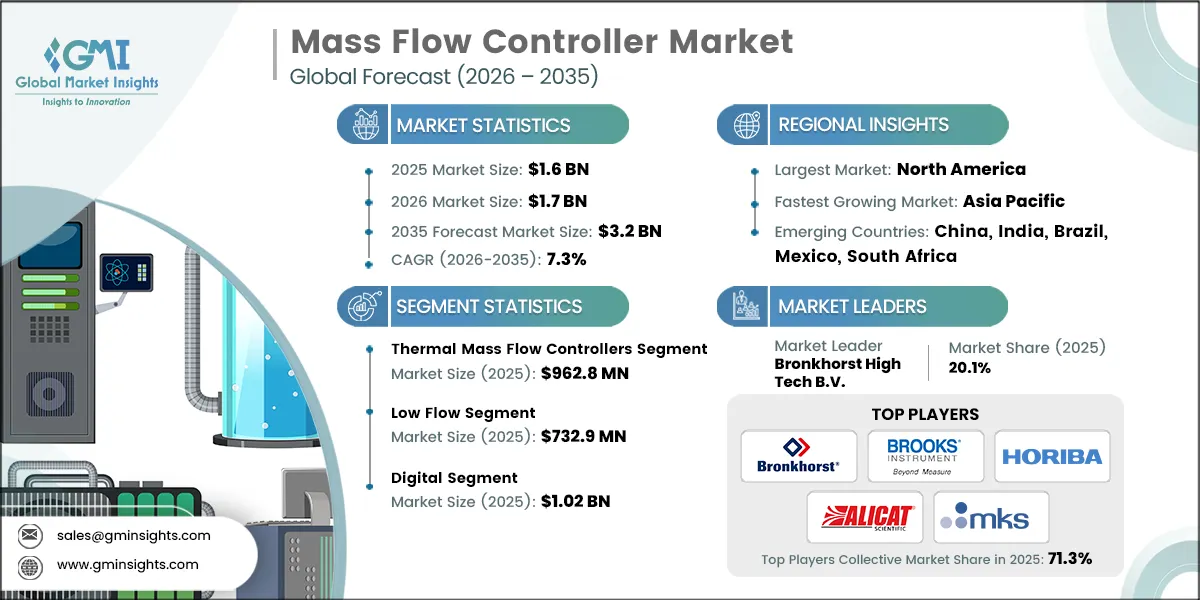
The global mass flow controller Market was valued at USD 1.6 Billion in 2025. The market is expected to grow from USD 1.7 Billion in 2026 to USD 3.2 Billion in 2035, at a CAGR of 7.3% during the forecast period according to the latest report published by Global Market Insights Inc.
Mass Flow Controller Market Key Takeaways
Market Size & Growth
- 2025 Market Size: USD 1.6 Billion
- 2026 Market Size: USD 1.7 Billion
- 2035 Forecast Market Size: USD 3.2 Billion
- CAGR (2026–2035): 7.3%
Regional Dominance
- Largest Market: North America
- Fastest Growing Region: Asia Pacific
Key Market Drivers
- Expansion of Semiconductor and Electronics Manufacturing.
- Integration of Digitalization and Industry 4.0 Technologies.
- Growth in Renewable Energy and Clean Technology Applications.
- Expansion in Pharmaceuticals, Chemical Processing and Biotechnology Sectors.
- Regional Industrialization & Manufacturing Investment.
Challenges
- High Cost of Advanced MFCs.
- Complex Integration with Existing Systems.
Opportunity
- IoT-Enabled and Smart MFC Solutions.
- Expansion in Emerging Markets.
Key Players
- Market Leader: Bronkhorst High‑Tech B.V. led with over 20.1% market share in 2025.
- Leading Players: Top 5 players in this market include Bronkhorst High‑Tech B.V., HORIBA Ltd., MKS Instruments, Inc., Brooks Instrument, Alicat Scientific, Inc., which collectively held a market share of 71.3% in 2025.
Get Market Insights & Growth Opportunities
The global mass flow controller market sees strong growth in demand as more industries-semiconductor, aerospace, chemicals, energy, and manufacturing-adopt automation and precision control technologies. With increasingly complex industrial processes and higher output levels, demand for accurate, reliable flow measurement solutions has increased substantially. Mass flow controllers are increasingly being deployed to ensure precise regulation of gases and liquids that are consistent with process stability, quality control, and safety compliance in a wide range of critical operations.
This, in addition to the rapid growth of semiconductor manufacturing and other advanced process industries, is continuing to accelerate the market. Advanced applications involved in the fabrication processes of semiconductors are some of the real areas that demand flow tolerances to be tighter, repeatability to be high, and compactness with system integration. Applications such as etching, CVD, and ALD necessitate higher dependability on advanced mass flow controllers.
Reflecting this trend, in January 2025, HORIBA STEC introduced the DZ-107 ultra-thin mass flow controller, offering a maximum flow capacity of 20 SLM and an extended operating temperature of 60°C within a 10 mm form factor, specifically designed to support next-generation semiconductor processes. This product launch highlights the industry’s focus on high-capacity, space-efficient, and digitally enabled MFCs to address evolving semiconductor equipment requirements.
The move towards the increased adoption of smart manufacturing and the growth of Industry 4.0 systems is also adding to the growth of the MFC market size with industries looking to incorporate digitally enabled and IIoT-interoperability MFCs into their systems to enhance the benefits of reduced downtime, increased process efficiencies, etc., and hence accelerate the growth of the MFC industry.
At the same time, the growing emphasis on clean energy technologies, including hydrogen production, fuel cells, and renewable energy technologies, creates additional opportunities for the mass flow controller market. This is because MFCs are essential in applications such as these, where precise and reliable flow control must be provided.
Moreover, tighter control on regulations and safety aspects in the pharmaceutical, chemical, and electronic device industries is further fueling the need for precise control solutions in terms of mass flow controllers. MFCs are used for accurate dosing control, prevention of contamination, and emission control. All these factors are likely to accelerate the growth of the global mass flow controller market in the future.
To get key market trends
Mass Flow Controller Market Trends
- The market for mass flow controllers is experiencing a paradigm shift towards compact, high-capacity products that can provide higher maximum flow rates without increasing the size of the device. This is particularly true for semiconductor processing and chemical processing industries.
- There is a growing trend of the adoption of digitally enabled MFCs that are compatible with IIoT, which possess real-time monitoring, diagnostics, and prediction control. These devices allow for the adjustment of the processes.
- Another emerging trend for MFCs includes energy-efficient and low-pressure-drop designs that, in turn, contribute to lowering power consumption and its effect on continuous flow processes, hence making MFCs a more sustainable technology for industrial use.
- The incorporation of modern communication protocols and cybersecurity capabilities in MFCs is gaining significant traction, which helps in safe data transfer and control, along with safe operation in connected manufacturing operations.
Mass Flow Controller Market Analysis
Learn more about the key segments shaping this market
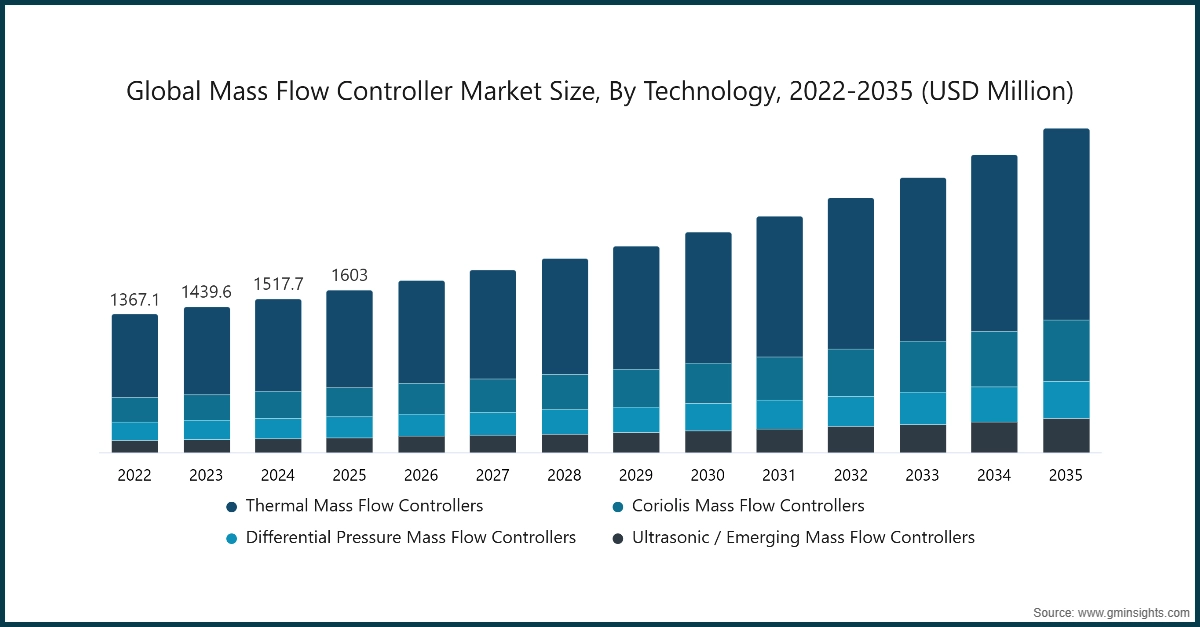
By Technology, the mass flow controller (MFC) market is segmented into thermal mass flow controllers, Coriolis mass flow controllers, differential pressure mass flow controllers, and ultrasonic/emerging mass flow controllers. The thermal mass flow controllers segment accounted for the largest market size of USD 962.8 million in 2025.
- The thermal mass flow controllers market segment dominates the market because they are commonly used in various processes, such as the fabrication of semiconductors, chemical processes, and clean technology-based opportunities, wherein the measurement of mass flow is critical. These mass flow controllers are highly accurate and reliable, with the ability to work smoothly in varying conditions, thereby making them critically necessary.
- Thermal mass flow controllers have fast response times, excellent repeatability, as well as endurance in rough process environments. With the capability to preserve precise flow rates for a range of gases and processes, there is a consistent appreciation for process stability and efficiency in the use of thermal mass flow controllers.
- Ultrasonic / Emerging mass flow controllers: This segment is growing at the highest rate, witnessed at an 8.8% CAGR during the forecast period due to the increasing requirement to measure flow without the need for invasive sensing, low pressure drop requirement, and the ability to handle corrosive or multi-phase fluids.|
- Advances in digital connectivity, miniaturization, and smart diagnostics are also continually refining the accuracy, adaptability, and simplicity of ultrasonic technology, as well as emerging MFCs, which are thereby increasingly incorporated within semiconductor processing, chemical processing, and clean energy technologies.
Learn more about the key segments shaping this market
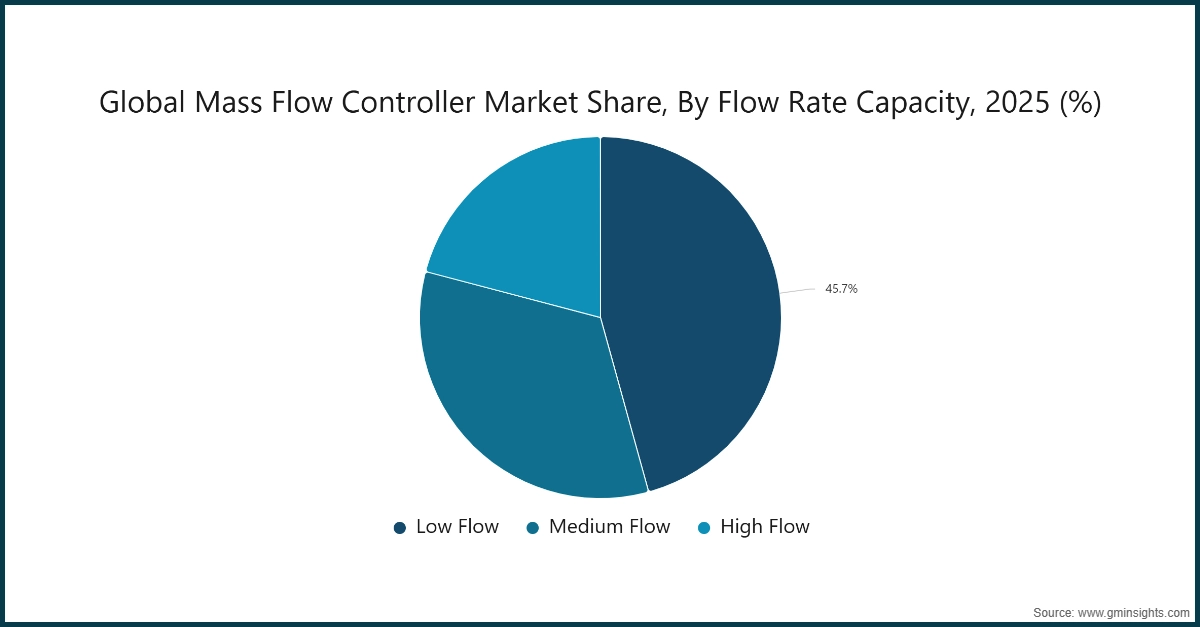
By flow rate capacity, the mass flow controller market is segmented into low flow, medium flow, and high flow. The low flow segment accounted for the largest market size of USD 732.9 million in 2025.
- The low flow segment retains the highest market size, primarily because of its extensive applications in the manufacturing of semiconductors, pharmaceuticals, and analytical studies, in which the control of small volumes of gas or liquid is very crucial.
- Low flow MFCs provide high accuracy, quicker responses, and high repeatability, thus making them suitable for applications where high precision is required. The maintenance of a controlled rate in processes facilitates the widespread use of Low Flow MFCs in high-precision industries.
- Medium flow segments are also expected to exhibit 7.1% CAGR during the forecast period, observing increasing applications in chemical processing, energy, and large-scale manufacturing, wherein higher volume flow control is a necessity, even though the market share for low flow MFCs is dominated owing to the crucial level of precision required in higher value manufacturing processes.
By Connectivity, the global mass flow controller (MFC) market is segmented into analog and digital connectivity. The digital segment accounted for the largest market size of USD 1.02 billion in 2025.
- The digital connectivity segment holds the largest market because of their ability to provide accurate, current flow monitoring, which is integratable with automated control systems, it offers compatibility with IIoT and Industry 4.0 platforms. Digital MFCs facilitate predictive maintenance, optimization of processes, and remote monitoring that add up value to operational efficiency at semiconductor, chemical, pharmaceutical, and energy industries.
- Digital MFCs boast higher data accuracy and repeatability and are supported by advanced communication protocols, including EtherCAT, Modbus, and DeviceNet, which allow easy integration into the modern automated and smart manufacturing environments. The reasons above explain why digital MFCs are finding wider applications compared to analog systems.
- The analog connectivity segment is expected to register 6.7% CAGR during the forecast period while still in use in some legacy systems and applications that are simple in nature yet is gradually becoming overtaken by digital solutions because of the increased demand for automation, predictive analytics, and remote process control.
Looking for region specific data?
The North American mass flow controller market dominated with a market share of 31.4% in 2025.
- There is increasing growth in the North American MFC market, driven by the adoption rate of automation, smart manufacturing, and digital process control solutions. Various industrial segments such as semiconductors, pharmaceuticals, chemicals, clean energy, etc., are embracing technology to provide real-time flow monitoring, predictive maintenance, and other process optimization benefits, which improve efficiency, reduce machine downtime, and ensure process stability.
- Integration of IIoT-enabled MFCs, digital control systems, and advanced analytics across manufacturing, energy, and semiconductor industries is further driving adoption. In addition, the growing interest in energy efficiency, sustainability, and regulatory compliance is driving demand for high-precision, reliable, and application-specific mass flow controllers in North America.
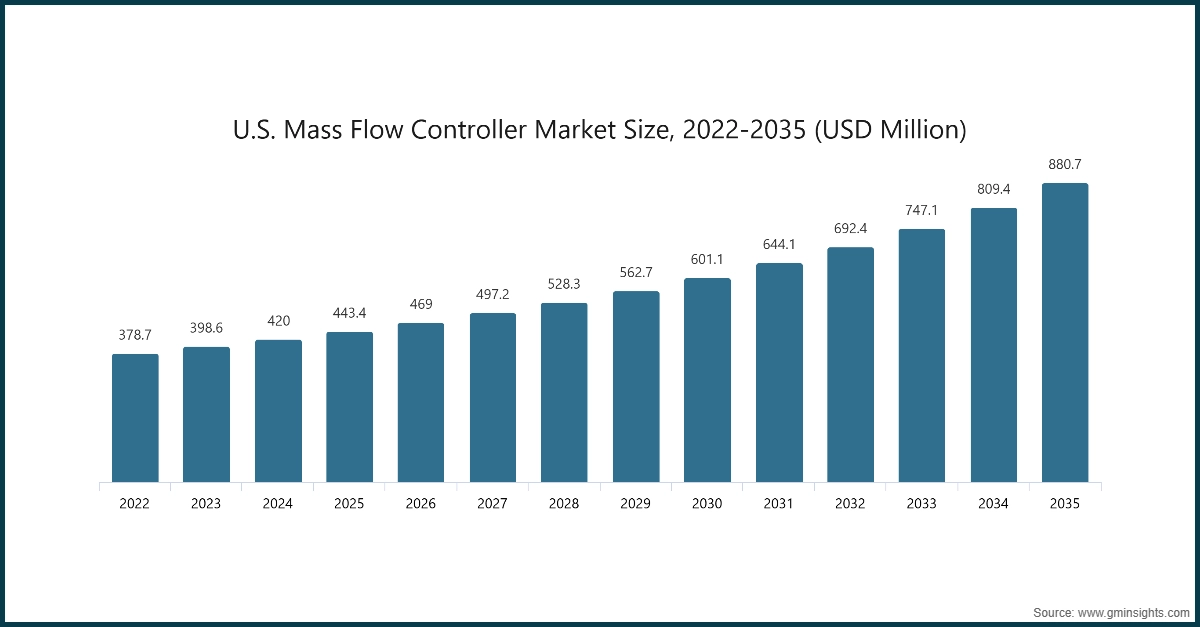
The U.S. mass flow controller market was valued at USD 378.7 million in 2022 and USD 398.6 million in 2023. The market reached USD 443.4 million in 2025, up from USD 420 million in 2024.
- U.S. market growth is being fueled by increasing investments in process automation, semiconductor manufacturing, and clean energy projects. Higher demand for precise flow control, monitoring, and digital integration in MFCs is driving the market for these products in industries such as chemical processing, pharmaceutical, energy, and semiconductor manufacturing.
- Ongoing modernization efforts related to industrial facilities, where there are opportunities to integrate IIoT-based MFC and predictive analytics solutions, are expected to facilitate further efficiency, reduced variability, and throughput optimization, which can create opportunities for mass flow controllers.
- According to the Semiconductor Industry Association (SIA), U.S. semiconductor shipments and domestic manufacturing capacity have been increasing, with policies such as the CHIPS and Science Act projected to nearly triple domestic chip fabrication capacity by 2032, reinforcing demand for MFCs used in gas delivery and process control.
Europe Mass Flow Controller Market
- The market for mass flow controllers in Europe is driven by increasing regulatory and safety standards and environmental concerns for industries such as pharmaceuticals, chemicals, semiconductor manufacturing, and clean technologies. The uptake of digitally enabled mass flow controllers involving IoT technologies has been increasing for controlling and optimizing various industrial and manufacturing processes.
- Growth prospects for investments made in technologies such as advanced MFC, smart manufacturing, and connected systems are adding to the overall growth prospects for this market. This industry is mostly sustained by the need for efficient operational performance, process consistency, and precise dosing and emissions control, thus increasing the usage of precise flow control solutions.
Germany Mass Flow Controller Market
- The strong growth in the mass flow controller market in Germany is attributed to the strong industry base in the sector, including the semiconductor, chemical, and energy industries.
- Germany appears to be an important market for Europe because of the high level of development of its industrial infrastructure, the Smart Factory concept, and the presence of IIoT-based MFC. Mass flow controllers continue to gain importance to ensure the stability and efficiency of processes, as well as the mandatory requirements for safety and the environment.
- Government initiatives are supporting smart manufacturing, energy efficiency, and digital transformation, and the growing consumption of industrial automation technologies will drive MFC deployment. Digital control, predictive technologies, and connected monitoring platforms are expected to be integral in sustaining MFC growth.
Asia Pacific Mass Flow Controller Market
- The Asia Pacific is one of the regions experiencing fast growth due to expansion in industries, semiconductors, and chemical production, as well as investments within the energy and manufacturing sectors. High-precision MFCs will be invaluable tools to further enhance process stability, increase yields, and improve process safety.
- The region is also developing IIoT-enabled MFCs, smart factory solutions, and predictive flow analytics to enhance the real-time monitoring, automation, and optimization of the processes involved. Further investments are being made into technologies like renewable energy systems, advanced manufacturing systems, and interconnected industrial systems to enhance the market for mass flow controllers.
The Chinese market for mass flow controllers is estimated to have a CAGR of 9.8% in the Asia Pacific region.
- It is anticipated that the China in the Asia Pacific region is expected to grow at a high rate of 8.2% due to modernization in manufacturing infrastructure, the development of a smart industry, and government initiatives related to the use of advanced flow control technology. Applications of high-precision MFCs are increasingly deployed for semiconductor fabrication, chemical processing, and clean-energy applications.
- Since industrial, energy, and semiconductor industries are concerned with operational efficiency, process reliability, and predictive flow management, the adoption would find its way to these verticals. Further, expansion of industrial infrastructure, integration of IIoT-enabled MFCs, AI-driven monitoring, and digital control platforms, and modernization of production systems would accelerate the market further in China.
Latin American Mass Flow Controller Market
- Brazil can be assured of rising investments across various sectors, including chemical processing, semiconductor fabrication, the energy sector, and various industrial automation processes. Industries are increasingly striving to achieve precision through MFC-based mass flow control, thus allowing precise monitoring and control of processes.
- The regulatory focus on safety, environmental compliance, and efficiency is also creating a need for sophisticated flow control solutions. However, the use of IIoT-enabled MFCs and digital monitoring solutions with industrial platforms is also seen to open newer prospects in the market in Latin America.
Middle East and Africa Mass Flow Controller Market
- South Africa and other regional markets are experiencing gradual growth in the MFC market as manufacturing, chemical, energy, and semiconductor sectors adopt precision flow control technologies. MFC is deployed due to increased focus on predictive maintenance, optimization, and operational reliability.
- Increasing investments in various industrial automation projects, renewable energy infrastructure, and smart manufacturing projects are creating new opportunities in the market. The market tends to grow based on the region's increased focus on regulatory compliance and environmental standards across industries and process control via digital technology.
Mass Flow Controller Market Share
The competitive landscape of the global mass flow controller industry is characterized by moderate consolidation, high technological intensity, and a strong emphasis on precision, reliability, and real-time flow control. Key players such as Bronkhorst High‑Tech B.V. (20.1%), HORIBA Ltd. (16.6%), MKS Instruments, Inc. (13.5%), Brooks Instrument (11.5%), and Alicat Scientific, Inc. (9.6%) collectively account for a significant portion of the market, reflecting a semi-consolidated structure where major MFC providers coexist with specialized niche technology firms.
The main competitive opportunities in the market lie in the areas of flow measurement accuracy, repeatability, operating range, and connectivity/integration capabilities. The top companies are focused on innovating in thermal, Coriolis, differential pressure, and ultrasonic mass flow control instruments for applications in the semiconductor, chemicals, pharmaceutical, energy, and clean technologies industries.
Major investment is made by major players in R&D, precise manufacturing, and automation calibration systems, which improve the performance and accuracy of the product. Strategic partnerships with semiconductor equipment vendors, chemical/pharma process, and industrial automation vendors are the key strategies adopted by almost all players, which enables the expansion of technology, improves flow control product performance, and accelerates the adoption of predictive maintenance, process efficiency, and compliance solutions.
Mass Flow Controller Market Companies
Prominent players operating in the mass flow controller industry are as mentioned below:
- Alicat Scientific, Inc.
- Azbil Corporation
- Brooks Instrument
- Bronkhorst High‑Tech B.V.
- Christian Bürkert GmbH & Co. KG
- Fujikin Incorporated
- HORIBA Ltd.
- KOFLOC Corporation
- MKS Instruments, Inc.
- Parker Hannifin Corporation
- Sensirion AG
- Sierra Instruments, Inc.
- Teledyne Hastings Instruments
- Tokyo Keiso Co., Ltd.
- Vögtlin Instruments GmbH
- Bronkhorst High‑Tech B.V.
Bronkhorst High‑Tech B.V. holds a market share of approximately 20.1% in the global mass flow controller market. The company specializes in high-precision thermal and Coriolis MFCs for semiconductor, chemical, and pharmaceutical applications. Bronkhorst focuses on accuracy, repeatability, and seamless integration with automated and IIoT-enabled process systems, enabling predictive maintenance, optimized process control, and improved operational efficiency. Continuous investments in R&D, advanced manufacturing, and smart flow technologies reinforce their leadership in high-performance MFC solutions.
HORIBA Ltd. commands a 16.6% share of the global mass flow controller market. The company provides ultra-thin, high-capacity MFCs for applications including semiconductor fabrication, chemical processing, and energy systems. HORIBA emphasizes high flow stability, digital control, and EtherCAT compatibility, supporting real-time process monitoring and precise gas and liquid delivery. Its strong R&D capabilities, global supply chain, and innovative product portfolio strengthen its competitive position in advanced flow control technologies.
MKS Instruments Inc. holds a 13.5% share in the global mass flow controller market. The company offers thermal, Coriolis, and differential pressure MFCs for industries such as semiconductor manufacturing, chemicals, and life sciences. MKS focuses on high precision, reliability under harsh conditions, and integration with automated process control and IIoT systems, enabling optimized flow regulation and operational efficiency. Strategic investments in technology development, automation solutions, and digital process integration support its strong position in the market.
Mass Flow Controller Market Report Attributes
| Key Takeaway | Details |
|---|---|
| Market Size & Growth | |
| Base Year | 2025 |
| Market Size in 2025 | USD 1.6 Billion |
| Market Size in 2026 | USD 1.7 Billion |
| Forecast Period 2026-2035 CAGR | 7.3% |
| Market Size in 2035 | USD 3.2 Billion |
| Key Market Trends | |
| Drivers | Impact |
| Expansion of Semiconductor and Electronics Manufacturing | Drives demand for high-precision mass flow controllers to support critical processes such as etching, CVD, and ALD, ensuring process stability and yield optimization. |
| Integration of Digitalization and Industry 4.0 Technologies | Accelerates adoption of digitally enabled mass flow controllers for real-time monitoring, predictive maintenance, and automated process control. |
| Growth in Renewable Energy and Clean Technology Applications | Increases demand for mass flow controllers for accurate gas regulation in hydrogen production, fuel cells, and electrolyzers. |
| Expansion in Pharmaceuticals, Chemical Processing and Biotechnology Sectors | Drives adoption of mass flow controllers for precise dosing, process consistency, and regulatory compliance. |
| Regional Industrialization & Manufacturing Investment | Supports increased deployment of mass flow controllers across expanding industrial and manufacturing facilities, particularly in high-growth regions. |
| Pitfalls & Challenges | Impact |
| High Cost of Advanced MFCs | Limits adoption among small and medium-sized manufacturers, slowing market penetration and delaying automation in cost-sensitive industries. |
| Complex Integration with Existing Systems | Challenges in integrating MFCs with legacy equipment and control architectures can lead to increased setup time, operational inefficiencies, and higher maintenance requirements. |
| Opportunities: | Impact |
| IoT-Enabled and Smart MFC Solutions | Enables real-time monitoring, predictive maintenance, and data-driven process optimization, creating value through improved efficiency and reduced downtime. |
| Expansion in Emerging Markets | Growth of manufacturing and clean energy sectors in APAC and Latin America drives new MFC deployments, increasing market reach and revenue potential. |
| Market Leaders (2025) | |
| Market Leader |
20.1% market share in 2025 |
| Top Players |
Collective market share is 71.3% in 2025 |
| Competitive Edge |
|
| Regional Insights | |
| Largest Market | North America |
| Fastest growing market | Asia Pacific |
| Emerging countries | China, India, Brazil, Mexico, South Africa |
| Future outlook |
|
What are the growth opportunities in this market?
Mass Flow Controller Industry News
- In April 2025, Alicat Scientific announced an expansion of its mass flow controller and meter product line, enabling accurate and fast control of gas flows up to 12,000 SLPM. The upgrade, achieved through a new high-flow Rolamite valve design, allows seamless scaling from benchtop prototypes to industrial-scale applications. The development supports sectors such as hydrogen fuel cells, bioreactors, manufacturing, and environmental monitoring, offering enhanced precision, multivariate data collection, and broad communication options.
- In March 2024, Brooks Instrument launched the GF120xHT Series, a high-temperature thermal mass flow controller designed for semiconductor manufacturing applications. The new MFC supports solid and liquid precursors with an operating range of 45°C to 150°C, surpassing conventional thermal MFCs. Featuring remote electronics, ultrafast EtherCAT communication, programmable alarms, and fault detection, the GF120xHT ensures precise, reliable delivery of critical precursors for advanced processes like atomic layer deposition (ALD).
The mass flow controller market research report includes in-depth coverage of the industry with estimates and forecast in terms of revenue in (USD Billion) & Volume (Units) from 2022 – 2035 for the following segments:
Market, By Technology
- Thermal mass flow controllers
- Coriolis mass flow controllers
- Differential pressure mass flow controllers
- Ultrasonic / emerging mass flow controllers
Market, By Connectivity
- Analog
- Digital
Market, By Media Type
- Gas
- Liquid
Market, By Flow Rate Capacity
Low flow
Medium flow
- High flow
Market, By End-use Application
- Semiconductor & electronics
- Chemical Vapor Deposition (CVD)
- Physical Vapor Deposition (PVD)
- Thermal processing & diffusion
- Others
- Chemicals & specialty chemicals
- Chemical reaction control
- Spray & coating processes
- Gas blending & mixing
- Others
- Environmental & utilities
- Water & wastewater treatment
- Air quality monitoring & emissions
- Others
- Pharmaceuticals & biotechnology
- Energy & advanced materials
- Metals & mining
- Food & beverage
- Aerospace & defense
- Medical & healthcare
- Others
The above information is provided for the following regions and countries:
- North America
- U.S.
- Canada
- Europe
- Germany
- UK
- France
- Spain
- Italy
- Netherlands
- Asia Pacific
- China
- India
- Japan
- Australia
- South Korea
- Latin America
- Brazil
- Mexico
- Argentina
- Middle East and Africa
- South Africa
- Saudi Arabia
- UAE
Frequently Asked Question(FAQ) :
What was the market size of the mass flow controller in 2025?
The market size was USD 1.6 billion in 2025, with a CAGR of 7.3% expected through 2035. Increasing adoption of automation and precision control technologies across industries is driving market growth.
What is the projected value of the mass flow controller market by 2035?
The market is poised to reach USD 3.2 billion by 2035, driven by advancements in automation, IIoT-enabled devices, and demand for accurate flow measurement solutions.
What is the expected size of the mass flow controller industry in 2026?
The market size is projected to reach USD 1.7 billion in 2026.
How much revenue did the thermal mass flow controllers segment generate in 2025?
The thermal mass flow controllers segment generated approximately USD 962.8 million in 2025.
What was the valuation of the low flow segment in 2025?
The low flow segment accounted for USD 732.9 million in 2025, led by its extensive use in semiconductor manufacturing, pharmaceuticals, and analytical studies.
Which region leads the mass flow controller sector?
North America leads the market with a 31.4% share in 2025, fueled by the adoption of automation, smart manufacturing, and digital process control solutions across industries like semiconductors, pharmaceuticals, and chemicals.
What are the upcoming trends in the mass flow controller market?
Trends include compact, high-capacity designs, IIoT-enabled MFCs with real-time monitoring, energy-efficient low-pressure-drop systems, and integration of advanced communication protocols with enhanced cybersecurity.
Who are the key players in the mass flow controller industry?
Key players include Alicat Scientific, Inc., Azbil Corporation, Brooks Instrument, Bronkhorst High Tech B.V., Christian Bürkert GmbH & Co. KG, Fujikin Incorporated, HORIBA Ltd., KOFLOC Corporation, MKS Instruments, Inc., Parker Hannifin Corporation, and Sensirion AG.
Mass Flow Controller Market Scope
Related Reports