Summary
Table of Content

Marine Sensors Market
Get a free sample of this report
Form submitted successfully!
Error submitting form. Please try again.
Thank you!
Your inquiry has been received. Our team will reach out to you with the required details via email. To ensure that you don't miss their response, kindly remember to check your spam folder as well!
Request Sectional Data
Thank you!
Your inquiry has been received. Our team will reach out to you with the required details via email. To ensure that you don't miss their response, kindly remember to check your spam folder as well!
Form submitted successfully!
Error submitting form. Please try again.
Marine Sensors Market Size
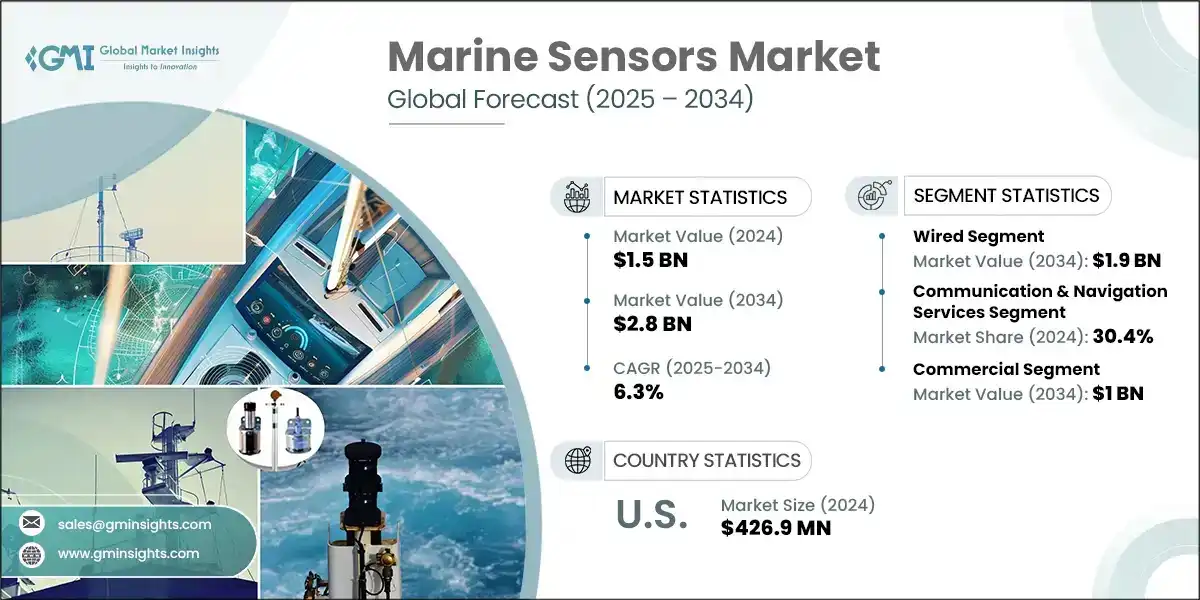
The global marine sensors market was valued at USD 1.5 billion in 2024 with a volume of 332.3 thousand units. The market is expected to grow from USD 1.6 billion in 2025 to USD 2.1 billion by 2030 and USD 2.8 billion by 2034 with a volume of 780.3 thousand units, growing at a value CAGR of 6.3% and volume CAGR of 9% during the forecast period of 2025-2034, according to Global Market Insights Inc.
Marine Sensors Market Key Takeaways
Market Size & Growth
- 2024 Market Size: USD 1.5 Billion
- 2034 Forecast Market Size: USD 2.8 Billion
- CAGR (2025–2034): 6.3%
Key Market Drivers
- Expansion of global maritime trade and port modernization.
- Increasing deployment of naval underwater surveillance systems.
- Stringent maritime safety and environmental regulations.
- Rising adoption of autonomous and unmanned marine vessels.
- Increasing demand for real-time navigation and monitoring systems.
Challenges
- High installation and maintenance costs of advanced sensor systems.
- Limited operational range and environmental constraints underwater.
Opportunity
- Integration of AI and machine learning for predictive marine analytics.
- Expansion of offshore renewable energy projects, including wind farms.
- Growing adoption of digital twin technology in maritime operations.
- Increasing public–private partnerships for marine conservation projects.
Key Players
- Market Leader: Kongsberg Maritime led with over 24.6% market share in 2024.
- Leading Players: Top 5 players in this market include Kongsberg Maritime, Teledyne Marine, Thales, Garmin, Furuno Electric, which collectively held a market share of 44% in 2024.
Get Market Insights & Growth Opportunities
- The installation of naval submarine surveillance systems along with the expansion of international maritime trade and the modernization of ports are propelling the growth of marine sensors market.
- The growing global maritime trade is propelling the use of sophisticated sensor technologies for enhancing the efficiency of operations in cargo handling, ports, and vessel traffic control. Modern port development focuses on the installation of advanced precision sensor systems for navigation, safety as well as environmental compliance. According to UNCTAD, global maritime trade expanded by 2.4% in 2023, marking an improvement over the contraction incurred in 2022. This growth encourages ports and governments around the world to invest in advanced sensor technologies to boost efficiency and manage the growing volume of trade.
- Naval forces are systematically deploying sophisticated underwater sensor systems to improve situational awareness in maritime domains, identify potential threats, and exercise control over vital sea routes. To monitor and track Chinese submarine activities, in April 2025, the Indian Navy, in association with the Defence Research and Development Organisation (DRDO), commenced the deployment of sophisticated underwater sensor systems in the Indian Ocean. These systems are crucial for defense and intelligence activities as they offer real-time tracking and monitoring capabilities. Such developments continue to underscore the growing utilization of underwater surveillance systems for military applications, which will subsequently drive the need for marine sensors.
- In 2024, Asia Pacific accounted for 39.8% share of the marine sensors market due to the sophisticated advancements in marine geoscience technologies and increasing offshore exploration activities. In March 2025, Shearwater GeoServices won a contract for two consecutive towed streamer survey projects in the Asia Pacific region. These projects support energy resource exploration and environmental studies by using advanced offshore seismic vessels and technologies to collect high-quality data. These initiatives further consolidate the position of the region in the adoption of marine sensor systems for accurate data collection, thereby reinforcing its position as a center for offshore surveying and oceanographic research.
To get key market trends
Marine Sensors Market Trends
- Marine sensor manufacturers are prioritizing miniaturization and integration, manufacturing compact units that combine multiple sensing functions in a single device. This shift improves deployment flexibility, particularly for autonomous platforms and small vessels. As operators seek economical and space-efficient options, steady market adoption is projected from 2025 to 2030.
- A transition is emerging toward the use of fiber optics for marine sensors due to their increased accuracy and robustness in extreme subsea conditions. These sensors are beneficial for defense and geophysical applications as they provide superior electromagnetic interference. Adoption momentum is anticipated from 2025 to 2031 as the need for accuracy in monitoring increases.
- The adoption of wireless and networked marine sensor systems is on the rise, allowing vessels, ports, and research stations to share data in real time. Such interconnectivity improves situational awareness and decision-making processes. Widespread adoption is anticipated in 2026-2032 as maritime industries shift to an IoT-based operational model.
- Sustainable sensor design is becoming a focus area, with manufacturers concentrating on the use of recyclable materials, low-energy operations, and environmentally-friendly deployment techniques. Wider adoption is anticipated between 2025 and 2030 as environmental compliance becomes a central factor in procurement decisions.
Marine Sensors Market Analysis
Learn more about the key segments shaping this market
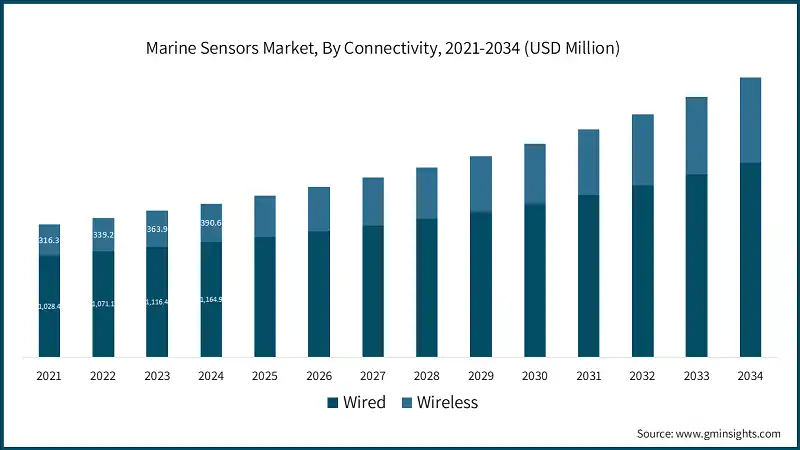
On the basis of connectivity, the market is segmented into wired and wireless.
- The wired segment is anticipated to reach USD 1.9 billion by 2034. Wired marine sensors continue to be favored due to their reliability and consistent data transmission in extreme marine conditions. The wired sensors are commonly used in permanent installations such as offshore platforms and port facilities. Research and development activities are concentrated on increasing resistance to corrosion in order to extend operational lifespan.
- With the steady industry growth, marine sensor manufacturers need to focus on enhancing the reliability and maintenance of wired sensor systems for offshore use by incorporating corrosion-resistant materials, making them easier to maintain in difficult environments.
- The wireless segment is anticipated to grow at a CAGR of 8.3% during the forecast period 2025 - 2034. The increasing use of wireless marine sensors in autonomous ships and temporary monitoring stations demonstrates the benefits of ease of use and flexibility. Moreover, the deployment of wireless marine sensors is being supported by advancements in reliable and secure data transmission as well as data transmission that uses low power.
- Manufacturers should focus on enhancing wireless sensor security protocols and optimizing power efficiency to capitalize on growing demand for flexible, real-time marine monitoring solutions.
Learn more about the key segments shaping this market
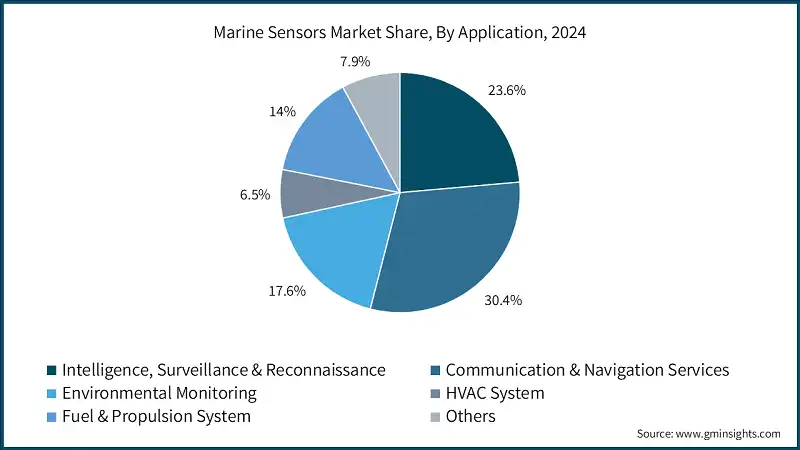
On the basis of application, the marine sensors market is divided into intelligence, surveillance & reconnaissance, communication & navigation services, environmental monitoring, HVAC system, fuel & propulsion system, and others.
- The communication & navigation services segment dominated the market with a market share of 30.4% in 2024. The incorporation of GPS, AIS, and satellite communication technologies is advancing sensor capabilities in the communication and navigation systems for increased maritime situational awareness and safety. The focus is on multi-sensor fusion systems that provide precise and timely information for collision avoidance and optimization of routes. The systems are becoming more widely accepted due to the increase in maritime traffic.
- Marine sensors manufacturers should develop integrated multi-sensor communication and navigation solutions that offer seamless data fusion and enhanced accuracy to support safer and more efficient maritime operations.
- The environmental monitoring market is anticipated to grow at a CAGR of 8.2% during the forecast period 2025 - 2034. Environmental monitoring sensors are advancing with greater sensitivity and real-time data capabilities to track water quality, pollution, and weather conditions. Compliance with regulations and research related to climate change are the primary drivers. In the coastal and offshore regions, sensor networks are being deployed for the continuous monitoring of ecosystems.
- As climate change and the need for regulatory compliance become increasingly important, manufacturers need to develop advanced, low-maintenance, and highly sensitive environmental sensors that are capable of long-term deployment.
On the basis of end user, the marine sensors market is segmented into commercial, military & defense, unmanned underwater vehicles, and others.
- The commercial market is anticipated to reach USD 1 billion by 2034. The application of marine sensors enhances operational efficiency in shipping, fisheries, and the offshore energy sectors. Advancements include automated monitoring systems that increase safety while reducing manual oversight. The commercial sector is swiftly embracing smart sensors for predictive maintenance and management of commercial assets.
- Marine sensor manufacturers should design solutions for commercial applications that focus on automation, predictive analytics, and integration with the current fleet management systems to maximize customer value.
- Unmanned underwater vehicles segment is anticipated to grow at a CAGR of 8.1% during the forecast period 2025 - 2034. Underwater vehicles (UUVs) are critical for gathering in deep-sea exploration and military applications. Marine sensors assist unmanned underwater vehicles (UUVs) in effective data processing and navigation.
- To ensure prolonged operational timelines and improved autonomous capabilities, marine sensor developers must focus on creating compact and energy efficient sensor suites tailored to UUVs.
Looking for region specific data?
North America held a market share of 31.6% in 2024 and is anticipated to grow at a CAGR of 5.8% during the forecast period 2025 - 2034. The North America marine sensors market is driven by increasing investments in maritime safety, offshore energy, and environmental monitoring. The advancement and widespread adoption of sensor technologies are enhancing the efficiency of port operations, vessel tracking, and compliance in both commercial and defense areas. Steady market growth continues to be fueled by ongoing innovation.
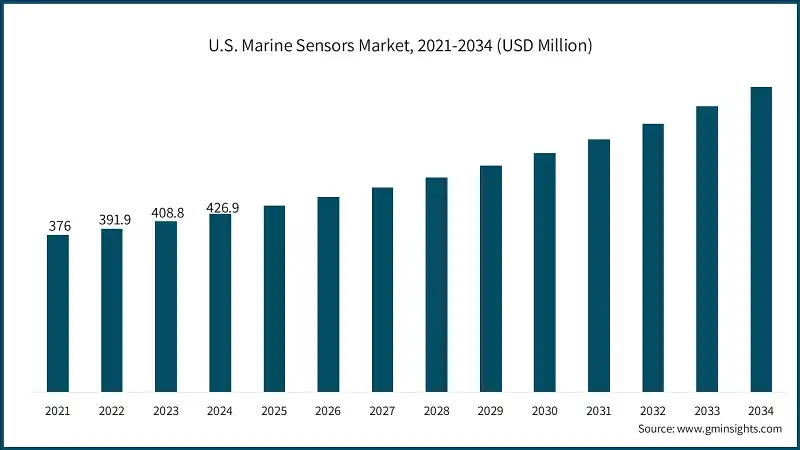
- U.S. dominated the marine sensors market, accounting for USD 426.9 million in the year 2024. The United States is prioritizing the use of advanced real-time marine sensor networks to enhance maritime navigation safety and situational awareness. These systems aid in the monitoring and management of intricate coastal operations, shipping lanes, and the environment to alleviate navigational hazards and enhance management of maritime domains. In May 2025, NOAA launched the Pearl Harbor-Honolulu PORTS (Physical Oceanographic Real-Time System). PORTS is a sensor network which facilitates precision marine navigation. Its purpose is to improve safety during navigation in the Hawaii region.
- Marine sensors manufacturers should prioritize developing high-precision, real-time sensor networks tailored for complex coastal and port environments to support expanding U.S. maritime safety programs.
- Canada is anticipated to grow at a 7% CAGR during the forecast period. Canada’s marine sensors market is bolstered by strong offshore oil and gas operations, expanding requirements for fisheries management, as well as environmental monitoring commitments for the vast coastal areas. Active investments in sensor technologies improve the collection of data for the management and security of maritime resources as well as for environmental conservation.
- To comply with Canada’s strict environmental policies, manufacturers must invest in designing long-lasting, climate-resilient marine sensors built for cold-water operations.
Europe accounted for 18% of the global marine sensors market in 2024 and is anticipated to grow with a CAGR of 4.8% during the forecast period 2025 - 2034. The European Union is promoting the development of marine sensors to monitor marine activities, track environmental changes, and safeguard the areas within the union, which is expected to advance Europe’s Blue Growth strategy. Priorities include the application of new technologies to existing marine infrastructures for better data compliance and precision in line with the EU’s strict standards on marine environmental protection.
- Germany is anticipated to grow at a 5.5% CAGR during the forecast period 2025 - 2034. Germany is enhancing its competitiveness in maritime technologies by incorporating artificial intelligence into the sensor systems of autonomous underwater vehicles (AUVs). In December 2024, the German Research Center for Artificial Intelligence (DFKI) contributed on the development of AUVs with multimodal oceanographic sensors and AI, greatly improving the data collection and exploration capabilities underwater.
- In alignment with Germany’s focus on intelligent marine technologies, manufacturers of marine sensors ought to emphasize multi-sensor, AI-enabled systems which facilitate autonomy in maritime activities.
- UK's marine sensors market is anticipated to grow at a 4.4% CAGR during the forecast period. The UK market is driven by the growth of offshore energy initiatives, modernization of maritime defense, and environment-related projects. To improve operational efficiency and meet the evolving maritime regulations, the market requires more sophisticated sensors. The UK continues to sponsor research partnerships to improve sensor capabilities for sophisticated marine environments.
- Manufacturers should tailor durable, high-accuracy marine sensor solutions to the UK’s expanding offshore wind and defense sectors, emphasizing integration with digital monitoring platforms.
Asia-Pacific held a share of 39.4% in the global marine sensors market and is the fastest-growing region with a 7.3% CAGR during the forecast period. The Asia Pacific area is witnessing increasing adoption of marine sensors due to the growth in offshore exploration, naval modernization, and maritime trade.
- The marine sensors market in China is anticipated to reach USD 550.7 million by the year 2034. China continues to lead in marine infrastructure development and naval capabilities, focusing on integrating cutting-edge sensor systems for surveillance, navigation, and environmental management. The nation's emphasis on attaining maritime supremacy is promoting the use of sensor technologies in both the military and commercial sectors.
- To meet China's strict requirements for defense and commercial maritime operations, manufacturers must develop sophisticated sensor systems with specialized security features and multipurpose functionalities.
- Japan's marine sensors market was valued at USD 77.8 million in 2024. Japan is developing marine sensors to enhance its maritime commerce, logistic systems, disaster management, and oceanographic research activities. The implementation of intelligent sensors onto autonomous ships, as well as onto vessels and port facilities, are improving operational safety and environmental compliance in a technologically sophisticated maritime environment.
- Marine sensors providers should focus on innovation-driven, high-precision sensor solutions compatible with autonomous technologies and disaster resilience applications prevalent in Japan’s maritime sector.
- India's marine sensors market is anticipated to grow at a CAGR of over 8.7% during the forecast period. According to IBEF, citing the Ministry of Shipping, around 95% of India’s trading by volume and 70% by value is conducted through maritime transport. This reliance underscores the importance of maritime logistics to the Indian economy, resulting in heightened investment in marine sensors for coastal surveillance, port modernization, and navigation safety.
- To support India's trade infrastructure and strategic defense requirements, manufacturers need to focus on the development of cost-effective, resilient sensor technologies intended for overarching port activities and coastal surveillance.
Latin America held 4.4% market share in 2024 and is anticipated to grow with a 5.3% CAGR during the forecast period. Latin America is gradually expanding its marine sensor market, driven by growing offshore oil and gas exploration, fisheries management, and port modernization efforts. Increasing environmental regulations and maritime safety requirements are also pushing sensor adoption across the region.
In 2024, the Middle East and Africa held a share of 6.6% and is anticipated to grow at a 6.7% CAGR during the forecast period 2025 - 2034. The MEA region is deploying marine sensors to foster the growth of offshore energy initiatives, the modernization of naval defense, and the surveillance of coastal areas.
- Saudi Arabia accounted for an 32.5% market share in 2024. Saudi Arabia is prioritizing the development of its offshore oil and gas infrastructure, ports, and naval capabilities. The Saudi Arabian government is investing heavily in advanced marine sensors to improve security and operational efficacy in its vital waterways.
- Manufacturers should focus on developing advanced, high-performing marine sensor systems for extensive offshore operations and maritime security.
- The South Africa market is anticipated to grow at a CAGR of 5.7% during the forecast period. South Africa's marine sensors market is shaped by its strategic position along key shipping routes, the expanding fishing industry, and environmental monitoring mandates. Furthermore, the need for improved coastal security and port modernization are additional factors propelling the adoption of marine sensors.
- Manufacturers of marine sensors should direct their efforts towards sensor technologies that are scalable and can support a wider range of applications like port management, fisheries, and maritime security in South Africa.
- The UAE accounted for a share of 39.5% in the market in 2024. The UAE is rapidly expanding its maritime infrastructure and offshore energy sectors, emphasizing smart port development and naval defense modernization. Advanced marine sensors are essential for real-time monitoring, navigation safety, and environmental protection in the region.
- Manufacturers should concentrate on integrating smart, connected sensor solutions with port management and defense systems to support the UAE’s ambition as a leading maritime hub.
Marine Sensors Market Share
The key players in the marine sensors industry are Kongsberg Maritime, Teledyne Marine, Thales, Garmin, and Furuno Electric. In 2024, these companies collectively accounted for over 44% of the market share.
- Kongsberg Maritime lead the marine sensors market with 13.4% share in 2024. Kongsberg Maritime is one of the foremost companies in the development of complex marine sensor systems as well as in navigation, automation, and subsea monitoring systems. Kongsberg Maritime serves the commercial shipping, offshore energy, and defense industries. The company's innovation in sensor integration and real-time data analytics improves efficiency and safety in the complex maritime environments.
- Teledyne Marine held 11.1% of the market share in 2024. Teledyne Marine provides a broad range of specialized sensors that focus on underwater exploration, oceanographic research, and subsea monitoring. The company manufactures sonar, imaging, and other environmental sensors for use in deep-sea applications. Teledyne Marine focuses on technological innovation and reliability, servicing the scientific, defense, and commercial maritime industries worldwide.
- Thales Group held a market share of 8.6% in 2024. Thales Group specializes in advanced marine sensor technologies developed for defense, security, and navigation applications. Its products encompass a range of systems such as radar and sonar, as well as communication sensors designed to improve maritime situational awareness and operational effectiveness. Thales utilizes advanced electronics technologies, as well as the integration of AI, to aid both naval and commercial clients in demanding maritime environments.
- Garmin held a market share of 6.5% in 2024. Garmin specializes in providing communication and navigation sensors, providing GPS, radar, and sonar technologies primarily for recreational, commercial, and fishing vessels. Garmin’s products, well-recognized for their ease of use and dependable performance, aid in improving safety, navigation precision, and vessel tracking across multiple marine segments.
- Furuno Electric held a market share of 4.3% in 2024. Furuno Electric is a leader in marine sensors such as radars, echo sounders, and weather monitoring systems. The company serves the shipping and fishing fleets as well as the offshore industries, delivering high-precision, high-quality sensor systems. Furuno’s steadfast innovations enhance safety and navigation in global shipping and fishing industries.
Marine Sensors Market Companies
Major players operating in the marine sensors industry are:
- Curtiss-Wright
- Eaton
- Furuno
- Garmin
- Honeywell
- Kongsberg Maritime
- NKE Marine Electronics
- Nortek
- Furuno Electric, Garmin, Teledyne Marine, Thales Group, and Kongsberg Maritime dominate the marine sensor market by providing comprehensive and technologically advanced solutions on a global scale. These companies serve diverse marine applications with industry-leading capabilities in R&D and a wide range of product offerings.
- Curtiss-Wright, Eaton, Honeywell, Northrop Grumman, Rockwell Collins, SBG Systems, Sonardyne, and TE Connectivity are classified as challengers in the market. These companies are increasing their market share by concentrating on the development of innovative marine sensor technologies to serve expanding sub-markets.
- Followers encompass NKE Marine Electronics, Nortek, Sea-Bird Scientific, Senmatic, Siren Marine, and Xylem. These companies continue to use traditional technologies to provide off-the-shelf sensor products as well as remain relevant in the industry.
- Trensor focuses on specialized and emerging marine sensor technologies and is classified as a niche player within the industry. These companies frequently address specific market needs with novel, ergonomic, or economical designs, fostering market diversity while meeting distinct customer needs and preferences.
Marine Sensors Market Report Attributes
| Key Takeaway | Details |
|---|---|
| Market Size & Growth | |
| Base Year | 2024 |
| Market Size in 2024 | USD 1.5 Billion |
| Forecast Period 2025 - 2034 CAGR | 6.3% |
| Market Size in 2034 | USD 2.8 Billion |
| Key Market Trends | |
| Drivers | Impact |
| Expansion of global maritime trade and port modernization | Boosts marine sensors market demand by over 25% as modernized ports require advanced navigation, traffic management, and cargo monitoring systems to handle increased trade volumes efficiently. |
| Increasing deployment of naval underwater surveillance systems | Accelerates market growth by around 22% through heightened adoption of sonar and detection sensors for maritime security, anti-submarine warfare, and territorial monitoring. |
| Stringent maritime safety and environmental regulations | Propels demand by nearly 20% as fleets invest in precision monitoring systems to ensure compliance with evolving safety protocols and environmental standards. |
| Rising adoption of autonomous and unmanned marine vessels | Elevates market growth by approximately 28% as these vessels depend on high-accuracy sensors for navigation, collision avoidance, and autonomous control. |
| Increasing demand for real-time navigation and monitoring systems | Strengthens demand by about 24% as shipping and defense operators rely on instant, accurate data for operational efficiency and safety assurance. |
| Pitfalls & Challenges | Impact |
| High installation and maintenance costs of advanced sensor systems | Restrains marine sensors market growth by limiting adoption among smaller operators and cost-sensitive maritime segments. |
| Limited operational range and environmental constraints underwater | Challenges market expansion as sensor performance is hindered by depth limitations, salinity, and water clarity. |
| Opportunities: | Impact |
| Integration of AI and machine learning for predictive marine analytics | Creates opportunities for enhanced decision-making, operational efficiency, and predictive maintenance in marine applications. |
| Expansion of offshore renewable energy projects, including wind farms | Opens new avenues for sensor deployment in monitoring, safety, and operational control of offshore installations. |
| Growing adoption of digital twin technology in maritime operations | Enables real-time simulation and optimization of vessel performance, driving demand for advanced sensor data integration. |
| Increasing public–private partnerships for marine conservation projects | Encourages broader use of environmental monitoring sensors for sustainable ocean management and biodiversity protection. |
| Market Leaders (2024) | |
| Market Leaders |
Top 2 players held 24.6% market share |
| Top Players |
Collective market share in 2024 is 44% |
| Competitive Edge |
|
| Regional Insights | |
| Largest Market | Asia Pacific |
| Fastest Growing Market | Asia Pacific |
| Emerging Country | Mexico, India, Brazil, Indonesia, South Africa |
| Future Outlook |
|
What are the growth opportunities in this market?
Marine Sensors Industry News
- In April 2025, The Australian Department of Defence awarded L3Harris Technologies a contract to deliver new Maritime Underwater Tracking Ranges (MUTR) for the Royal Australian Navy. Through a series of sensors, the tracking ranges will capture and relay information on the location and movement of assets that are operating within the tracking field.
- In July 2025, LIG Nex1 was awarded a contract by the Republic of Korea Navy to provide "ultra-thin" linear sensors for use in next-generation submarines and unmanned underwater vehicles (UUVs).
The marine sensors market research report includes in-depth coverage of the industry with estimates & forecasts in terms of revenue (USD Million) & Volume (Thousand Units) from 2021 to 2034, for the following segments:
Market, By Sensor Type
- Pressure sensors
- Temperature sensors
- Force sensors
- Torque sensors
- Speed sensors
- Position & displacement sensors
- Level sensors
- Proximity sensors
- Flow sensors
- Optical sensors
- Motion sensors
- Radar sensors
- Smoke detection sensors
- GPS sensors
- Acoustic sensors
- Current sensors
- Others
Market, By Connectivity
- Wired
- Wireless
Market, By Application
- Intelligence, surveillance & reconnaissance
- Communication & navigation services
- Environmental monitoring
- HVAC system
- Fuel & propulsion system
- Others
Market, By End Use
- Commercial
- Cruise ship
- Passenger ferries
- Yachts
- Tankers
- Bulk carriers
- Cargo ships
- Others
- Military & defense
- Aircraft carriers
- Amphibious ships
- Frigates
- Destroyers
- Submarines
- Others
- Unmanned underwater vehicles
- Autonomous underwater vehicles
- Remotely operated underwater vehicles
- Others
The above information is provided for the following regions and countries:
- North America
- U.S.
- Canada
- Europe
- Germany
- Uk
- France
- Spain
- Italy
- Netherlands
- Asia Pacific
- China
- India
- Japan
- Australia
- South Korea
- Latin America
- Brazil
- Mexico
- Argentina
- Middle East and Africa
- Saudi Arabia
- South Africa
- UAE
Frequently Asked Question(FAQ) :
What is the market size of the marine sensors in 2024?
The market size was USD 1.5 billion in 2024, with a CAGR of 6.3% expected through 2034 driven by rising adoption of autonomous and unmanned marine vessels.
What is the projected value of the marine sensors market by 2034?
The market size for marine sensors is expected to reach USD 2.8 billion by 2034, supported by port modernization, naval surveillance systems, and expansion of maritime trade.
How much revenue did the communication & navigation services segment generate in 2024?
The communication & navigation services segment held 30.4% market share in 2024, driven by integration of GPS, AIS, and satellite technologies to enhance maritime safety and situational awareness.
What was the valuation of the wired connectivity segment in 2024?
Wired marine sensors dominated in 2024 and are projected to reach USD 1.9 billion by 2034, as they remain the preferred choice for reliability in harsh marine environments.
What is the growth outlook for wireless marine sensors from 2025 to 2034?
Wireless marine sensors are projected to grow at a CAGR of 8.3% till 2034, driven by adoption in autonomous ships, temporary monitoring stations, and advancements in secure low-power data transmission.
How much revenue did the U.S. marine sensors market generate in 2024?
The U.S. generated USD 426.9 million in 2024, driven by investments in maritime navigation safety, coastal surveillance, and advanced real-time sensor networks.
What are the upcoming trends in the marine sensors industry?
Key trends include adoption of fiber optic and wireless sensor systems, AI-driven predictive marine analytics, digital twin technology, and rising demand for sustainable eco-friendly sensor solutions.
Who are the key players in the marine sensors market?
Key players include Kongsberg Maritime, Teledyne Marine, Thales, Garmin, Furuno Electric, Honeywell, Northrop Grumman, Curtiss-Wright, Rockwell Collins, Sonardyne, and Eaton.
Marine Sensors Market Scope
Related Reports