Summary
Table of Content

Marine Scrubber Systems Market
Get a free sample of this report
Form submitted successfully!
Error submitting form. Please try again.
Thank you!
Your inquiry has been received. Our team will reach out to you with the required details via email. To ensure that you don't miss their response, kindly remember to check your spam folder as well!
Request Sectional Data
Thank you!
Your inquiry has been received. Our team will reach out to you with the required details via email. To ensure that you don't miss their response, kindly remember to check your spam folder as well!
Form submitted successfully!
Error submitting form. Please try again.
Marine Scrubber Systems Market Size
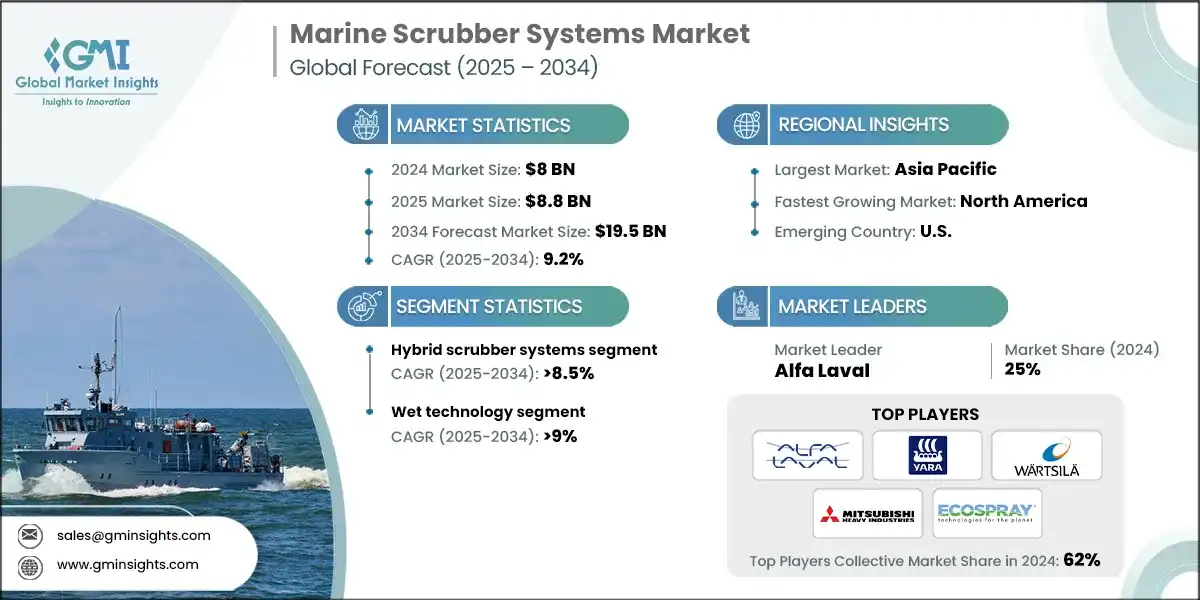
The marine scrubber systems market size was valued at more than USD 8 billion in 2024. The market is expected to grow from USD 8.8 billion in 2025 to USD 19.5 billion by 2034, at a CAGR of 9.2%, according to Global Market Insights, Inc.
Marine Scrubber Systems Market Key Takeaways
Market Size & Growth
- 2024 Market Size: USD 8 Billion
- 2025 Market Size: USD 8.8 Billion
- 2034 Forecast Market Size: USD 19.5 Billion
- CAGR (2025–2034): 9.2%
Regional Dominance
- Largest Market: Asia Pacific
- Fastest Growing Region: North America
Key Market Drivers
- Expansion in global seaborn trade.
- Stringent regulatory framework related to emissions.
- Technological advancements.
Challenges
- High installation cost.
Opportunity
- Regulatory driven adoption.
- Growing demand for clean fuel.
- Retrofit market growth for the existing fleets.
- Integration with hybrid and alternative fuel solutions.
Key Players
- Market Leader: Alfa Laval led with over 25% market share in 2024.
- Leading Players: Top 5 players in this market include EcoSpray Technologies, Mitsubishi Heavy Industries, Wärtsilä, Yara Marine Technologies, Alfa Laval, which collectively held a market share of 62% in 2024.
Get Market Insights & Growth Opportunities
- Rising shipping pollution in the form of SOx and NOx will impact the environment health along with the marine habitat, thereby driving the product demand. Introduction of sulfur standards for shipping fuel, by the international marine regulatory authorities, including the IMO, with an aim to reduce adverse impact of marine pollution on human heath is set to drive the marine scrubber systems market landscape.
- A marine scrubber system or an exhaust gas cleaning system, is a technology used on ships to reduce air pollution from the combustion of marine engines. The primary purpose of a marine scrubber is to remove pollutants, particularly sulfur oxides (SOx), from the exhaust gases emitted by the ship's engines.
- Growing requirement to reduce the impact of shipping emissions, primarily in emission control areas (ECAs) coupled with increasing requirement to comply with the environment regulations comprising of International Maritime Organization's (IMO) sulfur cap regulations under MARPOL Annex VI, is set to influence the industry trends.
- Ongoing research and development in scrubber technology aimed to address challenges, improve efficiency, and reduce the environmental impact of scrubber systems will drive the product adoption. Further, advancements in hybrid scrubbers and other technologies to provide more options and flexibility for ship operators will augment the marine scrubber systems market landscape.
- Expanding seaborne trade is favoring the adoption of maritime technologies including scrubbers to curtail sulfur emissions from ships. Increasing inter regional trade practices coupled with the growing demand for cargoes and imports across the globe will further augment the industry landscape.
- The government clearances and the need to minimize emission limits has complemented the entrance of marine scrubber system manufacturers in the industry. The government of numerous countries have underlaid strict emission norms to minimize the airborne emissions from ship and this, in turn, has increased the demand for EGCS.
- Introduction of clean fuels that emit fewer toxic gases when burnt along with development of exhaust gas cleaning technologies to comply with the new rules and regulations is set to drive the market growth. Furthermore, extensive investments in research and development to reduce harmful emissions from the ships coupled with the efforts to reduce operational costs have resulted in groundbreaking innovations in the marine scrubber systems market.
- Ongoing developments in scrubber technology by leading industry players including Mitsubishi, Alfa Laval, Damen, Wärtsilä, DuPont and Clean Marine, involved in design and introduction of new versions of existing scrubbers will complement the business landscape. In addition, the scrubber designs are constantly renovated in terms of their weight, effectiveness, size, and their effect on marine environment, leading to product penetration.
- Stringent government norms to curb sulfur emissions by ships along with stakeholder & regulatory pressure to deploy Exhaust Gas Cleaning (EGC) technology in and outside ECAs will influence the demand for scrubber systems. Government initiatives, investments, research & development, technological advancements, innovations, and the demand for product upgrades are a few major factors influencing the market growth.
To get key market trends
Marine Scrubber Systems Market Trends
- Various international and regional regulations aim at reducing the environmental impact of shipping emissions, specifically sulfur oxide (SOx) emissions. Increasing requirement to use low-sulfur fuels coupled with ongoing designation of Emission Control Areas (ECAs) with strict sulfur emission limits will stimulate the product demand.
- Further, technological advancements in marine scrubber systems aiming to enhance efficiency, reduce operational costs, and address environmental concerns will contribute to the market statistics. Additionally, ongoing research and development focuses on developing materials that can withstand the corrosive nature of exhaust gases and the scrubbing process, leading to improved durability and longer lifespan for scrubber systems, thereby contributing to product penetration.
- Retrofitting of the existing vessels equipped with marine scrubbers allows shipowners to refurbish their fleets to comply with the regulatory requirements, thus accelerating the product penetration. In addition, newbuild installations incorporate the systems as part of the initial design, thereby reflecting a long-term commitment to compliance and operational flexibility.
- Positive outlook toward drilling activities along with the need to explore and appropriately harness the potentials that the high seas offer will result in the increased demand for offshore vessels. The growing deep water exploration activities along with the growing demand for drilling platforms, AHTS, and PSV will propel the demand for scrubber systems in offshore vessels.
- The rapid rise in shipbuilding activities primarily in China, South Korea, and Japan has stimulated the demand for these vessels. The opening and expansion of major shipping routes, especially the choke points, will complement the growth in the demand for commercial vessels. In addition, demographic shifts in the global urbanization along with the rising cross-border transport will enhance the market share of the vessels, further encouraging the demand for these systems.
Marine Scrubber Systems Market Analysis
Learn more about the key segments shaping this market
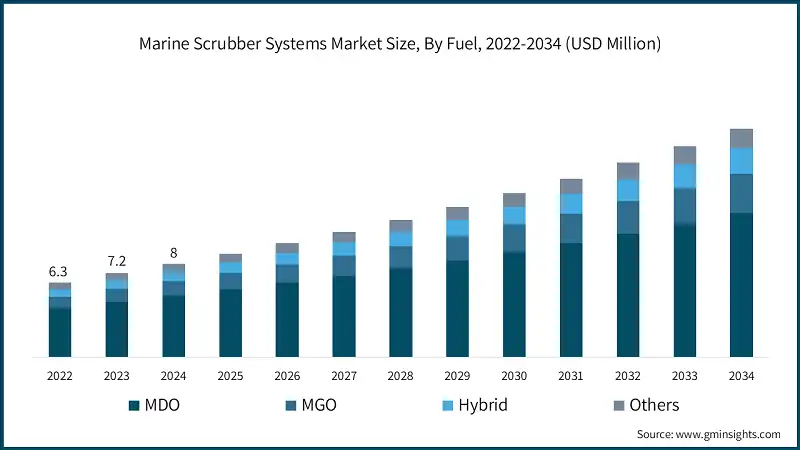
- Based on fuel, the market is segmented as MDO, MGO, Hybrid and others. The hybrid scrubber systems will grow at a rate of over 8.5% till 2034. Stringent environmental regulations, consisting of nitrogen oxide (NOx) and sulfur oxide (SOx) emission limits will augment the use of hybrid fuels, thereby allowing ship operators to meet with the emission limits.
- Hybrid fuel systems owing to their flexibility, allowing ships to switch between different fuel sources based on factors such as cost, availability, and regulatory requirements, will drive the business scenario. Moreover, expanding the fuel mix will enhance the energy security and reduce dependency on a single fuel source, thereby augmenting the industry landscape.
- MDO market is anticipated to reach more than USD 12.1 billion by 2034 on account of its reduced prices, easy availability, and increased thermal & oxidation stability characteristics. The fuel finds its applications in high & medium speed marine engines. Rising health and environment concerns pertaining SOx by ships coupled with acceptance of low-cost fuel with scrubber systems to comply with sulfur emission norms is augmenting the market growth.
- The penetration of the MGO fuel will grow at over 10% CAGR through 2034 primarily across various locations including the polar regions, the North Sea, the Caribbean Sea, the Baltic Sea, and North American waters. Furthermore, increased adoption of the fuel by ship owners, specifically in SECAs, will stimulate the demand for scrubbers.
Learn more about the key segments shaping this market
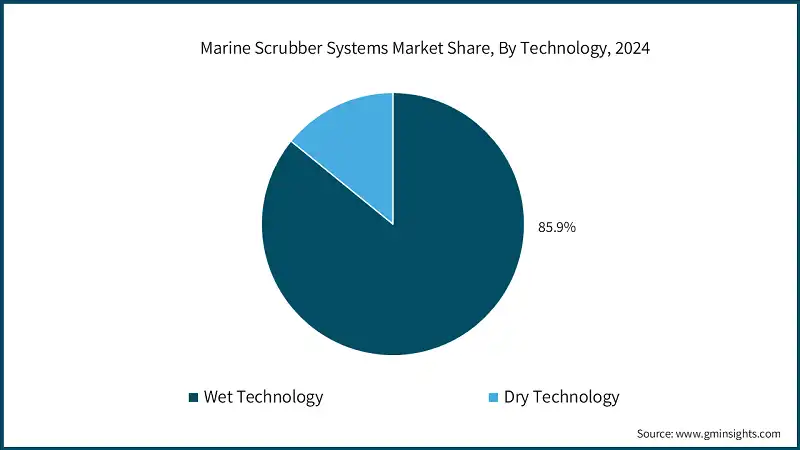
- Based on technology, the marine scrubber systems market is segmented as wet and dry technology. The wet technology market will grow more than 9% CAGR through 2034. Wet technology is divided into three forms including closed-loop, open-loop, and hybrid scrubbers. Hybrid scrubbers operate in both closed-loop and open-loop modes, thereby providing greater flexibility to ship operators. This allows vessels to adapt to the varying environmental conditions to comply with different regulatory requirements, driving the product landscape.
- For instance, in September 2022, Wärtsilä partnered with Maersk to develop an ‘pipe in pipe’ solutions to prevent corrosion problems of open loop scrubber wash water discharge. This solution assist in reducing maintenance, repair, service, and modification costs because of its permanent in-pipe solution.
- Dry marine scrubber systems market cross USD 2.5 billion by 2034. They produce less waste materials when compared to wet technology and most of the waste is filtered or burned off. Stringent regulations to limit sulfur emissions and the acceptance of low-cost fuel with scrubber systems to comply with SOx norms will complement the product penetration.
Looking for region specific data?
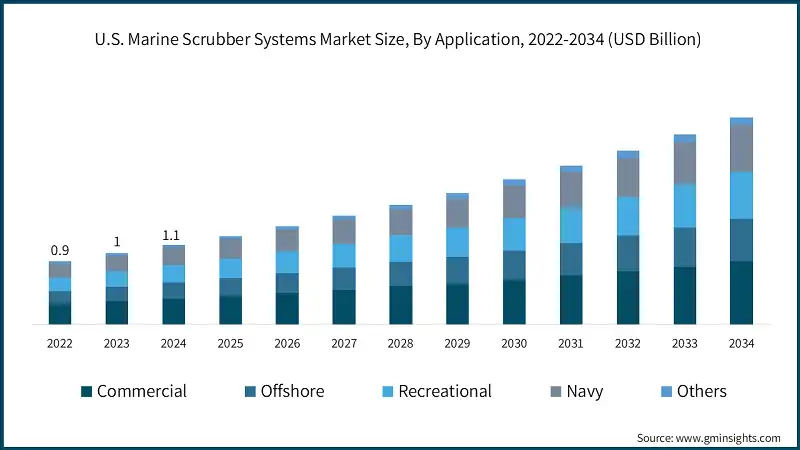
- The U.S. marine scrubber systems market recorded a valuation of over USD 900 million in 2022, rising to USD 1 billion in 2023 and reaching USD 1.1 billion by 2024. North America accounted for 20.7% of the market share in 2024.
- North America witnessed a surge in the scrubber demand owing to the increased spending toward shipbuilding activities. Implementation of strict emission norms to combat harmful emissions will propel the industry manufacturers to develop efficient exhaust gas cleaning systems.
- The ongoing retrofitting activities in the shipping yards for the installation of scrubbers, primarily in the U.S., are accelerating the product demand. For instance, in August 2024, Pacific Environment, released a study, showcasing how scrubbers discharge are damaging the marine environment. Further, they have compiled 26 recent studies showing the new substantial data, inflicting why the U.S. Environmental Protection Agency must ban the scrubber discharge.
- Europe’s marine scrubber systems market is set to surpass USD 4 billion by 2034. Europe’s Connecting Europe Facility (CEF) is constantly financing companies to develop innovative exhaust cleaning solutions. The onboard system in its carbon capture module captures carbon dioxide and use it to charge a CO2 battery, storage facility on which CO2 can be discharged or charged. This is the first solution that has the onboard capability to capture & store CO2.
- For instance, In April 2024, the government of Denmark, introduced a ban on the discharge of wash water from scrubbers in its water. The ban is effective from July 1, 2025, at a distance of up to 12 nautical miles from the Danish coast. This will further mark a significant step towards maintaining a better marine environment.
- Asia Pacific marine scrubber systems market will grow at a CAGR of more than 8.5% till 2032. The region is categorized by varying fuel price dynamics and diverse economic conditions. Increasing fluctuations in fuel prices will influence the economic feasibility of installing marine scrubbers, thereby accelerating the product penetration.
- Increasing adoption of scrubber systems across large container ships and coastal vessels coupled with rising operational needs of vessels, including considerations for compliance with emission regulations will sway the market statistics. Furthermore, increasing trade volumes and economic growth in the region is set to contribute to higher demand for maritime transportation.
- Growing compliance with regional ECAs is set to drive the penetration in vessels operating in these areas. For instance, specific areas in the region, comprising of the Pearl River Delta in China, is set to implement the local emission control areas with stricter sulfur emission limits.
Marine Scrubber Systems Market Share
- The top five players in the marine scrubber systems industry include Alfa Laval, Wärtsilä, Mitsubishi Heavy Industries, Yara Marine Technologies, and Ecospray technologies. The competitive landscape of the marine scrubber systems industry is characterized by a mix of regional shipyard integrators, global technology leaders, and niche innovators, with the competition shaped by retrofit demand, regulatory compliance, and technological advancements.
- These leaders compete by offering hybrid and closed-loop systems, modular and compact designs, and digital monitoring platforms to meet growing environmental restrictions. Strategic partnerships between technology providers, shipyards, and retrofit specialists are common, helping reduce installation time and cost.
- The landscape is further shaped by regional regulatory differences, specifically between Europe and Asia Pacific, due to discharge bans. The industry is moving toward consolidation around key global suppliers, while leaving room for innovators and regional firms to grow in specific vessel segments or compliance niches.
- VDL participates in the manufacturing, designing, marketing, installation, and commissioning of scrubber systems. It also offers cost-effective scrubber technology for the shipping industry. It specializes in SOx scrubbers for ships. The company offers three types of scrubbers, open loop, closed loop, and hybrid and has 97 units operational in 20 countries.
- Langh Tech designs and manufactures marine emission control products. It produces scrubber systems for sulfur emission removal from exhaust gas and water treatment systems used for closed loop scrubbers. In addition to the delivery of marine equipment, the company also provides technical support, installation, commissioning, crew training, turnkey deliveries, and after-sales services.
Marine Scrubber Systems Market Companies
Eminent players operating in the marine scrubber systems industry are:
- ALFA LAVAL
- ANDRITZ
- CR Ocean Engineering
- Clean Marine
- Damen Shipyards Group
- DuPont
- Ecospray Technologies
- Hyundai Heavy Industries
- KwangSung
- Fuji Electric
- Langh Tech
- MAN Energy Solutions
- Mitsubishi Heavy Industries
- PANASIA
- SAACKE
- Samsung Heavy Industries
- Shanghai Bluesoul Environmental Technology
- Valmet
- VDL AEC Maritime
- Wärtsilä
- Yara International
- Wärtsilä offers products including engines, power plants, automation, and environmental solutions including scrubbers. The company generated a revenue of USD 7.5 billion in 2024, increasing the overall order intake to USD 9.4 billion. Further, it is the only scrubber manufacturer offering integrated water treatment capabilities enhancing environmental safety for discharges.
- Valmet is a leading global supplier of process technologies, automation systems, and services. In 2024, the company reported revenue of USD 6.8 billion, with an operating income of USD 523 million. Additionally, the company’s DNA automation system controls scrubber operations by automatically adjusting parameters, while providing user-friendly dashboards and streamlined emissions reporting.
- ANDRITZ is a global technology group, specializing in industrial plant construction. The company had an overall revenue of USD 9.7 billion in 2024 is an active manufacturer of marine exhaust gas cleaning systems, branded as SeaSOx, under its Environment & Energy segment. Moreover, the company leverages CFD design and modeling optimization to deliver scrubbers with compact footprints.
- Hyundai Heavy Industries is the world’s largest shipbuilder and serves the offshore engineering, shipbuilding, industrial plant, and marine engine markets. The company reported an overall revenue of USD 9.75 billion in 2024. Moreover, the company in June 2024, introduced a patented eco-friendly scrubber technology for ammonia-fueled ships. It is designed to safely remove emissions through dual-stage absorption, thereby significantly enhancing the crew safety.
- CR Ocean Engineering designs and supplies marine Exhaust Gas Cleaning Systems (EGCS) and related wash water treatment solutions. It offers compact, inline wet scrubbers in three configurations for newbuilds, retrofits, single or multi-stream, across different vessel types.
Marine Scrubber Systems Market Report Attributes
| Key Takeaway | Details |
|---|---|
| Market Size & Growth | |
| Base Year | 2024 |
| Market Size in 2024 | USD 8 Billion |
| Market Size in 2025 | USD 8.8 Billion |
| Forecast Period 2025 – 2034 CAGR | 9.2% |
| Market Size in 2034 | USD 19.5 Billion |
| Key Market Trends | |
| Drivers | Impact |
| Expansion in global seaborn trade | Increasing import demand across the developing economies will drive the global seaborne trade growth rate. Container revolution will further result in an exponential growth of containerized consumer goods from Asia pacific to Europe and the U.S. |
| Stringent regulatory framework related to emissions | Emissions from marine industry travel long distances significantly affecting air quality across the globe. The particles directly emitted by the ships including black carbon, when combined with sulphate aerosols in the atmosphere, increases the health and environment impacts of shipping pollution. |
| Technological advancements | Rapid technological advancements in marine industry is leading to a competitive industrial scenario across the marine scrubber systems market. Increasing awareness toward shipping pollution and stringent government norms to curb them is resulting in the development of sustainable technology. |
| Pitfalls & Challenges | Impact |
| High installation cost | The scrubber deployment requires numerous other installation equipment including circulation tank, cooling systems and automation and control system that further increases the overall cost of the technology. |
| Opportunities: | Impact |
| Regulatory driven adoption | Stringent norms and mandates of GHG and particulate emissions regulations including the IMO 2030 and 2050 decarbonization targets will create opportunities for the next-generation scrubbers that can manage NOx, SOx, and particulate matter simultaneously. |
| Growing demand for clean fuel | Heavy fuel is the primary choice of shipowners as shipping fuel since many decades majorly owing to its low-cost and easy availability. However, recently growing pressure from the international communities to limit the environmental pollution from ships has led ship owners to adapt to alternative forms of energy. |
| Retrofit market growth for the existing fleets | Shipowners are increasingly retrofitting vessels with scrubbers to capitalize on the fuel cost savings over the vessel’s lifetime, creating strong aftermarket opportunities. |
| Integration with hybrid and alternative fuel solutions | The hybrid scrubbers, both open-loop & closed-loop systems integrated with carbon capture technologies are emerging as a growth avenue, particularly for long-haul vessels that face stricter emission monitoring. Further, with introduction and exploration of fuels comprising of LNG, methanol, ammonia, and biofuels, the scrubber systems can evolve into multi-pollutant abatement solutions. |
| Market Leaders (2024) | |
| Market Leaders |
25% market share |
| Top Players |
Collective market share in 2024 is 62% |
| Competitive Edge |
|
| Regional Insights | |
| Largest Market | Asia Pacific |
| Fastest Growing Market | North America |
| Emerging Countries | U.S. |
| Future outlook |
|
What are the growth opportunities in this market?
Marine Scrubber Systems Industry News
- In October 2024, OCEANKING and CR Ocean Engineering (CROE) entered in an agreement to offer advanced environmental solutions to the maritime industry, supporting cleaner and more sustainable shipping practices worldwide. CROE has extensive manufacturing capabilities across Europe and Asia, ensuring a robust global presence. Moreover, their extensive worldwide support network will enhance their ability to provide first-class service to their customers.
- In September 2024, Wärtsilä entered in an agreement with Leonhardt & Blumberg to supply carbon capture and storage ready scrubber systems for three container ships. It reduces the vessel’s operational expenses by permitting it to operate with more readily available and less costly fuel (HFO).
- In July 2022, World Direct Shipping LLC, a shipping company based in Florida, selected CR Ocean Engineering for the supply of scrubbing system to its containership Queen B III. Previously the company offered scrubbing systems for Queen B & Queen B II vessels. CR Ocean Engineering is set to install open loop scrubber with modifying facilities to Queen B III.
This marine scrubber systems market research report includes in-depth coverage of the industry with estimates & forecast in terms of ‘Units & USD Million’ from 2024 to 2034 for the following segments:
Market, By Technology
- Wet technology
- Open loop
- Closed loop
- Hybrid
- Others
- Dry technology
Market, By Fuel
- MDO
- MGO
- Hybrid
- Others
Market, By Application
- Commercial
- Container vessels
- Tankers
- Bulk carriers
- RO-RO
- Others
- Offshore
- AHTS
- PSV
- FSV
- MPSV
- Others
- Recreational
- Cruise ships
- Ferries
- Yachts
- Others
- Navy
- Others
The above information has been provided for the following regions and countries:
- North America
- U.S.
- Canada
- Europe
- Greece
- Norway
- Germany
- UK
- France
- Netherlands
- Italy
- Croatia
- Poland
- Russia
- Denmark
- Asia Pacific
- China
- Japan
- South Korea
- Philippines
- Vietnam
- Taiwan
- India
- Indonesia
- Malaysia
- Singapore
- Australia
- Rest of World
Frequently Asked Question(FAQ) :
What is the market size of marine scrubber systems in 2024?
The market size was over USD 8 billion in 2024, with a CAGR of 9.2% expected through 2034 driven by stringent emission regulations, expanding seaborne trade, and technological advancements.
What is the projected value of the marine scrubber systems market by 2034?
The marine scrubber systems market is expected to reach USD 19.5 billion by 2034, propelled by IMO sulfur cap regulations, retrofit demand, and integration with alternative fuel solutions.
What is the current marine scrubber systems market size in 2025?
The market size is projected to reach USD 8.8 billion in 2025.
Which fuel segment is expected to dominate the marine scrubber systems market by 2034?
MDO (Marine Diesel Oil) market is anticipated to reach over USD 12.1 billion by 2034, driven by its reduced prices, easy availability, and thermal stability characteristics.
What is the growth outlook for MGO fuel segment from 2025 to 2034?
MGO (Marine Gas Oil) fuel segment is projected to grow at over 10% CAGR till 2034, particularly across polar regions, North Sea, Caribbean Sea, Baltic Sea, and North American waters.
Which technology type leads the marine scrubber systems market?
Wet technology market will grow at more than 9% CAGR by 2034, with hybrid scrubbers providing flexibility to operate in both closed-loop and open-loop modes for varying environmental conditions.
Which region leads the marine scrubber systems market?
North America accounted for 20.7% of the global market share in 2024, driven by shipbuilding activities and emission norms.
What are the upcoming trends in the marine scrubber systems market?
Key trends include development of hybrid scrubbers with carbon capture technologies, AI-driven optimization, real-time monitoring systems, and integration with alternative fuels like LNG, methanol, and ammonia.
Who are the key players in the marine scrubber systems market?
Key players include ALFA LAVAL, ANDRITZ, CR Ocean Engineering, Clean Marine, Damen Shipyards Group, DuPont, Ecospray Technologies, Hyundai Heavy Industries, KwangSung, Fuji Electric, Langh Tech, MAN Energy Solutions, Mitsubishi Heavy Industries, PANASIA, SAACKE, Samsung Heavy Industries.
Marine Scrubber Systems Market Scope
Related Reports