Summary
Table of Content

Marine Onboard Communication and Control Systems Market
Get a free sample of this report
Form submitted successfully!
Error submitting form. Please try again.
Thank you!
Your inquiry has been received. Our team will reach out to you with the required details via email. To ensure that you don't miss their response, kindly remember to check your spam folder as well!
Request Sectional Data
Thank you!
Your inquiry has been received. Our team will reach out to you with the required details via email. To ensure that you don't miss their response, kindly remember to check your spam folder as well!
Form submitted successfully!
Error submitting form. Please try again.
Marine Onboard Communication and Control Systems Market Size
The growth of the market is attributed to the increasing deployment of smart vessel automation platforms, rising demand for reliable maritime satellite connectivity, expansion of global commercial shipping fleets, growing adoption of real-time vessel monitoring and fleet management systems, and the strengthening implementation of digital navigation and maritime safety frameworks across international shipping operations.
Marine Onboard Communication and Control Systems Market Key Takeaways
Market Size & Growth
- 2025 Market Size: USD 10 Billion
- 2026 Market Size: USD 10.6 Billion
- 2035 Forecast Market Size: USD 21.3 Billion
- CAGR (2026–2035): 8.1%
Regional Dominance
- Largest Market: Asia Pacific
- Fastest Growing Region: Asia Pacific
Key Market Drivers
- Increasing adoption of smart and connected vessels.
- Growing maritime satellite communication demand.
- Expansion of global seaborne trade and fleet size.
- Rising need for real-time vessel monitoring systems.
- IMO regulations driving digital navigation systems adoption.
Challenges
- High installation and retrofitting costs for legacy fleets.
- Cybersecurity risks in connected shipboard networks.
Opportunity
- Autonomous and remotely operated vessel development.
- Expansion of satellite broadband for offshore vessels.
Key Players
- Market Leader: Kongsberg Gruppen led with over 14.2% market share in 2025.
- Leading Players: Top 5 players in this market include Kongsberg Gruppen, Wärtsilä, Emerson Electric Co., ABB Ltd., Northrop Grumman Corporation, which collectively held a market share of 49.3% in 2025.
Get Market Insights & Growth Opportunities
The marine onboard communication and control systems market is fueled by the increased use of smart and connected vessels in both commercial and naval shipping. Shipping companies are using integrated digital systems to connect vessel navigation systems, propulsion systems, and onboard vessel control systems. For instance, the International Maritime Organization is working on the development of regulatory standards for Maritime Autonomous Surface Ships (MASS) that can integrate new digital technologies with the shipping industry. This move is enhancing the use of connected vessel technology, thereby creating a demand for advanced onboard vessel communication systems.
In addition, the expansion of the global shipping industry is also increasing the need for advanced communication systems. Governments are investing heavily in the development of digital systems for the surveillance and monitoring of the shipping industry. For instance, the United States government has developed the SeaVision maritime situational awareness system, which integrates vessel tracking systems for the purpose of enhancing maritime monitoring. This has increased the need for advanced communication systems that can transmit information across the global shipping industry.
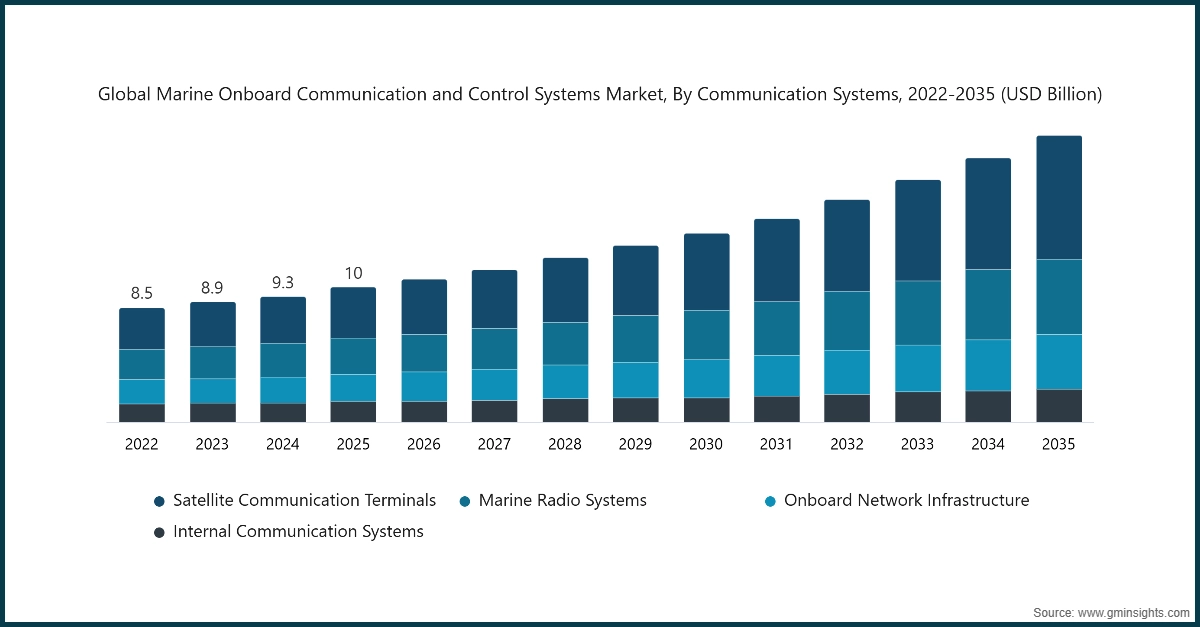
The market increased steadily from USD 8.4 billion in 2022 and reached USD 9.4 billion in 2024, as shipping companies accelerated investments in digital vessel technologies and onboard automation platforms. The need to improve safety in maritime operations, fleet management, and operation monitoring has been instrumental in propelling the growth of the market in recent times. Other factors that have contributed to the growth of the communication and control systems in marine operations include the increasing use of digital bridge technology, enhanced communication between ships and land, and the increasing use of modern technology in commercial and naval fleets in terms of onboard control technology.
The global marine onboard communication and control systems market was valued at USD 10 billion in 2025. The market is expected to grow from USD 10.6 billion in 2026 to USD 15.2 billion in 2031 & USD 21.3 billion in 2035, at a CAGR of 8.1% during the forecast period according to the latest report published by Global Market Insights Inc.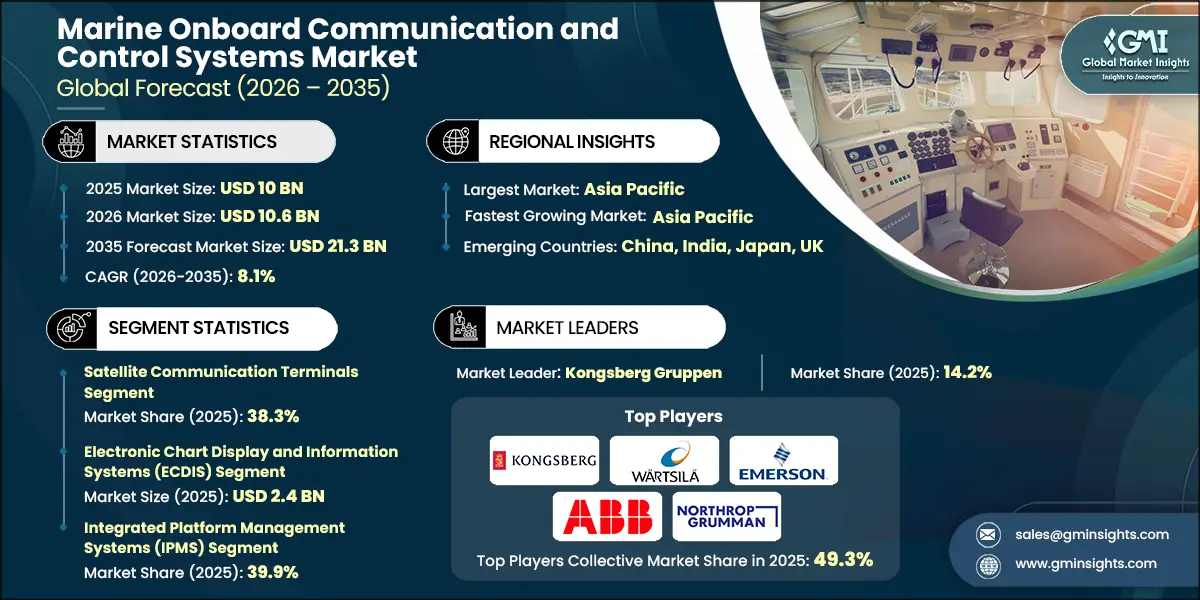
To get key market trends
Marine Onboard Communication and Control Systems Market Trends
- The adoption of integrated digital bridge and vessel automation systems is becoming a major trend in marine onboard communication and control platforms. Adoption accelerated around 2021–2022 as shipping companies sought centralized navigation, propulsion monitoring, and operational control. The trend is expected to continue through 2032 as fleets modernize with unified control architectures. This integration improves situational awareness, reduces crew workload, and enhances vessel operational efficiency.
- The use of hybrid and cloud-based fleet management technology has been instrumental in revolutionizing ship-to-shore communication technology in marine operations. The use of this technology started gaining momentum in 2020 due to the increasing need to monitor fleets remotely by shipping firms. The technology is expected to continue through 2030 with improvements in connectivity infrastructure in maritime operations globally.
- Maritime cybersecurity frameworks used in vessel onboard communication systems are a developing industry trend. This trend has seen an increase since around 2021, driven by an increase in cyber incidents on vessel navigation and control systems. This trend is likely to continue into 2031 as digital shipping systems continue to advance.
- Modular and flexible vessel onboard communication systems are a developing trend used on both commercial and military vessels. This trend started around 2019, driven by the need for flexibility in communication systems that could be upgraded without the need for hardware changes. The use of modular communication systems is expected to continue until 2030 with the development of digital vessel systems.
Marine Onboard Communication and Control Systems Market Analysis
Learn more about the key segments shaping this market
Based on the communication systems, the marine onboard communication and control systems market is divided into satellite communication terminals, marine radio systems, onboard network infrastructure, and internal communication systems.
- The satellite communication terminals segment led the market in 2025, holding a 38.3% share. The satellite communication terminals segment dominates the market because of the uninterrupted long-range communication that can be established between ships and shore-based operations. These systems can facilitate real-time communication for the management of ships, providing updates to the ships' routes, as well as enabling the crew to communicate effectively. The importance of the systems in enabling communication across long distances in the seas will continue to drive the demand for the products.
- The marine radio systems segment is anticipated to grow at a CAGR of 7.9% over the forecast period. The segment is growing because of the rising need for reliable short-range vessel-to-vessel and vessel-to-shore communication to facilitate maritime safety and traffic management. The ease of integration of the systems into modern vessel navigation systems, as well as the requirement to implement the systems in vessel distress communication, is driving the demand for the technology in the marine industry.
Based on navigation and positioning systems, the marine onboard communication and control systems market is divided into electronic chart display and information systems (ECDIS), radar systems, automatic identification systems (AIS), global navigation satellite systems (GNSS/GPS), voyage data recorders (VDR), and dynamic positioning systems.
- The electronic chart display and information systems (ECDIS) segment dominated the market in 2025 and valued at USD 2.4 billion. This is because electronic chart display and information systems play a critical role in digital navigation and maritime safety. Electronic chart display systems are used instead of paper charts because they offer real-time information for vessel operators. Additionally, electronic chart display systems have been made mandatory on various commercial vessels by maritime safety regulations. Moreover, electronic chart display systems can be used with other systems such as radar, AIS, and GNSS systems.
- The dynamic positioning systems segment is expected to witness growth at a CAGR of 9.8% during the forecast period as dynamic positioning systems are used for offshore energy exploration and construction. Dynamic positioning systems are used by vessels to maintain their position automatically using vessel thrusters and sensors. This can be achieved even in harsh sea conditions. Additionally, dynamic positioning systems can be used for offshore wind farm construction and exploration of deep seas.
Learn more about the key segments shaping this market
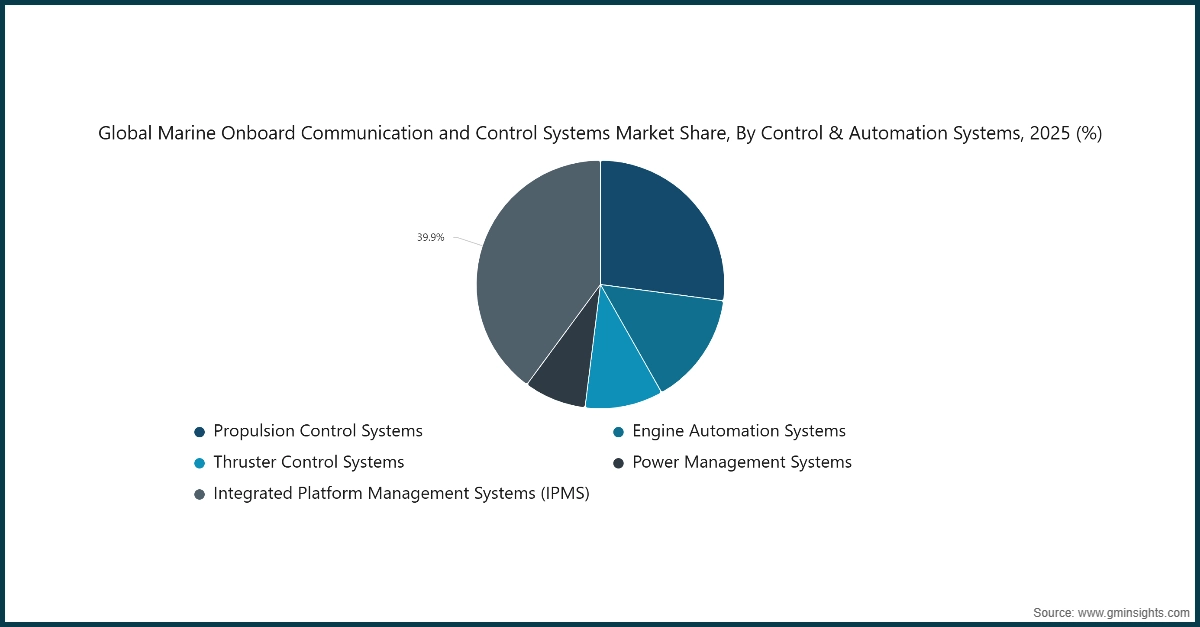
Based on control and automation systems, the marine onboard communication and control systems market is divided into propulsion control systems, engine automation systems, thruster control systems, power management systems, and integrated platform management systems (IPMS).
- The integrated platform management systems (IPMS) segment led the market in 2025 with a market share of 39.9%, as these systems enable centralized monitoring and control of critical onboard functions such as propulsion, power generation, safety systems, and machinery operations. Their ability to integrate multiple vessel subsystems into a single control platform improves operational efficiency, safety monitoring, and maintenance planning, making them widely adopted across commercial vessels and naval fleets.
- The propulsion control systems segment is expected to grow at a CAGR of 9.2% during the forecast period. The growth is driven by increasing demand for fuel-efficient vessel operations, advanced propulsion technologies, and automated engine management systems. The adoption of hybrid propulsion systems, electrified vessels, and smart engine control platforms is accelerating deployment, enabling ship operators to optimize fuel consumption, reduce emissions, and enhance vessel performance.
Looking for region specific data?
North America Marine Onboard Communication and Control Systems Market
North America held a share of 28.3% of market in 2025.
- North America’s onboard communication and control system market for the marine segment is increasing due to significant investment in naval modernization, offshore maritime activities, and digital vessel technology. Commercial shipping companies and naval authorities are increasingly employing onboard vessel automation, integrated bridge system, and satellite communication solutions for enhancing vessel operations’ safety and management.
- Government schemes for maritime domain awareness and naval communications are also fueling technology adoption for naval communications. The region has been identified to be one of the key centers of innovation in the global marine onboard communication and control systems industry, and this trend is expected to continue until 2035.
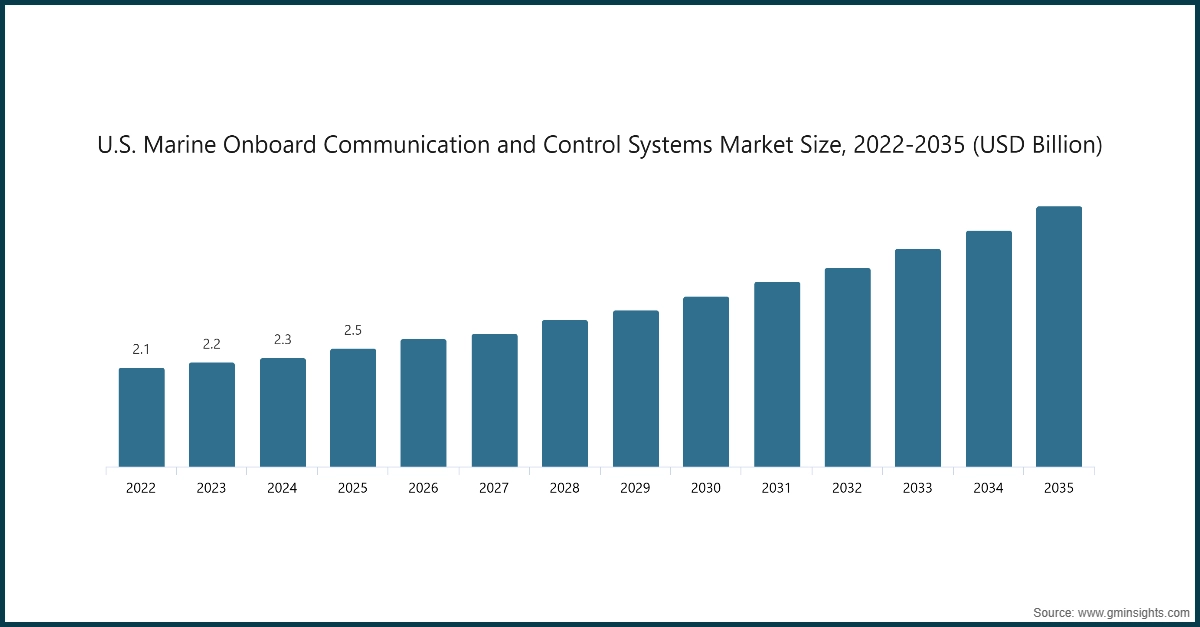
The U.S. marine onboard communication and control systems market size reached USD 2.5 billion in 2025, growing from USD 2.3 billion in 2024.
- The market for marine onboard communication and control systems in the United States is growing strongly due to large-scale naval modernization and maritime digitalization initiatives. The U.S. Navy is investing heavily in next-generation shipboard networking and communication infrastructure through programs such as the Consolidated Afloat Networks and Enterprise Services (CANES) initiative, which integrates shipboard IT and communication systems across naval vessels.
- Additionally, the U.S. Department of Transportation Maritime Administration is supporting port modernization and vessel connectivity programs under the Port Infrastructure Development Program. These initiatives are accelerating deployment of advanced communication, navigation, and automation systems, making the U.S. the leading market for marine onboard communication and control technologies in North America.
Europe Marine Onboard Communication and Control Systems Market
Europe market accounted for USD 2 billion in 2025 and is anticipated to show lucrative growth over the forecast period.
- The European market for marine onboard communication and control systems experiences growth because of three forces which include regulatory requirements for maritime safety, vessel emissions reduction and the digital transformation of maritime fleet operations. The European Maritime Safety Agency (EMSA) and EU regulations like IMO MARPOL Annex VI are driving the adoption of integrated bridge systems, propulsion control platforms, and advanced shipboard communication networks.
- Countries such as Norway, the Netherlands, and Finland are investing in autonomous vessel trials, satellite-enabled maritime connectivity, and port-to-ship digital infrastructure. These initiatives are expected to sustain high adoption of smart onboard communication and control technologies across commercial and defense fleets in Europe.
UK dominates the Europe marine onboard communication and control systems market, showcasing strong growth potential.
- The United Kingdom serves as the primary European market for marine onboard communication and control systems because the country makes significant investments toward updating its naval and commercial shipping fleet. The Royal Navy integrates advanced communication, navigation and automation systems into its Type 26 and Type 31 frigates to achieve better operational coordination and situational awareness and onboard system interoperability
- In parallel, the Port of London Authority has upgraded its Vessel Traffic Service (VTS) system, combining radar, AIS, CCTV, and sensor data to improve real-time vessel monitoring, traffic management, and maritime safety along the Thames. These initiatives reflect the UK’s strategic focus on digitalized, connected, and automated maritime operations, positioning it as a hub for adoption of advanced onboard communication and control technologies in Europe..
Asia Pacific Marine Onboard Communication and Control Systems Market
The Asia Pacific market is anticipated to grow at the highest CAGR of 9% during the forecast period.
- The market in the Asia Pacific is expanding rapidly due to the modernization of commercial shipping fleets and increasing naval investments. Countries like Singapore, South Korea, and Japan are deploying integrated bridge systems, digital propulsion control, and satellite-enabled communication networks to improve fleet efficiency, safety, and operational coordination.
- Regional port authorities are investing in automated vessel traffic management and port-to-ship digital platforms, while governments encourage adoption of IoT-based onboard monitoring and navigation systems. These initiatives, combined with growing offshore oil & gas operations and cruise shipping, are fueling the adoption of advanced marine communication and control technologies throughout APAC.
China marine onboard communication and control systems market is estimated to grow with a significant CAGR, in the Asia Pacific market.
- China is emerging as a key growth market for marine onboard communication and control systems due to the rapid expansion of its merchant and naval fleets and investments in digitalized ports such as Shanghai and Ningbo. The government’s Maritime Safety Administration is promoting the use of satellite-based vessel monitoring, AIS, and integrated bridge solutions to enhance navigation safety, port efficiency, and regulatory compliance.
- Chinese shipbuilders are increasingly incorporating autonomous navigation modules and onboard automation systems in new vessels to meet international safety and environmental standards, positioning China as the fastest-growing market in APAC for advanced marine communication and control technologies.
Middle East and Africa Marine Onboard Communication and Control Systems Market
UAE market to experience substantial growth in the Middle East and Africa market.
- The United Arab Emirates (UAE) is experiencing robust growth in marine onboard communication and control systems driven by substantial investments in smart ports, maritime digitalization, and shipping logistics modernization. Major UAE ports like Jebel Ali and Khalifa Port are deploying advanced vessel traffic management systems, satellite communication terminals, and integrated bridge technologies to improve berth planning, navigation safety, and real‑time ship monitoring.
- Strategic government initiatives such as the UAE’s Maritime Vision 2030 are accelerating adoption of IoT‑enabled onboard monitoring, digital navigation platforms, and automated vessel control systems to enhance fleet competitiveness, energy efficiency, and port connectivity across the Gulf region.
Marine Onboard Communication and Control Systems Market Share
The market is led by players such as Kongsberg Gruppen, Wärtsilä, Emerson Electric Co., ABB Ltd., and Northrop Grumman Corporation. These five companies collectively hold a market share of 49.3% of the market in 2025 because of their technological expertise and global presence. The extensive range of products offered by these companies, including vessel automation systems, integrated bridge systems, vessel power management systems, and secure naval communication systems, has helped these organizations maintain a strong position in the market.
These companies maintain competitive edge by developing advanced digital vessel technologies and digital shipboard control systems to build operational capacity which meets demand for automated maritime operations in both commercial and defense operations. Furthermore, these companies use strategic partnerships with shipbuilders, naval agencies and offshore operators to expand their advanced onboard communication and control technologies throughout the world.
Marine Onboard Communication and Control Systems Market Companies
Prominent players operating in the marine onboard communication and control systems industry are as mentioned below:
- ABB Group
- Emerson Electric Co.
- Furuno Electric Co., Ltd.
- Honeywell International Inc.
- Japan Radio Co., Ltd.
- Kongsberg
- L3Harris Technologies, Inc.
- Navico Group
- Northrop Grumman Corporation
- Raymarine
- Saab Ab
- ST Engineering
- Viasat, Inc.
- Wartsila
- Kongsberg Gruppen
Kongsberg Gruppen delivers advanced vessel automation systems, integrated bridge systems and digital navigation solutions. The company develops smart ship technologies, autonomous vessel systems and integrated communication platforms to improve safety and efficiency in maritime operations for commercial shipping and offshore and naval use.
Wärtsiläo provides complete maritime solutions which include navigation systems, ship automation systems, propulsion management systems and fleet performance optimization platforms. The company emphasizes smart marine ecosystems, digital vessel technologies, and remote operational capabilities that improve vessel efficiency, safety, and sustainability across global maritime operations.
Emerson Electric provides advanced marine automation and control solutions supporting monitoring, diagnostics, and operational management of onboard systems. Its technologies focus on process automation, predictive maintenance, and integrated control platforms that enhance reliability, efficiency, and safety across maritime and offshore vessel operations.
ABB provides complete marine systems which include power solutions, propulsion systems and automation technology to help ships reach optimal performance levels while maintaining energy efficiency. The digital solutions developed by the company integrate onboard control systems with both analytics tools and electrification technologies to help create intelligent maritime transport systems that operate sustainably.
Northrop Grumman specializes in advanced communication and integrated combat management solutions for defense vessels in the maritime sector. The company primarily deals with advanced communication architectures for defense vessels to improve situational awareness and operation coordination in modern warfare operations at sea.
Marine Onboard Communication and Control Systems Market Report Attributes
| Key Takeaway | Details |
|---|---|
| Market Size & Growth | |
| Base Year | 2025 |
| Market Size in 2025 | USD 10 Billion |
| Market Size in 2026 | USD 10.6 Billion |
| Forecast Period 2026-2035 CAGR | 8.1% |
| Market Size in 2035 | USD 21.3 Billion |
| Key Market Trends | |
| Drivers | Impact |
| Increasing adoption of smart and connected vessels | Drives 22% growth as shipping companies increasingly deploy smart and connected vessel technologies integrating onboard communication, navigation, and control platforms. |
| Growing maritime satellite communication demand | Supports 20% growth as rising reliance on maritime satellite communication enables continuous connectivity for vessels operating in deep-sea and remote routes. |
| Expansion of global seaborne trade and fleet size | Contributes 21% growth as expanding global seaborne trade and increasing commercial fleet size create higher demand for reliable onboard communication infrastructure. |
| Rising need for real-time vessel monitoring systems | Adds 18% growth as ship operators adopt real-time vessel monitoring solutions for engine performance, navigation data, fuel consumption, and equipment diagnostics. |
| IMO regulations driving digital navigation systems adoption | Accounts for 19% growth as compliance with e-navigation standards, safety monitoring requirements, and vessel tracking protocols is accelerating installation of integrated onboard control systems. |
| Pitfalls & Challenges | Impact |
| High installation and retrofitting costs for legacy fleets | Restrains market growth as high installation and retrofitting costs remain a major barrier for aging vessels. Integrating advanced onboard communication and control systems into legacy fleets often requires significant modifications to existing navigation, electrical, and network infrastructure, increasing upgrade costs and delaying modernization initiatives. |
| Cybersecurity risks in connected shipboard networks | Limits growth as increasing vessel connectivity exposes shipboard communication networks to cybersecurity threats. Unauthorized access, data breaches, and potential disruption of navigation or control systems create operational risks, forcing ship operators to invest heavily in secure communication architectures and cyber-protection frameworks. |
| Opportunities: | Impact |
| Autonomous and remotely operated vessel development | Presents significant growth potential as the development of autonomous and remotely operated vessels accelerates the need for advanced onboard communication and control architectures. These systems enable continuous data exchange between vessels and shore-based control centers, supporting remote navigation, automated route optimization, and centralized fleet supervision while improving operational safety and efficiency. |
| Expansion of satellite broadband for offshore vessels | Offers opportunity through the expansion of satellite broadband connectivity for offshore and deep-sea vessels. High-capacity satellite networks enable reliable real-time communication, remote diagnostics, and data-intensive applications such as predictive maintenance, crew connectivity, and integrated fleet management across long-distance maritime routes. |
| Market Leaders (2025) | |
| Market Leader |
14.2% market share in 2025 |
| Top Players |
Collective Market Share for top 5 players is 49.3% in 2025 |
| Competitive Edge |
|
| Regional Insights | |
| Largest Market | Asia Pacific |
| Fastest growing market | Asia Pacific |
| Emerging countries | China, India, Japan, UK |
| Future outlook |
|
What are the growth opportunities in this market?
Marine Onboard Communication and Control Systems Industry News
- In August 2025, Wärtsilä announced the divestment of its Automation, Navigation and Control Systems (ANCS) business to Solix Group, enabling the creation of a specialized company focused on advanced ship automation and navigation technologies. The move is expected to strengthen innovation and market focus in onboard navigation and control platforms used across commercial vessels and offshore fleets.
- In March 2025, Kongsberg Gruppen launched the first satellite in its N3X maritime surveillance constellation to provide ship tracking and maritime situational awareness data for the Norwegian Armed Forces. The satellite supports advanced monitoring of maritime activity and vessel positioning, improving real-time communication and tracking capabilities across strategic sea routes.
- In March 2024, ABB Ltd. launched its ABB Ability Marine Advisory System, an advanced digital platform enabling real-time vessel performance monitoring and decision support for ship operators. The system combines onboard data collection with analytics to optimize energy efficiency and operational performance. This development strengthens ABB’s position in smart ship automation and connected maritime operations.
The marine onboard communication and control systems market research report includes in-depth coverage of the industry with estimates and forecast in terms of revenue (USD Million) from 2022 – 2035 for the following segments:
Market, By Communication Systems
- Satellite communication terminals
- VSAT terminals
- L-band terminals
- Marine Radio Systems
- VHF radio systems
- MF/HF radio systems
- GMDSS equipment
- Onboard network infrastructure
- Routers & switches
- Onboard broadband backbone systems
- Internal communication systems
- Public address / general alarm (PA/GA) systems
- Intercom systems
Market, By Navigation & Positioning Systems
- Electronic chart display & information systems (ECDIS)
- Radar systems
- X-Band radar
- S-Band radar
- Automatic identification systems (AIS)
- Global navigation satellite systems (GNSS/GPS)
- Voyage data recorders (VDR)
- Dynamic positioning systems
Market, By Control & Automation Systems
- Propulsion control systems
- Engine automation systems
- Thruster control systems
- Power management systems
- Integrated platform management systems (IPMS)
Market, By Monitoring & Surveillance Systems
- Fire detection systems
- Gas detection systems
- CCTV & onboard security systems
- Hull stress monitoring systems
- Condition-based monitoring systems
Market, By Platform
- Commercial vessels
- Passenger vessels
- Cargo vessels
- Offshore & specialized vessels
- Defense vessels
- Aircraft carriers
- Destroyers
- Frigates
- Corvettes
- Submarines
- Amphibious assault ships
Market, By End-User
- OEM
- Aftermarket
The above information is provided for the following regions and countries:
- North America
- U.S.
- Canada
- Europe
- Germany
- UK
- France
- Spain
- Italy
- Russia
- Asia Pacific
- China
- India
- Japan
- Australia
- South Korea
- Latin America
- Brazil
- Mexico
- Argentina
- Middle East and Africa
- South Africa
- Saudi Arabia
- UAE
Frequently Asked Question(FAQ) :
What was the market size of the marine onboard communication and control systems market in 2025?
The marine onboard communication and control systems market was valued at USD 10 billion in 2025, with a CAGR of 8.1% expected during the forecast period, driven by the adoption of smart vessel automation platforms, reliable maritime satellite connectivity, and digital navigation frameworks.
What is the projected value of the marine onboard communication and control systems market by 2035?
The market is expected to reach USD 21.3 billion by 2035, fueled by the expansion of global commercial shipping fleets, real-time vessel monitoring systems, and maritime safety regulations.
What is the projected size of the marine onboard communication and control systems market in 2026?
The market is expected to reach USD 10.6 billion in 2026.
How much revenue did the satellite communication terminals segment generate in 2025?
The satellite communication terminals segment accounted for a 38.3% market share in 2025, due to its ability to enable uninterrupted long-range communication and real-time ship management.
What was the valuation of the electronic chart display and information systems (ECDIS) segment in 2025?
The Electronic Chart Display and Information Systems (ECDIS) segment was valued at USD 2.4 billion in 2025, driven by its critical role in digital navigation and compliance with maritime safety regulations.
Which region leads the marine onboard communication and control systems market?
North America held a 28.3% market share in 2025, driven by investments in naval modernization, offshore maritime activities, and digital vessel technology.
Who are the key players in the marine onboard communication and control systems market?
Major companies include ABB Group, Emerson Electric, Furuno Electric, Honeywell International, Japan Radio Co., Kongsberg Gruppen, L3Harris Technologies, Navico Group, Northrop Grumman, and Raymarine.
Marine Onboard Communication and Control Systems Market Scope
Related Reports