Summary
Table of Content

Marine Energy Market
Get a free sample of this report
Form submitted successfully!
Error submitting form. Please try again.
Thank you!
Your inquiry has been received. Our team will reach out to you with the required details via email. To ensure that you don't miss their response, kindly remember to check your spam folder as well!
Request Sectional Data
Thank you!
Your inquiry has been received. Our team will reach out to you with the required details via email. To ensure that you don't miss their response, kindly remember to check your spam folder as well!
Form submitted successfully!
Error submitting form. Please try again.
Marine Energy Market Size
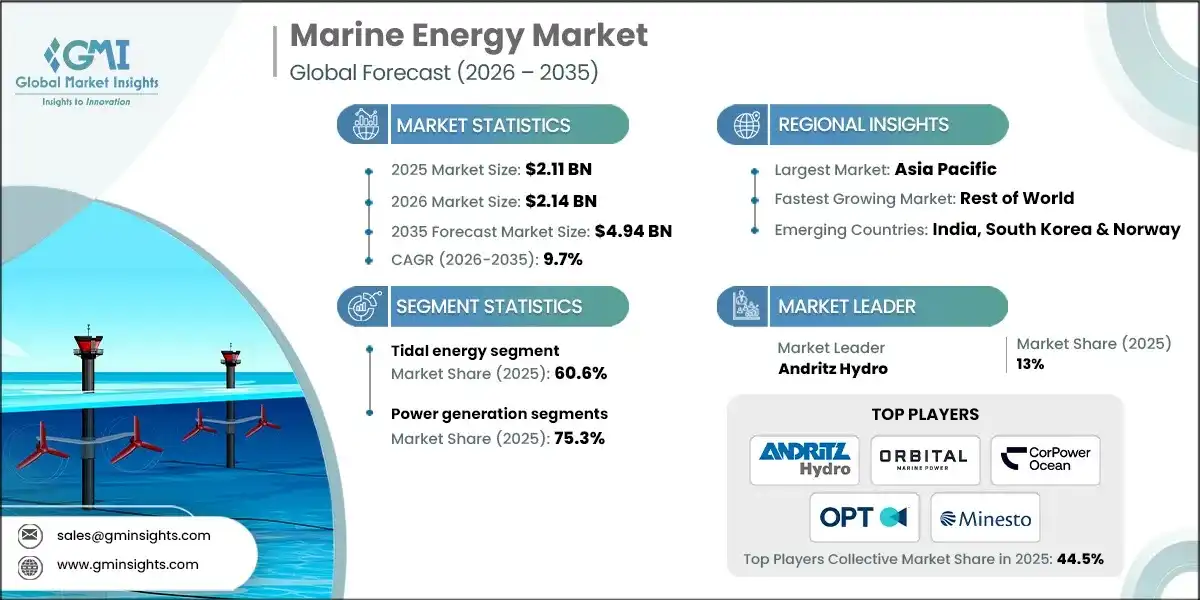
The global marine energy market was estimated at USD 2.11 billion in 2025. The market is expected to grow from USD 2.14 billion in 2026 to USD 4.94 billion in 2035, at a CAGR of 9.7% according to Global Market Insights Inc.
Marine Energy Market Key Takeaways
Market Size & Growth
- 2025 Market Size: USD 2.11 Billion
- 2026 Market Size: USD 2.14 Billion
- 2035 Forecast Market Size: USD 4.94 Billion
- CAGR (2026–2035): 9.7%
Key Market Drivers
- Increasing government support.
- Rising demand for reliable energy.
Challenges
- High capital costs.
- Rising technical challenges.
Opportunity
- Offshore renewable integration.
- Coastal community electrification.
Key Players
- Market Leader: Andritz Hydro led with over 13% market share in 2025.
- Leading Players: Top 5 players in this market include Andritz Hydro, Orbital Marine Power, CorPower Ocean, Ocean Power Technologies (OPT), Minesto, which collectively held a market share of 44.5% in 2025.
Get Market Insights & Growth Opportunities
- Increasing government funding for ocean energy through grants, subsidies, and pilot programs, including the UK’s Contracts for Difference and U.S. Department of Energy initiatives, is accelerating innovation, enhancing commercial viability, and driving broader technology adoption.
- For instance, in August 2024, the U.S. Department of Energy’s Waterpower Technologies Office announced over USD 41 million for four university-led National Marine Energy Centers. This includes USD 36 million from the Bipartisan Infrastructure Law to advance research, development, and testing infrastructure for marine energy.
- Marine energy refers to renewable power generated from ocean resources, including tides, waves, currents, and thermal gradients. It harnesses the kinetic and potential energy of seawater to produce electricity, offering a sustainable alternative to fossil fuels. Technologies such as tidal turbines, wave energy converters, and ocean thermal systems enable this process. Marine energy is considered a clean, predictable, and abundant source, contributing to global efforts for decarbonization and energy diversification while supporting coastal communities and reducing greenhouse gas emissions.
- Rising adoption of renewable technologies with lower environmental impact and minimal emissions is driving market growth. Additionally, the growing demand for energy sources offering stable output and resilience to climate change is shaping industry dynamics. Increasing integration of marine energy with offshore wind farms to optimize infrastructure, such as subsea cables and grid connections, is fostering sector expansion. Hybrid renewable projects further enhance efficiency and ensure continuous power generation, strengthening marine energy adoption and supporting long-term sustainability goals.
- Asia Pacific is among the dominant regions on account of increasing investments in renewable energy projects, supported by government incentives and funding programs, accelerating marine energy adoption. Countries such as Japan and South Korea are actively promoting ocean-based technologies to diversify energy sources and reduce carbon emissions. For instance, China launched the world’s first megawatt-scale floating wave power station, Nankun, in June 2023. Located south of Zhuhai in Guangdong, the facility can produce up to 10 MWh daily, supplying electricity for approximately 1,500 households.
- Rest of world is the fastest-growing region in the marine energy market. Many island and coastal countries in Africa, Latin America, and the Middle East face rising electricity demand and limited grid connectivity, increasing marine solution adoption. Marine energy offers a reliable, renewable solution to reduce diesel dependency, lower fuel import costs, and enhance energy security. Governments in these regions are also promoting pilot projects and offering incentives to attract investment, making marine energy a strategic choice for sustainable development and climate resilience.
To get key market trends
Marine Energy Market Trends
- Growing concerns over global warming and rising carbon emissions are accelerating the global shift toward renewable energy. Marine energy stands out as a reliable and predictable source, offering consistent power generation compared to intermittent renewables such as solar and wind. Its ability to harness ocean currents, waves, and tides positions it as a critical contributor to decarbonization strategies. As nations prioritize sustainability, marine energy will play a vital role in meeting clean energy targets and reducing dependence on fossil fuels.
- Increasing government-backed incentives, grants, and funding programs are driving marine energy adoption worldwide. For instance, Spain announced a USD 260.7 million program in December 2022 to support pilot projects, testing platforms, and infrastructure development for marine renewables. Similar initiatives in Europe, North America, and Asia Pacific are accelerating commercialization and reducing technology costs. These financial commitments not only encourage innovation but also attract private investments, fostering a robust ecosystem for marine energy deployment and positioning it as a key pillar in future energy systems.
- Growing investments by companies in advanced wave and tidal energy converters are improving durability, scalability, and cost-efficiency. These innovations aim to reduce maintenance expenses and enhance long-term performance. For instance, CorPower Ocean secured USD 18.2 million from the European Innovation Council Accelerator in February 2025, including grants and equity funding. Such financial support accelerates commercialization and fosters high-impact innovations, positioning marine energy as a competitive renewable solution for global markets.
- Rising deployment of tidal stream projects backed by government contracts is accelerating marine energy adoption and proving its viability for large-scale renewable generation. For instance, in December 2025, Orbital Marine Power’s orderbook for tidal turbines is set to double after securing UK CfD contracts. Six new O2 turbines, totaling 14.4 MW, will be installed at EMEC in Orkney. The O2, Orbital’s flagship 2 MW+ turbine, delivers predictable, utility-scale tidal energy, reinforcing confidence in marine renewables and supporting the UK’s clean energy transition.
Marine Energy Market Analysis
Learn more about the key segments shaping this market
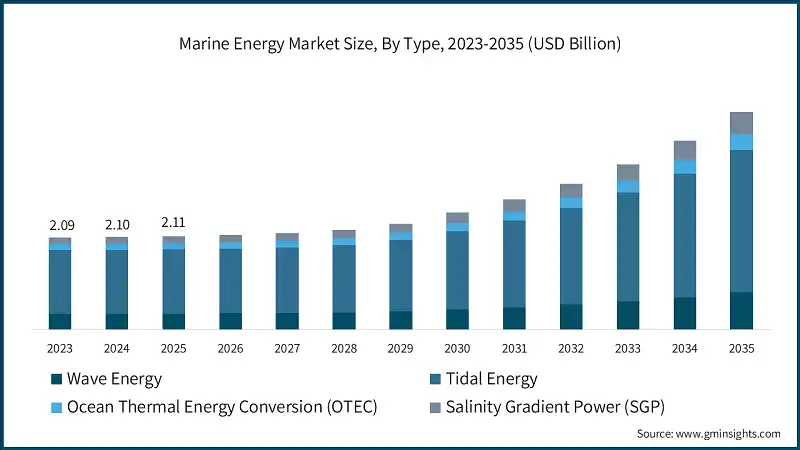
Based on type, the industry is segmented into wave energy, tidal energy, ocean thermal energy conversion (OTEC), and salinity gradient power (SGP). Tidal energy dominated about 60.6% market share in 2025 and is expected to grow at a CAGR of 9.2% through 2035.
- Growing government initiatives, including subsidies, grants, and favorable regulations, are accelerating tidal energy adoption. In February 2024, two Dutch firms secured over USD 2 million each to advance projects in the Wadden Sea. Equinox raised USD 2.5 million to launch a pre-commercial turbine by 2025, aiming to expand globally. Such funding programs encourage innovation, reduce financial risks, and strengthen marine energy’s role in meeting clean energy targets, fostering a positive outlook for the industry.
- Wave energy segment will grow at a CAGR of 9.5% by 2035, driven by its consistency and abundance in coastal regions with strong wave activity, such as the North Atlantic and Pacific. In September 2022, according to the U.S. EIA, wave energy of U.S. coasts holds a theoretical annual potential of 2.64 trillion kWh, which is about 63% of the nation’s utility-scale electricity generation. These immense potential positions wave energy as a critical contributor to future renewable energy portfolios globally.
- Additionally, rising innovations in wave energy converters, materials, and design are reducing installation and maintenance costs while improving durability and scalability. Modern systems now feature enhanced energy capture efficiency and remote monitoring capabilities, making wave energy commercially viable. These advancements, combined with economies of scale and supportive R&D programs, are positioning wave energy as a cost-effective renewable solution.
- The ocean thermal energy conversion segment is anticipated to reach more than USD 350 million by 2035. Increasing demand for reliable and continuous energy is driving OTEC adoption, leveraging the constant temperature difference in ocean waters. Countries including Japan, the Philippines, and the U.S. are investing heavily in OTEC to reduce dependence on imported fossil fuels and strengthen energy security. These initiatives highlight OTEC’s potential as a sustainable solution for meeting clean energy targets and supporting long-term decarbonization strategies globally, leading to escalate the business scenario.
- The salinity gradient power segment is projected to hit USD 500 million by 2035. Rising investments in the development of advanced membrane technology, including nanostructured and graphene-based designs, are improving energy conversion efficiency and reducing costs, making SGP more commercially viable. Current research shows reverse electrodialysis and pressure-retarded osmosis systems achieving efficiencies above 50%, significantly enhancing performance and scalability. These breakthroughs position SGP as a promising renewable energy solution, attracting investments and accelerating deployment in regions with abundant saline water resources.
Learn more about the key segments shaping this market
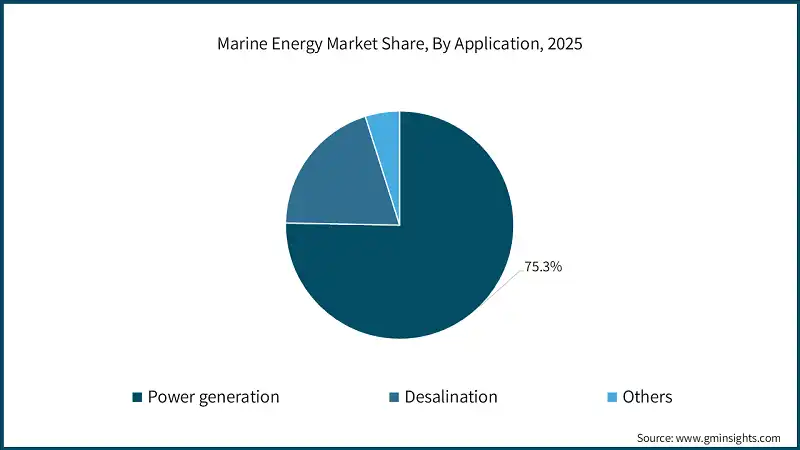
Based on application, the marine energy market is segmented into power generation, desalination, and others. The power generation application dominates the market with a 75.3% share in 2025 and is expected to grow at a CAGR of 9.4% from 2026 to 2035.
- Increasing dependence on imported fossil fuels is pushing nations to diversify energy sources for greater security and sustainability. Marine energy offers predictable and renewable power, reducing vulnerability to supply disruptions. Countries with vast coastlines, such as Japan, the UK, and the U.S., are leveraging ocean resources to meet clean energy targets. This shift not only strengthens energy independence but also supports decarbonization goals, making marine energy a strategic choice for future power generation portfolios.
- The desalination segment is set to grow at a CAGR of 10.7% by 2035. Increasing demand for freshwater in coastal and island areas is driving interest in marine energy-powered desalination. Conventional desalination methods are energy-intensive and costly, but integrating wave, tidal, or OTEC systems provides a sustainable and continuous power source. This approach reduces reliance on fossil fuels, lowers operational costs, and supports water security.
- Moreover, as climate change intensifies water scarcity, marine energy-driven desalination offers an eco-friendly solution, aligning with global sustainability goals and ensuring a reliable freshwater supply for growing populations, leading to business expansion.
- Growing sustainability awareness and the global shift toward clean energy are encouraging strategic partnerships to accelerate marine technology adoption. In January 2025, AquaX Energy Americas and Exowaven formed AquaX JV to deploy wave energy solutions across North America. The venture integrates WEC technology to deliver affordable renewable power and cost-effective desalination, supporting clean energy and water security objectives.
Looking for region specific data?
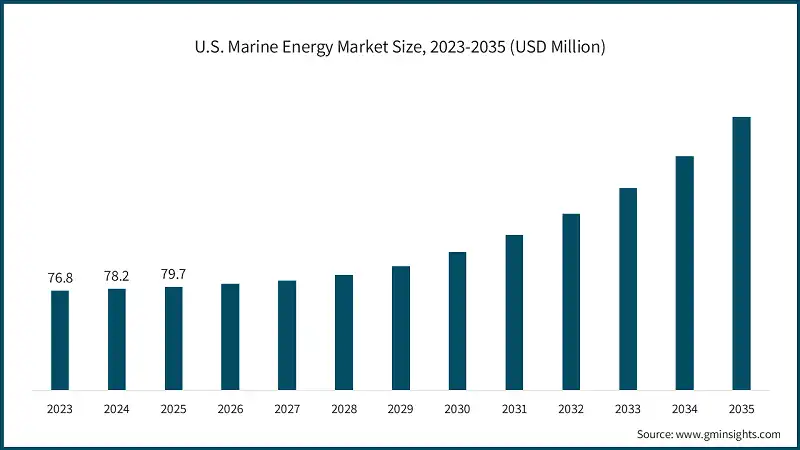
- The U.S. dominated the marine energy market in North America with around 89.9% share in 2025 and is expected to generate over USD 200 million by 2035.
- Rising ambitious renewable energy targets set by several U.S. states are creating strong opportunities for marine energy to become part of clean energy strategies. Growing interest from the U.S. Navy in using marine energy for coastal installations and remote operations, combined with increasing private sector investments, is boosting the industry outlook. These developments highlight marine energy’s potential to deliver reliable, sustainable power while supporting national energy security and decarbonization objectives.
- Growing renewable energy commitments from states such as California, Oregon, and Hawaii are accelerating marine energy adoption. According to the World Resources Institute, the U.S. aims to achieve 100% carbon-free electricity by 2035. These ambitious targets will drive demand for diverse renewable sources, positioning marine energy as a critical contributor to meeting future energy needs. Its predictable output and compatibility with offshore infrastructure make it an attractive option for achieving long-term sustainability and energy transition goals.
- The North America marine energy market exceeded USD 88.7 million in 2025. Increasing prioritization of energy systems that can withstand extreme weather events and grid disruptions will foster industry growth. Marine energy offers decentralized, reliable power generation near coastal communities, reducing vulnerability during hurricanes or storms. This resilience aligns with federal and state initiatives promoting renewable energy infrastructure for emergency preparedness and long-term sustainability, making marine energy an attractive solution for critical power needs, thereby driving the business growth.
- Asia Pacific marine energy market is anticipated to grow at a CAGR of 9.6% by 2035. Increasing energy security concerns across resource-limited nations such as Japan, South Korea, and Australia are accelerating marine energy adoption to reduce reliance on imported fossil fuels and strengthen regional energy stability.
- Additionally, rising collaborative initiatives aimed at fostering industry growth are driving technology uptake. For instance, in February 2025, BPCL partnered with Eco Wave Power to advance wave energy projects in India. The collaboration begins with a feasibility test, followed by a 100-kW pilot at BPCL’s Mumbai Oil Terminals, with plans to scale toward broader commercial deployment.
- Europe marine energy market is expected to reach more than USD 2.2 billion by 2035. The extensive coastlines in the region, offering abundant tidal, wave, and ocean thermal energy resources, are accelerating marine energy deployment. Countries such as the UK, France, and Portugal are actively utilizing these natural advantages to develop large-scale commercial marine energy projects, aiming to diversify their renewable energy mix and enhance sustainability.
Marine Energy Market Share
- The top 5 companies, including Andritz Hydro, Orbital Marine Power, CorPower Ocean, Ocean Power Technologies (OPT) and Minesto, account for around 44.5% market share. Companies are prioritizing research and development to enhance marine energy efficiency and reduce costs. A major focus is on hybrid systems that integrate marine energy with wind, solar, and battery storage to ensure consistent power output and grid stability. These innovations aim to maximize renewable energy generation, improve reliability, and make marine energy more competitive compared to traditional sources.
- Businesses are forming alliances with technology providers and energy firms to accelerate innovation and commercialization. These collaborations facilitate knowledge sharing, the joint development of advanced marine energy systems, and expedite the deployment of projects. Partnerships often focus on creating scalable solutions, optimizing energy conversion technologies, and integrating smart grid capabilities. Such cooperative strategies help companies access new markets, reduce development costs, and strengthen their competitive edge in delivering sustainable and cost-effective marine energy solutions globally.
- Moreover, key players are targeting regions with abundant tidal and wave resources, such as Europe and emerging markets, such as Canada and Southeast Asia. Alongside geographic expansion, companies are streamlining manufacturing processes, improving material efficiency, and deploying larger-scale projects to reduce the levelized cost of energy (LCOE). These efforts aim to make marine energy economically viable and attractive for governments and private investors. By focusing on cost reduction and market diversification, firms are ensuring long-term profitability and widespread adoption.
Marine Energy Market Companies
- Andritz Hydro, a global leader in hydropower solutions, is expanding into marine energy by leveraging its expertise in turbines and water-based technologies. The company focuses on developing advanced systems for tidal and wave energy projects, supporting sustainable power generation and contributing to global renewable energy goals. A division of Andritz Group, global hydropower equipment provider, reporting group-wide revenue of USD 9.7 billion in 2024.
- Orbital Marine Power, develops floating tidal stream turbines, delivering predictable renewable energy from ocean currents. Its technology supports scalable marine projects for clean power generation globally.
- CorPower Ocean, a privately held Swedish wave energy company, develops high-efficiency wave energy converters and point-absorber buoys, seeking to commercialize turnkey wave farms and enhance global clean energy generation.
- Ocean Power Technologies (OPT) reported revenues of USD 5.9 million, an increase 6% over FY24 revenues. develops wave energy buoys and autonomous offshore systems, integrating AI for maritime operations. Its solutions deliver clean, predictable power for remote applications and support sustainable ocean energy projects globally.
- Minesto, a pioneer in tidal energy technology, the company focuses on low-flow tidal stream solutions to harness ocean currents efficiently. In 2024, the company reported net sales of USD 8,062, reflecting its commitment to scaling marine energy projects and advancing renewable energy adoption globally.
Eminent players operating in the marine energy market are:
- Andritz Hydro
- AWS Ocean Energy
- BioPower Systems
- Carnegie Clean Energy
- CorPower Ocean
- Eco Wave Power
- Havkraft AS
- Marine Energy Group
- Minesto
- Mocean Energy
- Nova Innovations
- Ocean Power Technologies (OPT)
- Ocean Renewable Power Company
- Orbital Marine Power
- Oscilla Power
- Sabella SAS
- Seabased AB
- SINN Power
- SSE Renewables
- Verdant Power
Marine Energy Market Report Attributes
| Key Takeaway | Details |
|---|---|
| Market Size & Growth | |
| Base Year | 2025 |
| Market Size in 2025 | USD 2.11 Billion |
| Market Size in 2026 | USD 2.14 Billion |
| Forecast Period 2026-2035 CAGR | 9.7% |
| Market Size in 2035 | USD 4.94 Billion |
| Key Market Trends | |
| Drivers | Impact |
| Increasing government support | Increasing government funding and incentives for ocean-based renewable projects, including grants and pilot programs, are accelerating technology development and commercial deployment of marine energy solutions. |
| Rising demand for reliable energy | Rising need for stable, low-carbon energy sources to ensure grid reliability and meet decarbonization targets is driving interest in marine energy across coastal regions. |
| Pitfalls & Challenges | Impact |
| High capital costs | Increasing upfront investment requirements for marine energy projects, including infrastructure and technology development, limit scalability and deter private sector participation in emerging markets. |
| Rising technical challenges | Rising operational difficulties in harsh marine environments, such as corrosion, maintenance, and grid integration, hinder reliability and increase long-term costs for developers. |
| Opportunities: | Impact |
| Offshore renewable integration | Growing integration of marine energy with offshore wind farms creates hybrid systems, optimizing infrastructure and reducing costs while enhancing grid stability and renewable energy penetration. |
| Coastal community electrification | Increasing demand for clean energy in remote coastal communities offers opportunities for marine energy projects, ensuring energy security, reducing diesel reliance, and supporting sustainable development goals. |
| Market Leaders (2025) | |
| Market Leaders |
13% market share |
| Top Players |
|
| Competitive Edge |
|
| Regional Insights | |
| Largest Market | Asia Pacific |
| Fastest Growing Market | Rest of World |
| Emerging Country | India, South Korea & Norway |
| Future Outlook |
|
What are the growth opportunities in this market?
Marine Energy Industry News
- In December 2025, Scotland’s Orbital Marine Power secured USD 8.2 million to advance tidal energy technology. The funding round included PXN Ventures and existing investors, supporting efforts to scale ocean-based renewable solutions and accelerate clean energy deployment globally.
- In March 2024, Orbital Marine Power, a UK-based tidal energy innovator, partnered with Orcas Power and Light Cooperative for a Washington project in Rosario Strait, supported by a USD 6 million U.S. Department of Energy grant for pilot tidal research initiatives.
This marine Energy market research report includes an in-depth coverage of the industry with estimates & forecast in terms of revenue in “USD Million & MW & MW” from 2022 to 2035, for the following segments:
Market, By Type
- Wave energy
- Tidal energy
- Ocean thermal energy conversion (OTEC)
- Salinity gradient power (SGP)
Market, By Application
- Power generation
- Desalination
- Others
The above information has been provided for the following regions and countries:
- North America
- U.S.
- Canada
- Europe
- France
- Spain
- UK
- Norway
- Asia Pacific
- China
- India
- South Korea
- Rest of World
Frequently Asked Question(FAQ) :
What is the market size of the marine energy in 2025?
The market size was USD 2.11 billion in 2025, with a CAGR of 9.7% expected through 2035 driven by rising adoption of low-emission renewable energy technologies and increasing government support.
What is the projected value of the marine energy market by 2035?
The marine energy market is expected to reach USD 4.94 billion by 2035, propelled by technological advancements, offshore renewable integration, and growing demand for reliable clean energy sources.
What is the current marine energy market size in 2026?
The market size is projected to reach USD 2.14 billion in 2026.
How much revenue did the tidal energy segment generate in 2025?
Tidal energy dominated with about 60.6% market share in 2025, leading the market with consistent and predictable power generation capabilities.
What was the valuation of power generation application segment in 2025?
Power generation held 75.3% market share in 2025 and is expected to grow at a CAGR of 9.4% from 2026 to 2035.
What is the growth outlook for wave energy from 2026 to 2035?
Wave energy is projected to grow at a 9.5% CAGR through 2035, as its consistency in coastal regions and advancing converter technologies that improve efficiency and reduce costs.
Which region leads the marine energy market?
U.S. led the North American marine energy market with 89.9% share in 2025 and is projected to exceed USD 200 million by 2035, supported by ambitious state-level renewable energy targets.
What are the upcoming trends in the marine energy market?
Key trends include integration with offshore wind farms for hybrid systems, advanced wave and tidal energy converters, government-backed funding programs, and deployment of marine energy for coastal community electrification and desalination.
Who are the key players in the marine energy market?
Key players include Andritz Hydro, Orbital Marine Power, CorPower Ocean, Ocean Power Technologies (OPT), Minesto, AWS Ocean Energy, BioPower Systems, Carnegie Clean Energy, Eco Wave Power, Havkraft AS, Marine Energy Group, Mocean Energy, Nova Innovations, Ocean Renewable Power Company, Oscilla Power, Sabella SAS, Seabased AB, SINN Power, SSE Renewables, and Verdant Power.
Marine Energy Market Scope
Related Reports