Summary
Table of Content

Manicure and Pedicure Tools Market
Get a free sample of this report
Form submitted successfully!
Error submitting form. Please try again.
Thank you!
Your inquiry has been received. Our team will reach out to you with the required details via email. To ensure that you don't miss their response, kindly remember to check your spam folder as well!
Request Sectional Data
Thank you!
Your inquiry has been received. Our team will reach out to you with the required details via email. To ensure that you don't miss their response, kindly remember to check your spam folder as well!
Form submitted successfully!
Error submitting form. Please try again.
Manicure and Pedicure Tools Market Size
The fundamental reason for the rapid embracement of specialized nail care equipment is the continuous innovation of new products at the cutting edge of advanced metallurgy, high-grade materials, and ergonomic design. Recent breakthroughs in medical-grade stainless steel, anti-microbial coatings, and diamond dust abrasives have enabled traditional nail nippers, pushers, and files to be made into precise instruments of great durability and hygiene.
The expanding market for nail care equipment has been the recent surge of strategic consolidations within the professional beauty and podiatry industries. Recent consolidations between premium steel companies, ergonomic design companies, and global distribution networks are indicative of the emerging trend toward integrated product portfolios within the nail care equipment market.
Manicure and Pedicure Tools Market Key Takeaways
Market Size & Growth
- 2025 Market Size: USD 19.4 Billion
- 2026 Market Size: USD 20.3 Billion
- 2035 Forecast Market Size: USD 33.3 Billion
- CAGR (2026–2035): 5.7%
Regional Dominance
- Largest Market: North America
- Fastest Growing Region: Asia Pacific
Key Market Drivers
- Shift toward medical-grade professional standards.
- Ergonomic design & material innovation.
- Sustainability & eco-conscious grooming.
Challenges
- Counterfeit & low-grade material saturation.
- Stringent sterilization compliance.
Opportunity
- Subscription-based Professional Kits.
- Expansion into Med-Spa & Podiatry.
Key Players
- Market Leader: Revlon led with over 7% market share in 2025.
- Leading Players: Top 5 players in this market include Revlon, Sally Hansen, Tweezerman, OPI, which collectively held a market share of 30% in 2025.
Get Market Insights & Growth Opportunities
This movement toward integrated product portfolios is designed to provide comprehensive, professional-grade kits to both high-volume salon environments and the emerging 'at-home' luxury user market. This increased demand for premium quality, "ethically sourced," and "salon-ready" solutions in North America and Europe, as well as the rising beauty budgets of the burgeoning middle class in the Asia-Pacific region, has made high-end tool sets more commercially viable. The trend of seeking material-optimized and sustainable production processes has also made eco-friendly and reusable stainless-steel tools more attractive as long-term solutions compared to disposable and single-use plastic-based tools.
The major technological influences on this market are multi-axis grinding, laser honing, and plasma coating, which provide cutting-edge tooling and longevity. In tandem with this, AI-based quality control and inspection have emerged as major influences in manufacturing units, allowing for microscopic accuracy in blade alignment and structural defects.
The market is also being influenced by increased ergonomics and sensory experiences, ensuring better stability and minimizing repetitive strain injuries for technicians. In the professional space, there is an increased emphasis on autoclavability and sterilization-resistant materials.
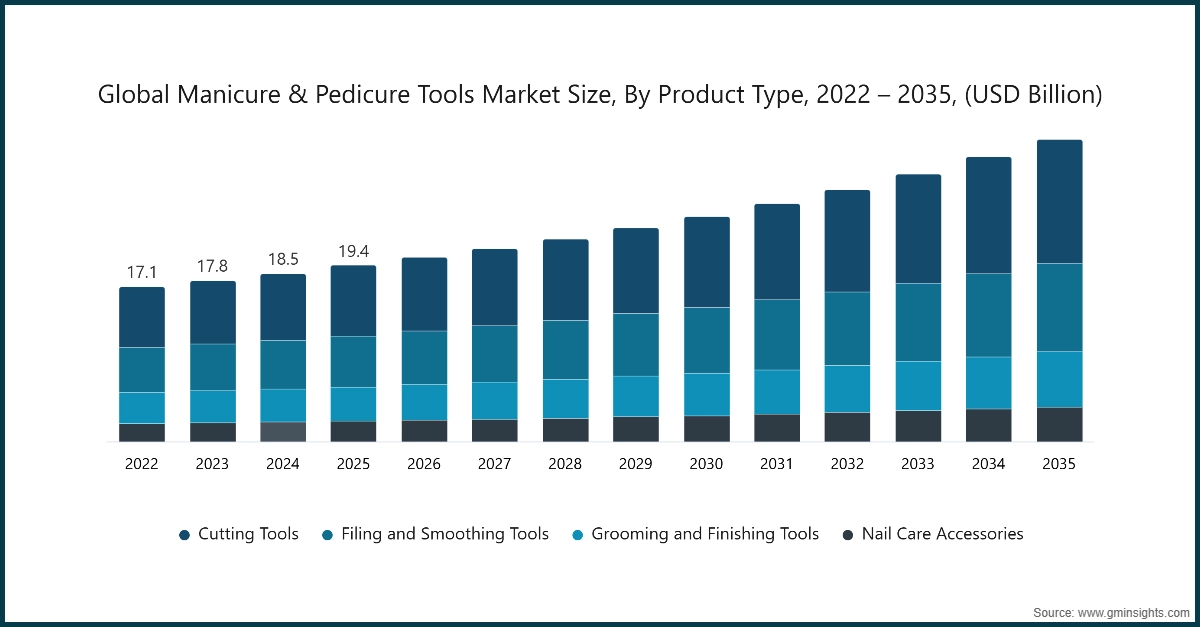
The manicure and pedicure tools market was estimated at USD 19.4 billion in 2025. The market is expected to grow from USD 20.3 billion in 2026 to USD 33.3 billion in 2035, at a CAGR of 5.7% according to latest report published by Global Market Insights Inc.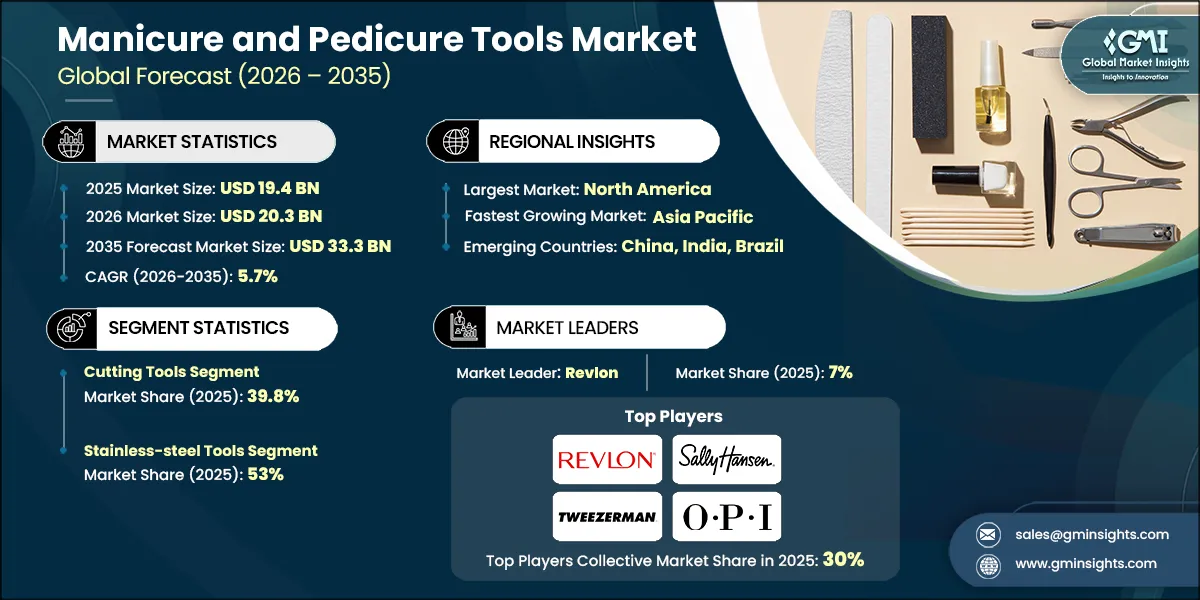
To get key market trends
Manicure and Pedicure Tools Market Trends
The market for professional nail technology has entered an era of significant evolution, driven by the advancement of cordless motor protocols, high-capacity lithium-ion standards, and AI-based speed torque regulations. Advances in brushless motor hardware are being combined with the latest digital interface technology, providing high-precision filing and cuticle management solutions with the advantage of tether-free mobility. Industry leaders are developing next-generation portable e-files, UV/LED curing stations, and intelligent battery management solutions designed for zero-downtime operation in high-volume salon environments. This has enabled the development of robust, self-regulating solutions for precise control of vibrations, thereby catering to the global demand for ergonomic and highly customized nail services.
- Adoption of advanced connectivity and power standards: The recent developments in the field of high-torque brushless motors, Bluetooth-enabled drill controllers, and wireless induction charging bases are providing a significant boost to the capabilities of modern manicure technology. Advanced power standards are providing the advantage of handling high-RPM (Revolutions Per Minute) operations and multi-layered gel removals seamlessly.
- High-performance smart interfaces and app integration: The fast pace of innovation in the development of smart nail applications, which provide diagnostic tools for remote use, speed presets for specific manufacturers, and cloud-based training modules for technicians, is increasing the level of precision and convenience of nail services. This trend makes it more feasible for high-end salons to substitute conventional wired, cumbersome table-top units with lightweight, mobile-first cordless units. The healthcare and podiatry sectors are increasingly using specialized wireless filing units for specific applications, such as high-precision medical pedicure services and diabetic foot care services, in which cordless sterilization is critical.
- Compact architecture and hybrid handpiece units: There is a significant emphasis in the development of compact, modular, and lightweight digital handpieces with hybrid power options such as USB-C fast recharge and secondary battery backup options. The integration of micro-chip "edge computing" into the physical drill hardware is efficient in executing complex filing operations such as automatic adjustment of torque in relation to material resistance. The emphasis on a "small footprint" architecture makes it feasible to integrate high-performance manicure services in unconventional applications such as mobile spa units, film set beauty kits, and high-end home service environments.
- Market momentum across verticals and smart hygiene: Advanced tool technologies are being increasingly utilized in various markets such as med spa, hospitality, and luxury retail to provide solutions such as waterless pedicures and quick-service manicures. Several hardware players are coming together to integrate antimicrobial coating technology into automatic tool sets, thus enabling companies to provide cost-effective and innovative service solutions that include functional components such as dust extraction synchronization and pressure sensing safety.
Manicure and Pedicure Tools Market Analysis
Learn more about the key segments shaping this market
Based on product type, the market is segmented into cutting tools, filing and smoothing tools, grooming and finishing tools, and nail care accessories. In 2025, the cutting tools segment held the largest share at 39.8%, valued at USD 7.7 billion in 2025.
- Cutting tools lead the market due to their essential role in both professional and home settings, high replacement rates, and the demand for precision-engineered stainless-steel nippers and clippers.
- Filing and smoothing tools maintain a significant share, driven by rapid innovations in long-lasting glass/crystal files and the growing popularity of high-performance electric filing systems (e-files).
- The cutting tools segment is also the fastest-growing category among the primary segments with a CAGR of 6%, fueled by the integration of ergonomic designs and advanced metallurgical coatings that enhance blade longevity.
- The transition to high-precision professional tools allows for superior nail health management; users can achieve salon-grade results through specialized instruments that minimize tissue trauma. This focus on "medical-grade" quality and specialized tool geometry is driving sustained market growth.
Learn more about the key segments shaping this market
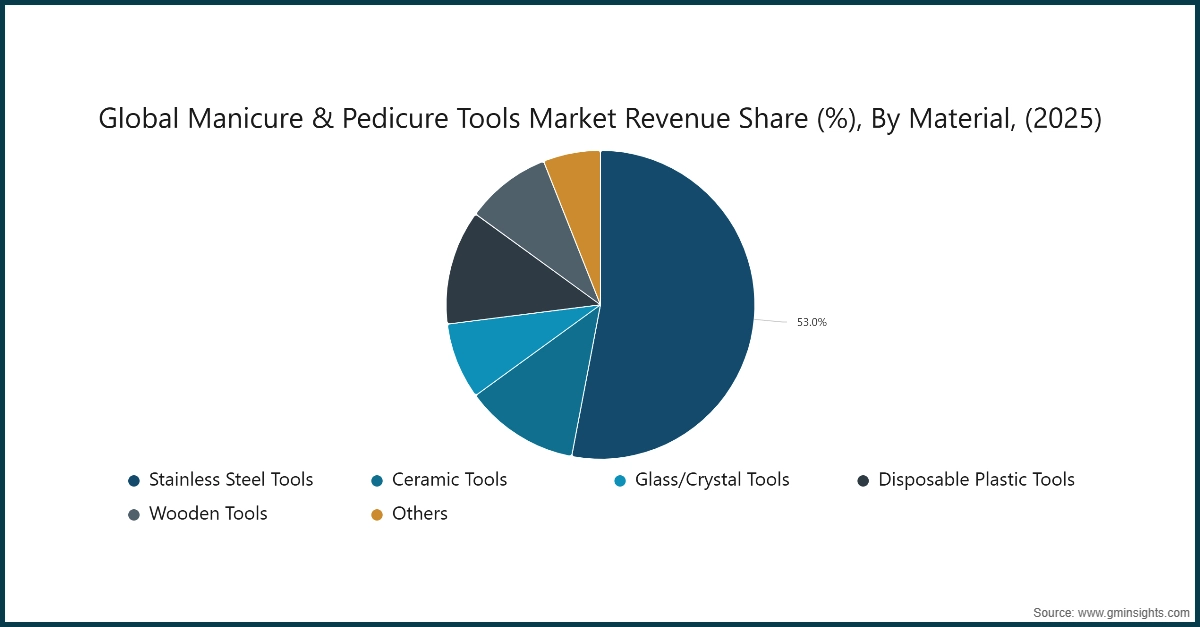
Based on material, the manicure and pedicure tools market is segmented into stainless steel, ceramic, glass/crystal, disposable plastic, wooden tools, and others. In 2025, the stainless-steel tools segment led the market with a 53% share, valued at USD 10.2 billion.
- The ceramic tools segment is the fastest-growing material pathway, projected to expand at a CAGR of 6.1% through 2035.
- Growth in the ceramic and glass/crystal segments is driven by increasing consumer preference for hypoallergenic materials and non-porous surfaces that offer superior hygiene and easier sterilization.
- The stainless-steel segment continues to hold the largest market share, particularly in the professional salon and podiatry sectors, where durability and autoclave compatibility are mandatory.
- Growth is further supported by the demand for wooden tools reflecting a shift toward biodegradable and eco-friendly options in the "clean beauty" and sustainable spa sectors.
- The segment benefits from the rise of premiumization, where manufacturers use titanium or plasma coatings on stainless steel bases to offer high-aesthetic tools for the retail market.
- The availability of detailed material specifications and durability ratings online assists professional technicians in selecting tools with specific properties (such as corrosion resistance or heat tolerance), reducing the frequency of replacement and ensuring consistent service quality.
Looking for region specific data?
North America Manicure and Pedicure Tools Market
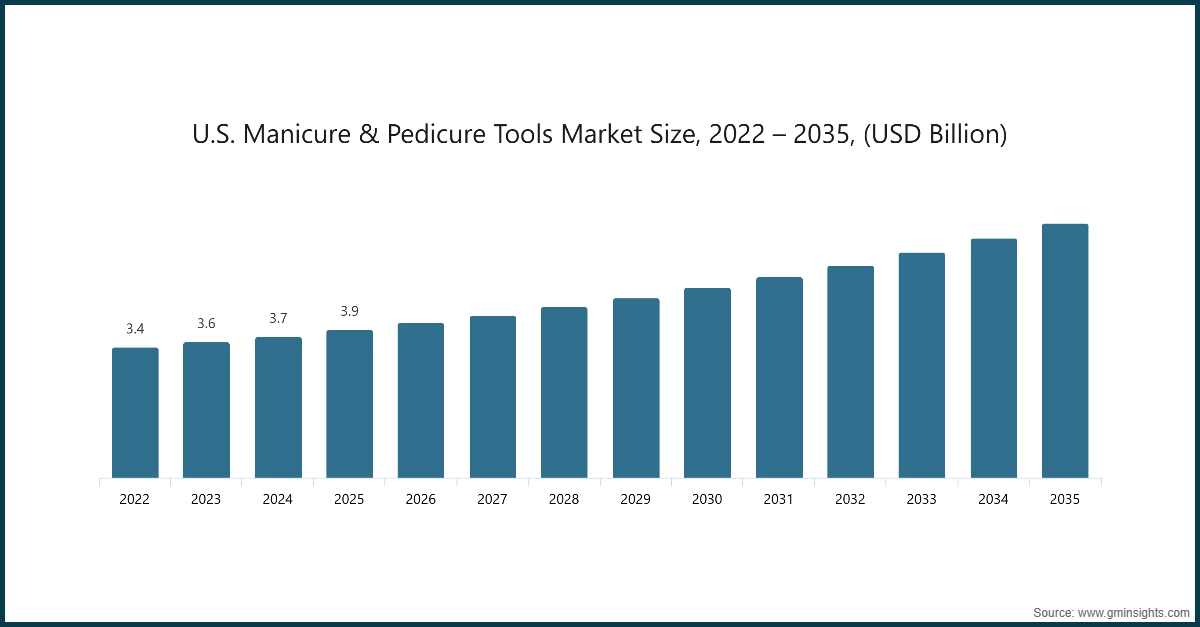
In 2025, North America stands as one of the most growing market for manicure and pedicure tools , reaching a valuation of USD 6.01 Billion with a projected CAGR of 5.6% through 2035.
- The United States dominates the regional market, contributing approximately 64.4% of the North American value. This position is driven by the high density of professional nail salons, a robust culture of personal grooming, and the rapid adoption of premium, medical-grade stainless steel instruments.
- The region benefits from fast-growing demand for ergonomic professional kits and home-use luxury sets, fueled by the rise of specialized "waterless" manicure trends and podiatry-focused foot care.
- Canada follows with a steady 5.5% CAGR, supported by increasing consumer spending on high-durability grooming tools and a transition toward sustainable, long-lasting personal care products.
- North America’s mature beauty ecosystem—home to leading professional tool brands and educators—makes it a primary hub for next-generation antimicrobial tool coatings and precision-engineered podiatry equipment
Europe Manicure and Pedicure Tools Market
Europe is a technologically advanced market, valued at USD 4.88 Billion in 2025, with a projected CAGR of 5.7% through 2035. Germany leads the region in growth, followed by the UK, France, Spain, and Italy.
- Europe’s focus on Industry 4.0 manufacturing and high craftsmanship standards encourages the adoption of laser-honed cutting tools and professional-grade ceramic files.
- Germany shows a strong sub-regional CAGR of 6.3%, driven by its reputation for high-quality surgical-grade steel production and a strong medical podiatry sector.
- The region’s emphasis on sustainability supports the shift toward plastic-free packaging, reusable metal tools, and glass/crystal files that offer an eco-friendly alternative.
Asia Pacific Manicure and Pedicure Tools Market
Asia Pacific is the fastest-growing regional market, with a 2025 valuation of USD 4.34 Billion and the highest CAGR globally at 6.3% through 2035.
- China is the dominant contributor with an impressive 6.4% CAGR, driven by the nation’s massive manufacturing base, the expansion of urban beauty chains, and a growing middle class investing in premium self-care.
- India follows with the highest individual growth rate of 6.8%, fueled by a burgeoning professional salon sector and increasing awareness of diabetic-safe pedicure tools.
- Massive investments in precision tool assembly and the mass-market production of high-quality stainless steel allow for cost-efficient scaling across the region.
- Asia Pacific is the center for high-volume production, enabling the global distribution of multi-functional nail kits and specialized grooming accessories.
- The region increasingly invests in automated manufacturing lines to boost the output of E-file bits and precision nippers, reducing labor costs while maintaining high-tensile strength standards.
Latin America Manicure and Pedicure Tools Market
Latin America represents a smaller but steadily growing segment of the global market, expanding at a 4.9% CAGR in the forecast period of 2026–2035.
- Latin America represents a smaller but vital segment of the global market, reaching a valuation of USD 2.57 Billion in 2025 and expanding at a 4.7% CAGR through 2035.
- Brazil is a key growth driver, supported by a deep-rooted cultural emphasis on nail aesthetics and a high frequency of salon visits compared to other global regions.
- Mexico and Brazil are seeing a shift toward professionalization, where traditional tools are being replaced by corrosion-resistant stainless steel and high-precision cuticle pushers to meet modern safety standards.
- Market adoption is supported by increasing urbanization and a rising demand for affordable yet durable retail tool sets in emerging economies.
- The region's growth is increasingly tied to the hospitality and tourism sectors, where luxury spa services require high-performance, aesthetically pleasing tool kits for premium guest experiences.
Manicure and Pedicure Tools Market Share
Revlon is currently the leading player in the Manicure and Pedicure Tools industry, holding an estimated 7% market share. The top companies including Revlon, Sally Hansen, Tweezerman, and OPI, collectively account for approximately 30% of the global market, indicating a moderately consolidated but highly competitive landscape. These major participants are actively engaging in strategic acquisitions, cross-technology collaborations, investments in advanced ink platforms, and global facility expansions to strengthen their portfolios and serve a broader industrial customer base.
Sally Hansen has shown significant momentum, recently expanding its footprint in the professional-grade retail segment by leveraging its "Salon Results at Home" branding. The company is undergoing a digital transformation to position itself as a high-growth leader in accessible, high-durability grooming tools. By expanding its subscription-based self-care kits and leveraging social media-driven "DIY" trends, Sally Hansen is focusing heavily on lowering the cost of high-quality maintenance while enhancing material safety and ergonomic comfort for home users.
Manicure and Pedicure Tools Market Companies
Major players operating in the manicure and pedicure tools industry are:
- Beurer
- CND
- Deborah Lippmann
- Fancii
- Harperton
- Kai Corporation
- KISS Products
- Nghia Export
- OPI
- Revlon
- Sally Hansen
- Seki Edge (Green Bell)
- Sephora Collection
- Tweezerman
- Zizzili Basics
Tweezerman holds a significant market share due to its pioneering focus on precision-aligned tips and extensive expertise in high-carbon stainless steel fabrication. Tweezerman’s advanced nippers and file solutions cater to high-demand professional environments, leveraging their robust R&D capabilities to deliver high-quality, long-lasting, and autoclavable tools.
Manicure and Pedicure Tools Market Report Attributes
| Key Takeaway | Details |
|---|---|
| Market Size & Growth | |
| Base Year | 2025 |
| Market Size in 2025 | USD 19.4 Billion |
| Market Size in 2026 | USD 20.3 Billion |
| Forecast Period 2026-2035 CAGR | 5.7% |
| Market Size in 2035 | USD 33.3 Billion |
| Key Market Trends | |
| Drivers | Impact |
| Shift toward medical-grade professional standards | Increasing consumer awareness of nail health and hygiene is accelerating the shift toward surgical-grade stainless steel and autoclavable tools, reducing the risk of infection. |
| Ergonomic design & material innovation | The industry is moving from generic tool shapes to AI-modeled ergonomic handles and advanced coatings (titanium, ceramic), reducing repetitive strain for professional technicians. |
| Sustainability & eco-conscious grooming | Growing demand for plastic-free solutions is driving the adoption of reusable metal tools and biodegradable wooden or glass alternatives, replacing single-use disposable plastic implements. |
| Pitfalls & Challenges | Impact |
| Counterfeit & low-grade material saturation | The influx of low-cost, substandard alloy tools in the e-commerce space poses a challenge to premium brands, as poor-quality metals can lead to rapid corrosion and safety issues. |
| Stringent sterilization compliance | Ensuring tool durability under high-temperature autoclave and chemical sterilization processes requires expensive material engineering and specialized manufacturing treatments. |
| Opportunities: | Impact |
| Subscription-based Professional Kits | Direct-to-consumer (DTC) models allow salons and mobile technicians to access high-end, sharpened tool rotations without high upfront costs—covering maintenance and recycling. |
| Expansion into Med-Spa & Podiatry | Rising demand for specialized tools for diabetic foot care and clinical pedicures allows manufacturers to diversify into high-margin, medical-certified tool segments. |
| Market Leaders (2025) | |
| Market Leader |
7% market share |
| Top Players |
Consolidate share of 30% |
| Competitive Edge |
|
| Regional Insights | |
| Largest Market | North America |
| Fastest growing market | Asia Pacific |
| Emerging countries | China, India, Brazil |
| Future outlook |
|
What are the growth opportunities in this market?
Manicure and Pedicure Tools Industry News
- In January 2026, Revlon partnered with a leading skincare technology firm to launch the first integration of antimicrobial silver-ion coating into its premium tool line. This collaboration ensures that nippers and clippers remain hygienic during repeated use, targeting the growing consumer demand for "medical-grade" safety in home grooming environments.
- In July 2025, Nghia Export introduced the Pro-X Cuticle Nipper, a high-precision wireless-honed tool designed to optimize salon performance. The device features a 20% reduction in handle tension compared to prior models and integrates proprietary Hand-Forged Alignment for microscopic cutting accuracy, catering to the professional technician segment.
- In 2025, Beurer was named a leader in electronic nail care, recognized for its consistent investment in high-torque, low-vibration e-file technology. Beurer’s latest cordless filing systems utilize lithium-ion battery technology and digital pressure sensors to stabilize RPM output and reduce heat friction, meeting the rising demand for intelligent and safe electronic manicures.
- In late 2024, KISS Products announced its goal for double-digit growth by targeting the Gen-Z and DIY sectors with its newly launched "Artificial Nail Prep" tool line. KISS is leveraging social media marketing and cost-efficient carbon-steel manufacturing to capture market share in cost-conscious regions like India and Latin America.
- In early 2025, OPI achieved a top global market position for professional nail accessories, capturing a significant share of the salon-exclusive market. This milestone was driven by the rapid adoption of its Pro-Tool series, which offers ergonomically weighted handles and superior corrosion resistance, aligning with global professional standards for repetitive-use instruments
The manicure and pedicure tools market research report includes in-depth coverage of the industry with estimates & forecasts in terms of revenue (USD Billion) and volume (Thousand Units) from 2022 to 2035, for the following segments:
Market, By Product Type
- Cutting Tools
- Nail Clippers
- Cuticle Scissors
- Nail Trimmers
- Others (Nail Nippers, etc.)
- Filing and Smoothing Tools
- Nail Files
- Buffing Blocks
- Grooming and Finishing Tools
- Cuticle Pushers
- Cuticle Removers
- Nail Buffers
- Nail Polishing Tools
- Nail Care Accessories
- Nail Separators
- Toe Separators
- Nail Cleaning Tools
- Callus Removers
- Others (Nail Art Tools, UV Lamps & LED Dryers, Maintenance Oils (e.g., cuticle oils))
Market, By Material
- Stainless Steel Tools
- Ceramic Tools
- Glass/Crystal Tools
- Disposable Plastic Tools
- Wooden Tools
- Others (titanium tools, etc.)
Market, By Price
- Low
- Medium
- High
Market, By End Use
- Personal Use
- Professional Use
- Nail Salons
- Spas
- Beauty Centers
- Others (dermatological centers, etc.)
Market, By Distribution Channel
- Online
- E-commerce
- Company websites
- Offline
- Supermarkets & Hypermarkets
- Specialty Stores
- Departmental Stores
- Others (Pharmacies & Drugstores, etc.)
The above information is provided for the following regions and countries:
- North America
- U.S.
- Canada
- Europe
- Germany
- UK
- France
- Italy
- Spain
- Asia Pacific
- China
- India
- Japan
- Australia
- South Korea
- Latin America
- Brazil
- Mexico
- Argentina
- Middle East and Africa
- South Africa
- Saudi Arabia
- UAE
Frequently Asked Question(FAQ) :
What is the market size of the manicure and pedicure tools in 2025?
The global manicure and pedicure tools market was valued at USD 19.4 billion in 2025, driven by continuous innovation in advanced metallurgy, ergonomic design, medical-grade materials, and the growing demand for professional-quality tools.
What is the projected value of the manicure and pedicure tools industry by 2035?
The manicure and pedicure tools market is projected to reach USD 33.3 billion by 2035, supported by advancements in plasma coating, diamond-dust abrasives, AI-based quality control, sustainable tool adoption, and expansion into clinical and med-spa segments.
What is the manicure and pedicure tools industry size in 2026?
The manicure and pedicure tools market size is projected to reach USD 20.3 billion in 2026.
Which product type segment dominated the manicure and pedicure tools market in 2025?
The cutting tools segment held the largest share at 39.8%, valued at USD 7.7 billion in 2025, driven by their essential role in professional and home settings, high replacement rates, and demand for precision-engineered stainless-steel nippers and clippers.
Which material segment led the manicure and pedicure tools market in 2025?
The stainless-steel tools segment led the market with a 53% share, valued at USD 10.2 billion in 2025, driven by its dominance in professional salon and podiatry sectors where durability and autoclave compatibility are mandatory.
Which region is the fastest growing in the manicure and pedicure tools market?
North America reached a valuation of USD 6.01 billion in 2025 with a projected CAGR of 5.6% through 2035, driven by the high density of professional nail salons, premium grooming culture, and rapid adoption of medical-grade stainless steel instruments.
What are the upcoming trends in the manicure and pedicure tools market?
Key trends include development of smart nail applications with cloud-based technician training, adoption of antimicrobial coating technologies, expansion into med-spa, and growing demand for sustainable plastic-free and biodegradable tool alternatives.
Who are the key players in the manicure and pedicure tools market?
Key players include Revlon, Sally Hansen, Tweezerman, OPI, Beurer, CND, Deborah Lippmann, Fancii, Harperton, Kai Corporation, KISS Products, Nghia Export, Seki Edge (Green Bell), Sephora Collection, and Zizzili Basics.
Manicure and Pedicure Tools Market Scope
Related Reports