Summary
Table of Content

Malt Ingredients Market
Get a free sample of this report
Form submitted successfully!
Error submitting form. Please try again.
Thank you!
Your inquiry has been received. Our team will reach out to you with the required details via email. To ensure that you don't miss their response, kindly remember to check your spam folder as well!
Request Sectional Data
Thank you!
Your inquiry has been received. Our team will reach out to you with the required details via email. To ensure that you don't miss their response, kindly remember to check your spam folder as well!
Form submitted successfully!
Error submitting form. Please try again.
Malt Ingredients Market Size
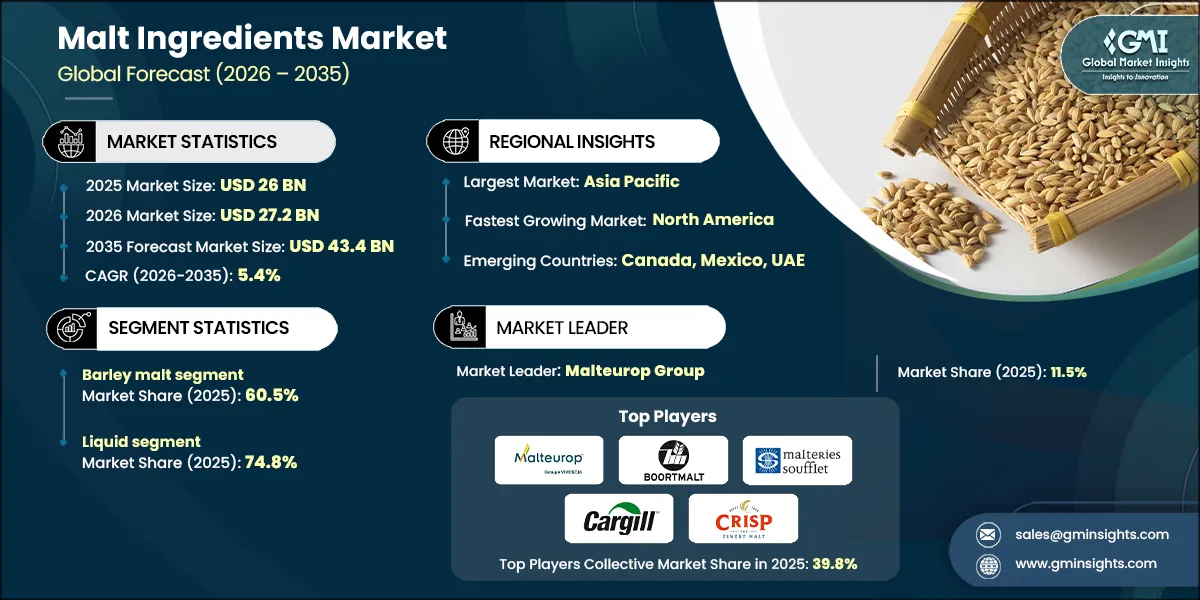
The global malt ingredients market was valued at USD 26 billion in 2025. The market is expected to grow from USD 27.2 billion in 2026 to USD 43.4 billion in 2035, at a CAGR of 5.4% according to latest report published by Global Market Insights Inc.
Malt Ingredients Market Key Takeaways
Market Size & Growth
- 2025 Market Size: USD 26 Billion
- 2026 Market Size: USD 27.2 Billion
- 2035 Forecast Market Size: USD 43.4 Billion
- CAGR (2026–2035): 5.4%
Regional Dominance
- Largest Market: Asia Pacific
- Fastest Growing Region: North America
Key Market Drivers
- Craft brewing revolution & specialty malt demand.
- Premium spirits & whiskey market growth.
- Rising demand for malt-based nutritional supplements.
Challenges
- Volatility in barley prices & supply.
- Climate change impact on malting barley quality.
Opportunity
- Emerging markets in Asia Pacific (China, India, Southeast Asia).
- Non-alcoholic beer & low-alcohol beverage trends.
Key Players
- Market Leader: Malteurop Group led with over 11.5% market share in 2025.
- Leading Players: Top 5 players in this market include Malteurop Group, Boortmalt, Malteries Soufflet, Cargill, Crisp Malt, which collectively held a market share of 39.8% in 2025.
Get Market Insights & Growth Opportunities
- Malt is an ingredient made from barley or other grains, which has been germinated and dried into malt and is used in brewing, distilling, and food applications. These are the main raw materials for beer, spirits, and health supplements in that they contribute flavoring, fermentable sugars, and nutrition to the end products.
- According to the United States Department of Agriculture (USDA) , barley is the primary cereal for malt globally, accounting for about 75% of the total malting cereal, with barley being produced at the level of over 150 million metric tons every year.
- The growing global demand for malt ingredients is evidently associated with the ever-growing craft brewing industry that actually had a major increase in recent years. The Brewers Association's report indicated that craft beer accounts for 24.7% of the whole beer market, largely fueled by consumer interest in unique flavors and artisanal quality. The demand for specialty malts has provided more markets for those malts to impart color and flavor, thus driving growth for the industry.
- At the same time, the premium spirits and whiskey markets have been performing well, buoyed by rising disposable income and changing consumer preference toward high-end aged spirits. The growth of these markets has led to high demand for high-quality malted barley that favors high-end whiskey and spirit for its better flavor and fermentability. Due to the presence of key nutrients such as vitamins, minerals, and antioxidants, malt extracts and derivatives are gaining ground in the field of functional foods and dietary supplements.
To get key market trends
Malt Ingredients Market Trends
- Recent malting technology or innovation upgrades have substantially enhanced the efficiency and quality of malt ingredients. Automated germination and drying processes equipped with precision control systems, enable producers to develop specialty malts with specified flavor profiles and functional properties. This advancement assures greater product consistency at lower production costs catering to the disparate needs of an industry that spans craft brewing to health supplements. Industry players are also exploring enzyme-assisted malting and biotechnological techniques to increase yield and nutritional content, which augur well for further innovations in the sector.
- Consumer appetite for natural, mildly processed, and clean-label food ingredients is growing. This trend influences the malt ingredients market such that it encourages manufacturers to develop organic and non-GMO malt products. Companies are trying to satisfy health-conscious consumers through sustainable sourcing practices and transparent labeling. Therefore, products are developed to cater to demand for natural malt extracts and derivatives that retain nutritional integrity as per regulatory trends that support food safety and transparency, shaping product development strategies and increasing market opportunities.
Malt Ingredients Market Analysis
Learn more about the key segments shaping this market
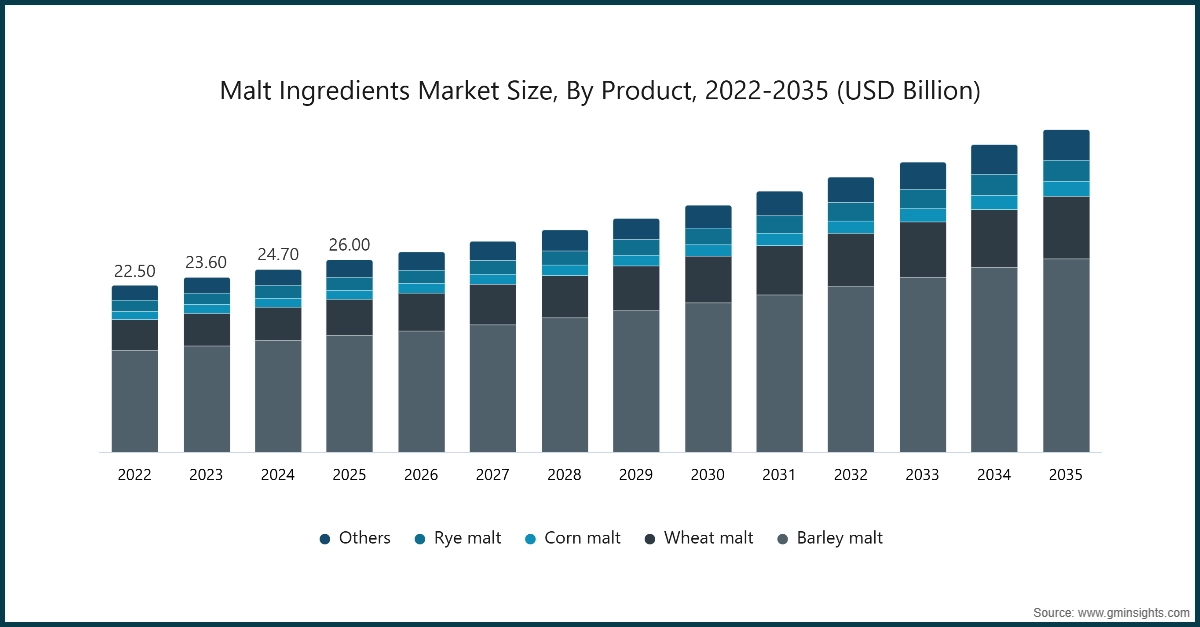
Based on product, the market is segmented into barley malt, wheat malt, corn malt, rye malt and others. Barley malt dominated the market with an approximate market share of 60.5% in 2025 and is expected to grow with a CAGR of 5.3% by 2035.
- Barley malt dominates in the market because it has a wider application in brewing because of the flavors, colors, and fermentable sugars it provides for the production of beer. Additionally, its natural enzymatic properties make it ideal for malting. In addition to the rich nutrition profile of barley malt and its traditional popularity in brewing and food applications, this has continued to bless the crop with leadership.
- Wheat malt is used in baking and some areas of brewing. The special flavor and gluten profile of this cereal allow it to be used in recipes known to produce bread, biscuits, and specialized beers. Wheat malt demand is driven by the inclination towards high-end baked products and artisanal ones, additional technological advancements in processing of wheat malting will develop and shape the wheat malt market.
- Corn malts have niche markets such as spirits and biofuels. This category expands its usage as gluten-free substitutes, increasingly appealing to consumers that care about health and specific diet needs. Increased demand for corn-based ingredients in functional foods coupled with innovations in processing will elevate corn malt's share in the market.
- Rye malt, on the other hand, is a more niche segment, rather for specialty breads, whiskey, and crafty spirits that are known to give a more unique flavor and aromatic qualities to the drinks where it is used. It contributes less to the market but is seeing slow but steady growth as consumers increasingly seek unique and premium products.
Learn more about the key segments shaping this market
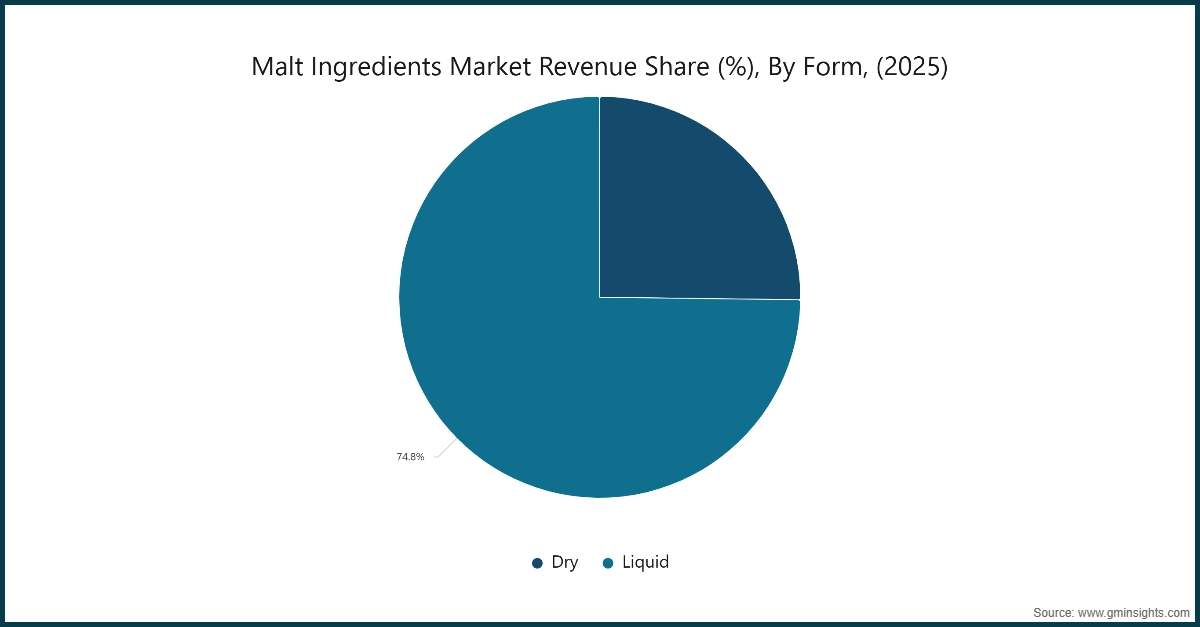
Based on form, the market is segmented into dry and liquid. Liquid held the largest market share of 74.8% in 2025.
- Liquid malt ingredients is the most prominent in the market because one can easily apply it and be very versatile in brewing, distilling, food processing, and so on. It facilitate easy integration into the lines without necessarily altering massive parts of the equipment, thus increasing demand for the products.
- Dry malt is a conventional form that is usually used in baking and the grinding of malts for specialty purposes primarily because storability and shelf life are major considerations. However, the low solubility rate makes this material freezing prone when used for mass industrial applications.
Based on grade, the market is segmented into specialty/premium grade and standard/commercial grade.
- The specialty/premium grade is the largest sector in the malt ingredients market due to craft brewing, high-end artisanal food products, and health applications. The demand of the consumers for the high-quality, natural, unique, and sometimes exotic flavor profiles that specialty malts offer has grown. Premium grades are preferred by breweries and food manufacturers for their distinctive sensory experiences as well as meeting the authenticity and quality expectations of consumers.
- Standard/commercial grade mainly cheap and high volumes go into mass-produced beers, baked goods and animal feeds. The cheap and widely available commercial-grade malt therefore gives this segment an importance for large manufacturers focusing mainly on standard formulations and cost-effective production.
Based on application, the market is segmented into alcoholic beverage production, food products (non-alcoholic), animal feed & nutrition, pharmaceuticals, cosmetics & personal care and others.
- Alcoholic beverage production remains the biggest constituent of the malt ingredients market as its extensive usage in brewing beer, whiskey, and other spirits accounts for more than 70% of total consumption. Demand is driven by the booming craft beer and premium spirits markets, with the
- Food products (non-alcoholic) share a significant chunk as increasing consumption of malt extracts in bakery, breakfast cereals, and energy bars for flavor and food value usefulness, sweetening naturally, enticing the health-conscious consumer. The growing demand for clean-label functional foods is a major motivating factor for the inclusion of malt ingredients by the manufacturers, thereby facilitating a steadier growth within this segment.
- Animal feed and nutrition are surging as a result of increasing awareness on the health benefits of malt-based additives that enhance digestion and promote overall health in livestock farming in particular.
- Malt derivatives are being used in pharmaceuticals because of their antioxidant and bioactive factors, but this remains a niche area. Some growth is being conferred by studies into the use of malt extracts for nutraceuticals and functional health products, albeit on a smaller scale than other applications.
- Malt extracts are included in cosmetics and personal care products for their antioxidant and moisturizing properties but its market share still remains relatively small. The rising interest of consumers in natural ingredients is expected to gradually translate to an increased penetration of these products into the market.
Looking for region specific data?
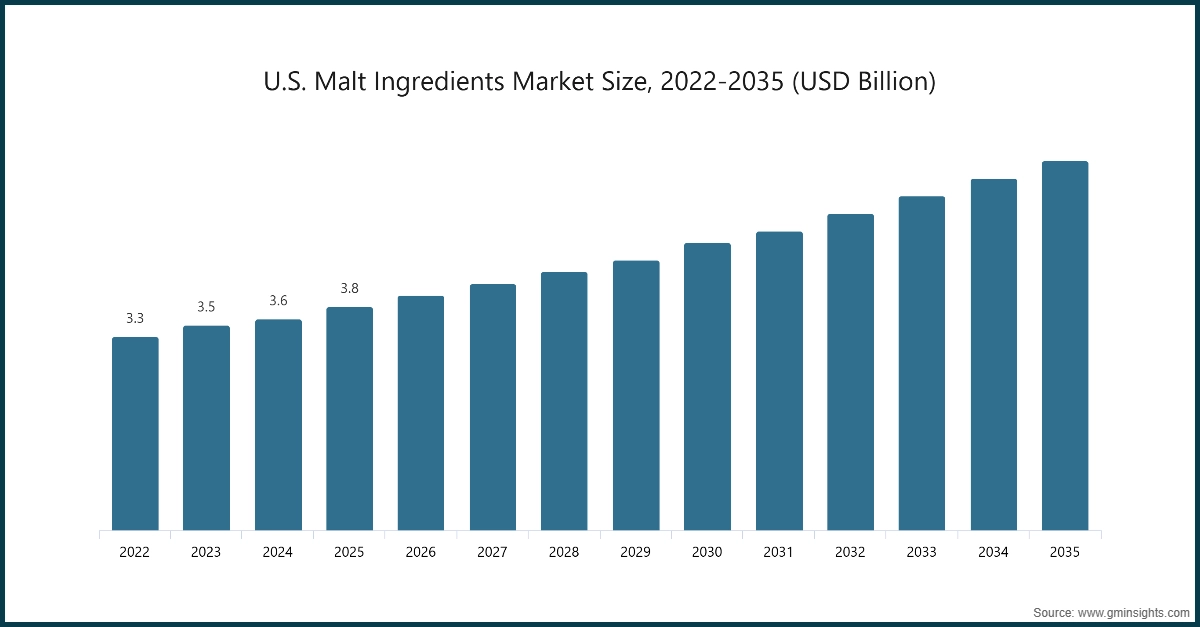
The malt ingredients market in North America will grow at a CAGR from approximately 5.3% between 2026 and 2035.
- Circular economy considerations are being promoted by the industry as sustainable malting practices are being further advanced through recycling wastewater and processing by-products with waste valorization techniques, adding to the environmental sustainability and application aspect. The growing focus of consumers toward eco-friendly and clean-label attributes (especially in health and personal care as well as functional foods) is actually forcing brands to incorporate malt ingredients.
The malt ingredients markets in Europe, especially in a few countries like Germany, are expected to grow with a rapid pace in the coming years.
- R&D resources are geared toward eco-friendly extraction technologies focused on reducing environmental impact and providing high-quality malt derivatives and expanded applications into pharmaceuticals, organic farming, and natural health products.
- Consumer demand for plant-based, allergen-free, and sustainable formulations on food and personal care fronts is driving investments toward environmentally sustainable malt ingredients production, which fits in the health-conscious and sustainability trends.
The malt ingredients market in China and India is expected to have lucrative growth between 2026 and 2035, with CAGR 5.7% in the Asia Pacific region.
- Rapid urbanization, rising disposable incomes, and a shift towards natural fertilizers, biogas, and eco-friendly cleaning products are driving the need for high-performing malt ingredients across various industries such as packaging, healthcare, and bio-based materials.
- The expanding demand for organic and natural products is further driving the growth of health and wellness markets, which is, in turn, extending benefits to malt ingredients.
Between 2026 and 2035, the market for malt ingredients in the Middle East is projected to grow significantly during this period.
- Various ongoing initiatives in the region promote sustainable agricultural practices and healthy lifestyles that indirectly promote the application of malt ingredients in the food processing, dietary supplement, and cosmetics industries.
Between 2025 and 2035, a promising expansion of the malt ingredients sector is foreseen in the Latin America.
- Environmental consciousness and action toward a sustainable waste management approach encourage the adoption of malt ingredients in applications for cosmetics and functional foods led by eco-UV and natural-extract innovations.
- The surge in discretionary income and increasing cognizance related to natural and bio-based ingredient offerings drive demand for natural malt ingredients in the food, pharma, and personal care industries.
Malt Ingredients Market Share
Malt ingredients industry is moderately consolidated with players like Malteurop Group, Boortmalt, Malteries Soufflet, Cargill and Crisp Maltwhich accounts for 39.8% market share in 2025.
The market consists of such leading companies operating mostly in their regional areas. Their long years of experience with malt ingredients have allowed these companies to maintain a strong market position worldwide. Their product offerings are diverse and majorly supported by production capacities and distribution networks, which can serve the increasing demand for malt ingredients in various regions.
Malt Ingredients Market Companies
Major players operating in the malt ingredients industry includes:
- Bairds Malt
- Boortmalt
- Briess Malt
- Cargill
- Crisp Malt
- Malt Products Corporation
- Malteries Soufflet
- Malteurop Group
- Rahr Corporation
- Simpsons Malt
- The Malt Company
- Weyermann Malz
Malteurop Group manufactures quality malt ingredients, with the main focus on beer and spirit brewing malts, surrounded by the activity of innovation and sustainability. The malts are intended to enhance flavor, aroma, and consistency in one of the most important processes in brewing, all for the benefit of the craft breweries around the world, and in due course the larger producers.
Boortmalt produces wide varieties of malt products, from traditional to specialty malts, all for brewing, distilling, and food applications. Malts rather emphasize quality, consistency, and traceability, for the benefit of large industrial clients and also craft brewers, who look for particular flavor profiles.
Malteries Soufflet has a broad spectrum of malt ingredients ranging from base malts to caramel malts and specialty malts. Their use runs through brewing and distilling into food, including an emphasis on natural flavor development, high purity, and sustainability of sourcing practices.
Crisp Malt produces a range of malts and malting barley, focusing on traditional and specialty malts for brewing and distilling. Their malts are more typically associated with being produced to a very consistent perception of quality and flavor in support of craft brewing and premium beverage innovation.
Cargill produces malt-based sweeteners, including wheat- and barley-malt syrups, which are used in brewing, baking, and confectionery. Their malt syrups are known for imparting natural sweetness alongside a variety of functional characteristics that contribute to flavor and texture in food and beverage items.
Malt Ingredients Market Report Attributes
| Key Takeaway | Details |
|---|---|
| Market Size & Growth | |
| Base Year | 2025 |
| Market Size in 2025 | USD 26 Billion |
| Market Size in 2026 | USD 27.2 Billion |
| Forecast Period 2026-2035 CAGR | 5.4% |
| Market Size in 2035 | USD 43.4 Billion |
| Key Market Trends | |
| Drivers | Impact |
| Craft brewing revolution & specialty malt demand | Increased craft brewing activity boosts demand for specialty malts, driving market growth. |
| Premium spirits & whiskey market growth | Rising popularity of premium spirits and whiskey elevates the need for high-quality malt ingredients, expanding market opportunities |
| Rising demand for malt-based nutritional supplements | Growing consumer interest in health and wellness fuels demand for malt-based nutritional products, positively impacting the market |
| Pitfalls & Challenges | Impact |
| Volatility in barley prices & supply | Fluctuations in barley prices and supply disruptions can lead to increased costs and supply chain uncertainties in the Malt Ingredients market |
| Climate change impact on malting barley quality | Climate change adversely affects barley quality, potentially reducing yield and increasing production challenges for malt manufacturers |
| Opportunities: | Impact |
| Emerging markets in Asia Pacific (China, India, Southeast Asia) | Rapid economic growth in Asia Pacific offers significant expansion opportunities for malt ingredient producers |
| Non-alcoholic beer & low-alcohol beverage trends | Rising consumer preference for non-alcoholic and low-alcohol beverages creates new demand channels for malt ingredients in these segments |
| Market Leaders (2025) | |
| Market Leader |
Market share: 11.5% |
| Top Players |
Collective Market Share of top 5 players in 2025: 39.8% |
| Competitive Edge |
|
| Regional Insights | |
| Largest Market | Asia Pacific |
| Fastest growing market | North America |
| Emerging countries | Canada, Mexico, UAE |
| Future outlook |
|
| Companies covered: | 12 |
| Tables, Charts & Figures: | 205 |
| Countries covered: | 18 |
| No of Pages: | 190 |
What are the growth opportunities in this market?
Malt Ingredients Industry News
- In March 2024, Muntons has unveiled PlantMalt, a sustainable and plant-based malt ingredient range that adds flavour, texture, and colour to meat alternatives and answers the rising plant-based market with clean-label, eco-friendly solutions.
- In November 2023, Malteries Soufflet announced the completion of acquiring United Malt Group culminating the formation of a global platform with 41 facilities covering 20 endpoints worldwide to serve the craft brewing and food sectors more efficiently.
This malt ingredients market research report includes in-depth coverage of the industry, with estimates & forecasts in terms of revenue (USD Billion) and volume (Kilo Tons) from 2022 to 2035, for the following segments:
Market, By Product
- Barley malt
- Wheat malt
- Corn malt
- Rye malt
- Others
Market, By Form
- Dry
- Liquid
Market, By Grade
- Standard/commercial grade
- Specialty/premium grade
Market, By Application
- Alcoholic beverage production
- Brewing
- Distilling
- Food products (non-alcoholic)
- Baking
- Confectionery
- Malted beverages (non-alcoholic)
- Breakfast cereals
- Nutritional supplements
- Others
- Animal feed & nutrition
- Ruminant feed
- Poultry feed
- Swine feed
- Aquaculture feed
- Pet food
- Pharmaceuticals
- Tablet excipients
- Nutritional formulations
- Probiotic carriers
- Others
- Cosmetics & personal care
- Skincare products
- Haircare products
- Others
- Others
The above information is provided for the following regions and countries:
- North America
- U.S.
- Canada
- Europe
- Germany
- UK
- France
- Spain
- Italy
- Rest of Europe
- Asia Pacific
- China
- India
- Japan
- Australia
- South Korea
- Rest of Asia Pacific
- Latin America
- Brazil
- Mexico
- Argentina
- Rest of Latin America
- Middle East and Africa
- Saudi Arabia
- South Africa
- UAE
- Rest of Middle East and Africa
Frequently Asked Question(FAQ) :
What is the malt ingredients market size in 2025?
The market size for malt ingredients was valued at USD 26 billion in 2025. The market's growth is driven by increasing demand for specialty malts, premium spirits, and malt-based nutritional products.
What is the market size of the malt ingredients industry in 2026?
The market size for malt ingredients reached USD 27.2 billion in 2026, reflecting steady growth supported by rising craft brewing activities and health-conscious consumer trends.
What is the projected value of the malt ingredients market by 2035?
The market size for malt ingredients is expected to reach USD 43.4 billion by 2035, growing at a CAGR of 5.4%. This growth is fueled by innovations in non-alcoholic beverages, premium spirits, and expanding opportunities in emerging markets.
What was the market share of barley malt in 2025?
Barley malt dominated the market with an approximate share of 60.5% in 2025. Its leadership is attributed to its widespread use in brewing and distilling applications.
What was the market share of the liquid form segment in 2025?
The liquid form segment held the largest market share of 74.8% in 2025, driven by its extensive application in brewing and beverage production.
What is the growth outlook for the North American malt ingredients market from 2026 to 2035?
The malt ingredients industry in North America is projected to grow at a CAGR of approximately 5.3% from 2026 to 2035. Increasing demand for craft beer and malt-based beverages is driving this growth.
What are the upcoming trends in the malt ingredients industry?
Key trends include the rising popularity of non-alcoholic and low-alcohol beverages, growing demand for specialty malts, and increasing consumer interest in health and wellness products. Additionally, sustainable sourcing and innovations in malt production are shaping the market.
Who are the key players in the malt ingredients market?
Key players include Malteurop Group, Boortmalt, Malteries Soufflet, Cargill, Crisp Malt, Bairds Malt, Briess Malt, Malt Products Corporation, Rahr Corporation, Simpsons Malt, The Malt Company, and Weyermann Malz.
Malt Ingredients Market Scope
Related Reports