Summary
Table of Content

Magnetoencephalography Market
Get a free sample of this report
Form submitted successfully!
Error submitting form. Please try again.
Thank you!
Your inquiry has been received. Our team will reach out to you with the required details via email. To ensure that you don't miss their response, kindly remember to check your spam folder as well!
Request Sectional Data
Thank you!
Your inquiry has been received. Our team will reach out to you with the required details via email. To ensure that you don't miss their response, kindly remember to check your spam folder as well!
Form submitted successfully!
Error submitting form. Please try again.
Magnetoencephalography Market Size
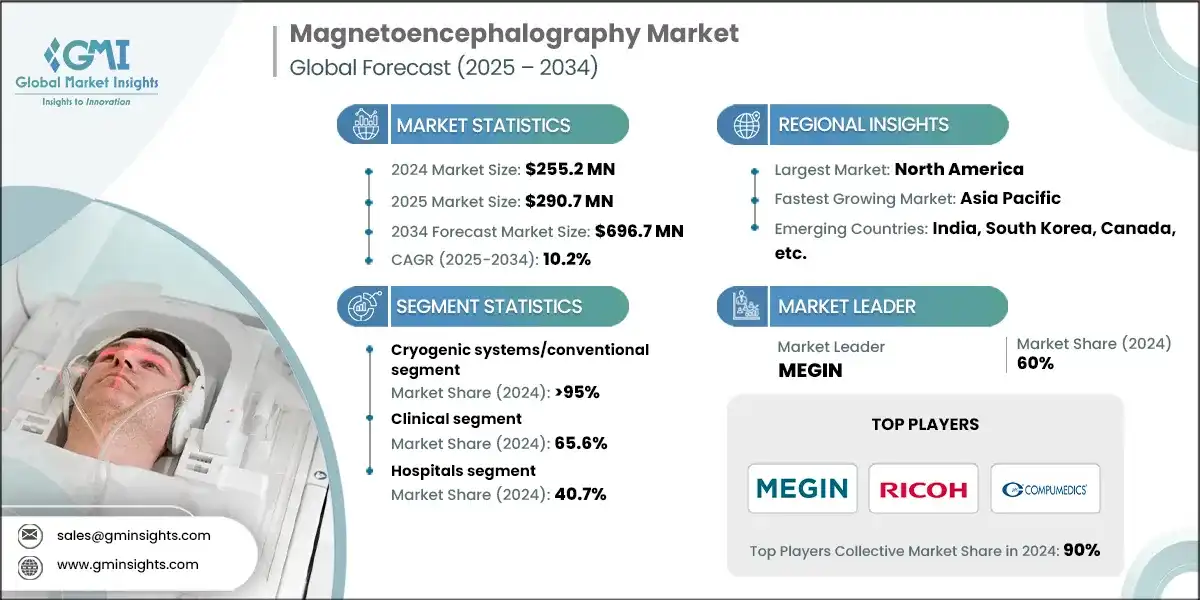
The global magnetoencephalography market was estimated at USD 255.2 million in 2024. The market is expected to grow from USD 290.7 million in 2025 to USD 696.7 million in 2034, at a CAGR of 10.2% during the forecast period, according to the latest report published by Global Market Insights Inc.
To get key market trends
The magnetoencephalography market growth is driven by increasing prevalence of neurological disorders, growing applications in clinical diagnosis and research coupled with rapid technological advancements in the field of magnetoencephalography, among other factors.
The rise in the target population suffering from different neurological conditions, growing aging population, and the focus on early diagnosis are among the key variables fueling the market growth. MEGIN, Ricoh, and Compumedics Limited are among the leading players operating in the market. These players mainly focus on product innovation, geographical expansion by installing systems in emerging countries, improving distribution networks, and offering precise diagnostic results, among other factors.
There is a consistent growth in the prevalence of different neurological conditions globally, including epilepsy, Parkinson's disease, and Alzheimer's, among others, which in turn is expected to continue to fuel the need for advanced diagnostic techniques such as MEG. For instance, according to the data reported in a 2023 report by the World Health Organization (WHO), the prevalence of Parkinson’s disease has doubled in the last 25 years globally. These conditions require mapping of the brain and functional brain assessment that MEG can provide easily and with high temporal resolution. Therefore, as people age, coupled with a rise in lifestyle-related neurological conditions, governments and healthcare systems are investing considerably with a focus on early and accurate diagnosis. The ability to non-invasively localize abnormal activity in the brain using MEG is a key benefit of this diagnostic tool in both clinical and research settings, particularly pre-surgically as well as in monitoring progression of disease.
Magnetoencephalography is being used to localize epilepsy and tumors more commonly, but also for assessments of cognitive function, psychiatric illnesses, and neurodevelopmental disorders such as autism. Because it is able to track the brain in real time, MEG has the potential to provide insight into the connectivity of the brain and functional networks. In the field of research, MEG is used in studies of language processing, memory, and sensory integration. As the fields of precision medicine and personalized treatment approaches gain popularity, the role of MEG in adapting treatment to an individual's pattern of brain activity is expanding.
Further, recent advances in magnetoencephalography (MEG) technology have made these systems more compact, sensitive, and cost-effective. The development of optically pumped magnetometers (OPMs) now allows patients to wear and move with MEG systems outside traditional shielded rooms. These improvements provide better image quality, less interference from outside noise, and make the experience more comfortable for patients. Utilizing artificial intelligence and machine learning algorithms, physicians can analyze data more accurately and arrive at more accurate diagnoses. As these technologies continue to evolve and improve, many more hospitals and research institutions can consider adopting MEG systems so the technology will be more accessible to patients requiring neurological evaluation.
Magnetoencephalography (MEG) is a non-obtrusive imaging technique documenting magnetic fields produced by neural activity when the brain is working. This means that brain activity can be documented while it occurs, and MEG allows us to determine with substantial accuracy a place where a number of cognitive activities take place. The MEG device can be used for both research and hospital applications.
Magnetoencephalography Market Report Attributes
| Key Takeaway | Details |
|---|---|
| Market Size & Growth | |
| Base Year | 2024 |
| Market Size in 2024 | USD 255.2 Million |
| Market Size in 2025 | USD 290.7 Million |
| Forecast Period 2025 - 2034 CAGR | 10.2% |
| Market Size in 2034 | USD 696.7 Million |
| Key Market Trends | |
| Drivers | Impact |
| Growing prevalence of neurological disorders | Increasing cases of epilepsy, dementia, and autism are driving MEG adoption for early diagnosis and surgical planning. |
| Rapid technology advancements in the field of magnetoencephalography | Innovations like wearable sensors and AI-enhanced analysis are making MEG more accessible and clinically useful. |
| Growing applications in clinical diagnosis and research | MEG is now widely used in both hospitals and research labs for functional brain mapping and cognitive studies. |
| Pitfalls & Challenges | Impact |
| Availability of alternative neuroimaging technologies | MRI, fMRI, and EEG remain more widely available and cost-effective, limiting MEG’s adoption in some settings. |
| High cost of magnetoencephalography systems | Expensive equipment and infrastructure requirements restrict MEG use to well-funded institutions. |
| Opportunities: | Impact |
| Portable & wearable MEG systems | These will expand MEG’s reach into outpatient care, pediatrics, and real-world cognitive research. |
| AI integration & automated analysis | AI will streamline MEG data interpretation, enabling faster diagnostics and broader clinical adoption. |
| Market Leaders (2024) | |
| Market Leaders |
60% market share |
| Top Players |
Collective market share in 2024 is 90% |
| Competitive Edge |
|
| Regional Insights | |
| Largest Market | North America |
| Fastest growing Market | Asia Pacific |
| Emerging countries | India, South Korea, Canada, etc. |
| Future outlook |
|
What are the growth opportunities in this market?
Magnetoencephalography Market Trends
The MEG market continues to evolve as new technologies emerge, medical applications expand, and people become more aware of the importance of brain health. The industry is witnessing remarkable progress in making MEG systems compact and more portable, owing to innovations such as optically pumped magnetometers (OPMs). These sensors work at normal room temperature, which means there is no longer a need for complex cooling systems. This progress has allowed the development of wearable MEG devices that clinicians can use at the bedside or patients can wear while they engage in their daily activities.
- Medical professionals are now combining MEG with other brain imaging tools such as magnetic resonance imaging (MRI) systems, fMRI, and PET to get better results. The combined technology supports clinicians in providing greater accuracy in diagnosis and understanding both brain structure and function, especially in complex brain and mental health conditions. AI and machine learning are also making it easier to analyze MEG data, helping doctors pinpoint brain activity more quickly and accurately.
- Increasingly more hospitals are employing MEG for future patients of all ages, particularly for ill children and elderly patients, where limitations to the system are minimal and sufficiently detailed brain monitoring is imperative. MEG is a better option for such groups of patients because it is non-invasive and can detect small changes in brain function without contributing any discomfort to the patient. Similarly, universities and research institutions are exploring MEG as a new way to discover how the brain connects, processes information, and develops.
- Further, as healthcare evolves into more personalized treatment approaches, MEG is becoming more important because it provides insight to physicians so they can personalize treatment options based on a patient's own brain activity patterns. These movements indicate that MEG is anticipated to be a common tool used in clinical practice and brain research in the near future.
Magnetoencephalography Market Analysis
Learn more about the key segments shaping this market
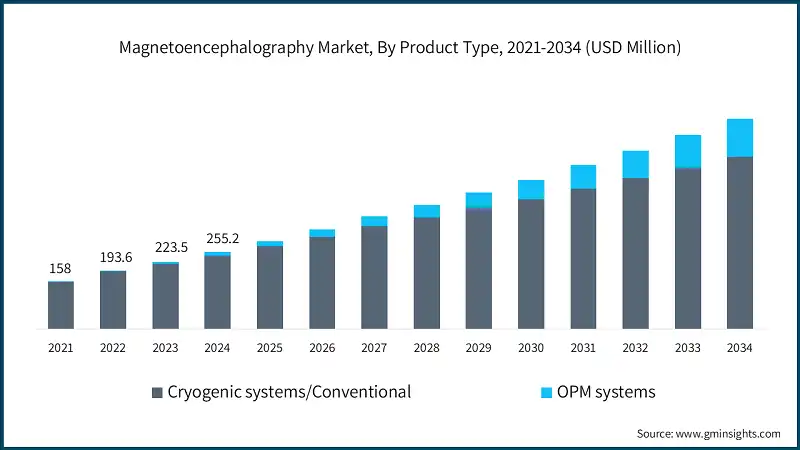
In 2021, the market was valued at USD 158 million and grew to USD 193.6 million in 2022, reaching USD 223.5 million by 2023. The increasing preference for non-invasive brain imaging for a wide range of neurological conditions is a key factor driving this growth.
Based on product type, the global magnetoencephalography market is segmented into cryogenic systems/conventional and OPM systems. The cryogenic systems/conventional segment accounted for a dominating share of over 95% in 2024. Conventional cryogenic cooling MEG systems are considered the gold standard in magnetoencephalography, thereby fueling the product demand. The segment is expected to exceed USD 569.8 million by 2034, growing at a CAGR of 8.5% during the forecast period.
- Traditional MEG systems utilize Superconducting Quantum Interference Devices (SQUIDs), which necessitate cryogenic cooling using liquid helium to sustain superconductivity. These systems demonstrate remarkable sensitivity and have been the trusted standard for imaging for several years.
- Additionally, they yield powerful signal-to-noise ratios and are common in hospitals and research labs for epilepsy mapping, brain tumor localization, and cognitive mapping.
- The OPM systems segment is anticipated to record a CAGR of 24.9% through 2034. OPM-based MEG systems are a next-generation technology in the neuroimaging space.
- In addition, the sensors created by OPMs work at room temperature, meaning cryogenic cooling is not needed and provide the option to create a wearable, potentially mobile MEG system.
- OPMs are lightweight and can be placed directly on the scalp, increasing resolution and enabling recordings while the participant is performing its natural movements. This is of particular interest for pediatric, ambulatory, and real-world cognitive assessments.
- Moreover, their portability and lower operational costs have significantly surged their acceptance in clinical and academic settings.
- Further, as technology strengthens, OPM systems will successfully democratize MEG access and generalize its availability to practice beyond a dedicated laboratory.
Based on application, the magnetoencephalography market is segmented into clinical and research. The clinical segment accounted for the majority market share of 65.6% in 2024 due to a growing target population coupled with increasing focus on early disease diagnosis.
- In the clinical field, MEG is primarily used to diagnose and manage neurological conditions, particularly epilepsy, brain tumors, and neurodegenerative disorders. MEG can localize altered brain function with millisecond precision, making it a valuable tool for presurgical planning for individuals with epilepsy who may qualify for resective surgical procedures.
- In the context of resective surgery, MEG is also utilized to map eloquent brain areas (e.g., areas of the brain responsible for language and movement) to reduce the risk of damaging these important regions.
- Lastly, MEG is gaining popularity among practitioners as a method of investigating Alzheimer’s disease, Parkinson’s disease, and traumatic brain injuries. MEG may be especially useful for young pediatric and older geriatric patients because it is non-invasive and can provide high temporal resolution.
- Research segment was valued at USD 87.8 million in 2024. MEG (magnetoencephalography) is a powerful method for cognitive and neuroscience researchers to evaluate how our brain processes information in real time. By using MEG, cognitive researchers address an array of topics, including sensory perception, attention, memory, language processing, and the connectivity of the brain and human development.
- Further, MEG is also showing potential in the new world of neurotechnology, and the development of human-computer applications and interfaces (BCI) formulations across the technological spectrum seems to be on the rise.
Learn more about the key segments shaping this market
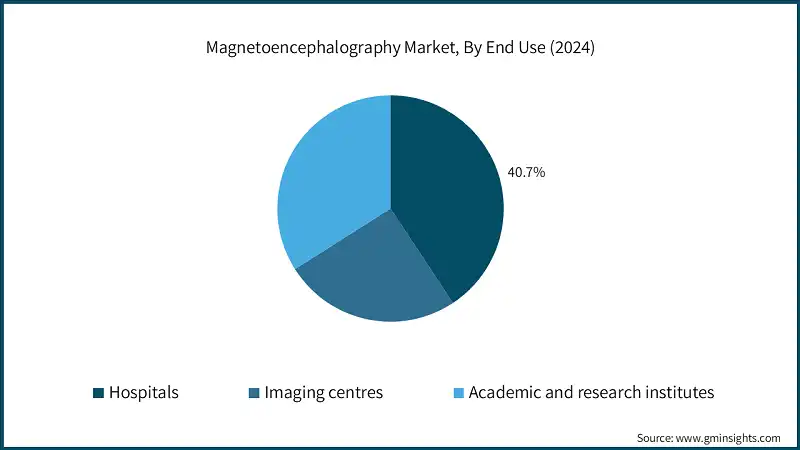
Based on end use, the magnetoencephalography market is segmented into hospitals, imaging centers, and academic and research institutes. The hospitals segment accounted for the majority market share of 40.7% in 2024 due to their ability to spend and install advanced systems with high cost factor.
- Hospitals, especially large, specialized care centers and institutions focused on neurology, primarily use MEG systems in their daily operations. Medical teams use MEG to plan surgeries, particularly for patients with epilepsy, helping them pinpoint seizure locations and understand important brain functions like speech and movement control.
- Additionally, as more people develop neurological conditions, hospitals increasingly need MEG's precise, non-invasive diagnostic capabilities.
- Academic and research institutions segment was valued at USD 86.7 million in 2024 and is projected to record healthy growth over the forecast period. These centers are at the forefront of MEG innovation and application. They use MEG to explore brain function, connectivity, and cognition in both healthy individuals and those with neurological or psychiatric conditions.
- Further, MEG’s high temporal resolution makes it ideal for studying real-time brain dynamics, such as sensory processing, attention, and language. Research institutes are also driving the development of next-generation MEG technologies, including wearable OPM-based systems and AI-driven data analysis tools.
Looking for region specific data?
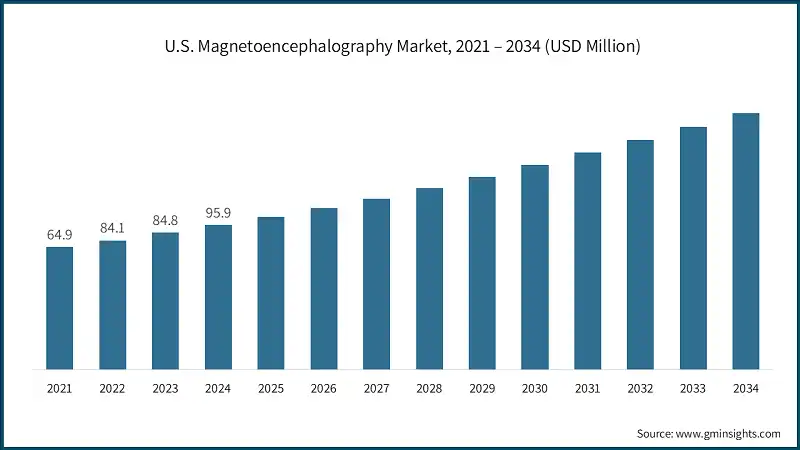
North America Magnetoencephalography Market North America accounted for the leading share of 39.5% in 2024 in the global magnetoencephalography industry and is anticipated to show lucrative growth over the forecast period. The U.S. magnetoencephalography market was valued at USD 64.9 million and USD 84.1 million in 2021 and 2022, respectively. In 2024 the market size was valued at USD 95.9 million from USD 84.8 million in 2023. The significant focus on early disease diagnosis from the local population due to high disease burden is a key variable in fueling the market growth. Europe market accounted for a substantial share in and was valued at USD 86.8 million in 2024. Germany held the leading share of the European magnetoencephalography market, showcasing strong growth potential. The Asia Pacific market for magnetoencephalography is anticipated to grow at the highest CAGR of 11.7% during 2025 to 2034. China magnetoencephalography market is estimated to grow at a notable CAGR in the Asia Pacific market. Leading companies operating in the market, such as MEGIN, Ricoh, and Compumedics Limited, among others, have a dominating presence in the industry. These players maintain their leading position by combining a strong product portfolio, regulatory clearances, wide distribution capability, and partnerships with healthcare providers. The competitive dynamics of the MEG market consist of a blended mix of established medical technology companies, niche neuroimaging companies, and academic start-ups. Traditional players are focused on producing cryogenic MEG systems utilizing SQUID sensors for ECoG and brain mapping clinical applications, as these systems are precise for their intended uses. New players are introducing systems based on OPM technology that are portable, wearable, and more affordable. These new companies collaborate with universities or research institutes to advance or develop sensors and software for data analysis. Furthermore, competition has grown significantly with respect to the integration of AI, cloud-based platforms, and multimodal imaging. As demand increases from hospitals and research institutions, companies have planned accordingly to differentiate their systems in regard to scalability, ease of use, and interoperability with existing neuroimaging capabilities. Few of the prominent players operating in the global magnetoencephalography industry include: MEGIN held a leading position in the magnetoencephalography market with a share of over 60% in 2024. MEGIN focuses on delivering end-to-end MEG solutions for hospitals and research institutions. Their strategy includes global expansion, full-service support, and continuous innovation in hardware and software. They emphasize clinical integration, training, and regulatory compliance to strengthen MEG adoption and improve standards in functional brain mapping. Ricoh is advancing MEG through miniaturization and portability, aiming to make systems more accessible and flexible. Their strategy involves integrating MEG with other imaging modalities like MRI and PET to enhance diagnostic precision. Ricoh targets broader clinical and research applications by developing compact, high-sensitivity MEG devices. Compumedics is expanding its MEG footprint with its Orion LifeSpan system, featuring dual-helmet hyperscanning for simultaneous neuroimaging of two subjects. Their strategy includes targeting academic centers of excellence, especially in China, and leveraging high-profile installations to drive further sales and establish global reference sites.Europe Magnetoencephalography Market
Asia Pacific Magnetoencephalography Market
Magnetoencephalography Market Share
Magnetoencephalography Market Companies
Magnetoencephalography Industry News:
The global magnetoencephalography market research report includes an in-depth coverage of the industry with estimates and forecasts in terms of revenue in (USD Million) and volume (Units) from 2021 - 2034 for the following segments:
Market, By Product Type
- Cryogenic Systems/Conventional
- OPM Systems
Market, By Application
- Clinical
- Epilepsy
- Autism
- Dementia
- Stroke
- Traumatic brain injury (TBI)
- Other applications
- Research
Market, By End Use
- Hospitals
- Imaging centers
- Academic and research institutes
The above information is provided for the following regions and countries:
- North America
- U.S.
- Canada
- Europe
- Germany
- UK
- France
- Asia Pacific
- China
- Japan
- Rest of the world
Frequently Asked Question(FAQ) :
What is the growth outlook for OPM systems from 2025 to 2034?
OPM systems are projected to grow at a CAGR of 24.9% through 2034, due to room-temperature operation, portability, and lower operational costs.
Which region leads the magnetoencephalography market?
North America held 39.5% share in 2024. Well-developed healthcare infrastructure and strong research capabilities fuel the region's dominance.
What are the upcoming trends in the magnetoencephalography market?
Key trends include adoption of portable and wearable MEG systems, AI-driven automated analysis, integration with multimodal imaging (MRI, fMRI, PET), and expansion into personalized medicine applications.
Who are the key players in the magnetoencephalography market?
Key players include Cerca Magnetics Limited, Compumedics Limited, CTF MEG NEURO INNOVATIONS, INC., FieldLine Inc., MAG4Health, MEGIN, and Ricoh.
What was the valuation of the clinical application segment in 2024?
The clinical segment held 65.6% market share in 2024, driven by growing target population and increasing focus on early disease diagnosis.
How much revenue did the cryogenic systems/conventional segment generate in 2024?
Cryogenic systems/conventional segment held over 95% market share in 2024.
What is the current magnetoencephalography market size in 2025?
The market size is projected to reach USD 290.7 million in 2025.
What is the projected value of the magnetoencephalography market by 2034?
The magnetoencephalography market is expected to reach USD 696.7 million by 2034, propelled by innovations like wearable sensors, AI-enhanced analysis, and growing demand for non-invasive brain imaging.
What is the market size of magnetoencephalography in 2024?
The market size was USD 255.2 million in 2024, with a CAGR of 10.2% expected through 2034 driven by rising neurological disorder cases, expanding clinical and research applications, and rapid technological advancements.
Magnetoencephalography Market Scope
Related Reports