Summary
Table of Content

Magnesium Nitrate Market
Get a free sample of this report
Form submitted successfully!
Error submitting form. Please try again.
Thank you!
Your inquiry has been received. Our team will reach out to you with the required details via email. To ensure that you don't miss their response, kindly remember to check your spam folder as well!
Request Sectional Data
Thank you!
Your inquiry has been received. Our team will reach out to you with the required details via email. To ensure that you don't miss their response, kindly remember to check your spam folder as well!
Form submitted successfully!
Error submitting form. Please try again.
Magnesium Nitrate Market Size
- Between 2022 and 2023, the magnesium nitrate market gained renewed traction as global agriculture rebounded from pandemic‑era slowdowns. FAO fertilizer trade data reflected increased demand across Asia and Latin America, owing to heightened crop‑yield optimization programs. Industrial utilization also recovered steadily, particularly in pyrotechnics, ceramics, and wastewater treatment, stabilizing overall consumption trends.
- In 2023, producers recognized the growing necessity for sustainable raw‑material sourcing and greener production routes. European manufacturers introduced low‑emission nitric‑acid processes, aligning with tightening EU carbon‑reduction targets. Meanwhile, Asian suppliers benefited from competitive costs and increased fertilizer exports. This dual dynamic underpinned a gradual shift toward cleaner, more regionally balanced magnesium nitrate production chains.
- By 2024, the market displayed balanced growth as modern agricultural practices expanded globally. OECD data noted incremental rises in fertilizer application rates across developing nations. Industrial players focused on digital monitoring for precise nutrient formulations, ensuring quality control and reduced nitrogen losses—key steps reinforcing magnesium nitrate’s reputation as an efficient and environmentally adaptive fertilizer solution.
- Heading into 2025, magnesium nitrate continues on a moderate upward trajectory, supported by its broad utility in agriculture, catalysis, and specialty chemicals. Sustainability‑driven innovations, coupled with steady fertilizer demand from Asia‑Pacific, sustain optimism. The sector exemplifies how precision agriculture, circular chemistry, and supportive policy frameworks converge to drive long‑term market resilience and efficiency.
The global magnesium nitrate market was valued at USD 561.1 million in 2025. The market is expected to grow from USD 579.3 million in 2026 to USD 815.7 million in 2035, at a CAGR of 4% according to latest report published by Global Market Insights Inc.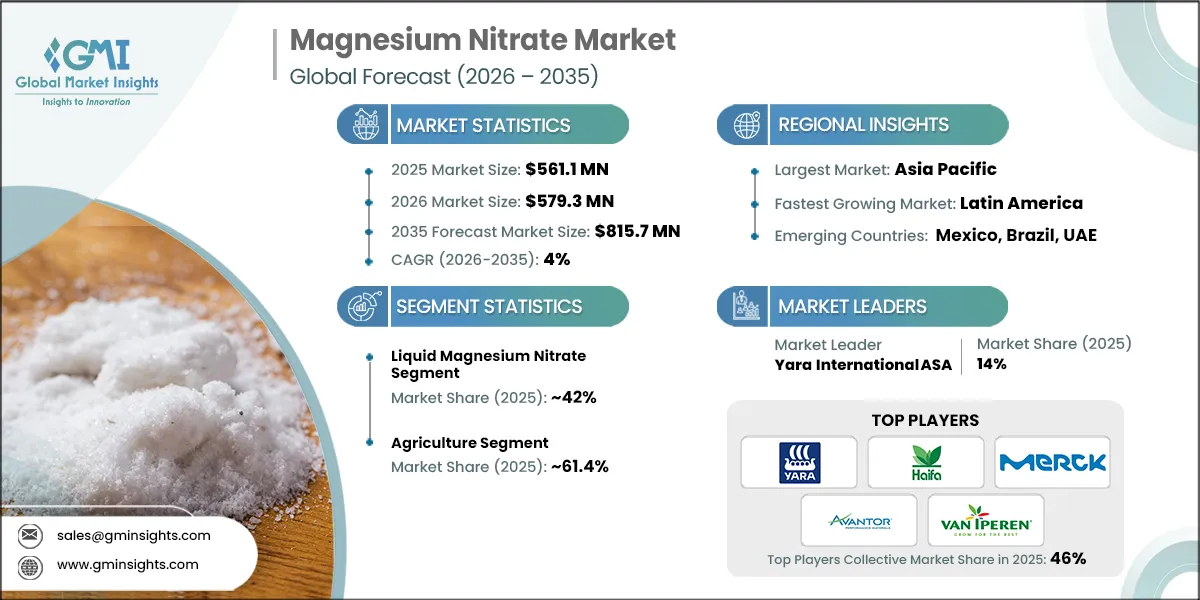
Magnesium Nitrate Market Key Takeaways
Market Size & Growth
- 2025 Market Size: USD 561.1 Million
- 2026 Market Size: USD 579.3 Million
- 2035 Forecast Market Size: USD 815.7 Million
- CAGR (2026–2035): 4%
Regional Dominance
- Largest Market: Asia Pacific
- Fastest Growing Region: Latin America
Key Market Drivers
- Growing adoption in high‑yield precision farming.
- Expanding role in wastewater treatment solutions.
- Rising demand from pyrotechnic manufacturing sector.
Challenges
- Dependence on ammonia and nitric acid supply.
- Stringent environmental regulations on nitrate emissions.
Opportunity
- Shift toward organic and eco‑balanced fertilizers.
- New production capacities in developing economies.
Key Players
- Market Leader: Yara International ASA led with over 14% market share in 2025.
- Leading Players: Top 5 players in this market include Yara International ASA, Haifa Mexico Ltd., Merck KGaA, Avantor Performance Materials Inc., Van Iperen International B.V., which collectively held a market share of 46% in 2025.
Get Market Insights & Growth Opportunities
To get key market trends
Magnesium Nitrate Market Trends
- Shift Toward Liquid Fertilizer Integration Liquid magnesium nitrate formulations are witnessing increased traction due to ease of mixing, rapid leaf absorption, and compatibility with drip‑irrigation systems. Producers such as Yara International have expanded smart‑liquid nutrient product lines to support precision agriculture. This segment’s appeal lies in uniform nutrient distribution, controlled application rates, and alignment with sustainable farming practices emphasizing water‑efficient fertilizer use.
- Rising Popularity of Powder Variants Powder‑form magnesium nitrate continues to dominate controlled‑feed and industrial applications. Its solubility advantages make it a favored input for specialty fertilizers and pyrotechnic blends. Companies like Haifa Chemicals are optimizing micro‑powder granulation to enhance reactivity and prevent caking during storage. The powder market remains crucial for manufacturers prioritizing high‑purity, easily transportable nitrate sources.
- Expanding Use of Granular Grades Granular magnesium nitrate is gaining relevance among bulk fertilizer blenders focusing on cost‑efficient field applications. Producers in India and Southeast Asia are adopting automated prilling technology to ensure consistent particle size for uniform nutrient release. Granular form facilitates mechanical spreading, improves soil stability in varied terrain, and strengthens global supply for large‑scale agricultural operations.
- Technological Advancements in Material Handling Across all forms—liquid, powder, and granular—manufacturers are investing in modern packaging, anti‑moisture coatings, and low‑dust handling technologies. These upgrades minimize material loss and extend shelf life. For instance, Deepak Nitrite introduced sealed high‑density storage solutions in 2024, improving product safety and logistics efficiency for export markets under humid or long‑distance transportation conditions.
Magnesium Nitrate Market Analysis
Learn more about the key segments shaping this market
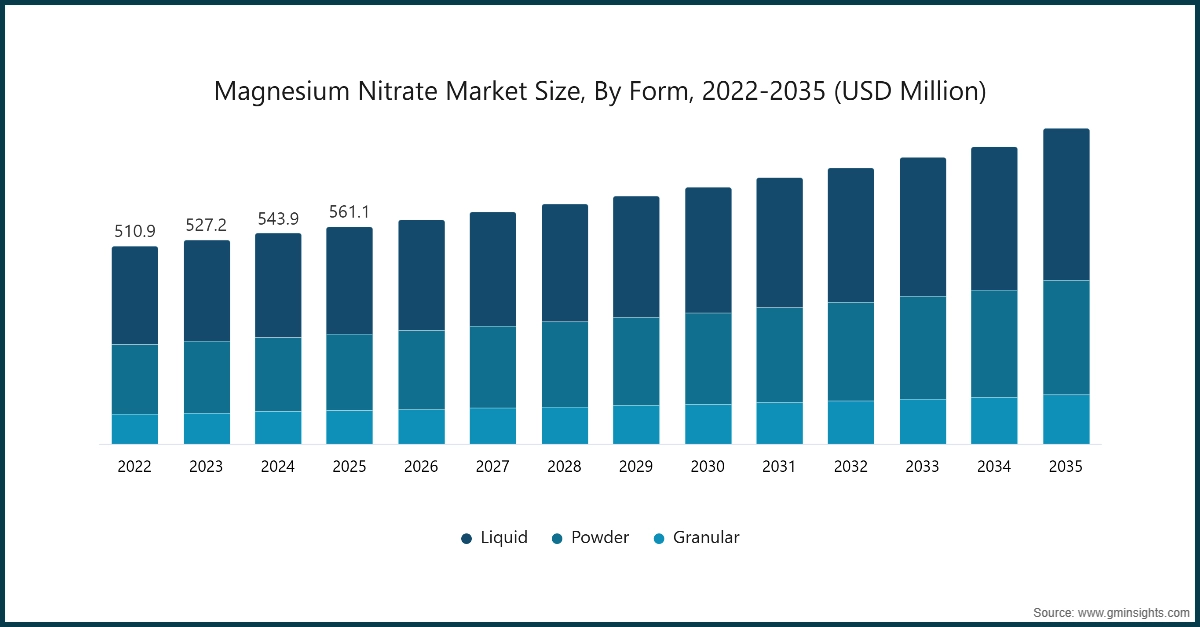
Based on form, the market is segmented into liquid, powder, and granular. Liquid magnesium nitrate dominated the market with an approximate revenue share of 42% in 2025 and is projected to grow at a CAGR of 4.2% by 2035, primarily driven by its superior solubility, uniform application efficiency, and rising adoption in precision farming and fertigation systems across major agricultural regions.
- The magnesium nitrate market across liquid, powder, and granular forms is showcasing a unified growth trend, fueled by demand for flexible fertilizer solutions and industrial adaptability. Widespread precision‑farming adoption favors liquid variants for efficient irrigation integration, while powder and granular forms remain vital for high‑purity nutrient blending, bulk fertilization, and ease of transportation in varying climatic zones.
- Producers are increasingly investing in formulation efficiency and material‑handling technologies to enhance solubility, reduce moisture absorption, and extend storage life across all forms. Innovations in automated mixing, anti‑dust granulation, and sealed packaging strengthen performance consistency. Collectively, the form‑based segment advances toward streamlined performance, higher safety standards, and lowered environmental impact, supporting long‑term agricultural and industrial sustainability.
Learn more about the key segments shaping this market
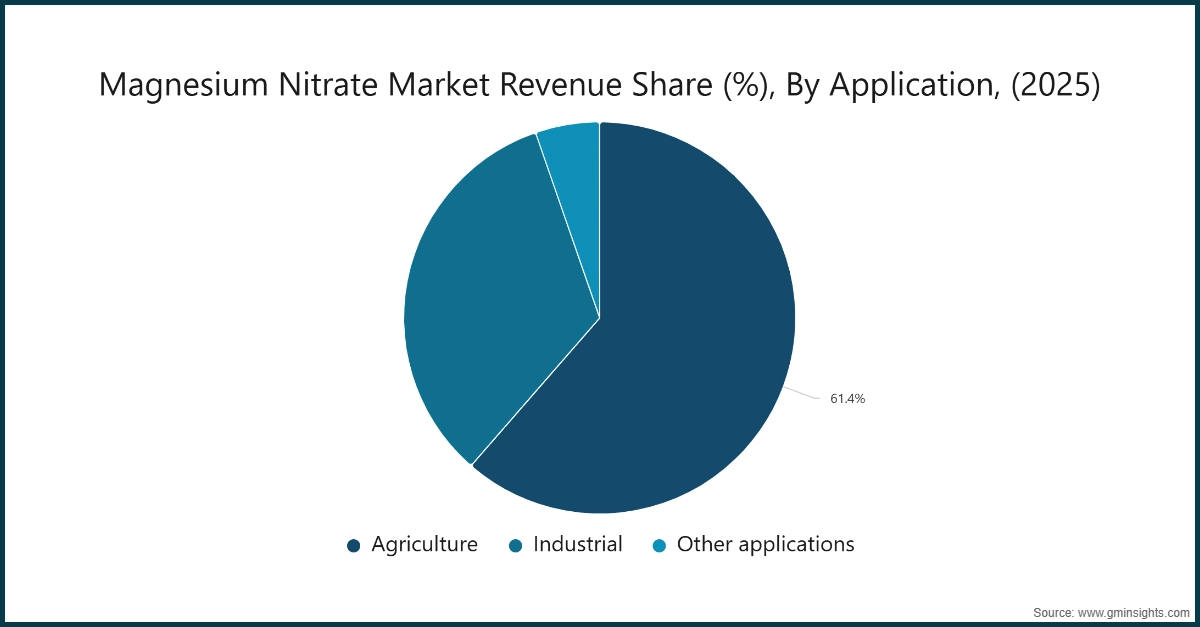
Based on applications, the market is segmented into agriculture, industrial, and other applications. The agriculture segment held the largest share of about 61.4% in 2025 and is expected to expand at a CAGR of 4.3% by 2035, owing to increasing fertilizer demand, nutrient‑balanced soil enhancement practices, and wider acceptance of water‑soluble magnesium nitrate in high‑value crop cultivation.
- The magnesium nitrate market across agriculture, industrial, and other emerging applications presents a cohesive trajectory shaped by technology advancement and sustainability trends. In agriculture, usage spans fertilizer blends, foliar sprays, and soil conditioners that enhance crop yields and nutrient absorption. Growing emphasis on precision farming, sustainable soil health, and climate‑smart fertilizers continues to push fertilizer‑grade magnesium nitrate adoption globally.
- Industrial utilization in pyrotechnics, petrochemical catalysts, and specialty chemical intermediates complements agricultural demand, while water treatment and pharmaceutical synthesis represent emerging diversification areas. With stakeholders prioritizing product purity, controlled reactivity, and eco‑efficiency, the application segment’s collective outlook integrates steady technological upgrades, supply‑chain flexibility, and consistent demand across both mature and developing markets worldwide.
Looking for region specific data?
North America represents a robust share of the global magnesium nitrate market, increasing from USD 146.2 million in 2025 to USD 214.2 million in 2035, driven mainly by advanced fertilizer technologies and steady industrial chemicals demand, expanding at a CAGR of 4%. Rising adoption of precision agriculture and stringent environmental guidelines encourage sustainable nitrate‑based formulations across the region.
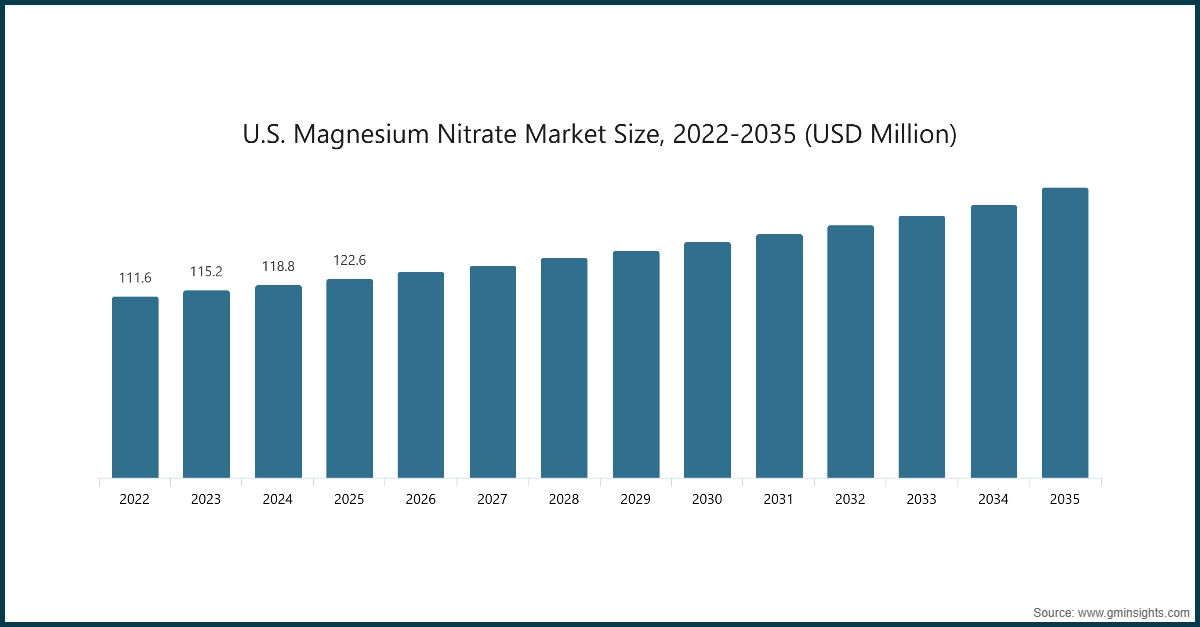
- United States: The United States is the most significant contributor to North America’s growth. Supported by strong agrochemical innovation and a mature industrial infrastructure, it maintains consistent fertilizer production while advancing emission‑reduction compliance through high‑efficiency nitric acid processes and modern waste‑management systems.
Europe’s magnesium nitrate market is projected to increase from USD 128.2 million in 2025 to USD 182.3 million in 2035, mainly influenced by environmental regulation, agriculture modernization, and adoption of nitrate‑based foliar nutrition. The CAGR of 3.6% reflects balanced growth supported by rising investment in low‑carbon fertilizer technologies and enhanced waste‑recycling systems across EU member states.
- Germany: Germany is a key market in Europe’s magnesium nitrate landscape. With continuous research into controlled‑release fertilizers and nitrate‑synthesis efficiency, it remains focused on clean technology integration and production optimization, ensuring sustainable agricultural and industrial supply chains.
Asia Pacific dominates the global magnesium nitrate market in value, increasing from USD 236.5 million in 2025 to USD 347.9 million in 2035, primarily driven by expanding agricultural activity, government investments in fertilizer capacity, and industrial diversification across China and India, with a CAGR of 4%..
- China: China holds the largest share within Asia Pacific’s market. Aggressive manufacturing scale‑ups, widespread adoption of precision fertilization, and state‑backed environmental compliance programs strengthen its leadership, ensuring long‑term supply stability and competitive export capability across Asian fertilizer markets.
Latin America’s market is forecasted to rise rapidly from USD 27.6 million in 2025 to USD 37.6 million in 2035, primarily fueled by growing fertilizer usage in key crop‑producing economies and emerging local nitrate manufacturing initiatives. The market maintains a steady expansion pattern with a CAGR of 6%, emphasizing agricultural self‑sufficiency and cost‑efficient production networks.
- Brazil: Brazil leads the Latin American magnesium nitrate consumption due to its high agricultural output. Increasing soybean and sugarcane cultivation fuels fertilizer integration, while ongoing partnerships with multinational suppliers improve product availability and technology transfer for enhanced soil health management.
MEA’s magnesium nitrate market is gradually expanding from USD 22.6 million in 2025 to USD 33.7 million in 2035, driven by diversification of petrochemical industries and improving agricultural infrastructure, with a healthy CAGR of 4.1%—among the most dynamic regional growth rates. Renewable‑energy integration and resource‑efficient fertilizer production shape the region’s forward outlook.
- Saudi Arabia: Saudi Arabia anchors MEA’s sodium nitrate and magnesium nitrate activities. Strong petrochemical integration, government‑led industrial diversification, and rising agricultural‑sector investment are positioning the country as a growing production and distribution hub for nitrate‑based fertilizers.
Magnesium Nitrate Market Share
Yara International ASA, Haifa Mexico Ltd., Merck KGaA, Avantor Performance Materials Inc., and Van Iperen International B.V., together accounting for about 47% of total market share. These companies dominate through advanced chemical processing, global distribution efficiencies, and sustainability‑driven fertilization technologies. Continuous R&D investment in precision agriculture, enhanced water‑soluble fertilizer formulations, and emission control ensures steady competitiveness across both developed and emerging regions.
- Yara International ASA: Holding approximately 14% share, Yara International leads the global magnesium nitrate space with extensive fertilizer production capacity and strong R&D capabilities. The company’s focus on crop‑specific nutrient formulations and sustainable farming has strengthened its leadership. In 2024, Yara expanded its smart‑fertilizer program across Asia, integrating AI‑based agronomic monitoring for enhanced efficiency and environmental responsibility.
- Haifa Mexico Ltd.: Possessing around 11% of the global market, Haifa Mexico is recognized for its high‑grade nitrate fertilizers and water‑soluble nutrient solutions. The company’s 2024 introduction of advanced micronutrient blends boosted its Latin American presence. Haifa’s emphasis on fertigation compatibility and superior nitrate purity enables farmers to achieve precision feeding and sustainable soil health improvements.
- Merck KGaA: With a 9% share, Merck KGaA maintains a strong industrial and specialty‑chemical presence in magnesium nitrate supply. Leveraging chemical precision and advanced production capability, it services electronics and pharmaceutical intermediates in addition to fertilizer sectors. Recent investments in greener nitric‑acid derivatives have aligned Merck’s portfolio with decarbonization goals and future‑ready chemical solutions.
- Avantor Performance Materials Inc.: Holding nearly 7% of market share, Avantor supports a growing footprint through high‑purity nitrate compounds used in laboratory, medical, and agrochemical settings. Its U.S. facility upgrades in 2024 focused on sustainability compliance and increased production reliability. Avantor’s commitment to quality assurance and vertical integration ensures stability within high‑specification industrial nitrates.
- Van Iperen International B.V.: With approximately 6% share, Van Iperen International distinguishes itself through innovation in water‑soluble fertilizers tailored for horticulture and intensive crop farming. Its “GreenSwitch®” nitrate initiative launched in 2023 accelerates renewable nutrient development by converting organic nitrogen into mineral nitrate, reinforcing the company’s sustainable fertilizer leadership across Europe and Asia.
Magnesium Nitrate Market Companies
Major players operating in the magnesium nitrate industry include:
- Yara International
- American Elements
- Avantor Performance Materials
- AKO Kasei Co. Ltd.
- Spectrum Chemical Manufacturing
- GFS Chemicals
- Haifa Mexico
- Merck KGaA
- Neochim PLC
- Rongyu Chemical Co. Ltd.
- Spectrum Chemical Manufacturing
- Thermo Fisher Scientific India Private Limited
- Van Iperen International
- Vishnupriya Chemicals Private Limited
- William Blythe
Magnesium Nitrate Market Report Attributes
| Key Takeaway | Details |
|---|---|
| Market Size & Growth | |
| Base Year | 2025 |
| Market Size in 2025 | USD 561.1 Million |
| Market Size in 2026 | USD 579.3 Million |
| Forecast Period 2026-2035 CAGR | 4% |
| Market Size in 2035 | USD 815.7 Million |
| Key Market Trends | |
| Drivers | Impact |
| Growing adoption in high‑yield precision farming | Strengthens agricultural productivity and global food security |
| Expanding role in wastewater treatment solutions | Enhances industrial sustainability and nitrogen management |
| Rising demand from pyrotechnic manufacturing sector | Supports specialty chemical diversification and steady growth |
| Pitfalls & Challenges | Impact |
| Dependence on ammonia and nitric acid supply | Creates production vulnerability and price fluctuation risks |
| Stringent environmental regulations on nitrate emissions | Imposes compliance costs and limits rapid capacity expansion |
| Opportunities: | Impact |
| Shift toward organic and eco‑balanced fertilizers | Opens innovation pathways for greener nutrient formulations |
| New production capacities in developing economies | Expands regional supply stability and export competitiveness |
| Market Leaders (2025) | |
| Market Leader |
Market Share-14% |
| Top Players |
Collective Market Share of 46% in 2025 |
| Competitive Edge |
|
| Regional Insights | |
| Largest Market | Asia Pacific |
| Fastest growing market | Latin America |
| Emerging countries | Mexico, Brazil, UAE |
| Future outlook |
|
What are the growth opportunities in this market?
Magnesium Nitrate Industry News
- In May 2025, Yara International ASA unveiled its “Smart Nutrients” platform integrating AI‑driven crop analysis with precision application of water‑soluble magnesium nitrate fertilizers, significantly enhancing nitrogen‑use efficiency and supporting Yara’s long‑term strategy for low‑emission, high‑yield fertilizer solutions in emerging markets.
- In September 2024, Haifa Mexico Ltd. expanded its Monterrey production unit with advanced evaporation and granulation technology, increasing magnesium nitrate output capacity by 15%. This strategic step improved product accessibility across the Americas and strengthened Haifa’s sustainable specialty‑fertilizer supply network.
- In March 2024, Merck KGaA introduced a new line of eco‑efficient nitrate compounds under its GreenLab Chemicals portfolio. This range includes optimized magnesium nitrate grades with reduced carbon intensity, aligning with the company’s broader climate‑neutral manufacturing objectives and expanded industrial‑chemical applications.
- In December 2023, Avantor Performance Materials Inc. completed upgrades at its Pennsylvania facility, focusing on nitrate purification and closed‑loop water recycling systems. The development improved operational sustainability and positioned Avantor as a key supplier for high‑purity magnesium nitrate across laboratory, semiconductor, and fertilizer‑grade markets.
This magnesium nitrate market research report includes in-depth coverage of the industry, with estimates & forecasts in terms of revenue (USD Million) and volume (Kilo Tons) from 2026 to 2035, for the following segments:
Market, By Form
- Liquid
- Powder
- Granular
Market, By Application
Agriculture
- Fertilizer blends (NPK, specialty fertilizers)
- Foliar sprays and soil conditioners
- Crop yield improvement and soil health
- Others
- Industrial
- Pyrotechnics and explosives manufacturing
- Petrochemical catalysts
- Chemical intermediates production
- Others
- Other applications
- Water treatment chemicals
- Pharmaceutical intermediates
The above information is provided for the following regions and countries:
- North America
- U.S.
- Canada
- Europe
- Germany
- UK
- France
- Spain
- Italy
- Rest of Europe
- Asia Pacific
- China
- India
- Japan
- Australia
- South Korea
- Rest of Asia Pacific
- Latin America
- Brazil
- Mexico
- Argentina
- Rest of Latin America
- Middle East and Africa
- Saudi Arabia
- South Africa
- UAE
- Rest of Middle East and Africa
Frequently Asked Question(FAQ) :
What is the market size of the magnesium nitrate in 2025?
The global market size was USD 561.1 million in 2025, with a CAGR of 4% expected through 2035 supported by growing adoption in precision farming and fertigation systems.
What is the projected value of the magnesium nitrate industry by 2035?
The magnesium nitrate market is expected to reach USD 815.6 million by 2035, driven by expanding fertilizer demand, precision agriculture adoption, sustainability-driven innovations, and rising industrial applications in catalysis and specialty chemicals.
What is the current magnesium nitrate market industry in 2026?
The market size is projected to reach USD 579.3 million in 2026.
Which form segment dominates the magnesium nitrate market?
Liquid magnesium nitrate dominated the market with an approximate revenue share of 42% in 2025, projected to grow at a CAGR of 4.2% through 2035, driven rising adoption in precision farming and fertigation systems.
Which application segment leads the magnesium nitrate market?
Agriculture held the largest application segment with about 61.4% market share in 2025, owing to increasing fertilizer demand.
Which region leads magnesium nitrate market?
Latin America’s market is projected to grow from USD 27.6 million in 2025 to USD 37.6 million by 2035, driven by rising fertilizer demand in major crop-producing countries.
What are the key trends shaping the magnesium nitrate market?
Key trends include rising adoption of liquid fertilizers for precision farming and drip irrigation, growing use of powder forms in industrial applications, and advancements in moisture-resistant storage and handling solutions.
Who are the key players in the magnesium nitrate market?
Key players include Yara International, American Elements, Avantor Performance Materials, AKO Kasei Co. Ltd., Spectrum Chemical Manufacturing, GFS Chemicals, Haifa Mexico, Merck KGaA, Neochim PLC.
Magnesium Nitrate Market Scope
Related Reports