Summary
Table of Content

Luxury Vacation Rental Market
Get a free sample of this report
Form submitted successfully!
Error submitting form. Please try again.
Thank you!
Your inquiry has been received. Our team will reach out to you with the required details via email. To ensure that you don't miss their response, kindly remember to check your spam folder as well!
Request Sectional Data
Thank you!
Your inquiry has been received. Our team will reach out to you with the required details via email. To ensure that you don't miss their response, kindly remember to check your spam folder as well!
Form submitted successfully!
Error submitting form. Please try again.
Luxury Vacation Rental Market Size
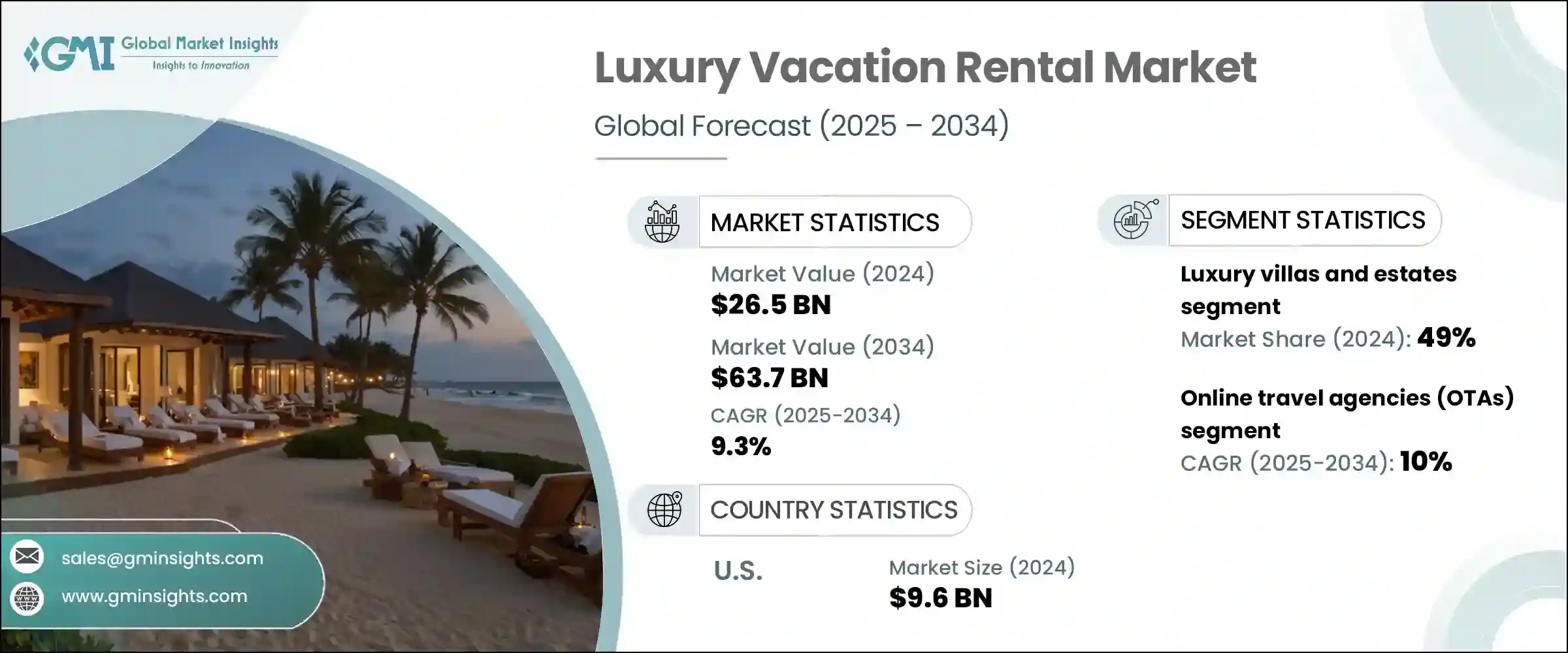
The global luxury vacation rental market size was estimated at USD 26.5 billion in 2024. The market is expected to grow from USD 28.5 billion in 2025 to USD 63.7 billion in 2034, at a CAGR of 9.3%.
Luxury Vacation Rental Market Key Takeaways
Market Size & Growth
- 2024 Market Size: USD 26.5 Billion
- 2034 Forecast Market Size: USD 63.7 Billion
- CAGR (2025–2034): 9.3%
Key Market Drivers
- Growing demand for privacy, space, and personalization.
- Increased popularity of experiential and immersive travel.
- Digital booking transformation and platform expansion.
- Remote work and extended stays.
- Growing influence of special occasions and multi-generational travel.
Challenges
- High operating and maintenance costs.
- Intense competition and commission wars.
Opportunity
- Integration of AI for personalized guest experiences.
- Expansion into emerging luxury destinations.
- Partnerships with experienced providers and local hosts.
- Sustainability-focused property features.
Key Players
- Market Leader: Airbnb Luxe led with over 28% market share in 2024.
- Leading Players: Top 5 players in this market include Airbnb Luxe, Luxury Retreats, Plum Guide, Rental Escapes, VRBO, which collectively held a market share of 39% in 2024.
Get Market Insights & Growth Opportunities
- The luxury vacation rental industry is rapidly evolving into a core segment of premium travel. As affluent travelers seek more personalized, private, and seamless experiences, the focus is shifting from just high-end properties to complete, curated guest journeys. This transformation is turning luxury rentals into strategic assets for brands targeting the modern high-end traveler.
- The evolving expectations of affluent travelers are reshaping the definition of Global customers today want highly customized, on-demand experiences like private chefs, carefully planned local tours, and wellness services, in addition to luxurious furnishings and stunning views. Travelers are prioritizing space, safety, and exclusivity as global mobility picks back up, which is pushing up reservations for independent villas, luxurious chalets, and luxury residences in popular vacation spots and luxury residences in popular vacation spots.
- The luxury vacation rental market was valued at USD 22.2 billion in 2021 and is projected to reach over USD 43 billion by 2030. Due to shifting lifestyles and the emergence of digital-first luxury services, high-income tourists are increasingly demanding private, customized, and experience-driven stays.
- Post-pandemic, the luxury vacation rental market saw a strong shift toward privacy, contactless services, and personalized amenities. Investors focused on high-end properties with smart home tech and enhanced hygiene. By 2024, many rentals adopted custom service models, aligning with travelers' demand for exclusivity, safety, and flexibility, boosting market resilience.
- Technology is playing a critical role in scaling luxury rentals while preserving the bespoke feel. Prominent platforms such as Inspirato, Onefinestay, and Plum Guide are making significant investments in AI-powered concierge capabilities, guest experience layers, and screening procedures. In February 2024, Villaway, a luxury rental website, introduced an AI-enhanced marketplace, incorporating selected villa listings and an AI-driven concierge to offer round-the-clock individualized guest service.
- Luxury travel has clearly changed due to remote work and "workations," with wealthy people looking for longer trips that strike a mix between comfort and efficiency. These days, families seek for rentals with home offices, private pools, and fast Wi-Fi. In June 2024, Onefinestay's expansion to more than 40 international locations reflected the rising demand for luxurious houses that seem like second homes.
- North America continues to lead the luxury vacation rental market, fueled by robust demand and well-established travel hubs. In May 2025, Casago's successful acquisition of Vacasa demonstrated their strong belief in high-end rentals throughout the continent. This action reflects an increasing level of operator and investor confidence in the private, high-touch stays that affluent tourists now want.
- Asia-Pacific is the fastest-growing region in the luxury vacation rental market, fueled by rising affluence, digital adoption, and tourism development. High-net worth tourists looking for exclusive, intimate experiences are drawn to countries like Thailand, Indonesia, and the Philippines due to their investments in first-rate travel infrastructure.
To get key market trends
Luxury Vacation Rental Market Trends
- In early 2024, large luxury vacation rental websites, such as Airbnb Luxe and Plum Guide, started implementing cutting-edge revenue-maximizing dynamic pricing systems to ensure maximum occupancy. This action emphasizes a wider change in the industry, with a focus on personalization based on data and advanced revenue management where investors focus on properties that can scale to changing approaches to pricing.
- An increased number of investors and developers are currently catering to the needs of smart luxury rentals featuring the global IoT solution, contactless guest service procedures, and energy-saving systems. These are technically advanced features that by 2027 are likely to become normal offerings that are likely to streamline operations, simplify guest conveniences, and increase the long-run value on high-end properties assets as rentals.
- The need to be healthy and to be environmentally friendly are some of the aspects that have made wellness and sustainability pillars in the development of luxury vacation rentals as more customers desire to visit eco-friendly villas and experience health products. Larger investment decisions are also being influenced by certifications because of the growing desire to invest in assets that meet targets of environmental and social responsibility, and this impact is likely to be felt further on until 2030.
- Luxury vacation rentals are evolving beyond upscale interiors to offer personalized, experience-driven stays. Curated services like private chefs, VIP access, and guided tours are becoming the norm. For instance, in May 2025, Airbnb Luxe partnered with the Tour de France to offer exclusive race-day access and private cycling tours, blending comfort with immersive travel.
- Luxury stays are shifting toward personalized, experience-focused travel. Guests now seek tailored services like VIP access, private chefs, and curated tours. In May 2025, Airbnb Luxe partnered with the Tour de France to offer exclusive race-day experiences, highlighting the fusion of luxury and immersive travel.
- Eco-luxury is now a key expectation in premium travel, with upscale guests seeking environmentally responsible stays focused on waste reduction and energy efficiency. For instance, in April 2025, Soneva Maldives cut diesel use by two million liters annually through renewable energy, showcasing the growing importance of sustainable practices.
Luxury Vacation Rental Market Analysis
Learn more about the key segments shaping this market
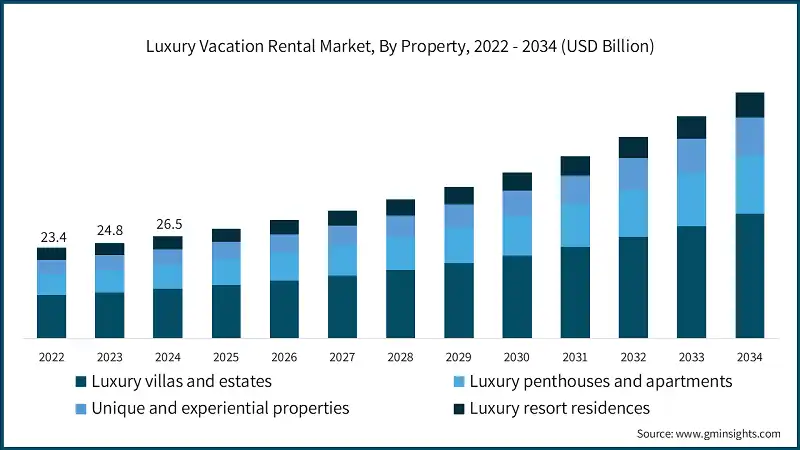
Based on property, the luxury vacation rental market is divided into luxury villas and estates, luxury penthouses and apartments, unique and experiential properties, and luxury resort residences. The luxury villas and estates segment dominated the luxury vacation rental market accounting for around 49% in 2024 and is expected to grow at a CAGR of around 10% from 2025 to 2034.
- Luxury villas and estates led the luxury vacation rental market in 2024, accounting for a significant share of overall bookings and investment interest. The combination of privacy, scalability, and exclusivity is what makes them so appealing to families, intergenerational groups, and wealthy distant workers. They are the standard for upscale short-term housing with their spacious designs, private pools, and customized experiences.
- Luxury penthouses and apartments are gaining traction in major urban markets with a CAGR of over 9%, offering high-end design, premium amenities, and strategic proximity to business and cultural hubs. These accommodations are especially well-liked for short-term metropolitan stays and executive travel. In March 2024, the demand for Plum Guide's city-based rentals in London, New York, and Paris increased by 30%, indicating a trend for well chosen, hotel-alternative urban accommodation.
- Luxury villas and estates remain the leading segment, favored for their space, privacy, and high-touch services. Because of their popularity for longer stays, group travel, and customized experiences, villas often surpass Luxury penthouses, Unique and experiential properties, and Luxury resort residences, even if these accommodations are becoming more popular. This market segment continues to set the standard in the luxury rental industry as traveler expectations change toward exclusivity and independence.
- For instance, in May 2024, Rental Escapes introduced a concierge digital platform to customize villa vacations with options like yacht charters and private chefs. The brand simplified luxury at scale by customizing experiences to guest preferences, demonstrating how technology is making villas feel both opulent and effortless.
- The top three segments luxury villas and estates, luxury penthouses and apartments, unique and experiential properties collectively account for over 87% of the luxury vacation rental market, indicating a highly consolidated structure. These categories drive niche or slower-moving areas like shared or unbranded rentals to the periphery by satisfying the fundamental needs of privacy, premium service, and location.
Learn more about the key segments shaping this market
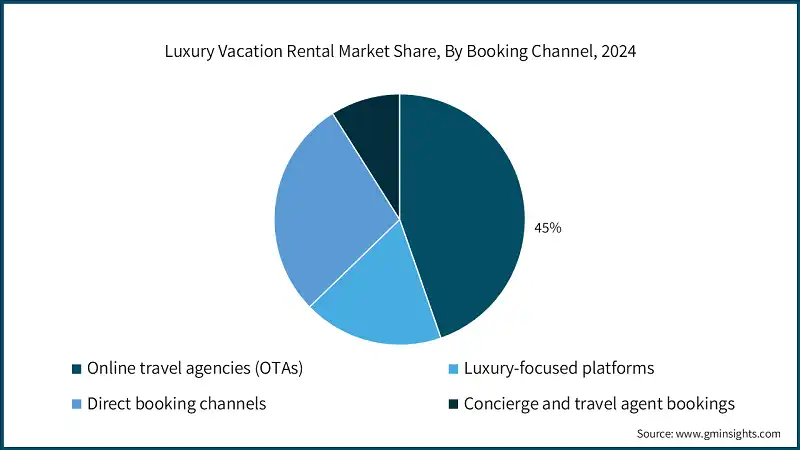
Based on booking channel, the luxury vacation rental market is segmented into online travel agencies (OTAs), luxury-focused platforms, direct booking channels, and concierge and travel agent bookings. The Online travel agencies (OTAs) segment dominates the market with 45% share in 2024, and the segment is expected to grow at a CAGR of around 10% from 2025 to 2034.
- Online travel agencies (OTAs) are now the leading booking channel in the luxury vacation rental market, offering ease, global reach, and strong brand trust. For instance, in October 2024, Onefinestay, Accor’s luxury rental brand, was recognized by Conde Nast Traveller for its curated villas and seamless booking experience, blending high-end service with digital convenience.
- Online travel agencies enrich the visitors by means of AI-based suggestions, intelligent filtering, and instant bookings to assist tourists in getting high-end rentals that they require. Included addons such as concierge services, free cancellations, and safe payments contribute to the levels of trust and convenience, strengthening OTAs as a booking option of choice.
- Direct booking is rising in the luxury vacation rental market with a CAGR of around 9% as owners seek stronger guest relationships and higher profits by avoiding third-party fees. With growing demand for authenticity, many are investing in user-friendly websites, loyalty programs, and concierge services to enhance the guest experience and drive repeat bookings.
- Other booking channels such as luxury-focused platforms and travel agent bookings make up less than 30% of the market, with slower growth and limited reach. Their scalability is limited because they frequently lack the technology, carefully chosen listings, and loyalty plans of well-known platforms. They are under increasing pressure from growing OTAs and premium platforms while catering to niche travel needs.
Based on guests, the luxury vacation rental market is segmented into ultra-high-net-worth (UHNW) travelers, Affluent leisure travelers, corporate and business travelers, millennial and gen z luxury travelers, multi-generational family groups, and special occasion travelers. The ultra-high-net-worth (UHNW) travelers’ segment is expected to dominate as the ability to train thousands of employees across varying technical backgrounds, languages, and regulatory environments demands scalable, secure, and customizable training solutions.
- Ultra-High Net Worth (UHNW) travelers are reshaping the luxury rental market, demanding smart tech, personalized safety, and tailored environments. Nowadays, privacy and comfort depend on features like AI climate management and sensor-driven entry. More than 31% of the market is dominated by this category.
- For instance, in November 2024, Airbnb Luxe added more than 2,000 meticulously screened luxury residences that adhere to stringent privacy and quality requirements to its inventory.
- Affluent leisure travelers are driving demand with a CAGR of around 9% for flexible, high-end stays with personalized amenities. In April 2024, Plum Guide reported bookings for residences in the countryside and along the coast increased, indicating a growing desire for immersive, experience-driven vacations. As more tourists choose privacy, space, and customized experiences over conventional hotel stays, this trend is predicted to continue growing.
- Corporate travelers and younger luxury seekers like Millennials and Gen Z are reshaping demand. While business visitors seek flexible, work-friendly accommodations, younger tourists favor eco-friendly, stylish rentals with a sense of place and digital convenience.
- Multi-generational families and special occasion travelers represent a growing segment, accounting for nearly 13% of luxury vacation rental bookings. Their preferences are shifting toward spacious properties that offer shared amenities, allowing for both togetherness and comfort. These travelers prioritize privacy, high-end features, and the ability to celebrate special moments in a single, exclusive setting. This trend is driving demand for larger, experience-focused rental homes.
Looking for region specific data?
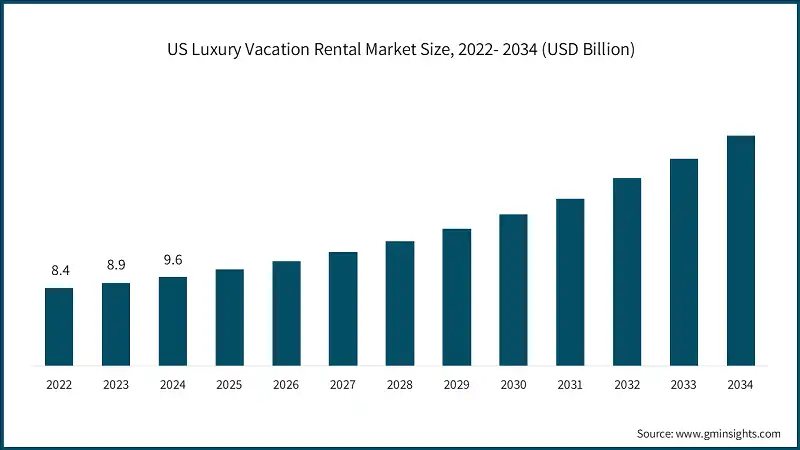
The US dominated the luxury vacation rental market in North America with around 82% share and generated USD 9.6 billion in revenue in 2024.
- The US dominates the luxury vacation rental market because of its solid economic underpinnings, advanced infrastructure, and consistent demand from both local and foreign travelers. It is a popular choice for both luxury travelers and investors due to its variety of locations, which range from urban centers to beach retreats.
- The US’s well-established regulatory structure, clear property rules, and effective transaction processes attract both domestic and foreign capital to luxury rental assets. A degree of regularity and trust that is frequently more difficult to find elsewhere is provided to investors by these qualities.
- Canada’s luxury vacation rental market is growing at a 6% CAGR, driven by demand for scenic, high-end getaways like lakefront villas and alpine retreats. In response to the growing demand for multilingual services and domestic travel, platforms such as Plum Guide and Le Collectionist are growing their curated offerings. Its attraction is being increased by robust environmental and digital tourism initiatives.
- The US leads in tech-driven luxury rentals, with features like contactless check-ins, smart energy systems, and app-enabled concierge services boosting guest satisfaction and operational efficiency. In May 2025, Airbnb expanded its Luxe collection across 260 US locations, offering in-app access to spa treatments, private chefs, and other premium services.
- The US luxury vacation rental market thrives on a mature digital ecosystem, driven by tech-savvy travelers, smart home adoption, and advanced property management tools. Collaborations with academic institutions and hospitality schools improve service quality and assist the United States become a global leader in tech-enabled, customized luxury travel.
The luxury vacation rental market in UK is projected to witness strong and sustained growth from 2025 to 2034, driven by rising demand for exclusive, flexible, and experience-focused accommodations.
- Europe is the second largest market player of the global luxury vacation rental in 2024 with a strong CAGR of over 9% through the magnitude inbound tourism, developed property infrastructure, and increasing investor attention in lifestyle-based real estate. Western European cities enjoy a combination of leisure and cultural movements and the regional development policies sponsored by EU are heralding new destinations in emerging regions of the country, namely rural and coastal regions.
- The UK remains a dominant player in the European market due to its attractiveness to both local and foreign high-net-worth travelers. Cities such as London and Edinburgh are gateway cities that provide ancient attractions, good luxury and quality rental apartments. Continuing to support the luxury rental market, the UK government in September 2023 unveiled new funding to support tourism zones to improve infrastructure and capacity of high-end accommodation.
- The luxury rental market in Germany is undergoing a transformation demanding a lot of attention to the concept of sustainability, digital facilities, and modern design. Investors are capitalizing on smart homes, as well as energy-efficient amenities and green-certified properties as a means of accommodating growth in the number of environmentally sensitive travelers. These retrofits will enhance the performance of the property as well as safeguard the country in energy and climate resilience objectives.
- For instance, in January 2024, a luxury villa collection launched in Lake Tegernsee, featuring solar-powered energy systems, touchless entry, and wellness-oriented interiors. This aligns with Germany’s strategy to offer upscale yet sustainable rentals in secondary destinations, capturing demand beyond traditional urban centers.
- Although business travel and global attractions keep Berlin, Munich and Frankfurt as prime areas of luxury rental, such cities as Hamburg, Freiburg and Heidelberg are already coming up in the boutique zone while their historic backgrounds and emerging developments towards accommodating high-end rental facilities are drawing attention.
The luxury vacation rental market in India is expected to experience significant and promising growth from 2025 to 2034.
- Asia Pacific is one of the fastest-growing areas, with over 19% of the luxury vacation rental market in 2024. Growth in places like Bali, Phuket, and Udaipur is being driven by rising incomes, mobile-first reservations, and interest in personalized, immersive stays. To satisfy this demand from younger, tech-savvy tourists, platforms like Plum Guide and Airbnb Luxe are growing their reach.
- India leads the region’s growth, driven by increasing demand for premium villa stays in destinations like Goa, Coorg, and Lonavala. in April 2024, StayVista's expansion to more than 30 locations in India, due to rise in domestic luxury travel. India is expected to be a long-term development engine for the luxury rental market in Asia Pacific due to its expanding base of wealthy millennials and occasion-based tourists.
- For instance, in March 2024, SaffronStays and Vista Rooms reported a 40% rise in reservations, particularly from professionals and urban families looking for upscale stays in Goa and Kerala.
- China and Japan are major contributors, and demand for design-led homes and rural getaways is rising. China's affluent middle class is becoming more interested in high-end rentals, while Japan's Hokkaido and Kyoto regions are well-liked for luxury and cultural vacation. Platforms and investors are responding by expanding curated listings in scenic, experience-rich locations to meet evolving traveler preferences.
- The Philippines, Vietnam, and Indonesia are rapidly developing due to lifestyle tourism and internet usage. In August 2024, Bali private villas achieved the peak-season occupancy rates of 85–90%, which greatly outperformed hotels, highlighting that travelers clearly prefer luxury rental accommodations in the area.
The luxury vacation rental market in UAE is expected to experience significant and promising growth from 2025 to 2034.
- The United Arab Emirates (UAE) dominates the MEA luxury rental market, with the help of ambitious tourism policies, significant expenditures in the hospitality industry, and demand from high-end tourists worldwide. The UAE is now a top destination for high-end, experience-driven vacations in the region because to Dubai's thriving short-term rental industry, customized experiences, and robust digital integration.
- The UAE luxury vacation rental market is set for strong growth from 2025 to 2034, driven by high tourist inflows and rising demand for premium short-term stays. Travelers looking for exclusivity, seclusion, and luxury-driven experiences are increasingly choosing Dubai and Abu Dhabi as their destinations.
- Dubai leads the market, backed by supportive policies and digital innovation. In April 2024, The Dubai Department of Economy and Tourism tightened holiday home license requirements, increasing the caliber of properties and increasing the number of listings for upscale villas and penthouses.
- Abu Dhabi and Ras Al Khaimah are subtly establishing themselves in the luxury rental market, with wellness retreats, heritage tours, and nature getaways. These locations are changing the definition of luxury, culturally diverse travel in the United Arab Emirates, whether it's a customized desert experience or a private island retreat.
- Emerging opportunities in the Middle East & Africa luxury vacation rental market are taking shape in destinations such as Egypt, Kenya, and Morocco. To attract affluent travelers, these markets utilize digital travel platforms, growing inbound tourism, and distinctive cultural assets. High development potential for carefully planned luxury stays is presented by their increased infrastructure investment and boutique lodging options.
The luxury vacation rental market in Brazil is expected to experience significant and promising growth from 2025 to 2034.
- Brazil is set to lead the Latin American luxury vacation rental market in 2024, with a projected CAGR of around 8%. The demand for private beachfront residences, more domestic travel, and growing interest in cultural and nature-based vacations in places like Bahia and Rio are the main drivers of growth. Adoption of technology and government backing for eco-friendly travel further boost the business.
- Regional and international platforms such as Casai and Airbnb, are scaling curated listings with enhanced design, security, and concierge services. Brazil is positioned as a major emergent participant in the global luxury rental market due to its combination of natural beauty, lifestyle appeal, and developing digital hospitality tools.
- Mexico and Colombia are emerging markets in the luxury vacation rental sector, driven by increasing foreign direct investment and strong government support for tourism. Growth is concentrated in key urban and resort destinations, with significant investment flowing into boutique villas, mixed-use luxury resorts, and branded properties catering to high-net-worth travelers from the US and Europe.
- New opportunities are developing in Argentina, Chile, and Peru fueled by diversifying tourism trends and improved investment frameworks attracting both local developers and international players. Focus areas include eco-friendly lodges, upscale urban rentals, and short-term luxury stays, especially in regions benefiting from enhanced accessibility and favorable regulatory environments.
Luxury Vacation Rental Market Share
- The top 7 companies in the luxury vacation rental industry are Airbnb Luxe, Le Collectionist, Rental Escapes, Plum Guide, Luxury Retreats, Onefinestay, and VRBO contributed around 41% of the market in 2024.
- Airbnb Luxe is redefining luxury travel by providing carefully chosen apartments that combine elegance, seclusion, and personalized service. Airbnb Luxe offers guests personalized itineraries, in-house staff coordination, and enhanced local experiences, with each booking backed by a professional trip designer. Travelers who desire hotel-level service and the independence of a private residence all provided via a smooth digital platform will find it appealing.
- Le Collectionist's in-depth local knowledge and high-touch curating make it stand out. It offers the top 3% of properties combined with specialized concierge services in upscale European, Caribbean, and North American locations. Authentic experiences such as private chefs and behind-the-scenes access are provided to guests. Its extremely chosen portfolio, however, may restrict choices in less well-known premium areas or at peak times.
- RentalEscapes emerged as a top 3 player, renowned for its extensive, boutique-style rental portfolio that covers top travel destinations. Professional villa management, on-site employees, and local knowledge are all part of their full-service approach. The company takes great satisfaction in maintaining a uniform standard throughout all its residences, guaranteeing that visitors are constantly taken care of while allowing owners to generate consistent revenue with little work.
- PlumGuide markets itself as the "Michelin Guide" of vacation rentals. Each property is subjected to a thorough screening procedure that includes on-site assessments and data analytics. The result is a reliable collection of exquisitely furnished residences that offer outstanding quality and design. Plum Guide offers customized luxury and peace of mind for both investors and travelers.
- Luxury Retreats, now part of Airbnb, blends premium villa offerings with the tech reach of its parent company. Its incorporation into the wider Airbnb ecosystem, however, has somewhat undermined its boutique positioning, resulting in listings and user experiences that are like those of the larger Airbnb platform.
- Onefinestay, a division of Accor's Luxe portfolio, focuses on luxurious residences in resort and urban settings. Their business strategy emphasizes carefully chosen homes, first-rate service, and a recognizable brand experience, which frequently includes private chefs, lifestyle services, and insider access. Onefinestay, which is built on individualized service, appeals to affluent international tourists looking for luxury and genuineness within reliable parameters.
- VRBO Luxe enhances a mainstream platform with premium listings, elevated filtering tools, and verified property collections. It provides tourists with high-end accommodations in an easy-to-use interface with robust customer service. Comparing VRBO Luxe to more established ultra-luxury businesses, however, still presents perception issues as it develops its luxury identity, particularly for tourists looking for more individualized treatment.
Luxury Vacation Rental Market Companies
Major players operating in the luxury vacation rental industry are:
- Airbnb Luxe
- Elite Havens
- Inspirato
- Le Collectionist
- Luxury Retreats
- Onefinestay
- Plum Guide
- Rental Escapes
- Sonder
- VRBO
- Airbnb Luxe and Le Collectionist are growing by offering personalized and well- chosen services. Le Collectionist concentrates on local partnerships and concierge- led stays, while Airbnb Luxe combines tech-enabled trip design with stringent property vetting. Both strike a balance between expansion and the exclusivity that high-end tourists demand.
- Rental Escapes and Plum Guide bring strong service and quality control to luxury rentals. Rental Escapes offers a boutique, hands-on experience with carefully chosen villas and complete concierge service. To establish visitor trust, Plum Guide uses stringent property vetting, data, and design criteria to guarantee consistency.
- Luxury Retreats and Onefinestay cater to discerning travelers seeking curated luxury with hotel-style service. With the support of Airbnb, Luxury Retreats offers a combination of luxurious villas, worldwide access, and individualized concierge services. Accor's luxury portfolio includes Onefinestay, which combines professional hospitality with local charm to offer branded, full-service stays in upscale residences.
- VRBO Luxe offers premium stays with broad platform reach, but less personalization than others. Le Collectionist and Onefinestay concentrate on high-touch concierge services, while Airbnb Luxe and Luxury Retreats are leaders in curated, full-service experiences. Rental Escapes combines boutique service with expert management, while Plum Guide is excellent at rigorous property screening.
Luxury Vacation Rental Market Report Attributes
| Key Takeaway | Details |
|---|---|
| Market Size & Growth | |
| Base Year | 2024 |
| Market Size in 2024 | USD 26.5 Billion |
| Forecast Period 2025 – 2034 CAGR | 9.3% |
| Market Size in 2034 | USD 63.7 Billion |
| Key Market Trends | |
| Drivers | Impact |
| Growing demand for privacy, space, and personalization | Luxury rentals are gaining preference for their private, spacious, and tailored offerings. |
| Increased popularity of experiential and immersive travel | Travelers increasingly seek unique, experience-driven accommodations. |
| Digital booking transformation and platform expansion | Enhanced digital platforms are streamlining access to premium rentals. |
| Remote work and extended stays | Blended work-leisure trends are driving demand for longer, flexible stays. |
| Growing influence of special occasions and multi-generational travel | Larger group travel fuels demand for spacious, high-comfort properties. |
| Pitfalls & Challenges | Impact |
| High operating and maintenance costs | Luxury rentals face rising upkeep expenses, impacting profitability and scalability. |
| Intense competition and commission wars | Heavy platform competition and fee undercutting are pressured margins and partner loyalty. |
| Opportunities: | Impact |
| Integration of AI for personalized guest experiences | AI tools can tailor recommendations, streamline service, and elevate the overall guest journey. |
| Expansion into emerging luxury destinations | Entering untapped high-end locations can attract new traveler segments and diversify revenue streams. |
| Partnerships with experienced providers and local hosts | Collaborations can enrich stays with curated local activities, enhancing guest satisfaction and loyalty. |
| Sustainability-focused property features | Eco-friendly amenities can attract conscious travelers and strengthen brand positioning in the luxury segment. |
| Market Leaders (2024) | |
| Market Leaders |
28% Market Share |
| Top Players |
Collective market share in 2024 is 39% |
| Competitive Edge |
|
| Regional Insights | |
| Largest Market | North America |
| Fastest growing market | Asia Pacific |
| Emerging countries | Mexico, Thailand, Indonesia, Portugal, Croatia |
| Future outlook |
|
What are the growth opportunities in this market?
Luxury Vacation Rental Industry News
- In May 2025, Airbnb released its Summer Release, revealing 260 cities' worth of Airbnb Services, including anything from expert chefs and photographers to yoga teachers and massage therapists, as well as an entirely revamped app and improved Airbnb Experiences. By combining upscale comfort with individualized on-site amenities, the launch presents Airbnb LUXE apartments as fully serviced getaways.
- In April 2025, Le Collectionist, a specialist in curated luxury villas, opened its first US location in St. Barts to improve in-market assistance and guest customization. This action demonstrates its dedication to providing individualized service and greater local involvement in prestigious locations.
- In December 2024, RentalEscapes debuted their "Luxury Villa Rentals of the Year" series, highlighting exceptional homes like historic estates in Italy, beachfront estates in Turks & Caicos, and a private island refuge in the BVI. The ad highlights carefully planned, experience-driven lodgings and reaffirms the brand's commitment to international premium standards.
- In March 2024, Plum Guide announced a partnership with the Global Hotel Alliance's loyalty program, enabling DISCOVERY members to accrue rewards while staying with Plum Guide. This transition between typical hotel loyalty programs and luxury house rentals highlights Plum Guide's standing as a reliable, upscale lodging choice.
- In August 2024, Inspirato expanded its luxury portfolio with 17 new properties, including a beachfront villa in Punta de Mita and heritage suites in Mallorca. This extends its carefully chosen selection to 200 partner hotels and more than 400 residences. The latest renovation demonstrates how Inspirato continues to combine comfort, style, and service to satisfy the high standards of luxury travelers with extras like private chefs, fine linens, and daily housekeeping.
The luxury vacation rental market research report includes in-depth coverage of the industry with estimates & forecasts in terms of revenue ($ Mn) from 2021 to 2034, for the following segments:
Market, By Property
- Luxury villas and estates
- Luxury penthouses and apartments
- Unique and experiential properties
- Luxury resort residences
Market, By Booking Channel
- Online travel agencies (OTAs)
- Luxury-focused platforms
- Direct booking channels
- Concierge and travel agent bookings
Market, By Guest
- Ultra-high-net-worth (UHNW) travelers
- Affluent leisure travelers
- Corporate and business travelers
- Millennial and gen z luxury travelers
- Multi-generational family groups
- Special occasion travelers
Market, By Service Level
- Full-service luxury rentals
- Self-service premium properties
- Hybrid service models
- Concierge-enhanced rentals
The above information is provided for the following regions and countries:
- North America
- US
- Canada
- Europe
- Germany
- UK
- France
- Italy
- Spain
- Russia
- Nordics
- Portugal
- Croatia
- Asia Pacific
- China
- India
- Japan
- Australia
- South Korea
- Singapore
- Thailand
- Indonesia
- Latin America
- Brazil
- Mexico
- Argentina
- MEA
- South Africa
- Saudi Arabia
- UAE
Frequently Asked Question(FAQ) :
What is the market size of the luxury vacation rental in 2024?
The market size was USD 26.5 billion in 2024, with a CAGR of 9.3% expected through 2034. The market growth is driven by increasing demand for personalized, private, and seamless travel experiences among affluent travelers.
What is the projected value of the luxury vacation rental market by 2034?
The market is poised to reach USD 63.7 billion by 2034, fueled by the shift toward curated guest journeys and the rising popularity of luxury rentals as strategic assets for premium travel brands.
Which segment dominated the luxury vacation rental market in 2024?
The luxury villas and estates segment accounting for approximately 49% of the market share in 2024 and is set to expand at a CAGR of around 10% till 2034.
What was the market share of Online Travel Agencies (OTAs) in 2024?
Online Travel Agencies (OTAs) held a 45% market share in 2024 and is likely to witness around 10% through 2034.
What is the growth outlook for direct bookings in the luxury vacation rental market?
Direct bookings segment is expected to grow at a CAGR of around 9% up to 2034, as property owners focus on building stronger guest relationships and increasing profits by avoiding third-party fees.
Which region leads the US luxury vacation rental sector?
The United States market holding approximately 82% of the regional market share and generating USD 9.6 billion in revenue in 2024. This dominance is attributed to its strong economic foundation, advanced infrastructure, and diverse travel destinations.
What are the upcoming trends in the luxury vacation rental market?
Key trends include the adoption of dynamic pricing systems by major platforms like Airbnb Luxe and Plum Guide, the rise of smart luxury rentals with IoT solutions and energy-efficient systems, and a growing focus on wellness and sustainability in property development.
Who are the key players in the luxury vacation rental industry?
Key players include Airbnb Luxe, Elite Havens, Inspirato, Le Collectionist, Luxury Retreats, Onefinestay, Plum Guide, Rental Escapes, Sonder, and VRBO.
Luxury Vacation Rental Market Scope
Related Reports