Luxury Footwear Market Size & Share 2025 – 2034
Market Size by Product Type, by Price, by Consumer Group, by Distribution Channel, Growth Forecast.
Report ID: GMI6284
Download Free PDFSummary
Table of Content

Luxury Footwear Market
Get a free sample of this report
Form submitted successfully!
Error submitting form. Please try again.
Thank you!
Your inquiry has been received. Our team will reach out to you with the required details via email. To ensure that you don't miss their response, kindly remember to check your spam folder as well!
Request Sectional Data
Thank you!
Your inquiry has been received. Our team will reach out to you with the required details via email. To ensure that you don't miss their response, kindly remember to check your spam folder as well!
Form submitted successfully!
Error submitting form. Please try again.
Luxury Footwear Market Size
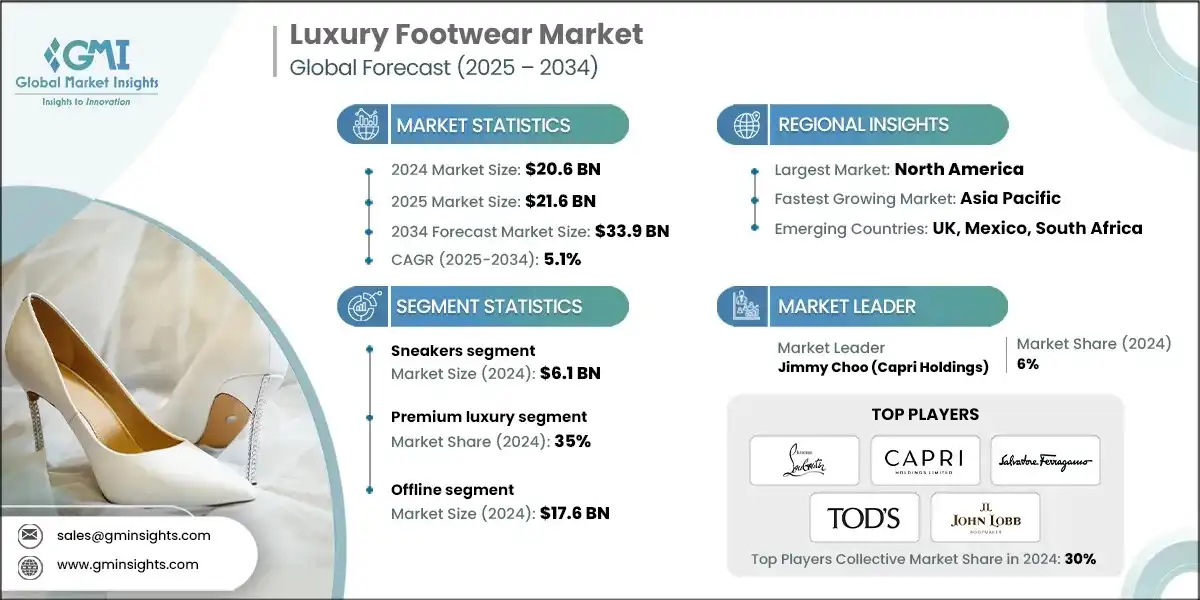
The global luxury footwear market was estimated at USD 20.6 billion in 2024. The market is expected to grow from USD 21.6 billion in 2025 to USD 33.9 billion in 2034, at a CAGR of 5.1%, according to latest report published by Global Market Insights Inc.
Luxury Footwear Market Key Takeaways
Market Size & Growth
- 2024 Market Size: USD 20.6 Billion
- 2025 Market Size: USD 21.6 Billion
- 2034 Forecast Market Size: USD 33.9 Billion
- CAGR (2025–2034): 5.1%
Regional Dominance
- Largest Market: North America
- Fastest Growing Region: Asia Pacific
Key Market Drivers
- Premiumization and Lifestyle Trends.
- Increasing fashion consciousness.
- Rise in footwear customizations and personalization.
- Celebrity endorsements and brand collaborations.
Challenges
- High price sensitivity in emerging markets.
- Rapid fashion cycles.
Opportunity
- Sustainable luxury footwear.
- Luxury athleisure segment.
Key Players
- Market Leader: Jimmy Choo (Capri Holdings) led with over 6% market share in 2024.
- Leading Players: Top 5 players in this market include Christian Louboutin, Jimmy Choo (Capri Holdings), Salvatore Ferragamo, Tod's Group, John Lobb (Hermès), which collectively held a market share of 30% in 2024.
Get Market Insights & Growth Opportunities
Footwear classified as luxury is now offered not only as an item of clothing for function, but also as a measure of status and lifestyle. Customers are likely to buy products that are positioned as exclusive, made by a skilled artisan, and have a heritage. Therefore, premiumization is a key growth driver for footwear. Luxury brands are in a unique position to leverage premiumization by attempting to create scarcity and luxury around the product through limited-edition collections, artisan styles, and co-branding and limited-collections with famous haute-couture designers. This connection with their customers will appeal to high-end consumers for their desire for uniqueness and brand legacy.
Moreover, shifts in lifestyle trends are directing customer purchasing behavior with respect to shoes because customers are now looking for footwear that corresponds with their overall fashion identity. Luxury shoes are being brought into everyday wardrobes thereby establishing comfort with sophistication for formal and casual occasions alike. The emergence of luxury athleisure where designer athletic shoes are clearly present, is one indicator of lifestyle-driven choices extending the footwear sector beyond traditional formal footwear. The combination of fashion with functionality ensures premium products will always be in demand.
With fashion being heavily influenced by social media, celebrity endorsements, and international fashion weeks, the awareness of consumers has evolved. Footwear has moved from being an afterthought to being front and centre to one's own identity and personal style. Consumers actively watch trends and seek designs based on seasonal collections. The execution of luxury footwear has never been more coveted among consumers. Increased consumer awareness now forces brands to push innovation further than in previous eras, through bold looks, sustainable materials, and functional versatility.
Furthermore, the democratization of fashion through digital channels is helping to make luxury footwear more accessible for a wider audience. Even in emerging markets, exposure to international fashion trends fuels interest in high-end shoes, encouraging brands to broaden their scope. Luxury footwear brands are focusing on storytelling, influencer engagements, and experiential in-store shopping experiences to boost engagement with their brand as customers become more discerning and trend-driven.
To get key market trends
Luxury Footwear Market Trends
The luxury footwear sector is experiencing rapid evolution and changing consumer preferences, improving technology, and adjustments in lifestyle. Brands are investing in technology, sustainability, and personalization to target a more informed, discerning and fashion-conscious consumer. An increase in athleisure fashion, sustainability, and online luxury footwear is adjusting the competitive landscape, while collaborations and exclusive limited-edition collections are striving for consumer mind share, and exclusivity.
- Luxury shoe brands are beginning to take sustainability seriously as consumer preferences shift towards eco-responsible choices. This entails using recycled leather, plant-based materials, and biodegradable components, without sacrificing craftsmanship or aesthetics. Sourcing in ethical practices and the creation of transparent supply chains are becoming a must-have as consumers want to validate that their purchase falls within the confines of ethical practices.
- The luxury footwear market is adopting digital innovations to improve customer experience. Companies are utilizing virtual try-on opportunities, augmented reality tools, and immersive online virtual showrooms or stores to help customers visualize products prior to making a purchase. E-commerce platforms are growing, expanding geography and e-commerce beyond traditional brick and mortar. Social media and influencer marketing campaigns help amplify brand awareness, and digital custom programs provide options to design a unique and exclusive piece while increasing consumer engagement.
- Athleisure has disrupted traditional luxury shoes by bridging the gap between comfort and luxury. Sneakers, casual luxury shoes, and dress sneakers have made their way into everyday wardrobes appealing to younger customer groups and professionals who want wearable, versatile styles. Overall, the trend signals a potential move away from completely dressed shoes to programs that meet a balance between dress, elegance, and functionality. As demands shift, brands have increased their investments in materials and innovative designs to create footwear that serves some property of performance and/or aesthetics. This presents additional growth opportunities for the luxury footwear category.
- Personalization is a potent trend in luxury shoes, as consumers desire to be an individual and feel a sense of exclusivity. Manufacturers are taking this into account and are offering tailored services, monogramming and limited-edition lines to appeal to these emotions. The more advanced methods of manufacturing and the rise of digital platforms now allow consumers to select specific colors, materials and designs, all generating an experience of ownership and uniqueness. This trend depicts loyalty to the brand and considers luxury footwear an intimate expression of oneself.
Luxury Footwear Market Analysis
Learn more about the key segments shaping this market
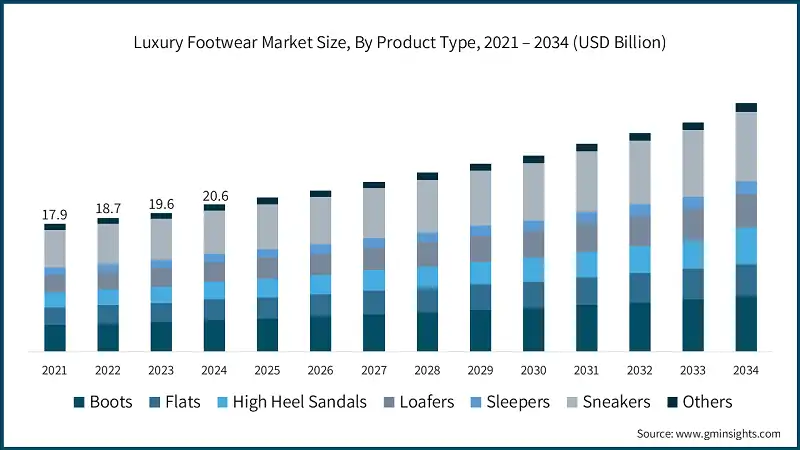
Based on product type, the luxury footwear market is divided into boots, flats, high heel sandals, loafers,, sneakers and others. In 2024, sneakers held the major market share, generating a revenue of USD 6.1 billion.
- Luxury sneakers have transitioned from leisure wear to an integral piece of high fashion; they signify an individual’s taste and social standing. Luxury sneakers combine comfort and high-end visual appeal, satisfying consumers’ preferences for diversity and style. Luxury brands have taken sneakers and made them statement pieces by producing bold designs, teaming-up with prominent figures, and releasing limited-edition drops to create a label consumers need to have in their luxury wardrobe.
- More hybrid systems are being designed to integrate into a wider gaming ecosystem, one with mechanics like cross-platform play, cloud saves, and synced content. The Steam Deck has direct access to the Steam platform, where gamers can access their entire library of games between the different devices in a hybrid system. ROG Ally from ASUS integrates directly with Windows and Xbox Game Pass, allowing a seamless experience between PC and handheld gaming. The integration will improve user interaction and encourage users to continue to use the brand’s software and services in the long run.
- This cultural relevance has cast a wider net than merely aspirational products for traditional luxury customers it has engaged younger customers who are also looking for aspirational products. The rise in appeal for luxury athleisure wear only intensifies this development in the sneaker category, which creates potential for brands to have more diversified collections and emerge into new markets where casual luxury has been gaining traction.
Learn more about the key segments shaping this market
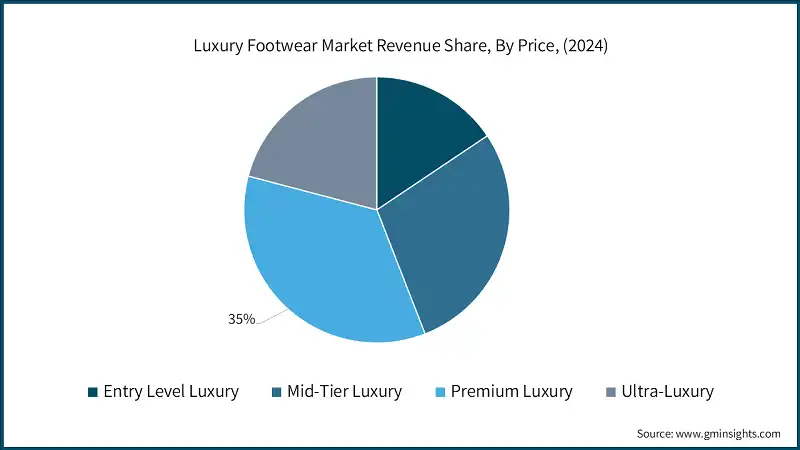
Based on price, the luxury footwear market is segmented into entry level luxury ($300-$800), mid-tier luxury ($800-$1,500), premium luxury ($1,500-$3,000), ultra luxury (above $3,000). The premium luxury segment held the largest share, accounting for 35% of the global market in 2024.
- The niche luxury footwear sector is characterized by its focus on exclusivity and superior craftsmanship. Such products are matched with artisanship, methodically designed with labor and time-intensive workmanship to ensure the quality, finish, and durability. Exotic leathers, rare fabrics, and expensive embellishments became customary as differences of footwear outside the mass market. Exclusivity is enhanced with the limited-edition collections and bespoke footwear service offerings that consider the consumers who appreciate rarity, individuality, and prestige.
- Heritage is a key driver within the premium luxury space, where consumers are more likely to be attracted to brands with a definition of tradition and history rooted in expertise. Rich storytelling around the origins, motivations, design thinking, and craftsmanship of a luxury product creates an emotional pause for consumers beyond the physical product itself. Luxury footwear brands will often market the importance of heritage through advertising campaigns, partnerships, flagship stores, and other means that work to bring in the elements of tradition, while honoring the demands of the consumer through modernity.
- Brands are adding advanced comfort technologies, sustainable materials, and digital customization tools to meet changing consumer expectations. For example, lightweight construction and ergonomic designs are being added without removing the trusted classic look that defines premium luxury shoes. Sustainability initiatives, like eco-friendly leather alternatives and ethically sourcing materials, are also gaining traction. The combination of heritage and innovation will allow premium luxury brands to maintain their relevance in the ever-changing landscape of consumer preference for both authenticity, and modern function.
Based on distribution channel, the luxury footwear market is segmented into online and offline. In 2024, offline held a major market share generating a revenue of USD 17.6 billion.
- Offline channels are still important for luxury footwear because they provide a brand experience that online cannot replicate. Flagship stores, boutique stores, and more upscale department stores provide an immersive experience with products where consumers can feel and appreciate craftsmanship as well as having the opportunity for more personalized service. All of which leverages brand identity and exclusivity while creating an emotional connection for customers that leads to greater loyalty and repurchase.
- Buyers of luxury footwear want a high level of individual attention, which offline channels provide through customized consultations, styling assistance, and bespoke offering. Experience in stores often offer private fit sessions, personalization options, and access to limited-edition collections. This tailored experience enhances perceived value and solidifies the brand's luxury positioning, which makes the offline retail channel a significant contributor to customer satisfaction and loyalty.
Looking for region specific data?
North America Luxury Footwear Market
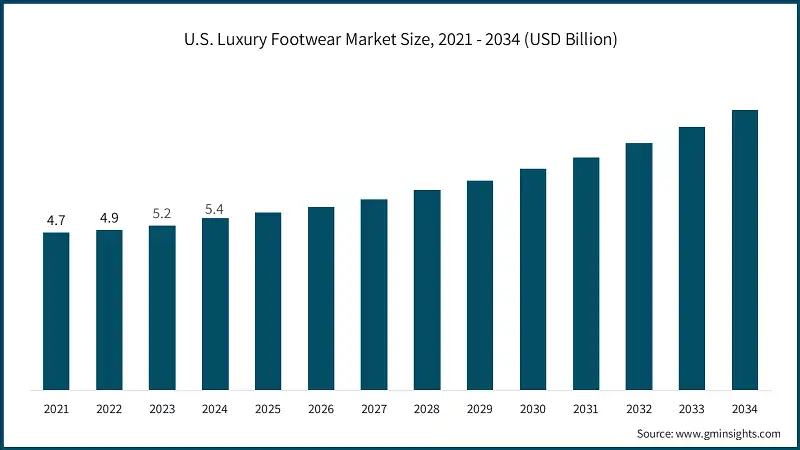
In 2024, the U.S. dominated the North America market, accounting for around 73.7% and generating around USD 5.4 billion revenue in the same year.
- The luxury footwear market in the U.S. demonstrating strong demand from consumers for high end products that combine style, comfort, and exclusivity. American consumers are shaped by a strong fashion culture, possessing disposable incomes that affords them brand heritage, craftsmanship, and a spirit of innovation. Sneakers remain the overall lifestyle statement of the moment, while sustainability and customization are new, emerging differentiators in the U.S. luxury footwear industry.
- With having the consolidated retail network, active lifestyle brands, and changing consumer spending habits, North America continues to dominate the global luxury footwear market. North America comprises a mix of traditional luxury consumers and younger consumer demographics adapting to the new norm of athleisure and designer sneakers. While brick and mortar retailer channels remain important for experiential retail, digital channels allow for expanded accessibility and personalization. Current and future trends driving the North American luxury footwear space include sustainability, digital innovation, and "collab" products, all of which concentrate the North American luxury footwear space for product innovation and sustained growth and development.
Europe Luxury Footwear Market
Europe market, UK leads the market with 20% share in 2024 and is expected to grow at 5.3% during the forecast period.
- Europe serves as a worldwide center for luxury footwear, claiming its prestige from its fashion history and craftsmanship. The area is associated with premium brands that are committed to lasting design, excellent quality, and exclusivity, making it a region of premier status for all footwear connoisseurs. Fashion centers like Paris, Milan, and London continue to be leading players in the world of styles and trends as well as innovation in the luxury footwear segment. Fewer people shop in person; however it is still important. Flagship stores are immersive experiences, showcasing what is meant by the brand, who the people are that make the product, and what the craftsmanship is all about. The digital world assists offline by extending access and imagination as well as ghost sold items that enhance any element of personalization to help consumers make purchases.
- Contemporary European trends reveal a notable emphasis on sustainability, personalization, and technology applications to enhance luxury retail experiences. In response to consumers increasingly demanding eco-friendly materials and ethical production methods, luxury brands have begun adopting more sustainable leather alternatives and used more transparent sourcing. Personalization is another growth driver, with bespoke service options and short editions growing in interest among buyers wanting to embrace a sense of individuality.
Asia Pacific Luxury Footwear Market
The Asia Pacific leads the market; China leads with market share of around 35.9% in 2024 and is anticipated to grow with a CAGR of around 6.1% from 2025 to 2034.
- The Asia-Pacific region is emerging as one of the more dynamic markets for luxury footwear due to rapid urbanization, increasing disposable income, and an increase in demand for premium fashion. In countries such as China, Japan, and India, we see a catalyzing of luxury consumption within younger demographics seeking luxury footwear as a sign of prestige and lifestyle.
- The main trends shaping the APAC market are the burgeoning digital retail space, influencer marketing, and growing demand for luxury athleisure. E-commerce and social media have increased accessibility to the luxury footwear segment, allowing brands to engage with tech-savvy consumers in urban and semi-urban areas. Sustainability and personalization are gaining momentum, and consumers are actively searching for eco-friendly materials and customized designs. With the region's strong appetite for fashion-forward products and experiential shopping, APAC will continue to thrive, as a barometer for innovation and growth, in an increasingly competitive global luxury footwear industry.
Latin America Luxury Footwear Market
Latin America markets are growing at a CAGR of 4.9% during the forecast period.
- Latin America, with a burgeoning middle class, rising urbanization, and growing interest in global fashion trends, is an emerging market for luxury shoes. Countries, like Brazil, Mexico, and Argentina, are shifting toward premium products when consumers become more brand-conscious and aspirational. International luxury brands are increasing their market presence through high-end retail stores and partnerships with local distributors, while regional designers are being recognized for cultural references within their line of luxury shoes.
- Some prominent trends in the region are the impact of social networks and influences, and the continuing rise of luxury sneakers and casual wear among youth. As e-commerce expands overall access to luxury brands regardless of the strength of the physical luxury retail environment in the market, consumers will introduce a broader range of brands into their wardrobes. Sustainability and responsible sourcing are starting to take hold and interest consumers who care about sustainable materials and responsible production. This already evolving scenario is allowing Latin America to present a new luxury growth region for brands willing to access a new, fashion-forward consumer.
Luxury Footwear Market Share
Jimmy Choo (Capri Holdings) is leading with 6% market share. Jimmy Choo (Capri Holdings), Christian Louboutin, Salvatore Ferragamo, Tod's Group, and John Lobb (Hermès) collectively hold around 30%, indicating moderately fragmented market concentration. These prominent players are proactively involved in strategic endeavors, such as mergers & acquisitions, facility expansions & collaborations, to expand their product portfolios, extend their reach to a broad customer base, and strengthen their market position.
Bottega Veneta stands for simplicity applied to luxury and sophistication to craftsmanship, mostly for customers who look for discreet luxury rather than flashy logos on their apparel. The brand’s signature Intrecciato woven leather experience illustrates its timeless design and quality and is applied to shoes as well as other products. The brand emphasizes understated style with high-quality materials, effectively attracting buyers who are fashion-minded and look for only those products with limited distribution.
Prada is considered a leader in luxury space and can reinvent a trend through its innovative design. The footwear collections use classic Italian craftsmanship to produce products with a progressive yet fashion forward style that maintains elegance and functionality. Prada, with its ability to utilize traditional techniques, modern materials, and a daring aesthetic, has positioned itself as a leader in the luxury market.
Luxury Footwear Market Companies
Major players operating in the luxury footwear industry are:
- Berluti (LVMH)
- Bottega Veneta (Kering)
- Brunello Cucinelli
- Christian Louboutin
- Crockett & Jones
- Edward Green
- J.M. Weston
- Jimmy Choo (Capri Holdings)
- John Lobb (Hermès)
- Manolo Blahnik
- Paraboot
- Prada
- Salvatore Ferragamo
- Santoni
- Tod's Group
Christian Louboutin is one of the most well-known names in shoes, known for its bright, elegant designs and signature red-lacquered soles. The brand's shoes are not simply shoes, they are statements - beautiful pieces that signify confidence and sophistication. The collections often display avant-garde shapes, bright colors, and detailed embellishments that appeal to celebrities and fashion lovers around the world. With its undeniable cultural relevance and relationship to high fashion, Christian Louboutin is a leader in luxury and individuality globally, and a successful player in the footwear market.
Salvatore Ferragamo represents Italian heritage and artisanal skills of the highest quality in footwear that combines timeless style and functionality. In the marketplace, Ferragamo is recognized for maximizing the details with quality materials and construction; the result is that Ferragamo has become a brand widely recognized for luxury and durable elegance. Ferragamo designs often feature classic shapes that are complemented by discreet elements of luxury in terms of effects that the consumer appreciates in traditional and elegant forms.
Luxury Footwear Market Report Attributes
| Key Takeaway | Details |
|---|---|
| Market Size & Growth | |
| Base Year | 2024 |
| Market Size in 2024 | USD 20.6 Billion |
| Market Size in 2025 | USD 21.6 Billion |
| Forecast Period 2025 – 2034 CAGR | 5.1% |
| Market Size in 2034 | USD 33.9 Billion |
| Key Market Trends | |
| Drivers | Impact |
| Premiumization and Lifestyle Trends | the demand for luxury footwear is driven by premiumisation lifestyle and culture trends as many consumers consider luxury footwear to be a representation of status & exclusivity. |
| Increasing fashion consciousness | Increasing awareness of fashion trends, particularly within the younger demographic continues to expand the marketplace for footwear as a means of self-expression in their forest statement of fashion. |
| Rise in footwear customizations and personalization | Increasing customization and personalization of shoes is leading to increased loyalty to brands and allows the brand to command a higher average selling price because the customer places more value on their individualised or unique product. |
| Celebrity endorsements and brand collaborations | Celebrity endorsement and collaborations between brands are driving tremendous growth in the luxury footwear market by increasing the visibility of brands providing an aspirational aspect of consumers when purchasing and drawing in younger fashionable consumers who are influenced by the popularity of current trends. |
| Pitfalls & Challenges | Impact |
| High price sensitivity in emerging markets | With an increase and high pricing sensitivity in other markets due to aspiring buyers looking for lower priced options instead the growth of high price sensitivity in emerging markets limits growth. |
| Rapid fashion cycles | Rapid fashion cycles create inventory risk and pressure bands to innovate rapidly leading to increased cost and decreased profit margin. |
| Opportunities: | Impact |
| Sustainable luxury footwear | An increasing number of eco conscious consumers are purchasing luxury footwear made from sustainable materials. Companies are focusing on sustainable products to set themselves apart from their competitors. |
| Luxury athleisure segment | The luxury athleisure market has seen growth as the demand for shoes that provide comfort, performance, aesthetic value continues to increase. |
| Market Leaders (2024) | |
| Market Leaders |
6% market share |
| Top Players |
Collective market share in 2024 is 30% |
| Competitive Edge |
|
| Regional Insights | |
| Largest market | North America |
| Fastest growing market | Asia Pacific |
| Emerging countries | UK, Mexico, South Africa |
| Future outlook |
|
What are the growth opportunities in this market?
Luxury Footwear Industry News
- In September 2025, John Lobb showcased its Autumn/Winter 2025 collection with a particular focus on artisan heritage and contemporary adaptability. The collection recognizes John Lobb's history, and featured items included the Highland boots in heavy duty waxed leather for resiliency in the elements, and a new version of the Smith derby in updated colours and premium materials. In commemoration of the 75th Anniversary regard to the iconic Lopez loafer, a limited run was released in Dark Cherry, Dark Green, and Bristle Hide, celebrating John Lobb’s sensibilities in timeless sophistication.
- In July 2025, Berluti invigorated their signature Stellar Sneaker with a renewed approach to comfort and artisanal details. New pop colors: softer patinated leather in rich options such as Abisso, Marrone Intenso and Iron Grey complimented with superior cushioning technology to create sneakers you can wear anywhere. This sneaker represents Berluti’s dedication to combining traditional craftsmanship with a performance aspect which allows the wearer to appreciate each sneaker for its greater purpose.
- In May 2025, Christian Louboutin launched a stand-out artistic collaboration with Otis Carey - an Australian artist for the Fall/Winter 2025 collection. The new collection features fun new silhouettes, such as the sculptural Miss Z pump, striking Viva Condora, sportier versions in the Astroloubi sneaker, and more rugged versions on a college lug-soled loafer. This collection blends glamour and insight the Louboutin brand is known for with the bright palette and vibrancy of Carey to create a collection of footwear which is both statement making and woven with creative expression.
- In April 2025, Jimmy Choo revealed its Spring 2025 “Hyper Glamour” collection, which is a celebration of bold design and dynamic detail. This collection featured jump-out statement pieces like the Lotta, Isa, and Staz sandals highlighted through design that's engaging curves, luxurious/clunky detailing, as well as some sparkly adornments. The other featured items in the show were Diamond motif trainers, which take sport-styling into account, while incorporating Jimmy Choo's exquisite sparkle into its tailoring.
- In February 2025, Brunello Cucinelli showed its Fall/Winter 2025 collection in Milan Fashion Week that takes the brand's understated direction toward luxury and blends it with an equestrian-inspired aesthetic. The collection's standout item was the chevalier boot, which was made of supple leather and had monili spurs completing the look and lending a slight sparkle to the more subdued design. This collection supported Cucinelli's philosophy which integrates heritage style inspired motifs with modern elegance, providing items that embody sophistication and craftsmanship.
The luxury footwear market research report includes in-depth coverage of the industry with estimates & forecasts in terms of revenue (USD Billion) and volume (Thousand Units) from 2021 to 2034, for the following segments:
Market, By Product Type
- Boots
- Flats
- High heel sandals
- Loafers
- Sleepers
- Sneakers
- Others
Market, By Price
- Entry-level luxury ($300–$800)
- Mid-tier luxury ($800–$1,500)
- Premium luxury ($1,500–$3,000)
- Ultra-luxury (Above $3,000)
Market, By Consumer Group
- Men
- Women
- Children
Market, By Distribution Channel
- Online
- E-commerce
- Brand websites
- Offline
- Luxury boutiques
- Department stores
- Multi-brand retail stores
- Others
The above information is provided for the following regions and countries:
- North America
- U.S.
- Canada
- Europe
- Germany
- UK
- France
- Italy
- Spain
- Asia Pacific
- China
- India
- Japan
- Australia
- South Korea
- Latin America
- Brazil
- Mexico
- Argentina
- Middle East and Africa
- South Africa
- Saudi Arabia
- UAE
Frequently Asked Question(FAQ) :
What is the market size of the luxury footwear market in 2024?
The market size was USD 20.6 billion in 2024, with the industry set to grow at a CAGR of 5.1% from 2025 to 2034 driven by rising fashion consciousness, premiumization, and lifestyle-driven footwear demand.
What is the current luxury footwear market size in 2025?
The market size is projected to reach USD 21.6 billion in 2025.
What is the projected value of the luxury footwear market by 2034?
The luxury footwear market is expected to reach USD 33.9 billion by 2034, supported by a 5.1% CAGR and increasing demand for athleisure luxury, craftsmanship-led products, and digital retail experiences.
How much revenue did the sneakers segment generate in 2024?
The sneakers segment generated USD 6.1 billion in 2024, leading the luxury footwear industry due to the crossover of athleisure, exclusivity, and designer collaborations.
What was the valuation of the offline distribution channel in 2024?
Offline distribution channels generated USD 17.6 billion in 2024, driven by experiential luxury retail and personalized in-store services that strengthen brand loyalty.
What is the growth outlook for the Asia Pacific luxury footwear market from 2025 to 2034?
The Asia Pacific region is anticipated to grow at a CAGR of around 6.1% through 2034, fueled by rising disposable incomes, digital-first purchasing behavior, and strong demand for premium lifestyle footwear.
Which region leads the luxury footwear market?
In the U.S., the market generated USD 5.4 billion in 2024 and accounted for 73.7% of the North America industry. Regional leadership is supported by mature fashion culture, high luxury spending, and strong adoption of designer sneakers and sustainable premium footwear.
What are the upcoming trends in the luxury footwear market?
Key trends include the rise of luxury athleisure, sustainable materials, hyper-personalization, virtual try-on technologies, and high-impact limited-edition collaborations.
Who are the key players in the luxury footwear market?
Key players include Christian Louboutin, Jimmy Choo (Capri Holdings), Salvatore Ferragamo, Tod's Group, John Lobb (Hermès), Prada, Bottega Veneta (Kering), Berluti (LVMH), Santoni, Manolo Blahnik, and Brunello Cucinelli.
Luxury Footwear Market Scope
Related Reports
Explore Our Licensing Options:
Premium Report Details
- Base Year:2024
- Companies covered:15
- Tables & Figures:243
- Countries covered:18
- Pages:250