Summary
Table of Content

Lubricants Market
Get a free sample of this report
Form submitted successfully!
Error submitting form. Please try again.
Thank you!
Your inquiry has been received. Our team will reach out to you with the required details via email. To ensure that you don't miss their response, kindly remember to check your spam folder as well!
Request Sectional Data
Thank you!
Your inquiry has been received. Our team will reach out to you with the required details via email. To ensure that you don't miss their response, kindly remember to check your spam folder as well!
Form submitted successfully!
Error submitting form. Please try again.
Lubricants Market Size
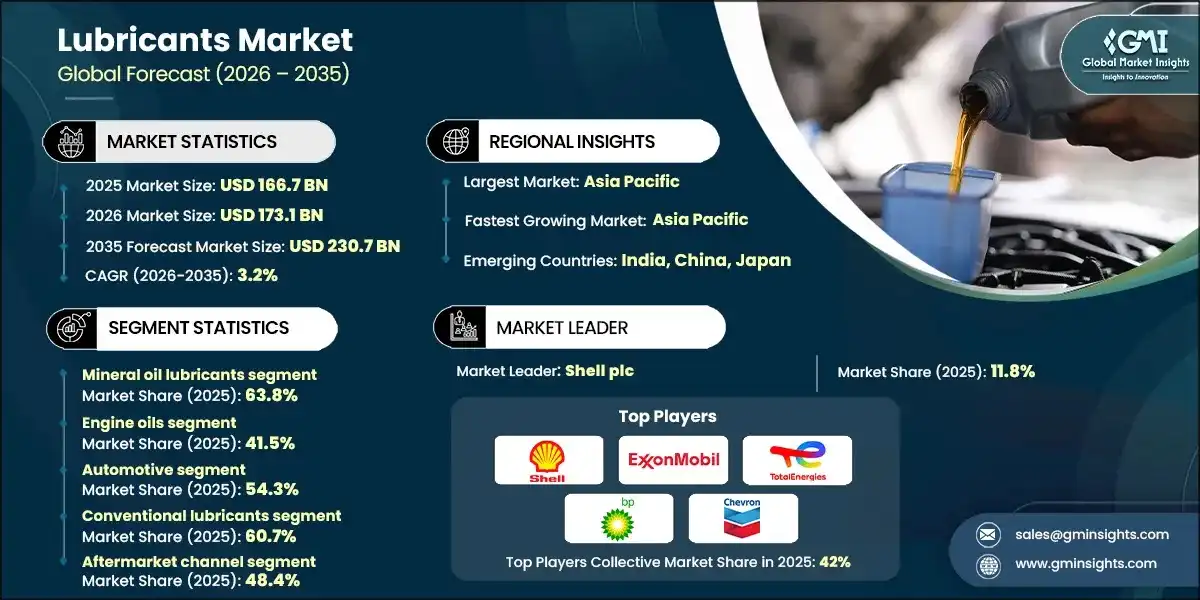
The global lubricants market was valued at USD 166.7 billion in 2025. The market is expected to grow from USD 173.1 billion in 2026 to USD 230.7 billion in 2035, at a CAGR of 3.2%, according to latest report published by Global Market Insights Inc.
Lubricants Market Key Takeaways
Market Size & Growth
- 2025 Market Size: USD 166.7 Billion
- 2026 Market Size: USD 173.1 Billion
- 2035 Forecast Market Size: USD 230.7 Billion
- CAGR (2026–2035): 3.2%
Regional Dominance
- Largest Market: Asia Pacific
- Fastest Growing Region: Asia Pacific
Key Market Drivers
- Growing automotive production & vehicle part.
- Industrial manufacturing expansion.
- Stringent emission regulations driving synthetic adoption.
Challenges
- Volatility in crude oil & base oil prices.
- Shifts toward electric vehicles reducing lubricant demand.
Opportunity
- Bio-based & biodegradable lubricants growth.
- Re-refined & circular economy lubricants.
Key Players
- Market Leader: Shell plc led with over 11.8% market share in 2025.
- Leading Players: Top 5 players in this market include Shell plc, ExxonMobil Corporation, TotalEnergies SE, BP plc (Castrol), Chevron Corporation, which collectively held a market share of 43.2% in 2025.
Get Market Insights & Growth Opportunities
- The lubricants market has in enabling effective and reliable operations in widely diverse industrial segments. In the marine environment, lubricants are required to reduce friction and wear, as well as for component protection from harsh environments. The role, however, goes beyond lubrication to thermal stability, corrosion resistance, adaptation to advanced machinery design, and much more.
- Technological advancement is the most important engine of growth in this market. Continuous advancements in lubricant formulations, including entirely novel synthetic blends and bio-based alternatives, are redefining performance standards for lubricants. As of today, these innovations are said to offer better protection under severe service conditions, as well as evolve in line with the environmental requirements. Sustainability, on the other hand, captures a global momentum forcing the hands of manufacturers to come out with lubricants that are biodegradable and less toxic.
- Operational efficiency is yet another key driver of demand. Industries, as such, are looking for high-performance lubricants, using which they can extend the life of their equipment while reducing maintenance costs and saving on energy. Emerging trends are bio-lubricants, smart lubrication systems, and hybrid formulations. Bio-lubricants process renewable non-toxic raw materials and seem to be particularly attractive to sectors that care about environmental impacts. Similarly, smart lubrication systems combining IoT and sensor technologies allow real-time monitoring, predictive maintenance, and optimized consumption.
To get key market trends
Lubricants Market Trends
- Lubricants hold great potential for new growth areas in this transformational phase that emphasizes innovation geared toward sustainability. Of the many opportunities that abound, perhaps one of the most critical development areas is bio-based and biodegradable lubricants. Thus, the appeal is in addressing the demand for greener alternatives that leave a locally smaller ecological footprint while being as reasonably viable in performance as existing alternatives.
- As industries work to align themselves with decarbonization goals on a global scale, bio-lubricants create a win-win solution for manufacturers to create differentiation while adhering to stringent environmental mandates. An equally large opportunity lies with the adoption of re-refined lubricants where circular economy models apply.
- By utilizing import re-refining technologies, firms can convert waste oils into high-quality base stocks, thereby decreasing reliance on virgin materials and lessening lifecycle emissions. This will not only drive down the costs but also lend considerable weight to the manufacturers on sustainability issues; on the other hand, it even makes them an attractive partner in the eyes of the customer and the regulators. Circular lubricants solution has grown to be looked upon as a competitive necessity, enabling firms to meet their economic and environmental goals amid the rapidly evolving market climate.
Lubricants Market Analysis
Learn more about the key segments shaping this market
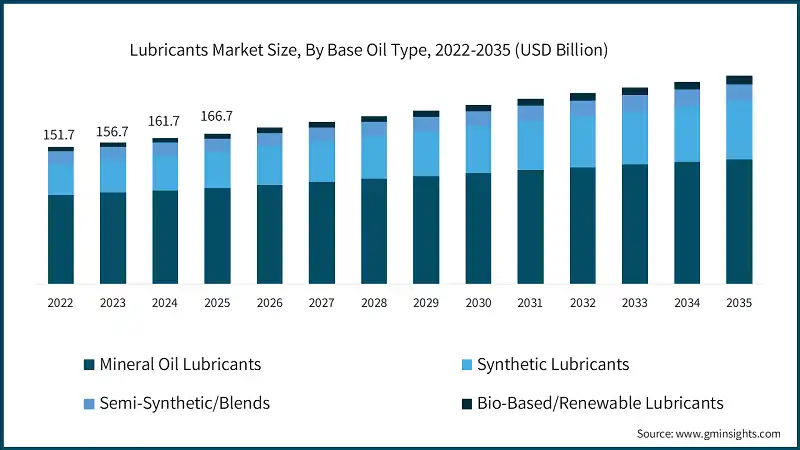
Based on base oil type, the market is segmented into mineral oil lubricants, synthetic lubricants, semi-synthetic/blends, bio-based/renewable lubricants. Mineral oil lubricants dominated the market with an approximate market share of 63.8% in 2025 and is expected to grow with a CAGR of 2.6% by 2035.
- Mineral-oil-based lubricants are still to this day used because they are cheap and can be used in almost all applications in the automotive, industrial, and marine sectors. They perform reliably under standard operating conditions and hence are preferred in those markets where economy and availability are important requirements. Today, though, the environmental regard of these substances and a shorter service life than those of some advanced alternatives are gradually shifting this market toward sustainable options.
- Synthetic lubricants are predominantly used in premium applications where they provide high thermal stability, resistance to oxidation, and longer drain intervals. These lubricants become indispensable when operating engines of high capacities and loads, highly critical for performance or industrial applications.
Learn more about the key segments shaping this market
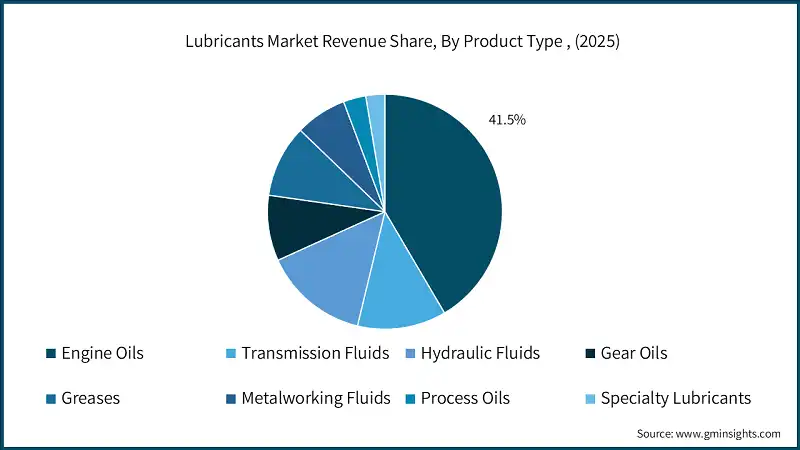
Based on product type, the lubricants market is segmented into engine oils, transmission fluids, hydraulic fluids, gear oils, greases, metalworking fluids, process oils, specialty lubricants. Engine oils held the largest market share of 41.5% in 2025 and is expected to grow at a CAGR of 2.6% during 2026-2035.
- Engine oils form the mainstay of applications in both marine and automotive, bestowing necessary protection against abrasive wear, heat, and contaminants in internal combustion engines. Transmission fluids complement this by geared up to facilitate the smooth shifting of gears along with efficient thermal stability, especially at technologically refreshed automatic and continuously variable transmissions systems that this product actually proves indispensable for supporting performance in extreme operation conditions.
- Heavy hydraulic fluids, gear oils, grease, and, to make up the last product, other heavy-duty application substances have contributed to most industrial applications. The first one refers to power transmission, whether in machinery or marine systems at extreme accuracy, while the application of gear oils is made possible due to their extreme pressure protection for gearboxes as well as for drive systems.
- The semi-solid consistency of the grease provides a good and durable oestrogen output under heavy load and contamination in bearings and joints. So all of these products make up the basics of industrial reliability, basically reducing downtime for quick recovery and making up for lost productivity in severe operating environments.
Based on application, the lubricants market is segmented into automotive, industrial manufacturing, marine, aerospace & defense, power generation, mining & construction, agriculture & off-highway, food & beverage processing, other industrial applications. Automotive segment dominated the market with an approximate market share of 54.3% in 2025 and is expected to grow with the CAGR of 2.4% by 2035.
- Lubricants are utilized in various applications, automotive being the most prominent, with essential roles in engine protection, fuel economy, and emissions compliance. Such lubricants are intended to withstand extreme temperature and friction in the engines, transmissions, and drivetrains while ensuring smooth operation. Demands rise for those specialized fluids intended to meet changing performance criteria with an increasingly modern vehicle environment, hybrid or even electric vehicles.
- Extreme robotic die maintenance protocols implemented in governing industries, marine, aerospace & defense, and power generation present lubricants as the mainstay of operations. Hydraulic fluids, gear oils, and greases are used in industries to reduce wear and make things work better, while marine applications need formulations resistant to corrosion and heavy load performance in extreme environments. The aerospace and defense industries would require special oils which give real-time physical changes whereas the power generation facility relies on high-performance oils because they cannot afford any outages in energy supply at any point.
Based on technology type, the lubricants market is segmented into conventional lubricants, high-performance/fully synthetic, bio-based/biodegradable, re-refined/recycled, advanced technology. Conventional lubricants segment dominated the market with an approximate market share of 60.7% in 2025 and is expected to grow with the CAGR of 2.8% by 2035.
- Conventional lubricants are still being preferred because they are low-cost and have a proven performance record under standard operating conditions. Mineral oils are the basic types of conventional lubricants served to automotive, industrial and marine applications. However, due to higher environmental toxicity and shorter life spans compared to what advanced alternatives could provide, there is a gradual shift towards sustainable technologies.
- High-performance lubricants, especially fully synthesized ones, dominate when it comes to applications requiring high heat and oxidation stability in conjunction with longer service intervals. These are mainly required for today's engines, heavy-duty machines, and aerospace systems to operate under exceptionally severe conditions. Other technologies emerging are the smart lubricants with sensors built in for predictive maintenance and nano-enhanced formulations for improved wear protection and even improved efficiency.
Based on distribution channel, the lubricants market is segmented into OEM/direct channel, aftermarket channel, industrial distributors. Aftermarket channel dominated the market with an approximate market share of 48.4% in 2025 and is expected to grow with the CAGR of 2.9% by 2035.
- With constant demand for maintenance, repairs, and replacements across the automotive, industrial, and marine segments, the aftermarket channel is a top player within the lubricants market. This segment focuses on just-in-time availability and flexibility to allow minimum downtime for end-users.
- OEM is important to the lubricants market because it guarantees high-quality fluids are built into engines, transmission, and machinery at production. It is concerned mainly with compliance with strict technical specifications and regulations, revealing strong links between lubricant manufacturers and equipment makers.
Looking for region specific data?
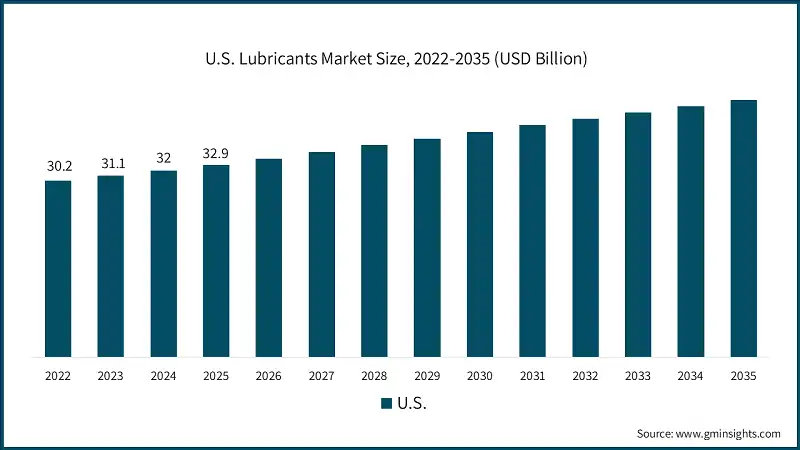
The North America Lubricants market is growing rapidly on the global level with a market share of 23.7% in 2025.
- Lubricant innovation and acceptance have all been primed within North America, all with the added complement of manufacturing excellence and a superior safety and sustainability regulatory framework.
U.S. dominates the North America Lubricants market, showcasing strong growth potential.
- While the United States remains the regional driver of policies encouraging modernizing fleets, improving energy efficiency, and utilizing clean materials, these measures have helped the U.S. to become an important player in shaping lubricant technology trends.
Europe Lubricants Market the industry with revenue of USD 30.9 billion in 2025 and is anticipated to show lucrative growth over the forecast period.
- Europe is one of the potential key growth regions for lubricants- driven by stringent environmental regulations and advanced industrial infrastructures. Sustainability and energy efficiency efforts drive the increased adoption of premium synthetic and bio-based lubricants.
Germany dominates the European Lubricants market, showcasing strong growth potential.
- Germany is the leading market in Europe, supported by the strong automotive and industrial base, advanced engineering capabilities, and the proactive regulatory frameworks that the country possesses.
The Asia Pacific Lubricants Market is anticipated to grow at a CAGR of 4.0% during the analysis timeframe.
- Asia-Pacific have positioned the region as the most dynamic growth area for the market. The region's strong manufacturing base, coupled with increasing transportation networks, generates significant demand for high-performance lubricants.
China Lubricants Market is estimated to grow with a significant CAGR in the Asia Pacific region.
- The regional growth is being led by China, propelled by its automotive industry, heavy machinery production, and sustainability efforts. The rapid adoption of synthetic and bio-based lubricants induced by China's shift toward cleaner technologies and energy-efficient.
Latin America Lubricants accounted for 7.3% market share in 2025 and is anticipated to show highest growth over the forecast period.
- Latin America is becoming a promising growth region for lubricants due to increasing industrial activity, modernization of infrastructure, and rising investment in energy projects.
Brazil leads the Latin American Lubricants market, exhibiting remarkable growth during the analysis period.
- Brazil is leading the Latin American market by adopting high-performance lubricants, aided by its industrial strength and maritime infrastructure.
Middle East & Africa Lubricants accounted for 5.7% market share in 2025 and is anticipated to show lucrative growth over the forecast period.
- With rapid development of industrial infrastructure, maritime activities, and energy projects, the Middle East and Africa are gradually emerging as potential markets. Economic diversification and sustainability-promoting policies provide good grounds for developing advanced lubricant technologies which meet global performance and compliance standards.
Saudi Arabia Lubricants industry to experience substantial growth in the Middle East and Africa Lubricants market in 2025.
- Saudi Arabia has become a major growth engine of the region, taking advantage from the industrial transformation agenda to drive the introduction of innovative lubricant solutions.
Lubricants Market Share
The top 5 companies in lubricants industry include Shell plc, ExxonMobil Corporation, TotalEnergies SE, BP plc (Castrol), Chevron Corporation. These are prominent companies operating in their respective regions covering approximately 42% of the market share in 2025. These companies hold strong positions due to their extensive experience in market. Their diverse product portfolios, backed by robust production capabilities and distribution networks, enable them to meet the rising demand across various regions.
- Shell PLC Shell is a world-spanning energy firm with a portfolio that comprises diversified interests in oil, gas, chemicals, and renewable energy. Shell's advanced formulations are aimed at protecting and enhancing equipment performance, driving emissions down, and enabling sustainability goals to be accomplished.
- ExxonMobil is a large international energy supply company, noted especially for its oil and gas products. The company emphasizes the high-performance synthetic lubricants intended for extreme conditions and fuel efficiency in advertising its lubricant products.
- TotalEnergies is positioned as a broad energy company with significant activities in lubricants, with solutions of performance and environmental responsibility.
- BP plc (Castrol) offers a complete range of lubricants that cover automotive, industrial, and marine applications through its Castrol brand.
- Chevron Corporation is one of the largest integrated companies in energy and owns a lubricants business that services automotive, industrial, and marine areas.
Lubricants Market Companies
Major players operating in the lubricants industry include:
- Shell plc
- ExxonMobil Corporation
- TotalEnergies SE
- BP plc (Castrol)
- Chevron Corporation
- FUCHS Group
- Valvoline Inc
- PetroChina Company Limited
- Sinopec Lubricant Company
- Indian Oil Corporation Limited (IOCL)
- ENEOS Corporation
- Petronas Lubricants International
- Lukoil
- Klüber Lubrication (Freudenberg Group)
Lubricants Market Report Attributes
| Key Takeaway | Details |
|---|---|
| Market Size & Growth | |
| Base Year | 2025 |
| Market Size in 2025 | USD 166.7 Billion |
| Market Size in 2026 | USD 173.1 Billion |
| Forecast Period 2026-2035 CAGR | 3.2% |
| Market Size in 2035 | USD 230.7 Billion |
| Key Market Trends | |
| Drivers | Impact |
| Growing automotive production & vehicle part | Increases the demand for formulations of much improved performance |
| Industrial manufacturing expansion | Increasingly drive up such machinerys reliability and productivity |
| Stringent emission regulations driving synthetic adoption | Increases the movement speed toward synthesization |
| Pitfalls & Challenges | Impact |
| Volatility in crude oil & base oil prices | Margins pressure and instability over prices render ill effect on profitability margins for lubricant manufacturers |
| Shifts toward electric vehicles reducing lubricant demand | Numbers of oil amounts derived from former engines lessen with time and necessitate blending with other formulations compatible with EVs |
| Opportunities: | Impact |
| Bio-based & biodegradable lubricants growth | Open new revenues with sustainability mandates and eco-friendly tastes in consumers unlocked |
| Re-refined & circular economy lubricants | Cost-effectiveness ends up being a boon to competitive positioning while matching up to circular economy requirements |
| Market Leaders (2025) | |
| Market Leaders |
11.8% |
| Top Players |
|
| Competitive Edge |
|
| Regional Insights | |
| Largest Market | Asia Pacific |
| Fastest growing market | Asia Pacific |
| Emerging countries | India, China, Japan |
| Future outlook |
|
What are the growth opportunities in this market?
Lubricants Industry News
- In October 2025, at the Taj Dubai Business Bay, Klüber Lubrication honoured with the Green Energy Efficiency Initiative Award at the 15th Edition of the Asian Leadership Awards, Dubai — a distinction that celebrates organizations rewriting the rulebook of industrial sustainability.
- In October 2025, Shell Lubricants India unveiled new range of advanced lubricants across auto segments. Developed with cutting-edge technology to cater to the diverse needs of passenger cars, two-wheelers, and pickup trucks. The launch underscores Shell’s continued focus on innovation, superior engine protection, and enhanced efficiency across its product lineup
These lubricants market research report includes in-depth coverage of the industry, with estimates & forecasts in terms of revenue (USD Billion) and volume (Kilo Tons) from 2022 to 2035, for the following segments:
Market, By Base Oil Type
- Mineral oil lubricants
- Group i (solvent-refined)
- Group ii (hydroprocessed)
- Group iii (severely hydroprocessed)
- Synthetic lubricants
- Group iv - polyalphaolefins (pao)
- Group v - synthetic esters
- Polyalkylene glycols (pag)
- Silicone-based lubricants
- Semi-synthetic/blends
- Bio-based/renewable lubricants
- Vegetable oil-based
- Animal fat-based
- Synthetic esters from renewable sources
Market, By Product Type
- Engine Oils
- Passenger Car Motor Oils (PCMO)
- Heavy-Duty Engine Oils (HDEO)
- Two-Stroke Engine Oils
- Marine Engine Oils
- Transmission Fluids
- Automatic Transmission Fluids (ATF)
- Manual Transmission Fluids
- Electric Vehicle Transmission Fluids
- Hydraulic Fluids
- Mineral Oil-Based Hydraulic Fluids
- Fire-Resistant Hydraulic Fluids
- Biodegradable Hydraulic Fluids
- Aviation Hydraulic Fluids
- Gear Oils
- Automotive Gear Oils
- Industrial Gear Oils
- Open Gear Compounds
- Greases
- Lithium/Lithium Complex Greases
- Calcium/Calcium Complex Greases
- Polyurea Greases
- Aluminum Complex Greases
- Other Thickener Types
- Metalworking Fluids
- Cutting Fluids
- Forming/Drawing Fluids
- Grinding Fluids
- Neat Cutting Oils
- Process Oils
- Rubber Process Oils
- Textile Oils
- White Oils
- Specialty Lubricants
- Compressor Oils
- Turbine Oils
- Refrigeration Oils
- Other Specialty Lubricants
Market, By Application
- Automotive
- Industrial manufacturing
- Marine
- Aerospace & defense
- Power generation
- Mining & construction
- Agriculture & off-highway
- Food & beverage processing
- Other industrial applications
Market, By Technology Type
- Conventional lubricants
- High-performance/fully synthetic
- Bio-based/biodegradable
- Re-refined/recycled
- Advanced technology
Market, By Distribution Channel
- OEM/direct channel
- Factory-fill lubricants
- Oem-branded products
- Direct industrial supply contracts
- Aftermarket channel
- Retail
- Wholesale
- Industrial distributors
- Industrial distributors
- Mro suppliers
- Specialty industrial distributors
The above information is provided for the following regions and countries:
- North America
- U.S.
- Canada
- Europe
- Germany
- UK
- France
- Spain
- Italy
- Rest of Europe
- Asia Pacific
- China
- India
- Japan
- Australia
- South Korea
- Rest of Asia Pacific
- Latin America
- Brazil
- Mexico
- Argentina
- Rest of Latin America
- Middle East and Africa
- Saudi Arabia
- South Africa
- UAE
- Rest of Middle East and Africa
Frequently Asked Question(FAQ) :
What was the market size of the lubricants market in 2025?
The global market was valued at USD 166.7 billion in 2025, with a CAGR of 3.2% projected through 2035, driven by the demand for sustainable and high-performance lubricants.
What is the projected value of the lubricants market by 2035?
The market is expected to reach USD 230.7 billion by 2035, fueled by advancements in bio-based lubricants, re-refined products, and increasing industrial applications.
What was the market share of mineral oil lubricants in 2025?
Mineral oil lubricants dominated the market with a 63.8% share in 2025 and are projected to grow at a CAGR of 2.6% by 2035.
Which product type held the largest market share in 2025?
Engine oils led the market with a 41.5% share in 2025 and are expected to grow at a CAGR of 2.6% during the forecast period (2026-2035).
What was the market share of the automotive segment in 2025?
The automotive segment accounted for 54.3% of the market in 2025 and is projected to grow at a CAGR of 2.4% by 2035.
Which technology type dominated the lubricants market in 2025?
Conventional lubricants held the largest share of 60.7% in 2025 and are expected to grow at a CAGR of 2.8% by 2035.
What was the market share of the aftermarket distribution channel in 2025?
The aftermarket channel led the market with a 48.4% share in 2025 and is projected to grow at a CAGR of 2.9% by 2035.
Which region held a significant share of the lubricants market in 2025?
North America accounted for 23.7% of the global market in 2025, driven by strong industrial and automotive sectors.
What are the key trends in the global lubricants industry?
Key trends include the growing adoption of bio-based and biodegradable lubricants, the shift toward re-refined products in line with circular economy models, and the increasing focus on sustainability and decarbonization goals.
Who are the major players in the global lubricants market?
Key players include Shell plc, ExxonMobil Corporation, TotalEnergies SE, BP plc (Castrol), Chevron Corporation, FUCHS Group, Valvoline Inc, PetroChina Company Limited, Sinopec Lubricant Company, and Indian Oil Corporation Limited (IOCL).
Lubricants Market Scope
Related Reports