Summary
Table of Content

Low Voltage Distribution Panel Market
Get a free sample of this report
Form submitted successfully!
Error submitting form. Please try again.
Thank you!
Your inquiry has been received. Our team will reach out to you with the required details via email. To ensure that you don't miss their response, kindly remember to check your spam folder as well!
Request Sectional Data
Thank you!
Your inquiry has been received. Our team will reach out to you with the required details via email. To ensure that you don't miss their response, kindly remember to check your spam folder as well!
Form submitted successfully!
Error submitting form. Please try again.
Low Voltage Distribution Panel Market Size
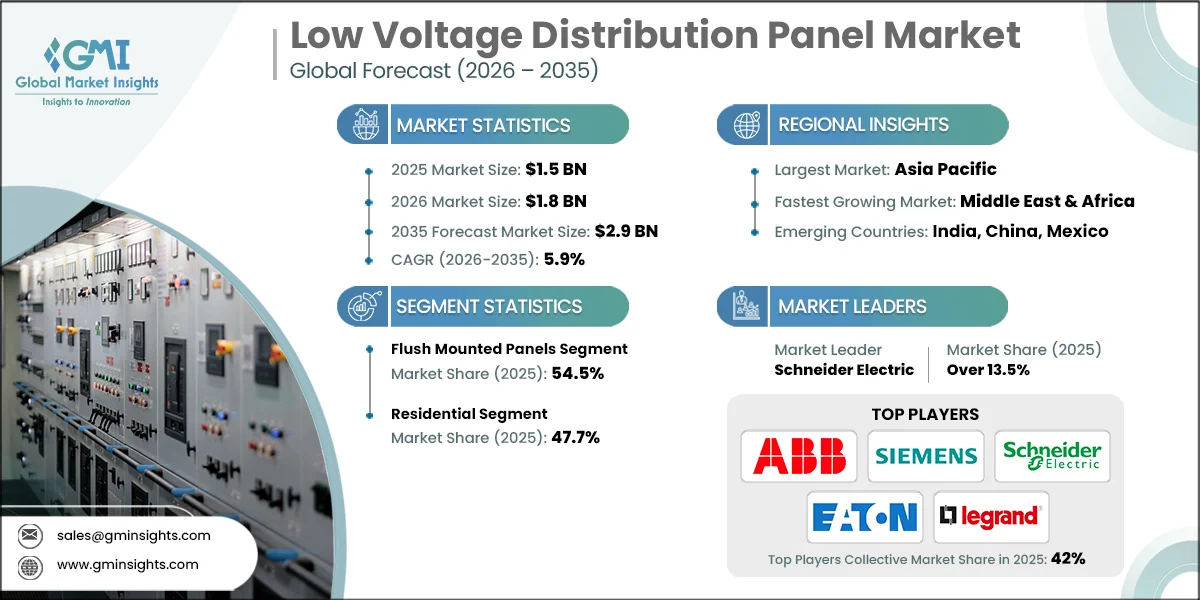
The low voltage distribution panel market was estimated at USD 1.5 billion in 2025. The market is expected to grow from USD 1.8 billion in 2026 to USD 2.9 billion by 2035, at a CAGR of 5.9%, according to a recent study by Global Market Insights Inc.
Low Voltage Distribution Panel Market Key Takeaways
Market Size & Growth
- 2025 Market Size: USD 1.5 Billion
- 2026 Market Size: USD 1.8 Billion
- 2035 Forecast Market Size: USD 2.9 Billion
- CAGR (2026–2035): 5.9%
Regional Dominance
- Largest Market: Asia Pacific
- Fastest Growing Region: Middle East & Africa
Key Market Drivers
- Rapid Urbanization and Construction Expansion.
- Rising Adoption of Renewable Energy Systems.
- Increasing Digitalization and Smart Grid Integration.
Challenges
- High Upfront Costs and Integration Complexity.
Opportunity
- Growing Demand for Energy‑Efficient and Green Buildings.
- Industrial Automation and Expansion of Manufacturing Facilities.
Key Players
- Market Leader: Schneider Electric led with over 13.5% market share in 2025.
- Leading Players: Top 5 players in this market include ABB, Siemens, Schneider Electric, Eaton, Legrand, which collectively held a market share of 42% in 2025.
Get Market Insights & Growth Opportunities
- Distributed renewables and behind‑the‑meter storage are driving upgrades to low‑voltage distribution panels in homes, commercial buildings and small industries, as more circuits need bidirectional metering, protection coordination and spare ways for inverters and batteries. For instance, IRENA reported that renewables additions reached a record 473 GW in 2023, representing 86% of global power capacity additions, an expansion that increases connection activity at distribution voltages and stimulates replacement of legacy panelboards with compliant assemblies.
- Rapid growth in data centres and AI workloads is raising demand for high‑density, resilient low‑voltage power distribution, panelboards, sub‑distribution boards and remote power panels, capable of tighter monitoring and selective coordination. For instance, the IEA’s 2025 Energy and AI analysis projects global electricity demand from data centres will more than double by 2030 to about 945 TWh, indicating accelerated buildouts that require expanded internal LV distribution architectures, redundancy and fast maintenance isolation at the rack and room level.
- Expansion of electric‑vehicle charging infrastructure is accelerating upgrades of building and site electrical rooms, where low‑voltage distribution panels must accommodate new feeder circuits, load management and revenue‑grade metering. For example, the IEA’s Global EV Outlook 2024 notes that the global number of public charging points was almost 4 million in 2023 and could exceed 15 million by 2030 under stated policies, signaling sustained deployment of chargers that typically trigger panelboard upsizing, additional breakers and smarter distribution monitoring.
- Distribution‑grid resilience and capacity investment is a strong demand catalyst for low‑voltage distribution panels used in critical facilities, community microgrids and upgraded service entrances. For instance, the U.S. Department of Energy announced up to USD 3.46 billion in GRIP program selections in October 2023 for 58 projects across 44 states to strengthen grid resilience and reliability, projects that commonly include downstream upgrades in building switchboards and low‑voltage feeder panels tied to new microgrids.
- Utility distribution modernization and loss‑reduction programmes are boosting demand for low‑voltage distribution panels in secondary substations, distribution transformers and consumer interface points. For instance, India’s Ministry of Power reported the RDSS has an outlay of USD 33.0 billion and explicitly funds prepaid smart metering plus upgradation of distribution infrastructure during FY2021‑22 to FY2025‑26. Such network strengthening typically requires new LT panels, feeder pillars and metering cubicles.
- Building regulation and EV‑readiness mandates are pushing developers to redesign low‑voltage distribution boards to support EV‑ready parking, load balancing and digital controls. For instance, the revised Energy Performance of Buildings Directive (EU) 2024/1275 entered into force in May 2024 and includes requirements for recharging points and “pre‑cabling” in certain new and renovated buildings, directly increasing the specification of larger panelboards, additional outgoing ways and monitoring devices during new builds and major refurbishments.
- Saudi Arabia – Renewable procurement and new grid connections are expanding demand for low‑voltage distribution panels inside solar and wind plants and for auxiliary loads at new substations and industrial zones. For instance, the Saudi Press Agency reported that SPPC issued an RFQ in September 2024 for Round 6 of the National Renewable Energy Program totaling 4,500 MW across solar PV and wind projects. Each project requires LV auxiliary distribution, protection and metering panels for inverters, trackers, site buildings and O&M loads.
- Distributed‑generation policy certainty is accelerating rooftop solar adoption, driving upgrades of residential and commercial low‑voltage distribution panels to safely interconnect PV, implement backfeed protection and add monitoring. For example, Brazil’s federal Law No. 14.300 (Jan 2022) established the legal framework for micro‑ and mini‑distributed generation and the electricity compensation system, giving consumers clearer rights to connect generation at distribution level. This policy clarity tends to increase permitted connections and, consequently, replacement of undersized or outdated panelboards.
To get key market trends
Low Voltage Distribution Panel Market Trends
- Rising adoption of digital, connected low‑voltage panelboards is a core market trend, as facility owners demand circuit‑level metering, remote diagnostics and integration with building energy management systems. For instance, the IEA reported in June 2024 that total energy investment worldwide is expected to exceed USD 3 trillion in 2024 for the first time, with about USD 2 trillion going to clean technologies including grids, storage and efficiency, spending patterns that accelerate monitoring and upgrade cycles within LV distribution architectures.
- Standardization of public EV‑charging requirements is shaping panel design trends toward higher feeder capacity, dynamic load management and interoperable data interfaces. For example, the EU’s Alternative Fuels Infrastructure Regulation (EU) 2023/1804 has applied since 13 April 2024 and sets mandatory targets for publicly accessible recharging, including fleet‑based power output provisions and TEN‑T corridor coverage, which drives installation of smarter, expandable LV distribution panels at service areas, parking assets and urban nodes.
- Cybersecurity‑by‑design in smart distribution ecosystems is increasingly influencing specifications for LV distribution panels that include metering, communications or remote monitoring modules. For instance, the EU’s NIS 2 Directive (EU) 2022/2555 establishes measures for a high common level of cybersecurity across the Union and aims to safeguard continuity of essential services in key sectors, including energy, reinforcing procurement requirements for secure connectivity and incident‑ready architecture wherever distribution panels exchange operational data.
- Acceleration of advanced metering infrastructure (AMI) is shifting demand toward retrofit‑friendly consumer units and metering compartments with clearer segregation, sealing options and remote reading compatibility. For instance, the UK Department for Energy Security and Net Zero reported that, at end‑2024, about 38 million smart and advanced meters were installed across homes and small businesses in Great Britain, with 3.0 million installed during 2024, scale that typically triggers refurbishment of legacy LV panels to accommodate new metering and communications.
- Greater use of modular and prefabricated electrical assemblies is a notable trend, with builders favoring factory‑wired LV distribution panels and skids to compress schedules and reduce on‑site labor risk. This shifts procurement toward standardized form factors, plug‑in outgoing ways and tested internal separation, while also improving quality consistency. For panel manufacturers, it increases demand for configurable bill‑of‑materials, rapid kitting and documentation packages aligned to project digital handover requirements across regions.
- Product optimization for space, heat and fault performance is trending as electrified buildings add more end circuits for heat pumps, EV readiness, lifts and power‑dense tenants. LV distribution panels are increasingly specified with higher busbar ratings, improved thermal management, selective coordination across molded‑case breakers and more spare capacity for future loads. This trend favors modular bus systems, segregated neutral/earth arrangements and panel layouts that simplify maintenance in practice without expanding footprint.
- Sustainability and compliance expectations are reshaping LV distribution panel materials and lifecycle practices, including low‑carbon steel or aluminum options, halogen‑free wiring, and designs that enable component replacement rather than full panel change‑out. Buyers are also demanding traceability, recycling pathways and reduced packaging. In parallel, lead‑time volatility is encouraging regional sourcing of enclosures, breakers and metering modules, pushing manufacturers to dual‑qualify suppliers and redesign panels for interchangeable components without re‑testing entire assemblies.
Low Voltage Distribution Panel Market Analysis
Learn more about the key segments shaping this market
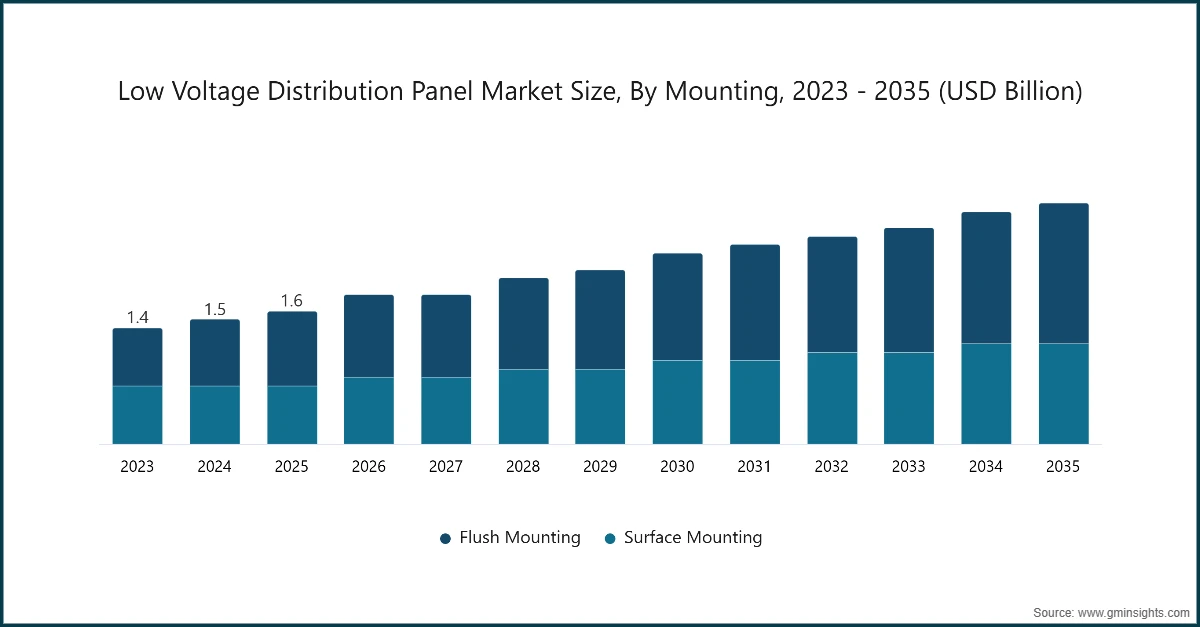
The low‑voltage (LV) distribution panel market, divided into surface‑mounted and flush‑mounted configurations, was valued at USD 1.4 billion in 2023, rising to USD 1.5 billion in 2024 and USD 1.6 billion in 2025. In 2025, flush‑mounted panels represent 54.5% of total revenue, driven primarily by their growing adoption in modern interior designs that prioritize compact, aesthetically integrated electrical installations.
- Growing residential electrification and retrofit activity is pushing demand toward flush‑mounted low‑voltage distribution panels that preserve usable floor area and deliver a clean, finished aesthetic in apartments and renovated homes. For instance, the U.S. Department of Energy stated in April 2024 that the Inflation Reduction Act’s Home Energy Rebates provide USD 8.8 billion to help install measures such as heat pumps, insulation and electrical panels, directly increasing replacement of aging in‑wall panelboards during upgrades.
- Government‑funded housing efficiency programmes are strengthening the trend toward flush‑mounted panels in multi‑dwelling retrofits, where recessed boards reduce corridor obstructions and improve tenant safety. For example, the UK government offered approximately USD 1.07 billion to 107 projects under Social Housing Decarbonization Fund Wave 2.1, alongside about USD 1.51 billion of match funding. The scale of works from 2023–2025 typically includes internal rewiring and consumer‑unit upgrades that favor recessed distribution boards.
- Design‑led commercial interiors are increasingly specifying flush‑mounted low‑voltage distribution panels in schools, clinics and offices to improve visual integration and reduce dust‑collecting ledges. This trend is reinforced by tighter expectations for accessibility, tamper resistance and cleaner wall lines in high‑traffic areas. Manufacturers are responding with slimmer enclosures, split‑load layouts and easier front‑access terminations that fit standard wall depths, enabling faster fit‑out while keeping final distribution close to loads and minimizing visible cabling.
- Industrial expansion and reshoring are boosting surface‑mounted low‑voltage distribution panels because they simplify maintenance access, future circuit additions and phased commissioning in large plants. For instance, the U.S. Department of Commerce announced in March 2024 preliminary terms to provide up to USD 8.5 billion in direct CHIPS Act funding for Intel projects across multiple states. Such multi‑site construction programs typically require extensive wall‑mounted panelboards and sub‑distribution boards in utilities corridors and equipment rooms.
- Highway‑corridor fast‑charging deployment is accelerating adoption of surface‑mounted, weather‑rated low‑voltage distribution panels that can be installed quickly on existing walls or plinths and expanded as charging capacity grows. For example, the U.S. Federal Highway Administration stated in February 2022 that the NEVI Formula Program will make nearly USD 5 billion available over five years to build a national EV charging network along designated corridors. Site build‑outs commonly add outdoor distribution panels for chargers, lighting and communications.
- Across warehouses, logistics hubs and small industrial sites, surface‑mounted low‑voltage distribution panels are trending for retrofit work because they avoid wall cutting, reduce downtime and keep wiring modifications visible for inspection. End users increasingly prefer modular surface enclosures with spare ways, labelled circuits and add‑on metering compartments to support energy management and tenant sub‑billing. This approach also suits temporary power and phased renovations, where panels may be relocated or reconfigured as space layouts and equipment loads change.
Learn more about the key segments shaping this market
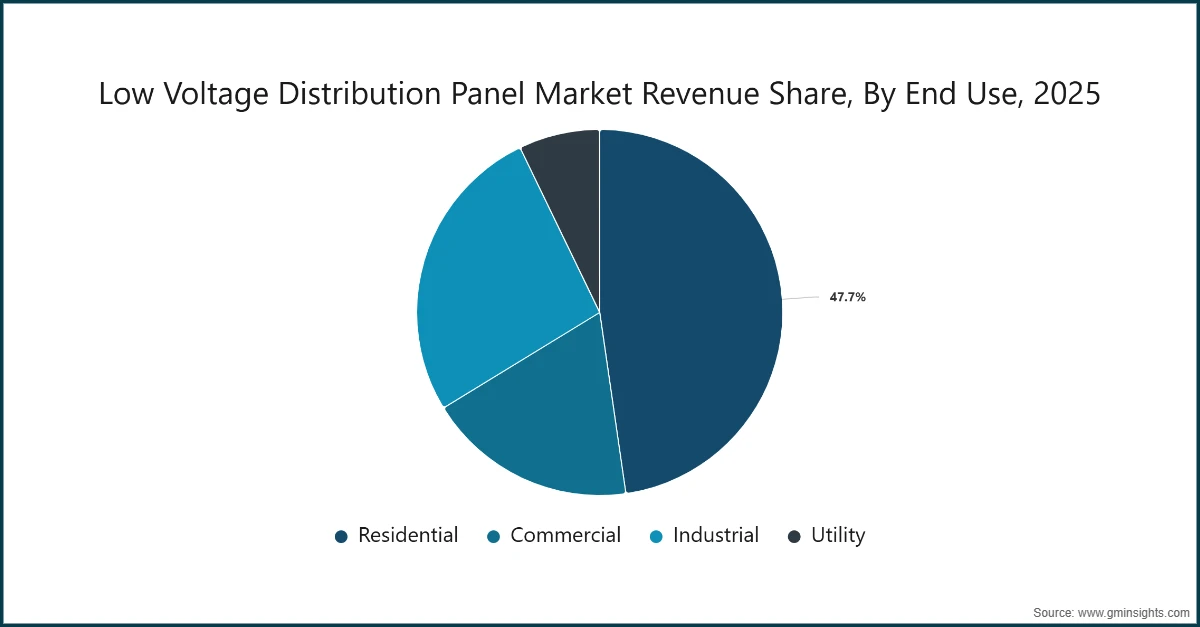
Based on end use, the industry is bifurcated into residential, commercial, industrial and utility. The residential scale low voltage distribution panel market holds a share of 47.7% in 2025 and is set to reach over USD 1.3 billion by 2035.
- Residential end users represent the largest share of low‑voltage distribution panel demand because panelboards are replaced frequently during remodelling, electrification, and safety upgrades across a vast installed housing base. For instance, the U.S. Census Bureau reported residential construction at a seasonally adjusted annual rate of USD 939.5 billion in December 2024, and total 2024 residential construction of USD 917.9 billion, activity levels that translate into sustained purchases of new consumer units and branch distribution panels.
- In residential applications, the market is trending toward compact, code‑compliant panels that support more branch circuits for heat pumps, induction cooking, rooftop solar backfeed, and EV charging while improving homeowner visibility through smart metering add‑ons. Contractors increasingly specify panels with spare ways, plug‑on neutral designs, and clearer labelling to speed installation and reduce call‑backs. Demand is also rising for arc‑fault and ground‑fault protection integration at the panel level, which drives higher value per home installation.
- Industrial end users account for the second‑largest share as plant expansions require dense, reliable final distribution to motors, process skids, lighting, and auxiliary systems served at low voltage. For instance, the U.S. Department of the Treasury noted in June 2023 that real manufacturing construction spending has doubled since the end of 2021, with much of the growth in computer, electronic, and electrical manufacturing facilities, projects that typically deploy large numbers of wall‑mounted panelboards and sub‑distribution panels across production areas.
- Industrial buyers are prioritizing maintainability and uptime, driving demand for rugged, surface‑mounted distribution panels with clear circuit segregation, thermal headroom, and expansion capacity for new lines. Facilities are also adopting standardized panel layouts across sites to simplify spares, documentation, and technician training. In addition, energy management programs are pushing more submetering at the panel level, which increases demand for panels with integrated meter compartments and communications‑ready spaces without moving into medium‑voltage switchgear scope.
- Commercial end users rank third, with demand concentrated in offices, retail, healthcare, and public facilities where frequent tenant improvements and efficiency retrofits trigger panel reconfiguration and replacement. For instance, the U.S. General Services Administration announced in June 2024 plans to invest USD 80 million in smart building technologies across an estimated 560 federal buildings, including installing about 1,000 new meters, work that typically requires upgrades to low‑voltage distribution panels to accommodate submetering and control wiring.
- In commercial buildings, low‑voltage distribution panels are increasingly specified to support flexible floorplans, distributed IT loads, and EV‑ready parking without major electrical room rebuilds. Designers favor panelboards with modular branch protection, higher bus ratings, and provisions for load‑management controllers tied to building automation. Another trend is closer‑to‑load electrical distribution, more sub‑panels per floor or zone, to reduce conductor runs, improve fault localization, and enable faster after‑hours maintenance in occupied facilities.
- Utilities represent the smallest end‑use share, but demand is rising where utilities harden distribution networks and add monitoring at service points, street‑lighting cabinets, and secondary substations that rely on low‑voltage panels for auxiliary power and metering. For instance, the U.S. Department of Energy’s Grid Resilience State and Tribal Formula Grants program is designed to distribute USD 2.3 billion over five years to strengthen and modernize grids against extreme events, funding projects that commonly include new low‑voltage distribution and control panels.
- Utility use cases increasingly emphasize standardized, outdoor‑rated low‑voltage panels for feeder automation, capacitor banks, communications shelters, and microgrid tie‑ins where auxiliary circuits must be protected and easily serviced. As distributed energy resources proliferate, utilities also add metering and protection at more nodes, increasing the need for compact panel assemblies with secure enclosures and clear separations for telecom and power. While smaller in volume than buildings, these projects often specify higher environmental and reliability requirements.
Looking for region specific data?
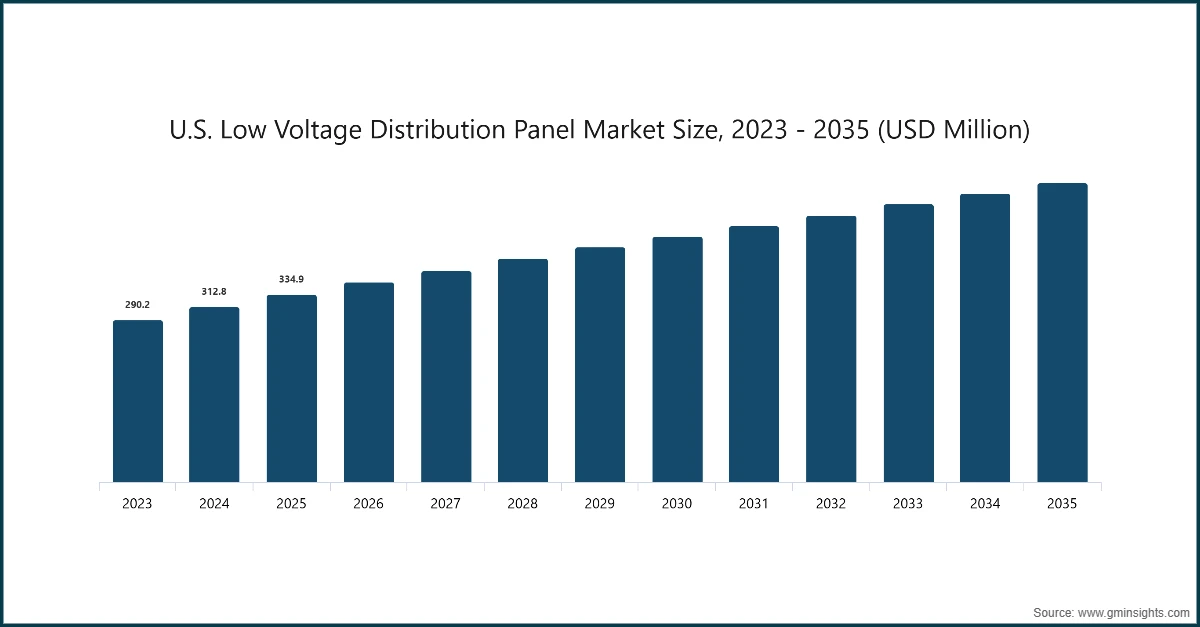
The U.S. low voltage distribution panel market was valued at USD 290.2 million in 2023, rising to USD 312.8 million in 2024 and USD 334.9 million in 2025. Growth is increasingly supported by expanding commercial construction activity and rising demand for modern, energy‑efficient electrical distribution systems.
In the U.S., demand for low‑voltage distribution panels is being reinforced by deep retrofit activity in federal facilities, where electrification and efficiency projects often require new panelboards, subpanels, and upgraded protection schemes. For example, the U.S. General Services Administration (GSA) announced in June 2023 that it planned to use USD 975 million in Inflation Reduction Act funding to upgrade federal buildings with emerging and sustainable technologies, leveraging additional financing to deploy roughly USD 1.9 billion in total, workstreams that typically expand low‑voltage distribution capacity and add building‑level metering.
- Across North America, the accelerating build‑out of EV charging and electrification projects is translating into incremental demand for low‑voltage distribution panels, particularly in multi‑unit housing and workplace settings where new circuits, feeder upgrades, and load management are installed. A useful example is Canada’s Zero Emission Vehicle Infrastructure Program (ZEVIP), for which Natural Resources Canada reports funding commitments of USD 460 million from 2019–20 through 2026–27 to support EV charging and hydrogen refueling infrastructure, deployments that commonly trigger service upgrades and new distribution panels at sites.
- Within Europe, Germany’s industrial investment cycle is supporting low‑voltage distribution panel demand through large, power‑intensive projects that require extensive final distribution across cleanrooms, utilities, and supporting buildings. For instance, the European Commission approved a USD 1 billion German State aid measure in February 2025 to support Infineon’s new semiconductor manufacturing facility in Dresden as part of a USD 4.13 billion investment program, a scale of build‑out that typically drives significant low‑voltage distribution and sub‑distribution board installations.
- In the Asia‑Pacific region, South Korea’s smart‑grid modernization and advanced metering push is creating steady demand for low‑voltage panels that integrate metering, communications readiness, and safer circuit protection, especially in dense apartment blocks and commercial buildings.
- As one illustration, Korea’s smart‑grid program documentation shows government subsidies totaling USD 1.3 billion for 2020–2022 AMI deployment targeting about 2.45 million households, and these rollouts often require refurbishment of low‑voltage distribution panels, metering compartments, and associated wiring layouts.
- Across the Middle East & Africa, South Africa’s grid‑resilience and energy‑transition pipeline is pushing utilities and public agencies to add auxiliary distribution, control power, and metering panels at substations and critical facilities. For example, South Africa’s Just Energy Transition progress reporting notes international pledges increasing to USD 13.8 billion, alongside institutional mechanisms and a funding platform intended to match projects with grants, investment frameworks that commonly translate into new low‑voltage distribution and control panels across transmission and resilience projects.
- In Latin America, Mexico’s long‑horizon electricity planning is supporting low‑voltage distribution panel demand through expansion and modernization activities across networks and public infrastructure, including secondary substations and municipal facilities.
- For instance, Mexico’s energy authority (SENER) describes PRODESEN 2023–2037 as incorporating programs for expansion and modernization of the National Transmission Network and the General Distribution Networks, defining infrastructure to be developed over a 15‑year horizon, work that typically requires low‑voltage auxiliary boards, feeders, and upgraded panel assemblies.
Low Voltage Distribution Panel Market Share
- The top five industry leaders, ABB, Siemens, Schneider Electric, Eaton, and Legrand, are projected to account for approximately 42% of the global low‑voltage distribution panel market in 2025, reflecting their extensive portfolios, strong technological capabilities, and firmly established international presence.
- Schneider Electric maintains a dominant position in the low‑voltage distribution panel market due to its extensive product ecosystem, global distribution network, and leadership in smart electrical infrastructure. It is consistently ranked as a top-tier player across LV panel market assessments, supported by a wide portfolio that includes panelboards, breakers, digital monitoring, and energy‑management technologies. Its innovation‑led approach and strong presence in commercial, industrial, and residential segments reinforce its sizable global market share.
- Siemens commands a strong share of the LV distribution panel market by leveraging its deep expertise in industrial automation, smart grid integration, and digital power systems. The company’s LV panels, switchboards, and protection systems meet advanced global standards, making them preferred in manufacturing, utilities, and infrastructure projects worldwide. Siemens’ consistent inclusion among the global market leaders highlights its technological leadership, reliability, and broad customer base. This sustained strength helps secure its significant role in the global LV distribution landscape.
- ABB holds a substantial market share through its comprehensive low‑voltage product range, including distribution panels, breakers, control devices, and digital enclosures. Its global footprint and long-standing presence in power distribution make it a trusted supplier across industrial, commercial, and utility projects. ABB is consistently cited among the major players shaping the LV panel market, supported by strong innovation, automation expertise, and investment in advanced manufacturing. These strengths enable ABB to maintain broad relevance and competitiveness worldwide.
Low Voltage Distribution Panel Market Companies
- Eaton’s low-voltage portfolio spans Pow‑R‑Line Xpert panelboards and switchboards, pairing Power Defense breakers with embedded communications, metering, and breaker-health diagnostics to support data centers, healthcare, and industrial sites worldwide. In 2024, Eaton reported net sales of USD 24.878 billion, with Electrical Americas segment sales of USD 11.436 billion, scale and profitability that fund continued capacity expansion, innovation, and channel reach, helping it defend share in LV distribution panels where lead times and service support matter.
- Legrand competes through integrated LV enclosures and distribution solutions such as the XL³ range (up to 4,000A) that supports multiple implementation styles and broad breaker compatibility, enabling standardized panel builds across commercial and industrial projects. Financially, Legrand’s 2024 full-year results showed +3.9% sales growth, a 20.5% adjusted operating margin, and USD 1.5 billion free cash flow, cash generation that sustains product launches and acquisitions supporting its LV panel ecosystem.
- Hager’s distribution-systems lineup covers small distribution boards through large cabinets, including the quadro evo platform for scalable commercial assemblies with enhanced safety and modularity. This breadth helps panel builders standardize across residential-to-tertiary projects while staying within IEC/assembly practices. As a privately held group, Hager reported 2023 turnover of USD 3.8 billion and reinvested 5% of sales into R&D, supporting steady product refreshes and digital add-ons that reinforce share in LV distribution boards and cabinets.
- Larsen & Toubro’s electrical offering (via its Electrical & Automation ecosystem) includes power distribution boards, MDB, SMDB and final distribution boards, alongside switchgear components like ACBs and MCCBs, targeting buildings, utilities, and industry. Financial strength comes from L&T’s scale: FY2024–25 revenue from operations USD 28.3 billion, order inflow USD 39.5 billion, and a record order book USD 64.2 billion, enabling sustained investments in manufacturing, service, and project-led panel demand.
Major players operating in the low voltage distribution panel industry are:
- ABB
- AGS
- Alfanar Group
- EAMFCO
- Eaton
- ESL Power Systems
- Evolution Interconnect System
- GE Vernova
- Hager Group
- Industrial Electric MFG
- Larsen & Toubro
- Legrand
- Maverick Power
- Meba Electric
- NHP
- Norelco
- Projoy Electric
- Schneider Electric
- Siemens
- TOSUNlux
Low Voltage Distribution Panel Market Report Attributes
| Key Takeaway | Details |
|---|---|
| Market Size & Growth | |
| Base Year | 2025 |
| Market Size in 2025 | USD 1.5 Billion |
| Market Size in 2026 | USD 1.8 Billion |
| Forecast Period 2026-2035 CAGR | 5.9% |
| Market Size in 2035 | USD 2.9 Billion |
| Key Market Trends | |
| Drivers | Impact |
| Rapid Urbanization and Construction Expansion | Accelerating urban development, smart housing projects, and commercial infrastructure growth increase demand for reliable low‑voltage distribution panels. These panels support electrical safety, space optimization, and load management, making them essential in new buildings, retrofits, and energy‑efficient construction. |
| Rising Adoption of Renewable Energy Systems | Distributed solar, EV charging, and hybrid energy systems require upgraded low‑voltage panels for safe power distribution, monitoring, and load balancing. As decentralized energy grows, modern panels with metering, breakers, and surge protection become indispensable to meet regulatory compliance and safety needs. |
| Increasing Digitalization and Smart Grid Integration | Utilities and industries are adopting IoT‑enabled panels with communication modules, sensors, and remote‑monitoring capabilities. These intelligent panels enhance reliability, detect faults early, and support automation, driving their adoption in industrial plants, commercial complexes, and digitally enabled power networks. |
| Pitfalls & Challenges | Impact |
| High Upfront Costs and Integration Complexity | Advanced low‑voltage panels with smart features, metering, and communication modules carry higher upfront costs. Integrating them into legacy electrical systems can require redesigns, specialized labor, and downtime, slowing adoption among price‑sensitive users and limiting uptake in older buildings. |
| Opportunities: | Impact |
| Growing Demand for Energy‑Efficient and Green Buildings | Global efficiency standards and green‑building certifications are pushing adoption of panels with energy monitoring, harmonics control, and power‑quality optimization. Manufacturers can leverage this trend by offering eco‑designed, compact, and smart panels tailored for sustainable residential and commercial installations. |
| Industrial Automation and Expansion of Manufacturing Facilities | Modern factories require precise power distribution, reliable protection, and digital diagnostics. Low‑voltage panels supporting automation, motor control centres, and predictive maintenance create significant opportunities, especially in emerging markets undergoing industrial expansion and adopting Industry 4.0 technologies. |
| Market Leaders (2025) | |
| Market Leader |
Over 13.5% Market Share |
| Top Players |
Collective Market Share of 42% |
| Competitive Edge |
|
| Regional Insights | |
| Largest Market | Asia Pacific |
| Fastest growing market | Middle East & Africa |
| Emerging countries | India, China, Mexico |
| Future outlook |
|
What are the growth opportunities in this market?
Low Voltage Distribution Panel Industry News
- In June 2025, Eaton and Siemens Energy announced a partnership to fast-track new data center capacity by combining modular construction with integrated on-site power generation. Siemens Energy’s standard concept centers on a scalable 500‑MW plant using SGT‑800 gas turbines, redundancy, and battery storage, while Eaton supplies medium- and low-voltage switchgear, UPS, busways, and engineering/software. The companies said parallel build-and-power deployment can cut time-to-market by up to two years, boosting demand for LV distribution equipment.
- In December 2024, Legrand disclosed the acquisition of Toronto-based Power Bus Way, a provider of custom-designed cable bus power feeder systems for data centers, industrial sites, and large commercial facilities. Legrand said the move expands its portfolio from a standardized, field-adjustable cable bus option to a fully engineered, end-to-end solution—reducing on-site labor and improving delivery for fast-track builds. These feeder systems connect into low-voltage distribution panels and switchboards, strengthening Legrand’s data-center “grey space” offer.
- In October 2024, Hager Group announced it had acquired France-based advizeo, a specialist in building energy management services and monitoring software, to accelerate its expansion in energy services for commercial and public buildings. The deal strengthens Hager’s mid-size commercial building offer and complements its energy-control capabilities, supporting projects that often require upgraded low-voltage distribution panels with better metering, monitoring, and load control.
The low voltage distribution panel market research report includes in-depth coverage of the industry with estimates & forecast in terms of revenue (USD Million) from 2022 to 2035, for the following segments:
Market, By Mounting
- Flush mounting
- Surface mounting
Market, By End Use
- Residential
- Commercial
- Industrial
- Utility
The above information has been provided for the following regions & countries:
- North America
- U.S.
- Canada
- Europe
- UK
- France
- Germany
- Russia
- Italy
- Asia Pacific
- China
- Australia
- India
- Japan
- South Korea
- Middle East & Africa
- Saudi Arabia
- UAE
- Qatar
- South Africa
- Egypt
- Latin America
- Brazil
- Argentina
- Mexico
Frequently Asked Question(FAQ) :
What was the market size of the low voltage distribution panel market in 2025?
The market size was USD 1.5 billion in 2025, with a CAGR of 5.9% projected through 2035, driven by the rising adoption of digital, connected low-voltage panelboards and increasing investments in clean technologies.
What is the projected value of the low voltage distribution panel Industry by 2035?
The market is expected to reach USD 2.9 billion by 2035, fueled by advancements in energy-efficient electrical distribution systems and the standardization of public EV-charging requirements.
What is the projected size of the low voltage distribution panel market in 2026?
The market is expected to grow to USD 1.8 billion in 2026.
What was the market share of flush-mounted panels in 2025?
Flush-mounted panels accounted for 54.5% of the market in 2025, driven by their growing adoption in modern interior designs that prioritize compact and aesthetically integrated electrical installations.
What was the market share of the residential segment in 2025?
The residential segment held a 47.7% market share in 2025 and is projected to surpass USD 1.3 billion by 2035.
Which region leads the low voltage distribution panel market?
The U.S. was a key market in 2025, valued at USD 334.9 million. Growth in the region is supported by expanding commercial construction activity and rising demand for modern, energy-efficient electrical distribution systems.
Who are the key players in the low voltage distribution panel market?
Major players include ABB, AGS, Alfanar Group, EAMFCO, Eaton, ESL Power Systems, Evolution Interconnect System, GE Vernova, Hager Group, Industrial Electric MFG, Larsen & Toubro, and Legrand.
Low Voltage Distribution Panel Market Scope
Related Reports