Summary
Table of Content

Living Room Furniture Market
Get a free sample of this report
Form submitted successfully!
Error submitting form. Please try again.
Thank you!
Your inquiry has been received. Our team will reach out to you with the required details via email. To ensure that you don't miss their response, kindly remember to check your spam folder as well!
Request Sectional Data
Thank you!
Your inquiry has been received. Our team will reach out to you with the required details via email. To ensure that you don't miss their response, kindly remember to check your spam folder as well!
Form submitted successfully!
Error submitting form. Please try again.
Living Room Furniture Market Size
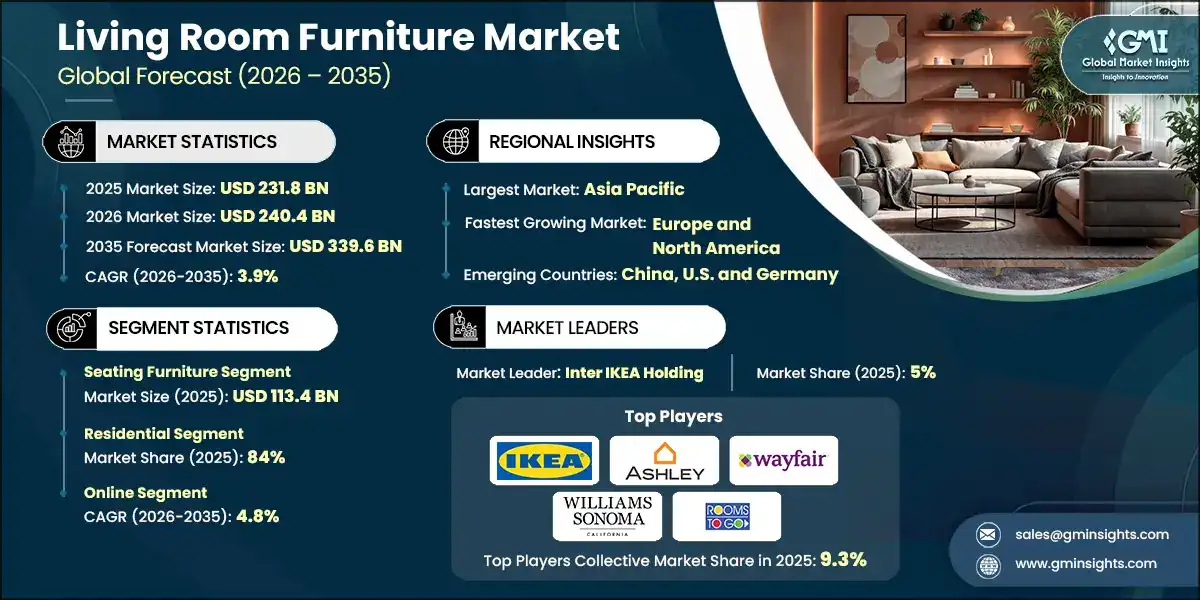
The global living room furniture market size was estimated at USD 231.8 billion in 2025. The market is expected to grow from USD 240.4 billion in 2026 to USD 339.6 billion in 2035, at a CAGR of 3.9% according to latest report published by Global Market Insights Inc.
Living Room Furniture Market Key Takeaways
Market Size & Growth
- 2025 Market Size: USD 231.8 Billion
- 2026 Market Size: USD 240.4 Billion
- 2035 Forecast Market Size: USD 339.6 Billion
- CAGR (2026–2035): 3.9%
Regional Dominance
- Largest Market: Asia Pacific
- Fastest Growing Region: Europe and North America
Key Market Drivers
- Increasing consumer preference for multifunctional and space-saving furniture.
- Growing urbanization and expansion of residential spaces.
Challenges
- Fluctuating raw material prices.
- High competition among market players.
Opportunity
- Growing demand for eco-friendly and sustainable furniture solutions.
- Technological advancements, such as smart furniture.
Key Players
- Market Leader: Inter IKEA Holding led with over 5% market share in 2025.
- Leading Players: Top 5 players in this market include Inter IKEA Holding, Ashley Furniture, Wayfair, Williams-Sonoma, Rooms To Go, which collectively held a market share of 9.3% in 2025.
Get Market Insights & Growth Opportunities
The market for living room furniture is expanding due to the increasing consumer demand for aesthetically appealing and multifunctional furniture, coupled with rising disposable incomes and urbanization trends.
Consumer spending on home decor and home improvement is further fueling the demand for luxury furniture market. According to the Home Stratosphere, China was top in overall spending on home improvement, topping the chart at $994.54 billion, while the U.S. was close behind at $932.77 billion.
A distant third on the list was India at $286.85 billion. Segmenting expenditures by category, American consumers expended $65.63 billion on living room furniture, $41.87 billion on bedroom furniture, $34.61 billion on dining room and kitchen furniture, $16.85 billion on office furniture, $28.38 billion on lighting and $31.28 billion on décor.
The increasing trend towards compact and modular furniture, particularly in Metro cities where maximizing space is of prime importance, is further boosting the growth of the marketplace. In addition, the increasing availability of online shopping platforms has made it quite easy for customers to buy all sorts of furniture products.
Innovations in furniture technology, including the development of eco-friendly furniture and the integration of intelligent furniture technology, have also proved instrumental in influencing the market.
Consumers’ increasing interest in green and long-lasting furniture has led companies to innovate based on these consumer demands. With customers being influenced by interior design trends and the growing interest in home renovation, consumers are being encouraged to invest in good-quality living room furniture.
Region-wise, the market is growing in emerging nations because of fast urbanization and an increased middle class. Developed nations, on the other hand, are experiencing steady demand because of replacement sales and an emphasis on customized furniture.
To get key market trends
Living Room Furniture Market Trends
- There is an emerging trend towards high-end, custom, and designer furniture among consumers. Consumers are increasingly looking for unique and personalized designs that convey their status, comfort, and style, making the luxury furniture as preferred choice.
- To cater the personalized furniture demand Versace Home exemplifies developed new collections. Electric blue, fuchsia pink, and sunny yellow are some of the bright colors that overwhelm their designs, providing customers with the chance to design interiors according to the need. This kind of customization makes furniture a one-of-a-kind expression of the owner's personality and lifestyle.
- Designers predict darker woods, or darker finishes on lighter woods becoming the trend. Sustainability has become more crucial than ever for customers and businesses alike therefore, customs have made furniture less of a luxury idea, and more of an intelligent investment.
- Furnitech Luxe, India's premier producer of upholstered furniture launches the latest Boho collection of green furniture. The complete collection is composed of reusable fabric made from recycled plastic PET bottles, eco-friendly materials, VOC-free adhesives, and breathable foam made from 100% natural rubber plant, making it a pure green line of furniture.
- As living spaces become more compact, especially in urban areas the demand for multi-use and functional furniture is higher than ever. From sofa beds that easily transform into comfortable guest sleeping arrangements to storage ottomans that double as seating, functional furniture is a must-have.
- Trend of smaller spaces, especially in urban settings, has triggered a huge requirement in the marketplace for smaller furniture designs. Modular furniture, with its flexibility and customization features, has been aggressively accepted in the marketplace.
- Technologies are also impacting the market, and a trend that has emerged here is the development of “smart furniture.” The inclusion of features such as wireless charging systems and sound systems into living room furniture is becoming quite popular among tech-conscious consumers.
- Color is also boasting a bold comeback. As Sugarman explains, “These trends are driven by the UK’s design influences, and jewel colors and bright colors like magenta and tangerine are emerging.”
Living Room Furniture Market Analysis
Learn more about the key segments shaping this market
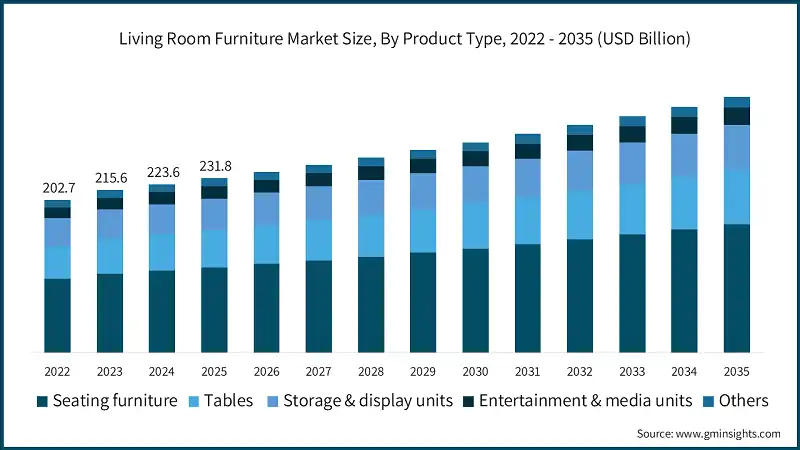
Based on the product type, the market is divided into seating furniture, tables, storage & display units, entertainment & media units, and others. In 2025, seating furniture dominated the market, generating revenue of USD 113.4 billion and expected to grow at a CAGR of 4.2% during the forecast period.
- The seating furniture sector is expected to grow significantly during the forecast period. This is attributed to the rising demand for comfortable and aesthetic furniture, especially among the urban population.
- Rising disposable incomes and a preference for modular and multi-functional sitting solutions also contribute to this segment’s growth. Additionally, the trend associated with home renovation and interior design personalization also works to foster high-end sitting solution adoption.
- The “tables” category is expected to grow steadily during the forecast period, driven by increasing demand for flexible furniture that utilizes space efficiently. The growing demand for foldable tables, commonly found in smaller homes, is a key driver that propels this category to grow.
- In addition to this, due to the rise in remote work, there has been a huge demand for functional and ergonomically designed tables. To cater to this demand, various new and advanced designs and materials are being introduced.
Learn more about the key segments shaping this market
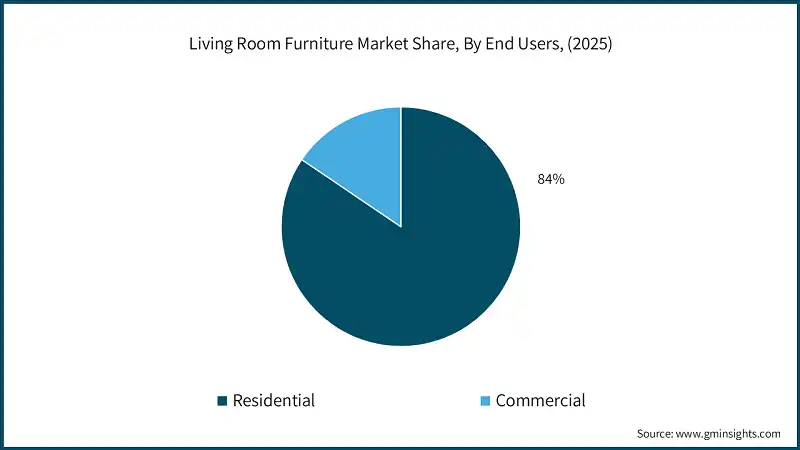
Based on end users, the living room furniture market is segmented into residential and commercial. In 2025, Residential segment dominates the market with 84% market share, and the segment is expected to grow at a CAGR of 3.8% from 2026 to 2035.
- The residential market is expected to grow rapidly over the forecast period, with rising levels of urbanization and rising consumer spending. Consumers are investing in furniture that is aesthetically pleasing as well as functional.
- Rising home renovation and interior decoration trends are also adding to this demand. Increasing numbers of e-commerce sites providing options in distinct kinds of living room furniture have also contributed to this growth.
- The commercial sector is likely to grow steadily with growing hospitality and business sector. Hotels, restaurants, and offices are increasingly opting for contemporary as well as ergonomic furniture to ensure enhanced customer satisfaction and employee efficiency.
Based on distribution channel, the living room furniture market is segmented into online and offline. In 2025, the online segment is expected to grow at a CAGR of 4.8% from 2026 to 2035.
- Offline channels, such as upscale showrooms, upscale furniture stores, and luxury department stores, provide an experiential and physical shopping experience that customers find appealing.
- Offline stores provide customers with an opportunity to directly interact with the furniture, test quality, and feel the luxury environments, which is imperative in high-ticket items like living room furniture. Additionally, offline channels often offer advanced customer service, including professional counsel and assistance in selecting one-of-a-kind and tailored furniture pieces.
- Stanley Lifestyles, a premium furniture and home interiors brand, has made a major expansion in India, entering one of India's fastest-growing premium home interiors markets. The company has opened a huge 12,000-square-foot Stanley Living store in the city as part of its national growth strategy.
Looking for region specific data?
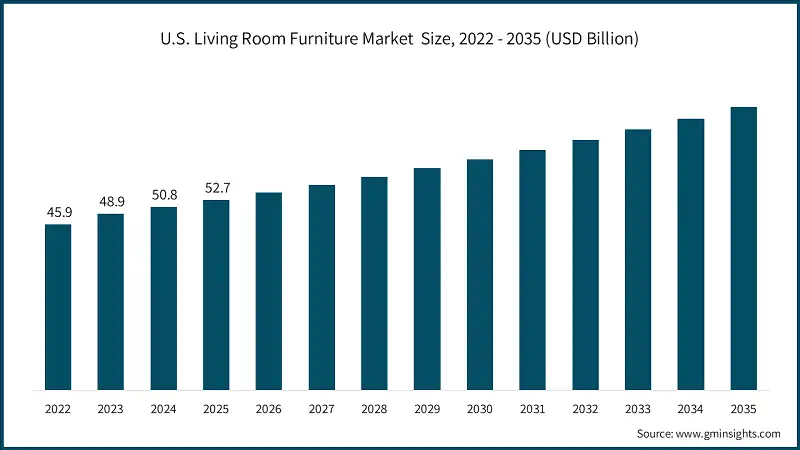
In terms of country, the U.S. led the living room furniture market with 77% of the North American market share and estimated USD 52.7 billion in revenue during 2025.
- The growth in the U.S. market is driven by advancements in consumer spending on home improvement and interior design, and growth in disposable incomes.
- Requirements for multi-functional and space-saving furniture are also fueling the market expansion as urbanization and reduced living space are on a rise. Furthermore, the trend toward buying furniture online is providing customers with greater choices, thus accelerating the growth within the market.
- Factors like the increasing number of residential projects under construction and the trend towards sustainable and environment-friendly furniture are also having a positive impact on the market.
- As per the Coldwell Banker Global Luxury program, the year-over-year annual price of single-family residences in the luxury residential market increased by 7.6%, whereas in the conventional residential market it increased by 3%, according to the report.
- According to the report, after the sales ratio percentage of the luxury market for single-family residences was 22.3% in 2023, which indicated a seller's market, it had shifted to 19.4% in year 2024, which indicates a balanced market. This trend is likely to follow through in 2025.
The Europe living room furniture market was valued at USD 59.5 billion in 2025 and is projected to grow at a CAGR of 3.6% between 2026 and 2035.
- The European market is growing steadily due to higher demand from consumers for modern and multifunctional designs of furniture. The higher disposal incomes and increased urbanization in this market further drive this expansion.
- France, Germany, and the United Kingdom are some of the most prominent contributing nations because of their strong furniture-making industry and consumer spending on home furnishings.
The Asia Pacific living room furniture market was valued at USD 74.1 billion in 2025 and is projected to grow at a CAGR of 4.4% between 2026 and 2035.
- The Asia Pacific living room furniture industry is growing at a substantial pace due to major developments such as a rise in the urban population, growing spending capacity, and changing consumer trends. Major countries like China, India, and Japan dominate the market.
The Middle East and Africa market was valued at USD 13.8 billion in 2025 and is projected to grow at a CAGR of 3.1% between 2026 and 2035.
- Some such factors are the rise in urbanization, an increase in disposable income, and an increased demand for modern and multi-functional furniture. Also, the growing real estate industry and the adoption of the e-commerce model are further triggering demand.
Living Room Furniture Market Share
- The top 5 companies in the market are Inter Ikea Holding, Ashley Furniture, Wayfair, Williams-Sonoma, and Rooms to Go collectively hold a share of 9.3% in the market.
- These companies continue to acquire and merge with others, expand facilities, and make various collaborations to increase their product offerings, access customer bases, and secure their market positions.
- Inter Ikea Holding is increasing market share by making use of the brand recognition they have developed across the globe. The firm is engaged in developing furniture solutions that are not only affordable but also functional and sustainable. This is because their innovative flat pack solution saves on costs.
- Ashley Furniture maintains its position in the market by innovating its products and offering them at competitive prices and with a strong retail presence. The company focuses on good craftsmanship and numerous design choices to meet the divergent demands of its consumers. It also has a vertically integrated supply chain to offer cost-effective and speedy delivery services to its customers.
- Wayfair leverages its strong online presence to capture market share in the market. The company provides a wide variety of products, along with easy search functionality and suggestions, which are major advantages to customers. Wayfair’s emphasis on data-driven marketing and targeted ads on social media platforms aids in customer acquisition and retention.
- Williams-Sonoma holds on to its share in the industry with an emphasis on offering the best quality furnishings as well as customer service. The company caters to the customers with high purchasing power through its upmarket home furnishings product line. The company's omnichannel approach makes it easy for customers to shop.
Living Room Furniture Market Companies
Major players operating in the living room furniture industry are:
- Ashley Furniture
- B&B Italia
- BoConcept
- Burrow
- Emeco
- Flexsteel
- Herman Miller
- Inter Ikea Holding
- Knoll
- RH
- Rooms To Go
- Skyline Furniture
- Steelcase
- Wayfair
- Williams-Sonoma
To improve the product and market share key players are constantly investing in technological activities and are also entering into partnerships to provide improved and better solutions for the customers. These investments are benefiting both companies and customers as they help develop and offer solutions as per the changing technological trends and thus the customer requirements.
Herman Miller is a world-renowned company known for the design and manufacturing of quality furniture. It is a leader in providing innovative and ergonomic designs. The company was founded in the year 1905 and has managed to create a distinct identity in the market since then. Its range of products includes chairs, tables, storage furniture, and accessories. The company is known to focus on sustainability and ergonomics.
Knoll is a well-established manufacturer of furniture that focuses primarily on modern product designs. Since 1938, this company has been noted for its association with some of the finest designers in the world. The product categories of Knoll involve seating options, tables, desks, as well as storage solutions.
RH, previously known as Restoration Hardware, is a luxury home furnishings and décor retailer that provides a carefully edited selection of high-end offerings. This company is dedicated to building elegant and enduring designs for those who value high-end residential environments. RH’s product lines consist of living-room furnishings and accessories designed with great attention to detail and quality.
Steelcase is a world leader in designing and manufacturing innovative furniture solutions for work environments as well as residential settings. Founded in 1912, Steelcase is recognized as a research-based company that focuses on developing sustainable furniture solutions. The portfolio of Steelcase includes furniture such as seating, desks, storage, and collaboration solutions that can facilitate productivity.
Living Room Furniture Market Report Attributes
| Key Takeaway | Details |
|---|---|
| Market Size & Growth | |
| Base Year | 2025 |
| Market Size in 2025 | USD 231.8 Billion |
| Market Size in 2026 | USD 240.4 Billion |
| Forecast Period 2026 - 2035 CAGR | 3.9% |
| Market Size in 2035 | USD 339.6 Billion |
| Key Market Trends | |
| Drivers | Impact |
| Increasing consumer preference for multifunctional and space-saving furniture | This trend is driving innovation in product design, leading to higher adoption rates and market growth. |
| Growing urbanization and expansion of residential spaces | Urbanization is increasing the need for modern living room furniture, particularly in emerging economies, positively impacting market growth. |
| Pitfalls & Challenges | Impact |
| Fluctuating raw material prices | Variability in material costs is affecting production expenses and profit margins, posing a challenge for manufacturers. |
| High competition among market players | Intense competition is leading to price wars, which can reduce profitability and hinder market growth. |
| Opportunities: | Impact |
| Growing demand for eco-friendly and sustainable furniture solutions | This trend is creating opportunities for manufacturers to innovate and cater to environmentally conscious consumers, driving market growth. |
| Technological advancements, such as smart furniture | Integration of IoT features in furniture is attracting tech-savvy consumers, opening new revenue streams for the market. |
| Market Leaders (2025) | |
| Market Leaders |
5% market share |
| Top Players |
|
| Competitive Edge |
|
| Regional Insights | |
| Largest Market | Asia Pacific |
| Fastest growing market | Europe and North America |
| Emerging countries | China, U.S. and Germany |
| Future outlook |
|
What are the growth opportunities in this market?
Living Room Furniture Industry News
- In July 2025, the renowned British architectural designer has revealed the Pawson Drift Sofa group, a new seating collection for Herman Miller. With cocooning solid-wood frames and pillowy cushions, the graceful perches are ideal for aesthetes and loafers like.
- In March 2025, RH announced the release of its RH Interiors Spring 2025 Sourcebook, debuting new collections from the imaginations of a range of designers and artisans. The new collection features a rich mahogany brown and an elegant white from the Alicante region of Spain, a subtle grey from the nearby province of Murcia, and tones of deep black, warm crema and gold unearthed from the mountains of Türkiye.
- In August 2024, Steelcase teamed up with the Frank Lloyd Wright Foundation to introduce two modern furniture collections inspired by the legendary architect’s later residential projects. These collections, known as Rockford and Galesburg, are rooted in designs from the extensive archives of the Frank Lloyd Wright Foundation (FLWF). Know more about it on Furniture Design and Technology (FDT).
- In November 2023, Rooms to Go introduced an unprecedented furniture collaboration with home renovation experts and entrepreneurs Drew and Jonathan Scott. The highly anticipated Drew & Jonathan for Rooms to Go collection offers stylish and functional solutions to transform the way families experience their homes.
The living room furniture market research report includes in-depth coverage of the industry with estimates & forecasts in terms of revenue (USD Billion) and volume (Thousand Units) from 2022 to 2035, for the following segments:
Market, By Product Type
- Seating furniture
- Sofas
- Sectionals
- Armchairs
- Recliners
- Ottomans
- Others (benches etc.)
- Tables
- Coffee tables
- Side tables
- End tables
- Console tables
- Others (accent tables etc.)
- Storage & display units
- Bookcases
- Shelving units
- Cabinets
- Others (display cases etc.)
- Entertainment & media units
- TV stands
- entertainment centers
- Others (media consoles etc.)
- Others (room dividers, decorative furniture etc.)
Market, By Material Type
- Wood furniture
- Upholstered furniture
- Metal furniture
- Glass furniture
- Plastic & composite materials
- Mixed materials
Market, By Design Style
- Traditional
- Modern/contemporary
- Transitional
- Mid-century modern
- Others (rustic/farmhouse etc.)
Market, By Price
- Up to $499
- $500 to 999
- $1000 to $1499
- Above $1500
Market, By End Use
- Residential
- Commercial
Market, By Distribution Channel
- Online
- E-commerce
- Company websites
- Offline
- Supermarkets/hypermarket
- Big-box retailers
- Others (designer studios etc.)
The above information is provided for the following regions and countries:
- North America
- U.S.
- Canada
- Europe
- Germany
- UK
- France
- Spain
- Italy
- Netherlands
- Asia Pacific
- China
- Japan
- India
- Australia
- South Korea
- Latin America
- Brazil
- Mexico
- Argentina
- MEA
- South Africa
- Saudi Arabia
- UAE
Frequently Asked Question(FAQ) :
What is the market size of the living room furniture market in 2025?
The global market for living room furniture was valued at USD 231.8 billion in 2025, driven by rising consumer spending on home décor and increasing urbanization.
What is the projected value of the living room furniture market by 2035?
The market is expected to reach USD 339.6 billion by 2035, growing at a CAGR of 3.9% from 2026 to 2035, supported by compact living trends, modular furniture adoption, and smart furniture integration.
What will the market value of the living room furniture industry be in 2026?
The market is projected to reach USD 240.4 billion in 2026, reflecting steady growth at the start of the forecast period due to continued residential construction and renovation activities.
Which product type segment generated the highest revenue in 2025?
Seating furniture dominated the market, generating USD 113.4 billion in revenue in 2025, driven by high demand for sofas, sectionals, recliners, and modular seating solutions in urban households.
Which end-user segment dominates the living room furniture industry?
The residential segment dominated the market with an 84% share in 2025, supported by rising home ownership, renovation trends, and increased preference for personalized interior design.
What are the upcoming trends in the living room furniture market?
Key trends include growth of modular and space-saving furniture, rising demand for eco-friendly and sustainable materials, increasing adoption of smart furniture with IoT features, and preference for customized and premium designs.
Who are the key players in the living room furniture market?
Major players include Inter IKEA Holding, Ashley Furniture, Wayfair, Williams-Sonoma, Rooms To Go, Herman Miller, Steelcase, RH, Knoll, and BoConcept.
Living Room Furniture Market Scope
Related Reports