Summary
Table of Content

Livestock Monitoring Robot Market
Get a free sample of this report
Form submitted successfully!
Error submitting form. Please try again.
Thank you!
Your inquiry has been received. Our team will reach out to you with the required details via email. To ensure that you don't miss their response, kindly remember to check your spam folder as well!
Request Sectional Data
Thank you!
Your inquiry has been received. Our team will reach out to you with the required details via email. To ensure that you don't miss their response, kindly remember to check your spam folder as well!
Form submitted successfully!
Error submitting form. Please try again.
Livestock Monitoring Robot Market Size
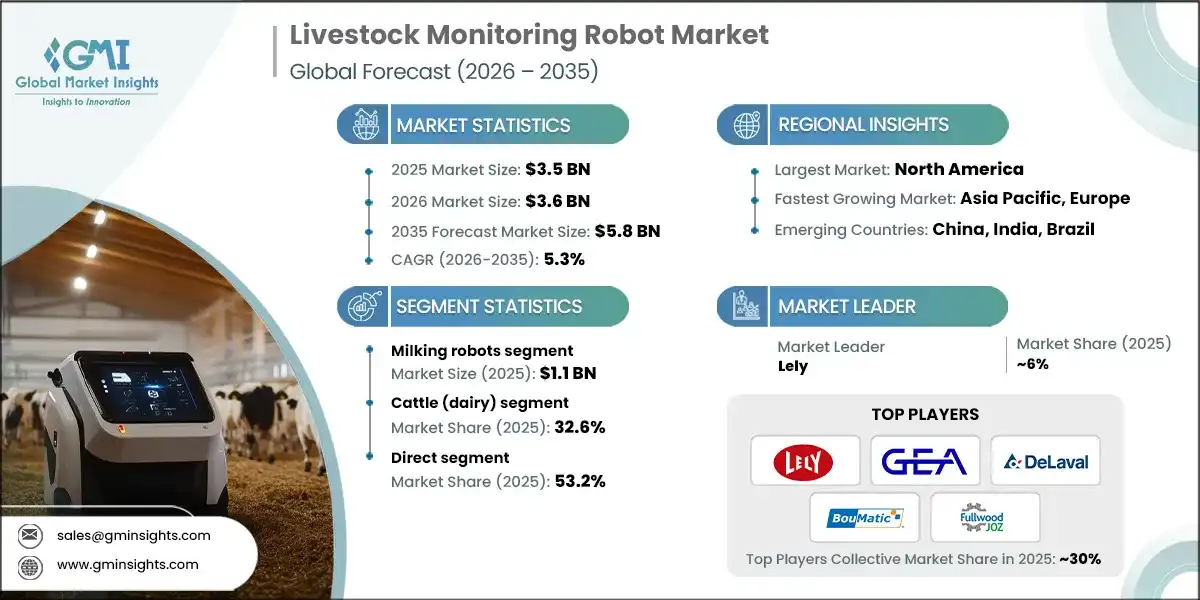
The livestock monitoring robot market was estimated at USD 3.5 billion in 2025. The market is expected to grow from USD 3.6 billion in 2026 to USD 5.8 billion in 2035, at a CAGR of 5.3% according to latest report published by Global Market Insights Inc.
Livestock Monitoring Robot Market Key Takeaways
Market Size & Growth
- 2025 Market Size: USD 3.5 Billion
- 2026 Market Size: USD 3.6 Billion
- 2035 Forecast Market Size: USD 5.8 Billion
- CAGR (2026–2035): 5.3%
Regional Dominance
- Largest Market: North America
- Fastest Growing Region: Asia Pacific, Europe
Key Market Drivers
- Growing demand for animal protein.
- Precision livestock farming adoption.
- IoT & AI advancements.
Challenges
- High initial investment.
- Infrastructure requirement.
Opportunity
- AI-powered predictive health monitoring.
- Integrated farm management platforms.
Key Players
- Market Leader: Lely led with over 6% market share in 2025.
- Leading Players: Top 5 players in this market include Lely, GEA Group, DeLaval, BouMatic, Fullwood JOZ, which collectively held a market share of 30% in 2025.
Get Market Insights & Growth Opportunities
- With the increase in population growth globally, along with increased disposable incomes for people in developing nations, the demand for meat, milk, and eggs and other forms of animal protein products is higher than the current supply; this high level of demand is putting extreme pressure on producers of livestock to increase their production capabilities while also ensuring the quality and sustainability of their product.
- In many areas, while traditional means of producing livestock do exist, those methods are not able to produce the desired volumes to meet the increasing consumer demand due to their reliance on outdated methods and they are also reliant upon excessive levels of manual labor and therefore do not utilize the same levels of efficiency as new technologies to provide the growing amounts of animal protein products needed. Therefore, it is necessary for producers of livestock to find new methods of producing livestock that allow them to remain competitive in the market, while also providing for a reasonable amount of animal welfare as well as the ability to produce efficiently.
- Livestock monitoring robots, which are currently being developed, present new potential opportunities to address this problem. The use of livestock monitoring robots automates many of the processes associated with livestock production and thus improves productivity and animal health through the automation of critical functions such as feeding, milking, and health monitoring. The livestock monitoring robots utilize robotics technology to create optimal living conditions for livestock, while at the same time reducing the risk of disease and minimizing farm operational inefficiencies through the removal of human intervention in these aspects of livestock production. As an example, by utilizing automated feeding robotics to dispense feed to individual dairy cows based on their nutritional requirements and automated milking robotics to extract clean, consistent milk from dairy cows, dairy farmers can produce higher quality milk, in greater quantities, using fewer resources compared to producing milk via conventional means.
- The adoption of robotic technologies in livestock management is further driven by the increasing focus on sustainability and animal welfare. Consumers are becoming more conscious of how their food is produced, demanding transparency and ethical practices in the supply chain. Livestock monitoring robots help farmers meet these expectations by ensuring that animals are raised in humane conditions and that resources such as water and feed are used efficiently. This not only enhances the overall productivity of farms but also aligns with global efforts to reduce the environmental impact of livestock farming.
- Robots are also significantly more cost-effective than human labor, which is often limited in supply and prices often continue to rise. By significantly reducing human error and improving productivity, robots can maintain more stable and consistent operations than humans, resulting in greater long term profitability of their livestock farmers.
- Just like PLF encompasses a lot of data-driven, agriculture-related technologies, it has led to an increased emphasis on automation of a range of processes to maximize livestock producer efficiency and profitability. Farmers today are utilizing more data-driven practices and using their data to detect and adjust to changing conditions on their farms, while monitoring their animals in real-time to decrease both waste and feed conversion ratios.
- Livestock-monitoring robots are playing a pivotal role in the growth of PLF through their use of machine learning, the IoT and AI to gather real-time data and enable automated decision making, such as feed adjustments and early identification of animal health issues, thus minimizing losses and increasing animal productivity. As PLF continues to grow in today’s livestock industry, robotic solutions are quickly becoming a vital component of efficient livestock operations.
To get key market trends
Livestock Monitoring Robot Market Trends
- The integration of IoT sensors and AI algorithms in robotic systems is revolutionizing the agricultural sector, particularly in livestock farming. These technologies enable robots to collect real-time data and perform predictive analytics, which are critical for improving operational efficiency. For instance, robots equipped with IoT and AI can monitor livestock health, detect diseases at an early stage, and optimize feeding schedules. This reduces the need for manual intervention, allowing farmers to focus on strategic decision-making. Additionally, these advancements contribute to better resource management, ensuring that farms operate more sustainably and profitably.
- Precision Livestock Farming (PLF) is gaining traction as farmers increasingly adopt data-driven approaches to enhance productivity and animal welfare. Robotic solutions are at the core of PLF, offering automated processes such as milking, feeding, and cleaning. These robots not only perform routine tasks but also provide actionable insights through integrated farm management platforms.
- Consumer preferences are shifting toward ethically produced animal products, prompting farms to adopt technologies that prioritize sustainability and animal welfare. Robotic systems play a crucial role in this transition by maintaining hygiene, monitoring livestock health, and reducing stress levels. For example, robots can ensure that animals have access to clean water and feed while maintaining optimal living conditions.
- The development of multi-functional robotic systems is addressing key challenges such as space and cost constraints, particularly for small and medium-sized farms. These robots combine multiple functions, including feeding, cleaning, and health monitoring, into a single unit. This integration reduces the need for multiple machines, thereby lowering capital and operational costs.
- The integration of robots with cloud-based farm management platforms is transforming how farmers monitor and manage their operations. These platforms enable remote access to real-time data, allowing farmers to oversee activities such as feeding schedules, health monitoring, and equipment maintenance from anywhere. Cloud connectivity also facilitates centralized decision-making, predictive maintenance, and seamless data sharing across devices. This level of integration enhances operational efficiency and ensures that farms can quickly adapt to changing conditions. Moreover, the use of cloud-based platforms supports collaboration among stakeholders, including veterinarians, suppliers, and farm managers.
Livestock Monitoring Robot Market Analysis
Learn more about the key segments shaping this market
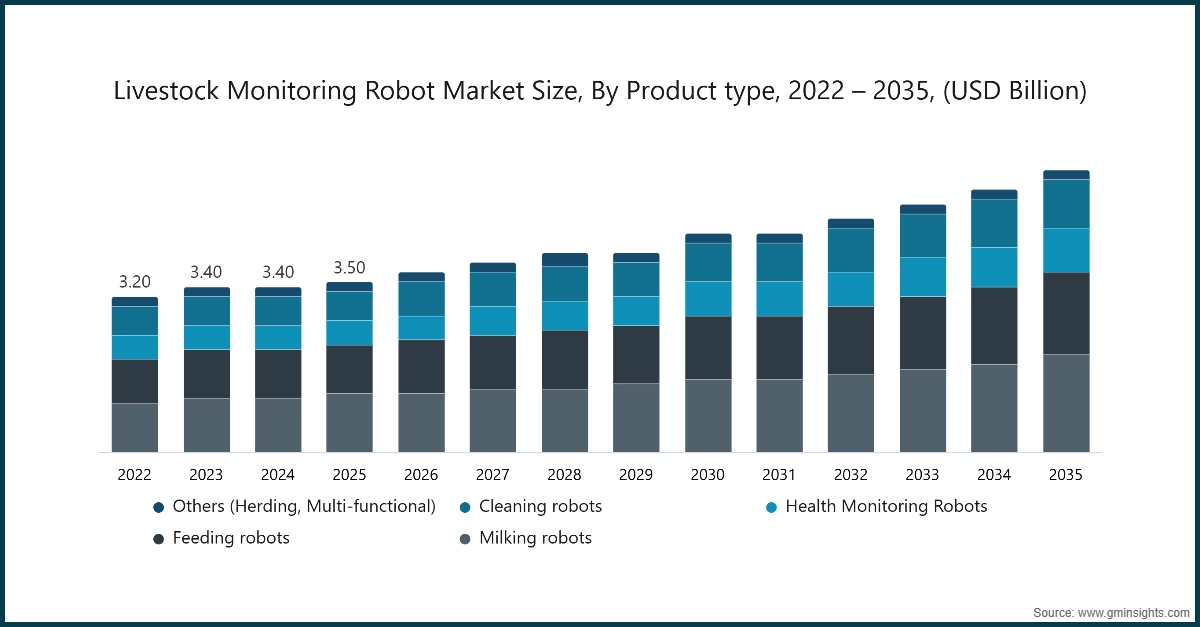
Based on robot type, the market is categorized into milking robots, feeding robots, health monitoring robots, cleaning robots and others (herding, multi-functional). The milking robots segment accounted for revenue of around USD 1.1 billion in 2025 and is anticipated to grow at a CAGR of 5.7% from 2026 to 2035.
- Milking robots hold the largest share in the livestock monitoring robot market, primarily due to the labor-intensive nature of dairy farming. Automated milking systems (AMS) address the challenges of high-frequency milking operations by significantly reducing labor costs, enhancing milk yields, and improving animal welfare. These systems ensure stress-free milking, which directly contributes to better milk production and healthier livestock. Additionally, their ability to collect real-time health and production data during milking strengthens their role in precision livestock farming, enabling farmers to make data-driven decisions for improved productivity.
- The dominance of milking robots is further supported by their strong adoption in developed regions such as Europe and North America. Large-scale dairy farms in these regions prioritize efficiency and compliance with stringent animal welfare standards, making milking robots an essential investment. Continuous advancements in technology, including AI-powered teat detection, cloud-based performance analytics, and automated cleaning systems, ensure that milking robots remain at the forefront of livestock automation. These innovations not only enhance operational efficiency but also reduce the risk of errors, making them indispensable for modern dairy farming.

Learn more about the key segments shaping this market
Based on livestock type of market consists of cattle (dairy), cattle (beef), swine, poultry, sheep & goats and others. The cattle (dairy) segment emerged as leader and held 32.6% of the total market share in 2025 and is anticipated to grow at a CAGR of 5.6% from 2026 to 2035.
- The cattle (dairy) segment dominates the livestock monitoring market, driven by the global demand for milk and dairy products. Dairy farms require constant monitoring of animal health, feeding schedules, and milking operations to ensure optimal productivity and profitability. Robotic solutions have become a cornerstone for these farms, as they help maintain milk quality, reduce the risk of diseases, and optimize production cycles. By automating routine tasks, these systems allow farmers to focus on strategic decision-making and long-term planning.
- This segment's dominance is further reinforced by the integration of advanced technologies such as IoT sensors, AI-driven analytics, and machine learning algorithms in dairy operations. These technologies enable real-time monitoring and predictive insights, helping farmers address potential issues before they escalate.
- Large dairy farms in regions like Europe, North America, and emerging economies are increasingly investing in robotic milking and feeding systems to meet the growing demand for dairy products. These investments not only enhance operational efficiency but also position the dairy cattle segment as the most lucrative in the livestock monitoring market.
- Moreover, the adoption of sustainable farming practices has further boosted the demand for robotic solutions in the dairy sector. Automated systems help reduce resource wastage, lower greenhouse gas emissions, and ensure compliance with environmental regulations, making them a preferred choice for environmentally conscious farmers.
Based on distribution channel, the market consists of direct and indirect. The direct segment emerged as leader and held 53.2% of the total market share in 2025.
- Direct distribution channels dominate the livestock monitoring robot market, as farmers prefer purchasing robotic systems directly from manufacturers. This approach ensures better customization, seamless installation, and comprehensive after-sales support. Robotic systems often require tailored configurations and specialized training, which direct engagement with manufacturers facilitates. By working closely with farmers, manufacturers can provide integrated farm management solutions that address specific operational needs.
- This trend is particularly prominent in high-value markets, where farms are heavily investing in advanced automation technologies. Farmers in these regions expect not only cutting-edge robotic systems but also comprehensive service packages that include maintenance, upgrades, and technical support. Direct distribution channels enable manufacturers to meet these expectations while maintaining control over pricing, quality, and customer experience.
- Additionally, direct distribution helps manufacturers build long-term relationships with their customers, fostering trust and loyalty. By offering personalized solutions and ongoing support, manufacturers can ensure customer satisfaction and drive repeat business. This approach is especially critical for complex, high-tech livestock monitoring robots, where reliability and performance are paramount. As a result, direct distribution channels remain the preferred route for delivering sophisticated robotic solutions to the livestock industry.
Looking for region specific data?
North America Livestock Monitoring Robot Market
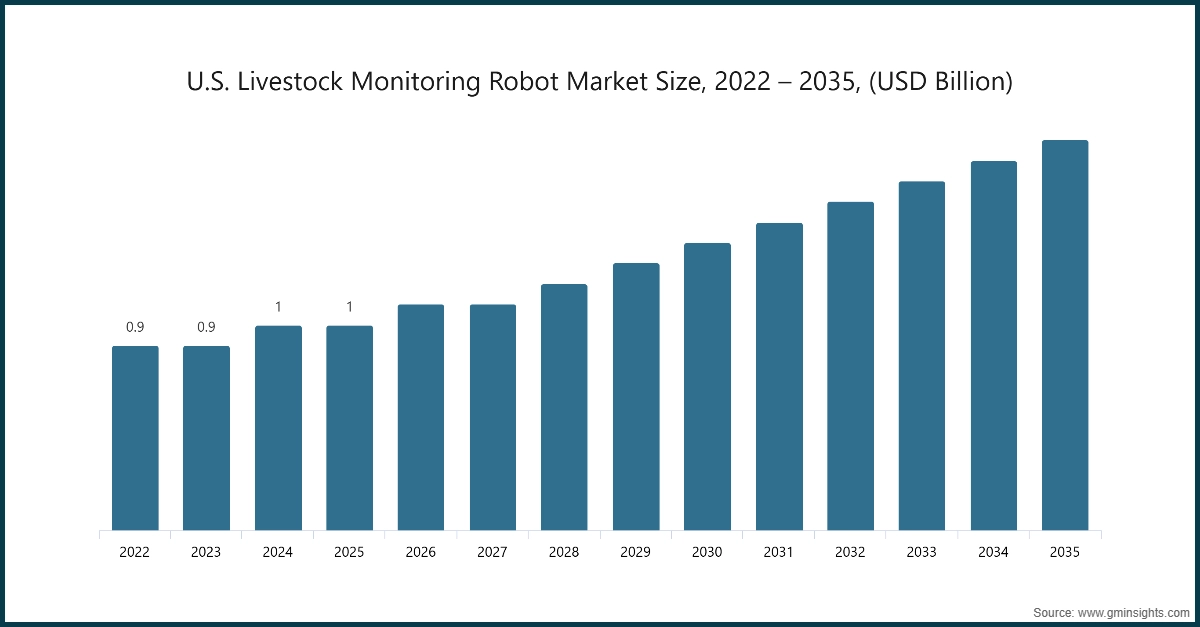
The U.S. dominates an overall North America market and valued at USD 1 billion in 2025 and is estimated to grow at a CAGR of 6.7% from 2026 to 2035.
- The U.S. dominates the market due to its highly industrialized livestock sector and strong adoption of precision farming technologies. Large-scale dairy farms, coupled with labor shortages, have accelerated the deployment of milking and feeding robots. Government support for smart agriculture and the presence of leading technology providers further strengthen its leadership position.
- Additionally, U.S. farmers prioritize efficiency and animal welfare compliance, driving investments in IoT-enabled and AI-powered robotic systems. The country’s advanced infrastructure and high purchasing power make it a key hub for innovation and early adoption of integrated farm management platforms.
Europe Livestock Monitoring Robot Market
In the European market, Germany is expected to experience significant and promising growth from 2026 to 2035.
- Germany leads in Europe thanks to its advanced dairy industry and strong emphasis on sustainability and animal welfare. The country has a well-established network of precision livestock farming practices, supported by government incentives and strict regulatory standards. German farms are early adopters of robotic milking systems, which align with their focus on quality and efficiency.
- Moreover, Germany’s robust manufacturing base and technological expertise foster continuous innovation in livestock automation. Partnerships between agri-tech companies and research institutions ensure that German farms remain at the forefront of smart farming solutions.
Asia Pacific Livestock Monitoring Robot Market
In the Asia Pacific market, the China held 34.3% market share in 2025 and is anticipated to grow at a CAGR of 5.8% from 2026 to 2035.
- China is emerging as a dominant force in Asia-Pacific due to its massive livestock population and rising demand for animal protein. Rapid urbanization and income growth have increased meat and dairy consumption, prompting farms to adopt automation for higher productivity. Government initiatives promoting smart agriculture and food security further accelerate this trend.
- China’s investment in IoT and AI technologies, combined with local manufacturing capabilities, is driving the development of cost-effective robotic solutions. This positions China as both a major consumer and producer in the livestock monitoring robot market.
Middle East and Africa Livestock Monitoring Robot Market
In the Middle East and Africa market, South Africa held 50.2% market share in 2025 promising growth from 2026 to 2035.
- South Africa is a leading market in Africa, driven by its growing livestock sector and increasing focus on disease control and productivity. Farmers are adopting robotic solutions to overcome labor shortages and improve herd health, particularly in dairy and beef operations. The country’s push toward modernizing agriculture through technology adoption supports this growth.
- While infrastructure challenges remain, South Africa benefits from government programs and private investments aimed at enhancing agri-tech capabilities. This makes it a strategic entry point for vendors targeting the African market.
Livestock Monitoring Robot Market Share
In 2025, the prominent manufacturers in market are collectively held the market share of ~30%.
Lely dominates the market through its comprehensive dairy automation ecosystem, including robotic milking, feeding, and cleaning solutions. Its strength lies in integrating these systems with advanced farm management software, enabling real-time data analytics and precision livestock farming. This holistic approach reduces operational complexity and positions Lely as a leader in efficiency and animal welfare.
GEA’s competitive edge is its scalable robotic milking solutions, which cater to both mid-sized and large farms. Its modular systems and global service network ensure flexibility and reliability, making it a preferred choice for farms seeking high-throughput automation. GEA’s focus on integrating herd management tools with milking technology enhances productivity and compliance with welfare standards.
Livestock Monitoring Robot Market Companies
Major players operating in the market include:
- AMS Galaxy USA
- AT-Collections B.V.
- BouMatic
- Cormall A/S
- Dairymaster
- DeLaval
- Fullwood JOZ
- GEA Group
- HETWIN Automation Systems GmbH
- Lely
- Milkomax
- Swine Robotics, Inc.
- System Happel GmbH
- Trioliet B.V.
- Waikato Milking Systems
DeLaval stands out for its advanced milking technology combined with strong after-sales support. Its robotic systems offer precision teat preparation, milk analysis, and health monitoring, all integrated into herd management platforms. This combination of innovation and service reliability makes DeLaval a trusted brand for farms prioritizing productivity and animal health.
BouMatic’s strength lies in durable, farmer-friendly designs that deliver automation without excessive complexity. Its solutions are tailored for farms seeking robust equipment and straightforward maintenance, making it popular in regions where reliability and cost-effectiveness are key. BouMatic’s practical approach ensures consistent performance in demanding environments.
Fullwood JOZ differentiates itself by combining milking expertise with barn cleaning automation, offering integrated solutions for hygiene and productivity. This dual capability appeals to farms looking for comprehensive automation under one brand. Its focus on improving cow comfort and operational efficiency strengthens its position in the European market.
Livestock Monitoring Robot Market Report Attributes
| Key Takeaway | Details |
|---|---|
| Market Size & Growth | |
| Base Year | 2025 |
| Market Size in 2025 | USD 3.5 Billion |
| Market Size in 2026 | USD 3.6 Billion |
| Forecast Period 2026-2035 CAGR | 5.3% |
| Market Size in 2035 | USD 5.8 Billion |
| Key Market Trends | |
| Drivers | Impact |
| Growing demand for animal protein | The global rise in meat and dairy consumption is pushing farms to scale production efficiently. Livestock monitoring robots help optimize herd health and productivity, ensuring consistent supply while meeting stringent quality and welfare standards |
| Precision livestock farming adoption | Farmers are increasingly adopting precision livestock farming techniques to improve resource efficiency and animal well-being. Robots equipped with sensors and AI enable real-time data collection and automated interventions, making precision farming practical and profitable |
| IoT & AI advancements | Integration of IoT devices and AI algorithms allows robots to monitor vital signs, detect anomalies, and predict health issues. This connectivity ensures seamless data flow for smarter decision-making and reduces manual labor dependency |
| Pitfalls & Challenges | Impact |
| High initial investment | Robotic systems require significant upfront capital for hardware, installation, and training. This cost barrier limits adoption among small and medium farms, despite long-term operational savings. |
| Infrastructure requirement | Implementing livestock monitoring robots often demands modernized barns, reliable internet connectivity, and power supply. Farms lacking these infrastructures face challenges in deploying advanced robotic solutions |
| Opportunities: | Impact |
| AI-powered predictive health monitoring | Robots equipped with AI can analyse behavioural and physiological data to predict diseases before symptoms appear. This proactive approach reduces mortality, improves productivity, and lowers veterinary costs. |
| Integrated farm management platforms | Modern robots are increasingly linked to centralized farm management systems, enabling farmers to monitor feeding, milking, health, and cleaning operations from a single dashboard. This integration enhances efficiency and decision-making. |
| Market Leaders (2025) | |
| Market Leaders |
Market share of ~ 6% |
| Top Players |
|
| Competitive Edge |
|
| Regional Insights | |
| Largest Market | North America |
| Fastest growing market | Asia Pacific, Europe |
| Emerging countries | China, India, Brazi |
| Future outlook |
|
What are the growth opportunities in this market?
Livestock Monitoring Robot Industry News
- In September 2025, At the Future Farm Days event, Lely rolled out two major upgrades in its milking robot lineup, featuring enhanced AI-driven arm precision, backwards-compatible upgrades, and a data safety solution (Lely Hub) enabling OTA updates and remote diagnostics.
- In June 2025, DeLaval revealed its improved VMS V300 robotic milking system featuring a larger milking box, Flow-Responsive Milking (steady teat vacuum), and an optional Milk Cell Analysis sensor for early mastitis detection. These innovations reduce milking time by up to 40 seconds per cow and elevate herd health monitoring.
- In September 2024, Lely introduced Juno Max, the first fully autonomous feed-pushing robot designed for large-scale dairy farms (800–1,000 cows). It leverages lidar navigation, stereo-camera obstacle detection, and remote control via app, marking a significant step in feeding automation.
The livestock monitoring robot market research report includes in-depth coverage of the industry, with estimates & forecast in terms of revenue (USD Billion) and volume (Thousand Units) from 2022 to 2035, for the following segments:
Market By, Product type
- Milking robots
- Feeding robots
- Health monitoring robots
- Cleaning robots
- Others (herding, multi-functional)
Market By, Livestock Type
- Cattle (dairy)
- Cattle (beef)
- Swine
- Poultry
- Sheep & goats
- Others
Market By, Farm type
- Dairy farms
- Poultry farms
- Swine farms
- Others (e.g., equine, mixed-use farms)
Market By, End Use
- Commercial farms
- Research institutions / academic use
- Other users (NGOs, etc.)
Market By, Distribution channel
- Direct
- Indirect
The above information is provided for the following regions and countries:
- North America
- U.S.
- Canada
- Europe
- Germany
- UK
- France
- Italy
- Spain
- Asia Pacific
- China
- Japan
- India
- South Korea
- Australia
- Latin America
- Brazil
- Mexico
- Argentina
- MEA
- Saudi Arabia
- UAE
- South Africa
Frequently Asked Question(FAQ) :
What is the market size of the livestock monitoring robot in 2025?
The market size was USD 3.5 billion in 2025, with a CAGR of 5.3% expected through 2035. Increasing global population, rising disposable incomes in developing nations, and growing demand for animal protein products are driving market growth.
What is the projected value of the livestock monitoring robot market by 2035?
The market is poised to reach USD 5.8 billion by 2035, driven by advancements in IoT, AI integration, and the adoption of sustainable farming practices.
What is the expected size of the livestock monitoring robot industry in 2026?
The market size is projected to reach USD 3.6 billion in 2026.
How much revenue did the milking robots segment generate in 2025?
The milking robots segment generated approximately USD 1.1 billion in 2025 and is anticipated to grow at a CAGR of 5.7% till 2035.
What was the market share of the cattle (dairy) segment in 2025?
The cattle (dairy) segment held 32.6% of the total market share in 2025 and is set to expand at a CAGR of 5.6% up to 2035.
What is the growth outlook for the direct distribution segment?
The direct distribution segment dominated the market with a 53.2% share in 2025, as farmers prefer direct purchases from manufacturers for better customization, seamless installation, and comprehensive after-sales support.
Which region leads the livestock monitoring robot sector?
The U.S. leads the North American market, valued at USD 1 billion in 2025, and is anticipated to observe around 6.7% CAGR through 2035, driven by technological advancements and increasing adoption of robotic systems.
What are the upcoming trends in the livestock monitoring robot market?
IoT and AI for real-time insights, Precision Livestock Farming, multi-function farm robots, cloud-based management platforms, and sustainable, ethical practices.
Who are the key players in the livestock monitoring robot industry?
Key players include AMS Galaxy USA, AT-Collections B.V., BouMatic, Cormall A/S, Dairymaster, DeLaval, Fullwood JOZ, GEA Group, HETWIN Automation Systems GmbH, Lely, and Milkomax.
Livestock Monitoring Robot Market Scope
Related Reports