Summary
Table of Content

Lithium Titanate Oxide (LTO) Battery Market
Get a free sample of this report
Form submitted successfully!
Error submitting form. Please try again.
Thank you!
Your inquiry has been received. Our team will reach out to you with the required details via email. To ensure that you don't miss their response, kindly remember to check your spam folder as well!
Request Sectional Data
Thank you!
Your inquiry has been received. Our team will reach out to you with the required details via email. To ensure that you don't miss their response, kindly remember to check your spam folder as well!
Form submitted successfully!
Error submitting form. Please try again.
Lithium Titanate Oxide Battery Market Size
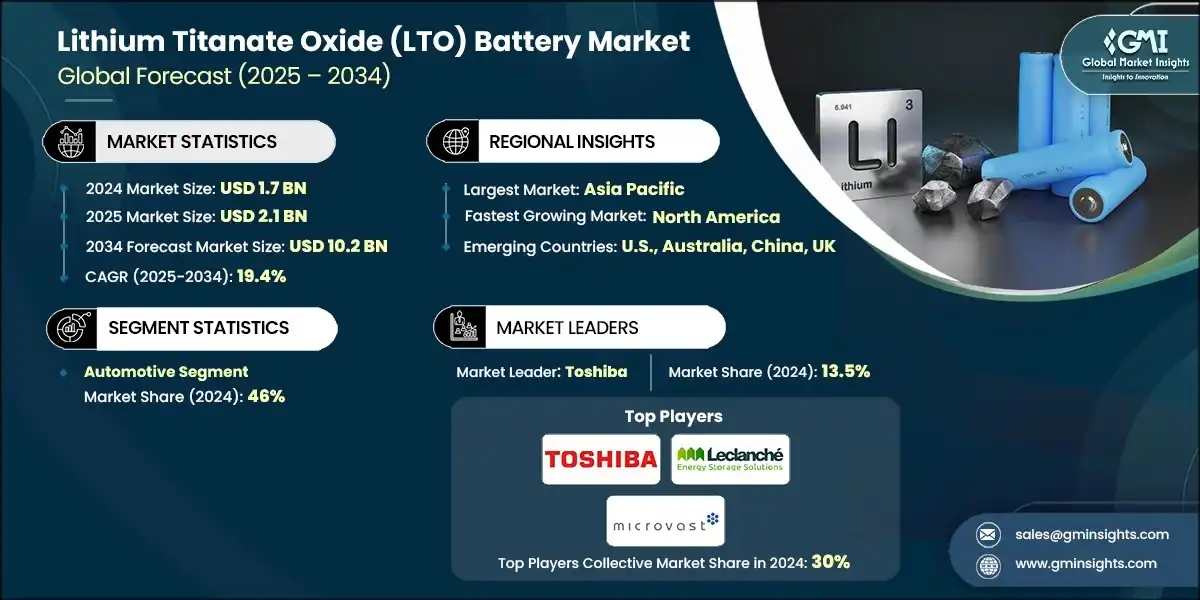
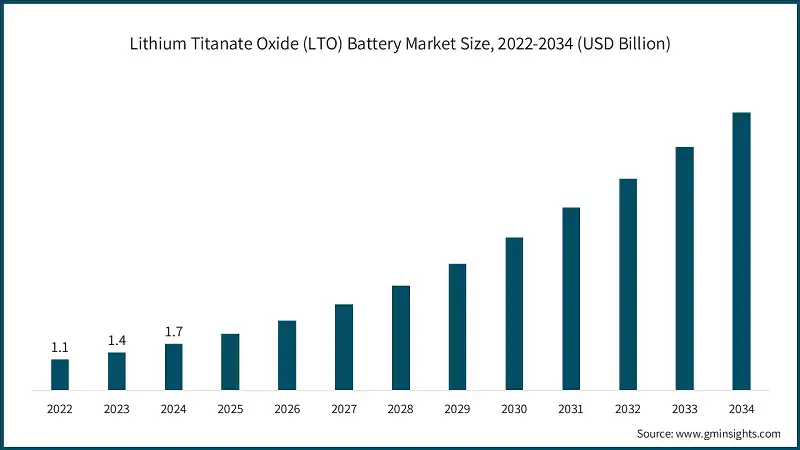
The global lithium titanate oxide battery market was valued at USD 1.7 billion in 2024. The market is expected to grow from USD 2.1 billion in 2025 to USD 10.2 billion by 2034, at a CAGR of 19.4%, according to Global Market Insights Inc.
Lithium Titanate Oxide (LTO) Battery Market Key Takeaways
Market Size & Growth
- 2024 Market Size: USD 1.7 Billion
- 2025 Market Size: USD 2.1 Billion
- 2034 Forecast Market Size: USD 10.2 Billion
- CAGR (2025–2034): 19.4%
Key Market Drivers
- Demand for ultra-fast charging solutions.
- Rising adoption in high-cycle applications.
Challenges
- High cost of production and limited energy density.
Opportunity
- Expansion of battery-swapping ecosystems.
- Integration into smart grid and v2g systems.
Key Players
- Market Leader: Toshiba led with over 13.5% market share in 2024.
- Leading Players: Top 5 players in this market include Toshiba Corporation, Leclanché, Microvast, which collectively held a market share of 30% in 2024.
Get Market Insights & Growth Opportunities
- LTO batteries are revolutionizing public transportation by enabling ultra-fast charging, often reaching 80% capacity in under five minutes. This rapid recharge supports “opportunity charging” during short layovers, reducing fleet size and increasing route frequency. Transit authorities in China, Europe, and North America are adopting LTO-powered buses, supported by government subsidies like the U.S. Low-No Emission Bus grants and China’s new-energy bus incentives.
- LTO batteries offer exceptional durability, with over 20,000 full-depth charge-discharge cycles and minimal capacity fade. This makes them ideal for stationary energy storage systems (ESS) used in frequency regulation, peak shaving, and voltage support. Their robust spinel lattice structure resists dendrite formation, ensuring long-term reliability. Utilities and industrial facilities are increasingly deploying LTO-based ESS to stabilize grids and reduce energy costs.
- Governments worldwide are incentivizing the shift to low-emission public transportation, directly benefiting the LTO battery market. For instance, New Mexico awarded a USD 400 million contract for electric buses with stringent safety and thermal resistance requirements—criteria well-suited to LTO chemistry. In South Korea, LG Energy Solution secured nearly USD 460 million in U.S. tax credits to expand LTO production. Europe’s Clean Industrial Deal also supports storage technologies that align with LTO’s fast-response and safety profile.
- Battery-as-a-service (BaaS) models are gaining traction, especially in Asia-Pacific, where companies like CATL plan to deploy tens of thousands of battery-swap stations. LTO batteries are ideal for this model due to their ability to withstand thousands of rapid charge-discharge cycles without degradation. Their structural integrity and low impedance rise make them suitable for robotic swap systems, such as those piloted in New Zealand.
- LTO batteries are increasingly used in remote micro-grids, particularly in mining operations and isolated communities across South America, Australia, and Africa. These environments demand rugged, reliable energy storage that can operate in extreme temperatures and under heavy cycling. LTO’s thermal stability and long life make it ideal for hybrid diesel-PV systems, reducing fuel consumption and emissions.
- For example, Chilean copper mines use LTO-based micro-grids to cut diesel use by 30%. As global mining and rural electrification efforts expand, LTO batteries are becoming a cornerstone of sustainable off-grid energy solutions.
- The defense sector values LTO batteries for their performance in extreme environments, including temperatures ranging from –40 °C to +60 °C. These batteries power unmanned aerial vehicles (UAVs), missile systems, and wearable soldier gear, where reliability and safety are paramount. Their resistance to thermal runaway and ability to deliver high power instantly make them suitable for mission-critical applications.
- LTO batteries are gaining traction in commercial vehicles such as buses, refuse trucks, and drayage tractors. These vehicles benefit from LTO’s fast-charging and long cycle life, which reduce downtime and total cost of ownership. Municipalities are adopting LTO-powered fleets to comply with zero-emission zones and sustainability mandates. The chemistry’s ability to handle frequent partial charges during short breaks makes it ideal for high-utilization fleets.
- The rise of fast-charging electric vehicle (EV) stations is a major driver for LTO batteries. These stations require buffer storage systems that can handle rapid cycling and high power throughput. LTO batteries meet these demands with minimal thermal management needs and no performance degradation. Ride-hailing fleets and logistics companies are adopting LTO-buffered charging hubs to reduce vehicle downtime.
To get key market trends
Lithium Titanate Oxide Battery Market Trends
Learn more about the key segments shaping this market
- In industrial settings, LTO batteries power continuous-duty equipment like forklifts, automated guided vehicles (AGVs), and robotic arms. These applications require batteries that can be partially charged during short breaks without affecting lifespan. LTO’s high power density and rapid recharge capability make it ideal for such use cases. Manufacturers are integrating LTO modules into factory automation systems to improve uptime and reduce maintenance.
- Hospitals and emergency services require uninterruptible power supplies (UPS) that are safe, reliable, and capable of rapid response. LTO batteries are increasingly used in these systems due to their thermal stability and long cycle life. They meet stringent safety standards and can deliver power instantly during outages. Medical carts and portable diagnostic equipment also benefit from LTO’s lightweight, compact design and fast recharge.
- For reference, in September 2025, Large Battery published a report on battery redundancy systems in critical care equipment. LTO batteries were cited for their fast recharge, thermal stability, and long cycle life, making them ideal for ventilators, anesthesia machines, and UPS systems. Hospitals are adopting modular LTO-based systems with automated switchover and real-time monitoring to ensure uninterrupted power. These systems are crucial during outages, protecting patient safety and maintaining data integrity.
- LTO batteries are well-suited for vehicle-to-grid (V2G) applications, where EVs feed power back into the grid during peak demand. Their ability to handle frequent, deep charge-discharge cycles without degradation makes them ideal for this emerging use case. Japan is leading V2G pilot programs using LTO-powered fleets to stabilize local grids and monetize idle vehicle capacity. As smart grid technologies evolve and regulatory frameworks support bidirectional energy flow.
- Urban bus operators in China and Japan are adopting LTO batteries to meet cost and performance targets. Projects like LTO-buffered shore power at Japanese ports and frequency-response farms in South Korea highlight the region’s commitment to clean energy. With strong policy support and technological leadership, Asia-Pacific continues to be a growth engine for LTO batteries, setting global benchmarks for deployment in public transport, grid storage, and industrial applications.
- Innovations in LTO cell architecture are enhancing performance and reducing costs. Toshiba’s 20 Ah-HP variant, for example, offers 60% higher discharge rates and improved thermal management. Pouch cells are gaining popularity for their lightweight, compact form, while cylindrical cells remain dominant in heavy-duty applications. Automated manufacturing processes are increasing throughput and consistency. These advancements are making LTO batteries more competitive with other chemistries, expanding their applicability across sectors.
- For instance, in April 2025, Global Batteries reported breakthroughs in LTO technology, including hybrid electrolytes and nanostructured anodes. MIT’s graphene-coated LTO electrodes achieved 165 Wh/kg—135% higher than standard designs. Toyota is testing solid-state LTO prototypes with 6-minute charging and 400 km range. These innovations address LTO’s traditional energy density limitations while preserving safety and cycle life. AI-driven manufacturing is also reducing costs and improving consistency.
- Battery manufacturers are forming strategic partnerships with OEMs, utilities, and material suppliers to co-develop LTO solutions tailored to specific applications. These collaborations enable the integration of custom features like crash-resistant casings, immersion cooling, and advanced battery management systems (BMS). Joint ventures with titanium suppliers aim to stabilize raw material costs, while R&D alliances focus on enhancing energy density through silicon-doped titania.
- As environmental regulations tighten, the recyclability and safety of battery chemistries are under scrutiny. LTO batteries, with their stable spinel lattice and non-toxic components, offer a safer and more sustainable alternative to traditional lithium-ion chemistries. Efforts are underway to simplify LTO recycling processes and reduce lifecycle emissions. Governments and industry players are investing in closed-loop systems and second-life applications for LTO cells.
- For illustration, in May 2025, HIMAX Electronics showcased its lithium-ion batteries for emergency equipment, emphasizing environmental benefits. While not LTO-specific, the report noted that LTO batteries, with their long life and high recyclability, are increasingly used in critical systems. LTO’s titanium-based anode allows for over 95% material recovery through hydrometallurgical processes. As regulations tighten around battery disposal, LTO’s non-toxic, stable chemistry is gaining favor.
Lithium Titanate Oxide Battery Market Analysis
Learn more about the key segments shaping this market
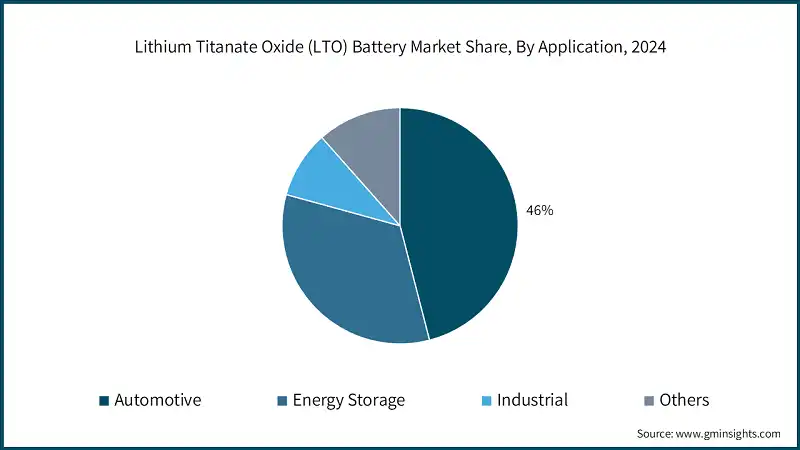
- Based on application, the industry is segmented into automotive, energy storage, industrial, and others. The automotive segment dominated about 46% market share in 2024 and is expected to grow at a CAGR of 19.5% through 2034.
- LTO batteries are gaining traction in urban electric vehicles (EVs) due to their ultra-fast charging capabilities. Unlike conventional lithium-ion chemistries, LTO can be charged to 80% in under 10 minutes, making it ideal for taxis, buses, and delivery fleets that require minimal downtime. This fast turnaround supports high vehicle utilization and reduces the need for large battery packs. As cities implement zero-emission zones and congestion charges, fleet operators are turning to LTO-powered EVs to meet operational and regulatory demands, driving growth in the automotive sector.
- Commercial vehicles such as buses, refuse trucks, and logistics vans benefit from LTO’s long cycle life—often exceeding 20,000 full-depth cycles. This durability reduces total cost of ownership and minimizes battery replacement frequency, which is critical for high-mileage fleets. Municipalities and logistics companies are increasingly adopting LTO-powered vehicles to meet sustainability goals while maintaining operational efficiency.
- In the energy storage sector, LTO batteries are used for grid stabilization, frequency regulation, and voltage support. Their fast response time and high power density make them suitable for ancillary services that require rapid charge-discharge cycles. Unlike other chemistries, LTO maintains performance over thousands of cycles, making it a reliable choice for utilities. As renewable energy penetration increases, grid operators are deploying LTO-based systems to manage intermittency and ensure stability, especially in regions with aging infrastructure or high solar and wind integration.
- LTO batteries are ideal for microgrids in remote or off-grid locations, such as mining operations, islands, and rural communities. Their ability to operate in extreme temperatures and withstand deep cycling makes them suitable for hybrid systems combining solar, wind, and diesel. These batteries reduce fuel consumption, lower emissions, and improve energy reliability. Governments and NGOs are funding rural electrification projects using LTO-based microgrids, particularly in Africa, Southeast Asia, and Latin America, where infrastructure is limited but energy demand is growing.
- In industrial automation, LTO batteries power automated guided vehicles (AGVs), forklifts, and robotic arms that require continuous operation. Their fast-charging and long-life characteristics reduce downtime and maintenance costs. LTO’s ability to handle high current loads and partial charges without performance loss makes it ideal for 24/7 manufacturing environments. As factories adopt Industry 4.0 technologies, the demand for reliable, high-performance battery systems like LTO is increasing, especially in sectors like automotive manufacturing, warehousing, and semiconductor production.
- LTO batteries are increasingly used in uninterruptible power supply (UPS) systems for data centers, hospitals, and industrial facilities. Their thermal stability and rapid discharge capability ensure instant power delivery during outages. Unlike lead-acid or traditional lithium-ion batteries, LTO offers longer service life and lower maintenance, reducing total cost of ownership. As digital infrastructure expands and power reliability becomes critical, LTO-based UPS systems are being adopted for mission-critical applications where downtime is not an option.
- The rise of battery-swapping models in shared mobility services is driving demand for LTO batteries. Their high cycle life and fast charge-discharge capability make them ideal for swap stations, where batteries are charged independently and replaced in seconds. This model is gaining popularity in Asia, particularly for electric scooters, taxis, and ride-hailing fleets. LTO’s robustness ensures consistent performance across thousands of swaps, supporting the scalability of battery-as-a-service (BaaS) platforms and reducing operational bottlenecks in urban mobility networks.
- LTO batteries are well-suited for vehicle-to-grid (V2G) applications, where EVs act as mobile energy storage units. Their ability to handle frequent, deep cycling without degradation makes them ideal for bidirectional energy flow. V2G systems help balance grid load during peak demand and provide backup power during outages. Governments and utilities are piloting V2G programs using LTO-powered fleets, especially in Japan and Europe, where smart grid infrastructure is more advanced.
- LTO batteries are used in aerospace and defense due to their performance in extreme environments. They power drones, satellites, and military vehicles that require high reliability, thermal stability, and long cycle life. LTO’s resistance to thermal runaway and ability to operate in a wide temperature range make it ideal for mission-critical systems.
- In the medical sector, LTO batteries are used in portable diagnostic devices, ventilators, and emergency backup systems. Their safety, fast recharge, and long life make them suitable for critical care environments. Hospitals are adopting LTO-based systems to ensure uninterrupted power during outages and reduce reliance on diesel generators. These batteries also support mobile healthcare units and telemedicine infrastructure in remote areas.
Looking for region specific data?
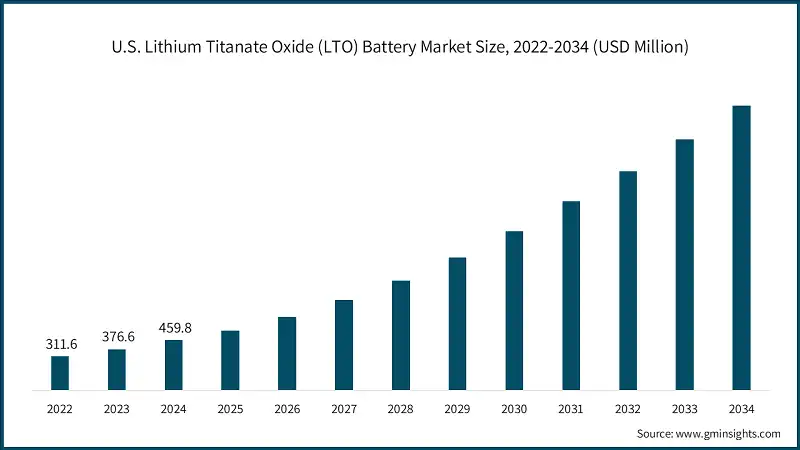
- The U.S. lithium titanate oxide battery market is set to reach a value of USD 2.6 billion by 2034. The U.S. government is actively promoting clean energy and transportation through tax credits, grants, and infrastructure investments. Programs like the Inflation Reduction Act and the Bipartisan Infrastructure Law offer billions in funding for electric vehicles (EVs), battery manufacturing, and grid modernization. LTO batteries, with their fast-charging and long-life characteristics, are well-positioned to benefit from these initiatives, especially in public transit and commercial fleet electrification.
- Frequent power outages, extreme weather events, and aging grid infrastructure are pushing U.S. utilities and industries to invest in resilient energy storage. LTO batteries, known for their thermal stability and long cycle life, are being deployed in microgrids, hospitals, and data centers. Their ability to deliver instant backup power and withstand harsh conditions makes them ideal for critical infrastructure. With growing interest in vehicle-to-grid (V2G) and distributed energy systems.
- Europe’s stringent safety and environmental regulations favor battery chemistries like LTO, which are non-toxic, thermally stable, and highly recyclable. The EU’s Battery Regulation and Green Deal initiatives emphasize lifecycle sustainability, circular economy practices, and carbon footprint reduction. LTO’s long service life and minimal degradation align with these goals, making it a preferred choice for public transport, industrial automation, and stationary storage.
- European countries are rapidly electrifying public transportation to meet climate targets and reduce urban pollution. LTO batteries are being adopted in electric buses, trams, and ferries due to their fast-charging capabilities and ability to operate in cold climates. Pilot projects in Germany, the Netherlands, and Scandinavia have demonstrated LTO’s effectiveness in high-frequency, short-route transit systems. EU funding programs like Horizon Europe and the Connecting Europe Facility are supporting these deployments, positioning LTO as a key enabler of sustainable mobility in the region.
- Asia Pacific, particularly China and Japan, dominates global LTO battery production. Companies like Toshiba, Yinlong, and Microvast lead in LTO cell innovation and large-scale manufacturing. Government support, low production costs, and robust supply chains have enabled rapid deployment of LTO batteries in buses, taxis, and energy storage systems. China’s aggressive electrification policies and Japan’s focus on disaster-resilient infrastructure are fueling demand.
- Asia Pacific is pioneering battery-swapping infrastructure, especially for two-wheelers, ride-hailing fleets, and last-mile delivery vehicles. LTO batteries, with their high cycle life and rapid charge-discharge capability, are ideal for this model. Countries like China, India, and Indonesia are investing in battery-as-a-service (BaaS) platforms to reduce EV costs and improve convenience. Government incentives, urban congestion, and air quality concerns are accelerating adoption.
- In Latin America and Africa, electrification efforts are focused on improving energy access and reducing diesel dependency. LTO batteries are being deployed in microgrids, rural electrification projects, and hybrid renewable systems. Their ability to operate in extreme temperatures and withstand frequent cycling makes them suitable for off-grid and remote applications. International development agencies and NGOs are funding LTO-based solutions to support sustainable development goals.
Lithium Titanate Oxide Battery Market Share
- The top 3 companies in the lithium titanate oxide battery industry are Toshiba, Leclanché, and Microvast contributing around 30% of the market in 2024.
- Toshiba Corporation, headquartered in Japan, is a global technology conglomerate with a strong presence in the LTO battery market through its SCiB™ (Super Charge ion Battery) platform. Known for its pioneering work in lithium titanate chemistry, Toshiba’s LTO batteries offer ultra-fast charging, high safety, and an exceptionally long cycle life exceeding 20,000 cycles. These batteries are widely used in electric buses, industrial equipment, and energy storage systems. Toshiba’s LTO solutions are particularly valued in applications requiring rapid charge-discharge, thermal stability, and operational reliability. The company continues to invest in R&D and global partnerships to expand its LTO battery footprint.
- Founded in 2006 and based in Stafford, Texas, Microvast is a vertically integrated battery manufacturer specializing in advanced lithium-ion chemistries, including LTO. The company designs and produces battery cells, modules, and packs for commercial vehicles, energy storage systems, and heavy equipment. Microvast’s LTO batteries are engineered for ultra-fast charging, long cycle life, and high thermal stability, making them ideal for high-utilization fleets and grid applications. With over 31,000 battery systems deployed in 34 countries, Microvast is recognized for its innovation in solid-state and bipolar battery technologies. Its global manufacturing and R&D capabilities position it as a leader in next-gen energy solutions.
Lithium Titanate Oxide Battery Market Companies
- Toshiba reported strong momentum in the LTO battery market through its SCiB platform, known for ultra-fast charging, high safety, and over 20,000 cycle life. The company supplies LTO batteries for electric buses, industrial vehicles, and stationary storage systems. Toshiba’s LTO cells are widely adopted in Japan and Europe, especially in transit and grid applications requiring rapid charge-discharge and thermal stability. With a vertically integrated model and a focus on safety-critical deployments, Toshiba continues to lead in LTO innovation. Strategic collaborations with OEMs and infrastructure providers are expanding its global footprint in mission-critical energy storage and mobility solutions.
- Microvast reported revenue of USD 380 million in 2024. The company is a vertically integrated battery manufacturer based in Texas, with operations in China and Germany. Microvast’s LTO batteries are used in commercial EVs, energy storage systems, and heavy-duty equipment. Known for fast-charging and long-life performance, its LTO solutions are deployed in over 31,000 systems across 34 countries. Recent breakthroughs include the launch of its True All-Solid-State Battery and expansion of its Huzhou facility to 2 GWh capacity. With strong R&D, global partnerships, and a growing ESS portfolio, Microvast is a key player in next-generation battery technologies.
- Leclanché is a Swiss energy storage company specializing in lithium-ion and LTO battery systems for transport and grid applications. The company’s LTO modules offer up to 20,000 cycles and are used in electric buses, AGVs, and hybrid rail systems. In 2021, Leclanché launched its M3 module line with high-volume European production capacity. The company also introduced the XN50 cell, featuring Echion’s niobium-based XNO anode, offering 50% higher energy density than LTO while maintaining fast charging and safety. With a legacy dating back to 1909 and a focus on sustainable transport, Leclanché is advancing high-performance battery solutions.
Major players operating in the lithium titanate oxide battery industry are:
- Altairnano
- Leclanché SA
- Microvast
- Nav Prakriti
- Nichicon Corporation
- PLANNANO
- Toshiba Corporation
- Yinlong Energy
Lithium Titanate Oxide (LTO) Battery Market Report Attributes
| Key Takeaway | Details |
|---|---|
| Market Size & Growth | |
| Base Year | 2024 |
| Market Size in 2024 | USD 1.7 Billion |
| Market Size in 2025 | USD 2.1 Billion |
| Forecast Period 2025 - 2034 CAGR | 19.4% |
| Market Size in 2034 | USD 10.2 Billion |
| Key Market Trends | |
| Drivers | Impact |
| Demand for ultra-fast charging solutions | The growing need for rapid charging in electric vehicles and industrial systems is driving demand for LTO batteries, which can charge to 80% in under 10 minutes without degradation |
| Rising adoption in high-cycle applications | LTO batteries offer over 20,000 charge-discharge cycles, making them ideal for applications like public transit, robotics, and grid storage where long service life and reliability are critical |
| Pitfalls & Challenges | Impact |
| High cost of production and limited energy density | LTO batteries are significantly more expensive than other lithium-ion chemistries due to the cost of titanium-based anodes and complex manufacturing processes, limiting their adoption in cost-sensitive markets |
| Opportunities: | Impact |
| Expansion of battery-swapping ecosystems | The rise of battery-swapping infrastructure, especially in Asia, presents a major opportunity for LTO batteries due to their high cycle life and rapid charge-discharge capabilities |
| Integration into smart grid and v2g systems | LTO batteries are well-suited for smart grid and vehicle-to-grid (V2G) applications, offering fast response, long life, and safety—key features for grid balancing and decentralized energy systems. |
| Market Leaders (2024) | |
| Market Leaders |
13.5% market share |
| Top Players |
Collective market share in 2024 is 30% |
| Competitive Edge |
|
| Regional Insights | |
| Largest Market | Asia Pacific |
| Fastest Growing Market | North America |
| Emerging Country | U.S., Australia, China, UK |
| Future Outlook |
|
What are the growth opportunities in this market?
Lithium Titanate Oxide Battery Industry News
- In June 2025, Leclanché introduced its next-generation M3 lithium-ion battery modules for e-transport vehicles and vessels, including configurations using LTO 34Ah cells. These modules support up to 800A continuous current and 1,200V system voltage, with a cycle life of up to 20,000 cycles for LTO variants. Simultaneously, the company unveiled a high-volume European production line in Yverdon-les-Bains, capable of producing over 60,000 modules annually. Developed with Comau (Stellantis Group), the automated line integrates Industry 4.0 principles.
- In February 2025, Microvast unveiled its next-generation fast-charging battery solutions at Smart Energy Week in Tokyo. The company introduced the ME6 BESS, a 565Ah lithium iron phosphate system designed for overhaulability and long life. Microvast’s LTO and LFP batteries now support 80% charge in 15 minutes and up to 8,000 cycles, targeting commercial vehicles, BESS, and specialty machinery. Certified to global safety standards, the new systems offer 180Wh/kg energy density and broad temperature tolerance. CEO Yang Wu emphasized Microvast’s commitment to innovation and sustainability, reinforcing its leadership in high-performance battery solutions for demanding applications.
- In October 2025, Toshiba launched its SCiB 24V battery pack (P25H20-3), designed for automotive, marine, and industrial use. The pack, featuring 20Ah-HP LTO cells, replaces conventional lead-acid batteries and supports configurations up to 48V and 5.76 kWh. Already deployed in Yamaha’s “e-Float Terrace” electric sightseeing boat, the system offers rapid charging, high vibration resistance, and waterproofing to IPX9K/IPX7 standards. Toshiba’s SCiB™ technology delivers over 20,000 cycles and exceptional low-temperature performance, supporting sustainable mobility and marine electrification. The company aims to expand SCiB™ adoption across logistics, heavy equipment, and clean transport sectors globally.
- In 2025, Yinlong Energy announced the deployment of the world’s fastest-charging LTO batteries in Abu Dhabi’s new electric bus fleet. These buses, capable of full charging in under 20 minutes, are part of the UAE’s push toward climate neutrality. Yinlong also signed an MoU with Hitachi ABB Power Grids to deliver integrated e-mobility solutions for urban transit. Their LTO systems offer over 20,000 cycles, extreme temperature tolerance, and high safety, making them ideal for public transport. The collaboration aims to reduce emissions and noise pollution while accelerating the shift to zero-emission mobility in the Middle East.
The lithium titanate oxide battery market research report includes in-depth coverage of the industry with estimates & forecast in terms of revenue (USD Million) from 2021 to 2034, for the following segments:
Market, By Application
- Automotive
- Energy Storage
- Industrial
- Others
The above information has been provided for the following regions and countries:
- North America
- U.S.
- Canada
- Europe
- UK
- Germany
- France
- Italy
- Spain
- Asia Pacific
- China
- South Korea
- Japan
- Australia
- Rest of World
Frequently Asked Question(FAQ) :
What is the market size of the lithium titanate oxide battery in 2024?
The market size was USD 1.7 billion in 2024, with a CAGR of 19.4% expected through 2034 driven by rising demand for fast-charging, durable batteries in EVs and industrial systems.
What is the projected value of the lithium titanate oxide battery market by 2034?
The lithium titanate oxide battery market is expected to reach USD 10.2 billion by 2034, propelled by ultra-fast charging solutions, high-cycle applications, and expansion of battery-swapping ecosystems.
What is the current lithium titanate oxide battery market size in 2025?
The market size is projected to reach USD 2.1 billion in 2025.
How much market share did the automotive segment hold in 2024?
The automotive segment dominated with about 46% market share in 2024 and is expected to grow at a CAGR of 19.5% through 2034.
Which region leads the lithium titanate oxide battery market?
The U.S. lithium titanate oxide battery market is set to reach a value of USD 2.6 billion by 2034.
What are the upcoming trends in the lithium titanate oxide battery market?
Key trends include innovations in LTO cell architecture, strategic partnerships between battery manufacturers and OEMs, expansion of battery-swapping ecosystems, integration into smart grid and V2G systems, and enhanced recyclability and sustainability focus.
Who are the key players in the lithium titanate oxide battery market?
Key players include Toshiba Corporation, Microvast, Leclanché SA, Altairnano, Nav Prakriti, Nichicon Corporation, PLANNANO, and Yinlong Energy.
Lithium Titanate Oxide (LTO) Battery Market Scope
Related Reports