Summary
Table of Content

Lithium Metal Battery Materials Market
Get a free sample of this report
Form submitted successfully!
Error submitting form. Please try again.
Thank you!
Your inquiry has been received. Our team will reach out to you with the required details via email. To ensure that you don't miss their response, kindly remember to check your spam folder as well!
Request Sectional Data
Thank you!
Your inquiry has been received. Our team will reach out to you with the required details via email. To ensure that you don't miss their response, kindly remember to check your spam folder as well!
Form submitted successfully!
Error submitting form. Please try again.
Lithium Metal Battery Materials Market Size
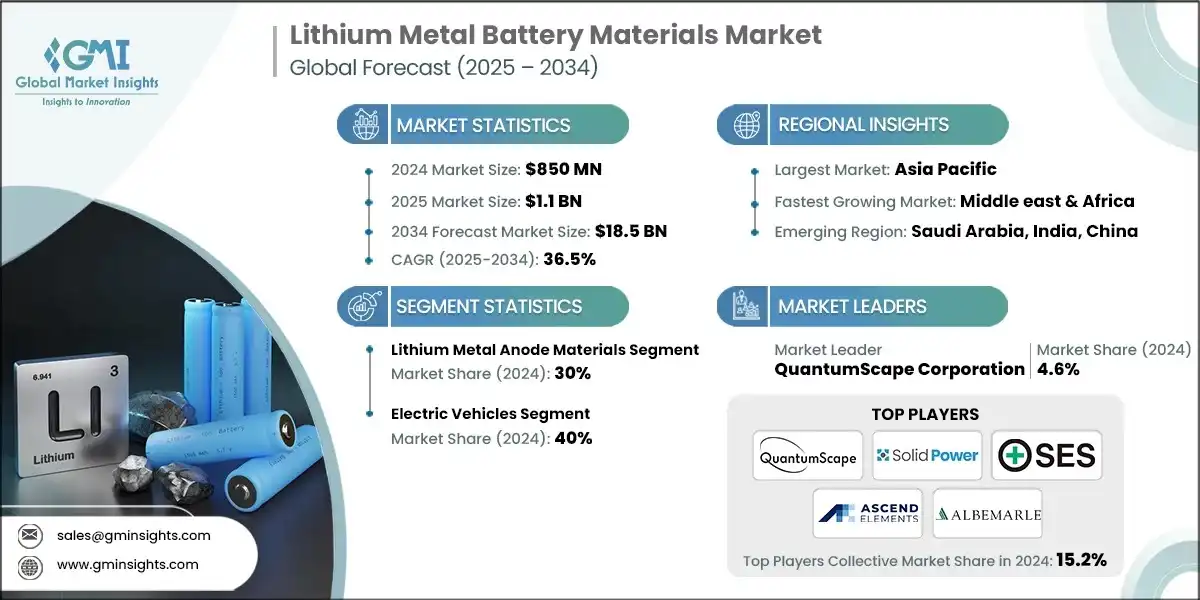
The global lithium metal battery materials market was valued at USD 850 million in 2024. The market is expected to grow from USD 1.1 billion in 2025 to USD 18.5 billion in 2034, at a CAGR of 36.5%, according to latest report published by Global Market Insights Inc.
Lithium Metal Battery Materials Market Key Takeaways
Market Size & Growth
- 2024 Market Size: USD 850 Million
- 2025 Market Size: USD 1.1 Billion
- 2034 Forecast Market Size: USD 18.5 Billion
- CAGR (2025–2034): 36.5%
Regional Dominance
- Largest Market: Asia Pacific
- Fastest Growing Region: Middle east & Africa
Key Market Drivers
- Rising demand for high-energy-density batteries for electric vehicles.
- Technological advancements in lithium metal anode and electrolyte materials.
- Increasing investments in solid-state battery development.
Challenges
- Safety concerns related to dendrite formation.
Opportunity
- Increasing demand for high-performance, long-lasting energy storage solutions..
Key Players
- Market Leader: QuantumScape Corporation led with over 4.6% market share in 2024.
- Leading Players: Top 5 players in this market include QuantumScape Corporation, Solid Power Inc, SES AI Corporation, Ascend Elements, Albemarle, which collectively held a market share of 15.2% in 2024.
Get Market Insights & Growth Opportunities
- Globally, rising electric vehicles demand is rapidly translating into ever-increasing demand for battery materials from different suppliers to achieve high energy densities, extended driving ranges, and fast charging capabilities. The International Energy Agency anticipates global demand for EV batteries to rise from 0.16 TWh in 2020 to 14 TWh by 2050 due to net zero emission targets. By the year 2040, the IEA forecasts that lithium demand will grow by as much as 40 times, while supply is set to cover less than 70% of global demand by 2030 due to the Net Zero Scenario. China's EV lithium demand alone is projected to reach 340,000-450,000 tons by 2035, representing 6-8 times increase versus 2022 levels.
- The adoption of renewable energy has been a further boost in demand for energy storage wrap. New technologies being developed with battery designs and safety features are additional drivers. The reason for moving toward electric mobility is that which comes from greater awareness of the environment. This is further supported by faster charging and higher-capacity requirements across industries. All these factors increase the demand for advanced lithium materials.
To get key market trends
Lithium Metal Battery Materials Market Trends
- Increasing Investment and R&D Focus on Solid-State Lithium Metal Batteries: The industry is witnessing massive investments for solid-state lithium metal battery technology, wherein several automakers and battery manufacturers have committed billions for research and development. Solid-state lithium metal batteries (SS-LMBs) solve durability and safety issues related to conventional lithium-ion batteries while theoretically delivering energy densities of above 500 Wh/kg vis-a-vis the ~350 Wh/kg limit for liquid-electrolyte cells. Leading companies such as QuantumScape, Solid Power, Toyota, Samsung SDI, and CATL already have pilot production facilities and are progressing toward commercialization timelines between the years 2026 and 2030.
- Growing Partnerships Between Automakers and Battery Material Suppliers: Strategic partnership between automotive manufacturers and battery materials suppliers has significantly increased in 2024 and 2025 to speed up the development path for next-generation batteries for electric vehicles. In July 2025 QuantumScape has extended its contract with PowerCo, Volkswagen's battery subsidiary, granting a license under PowerCo to manufacture as much as 45 GWh annually of solid-state battery cells, enough to back around 500,000 electric vehicles production each year.
- Advancements in Lithium Metal Foil and Anode Manufacturing Processes: Excellent progress in lithium-metal anode production methods would significantly lower manufacturing costs and scale up use for commercial deployment. The most promising production route for thin lithium anodes is thermal evaporation. Avesta Battery and Energy Engineering commenced series production on the lithium metal anode technology in July 2024, claiming to be the only supplier of lithium metal anode in Europe producing varied lithium thickness from 50 µm down to under 10 µm with continuous production capacity.
Lithium Metal Battery Materials Market Analysis
Learn more about the key segments shaping this market
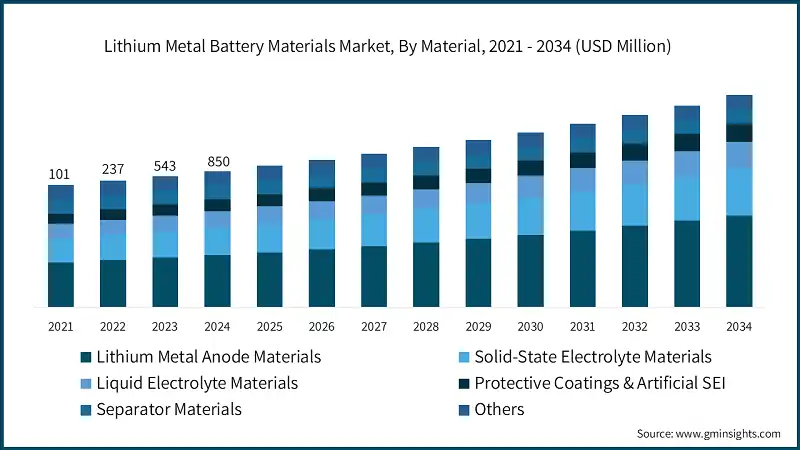
On basis of material, the market is segmented as lithium metal anode materials, solid-state electrolyte materials, liquid electrolyte materials, protective coatings & artificial SEI materials, separator materials, and others.
- Lithium Metal Anode Materials represent the largest segment, about 30% in market share in 2024. Lithium metal anodes stand to offer exceptional theoretical specific capacity of 3,860 mAh/g, exceedingly more than ten times the 372 mAh/g capacity of conventional graphite anodes. These features allow significant increases in the energy density, allowing for the extension of range in electric vehicles and miniaturization in portable electronics.
- These solid-state electrolytes accounted for about 25% of the overall market share in the year 2024. They have been important to next-level advancements in battery technology because they are bringing about the next generation of lithium metal batteries, which are safer and much more efficient than the traditional liquid-based batteries. Solid-state electrolyte materials are attractive for variety of applications because they are much more stable, provide higher energy density, and are safer.
Learn more about the key segments shaping this market
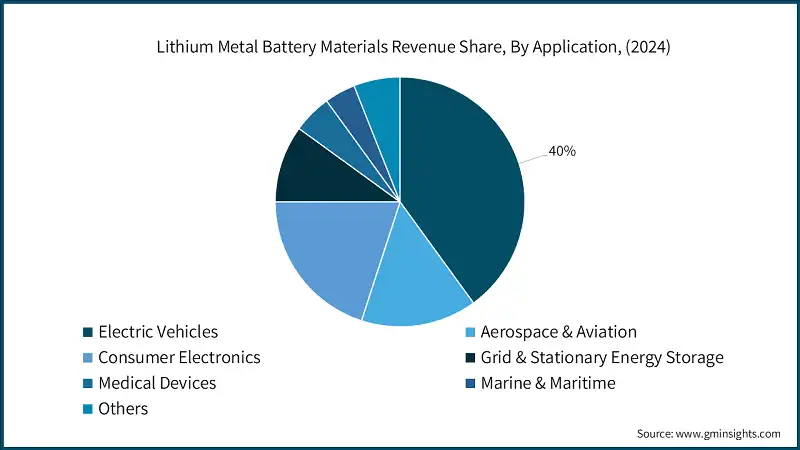
On basis of application, the lithium metal battery materials market is segmented as electric vehicles, aerospace & aviation, consumer electronics, grid & stationary energy storage, medical devices, marine & maritime, and others.
- Electric vehicles are currently the largest and fastest growing application sector. It holds around 40% of market share in 2024. It is primarily the electric vehicle segment driving the demand for lithium metal battery materials getting its traction for the higher energy density needs enabling extended driving range, faster charging capability matching those consumer expectations, enhancing safety to address thermal runaway threat, and longer cycle life to match vehicle warranties, making lithium the preferred choice for battery materials simply.
- By 2023, global demand for EV batteries exceeded 750 GWh, which marks an increase of about 40% over lithium demand in 2022, and made up around 85% of the total lithium demand. Global EV battery demand is expected to rise from 0.16 TWh in 2020 to about 14 TWh by 2050 as required by net zero emissions. By 2035, China's demand for lithium for EVs alone will have reached 340,000-450,000 tons, which will entail 6-8 times increase from levels in 2022.
- Consumer electronics accounted for nearly 20% of the market share in the year 2024, and these growth rates are attributed to demand for slimmer device levels, long usage time between charges, and enhanced safety when it comes to powering portable devices such as smartphones, laptops, tablets, wearables, and wireless earbuds. The volume energy density is favored over gravimetric energy density for consumer electronics as thickness and volume become the real constraints in design specification, lithium metal batteries are superior in volumetric energy density, producing major reductions in device dimensions or increases in capacity.
- This segment enjoys shorter development cycles than automotive applications, fewer regulatory hurdles, and greater price tolerance in higher-end products. The improvement in safety profile that solid state drives bring will solve thermal runaway problems for devices that are either kept close to the body, or used in confined spaces. According to IEA, portable electronics consume approximately 5% of the total battery market, and further expansion is expected with the technological boom in the wearables, augmented reality systems, and Internet of Things devices.
Looking for region specific data?
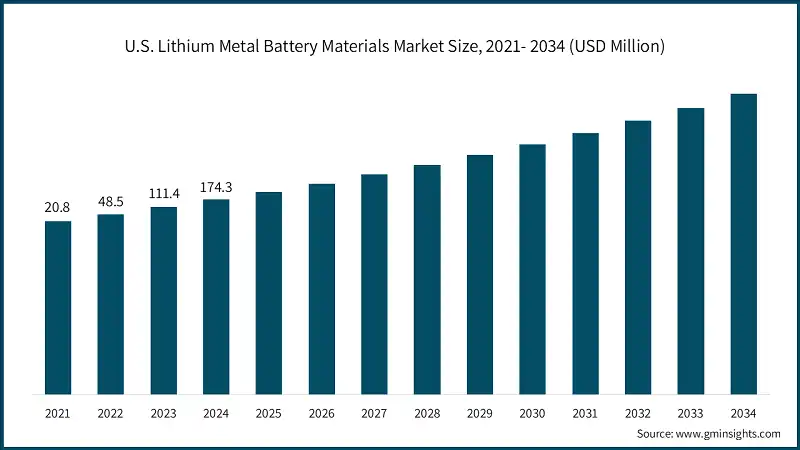
The U.S. lithium metal battery materials market reached USD 174.3 million in 2024 and estimated to grow to almost USD 3.7 billion by 2034.
- By 2024, North America will hold around 25% of the market share, and there is rapid movement forward due to policy support such as the Inflation Reduction Act that offers significant incentives for domestic battery manufacturing and electric vehicle adoption. Also, in terms of private sector investment in battery materials production has been significant. Battery production in the U.S. in 2023 was nearly 70 GWh and growing rapidly from virtually no production capacity not too many years ago.
- The Asia-Pacific region is the leading region in the global market with about 60% market share in 2024. This is because of China's dominant position along the battery materials value chain, technological leadership in solid-state battery development within Japan, advanced battery manufacturing capabilities from South Korea, and the emerging interest in India and Southeast Asia. China dominates around 80% of worldwide production of battery-grade chemicals, about 90% of global capacity for cathode active materials, and over 97% capacity for anode active materials.
- Europe is expected to hold about 12% of the market share by 2024, driven by the European Union's very ambitious decarbonization targets that call for a ban on the sale of new internal combustion engine vehicles by 2035, research funding through Horizon Europe and other programs, and strategic initiatives to establish a domestic battery supply chain to significantly reduce dependence on Asian suppliers. European battery production was around 110 GWh in 2023 and is scaling fast as large gigafactories come online.
Lithium Metal Battery Materials Market Share
The lithium metal battery materials industry is highly competitive, the total market share of the top five players QuantumScape Corporation, Solid Power Inc, SES AI Corporation, Ascend Elements and Albemarle was around 15.2% in 2024. Sufficient opportunities exist for consolidation as the sector grows and evolves from research and development to manufacturing on a commercial scale. Quantumscape Corporation is currently in pole position, while other notable players are Solid Power Inc., SES AI Corporation, and Ascend Elements.
The market fragmentation is an indication of the early stage of commercialization of lithium metal batteries. In fact, it is remarkable for the number of different players pursuing a variety of technological routes in the early development phase of commercialization. Those include solid state batteries with ceramic electrolytes, solid state batteries with sulfide electrolytes, and hybrid solid-liquid architectures. Technical diversity leads to a plethora of possible avenues towards commercialization but will surely also change the weights in market share as these companies advance through the pilot production stages, automotive qualification, and mass manufacturing in the window 2025-2030.
Lithium Metal Battery Materials Market Companies
Major players operating in the lithium metal battery materials industry are:
- QuantumScape Corporation
- Solid Power
- SES AI Corporation
- Ascend Elements
- Saft
- Albemarle
- Pure Lithium Corporation
- Cuberg
- Group14 Technologies
- QuantumScape Corporation-
- QuantumScape Corporation headquartered in San Jose, California is one of the leaders in developing solid-state lithium metal batteries, creating innovative ceramic separator technology that enables lithium metal anodes with a high density of energy with improved safety. The QSE-5 battery produced by the company is a 5 Ah pouch cell designed for use in electric vehicles which has an achievement of energy density approximately pegged at 844 Wh/L with charge from 10%-80% being about 12.2 minutes.
- QuantumScape Corporation headquartered in San Jose, California is one of the leaders in developing solid-state lithium metal batteries, creating innovative ceramic separator technology that enables lithium metal anodes with a high density of energy with improved safety. The QSE-5 battery produced by the company is a 5 Ah pouch cell designed for use in electric vehicles which has an achievement of energy density approximately pegged at 844 Wh/L with charge from 10%-80% being about 12.2 minutes.
- Solid Power Inc -
- Solid Power Inc. has made sulfide-based solid-state electrolyte technology development through a licensing model with partners. The key pilot production has also been achieved through its SP2 facility in Colorado, providing EV-scale cells. BMW has already integrated A-sample cells into demonstration vehicles for road testing and is expected to include them in its production vehicles around 2028. As much as the company has targeted more than 500 miles for electric vehicle range to be on the safe side, double lifespan compared to conventional lithium-ion batteries, and cost target of USD 85/kWh, the company started 2 Ah all-solid-state-battery deliveries in 2020 at 320 Wh/kg with automotive targets for 2026.
- Solid Power Inc. has made sulfide-based solid-state electrolyte technology development through a licensing model with partners. The key pilot production has also been achieved through its SP2 facility in Colorado, providing EV-scale cells. BMW has already integrated A-sample cells into demonstration vehicles for road testing and is expected to include them in its production vehicles around 2028. As much as the company has targeted more than 500 miles for electric vehicle range to be on the safe side, double lifespan compared to conventional lithium-ion batteries, and cost target of USD 85/kWh, the company started 2 Ah all-solid-state-battery deliveries in 2020 at 320 Wh/kg with automotive targets for 2026.
- SES AI Corporation -
- SES AI Corporation sets itself apart from the rest of its competitors with its solid-liquid hybrid battery approach. It operates three A-sample pilot facilities across different parts of the world and has ventured into joint development agreements with General Motors, Hyundai, and Honda on large-format cells, which now undergo testing by automotive partners. Series D financing amounting to USD 139 million was led by General Motors, while its concurrent post-listing valuation was pegged at USD 3.6 billion.
- SES AI Corporation sets itself apart from the rest of its competitors with its solid-liquid hybrid battery approach. It operates three A-sample pilot facilities across different parts of the world and has ventured into joint development agreements with General Motors, Hyundai, and Honda on large-format cells, which now undergo testing by automotive partners. Series D financing amounting to USD 139 million was led by General Motors, while its concurrent post-listing valuation was pegged at USD 3.6 billion.
- Ascend Elements -
- Ascend Elements manufactures and recycles battery materials and produces cathode active materials sustainably through its Hydro-to-Cathode direct precursor synthesis technology. They recover critical materials such as lithium, nickel, cobalt, and manganese from end-of-life batteries and manufacturing scrap. Ascend Elements manufactures high-performance cathode materials to be used in next-generation batteries, including lithium metal systems.
- Ascend Elements manufactures and recycles battery materials and produces cathode active materials sustainably through its Hydro-to-Cathode direct precursor synthesis technology. They recover critical materials such as lithium, nickel, cobalt, and manganese from end-of-life batteries and manufacturing scrap. Ascend Elements manufactures high-performance cathode materials to be used in next-generation batteries, including lithium metal systems.
- Albemarle-
- Albemarle is a leading producer of lithium globally and is progressively getting into advanced battery materials which include lithium metal and specialized lithium compounds for next-generation batteries. The company's integrated position across lithium mining, refining, and specialty chemicals production gives it supply-chain advantages and technical expertise in lithium processing. Albemarle is set to invest R&D programs that are intended to develop capabilities future in lithium metal production and advanced lithium compounds optimized for solid-state and lithium metal battery applications, leveraging its existing customer relationships with major battery manufacturers and automotive companies.
- Albemarle is a leading producer of lithium globally and is progressively getting into advanced battery materials which include lithium metal and specialized lithium compounds for next-generation batteries. The company's integrated position across lithium mining, refining, and specialty chemicals production gives it supply-chain advantages and technical expertise in lithium processing. Albemarle is set to invest R&D programs that are intended to develop capabilities future in lithium metal production and advanced lithium compounds optimized for solid-state and lithium metal battery applications, leveraging its existing customer relationships with major battery manufacturers and automotive companies.
Lithium Metal Battery Materials Market Report Attributes
| Key Takeaway | Details |
|---|---|
| Market Size & Growth | |
| Base Year | 2024 |
| Market Size in 2024 | USD 850 Million |
| Market Size in 2025 | USD 1.1 Billion |
| Forecast Period 2025 – 2034 CAGR | 36.5% |
| Market Size in 2034 | USD 18.5 Billion |
| Key Market Trends | |
| Drivers | Impact |
| Rising demand for high-energy-density batteries for electric vehicles | Rising demand for high-energy-density batteries for electric vehicles is driving innovation and expansion in the lithium metal battery materials market. |
| Technological advancements in lithium metal anode and electrolyte materials | Technological advancements in lithium metal anode and electrolyte materials are enhancing battery performance and safety, fostering market growth. |
| Increasing investments in solid-state battery development | Increasing investments in solid-state battery development are accelerating the adoption of safer and more efficient lithium metal battery technologies. |
| Pitfalls & Challenges | Impact |
| Safety concerns related to dendrite formation | Safety concerns related to dendrite formation pose risks of short circuits and battery failure in lithium metal batteries. |
| Opportunities: | Impact |
| Increasing demand for high-performance, long-lasting energy storage solutions. | The increasing demand for high-performance, long-lasting energy storage solutions offers significant growth potential for advanced lithium metal battery materials. |
| Market Leaders (2024) | |
| Market Leaders |
4.6% market share |
| Top Players |
Collective market share in 2024 is 15.2% |
| Competitive Edge |
|
| Regional Insights | |
| Largest Market | Asia Pacific |
| Fastest growing market | Middle east & Africa |
| Emerging country | Saudi Arabia, India, China |
| Future outlook |
|
What are the growth opportunities in this market?
Lithium Metal Battery Materials Industry News
- In April 2025, Lyten announced the start of battery-grade lithium metal production within the U.S., paving the way for perhaps the greatest leap in domestic battery supply chain development. This development aims to consolidate the ongoing efforts of Lyten in the growing electric vehicle and energy storage markets.
- In March 2024, Sakuu developed 3Ah Lithium Metal Solid-state Battery that Offers improved energy performance. This product offers high-capacity, safer, and more efficient energy storage solutions for applications.
The lithium metal battery materials market research report includes in-depth coverage of the industry, with estimates & forecast in terms of revenue (USD Billion) and volume (Kilo Tons) from 2021 to 2034, for the following segments:
Market, By Material
- Lithium metal anode materials
- Pure lithium metal foils
- Lithium alloy anodes
- Composite lithium anodes
- Solid-state electrolyte materials
- Sulfide-based electrolytes
- Oxide/garnet electrolytes
- Polymer electrolytes
- Halide-based electrolytes
- Liquid electrolyte materials
- Advanced liquid electrolytes
- Electrolyte additives
- Protective coatings & artificial sei materials
- Separator materials
- Others
Market, By Application
- Electric vehicles
- Battery electric vehicles (BEV)
- Plug-in hybrid electric vehicles (PHEV)
- Aerospace & aviation
- Commercial aircraft systems
- Drones & UAVs
- Space applications
- Consumer electronics
- Grid & stationary energy storage
- Medical devices
- Marine & maritime
- Others
The above information is provided for the following regions and countries:
- North America
- U.S.
- Canada
- Europe
- UK
- Germany
- France
- Italy
- Spain
- Rest of Europe
- Asia Pacific
- China
- India
- Japan
- South Korea
- Australia
- Rest of Asia Pacific
- Latin America
- Brazil
- Mexico
- Argentina
- Rest of Latin America
- Middle East & Africa
- UAE
- Saudi Arabia
- South Africa
- Rest of Middle East & Africa
Frequently Asked Question(FAQ) :
What is the market size of the lithium metal battery materials industry in 2024?
The market was valued at USD 850 million in 2024, with a 36.5% CAGR expected through 2034, driven by rising demand for high-energy-density EV batteries.
What is the current lithium metal battery materials market size in 2025?
The market size is projected to reach USD 1.1 billion in 2025. Growth is supported by increasing EV adoption and advancements in solid-state battery chemistry.
What is the projected value of the lithium metal battery materials market by 2034?
The market size for lithium metal battery materials is expected to reach USD 18.5 billion by 2034. This surge is driven by breakthroughs in lithium metal anodes and large-scale investments in solid-state battery development.
How much revenue did the lithium metal anode materials segment generate in 2024?
Lithium metal anode materials represented about 30% of the global industry in 2024. The segment leads the market as lithium metal anodes offer extremely high specific capacity, enabling next-generation EV and electronics performance.
What was the valuation of the solid-state electrolyte materials segment in 2024?
Solid-state electrolyte materials accounted for around 25% market share in 2024. Their adoption is rising due to superior safety, higher energy density, and growing commercialization of solid-state battery technologies.
What is the growth outlook for electric vehicles as an application segment from 2025 to 2034?
Electric vehicles held around 40% share in 2024, making it the largest and fastest-growing application in the lithium metal battery materials industry. Growth is fueled by demand for extended driving range, rapid charging, and improved safety performance.
Which region leads the lithium metal battery materials market?
The U.S. market reached USD 174.3 million in 2024. Growth is driven by EV adoption under the Inflation Reduction Act and rising private-sector battery materials investments.
What are the upcoming trends in the lithium metal battery materials industry?
Key trends include rapid investments in solid-state lithium metal batteries, expansion of EV–battery material partnerships, and advancements in lithium metal anode manufacturing technologies. These innovations aim to improve energy density, safety, and commercial scalability.
Who are the key players in the lithium metal battery materials market?
Major companies include QuantumScape Corporation, Solid Power Inc., SES AI Corporation, Ascend Elements, Saft, Albemarle, Pure Lithium Corporation, Cuberg, and Group14 Technologies.
Lithium Metal Battery Materials Market Scope
Related Reports