Summary
Table of Content

Lithium-Ion Battery Recycling Market
Get a free sample of this report
Form submitted successfully!
Error submitting form. Please try again.
Thank you!
Your inquiry has been received. Our team will reach out to you with the required details via email. To ensure that you don't miss their response, kindly remember to check your spam folder as well!
Request Sectional Data
Thank you!
Your inquiry has been received. Our team will reach out to you with the required details via email. To ensure that you don't miss their response, kindly remember to check your spam folder as well!
Form submitted successfully!
Error submitting form. Please try again.
Lithium-Ion Battery Recycling Market Size
- Rising concern over the environmental risks posed by improper disposal of lithium‑ion batteries is accelerating recycling process adoption. Leaks of hazardous and toxic materials from discarded batteries threaten soil and water systems, prompting stricter environmental scrutiny. As sustainability compliance becomes critical, battery recycling processes are increasingly viewed as essential solutions to mitigate pollution, reduce landfill dependency, and support circular economy objectives.
Lithium‑ion battery recycling involves collecting, dismantling, and processing spent batteries to recover valuable materials such as lithium, cobalt, nickel, and graphite. It reduces environmental impact, supports resource conservation, and supplies critical minerals for new batteries, enabling a more sustainable and circular energy‑storage ecosystem.
Lithium-Ion Battery Recycling Market Key Takeaways
Market Size & Growth
- 2025 Market Size: USD 5.8 Billion
- 2026 Market Size: USD 6.9 Billion
- 2035 Forecast Market Size: USD 37.5 Billion
- CAGR (2026–2035): 20.6%
Regional Dominance
- Largest Market: Asia Pacific
- Fastest Growing Region: Rest of World
Key Market Drivers
- Environmental regulation tightening.
- Critical mineral demand growth.
Challenges
- Capital and technology constraints.
- Battery design complexity.
Opportunity
- Rising material reintegration potential.
- Investments on technology advancement.
Key Players
- Market Leader: Umicore led with over 15% market share in 2025.
- Leading Players: Top 5 players in this market include Umicore, Glencore, Redwood Materials, Ecobat, Ganfeng Lithium, which collectively held a market share of 52% in 2025.
Get Market Insights & Growth Opportunities- Rising investments by manufacturers to secure resilient and less vulnerable supply chains are advancing battery recycling adoption. For instance, in February 2025, Northstar Ventures led a USD 1.7 million investment round for Lithium Salvage. The company’s proposed lithium‑ion battery waste refinery in Sunderland will recover essential metals, including lithium, manganese, cobalt, and nickel, strengthening localized material sourcing and reducing dependency on volatile global markets.
- Moreover, increasing focus on cost optimization among battery manufacturers is boosting recycling process adoption. Recovering high‑value materials from end‑of‑life batteries significantly lowers expenses related to raw material extraction, refining, and long‑distance transportation. Recycled inputs also reduce exposure to commodity price volatility, enabling manufacturers to improve margins while maintaining competitive pricing in rapidly expanding electric vehicle and energy storage markets.
- Asia Pacific is among the dominant regions due to growing government focus on resource security and circular economy policies. Policymakers are encouraging recycling to reduce dependence on imported raw materials and mitigate supply chain risks. Supportive regulations, recycling mandates, and investments in local processing facilities are strengthening regional capabilities for recovering lithium, cobalt, nickel, and other high‑value materials.
- Moreover, growing developing countries focus on building domestic recycling plants will update the business scenario. For instance, BatX Energies opened a lithium‑ion battery recycling plant in Uttar Pradesh, India, in January 2025, scaling to commercial operations after a 21‑month industrial pilot. The zero‑emission, zero‑waste facility recovers lithium, cobalt, nickel, and manganese to support India’s EV supply chain.
- The rest of the world is the fastest-growing region in the lithium-ion battery recycling market. Rising emphasis on environmental compliance and waste management across regions, including the Middle East & Africa is driving the recycling methods adoption. Expanding use of EVs, renewable energy storage, and consumer electronics is increasing battery waste volumes. Recycling is gaining importance as governments and industries seek sustainable disposal solutions, reduce environmental risks, and build localized sources of critical battery materials.
- Additionally, growing focus on resource efficiency and domestic value creation in Latin America is boosting lithium‑ion battery recycling adoption. As the region plays a key role in global lithium supply, recycling is increasingly viewed as a complementary pathway to extend material availability. Recovering valuable metals from spent batteries supports circular economy goals, reduces reliance on imports, and strengthens regional battery and energy storage supply chains.
The global lithium-ion battery recycling market was estimated at USD 5.8 billion in 2025. The market is expected to grow from USD 6.9 billion in 2026 to USD 37.5 billion in 2035, at a CAGR of 20.6% according to Global Market Insights Inc.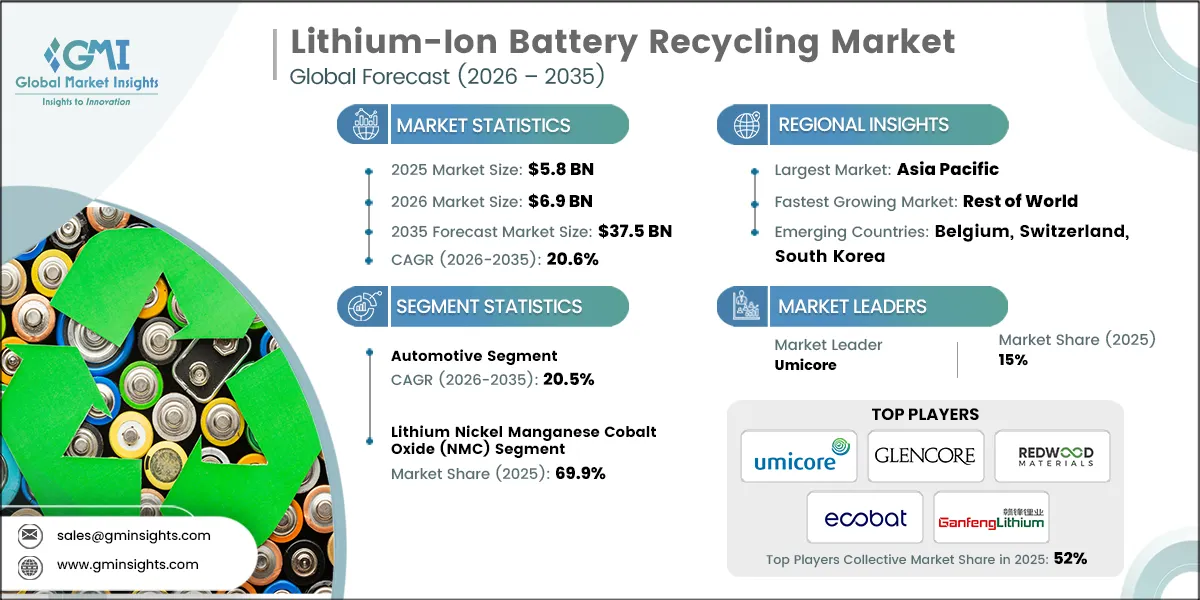
To get key market trends
Lithium-Ion Battery Recycling Market Trends
- Rising enforcement of tougher global regulations on safe battery and e‑waste disposal is accelerating demand for lithium‑ion recycling solutions. The European Union’s mandated recycling targets for battery producers are setting a strong precedent, while similar compliance frameworks are being introduced across North America and Asia Pacific. These policy pressures are pushing manufacturers and recyclers toward more responsible, large‑scale recovery processes.
- Moreover, companies are increasingly directing capital toward next‑generation recycling technologies that deliver higher recovery rates and reduced environmental impact, strengthening commercial interest in the sector. For instance, in January 2025, Marubeni Corporation invested USD 5 million in third‑party shares of Altilium Metals Ltd., which is actively establishing a dedicated lithium‑ion battery recycling business in the UK.
- Accelerated development of hydrometallurgical and direct‑recycling methods is improving cost‑effective material recovery, making these processes more attractive for large‑scale deployment. Enhanced recovery efficiency and reduced operational expenses are increasing overall economic viability. These improvements encourage battery manufacturers and recyclers to shift toward modern, optimized processes capable of retrieving valuable materials at lower cost and with improved sustainability benefits.
- Technological advancements such as direct cathode recovery and improved separation techniques are elevating the efficiency, purity levels, and sustainability of lithium‑ion recycling. These innovations also reduce energy use and operational complexity. For instance, in July 2024, Novocycle Technologies announced new battery‑recycling breakthroughs, achieving a 99.9% graphite recovery rate, significantly higher than the industry’s typical 80% benchmark, highlighting the progress emerging in the sector.
- Rising demand for localized recycling capacity is prompting governments and private players to invest in regional processing hubs, reducing reliance on cross‑border waste shipments. This shift improves supply‑chain resilience, ensures faster material turnaround, and supports domestic manufacturing of battery‑grade materials. As nations prioritize resource security, decentralized recycling ecosystems are becoming critical to stabilizing raw‑material availability for future battery production.
- Additionally, growing companies' development of new recycling facilities will complement the industry scenario. For instance, in April 2025, Ecobat brought three lithium‑ion battery recycling plants online within a year in Germany, the U.S., and the UK. Together, the facilities handle around 10,000 tons annually and prioritize black‑mass production, with expansion plans targeting 25,000 tons.
Lithium-Ion Battery Recycling Market Analysis
Learn more about the key segments shaping this market
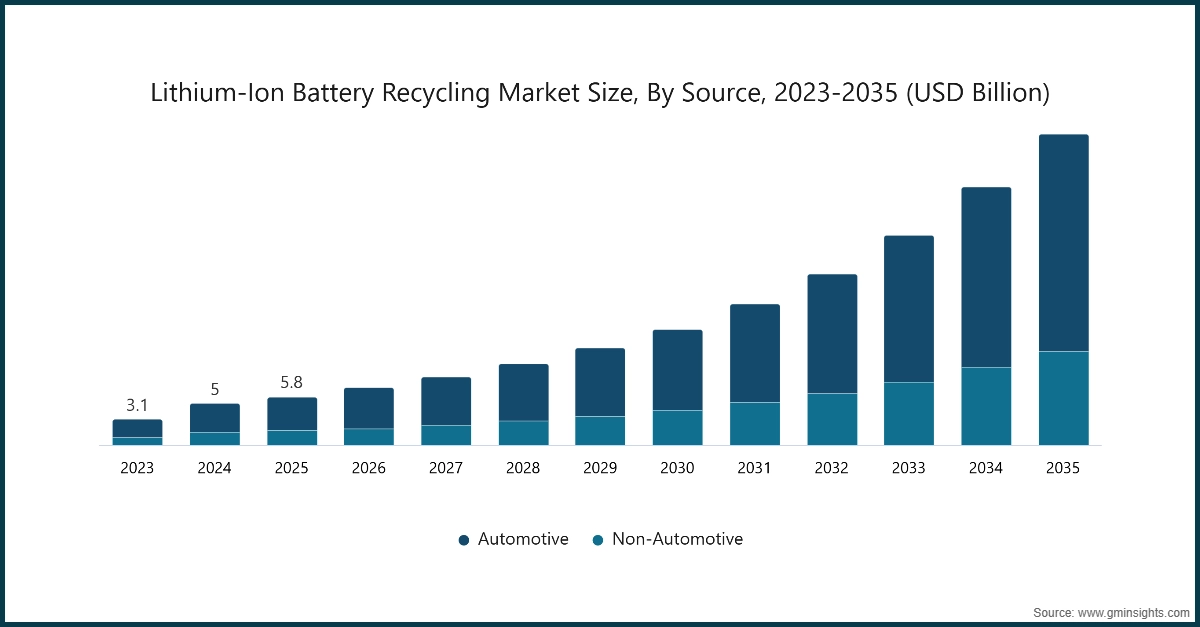
Based on the source, the industry is segmented into automotive and non-automotive categories. Automotive dominated the lithium-ion battery recycling market, accounting for 70.5% in 2025 and is expected to grow at a CAGR of 20.5% through 2035.
- Surging global EV industry with nearly sales of 20.7 million in 2025 as per IEA data, corresponds to increasing volume of end-of-life (EoL) batteries, driving adoption of recycling practices to manage waste and recover valuable materials. New entrants in the industry are getting support from the government in terms of funding and certification to further escalate the recycling industry. For instance, in September 2023, Electric two-wheeler manufacturer PURE EV received certification for lithium‑ion battery recycling, supporting India’s Battery Waste Management Rules introduced in August 2022. The move strengthens responsible disposal practices and advances nationwide efforts to improve sustainable battery‑recycling frameworks.
- Additionally, growing recycling companies support helping automakers to achieve their sustainability and ESG commitment by lowering the need for new mining and mitigating battery waste, will escalate the recycling infrastructure investments. For instance, in September 2024, Cylib is constructing Europe’s largest end-to-end lithium-ion battery recycling plant. The facility aims to process around 30,000 metric tons of end-of-life EV batteries annually.
- The non automotive market will grow at a CAGR of 20.9% by 2035. Rising deployment of energy storage systems for grid balancing, commercial backup power, and renewable energy integration increase batteries demand, particularly LFP chemistry due to their longevity and safety. As older ESS systems reach retirement age, necessitating recycling to recover valuable materials and free up space for newer technologies thereby improving the market growth.
Learn more about the key segments shaping this market
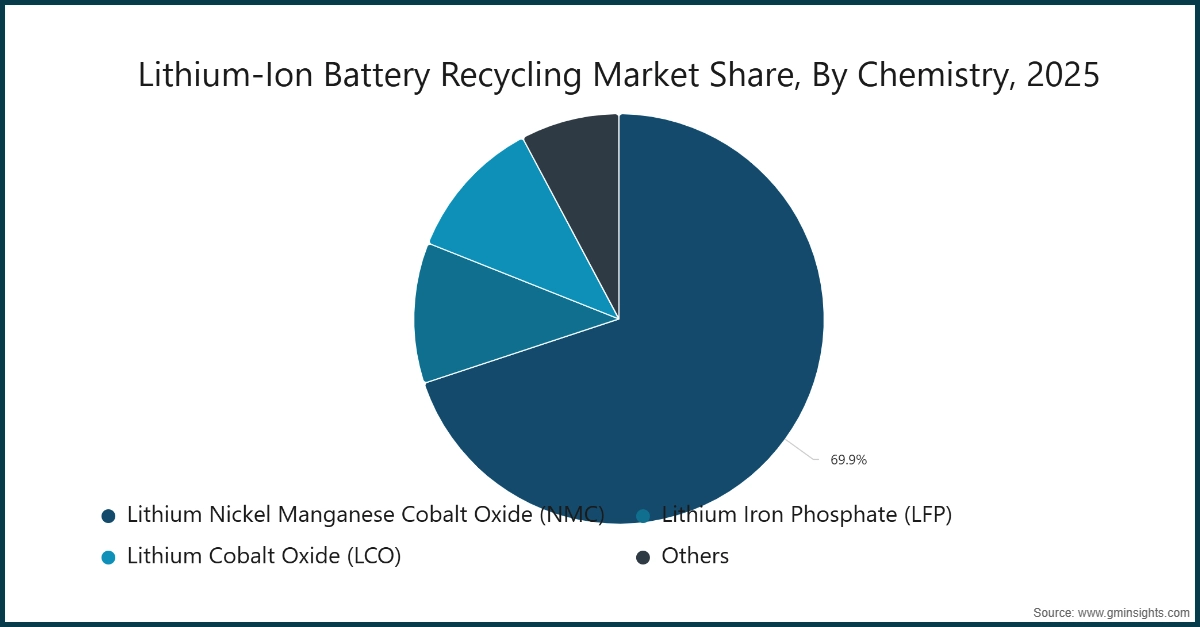
Based on chemistry, the lithium-ion battery recycling market is segmented into lithium iron phosphate, lithium nickel manganese cobalt oxide, lithium cobalt oxide and others. Lithium nickel manganese cobalt oxide (NMC) dominates the market with a 69.9% share in 2025, and the segment is expected to grow at a CAGR of 21% from 2026 to 2035.
- Rising government and regulatory guidelines around battery disposal and critical material reuse will foster the product recycling market. Furthermore, the technological compatibility of NMC with both pyrometallurgical and hydrometallurgical recycling methods will make the chemistry a preferred choice. These technologies are already mature and commercially deployed, allowing efficient recovery of target metals from NMC cells, leading to business expansion.
- Moreover, growing preference for batteries that deliver strong energy density, long operational life, and stable thermal performance, key requirements for EVs and stationary storage, is strengthening interest in NMC chemistries. At the same time, companies are advancing recycling technologies. In February 2025, Altilium introduced a process in the UK to recycle lithium‑iron‑phosphate batteries from a global EV and storage manufacturer. Using its proprietary EcoCathode technology, the company reports recovering over 97% of lithium and 99% of graphite, ensuring efficient material reutilization.
- Lithium iron phosphate is set to grow at a CAGR of 20.3% by 2035. LFP batteries maintain higher usable capacity at the end of their first life compared to many other chemistries, making them well‑suited for second‑life uses such as stationary storage systems. This extended utility reduces disposal volumes and enhances economic returns, while also complementing recycling efforts and supporting broader market growth.
- Lithium cobalt oxide (LCO) is set to grow at a CAGR of 19% by 2035. Increasing demand for LCO batteries in consumer electronics, which are disposed of in large volumes globally, will uplift the recycling plants deployment. Strengthening governments and environmental agencies' regulations around electronic waste management encourages manufacturers and recyclers to implement efficient collection and recycling systems for electronic products containing LCO cells, driving the industry forecast.
Looking for region specific data?
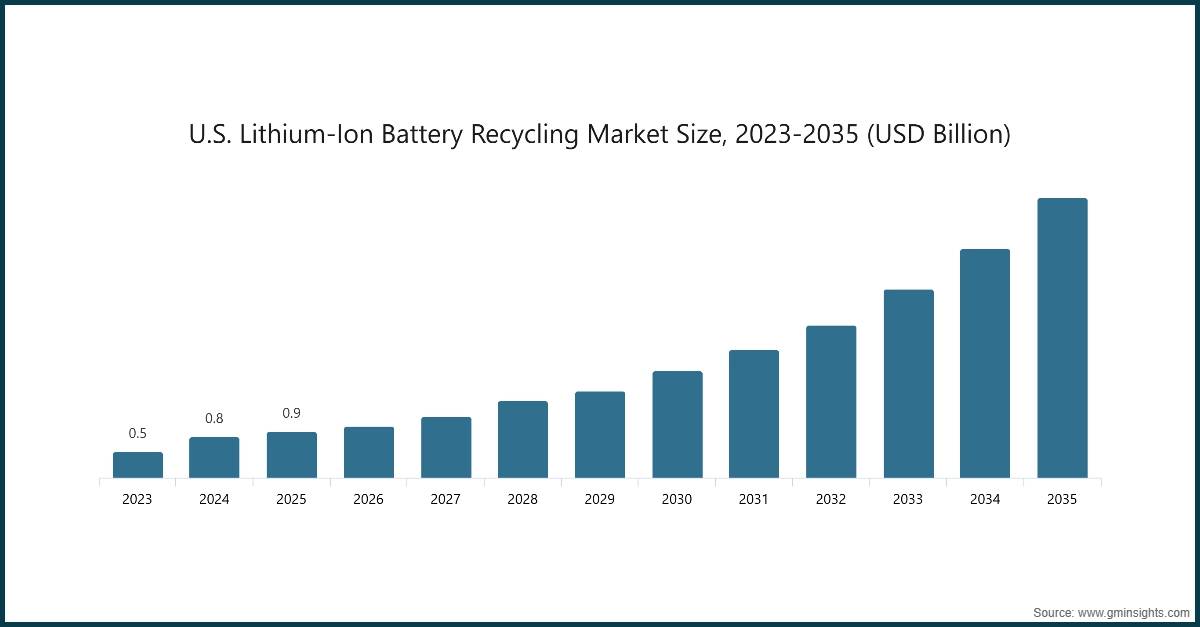
- The U.S. dominated the lithium-ion battery recycling market in North America with around 86.5% share in 2025 and is expected to generate over USD 5.4 billion in revenue by 2035.
- Rising federal initiatives such as DOE grants, tax incentives, and investments under the Bipartisan Infrastructure Law are accelerating domestic battery recycling capacity. These programs aim to reduce dependence on imported critical minerals, strengthen supply‑chain resilience, and support a circular economy, encouraging companies to expand large‑scale recycling operations.
- Additionally, rapid growth in electric vehicle sales is generating increasing quantities of spent lithium‑ion batteries, creating urgent demand for recycling infrastructure. Recovering high‑value materials like lithium, cobalt, and nickel helps reduce raw‑material imports, stabilizes costs, and supports sustainable manufacturing, driving stronger adoption of advanced recycling technologies across the U.S.
- The North America lithium-ion battery recycling market accounted for a market value of USD 1 billion in 2025. Ongoing partnerships in the region among new entrants, established players, recyclers, and automakers will augment the industry expansion. For instance, in February 2025, Blue Whale Materials formed a strategic alliance with Call2Recycle, a prominent battery stewardship organization in North America. Through this partnership, Blue Whale’s cutting-edge recycling facility in Oklahoma will handle batteries gathered from Call2Recycle’s extensive U.S. collection network. Additionally, the drive to reduce landfill waste and environmental hazards from improper battery disposal further supports the development of responsible recycling systems.
- Europe lithium-ion battery recycling market is anticipated to grow to over USD 12.4 billion by 2035. Increasing enforcement of the EU Battery Regulation, mandating minimum recycled content, mandatory collection targets, and strict end‑of‑life treatment rules, is accelerating recycling adoption. These policies push manufacturers and recyclers to invest in compliant facilities, strengthen traceability systems, and build closed‑loop value chains to meet Europe’s sustainability and circular‑economy goals.
- Additionally, rising automakers focus on opening up new in-house recycling facilities to cater to growing scrap production will foster the business growth. For instance, in October 2024, Mercedes-Benz launched a battery recycling facility in Germany, in partnership with Primobius, a joint venture between SMS group and Australia’s Neometals, leveraging advanced recycling technologies. Additionally, country’s well-developed waste management infrastructure supports efficient battery collection and sorting, improving the industry growth.
- Asia Pacific lithium-ion battery recycling market is anticipated to grow at a CAGR of 21% by 2035. Rising enforcement of battery waste‑management rules in China, India, Japan, and South Korea is accelerating recycling adoption. Policies requiring formal collection channels, extended producer responsibility, and safe material recovery are pushing manufacturers and recyclers to build large‑scale facilities, strengthening the region’s circular‑economy framework.
Lithium-Ion Battery Recycling Market Share
- The top 5 companies, including Umicore, Glencore, Redwood Materials, Ecobat and Ganfeng Lithium, account for around 52% market share. Key players are scaling hydrometallurgical and direct‑recycling technologies to increase recovery efficiency and lower processing costs. These innovations enable higher yields of lithium, nickel, cobalt, and graphite, helping companies meet circular‑economy mandates while improving profitability and attracting partnerships with battery manufacturers for long‑term feedstock security.
- Companies are collaborating with automakers, energy‑storage providers, and OEMs to secure steady end‑of‑life battery inflows. Long‑term supply agreements, joint ventures, and take‑back programs ensure predictable raw‑material access, support stable plant utilization, and position recyclers as essential partners in EV ecosystem sustainability.
- Leading players are setting up strategically located recycling plants near EV manufacturing hubs to reduce logistics costs and strengthen domestic value chains. These localized facilities support compliance with national content rules, improve turnaround times, and help nations reduce dependence on imported critical minerals by recovering materials locally.
- Moreover, companies actively leverage national incentives, grants, and sustainability policies to reduce capital expenditure on new facilities. By aligning operations with evolving recycling standards and reporting frameworks, players enhance compliance, attract public–private funding, and position themselves favorably within regulated battery‑manufacturing ecosystems globally.
Lithium-Ion Battery Recycling Market Companies
Eminent players operating in the lithium-Ion battery recycling industry are:
- 3R Recycler
- Accurec Recycling
- ACE Green Recycling
- American Battery Technology Company
- Attero Recycling
- Altilium Metals
- BatX Energies
- Cylib
- Cirba Solutions
- Ecobat
- Eramet
- Glencore
- Ganfeng Lithium
- Lohum Cleantech
- Neometals
- Recyclus Group
- RecycLiCo Battery Material
- Redwood Materials
- SK TES
- Umicore
- Umicore is a leading global recycler with advanced hydrometallurgical processes that recover lithium, cobalt, nickel, and other battery metals with high efficiency. The company operates large facilities in Europe and integrates recycling into a closed‑loop model that supports sustainable cathode‑material production for EV and energy‑storage markets.
- Glencore leverages its global mining, smelting, and refining network to build a large‑scale battery recycling ecosystem. The company focuses on recovering cobalt, nickel, and copper from end‑of‑life batteries and black mass, supporting circular supply chains and strengthening raw‑material security for EV manufacturers through integrated processing infrastructure.
- Redwood Materials emphasizes closed‑loop recycling by producing battery‑grade lithium, nickel, and cobalt from end‑of‑life batteries and manufacturing scrap. Operating major facilities in the U.S., it partners with automakers and cell manufacturers to supply sustainably sourced materials while reducing reliance on imported critical minerals and lowering manufacturing carbon intensity.
- Ecobat is a global battery recycler operating advanced lithium‑ion recycling plants in Germany, the UK, and the U.S., collectively processing up to 10,000 tons annually. The company focuses on producing black mass rich in lithium, cobalt, and nickel, supporting circular battery supply chains and reducing dependence on new mining.
- Ganfeng Lithium known for its expertise in lead recycling, is expanding into lithium‑ion battery recycling with dedicated plants for material recovery and black‑mass production. The company focuses on safe collection, sorting, and dismantling processes, aiming to build a strong presence in Europe and the U.S. to support evolving EV‑battery value chains.
Lithium-Ion Battery Recycling Market Report Attributes
| Key Takeaway | Details |
|---|---|
| Market Size & Growth | |
| Base Year | 2025 |
| Market Size in 2025 | USD 5.8 Billion |
| Market Size in 2026 | USD 6.9 Billion |
| Forecast Period 2026-2035 CAGR | 20.6% |
| Market Size in 2035 | USD 37.5 Billion |
| Key Market Trends | |
| Drivers | Impact |
| Environmental regulation tightening | Rising environmental regulation and sustainability mandates are accelerating lithium‑ion battery recycling adoption by reducing hazardous waste, enforcing responsible disposal, strengthening circular economy practices, and supporting compliant growth across EV markets. |
| Critical mineral demand growth | Growing demand for lithium, cobalt, nickel, and manganese from electric vehicles and grid storage is boosting lithium‑ion battery recycling to stabilize supply chains, reduce import dependence, and lower volatility risks. |
| Pitfalls & Challenges | Impact |
| Capital and technology constraints | Increasing capital intensity and technological complexity are constraining lithium‑ion battery recycling adoption, as advanced separation processes, safety requirements, and compliance standards raise project costs, extend timelines, and limit commercial viability. |
| Battery design complexity | Growing diversity of battery chemistries and pack designs complicates lithium‑ion recycling efficiency, requiring frequent process adjustments, specialized equipment, and skilled labor, which increases operational costs and slows large‑scale deployment rates. |
| Opportunities: | Impact |
| Rising material reintegration potential | Increasing electric vehicle and renewable energy storage deployment creates opportunities for recycled lithium‑ion battery materials to reenter manufacturing, reducing production costs, improving margins, and strengthening long‑term supply security globally industries. |
| Investments on technology advancement | Rising advancements in hydrometallurgical and direct recycling technologies enable higher material recovery, lower emissions, reduced energy consumption, and localized processing, creating scalable lithium‑ion battery recycling opportunities within circular economy frameworks. |
| Market Leaders (2025) | |
| Market Leader |
15% Market Share |
| Top Players |
Collective Market Share of 52% |
| Competitive Edge |
|
| Regional Insights | |
| Largest Market | Asia Pacific |
| Fastest growing market | Rest of World |
| Emerging countries | Belgium, Switzerland, South Korea |
| Future outlook |
|
What are the growth opportunities in this market?
Lithium-Ion Battery Recycling Industry News:
- In February 2025, Ace Green Recycling has entered into two strategic agreements to license its GREENLEAD hydrometallurgical technology and lithium battery recycling equipment to Mel Metal in Armenia and Georgia. The deal includes a 15-year lead battery recycling license and equipment for processing 6,000 metric tons annually, alongside lithium battery systems set to launch in Q3 2025.
- In January 2025, Ace Green Recycling entered a strategic partnership with Spiro to serve as its exclusive global recycling partner for end-of-life lithium-ion and LFP batteries, as well as manufacturing waste. The alliance aims to establish modular recycling facilities near Spiro’s collection hubs, leveraging Ace’s zero-emission Lithium First technology. Moreover, this collaboration supports Africa’s circular battery value chain and accelerates sustainable electric mobility expansion across the continent.
The lithium-Ion battery recycling market research report includes an in-depth coverage of the industry with estimates & forecast in terms of revenue and volume in “USD Billion & Thousand Tons” from 2022 to 2035, for the following segments:
Market, By Chemistry
- Lithium nickel manganese cobalt oxide (NMC)
- Lithium iron phosphate (LFP)
- Lithium cobalt oxide (LCO)
- Others
Market, By Process
- Pyrometallurgical
- Hydrometallurgical
- Physical/Mechanical
Market, By Source
- Automotive
- Non-automotive
The above information has been provided for the following regions and countries:
- North America
- U.S.
- Canada
- Europe
- UK
- France
- Belgium
- Switzerland
- Germany
- Asia Pacific
- China
- South Korea
- Japan
- Rest of World
Frequently Asked Question(FAQ) :
What was the market size of the lithium-ion battery recycling in 2025?
The market size was USD 5.8 billion in 2025, with a CAGR of 20.6% expected through 2035. Growing environmental concerns and stricter regulations on battery disposal are driving market growth.
What is the projected value of the lithium-ion battery recycling market by 2035?
The market is poised to reach USD 37.5 billion by 2035, fueled by advancements in recycling technologies, sustainability initiatives, and increasing adoption of electric vehicles.
What is the expected size of the lithium-ion battery recycling industry in 2026?
The market size is projected to reach USD 6.9 billion in 2026.
What was the share of the automotive sector in the market in 2025?
The automotive sector dominated the market with a 70.5% share in 2025 and is expected to grow at a CAGR of 20.5% through 2035.
What was the market share of lithium nickel manganese cobalt oxide (NMC) in 2025?
Lithium nickel manganese cobalt oxide (NMC) held a 69.9% market share in 2025 and is set to expand at a CAGR of 21% till 2035.
What is the growth outlook for lithium iron phosphate (LFP) batteries by 2035?
Lithium iron phosphate (LFP) batteries segment is anticipated to observe around 20.3% up to 2035.
Which region dominated the lithium-ion battery recycling sector in North America in 2025?
The U.S. dominated the North American market with an 86.5% share in 2025 and is expected to generate over USD 5.4 billion in revenue by 2035.
What are the emerging trends in the lithium-ion battery recycling market?
Key trends include stricter battery disposal regulations, advances in hydrometallurgical and direct recycling, direct cathode recovery innovations, rising investment in regional recycling hubs, and expanded recycling capacity.
Who are the key players in the lithium-ion battery recycling industry?
Key players include 3R Recycler, Accurec Recycling, ACE Green Recycling, American Battery Technology Company, Attero Recycling, Altilium Metals, BatX Energies, Cylib, Cirba Solution, Ecobat, and Eramet.
Lithium-Ion Battery Recycling Market Scope
Related Reports