Summary
Table of Content

Liquid-Cooled EV Charging Cable Market
Get a free sample of this report
Form submitted successfully!
Error submitting form. Please try again.
Thank you!
Your inquiry has been received. Our team will reach out to you with the required details via email. To ensure that you don't miss their response, kindly remember to check your spam folder as well!
Request Sectional Data
Thank you!
Your inquiry has been received. Our team will reach out to you with the required details via email. To ensure that you don't miss their response, kindly remember to check your spam folder as well!
Form submitted successfully!
Error submitting form. Please try again.
Liquid-Cooled EV Charging Cable Market Size
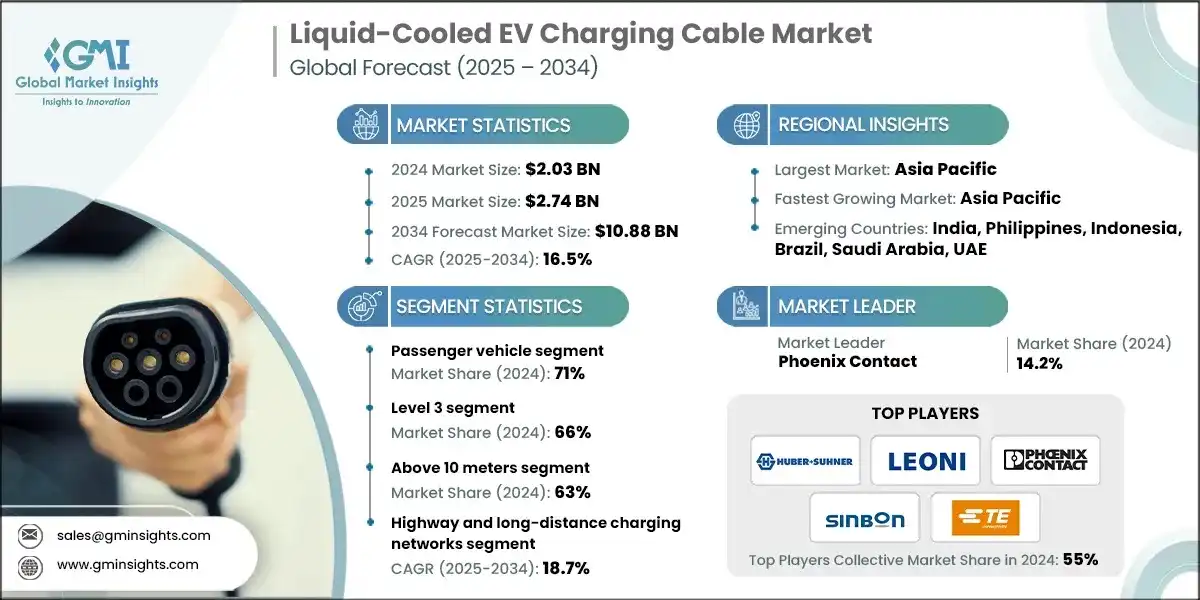
The global liquid-cooled EV charging cable market size was estimated at USD 2.03 billion in 2024. The market is expected to grow from USD 2.74 billion in 2025 to USD 10.88 billion in 2034, at a CAGR of 16.5%, according to latest report published by Global Market Insights Inc.
Liquid-Cooled EV Charging Cable Market Key Takeaways
Market Size & Growth
- 2024 Market Size: USD 2.03 Billion
- 2025 Market Size: USD 2.74 Billion
- 2034 Forecast Market Size: USD 10.88 Billion
- CAGR (2025–2034): 16.5%
Key Market Drivers
- Rising demand for high-power DC fast charging.
- Increasing EV adoption across passenger and commercial segments.
- Growing investments in charging infrastructure expansion.
- Advancements in cable durability and thermal management.
Challenges
- Complex installation and cooling system integration.
- Limited availability of skilled maintenance personnel.
Opportunity
- Integration of liquid-cooled cables in megawatt charging corridors.
- Expansion of public-private partnerships in EV infrastructure.
- Technological innovation in lightweight and flexible cable design.
- Rising demand for fleet electrification and depot charging.
Key Players
- Leading Players: Top 5 players in this market include Phoenix Contact, Huber+Suhner, Leoni AG, Sinbon Electronics, TE Connectivity, which collectively held a market share of 55% in 2024.
Get Market Insights & Growth Opportunities
The rapid roll-out of ultra-fast DC charging infrastructure is driving structural change across the EV charging ecosystem. Liquid-cooled charging cables enable high current (150 kW to 1.5+ MW) safely and compactly, allowing network operators and site owners to deliver much shorter charge times without excessive cable bulk or thermal risk. This trend minimizes per-site area, minimizes the complexity of O&M of high-power chargers, and facilitates fleet electrification and highway corridor implementations.
For instance, in February 2025, the total number of public charging stations in Europe has crossed 1 million, with Netherlands leading the region with 175 thousand charging points. This trend suggests that the region will reach 2 million by 2029.
Strategic investments and capacity expansions are now the norm as the OEMs and cable specialists expand to serve the megawatt-level demand. Multiple manufacturers and charging-infrastructure integrators have announced upgrades of their plant, pilot fabrication of liquid-cooled structure, and collaborated with connector and cool-system vendors to promote an abbreviated time-to-market of 350-1,000+ kW installations.
For September 2025, Autel Energy has partnered with Phoenix Contact to integrate Phoenix Contact’s 1,000 A liquid-cooled CCS2 cable and connector into Autel’s MaxiCharger DT1000 series, enabling up to megawatt-class charging for heavy-duty fleets and infrastructure.
The energy shift and increase in commercial electrification (buses, trucks, delivery fleet) is spurring liquid-cooled solution demand. The high power cycles are repeated in heavy-duty charging applications; liquid-cooled cables are favored by the rental/depot operator and fleet owners, in applications where sustained thermal operations are required and decreasing operating life in harsh duty cycles is undesirable.
The supply chain resiliency and digital transformation post-pandemic strategies have also had a great effect on the procurement and servicing of charging hardware. Telematics-enabled condition monitoring is increasingly proving to be an attractive option used by operators to integrate cables and cooling systems. These systems offer real-time diagnostics of temperature, flow and leakage as well as predictive maintenance contracts that are reducing downtime on high usage charging stations.
Liquid-cooled cables are also becoming popular in smart-city and corridor charging projects. The fast-charging hubs, intercity megawatt charging stations and bus depots are taking advantage of automated cable manipulation, modular liquid-cooling skids and standardized connector interfaces including CCS, GB/T and NACS. These innovations are contributing to the enhancement of safety, interoperability, and regulatory compliance.
North America, and Europe is a significant expansion market where both public and private investment in fast-charging corridors, fleet electrification programs, and greater use of newer connector standards are actively encouraged. This is because established infrastructure integrators and connector experts are in the market; the emphasis is on fast rollouts, retrofits to accommodate 350 kW+ chargers, and compatibility with emerging standards.
Asia-Pacific remains the largest and fastest-growing regional market on account of scale manufacturing, dense urban fleets, and large-scale pilot projects. China and select APAC markets lead in volume deployments and cost-competitive production; Japan and Korea emphasize advanced materials and reliability for high-duty applications.
To get key market trends
Liquid-Cooled EV Charging Cable Market Trends
Increasing the use of high-voltage EV architectures (800 V and higher) is necessitating liquid-cooled cables with 350 kW to 1.5 MW of power requirements. These systems also permit 5–10-minute charging, which is required by long-haul trucks and fleets, and liquid-cooling becomes an important facilitator of next-gen ultra-fast charging infrastructure.
In September 2024 Mercedes-Benz introduced the AMG GT XX Concept with a liquid-cooled CCS cable capable of liquid-cooled charging of over 1 megawatt (1,014 kW) in under two minutes. The demonstration was held at the IAA Munich Motor Show and emphasized the advancement of the automaker toward the integration of megawatt-range ultra-fast charging into its next-generation EV platforms.
Liquid cooling can be applied to conductor and cable to reduce by up to 40 the size and weight of conductors and cables, enhancing their flexibility and ease of handling. To ensure that users are safe and comfortable during high-power charging manufacturers are putting emphasis on ergonomic designs that are efficient to provide thermal performance during constant heavy current charging.
Modern liquid-cooled EV cables are equipped with sensors and intelligent control systems, which allow a real-time monitoring of temperature, current flow, and coolant pressure. Modular structures enable scalability in their installation, ease in their maintenance, and anticipatory diagnostics, enhancing reliability and operational availability in heavily used public and commercial charging systems.
Liquid-Cooled EV Charging Cable Market Analysis
Learn more about the key segments shaping this market
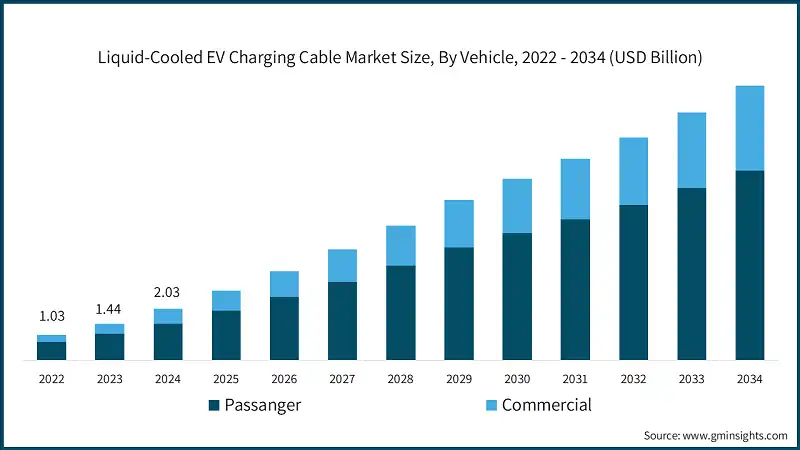
Based on vehicle, the liquid-cooled EV charging cable market is divided into passenger vehicle, and commercial vehicle. The passenger vehicle segment dominated the market, accounting for around 71% share in 2024 and is expected to grow at a CAGR of more than 16.2% through 2034.
- The passenger vehicle segment dominates the liquid-cooled EV charging cable market due to the number of electric cars in the world has been increasing rapidly and because more people need ultra-fast charging stations. As major vehicle manufacturers like Tesla, BYD, Mercedes-Benz, and Hyundai incorporate 800 V and 1,000 V systems, the challenge of effective thermal management during the process of high-power charging has become urgent. Liquid-cooled cables facilitate safe, reliable, compact charging solutions, and accommodate higher vehicle power densities and reduced charging times.
- Additionally, market dominance is driven by the expansion of networks of the public fast-charging stations in North America, Europe, and Asia-Pacific and the consumer demands towards fast and immediate charging options. The infrastructure operators and cable companies are also spending in new highly efficient cooling technology and ergonomic designs that suit passenger EV usage, which are long lasting, safe and with high efficiency in charging.
- In October 2025, Philatron Wire & Cable declared that it would present next-generation liquid-cooled EV fast-charging cables focused on passenger EVs at the CharIN North America Testival.
- The commercial vehicle segment will experience a CAGR of more than 17.4% in the liquid-cooled EV charging cable market due to the speeding up process of electrifying logistics, public transport and fleet operations. Electric buses, delivery trucks, and heavy-duty haulers need high-capacity charging with high power, so that the downtime is reduced and the fleet is exploited. Liquid-cooled cables are also essential as they can be used to transport high currents with high heat management and thus the liquid-cooled cables can be used to run continuously even when under extreme load conditions.
Learn more about the key segments shaping this market
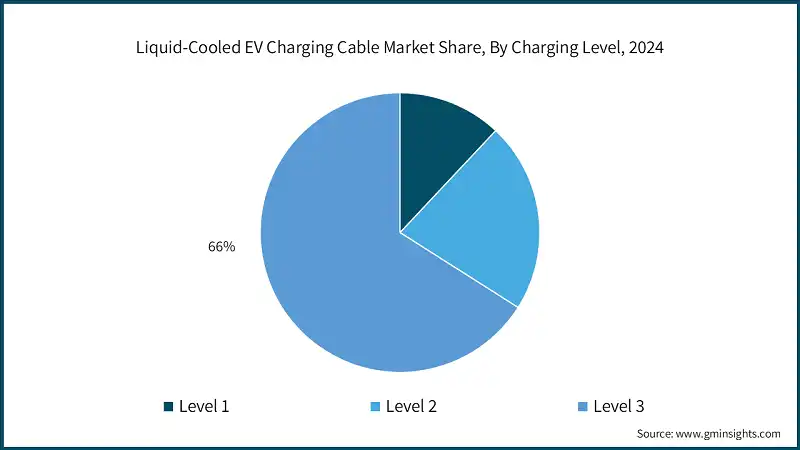
Based on charging level, the liquid-cooled EV charging cable market is segmented into level 1, level 2, and level 3. The level 3 segment dominates the market accounting for around 66% share in 2024, and the segment is expected to grow at a CAGR of over 17.5% from 2025 to 2034.
- Level 3 segment has the highest market share in the liquid-cooled EV charging cable market because it can provide ultra-fast DC charging, meaning a significant reduction of vehicle downtime. Due to the increase in EV usage, there is an increment in the demand of the high-power charging which is more than 350 kW, especially in the scope of the public and highway charging networks. Liquid-cooled cables are crucial in this level to effectively handle the heat when high current is passing through, which guarantees operational safety, reliability and extension of the life of the cables when there is continuous heavy load.
- Moreover, the Level 3 has been propelled by the global rollout of high-power charging infrastructure by network operators and OEMs, including Tesla Superchargers, Ionity, Electrify America, and Chinese national networks. These systems are becoming increasingly liquid-cooled based to accommodate next-generation 800 V and 1,000 V based systems to comply with user requirements of fast, seamless charging experiences.
- In May 2025, Leoni AG presented its new high-voltage cable Hivocar Cool at the Battery Show Europe, which is a liquid-cooled cable, aimed at ultrafast charging systems, allowing a thinner diameter of the cables and better thermal management.
Based on cable length, the liquid-cooled EV charging cable market is segmented into below 5 meters, 6-10 meters, and above 10 meters. Above 10 meters segment dominated the market in 2024 with around 63% share due to its suitability for large commercial stations and flexible multi-vehicle charging.
- The above 10 meters segment dominates the liquid-cooled EV charging cable market, driven by its critical role in large-scale installations of the cable in the general and fleet charging market. These are additional lengthy cables that give more flexibility in the placement of chargers compared to a vehicle especially at bus depots, logistics centers, and highway megawatt charging corridors. Their design helps to deliver power safely over long distances and conducts effective cooling to avoid overloading in case of high-current use.
- Additionally, long-length cables are rapidly becoming a standard with major developers of charging infrastructure and OEMs in response to the requirements of electric trucks, buses, and multi-bay charging stations. Companies like Huber plus Suhner and Phoenix contact are also targeting more thermal management and lightweight models to make them durable and easy to carry, further contributing to its increased adoption in commercial use.
- The 6-10 meters segment will expand at a CAGR of more than 18.1% because more public fast-charging stations will be installed in urban and semi-urban regions, where moderate cable lengths are a balance between flexibility and efficiency. The range provides a good reach for parking lots design, fleet depots and roadside charging networks without the need to affect cooling functions or safety standards.
Based on application, the market is divided into public charging stations, commercial fleet charging, residential / private charging, and highway and long-distance charging networks. The public charging stations dominated the liquid-cooled EV charging cable market.
- The public charging stations segment holds the highest market share in the market as it plays a vital role in facilitating the mainstream use of electric vehicles. With the rapid expansion of urbanization and the growth of the EV market, governments and individual operators are betting large sums on high-power public charging systems that can supply multiple users at the same time. Liquid-cooled cables allow very high-speed charging with minimal heat loss that helps to be reliable, and the charging time is shorter at crowded public locations.
- Additionally, there is an increase in demand for cross-country travel and highways with fast-charging corridors, which has driven installations of DC fast chargers with power exceeding 350 kW, at which liquid-cooled systems are required to ensure safe, long-lasting operation. Collaborations between OEMs and utilities and charging networks are increasing access, standardization, and faster implementation around the world.
- The highway and long-distance charging networks segment will experience a CAGR of 18.7% owing to the increasing demand of ultra-fast and reliable charging systems enabling long-range EV travel. Governments and privates are investing in high-capacity corridor networks with 500 kW to 1 MW chargers of passenger and commercial EVs.
Looking for region specific data?
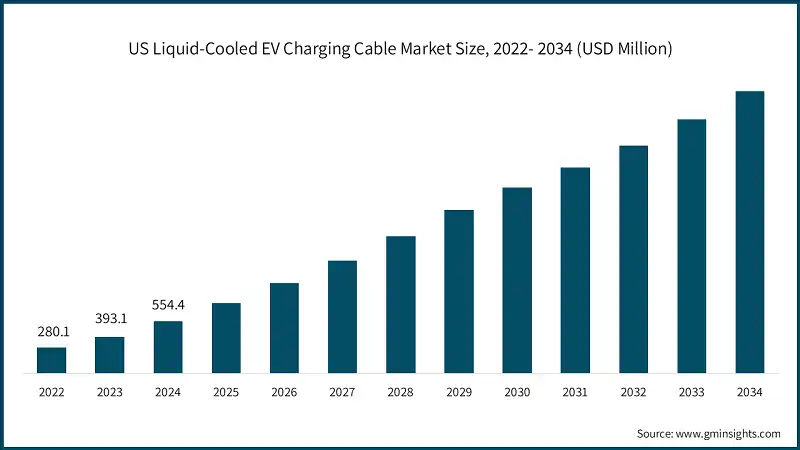
US dominated the liquid-cooled EV charging cable market in North America with around 85% share and generated USD 554.4 million in revenue in 2024.
- The U.S. market is witnessing strong growth driven by the rapid roll out of ultra-fast and megawatt-scale charging infrastructure both federal and state programs like the NEVI (National Electric Vehicle Infrastructure) Program. Large charging network operators such as Electrify America, Tesla and ChargePoint are moving to high-power charging systems with capacities as high as 1,000V and 500A, demanding high-quality liquid-cooled cable technologies. These systems are faster, safer, and thermally stable charging and is important in high utilization public and fleet charging.
- Moreover, the increasing use of commercial electric fleets is increasing, and this includes delivery vans as well as heavy-duty trucks; this is boosting the demand of durable and high-performance cooling solutions. The partnerships between the technology giants such as Phoenix Contact, ABB, and Autel Energy are developing local manufacture and combining of liquid-cooled cables, which place the U.S. as a top supplier of next-generation charging systems.
- For instance, in October 2025, Philatron Wire & Cable introduced at the CharIN North America Testival that it will launch its next-generation liquid-cooled EV fast-charging cables that would be high-current and have a high-temperature service life and designed to fit ultra-fast charging infrastructure.
- Canada is projected to grow at a CAGR of around 18% for the liquid-cooled EV charging cable market due to increased investments in ultra-fast charging facilities in national programs like the Zero-Emission Vehicle Infrastructure Program (ZEVIP) and the Natural Resources Canada (NRCan) funding programs. The increase in the use of electric trucks and buses is driving the need to have megawatt-level charging systems and this necessitates highly thermal efficient and safe liquid cooled cables.
The liquid-cooled EV charging cable market in Germany is expected to experience significant and promising growth from 2025-2034.
- Europe accounts for over 26% of the market in 2024 and is expected to grow at a CAGR of around 15.5% driven by rapid ultra-fast charger deployment and stringent EU carbon regulations.
- Germany is a strong liquid-cooled EV charging cable market leader because of the high concentration of large liquid-cooled EV infrastructure providers, strong research and development base and an early adopter of high-power charging systems. Major players in the country include Phoenix contact, Huber+Suhner and Siemens that are leading the pack in terms of significant changes made to the high-current and thermal efficient and liquid-cooled cable technology. Government-supported programs such as the Deutschlandnetz program are hastening the implementation of ultra-fast chargers throughout the country with charge power of up to 1,000 V and 600 A.
- Moreover, the increasing number of high-end EVs in Germany of BMW, Mercedes-Benz, and Porsche is fueling the necessity of an effective cooling system to reduce the charging period and improve the range of the vehicles. Collaborations between vehicle manufacturers and charging infrastructure solution providers are making Germany the European center of innovation with next-generation liquid-cooled charging infrastructure.
- For instance, in May 2025, LEONI Group announced at The Battery Show Europe its latest liquid-cooled high-power charging cables and compact high-voltage solutions for electromobility, enabling up to 30 % diameter-reduction and 75 % weight-savings over standards.
- The UK is a growing market with rapid expansion of ultra-fast charging networks on national projects like Project Rapid and Local EV Infrastructure (LEVI) Fund to become one of the largest growing markets of liquid-cooled EV charging cables. Such programs encourage the installation of 350 kW+ stations on motorways and urban centers, which entails the use of high-end liquid-cooled cable systems to transfer high-currents.
The liquid-cooled EV charging cable market in China is expected to experience significant and promising growth from 2025-2034.
- Asia Pacific accounts for over 34% of the market in 2024 and is expected to grow at a CAGR of around 17.5% owing to rapid EV adoption, infrastructure expansion, and government-backed ultra-fast charging initiatives in China, Japan, and South Korea.
- China is the market leader in the liquid-cooled EV charging cable market because of its widespread investment in ultra-fast charging systems and robust government policies in favor of mass EV rollout. High-voltage platforms 800 V The active use of high-voltage 800 V liquid-cooled cables in large-scale automakers, including BYD, NIO and XPeng, has contributed to the necessity of developing new high-voltage liquid-cooled cables that make efficient charging of power exceeding 500 kW possible. The intense proliferation of the high-capacity charging stations of State Grid Corporation contributes to growth of the market even more.
- Additionally, Chinese firms as TGOOD, Sinexcel, and Megmeet are also working on cost-effective high-performance liquid-cooled cable, which places China as a manufacturing center and an innovation center. The ongoing technological advancements, tactical partnerships with other players the world over and powerful government incentives are helping China to command this segment in the world.
- In March 2025, BYD unveiled an “all liquid-cooled megawatt flash-charging terminal system” that enables EVs to add roughly 250 miles of range in just five minutes. The innovation uses a 1,000-volt architecture and specialized SiC power chips.
- India is becoming one of the fastest-growing markets in the Asia-Pacific liquid-cooled EV charging cable business owing to government-based programs such as the FAME-II program, and the National Electric Mobility Mission Plan (NEMMP), which intends to boost the rate of EV uptake and the installation of charging cables. The increased installation of large liquid cables of 350 kW+ fast chargers by players in the industry like Tata Power, Statiq and ChargeZone is escalating the necessity of high-efficiency liquid cables that can accommodate high-current heat-sensitive charging systems.
The liquid-cooled EV charging cable market in Brazil is expected to experience significant and promising growth from 2025-2034.
- Latin America holds around 5% of the market and is growing steadily at a CAGR of around 12.9%. The developments are fueled by increasing investments in EV charging infrastructure across countries such as Brazil, Mexico, and Chile, supported by regional clean mobility initiatives and international funding programs.
- Brazil dominates the liquid-cooled EV charging cable in Latin America because the country has the fastest growth in EV charging infrastructure and government encouragement of electric mobility. The national electric mobility strategy (ENME) has programs and Brazilian Development Bank (BNDES) incentives to promote domestic and foreign investment in high-power charging networks. The increased adoption of EVs by manufacturers that include BYD, GWM, and Volvo has facilitated the need to develop sophisticated liquid-cooled charging cables that guarantee effective heat control and shorter charging duration in hot climates.
- Moreover, the joint ventures of local energy companies, such as EDP Brazil and Neoenergia with international technology providers, such as ABB and Siemens, enable the implementation of fast-charging 350- and 600-kW stations. Brazil is a country that is highly interested in implementing renewable energy and sustainable transportation, which is why the country is a leader in the region when implementing next-generation liquid-cooled EV chargers.
- For example, in October 2025, the industrial-giant WEG SA of Brazil, said it would start to produce EV chargers in Europe next year, and roll out a 1 MW charger in Brazil, and step up its investment in Mexico, amid exploding electrical-component demand.
- The market of the liquid-cooled EV charging cable in Mexico has a high growth rate because of the increased adoption of the EV in the country, the policies of the government encouraging clean mobility and the rise of investments in charging infrastructure foreign investments. Most major global players are setting up local manufacturing and assembly facilities to serve the needs of that region. The strategic position of Mexico as a manufacturing center of North America, combined with the growth of the industrial EV fleet and cross-border logistics electrification, is also causing the necessity of high-capacity and liquid-cooled charging systems even faster.
The liquid-cooled EV charging cable market in UAE is expected to experience significant and promising growth from 2025-2034.
- MEA holds around 4% of the market and is growing steadily at a CAGR of around 13.6% due to increasing government focus on EV adoption, renewable energy integration, and sustainable mobility initiatives.
- The UAE dominates the MEA market owing to its strong government-led EV adoption initiatives, rapid infrastructure expansion, and sustainability-focused policies under the UAE Vision 2031. The country has emerged as a regional hub for EV innovation, supported by the deployment of ultra-fast DC charging stations capable of 350kW and above. These high-power systems increasingly rely on liquid-cooled cable technologies to ensure safe, efficient, and reliable performance in extreme temperatures.
- Leading infrastructure developers such as DEWA, ADNOC Distribution, and Emirates National Oil Company (ENOC) are partnering with international technology providers like ABB, Siemens, and Kempower to expand the liquid-cooled charging ecosystem. Ongoing smart mobility projects in Dubai and Abu Dhabi, coupled with Expo City’s sustainability roadmap, further strengthen the UAE’s leadership in next generation charging technologies.
- Saudi Arabia is expected to grow at the fastest CAGR in the MEA liquid-cooled EV charging cable market owing to its ambitious electrification goals, large-scale infrastructure projects, and investments under Vision 2030. The government’s target to have 30% of Riyadh’s vehicles electric by 2030 is driving rapid expansion of ultra-fast charging networks, particularly those equipped with liquid-cooled systems capable of supporting 350kW–1MW power delivery.
Liquid-Cooled EV Charging Cable Market Share
- The top 7 companies in the liquid-cooled EV charging cable industry are Phoenix Contact, Huber+Suhner, TE Connectivity, Leoni, Sinbon Electronics, KemPower, and ABB, contributed around 70% of the market in 2024.
- Phoenix Contact focuses on advancing high-current CCS2 and Megawatt Charging System (MCS) technologies through collaborations with charging solution providers. The company emphasizes innovation in liquid-cooling integration, modular connector designs, and interoperability to support ultra-fast charging infrastructure for both passenger and heavy-duty EVs.
- Huber+Suhner’s strategy centers on expanding its RADOX HPC (High Power Charging) portfolio with enhanced cooling performance and lightweight materials. The company prioritizes partnerships with charging network operators and OEMs to deliver safe, reliable, and scalable high-current cable solutions for next-generation fast-charging systems.
- TE Connectivity is investing in advanced thermal management, sensor integration, and compact connector technology to optimize heat dissipation and safety in high-power cables. The company’s strategy includes supporting high-voltage EV infrastructure and collaborating with charger manufacturers for global standardization and improved interoperability.
- Leoni focuses on developing sustainable, high-efficiency cable solutions with improved flexibility, temperature tolerance, and reduced energy loss. Its strategy emphasizes R&D investments and collaborations with EV OEMs to co-develop customized liquid-cooled charging cables aligned with evolving fast-charging standards.
- Sinbon Electronics pursues a customization-led strategy, delivering precision-engineered liquid-cooled cables for OEM and charging infrastructure clients. The company emphasizes cost-efficient production, modular design flexibility, and partnerships with EV charging equipment makers to expand its footprint in the global fast-charging segment.
- KemPower’s strategy revolves around integrating liquid-cooled cable technology into its modular DC fast-charging systems. The company focuses on flexible deployment models, adaptive load balancing, and real-time monitoring to optimize power delivery for fleet depots and high-demand commercial charging environments.
- ABB is expanding its high-power charging portfolio with advanced liquid-cooled cable systems capable of delivering over 500 kW. The company focuses on digital integration, interoperability, and sustainable manufacturing, aligning with global EV infrastructure expansion and partnerships with fleet and energy operators.
Liquid-Cooled EV Charging Cable Market Companies
Major players operating in the liquid-cooled EV charging cable industry are:
- ABB
- Besen International
- Brugg eConnect
- Huber+Suhner
- KemPower
- Leoni
- Phoenix Contact
- Sinbon Electronics
- Sumitomo Electric
- TE Connectivity
- Manufacturers in the liquid-cooled EV charging cable market are increasingly adopting digital design, testing, and monitoring platforms that enhance product reliability, energy efficiency, and lifecycle management. Cloud-based performance analytics and IoT integration enable predictive maintenance and real-time thermal regulation, improving charging uptime, user safety, and operational scalability across global EV infrastructure networks.
- Strategic collaborations and vertical integration are reshaping industry dynamics. Partnerships between cable manufacturers, EV charger OEMs, and energy providers are accelerating innovations in megawatt-class charging, sustainable materials, and standardized connector interfaces. These alliances strengthen global supply chains, ensure regulatory compliance, and drive the transition toward high-power, eco-friendly, and digitally intelligent EV charging ecosystems.
Liquid-Cooled EV Charging Cable Market Report Attributes
| Key Takeaway | Details |
|---|---|
| Market Size & Growth | |
| Base Year | 2024 |
| Market Size in 2024 | USD 2.03 Billion |
| Market Size in 2025 | USD 2.74 Billion |
| Forecast Period 2025 - 2034 CAGR | 16.5% |
| Market Size in 2034 | USD 10.88 Billion |
| Key Market Trends | |
| Drivers | Impact |
| Rising demand for high-power DC fast charging | The increasing need for ultra-fast charging to reduce EV downtime is driving demand for liquid-cooled cables that efficiently manage high current levels above 350kW, supporting rapid vehicle turnaround for both public and commercial charging networks. |
| Increasing EV adoption across passenger and commercial segments | The rapid growth of electric passenger vehicles and the electrification of commercial fleets are creating strong demand for advanced charging systems that require liquid-cooled cables to handle higher power delivery safely and maintain consistent performance in heavy-duty operations. |
| Growing investments in charging infrastructure expansion | Global investments in EV charging networks, supported by national and regional funding programs, are boosting the deployment of ultra-fast DC chargers. This expansion directly increases the requirement for liquid-cooled cable systems capable of sustaining continuous high-power operation. |
| Advancements in cable durability and thermal management | Innovations in cable insulation, flexible materials, and advanced cooling fluids have enhanced the reliability and safety of liquid-cooled cables, making them suitable for long-term, high-temperature operations and reducing maintenance frequency in demanding commercial environments. |
| Pitfalls & Challenges | Impact |
| Complex installation and cooling system integration | Liquid-cooled charging cables require additional components, such as pumps, heat exchangers, and coolant reservoirs, which increase installation complexity, system cost, and maintenance needs compared to conventional air-cooled charging solutions. |
| Limited availability of skilled maintenance personnel | The lack of trained technicians capable of maintaining and servicing advanced cooling systems restricts widespread adoption, especially in developing markets where technical expertise and spare parts availability remain limited. |
| Opportunities: | Impact |
| Integration of liquid-cooled cables in megawatt charging corridors | As global megawatt charging corridors for electric trucks and buses expand, liquid-cooled cable providers have vast opportunities to deliver high-current, thermally stable solutions. These cables are crucial for enabling ultra-fast, long-haul EV charging infrastructure that supports heavy-duty commercial transport and fleet electrification goals. |
| Expansion of public-private partnerships in EV infrastructure | Increasing collaborations among governments, utilities, and private enterprises are accelerating the rollout of ultra-fast charging stations. These partnerships create lucrative prospects for liquid-cooled cable suppliers, as such projects demand efficient, high-capacity power transfer solutions to support public highway corridors and nationwide EV infrastructure networks. |
| Technological innovation in lightweight and flexible cable design | Manufacturers are developing advanced lightweight and flexible cable designs with improved cooling efficiency, durability, and user ergonomics. These innovations enhance safety, reduce thermal strain during operation, and simplify handling, making liquid-cooled systems more practical for both high-power public chargers and commercial fleet applications. |
| Rising demand for fleet electrification and depot charging | As logistics, delivery, and public transportation fleets transition to electric vehicles, depot-based high-capacity charging solutions are gaining momentum. Liquid-cooled cables are ideal for continuous, high-load charging operations, providing reliability, safety, and temperature control, essential for large-scale fleet charging hubs. |
| Market Leaders (2024) | |
| Market Leaders |
14.2 % market share |
| Top Players |
Collective Market Share in 2024 is 55% |
| Competitive Edge |
|
| Regional Insights | |
| Largest Market | Asia Pacific |
| Fastest Growing Market | Asia Pacific |
| Emerging Country | India, Philippines, Indonesia, Brazil, Saudi Arabia, UAE |
| Future Outlook |
|
What are the growth opportunities in this market?
Liquid-Cooled EV Charging Cable Industry News
- In March 2025, BYD unveiled its Super-e platform, capable of delivering a 400 km range in just five minutes through an advanced all-liquid-cooling system and 1,000 V architecture. The company also announced plans to deploy 4,000 megawatt chargers integrated with battery storage across China, marking the world’s largest commercial rollout of megawatt-class liquid-cooled charging infrastructure.
- In February 2025, Phoenix Contact confirmed the Q1 2026 launch of its NACS charging cables supporting up to 500 kW output, with boost capability up to 500 A and operation at 1,000 V. The company also revealed plans for MCS connectors capable of handling 2.25 MW (1,800 A, 1,250 V), with rollout expected in 2026, underscoring its commitment to next-generation ultra-fast charging solutions.
- In February 2024, Leoni expanded its production capacity for high-voltage and liquid-cooled cables to meet surging demand from the automotive sector, particularly for 800 V EV architectures used in high-performance electric vehicles.
- In January 2024, Huber+Suhner showcased its 600-kW liquid-cooled charging cables at major industry exhibitions, highlighting advanced thermal management innovations designed to support ultra-high-power EV charging applications.
- In December 2023, OMG EV Cable secured a major contract to supply liquid-cooled charging cables for electric bus fleet infrastructure, signaling growing adoption of high-power cooling solutions in the commercial and public transport segments.
The liquid-cooled EV charging cable market research report includes in-depth coverage of the industry with estimates & forecasts in terms of revenue ($Bn), Shipment (Units) from 2021 to 2034, for the following segments:
Market, By Vehicle
- Passenger
- Hatchbacks
- Sedans
- SUV
- Commercial
- Light commercial vehicles (LCV)
- Medium commercial vehicles (MCV)
- Heavy commercial vehicles (HCV)
Market, By Application
- Public Charging Stations
- Commercial Fleet Charging
- Residential / Private Charging
- Highway and Long-Distance Charging Networks
Market, By Charging Level
- Level 1
- Level 2
- Level 3
Market, By Cable Length
- Below 5 meters
- 6-10 meters
- Above 10 meters
Market, By Conductor Material
- Copper
- Aluminium
Market, By Connector
- Type 1
- Type 2
- CCS1
- CCS2
- CHAdeMO
- Others
Market, By Power
- AC charging
- DC charging
The above information is provided for the following regions and countries:
- North America
- US
- Canada
- Europe
- Germany
- UK
- France
- Italy
- Spain
- Russia
- Asia Pacific
- China
- India
- Japan
- Australia
- South Korea
- Philippines
- Indonesia
- Latin America
- Brazil
- Mexico
- Argentina
- MEA
- South Africa
- Saudi Arabia
- UAE
Frequently Asked Question(FAQ) :
What is the market size of the liquid-cooled EV charging cable in 2024?
The market size was estimated at USD 2.03 billion in 2024, with a CAGR of 16.5% expected through 2034. The rapid deployment of ultra-fast DC charging infrastructure is driving market growth.
What is the projected value of the liquid-cooled EV charging cable market by 2034?
The market is poised to reach USD 10.88 billion by 2034, driven by advancements in high-power charging systems and fleet electrification initiatives.
What is the expected size of the liquid-cooled EV charging cable industry in 2025?
The market size is projected to reach USD 2.74 billion in 2025.
What was the market share of the passenger vehicle segment in 2024?
The passenger vehicle segment dominated the market with approximately 71% share in 2024 and is expected to witness over 16.2% CAGR through 2034.
What was the market share of the level 3 segment in 2024?
The level 3 segment accounted for around 66% of the market share in 2024 and is set to expand at a CAGR of over 17.5% from 2025 to 2034.
What was the valuation of the
The
Which region leads the liquid-cooled EV charging cable sector?
The U.S. leads the market in North America, accounting for 85% of the regional share and generating USD 554.4 million in revenue in 2024.
What are the upcoming trends in the liquid-cooled EV charging cable market?
Trends include high-voltage EV systems, ergonomic cables, real-time monitoring, modular scalability, and ultra-fast charging advancements.
Who are the key players in the liquid-cooled EV charging cable industry?
Key players include ABB, Besen International, Brugg eConnect, Huber+Suhner, KemPower, Leoni, Phoenix Contact, Sinbon Electronics, Sumitomo Electric, and TE Connectivity.
Liquid-Cooled EV Charging Cable Market Scope
Related Reports