Summary
Table of Content

Light Field Cameras Market
Get a free sample of this report
Form submitted successfully!
Error submitting form. Please try again.
Thank you!
Your inquiry has been received. Our team will reach out to you with the required details via email. To ensure that you don't miss their response, kindly remember to check your spam folder as well!
Request Sectional Data
Thank you!
Your inquiry has been received. Our team will reach out to you with the required details via email. To ensure that you don't miss their response, kindly remember to check your spam folder as well!
Form submitted successfully!
Error submitting form. Please try again.
Light Field Cameras Market Size
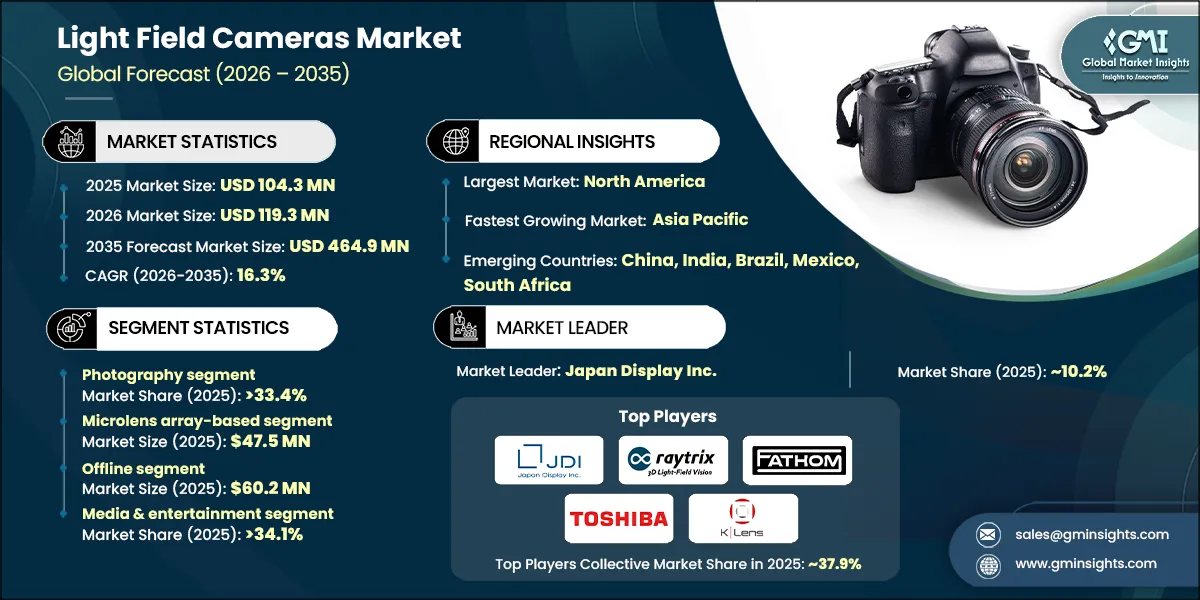
The global light field cameras market was estimated at USD 104.3 million in 2025. The market is expected to grow from USD 119.3 million in 2026 to USD 245.2 million in 2031 and USD 464.9 million by 2035, at a CAGR of 16.3% during the forecast period of 2026–2035, according to the latest report published by Global Market Insights Inc.
Light Field Cameras Market Key Takeaways
Market Size & Growth
- 2025 Market Size: USD 104.3 Million
- 2026 Market Size: USD 119.3 Million
- 2035 Forecast Market Size: USD 464.9 Million
- CAGR (2026–2035): 16.3%
Regional Dominance
- Largest Market: North America
- Fastest Growing Region: Asia Pacific
Key Market Drivers
- Rising adoption in virtual reality, augmented reality, and immersive media applications..
- Increasing use in healthcare and medical imaging for advanced diagnostics..
- Advancements in computational photography and AI-based image processing..
- Growing demand from robotics, drones, and autonomous systems..
- Expanding applications in industrial inspection and machine vision..
Challenges
- High cost limiting adoption.
- Complex data processing and storage requirements.
Opportunity
- Rising investments in research and development for next-gen light field imaging..
- Expansion in automotive, aerospace, and defense applications..
Key Players
- Market Leader: Japan Display Inc. led with over 10.2% market share in 2025.
- Leading Players: Top 5 players in this market include Japan Display Inc., Raytrix GmbH, Fathom Holografika Kft., Toshiba Corporation, K-Lens GmbH, which collectively held a market share of 37.9% in 2025.
Get Market Insights & Growth Opportunities
Demand for advanced imaging technologies is required for the Healthcare industry, the Media and Entertainment industry, as well as Industrial Inspection applications is driving overall growth. Adoption of light field cameras used in VR, AR, and computational photography is promoting market growth due to the ability of light field cameras to allow users to determine depth, refocus, and create 3D images from depth information.
- Using light field cameras to collect depth data, post-process and analyze images of 3D scenes in real time is creating large-scale adoption of these devices within all applications, including creating immersive gaming environments and interactive media across the entertainment, education, and enterprise visualization sectors worldwide. For instance, in 2024, Google partnered with HP to launch Project Starline, a light-field display technology designed to deliver highly realistic, in-person-like videoconferencing experiences.
- Light Field Cameras and imaging technology play an important role in healthcare, microscopy, surgical imaging, and diagnostics, because they can capture all three dimensions of data at once. This Will Improve the Image Quality and Depth of Field, as Well as Create Better Image Analysis to Support Research, Minimally Invasive Surgery, and Improve Patient Health Overall. For instance, in September 2024, ZEISS launched Lightfield 4D as a new microscopy technology based on the light-field principle. As a new imaging mode integrated into the new ZEISS LSM 910 and LSM 990 confocal microscope systems, ZEISS Lightfield 4D redefines the way researchers observe living organisms, especially in neurosciences, cancer research, developmental biology, and plant sciences.
- Robotics, drones, and autonomous vehicles require the presence of depth to provide precise perception and navigation capabilities. Therefore, light field cameras provide multi-image and depth information, enabling successful object recognition, navigation, and obstacle avoidance. As such, light field cameras are growing rapidly due to increasing investment in robotic and autonomous technology. For instance, in March 2024, Hanwha launched new dual light capabilities to Q series AI Cameras to deliver enhanced low-light performance, even in zero-lux environments.
- Between 2022 and 2024, the light field cameras market experienced significant growth, rising from USD 69.8 million in 2022 to USD 91.5 million in 2024. One major trend during this period was the progress in computer vision technologies. Improvements in AI have helped computers better understand visual information, making it easier to map 2D and 3D images accurately. These advances are making it easier for people to work with computers and can help increase productivity. For instance, in December 2025, Leopard Imaging showcased the Eagle Cameras at CES (Camera Series Eagle) 2026, expanding the series of high-resolution RGB-IR stereo Cameras. The Eagle camera product integrates with NVIDIA's Hololens and Jetson Thor hardware platforms to provide a complete solution for developing and deploying physical AI applications.
- Light field cameras are being used by manufacturers for dimensional measurement, defect detection, and quality control. The automotive, electronics, and precision engineering industries have seen a sharp rise in the use of these technologies for better analysis, comprehension, and quantification of 3D surface dimensions. This has improved manufacturing efficiency and reduced defect levels by enabling more accurate inspections of complex parts. For instance, in June 2021, Wooptix collaborated with poLight ASA on their Phase RT1000 Camera.
- Future light-field imaging systems will provide greatly enhanced imaging capabilities when combined with future optical technologies (including next-generation optical devices). The significant investment of many research institutions (including defense agencies) and technology companies to advance the development of next-generation optical components and associated technologies has created an opportunity for the creation of commercially viable light-field imaging products that support significant future growth in both new, emerging and niche markets, as well as all defined segments in a rapidly growing market (i.e., all segments in the light-field camera market). For instance, in December 2024, ZenaTech’s Spider and Vision Sensors Ltd. partnered to supply Blue UAS and NDAA- Compliant AI Drone Cameras for US Défense.
To get key market trends
Light Field Cameras Market Report Attributes
| Key Takeaway | Details |
|---|---|
| Market Size & Growth | |
| Base Year | 2025 |
| Market Size in 2025 | USD 104.3 Million |
| Market Size in 2026 | USD 119.3 Million |
| Forecast Period 2026 - 2035 CAGR | 16.3% |
| Market Size in 2035 | USD 464.9 Million |
| Key Market Trends | |
| Drivers | Impact |
| Rising adoption in virtual reality, augmented reality, and immersive media applications. | Growing adoption in immersive media and entertainment drives around 35% of market demand. Light field cameras enable 3D depth capture, refocusing, and realistic imagery for virtual reality, augmented reality, and gaming applications, enhancing user experiences and fueling widespread implementation across media, content creation, and digital platforms. |
| Increasing use in healthcare and medical imaging for advanced diagnostics. | Increasing integration in healthcare and medical imaging contributes about 30% to market growth. Applications in microscopy, surgical imaging, and diagnostics benefit from volumetric imaging and precise depth capture, supporting accurate analysis, research, and improved patient outcomes, which encourages adoption of light field camera technologies. |
| Advancements in computational photography and AI-based image processing. | Expansion of industrial automation and robotics fuels roughly 20% of market growth. Light field cameras enhance robotics, drones, and autonomous systems by providing accurate depth sensing, object recognition, and spatial awareness, improving operational efficiency and enabling seamless integration into manufacturing, logistics, and inspection workflows. |
| Growing demand from robotics, drones, and autonomous systems. | Technological advancements in AI, computational imaging, and sensor design drive about 15% market improvement. Enhanced image processing, machine learning-based reconstruction, and improved sensor performance increase accuracy, reduce processing time, and broaden use cases, supporting adoption in scientific research, industrial applications, and autonomous systems. |
| Expanding applications in industrial inspection and machine vision. | Rising demand for precision, efficiency, and advanced imaging contributes approximately 10% of market growth. End use increasingly seek high-resolution, single-shot 3D imaging for applications in research, defense, automotive, and entertainment, motivating investments in light field camera solutions to enhance performance and productivity. |
| Pitfalls & Challenges | Impact |
| High cost limiting adoption | The premium pricing of light field camera systems restricts widespread adoption, particularly among small and medium enterprises and emerging markets by 9.5%. High initial investment and expensive components, including advanced lenses and sensors, make procurement challenging, slowing market penetration despite the growing demand for immersive imaging and 3D visualization applications. |
| Complex data processing and storage requirements | Light field cameras generate massive volumes of multidimensional data, requiring advanced processing algorithms, high-performance computing, and extensive storage solutions. The complexity of handling, analyzing, and managing this data increases operational costs and technical challenges, hampering adoption in industries where infrastructure and computational resources are limited or cost sensitive. |
| Opportunities: | Impact |
| Rising investments in research and development for next-gen light field imaging. | Increasing investments in research and development are driving innovation in next-generation light field imaging, including improvements in sensor technology, computational photography, and AI integration. These advancements expand application possibilities, enhance image quality, and reduce costs, creating significant growth opportunities across healthcare, industrial, and consumer markets. |
| Expansion in automotive, aerospace, and defense applications. | Light field cameras are gaining traction in automotive, aerospace, and defense sectors for applications such as autonomous driving, in-cabin monitoring, robotics, and surveillance. Growing adoption in these high-tech industries presents opportunities to develop specialized solutions, improve operational efficiency, and address complex imaging challenges, fueling market growth globally. |
| Market Leaders (2025) | |
| Market Leaders |
~10.2% market share. |
| Top Players |
|
| Competitive Edge |
|
| Regional Insights | |
| Largest Market | North America |
| Fastest growing market | Asia Pacific |
| Emerging countries | China, India, Brazil, Mexico, South Africa |
| Future outlook |
|
What are the growth opportunities in this market?
Light Field Cameras Market Trends
- Light Field Cameras are an emerging technology in the light field camera industry, primarily driven by the increasing demand for High Powered Automated Versatile 3D Imaging Systems for a wide variety of applications, including Virtual Reality, Industrial Inspection, Robotics, and Scientific Research. Using advanced Light Field Cameras to create 3D depth capture and Volumetric Imaging, along with the Refocus Capability of Light Field Cameras, makes these technologies valuable in developing products faster and more accurately than was previously possible.
- For instance, in February 2025, Ratri GmbH announced that it was extending the number of installations of its Single Shot 3D Light Field Camera for use in Industrial Inspection, Microscopy, and Robotics, allowing for an increase in the speed at which 3D image data could be captured, improved operational accuracy, and greater levels of automation in manufacturing and research processes.
- The increased usage of smart manufacturing, digital infrastructure, and connected research sites are further accelerating the adoption of light field imaging solutions as these technologies support large-scale deployment of real-time 3D analyses and advanced visualizations; therefore, light field imaging technologies will become necessary components for high precision industries where speed and accuracy are critical to success.
- With the continued expansion of imaging applications, light field cameras are implementing artificial intelligence techniques to reconstruct depth and process in real time using high-performance sensors; improving image quality, operational durability, and data quality for industrial, scientific, and entertainment applications as compared to previous generations of light field cameras.
Light Field Cameras Market Analysis
Learn more about the key segments shaping this market
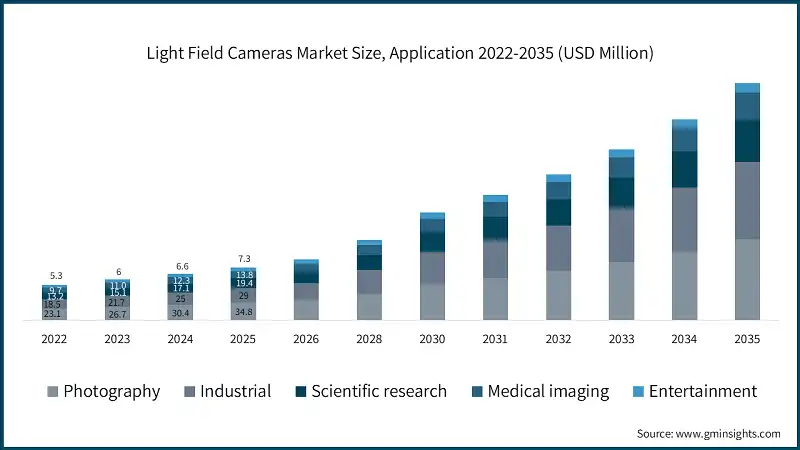
The light field cameras industry was valued at USD 69.8 million and USD 80.5 million in 2022 and 2023, respectively. The market size reached USD 104.3 million in 2025, growing from USD 91.5 million in 2024.
Based on applications, the market is segmented into photography, industrial, scientific research, medical imaging, and entertainment. The photography segment is estimated to register a significant growth rate of over 33.4% of the market in 2025.
- The photography segment holds the largest share in the market, due to their ability to create three-dimensional (3D) images, refocus at any time after the shooting, map the depth of the subject matter, and reconstruct the image to better represent the subject matter. The growing need for digital and hybrid photography, media content creation in the form of professional film and television production, and the emergence of social media are the driving forces behind the rapid growth of the light field camera industry.
- Manufacturers are encouraged to produce light field cameras that offer high-resolution capabilities, provide user-friendly, advanced sensors and lenses, and include a variety of digital and computational imaging features to support professional photographers, media creators, and virtual-reality (VR) content developers in their quest to achieve increased adoption of light field cameras across multiple areas of photography, media creation, and social media platforms.
- The industrial segment is the fastest growing within the light field cameras industry, projected to expand at a CAGR of 18.2% during the forecast period. Increased demand for robotics, which includes Automated Inspection & Quality Control as well as Machine Vision, will continue to grow in the market. The light field cameras deliver accurate depth sensing, volumetric imaging, and real-time 3D capture, providing higher efficiency and accuracy than previous solutions.
- In order to keep up with this growing demand in the market, manufacturers need to develop High-Quality Light Field Cameras Industrial Grade Light Field Cameras, with a focus on High Precision Depth Sensing, Real-Time 3D Imaging, and AI-Driven Analysis, that will Increase Performance within the areas of Robotics, Automated Inspection, and Machine Vision.
Based on technology, the light field cameras market is segmented into microlens array-based, coded aperture, and camera array. The microlens array-based segment dominated the market in 2025 with a revenue of USD 47.5 million.
- The microlens array-based segment holds the largest share of the market, driven by its capacity to collect multiple viewpoints from a single exposure while providing in-depth information. This has resulted in the improvement of high-resolution three-dimensional imaging, the ability to refocus images, and three-dimensional volumetric reconstruction. Applications include photographic images, Augmented Reality/ Virtual Reality, industrial inspection, and scientific research.
- Manufacturers of these products need to continue their efforts to improve the combination of microlens array technology with sensor integration technologies, CI, and high-resolution 3D image capture. In addition, manufacturers need to work with designers to develop improved depth approximation and refocusing capabilities, volumetric reconstruction, and all the other components needed to make light field imagery viable for photographic images, Augmented Reality/ Virtual Reality, industrial inspection & scientific research, thus enabling the deployment of light field imaging systems within professional, industrial & consumer markets globally.
- The coded aperture segment in the light field cameras market is expected to witness significant growth, projected to expand at a CAGR of 16.6% and reach USD 144.1 million by 2035. The popularity of light field imaging is on the rise primarily due to its capacity to capture multiple viewpoints as well as depth data from a single exposure. Light field technology is used to create high-resolution 3D images, refocus, and reconstruct objects volumetrically. Light field cameras are being used widely in photography, augmented and virtual reality (AR/VR), Industrial Inspection, and Scientific Research, as such, they are also expected to be widely adopted in professional, Industrial and Consumer use, globally due to the advancements in microlens design, sensor integration, and computational imaging software that improve the image quality and usability.
- Many of the advancements in microlens design, sensor integration, and computational imaging will spur continued advancements towards the manufacture of better-performing light field cameras. manufacturers should make it a priority to create improved microlens array-based light field cameras with better integration of sensors, computational imaging, and high-resolution 3d capture. The improvements in the capabilities of capturing depth information, refocusing after the image is taken, and doing volumetric reconstruction will allow for light field cameras to be used in photography, AR/VR, industrial inspection, and scientific research, and will drive the increased adoption of light field cameras across the professional, industrial, and consumer markets globally.
Based on the distribution channel, the light field cameras market is segmented into online and offline. The offline segment dominated the market in 2025 with a revenue of USD 60.2 million.
- The offline segment holds the largest share of the market, due to its ability to create high-quality 3D images with telescopic lenses, which simplifies the optical design, resulting in lower complexity and cost. Coded aperture cameras are widely used in computational photography, scientific imaging, medical diagnostics, and industrial inspection, due to their compact, efficient nature. Advancements in coding patterns, sensor technology, and image reconstruction algorithms are improving the performance of coded aperture cameras, which is expected to increase the demand in research, healthcare, and industrial applications.
- Manufacturers should focus on creating offline light field cameras with greater storage, processing capacities, and a higher resolution image for professional photographers, media producers, and scientists, improving the ease of capturing 3D images.
- The online segment in the light field cameras market is anticipated to witness significant growth, projected to expand at a CAGR of 15.9% and reach USD 189.2 million by 2035. Growth is driven by increasing interest in capturing, processing, and sharing images of three-dimensional objects, which has driven the growth of the use of industry-wide applications, including real-time 3D images and videos being shared and broadcast to online audiences, providing more effective ways for all businesses and services to share their products and services with their customer base.
- Manufacturers should focus on developing online light field cameras with real-time capture of three-dimensional images at high speeds, and the ability to search or analyze the captured 3D images from anywhere in the world, allowing for a wide variety of applications, such as in autonomous systems (e.g., drones), industrial robots, live video production, and surveillance.
Learn more about the key segments shaping this market
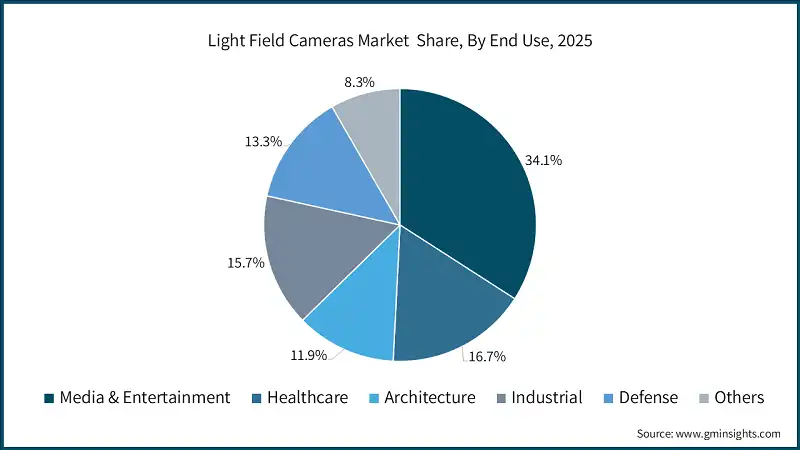
Based on end use, the market is segmented into media & entertainment, healthcare, architecture, industrial, defense, and others. The media & entertainment segment accounted for a market share of over 34.1% in 2025.
- The media and entertainment industry holds the largest share in the light field cameras market, owing to the growing popularity of immersive content, Virtual Reality Experiences, and 3D filmmaking. This has resulted in an increased demand for Light Field Cameras to generate immersive content due to the technology's capacity to record 3D material with previously unattainable precision. With the advent of light field cameras, users can now create depth maps, spin images in various directions, refocus photos after they are taken, and record scenes in complete volumetric detail.
- Manufacturers should focus on producing Light Field Cameras with improved depth maps, refocus, and volumetric capabilities for the creation of Virtual Reality, 3D Cinematic Content, and Live Media to create immersive content, attract filmmakers and game developers, and maintain their dominance in the Media and Entertainment market at a global level.
- The industrial segment is the fastest growing in the market, anticipated to expand at a CAGR of 17.7% during the forecast period. Growth is driven by increasing adoption of light field cameras in Robotic, automated inspection, quality control, and machine vision applications, which are increasingly adopting the light-field camera (LFC), which, in turn, drives growth. The unique characteristics of LFCs, such as the ability to capture 3D data in real time, develop an accurate volumetric image, and measure precise depths, create better operational efficiencies and accuracy.
- Manufacturers of light-field camera systems need to design, engineer, and manufacture industrial-grade LFCs that use advanced depth sensing systems, real-time 3D imaging systems, and AI-enhanced imaging systems to cater to the increased demand of the automotive, aerospace, electronics, and manufacturing sectors. As LFCs become more widely adopted by the sectors, they will create greater demand for efficient, high-precision industrial imaging systems.
Looking for region specific data?
The North America light field cameras market dominated with a market share of 37.5% in 2025.
- In North America, the market is experiencing robust growth due to the rising demand for immersive media, virtual reality (VR), and 3D content creation, the market continues to expand. Across many industrial sectors, such as automation, robotics, healthcare, and scientific research, the market is growing because of the increased use of advanced computational imaging techniques, AI-assisted image processing, and high-resolution camera sensors.
- Manufacturers should focus on developing and improving the technology to create high-quality, AI-enabled light field cameras with sophisticated computational imaging and volumetric imaging capabilities. Improvements in performance for immersive media, VR, industrial automation, robotics, healthcare, and scientific research will continue to stimulate demand for these technologies within North America, increase the rate of growing adoption, and foster precision, efficiency, and innovation across all professional, commercial, and industrial sectors.
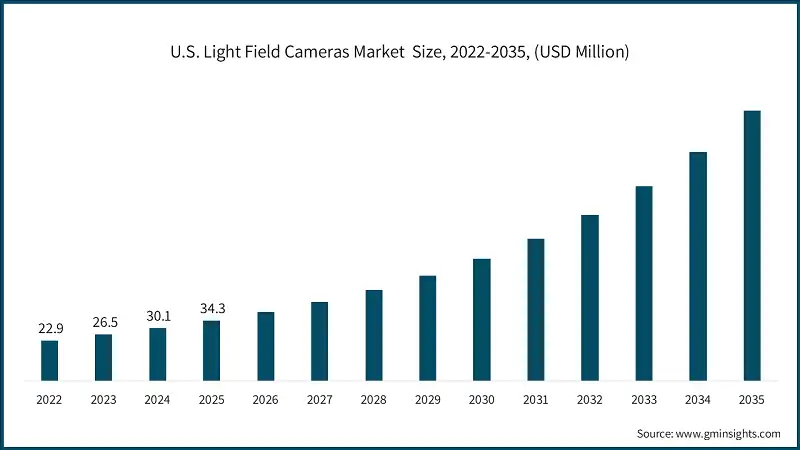
The U.S. light field cameras market was valued at USD 22.9 million in 2022 and USD 26.5 million in 2023, reaching USD 34.3 million in 2025, up from USD 30.1 million in 2024.
- The US continues to lead the light field camera market, driven by significant investments in R&D by many companies, as well as the widespread and growing use of light field cameras across the media and entertainment sectors, and increasing use in industrial automation, robotics, and healthcare, which are propelling rapid growth in the market for light field cameras.
- Manufacturers are encouraged to focus on developing and manufacturing high-resolution, AI-enabled light field cameras that will allow the business to grow into the media, entertainment, industrial automation, robotics, and healthcare sectors. This will accelerate the commercialization process of these products into the market and increase their adoption, further solidifying the United States' position as the world leader in light field camera production. The European market accounted for USD 29.7 million in 2025 and is anticipated to witness strong growth over the forecast period.
- Europe holds a significant share of the light field cameras market, as a result of the increase in adoption within Media & Entertainment, Industrial Automation, and Scientific Research. The region benefits from a robust technology infrastructure and significant support from the government for innovation, for AI, high-precision software-based cameras, and sensors. The concentration of manufacturers and research institutes will continue to secure Europe's position within the light field camera market.
- Manufacturers should focus on developing and producing Advanced Light Field Cameras targeted at Media & Entertainment, Industrial Automation, Scientific Research, and Agricultural Applications. By taking advantage of AI-Based Software, Computational Imaging, and High-Precision Sensors, they able to provide the customer with what they are looking for in terms of the growing demand for 3D imaging, Augmented and Virtual Reality applications along with High Precision Industrial Inspection Applications which will increase their presence in the market and support further innovative Technological Development and Advancement in all areas across Europe.
Germany dominates the European light field cameras market, showcasing strong growth potential.
- Germany holds a substantial share of the market, driven by high demand from several industries, including Media Production, Industry Automation, Scientific Research & Robotics. The advanced technological infrastructure in Germany provides an ideal environment for the development and deployment of AI-enabled Light Field Imaging (LFI) systems, 3D captures with ultra-high resolution, and Computational Imaging Solutions.
- Manufacturers should focus on developing and deploying these LFI products. It is predicted that manufacturers will build and develop AI-enabled High-Resolution LFI Cameras across Germany. By leveraging the country’s advanced infrastructure, technological capabilities, and innovation ecosystem, manufacturers will provide users with the ability to create high-quality images for a variety of different media, industrial inspection, robotics, and research applications, thus improving image quality and operational efficiency and meeting the growing demand for advanced 3D imaging of all types and sizes.
The Asia-Pacific light field cameras market is expected to grow at the highest CAGR of 16.1% during the analysis period.
- The Asia-Pacific market is experiencing rapid growth, due to the increased use and demand in Media/Entertainment, Industrial Automation, Scientific Research, and Robotics. More people want to have access to high-quality 3D images produced with the help of technology. Additionally, government funding has provided manufacturers with an opportunity to invest resources in developing these technologies.
- Manufacturers should focus on developing high-resolution 3D Image Capture, Computation Imaging, Real-Time Depth Sensing, and Volumetric Analysis capabilities that are being sought in growing numbers of Media, Industrial & Research applications to reduce their time & costs when developing/improving technology solutions using these Advanced Image Technologies.
The Chinese light field cameras market is estimated to grow at a significant CAGR of 17.1% from 2026 to 2035.
- China dominates the light field cameras industry, driven by growing use of medium density, office automation, robotics, and research in the world, which has driven up the number of businesses expanding into media and entertainment. The high-resolution demand for 3D viewed media, augmented and virtual reality, and precise inspection is being met by governments that continue to support FILM for technological growth and development of digital infrastructure.
- Manufacturers are leveraging the potential of using integrated camera systems, such as those using AI and IoT, for mass production of lightweight camera systems. As demand for high-definition 3D captured media continues to grow, the production of lightweight camera systems will allow brands to maximize business development efficacy and expand their market reach.
The Latin America light field cameras market, valued at USD 6.6 million in 2025, is driven by increasing usage in N/A) media and entertainment, (O) industrial inspection, and (R) scientific research. The rise of 3D imaging, V/A and augmented reality applications, along with advancements in sensor and computational imaging technologies, combined to accelerate the growth rate of the light-field cameras market.
The Middle East and Africa market, projected to reach USD 12.2 million by 2035, is driven by increasing adoption of light-field cameras in media production, industrial automation, and scientific research. The increasing usage of 3D imaging, V/A and augmented reality applications has increased the pace of research in AI and computational imaging, which are also major contributors to market growth.
In Saudi Arabia, the market is set to experience substantial growth in 2025.
- Saudi Arabia is emerging as a key growth hub for the light field cameras market, fueled by increasing production of light field cameras, which will drive the increasing demand for HD 3D captured media within media, industrial, and scientific research through enhancing the effective use of A.I., IOT, and other available technologies.
- Manufacturers should focus on developing reliable, scalable, and high-quality light field camera solutions for use in media production, inspection, robotics, and scientific research. Manufacturers are better positioned to penetrate existing markets and enhance the use of imaging technologies. Manufacturers can take advantage of advanced camera solutions to improve their ability to develop, expand, market, and sell their products and services through leveraging A.I., IOT, and Cloud-based technologies, and forming partnerships with established local technology providers.
Light Field Cameras Market Share
The global light field camera market is experiencing rapid advancement, driven by increasing interest in high-resolution, AI-based imaging technologies and the growing adoption of scalable imaging solutions offered by a wide range of market participants. The competitive landscape remains moderately consolidated, with leading companies such as Japan Display Inc., Rectrix GmbH, Fathom Holografika Kft., Toshiba Corporation, and K-Lens GmbH collectively accounting for approximately 37.9% of the global market. Innovation in the sector is being accelerated through strategic partnerships between camera manufacturers, AI developers, computational imaging firms, and hardware suppliers. These collaborations are enabling the development of advanced technologies for enhanced 3D capture, depth mapping, volumetric reconstruction, and real-time image processing.
Alongside established players, a growing number of specialized solution providers are entering the market with compact, energy-efficient, and high-performance light field cameras designed for real-time 3D imaging, AI-based analytics, and seamless integration into industrial, research, and media workflows. Continuous advancements in computational imaging, artificial intelligence, Internet of Things (IoT), cloud processing, and sensor technologies are further improving image accuracy, scalability, and operational efficiency. Moreover, partnerships with research institutions, industrial end use, and content creators are accelerating market adoption and supporting the global deployment of light field camera solutions across diverse applications.
Light Field Cameras Market Companies
Some of the prominent market participants operating in the light field cameras industry include:
- Japan Display Inc.
- Raytrix GmbH
- Fathom Holografika Kft.
- Toshiba Corporation
- K-Lens GmbH
- CREAL SA
- AYE3D Inc.
- Surface Optics Corporation
- Avegant Corporation
- Wooptix S.L.
- OTOY Inc.
- NVIDIA Corporation
- Light Field Lab, Inc.
- Fathom Optics
- Holografika
- Leia Inc.
- Google Inc.
- Xperi
- Photonics Group
- Japan Display Inc
Japan Display Inc. has a presence in the light field camera market with an approximate market share of 10.2% and has been recognized for its cutting-edge technology. The company provides users with various high-resolution light field sensor types, computational imaging systems, and volumetric capturing technologies. Using these camera solutions, users can achieve accurate and high-resolution 3D image capture and depth mapping and can perform post-capture focus adjustments. These camera solutions are being deployed in various applications, including, but not limited to, media production, industrial inspection, and robotic systems.
Raytrix GmbH focuses on being an important participant in the light field camera space by providing high-performance light field imaging systems to the industrial, research, and media segments. Raytrix develops and delivers AI-enabled camera systems designed to provide accurate and reliable real-time 3D scene capture. Its solutions enable precise depth measurement and distance estimation, allowing users to determine how far objects are positioned within a scene. These capabilities position the company as a key technology provider for applications requiring advanced depth sensing, real-time 3D imaging, and high-precision spatial analysis.
Fathom Holografika Kft. is a leader in providing complete solutions for light field imaging, which includes not only high-quality 3D capture systems but also other types of 3D volume imaging solutions, as well as computational photography-based products. These products help perform large-scale industrial inspections, scientific research projects, and media production projects with the help of the latest technology and real-time 3D imaging capabilities.
Light Field Cameras Industry News
- In January 2025, CREAL launched its next-generation light field display for augmented reality glasses, delivering genuine focus depth and natural 3D perception for AR devices. This solution is positioned for OEM integration to enable high-comfort and realistic AR experiences.
- In July 2025, Leia launched the Immersity mobile app, enabling users to turn everyday photos into dynamic 3D reels using AI, boosting everyday light-field content creation.
- In February 2023, Light Field Lab had previously partnered with LG to manufacture and commercialize SolidLight holographic display platforms, expanding commercial light-field content and display deployment.
- In March 2025, Leia expanded 3D Lightfield technology at Mobile World Congress, emphasizing immersive light-field display solutions for mobile and connected devices.
The light field cameras market research report includes in-depth coverage of the industry, with estimates & forecast in terms of revenue (USD million) from 2022 to 2035, for the following segments:
Market, By Application
- Photography
- Industrial
- Scientific research
- Medical imaging
- Entertainment
Market, By Technology
- Microlens array-based
- Coded aperture
- Camera array
Market, By Distribution Channel
- Online
- Offline
Market, By End Use
- Biometric
- Media & Entertainment
- Healthcare
- Architecture
- Industrial
- Defense
- Others
The above information is provided for the following regions and countries:
- North America
- U.S.
- Canada
- Europe
- Germany
- UK
- France
- Italy
- Spain
- Russia
- Rest of Europe
- Asia-Pacific
- China
- Japan
- India
- South Korea
- ANZ
- Rest of Asia-Pacific
- Latin America
- Brazil
- Mexico
- Rest of Latin America
- MEA
- Saudi Arabia
- UAE
- South Africa
- Rest of MEA
Frequently Asked Question(FAQ) :
What is the market size of the light field cameras industry in 2025?
The market size exceeded USD 104.3 million in 2025, driven by rising adoption across virtual reality, augmented reality, and immersive media applications.
What is the current light field cameras market size in 2026?
The market size is projected to reach USD 119.3 million in 2026, supported by increasing demand for advanced 3D imaging, computational photography, and depth-sensing technologies.
What is the projected value of the light field cameras market by 2035?
The market is expected to reach USD 464.9 million by 2035, expanding at a CAGR of 16.3% as demand accelerates across healthcare imaging, robotics, industrial inspection, and immersive media applications.
How much revenue did the microlens array-based technology segment generate in 2025?
Microlens array-based technology generated USD 47.5 million in 2025, leading the market due to its superior depth capture, refocusing capability, and high-resolution 3D imaging performance.
Which application segment holds the largest share in the light field cameras industry?
The media and entertainment segment accounted for over 34.1% market share in 2025, driven by growing demand for immersive content, virtual reality experiences, and 3D filmmaking technologies.
Which end-use segment is growing the fastest in the light field cameras market?
The industrial segment is the fastest-growing end-use segment, projected to expand at a CAGR of 17.7% during the forecast period, supported by rising adoption in robotics, automated inspection, and machine vision systems.
What is the market outlook for online distribution channels in the light field cameras industry?
The online distribution channel is projected to grow at a CAGR of 15.9% and reach USD 189.2 million by 2035, driven by increasing demand for real-time 3D image sharing, remote analysis, and cloud-enabled imaging platforms.
Which region leads the light field cameras market, and what is the U.S. market value?
The U.S. industry reached USD 34.3 million in 2025, increasing from USD 30.1 million in 2024. Growth is driven by strong R&D investments and widespread adoption across media & entertainment, industrial automation, robotics, and healthcare imaging applications.
What are the key trends shaping the light field cameras industry?
Key trends include AI-enabled computational imaging, real-time 3D depth sensing, and increasing integration of light field cameras in robotics, healthcare diagnostics, and immersive media platforms to enhance accuracy and visualization quality.
Who are the key players operating in the light field cameras market?
Key players include Japan Display Inc., Raytrix GmbH, Fathom Holografika Kft., Toshiba Corporation, K-Lens GmbH, CREAL SA, NVIDIA Corporation, Leia Inc., Wooptix S.L., and Light Field Lab, Inc.
Light Field Cameras Market Scope
Related Reports