Summary
Table of Content

LED Lamp Market
Get a free sample of this report
Form submitted successfully!
Error submitting form. Please try again.
Thank you!
Your inquiry has been received. Our team will reach out to you with the required details via email. To ensure that you don't miss their response, kindly remember to check your spam folder as well!
Request Sectional Data
Thank you!
Your inquiry has been received. Our team will reach out to you with the required details via email. To ensure that you don't miss their response, kindly remember to check your spam folder as well!
Form submitted successfully!
Error submitting form. Please try again.
LED Lamp Market Size
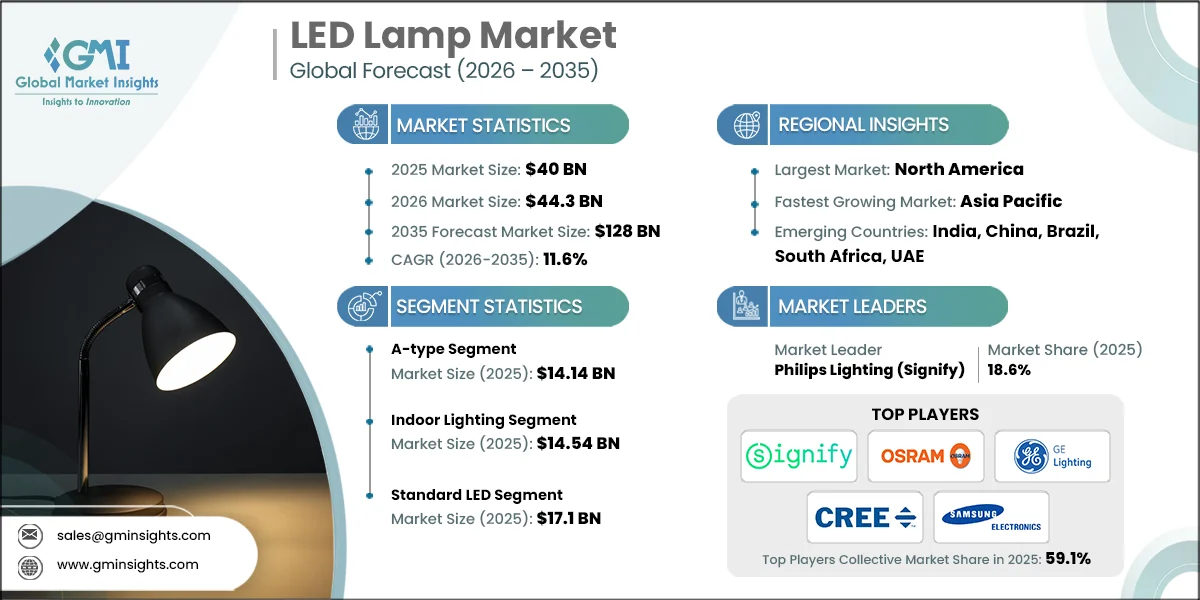
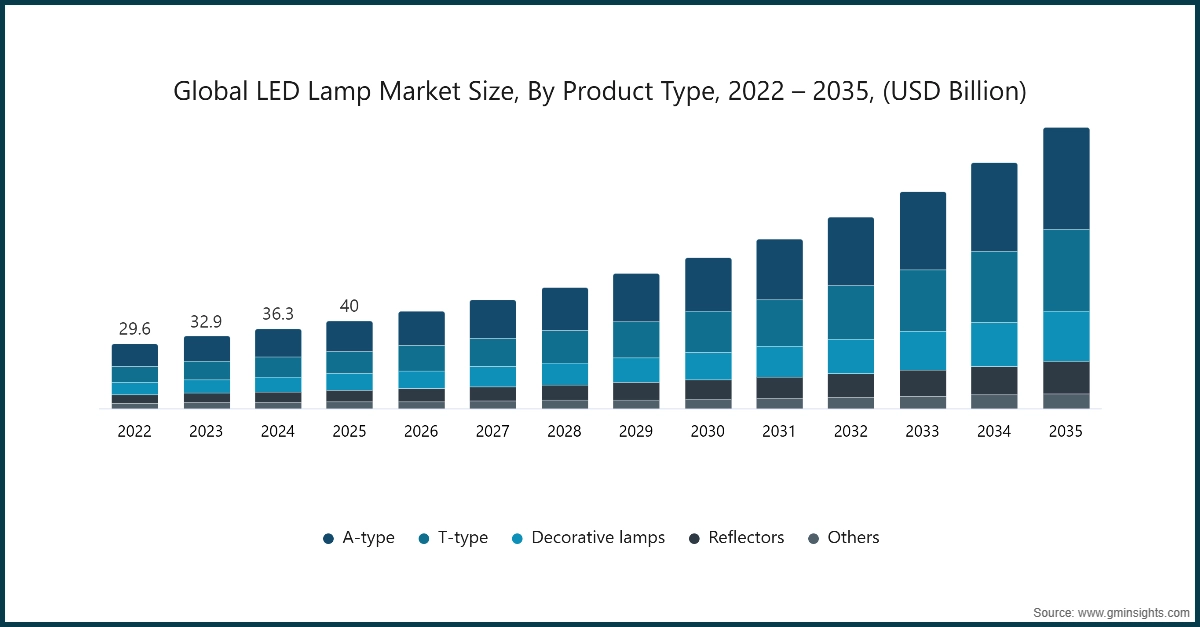
The global LED lamp market was valued at USD 40 billion in 2025. The market is expected to grow from USD 44.3 billion in 2026 to USD 77.1 billion in 2031 and USD 128 billion in 2035, at a CAGR of 11.6% during the forecast period, according to the latest report published by Global Market Insights Inc.
LED Lamp Market Key Takeaways
Market Size & Growth
- 2025 Market Size: USD 40 Billion
- 2026 Market Size: USD 44.3 Billion
- 2035 Forecast Market Size: USD 128 Billion
- CAGR (2026–2035): 11.6%
Regional Dominance
- Largest Market: North America
- Fastest Growing Region: Asia Pacific
Key Market Drivers
- Energy Efficiency and Cost Savings.
- Government Regulations and Energy Policies.
- Rapid Urbanization and Infrastructure Development.
- Growing Demand for Smart and Connected Lighting.
- Rising Adoption in Commercial and Industrial Applications.
Challenges
- High Initial Installation Costs in Price-Sensitive Markets.
- Quality Inconsistency and Presence of Counterfeit Products.
Opportunity
- Adoption of Smart, Software-Integrated LED Systems.
- Growth of Modular and Retrofit LED Solutions.
Key Players
- Market Leader: Philips Lighting (Signify) led with over 18.6% market share in 2025.
- Leading Players: Top 5 players in this market include Philips Lighting (Signify), Osram, GE Lighting, Cree Inc., Samsung Electronics, which collectively held a market share of 59.1% in 2025.
Get Market Insights & Growth Opportunities
The LED lamp market is expanding, owing to energy efficiency and cost savings, government regulations and energy policies, rapid urbanization and infrastructure development, growing demand for smart and connected lighting, and rising adoption in commercial and industrial applications. LEDs consume less energy than the traditional lighting technologies and offer the advantages of environmental friendliness, including cost reduction to users. Quality LED lighting solutions use up to three quarters of the energy that incandescent products do and can last much longer, which would be translated into long-term cost savings at home, in the business and government.
Efficiency standards have been introduced, or suggested, by governments of various countries all over the world, speeding up the adoption of LED lighting and increasing the energy savings, cutting greenhouse gas emissions, and lowering the electricity bills of households and companies. For instance, On April 2024, the U.S. Department of Energy (DOE) finalized new energy efficiency rules on general service lamps, which increase the minimum lumens per watt of bulbs to more than 120 lumens per watt by July 25, 2028. It has been estimated that this regulation would essentially eliminate compact fluorescent lamps (CFLs) would save USD 1.6 billion every year and cut carbon dioxide emissions by 70 million metric tons in 30 years, which would save money to the consumers.
Smart and connected LED lighting systems combine sensors, controls and network connection to maximize light applications, promote automation, and provide real-time energy control. These systems help to streamline operations, enhance the level of comfort to users, and are becoming more important in smart building and smart city projects by governmental agencies. The use of connected LED solutions and the overall efficiency of infrastructure are triggered by government energy programs and policies promoting the use of advanced lighting technologies. In June 2022, an example is Signify (previously Philips Lighting) which suggested an immediate move to energy-efficient connected LED lighting as a key action to meeting national climate targets and helping reduce the global energy crisis.
The LED lamp market is defined as the global industry that revolves around the production, distribution, and consumption of light-emitting diode (LED)-based lighting products. The market includes light bulbs, luminaires, and smart lighting systems that are designed to provide high energy efficiency, a longer lifespan, lower maintenance costs, and a reduced environmental impact compared to traditional lighting solutions.
To get key market trends
LED Lamp Market Trends
- Lighting investments in energy saving LEDs are changing the infrastructure in society as a result of government sustainability goals. Local and national government are in the process of enhancing street lights and government buildings to minimize electricity use and emissions. In a government-linked survey by the Association française de l’eclairage, it was stated that, by 2023, some 40 percent of street lamps in France were going to be changed to LED. The transition led to a reduction in electricity use by almost 29 percent, as well as major cuts in CO2 emissions and light pollution.
- Blending smart and connected LED lighting solutions are transforming the lighting industry and more so in cities and smart city projects. Real-time control, automation and connectivity are also being used by governments to ensure maximum energy efficiency and operation performance. Smart LED streetlights are being led at the local level in different regions with sensors and mobile applications overseeing them to boost service delivery, facilitate the maintenance process, and ensure sustainability.
- Government policies are also providing more and more incentives in the form of financial incentives and regulations to boost the adoption of LED lamps. Energy efficient lighting programs stimulate the substitution of conventional lighting with the solutions of LED lighting with the purpose of energy performance improvement and the consumption reduction. These programs lead to massive uptake in the industrial, commercial, and domestic segments.
- Most governments are working to upgrade the old lighting systems with LED technology as a measure of energy efficiency and emission mitigation. The upgrading of older lighting systems using LED solutions can decrease energy consumption, reduce maintenance requirements and aid the sustainability agenda in the country. As an example, the modernization of aging lighting systems was one of 15 major measures in a national energy-saving plan (plan de sobriété energetique) introduced in October 2022 by the French government. Special attention was paid to the transfer to LED technology in combination with automated control systems, especially when it comes to the lighting of the population, which occupies a major part of the electricity expenses of local authorities.
LED Lamp Market Analysis
Learn more about the key segments shaping this market
Based on the product type, the market is divided into A-type, T-type, decorative lamps, reflectors, and others.
- The A-type segment accounted for the largest market and was valued at USD 14.14 billion in 2025. A‑type LED lamps benefit from global energy‑efficiency mandates phasing out incandescent and inefficient lighting, prompting widespread replacement with LEDs that deliver reduced power consumption, longer life, and lower maintenance across residential and commercial lighting.
- Government programs and building codes increasingly favor LED A‑type lamps in new constructions and retrofits, driving mainstream adoption as standard general‑purpose lighting due to improved performance, sustainability commitments, and operational cost savings.
- Manufacturers should optimize production of high‑efficacy, retrofit‑ready A‑type LEDs and pursue energy certification compliance to leverage government efficiency mandates and procurement programs effectively.
- The T-type segment was the fastest growing market during the forecast period, growing at a CAGR of 13.2% during the forecast period. T‑type LED lamps expand market share as regulations restrict fluorescent tubes, encouraging adoption of tubular LED solutions that retrofit existing fixtures with superior efficiency, uniform illumination, and reduced environmental impact in industrial and commercial environments.
- For instance, in June 2024, the European Union’s ban on fluorescent lighting under RoHS and Ecodesign rules, encouraging T‑type LED adoption for energy savings and compliance with environmental standards across member states.
- LED manufacturers should develop compliant, retrofit‑focused T‑type tubes that directly address fluorescent phase‑out policies and appeal to facility managers upgrading legacy infrastructure.
Learn more about the key segments shaping this market
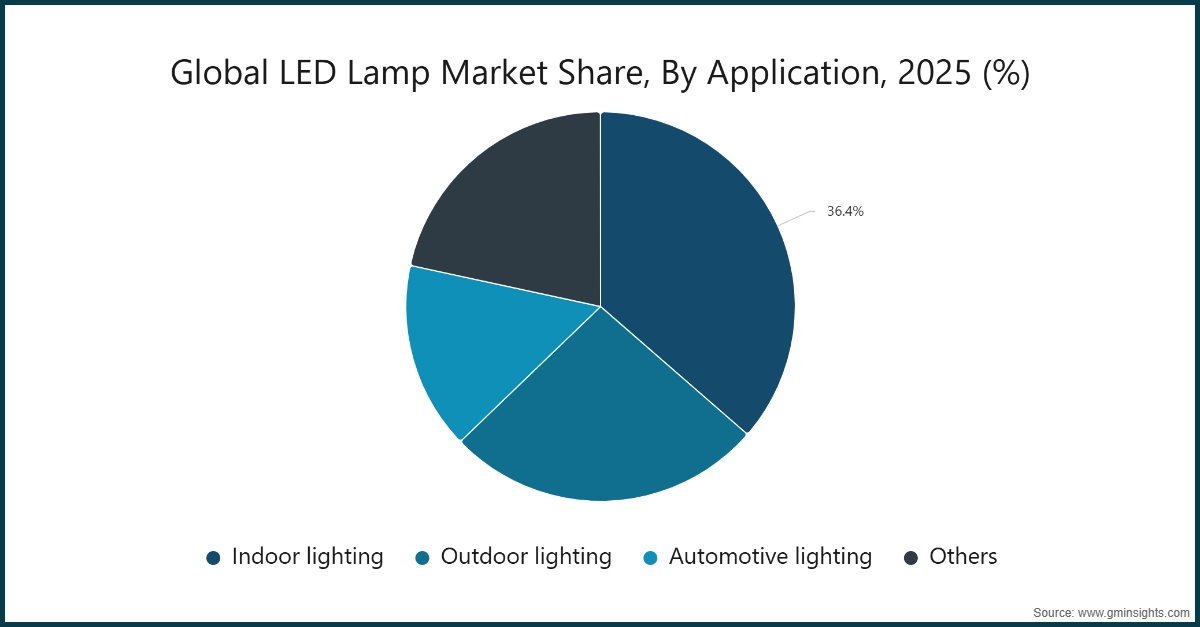
On the basis of application, the LED lamp market is segmented into indoor lighting, outdoor lighting, automotive lighting, and others (e.g., horticulture, signage).
- The indoor lighting segment accounted for the largest market and was valued at USD 14.54 billion in 2025. Rising adoption in residential, commercial, and institutional buildings drives demand for indoor LED lighting. High efficiency, long lifespan, and lower maintenance costs make LEDs the preferred choice over conventional lighting in homes, offices, and retail spaces.
- Energy-efficiency regulations and building codes across multiple regions promote indoor LED lighting installation in new and retrofitted structures, ensuring compliance with sustainability targets and lowering electricity consumption.
- Manufacturers should focus on designing versatile, high-quality indoor LED solutions, including retrofit kits and smart controls, to capture large-scale adoption in residential and commercial projects.
- The outdoor lighting segment was the fastest growing market during the forecast period, growing at a CAGR of 13.1% during the forecast period. Urbanization, smart city initiatives, and municipal sustainability programs accelerate outdoor LED lighting adoption. Street lighting, parks, and public spaces increasingly require energy-efficient, durable, and reliable LED solutions to reduce operational costs and emissions.
- For instance, in March 2025, news reported that the U.S. Department of Energy launched a nationwide initiative supporting LED streetlight retrofits in cities to enhance energy efficiency and reduce greenhouse gas emissions.
- LED manufacturers should develop rugged, high-lumen, and smart outdoor lighting products that meet government energy-efficiency guidelines and are suitable for large-scale municipal installations.
Based on technology, the LED lamp market is categorized into standard LED, smart LED, and OLED (Organic LED).
- The standard LED segment accounted for the largest market and was valued at USD 17.1 billion in 2025. Standard LEDs are widely adopted due to their high energy efficiency, long lifespan, and cost-effectiveness. They replace traditional incandescent and fluorescent lighting across residential, commercial, and industrial applications, driving consistent market growth.
- Government energy-efficiency programs and building codes support the installation of standard LED lamps in new constructions and retrofits, ensuring compliance with regulatory targets while reducing operational electricity costs.
- Manufacturers should focus on high-quality, energy-efficient standard LEDs that meet regulatory standards, emphasizing durability, low maintenance, and cost-effectiveness to maintain market dominance.
- The smart LED segment was the fastest growing market during the forecast period, growing at a CAGR of 13% during the forecast period. Smart LEDs are increasingly adopted due to integration with IoT, sensors, and building automation systems, offering energy optimization, remote control, and adaptive lighting features for residential, commercial, and urban infrastructure projects.
- For instance, in January 2025, news reported that the European Commission highlighted smart lighting initiatives under the EU Green Deal, encouraging municipalities and public facilities to deploy connected LED solutions for enhanced energy efficiency.
- Manufacturers should prioritize developing connected, IoT-enabled smart LED systems compatible with smart city and building automation programs to capture rapid adoption and government-supported projects.
Looking for region specific data?
North America LED Lamp Market
North America dominated the market and held a market share of 38.5% in 2025 of the global market.
- The LED lamp industry in North America is propelled by robust government energy‑efficiency standards and sustainability commitments. Federal and state policies increasingly favor solid‑state lighting in public infrastructure, commercial buildings, and residential retrofits to reduce electricity use and greenhouse gas emissions.
- Utility rebate programs and building codes promote LED specifications and connected lighting with controls and sensors to optimize performance. Energy efficiency and reduced lifecycle costs are core value propositions driving retrofit and new build projects.
- Collaboration across public utilities, regulators, and industry bodies strengthens these trends, with manufacturers aligning product lines to evolving codes and certification frameworks to enhance competitiveness.
- North American manufacturers should focus on ENERGY STAR compliance, rebate‑eligible products, and integrated control systems to capitalize on efficiency policies and institutional procurement.
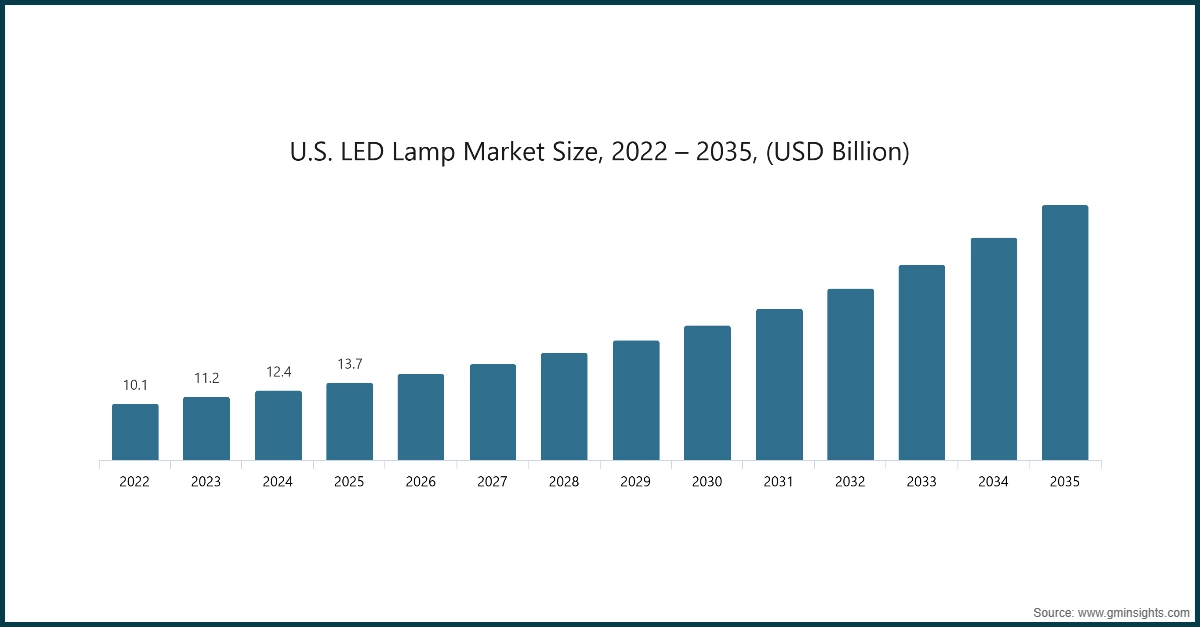
The U.S. LED lamp market was valued at USD 10.08 billion and USD 11.21 billion in 2022 and 2023, respectively. The market size reached USD 13.72 billion in 2025, growing from USD 12.38 billion in 2024.
- The U.S. market growth is strongly influenced by federal and state energy‑efficiency regulations and utility incentive programs. Government frameworks such as DOE efficiency standards, ENERGY STAR qualification, and state building codes drive broad LED adoption across residential, commercial, and institutional sectors.
- These standards push manufacturers toward higher performance, quality, and integrated lighting control systems compatible with modern building automation. Public procurement and infrastructure modernization projects further stimulate demand, especially when tied to energy savings goals and emissions reductions.
- Robust engagement with standards development and certification programs helps firms align offerings to market needs and regulatory expectations, supporting long‑term growth.
- U.S. manufacturers must ensure rigorous compliance with federal procurement rules and energy performance standards to protect eligibility and compete for government and institutional projects.
Europe LED Lamp Market
Europe market accounted for USD 8.34 billion in 2025 and is anticipated to show lucrative growth over the forecast period.
- Europe’s LED lamp industry is anchored in ambitious energy‑efficiency and climate goals led by the EU and national governments. Regulatory frameworks such as Ecodesign and the EU Green Deal prioritize the phase‑out of inefficient lighting technologies and elevate LED specifications, while public procurement policies emphasize sustainability and lifecycle performance.
- Governments and lighting associations actively promote LED adoption in infrastructure retrofits, urban modernization, and building renovations. Sustainability targets for reduced energy demand and lower carbon emissions further catalyze adoption of advanced and connected LED solutions across sectors.
- Policy support encourages innovation, system integration, and quality assurance, creating a favorable environment for efficient, high‑performance lighting technologies.
- European manufacturers should emphasize regulatory compliance, high‑quality energy‑saving features, and support for smart lighting integrations to align with policy directives.
Germany dominated the Europe LED lamp market, showcasing strong growth potential.
- Germany’s market is underpinned by extensive energy‑efficiency laws and sustained support from industry bodies and government programs that promote sustainable lighting adoption.
- National initiatives and alignment with EU regulatory frameworks foster strong uptake in commercial, industrial, and public infrastructure applications. Industry associations, such as ZVEI and licht.de, support market education and standardization to enhance LED quality and performance awareness.
- Manufacturers benefit from Germany’s focus on sustainable technologies, urban modernization, and retrofit initiatives that align with national climate goals. Collaboration between government, industry, and standards entities improves adoption and product innovation.
- German manufacturers should engage with associations and align products with national climate and energy mandates to capture institutional and commercial demand.
Asia Pacific LED Lamp Market
The Asia Pacific market is the fastest growing market and is anticipated to grow at the CAGR of 12.6% during the analysis timeframe.
- In Asia Pacific, rapid urbanization, large infrastructure projects, and rising energy costs are key drivers of LED lamp adoption. Governments are incorporating LED technology into smart city frameworks, public lighting upgrades, and energy‑efficiency programs.
- Policy emphasis on reducing energy demand supports national and municipal LED initiatives across residential, commercial, and industrial segments. Many markets are expanding production capabilities to serve domestic and export needs while stimulating local demand through incentive schemes and modernization campaigns.
- Demand for connected lighting and IoT integration is intensifying, especially in urban redevelopment and sustainable infrastructure projects.
- Asia Pacific manufacturers should tailor LED solutions for large infrastructure tenders, retrofit programs, and connected lighting systems aligned with regional energy policies.
China LED lamp industry is estimated to grow with a CAGR of 13.9% during the forecast period, in the Asia Pacific market.
- China’s LED lamp market benefits from significant government support, subsidy programs, and policy emphasis on energy efficiency and industrial modernization.
- Government initiatives incentivize LED product deployment across residential renovations, smart community projects, and public infrastructure frameworks. Local subsidy schemes and industrial development plans enhance adoption while encouraging technological upgrades and smart lighting integration.
- China’s policy focus aims to stimulate consumption and promote domestic LED manufacturers, fostering innovation and market growth.
- Manufacturers in China should leverage subsidy programs and integrate smart features to meet policy priorities and boost adoption in residential and public sectors.
Latin American LED Lamp Market
Brazil leads the Latin American market, exhibiting remarkable growth during the analysis period.
- Brazil’s LED lamp industry is supported by government energy‑efficiency initiatives and lighting subsidy programs that encourage end users to switch from traditional lighting.
- National strategies focused on reducing energy consumption and promoting sustainable technologies drive adoption in residential, commercial, and public infrastructure projects.
- Incentive schemes lower barriers for LED purchases, while urban modernization and smart city development increase demand for advanced lighting solutions.
- Manufacturers targeting Brazil should align offerings with national subsidy frameworks and retrofit programs to enhance market penetration and affordability.
Middle East and Africa LED Lamp Market
South Africa market to experience substantial growth in the Middle East and Africa market in 2025.
- In South Africa, government initiatives under energy‑efficiency plans such as the Integrated Resource Plan promote the use of LED lighting to reduce electricity usage and enhance sustainability.
- Regional harmonization of lighting standards supports consistent adoption across public and private sectors. Urban electrification projects and campaigns to raise energy‑efficiency awareness bolster demand for LED solutions.
- Policy focus on reducing operational costs and enhancing infrastructure resilience continues to support market growth in urban and peri‑urban contexts.
- LED manufacturers in South Africa should support regional standards compliance and tailor products to energy‑efficiency and electrification project requirements.
LED Lamp Market Share
The global LED lamp industry exhibits a moderately consolidated structure, dominated by major multinational lighting and electronics companies alongside specialized regional manufacturers. As of 2025, key players such as Philips Lighting (Signify), Osram, GE Lighting, Cree, Inc., and Samsung Electronics collectively account for 59.1% of the total market share, reflecting their strong brand recognition, diverse product portfolios, and extensive distribution networks.
Emerging regional and local players are expanding rapidly in Asia Pacific, Latin America, and Africa by offering cost-effective, energy-efficient LED solutions and targeting infrastructure, commercial, and residential applications. Regionally, North America leads the global market, fueled by large-scale urbanization, industrial and commercial infrastructure projects, and government policies promoting energy efficiency.
LED Lamp Market Company
Prominent players operating in the LED lamp industry are as mentioned below:
- Philips Lighting (Signify)
- Osram
- GE Lighting
- Cree, Inc.
- Samsung Electronics
- LG Innotek
- Acuity Brands
- Eaton Corporation
- Hubbell Incorporated
- Zumtobel Group
- Nichia Corporation
- Seoul Semiconductor
- Everlight Electronics
- Lumileds Holding B.V.
- Dialight plc
- MLS Co., Ltd. (Forest Lighting)
- Toshiba Lighting & Technology Corporation
- Panasonic Corporation
- Bridgelux, Inc.
- Lumens Co., Ltd.
- Epistar Corporation
- Toyoda Gosei Co., Ltd.
- Citizen Electronics Co., Ltd.
- Sharp Corporation
- Philips Lighting (Signify) leads the LED lamp market with an 18.6% share, driven by its comprehensive portfolio of high-performance, energy-efficient, and smart lighting solutions for residential, commercial, and industrial applications. The company emphasizes connected lighting, IoT-enabled systems, and retrofit-ready products. Signify collaborates closely with governments, municipalities, and large-scale infrastructure projects to expand deployments, ensuring compliance with energy-efficiency standards while maintaining operational reliability and superior lighting quality.
- Osram holds a 14.4% share, offering advanced LED solutions including high-lumen, color-tunable, and smart lighting systems. Its products focus on energy savings, long lifespan, and regulatory compliance. Osram partners with commercial builders, industrial facilities, and public institutions to deploy innovative lighting solutions that optimize energy use and enhance environmental sustainability.
- GE Lighting controls 11.2% of the market, providing versatile LED lamps and luminaires for residential, commercial, and industrial segments. Its solutions combine efficiency, durability, and compatibility with building automation systems. GE Lighting collaborates with energy service companies, smart building integrators, and facility managers to deliver reliable, high-quality lighting solutions that reduce operational costs.
- Cree, Inc. accounts for 8.7% of the market, focusing on high-performance, cost-effective LED lamps suitable for commercial, industrial, and outdoor applications. Its solutions emphasize scalability, durability, and energy efficiency. Cree works with contractors, urban development projects, and industrial clients to implement LED lighting systems that balance quality, operational reliability, and energy savings.
- Samsung Electronics holds a 6.2% share, delivering specialized LED lighting products for smart cities, commercial infrastructure, and premium residential applications. Its offerings emphasize advanced LED chip technology, high efficacy, and IoT-enabled controls. Samsung collaborates with municipalities, enterprises, and technology integrators to deploy innovative, energy-efficient, and connected lighting solutions that comply with global sustainability standards.
LED Lamp Market Report Attributes
| Key Takeaway | Details |
|---|---|
| Market Size & Growth | |
| Base Year | 2025 |
| Market Size in 2025 | USD 40 Billion |
| Market Size in 2026 | USD 44.3 Billion |
| Forecast Period 2026-2035 CAGR | 11.6% |
| Market Size in 2035 | USD 128 Billion |
| Key Market Trends | |
| Drivers | Impact |
| Energy Efficiency and Cost Savings | Strengthens market demand as consumers, businesses, and governments seek lighting solutions that significantly reduce electricity consumption and maintenance costs, while supporting sustainability and lowering total cost of ownership. |
| Government Regulations and Energy Policies | Sustains procurement and adoption as national energy standards, building codes, and incentive programs enforce energy-efficient lighting. |
| Rapid Urbanization and Infrastructure Development | Enhances market growth as expanding urban areas, smart city projects, and infrastructure modernization require reliable, scalable, and sustainable lighting solutions. |
| Growing Demand for Smart and Connected Lighting | Expands deployment opportunities as building automation, IoT, and smart city initiatives integrate LED systems with sensors, connectivity, and controls. |
| Rising Adoption in Commercial and Industrial Applications | Strengthens market penetration as businesses, factories, warehouses, and public institutions replace legacy lighting with high-performance LED solutions to reduce energy costs, improve lighting quality, and comply with sustainability targets. |
| Pitfalls & Challenges | Impact |
| High Initial Installation Costs in Price-Sensitive Markets | Limits adoption in cost-conscious regions, small businesses, and residential sectors. The upfront cost of high-quality LED lamps and smart lighting systems can discourage large-scale deployment despite long-term energy savings. |
| Quality Inconsistency and Presence of Counterfeit Products | Reduces consumer confidence and adoption rates, as low-quality or counterfeit LEDs fail to meet efficiency, lifespan, or safety standards. This can result in higher replacement costs and damage brand credibility. |
| Opportunities: | Impact |
| Adoption of Smart, Software-Integrated LED Systems | Enables manufacturers and end-users to optimize energy consumption, implement automation, and remotely control lighting networks. |
| Growth of Modular and Retrofit LED Solutions | Creates demand for flexible lighting upgrades in existing buildings, urban developments, and infrastructure projects. |
| Market Leaders (2025) | |
| Market Leader |
18.6% Market Share |
| Top Players |
Collective market share in 2025 is 59.1% |
| Competitive Edge |
|
| Regional Insights | |
| Largest Market | North America |
| Fastest growing market | Asia Pacific |
| Emerging countries | India, China, Brazil, South Africa, UAE |
| Future outlook |
|
What are the growth opportunities in this market?
LED Lamp Industry News
- In January 2026, Crompton Greaves has launched new 70W and 80W Dynaray LED lamps for the Indian B2C market, expanding their high-wattage LED lighting options. These products are targeted at domestic use and feature high durability and energy efficiency.
- In October 2023, Halonix Technologies launched India's first "UP-DOWN GLOW" LED bulb, a 10W innovation that illuminates both the top dome and bottom stem in different colors. Engineered for versatility, it features three switch-enabled modes for varied lighting effects and is manufactured in Haridwar.
- In August 2023, ansOSRAM unveiled the OSCONIQ C 2424 for lighting applications. Unlike conventional CSP solutions, the OSCONIQ C 2424 not only offers highest performance levels, but measures up to other lensed High Power devices in terms of reliability and lifetime.
- In June 2024, Hikvision hosted the LED Displays Launch Event 2024, showcasing significant upgrades in R&D and product lineup. This spectacular event impressed the global audience with the coordinated operations of dual manufacturing bases, the debut of its 5th generation LED cabinets, as well as the launch of diverse LED products for outdoor displays, creative displays, modules, and controllers.
The LED lamp market research report includes in-depth coverage of the industry with estimates & forecasts in terms of revenue (USD Million & Units) from 2022 to 2035, for the following segments:
Market, By Product Type
- A-type
- T-type
- Decorative lamps
- Reflectors
- Others
Market, By Technology
- Small Parcels
- Break Pallet Cargo
- Oversized Cargo
Market, By Distribution Channel
- Online retailers
- Specialty stores
- Supermarkets/Hypermarkets
- Direct sales
Market, By Application
- Small Parcels
- Break Pallet Cargo
- Oversized Cargo
Market, By End-User
- Residential
- Commercial
- Industrial
- Government/Public
The above information is provided for the following regions and countries:
- North America
- U.S.
- Canada
- Europe
- Germany
- UK
- France
- Spain
- Italy
- Netherlands
- Asia Pacific
- China
- India
- Japan
- Australia
- South Korea
- Latin America
- Brazil
- Mexico
- Argentina
- Middle East and Africa
- Saudi Arabia
- South Africa
- UAE
Frequently Asked Question(FAQ) :
What is the LED lamp market size in 2025?
The market size for LED lamp is valued at USD 40 billion in 2025. Increasing demand for energy-efficient lighting solutions and government regulations promoting sustainability drive market growth.
What is the market size of the LED lamp industry in 2026?
The market size for LED lamps reached USD 44.3 billion in 2026, reflecting steady growth driven by urbanization, infrastructure development, and adoption of smart lighting systems.
What is the projected value of the LED lamp market by 2035?
The market size for LED lamp is expected to reach USD 128 billion by 2035, growing at a CAGR of 11.6% during the forecast period. This growth is fueled by advancements in smart lighting technologies, increasing adoption in commercial and industrial sectors, and global energy-efficiency mandates.
How much revenue did the A-type segment generate in 2025?
The A-type segment accounted for USD 14.14 billion in 2025, making it the largest market segment. Its dominance is supported by global energy-efficiency mandates phasing out incandescent lighting, leading to widespread adoption of A-type LED lamps.
What was the valuation of the indoor lighting segment in 2025?
The indoor lighting segment was valued at USD 14.54 billion in 2025, making it the largest application segment. Rising adoption in residential, commercial, and institutional buildings, driven by high efficiency and long lifespan, supports its leadership.
What was the valuation of the standard LED segment in 2025?
The standard LED segment was valued at USD 17.1 billion in 2025, leading the market due to its energy efficiency, cost-effectiveness, and widespread adoption across residential, commercial, and industrial applications.
Which region leads the LED lamp market?
North America dominated the market in 2025, holding a 38.5% share of the global market. Its leadership is driven by strong adoption of energy-efficient lighting solutions, government incentives, and advancements in smart lighting technologies.
What are the upcoming trends in the LED lamp industry?
Key trends include the adoption of smart, connected lighting systems integrated with IoT and sensors, growth in modular and retrofit LED solutions, and increasing demand for energy-efficient lighting in smart city projects and infrastructure modernization.
Who are the key players in the LED lamp market?
Key players include Philips Lighting (Signify), Osram, GE Lighting, Cree, Inc., Samsung Electronics, LG Innotek, Acuity Brands, Eaton Corporation, Hubbell Incorporated, Zumtobel Group, and Nichia Corporation.
LED Lamp Market Scope
Related Reports